Fill Out Your TMDSAS Application Faster With This Section-by-Section Plan
September 9, 2026

Key Takeaways
- TMDSAS spans 14 sections. Most applicants do not budget enough time.
- The application window runs May 1 through November 1 for medical and dental programs. One submission covers all participating Texas schools for a flat $235 fee, regardless of how many you select.
- Coursework entry is one of the two hardest sections. Every course must be manually transcribed from official transcripts, with institution names and credit hours matched exactly to what TMDSAS will cross-check.
- Activity descriptions lock permanently on submission. Finalize all wording before you open the portal — drafting inside it is a mistake.
- Transcripts older than one year at time of submission are rejected outright. Order fresh copies before the application window opens.
- Draft your personal statement well before May 1, with Texas-specific framing rather than a recycled AMCAS essay.
- The photo upload has strict technical specs: under 100KB in .jpg or .png format. A non-compliant file will bottleneck what looks like the simplest section.
Quick Summary
The Texas Medical and Dental Schools Application Service covers every participating Texas school. The sections that sink timelines are rarely the ones students fear most.
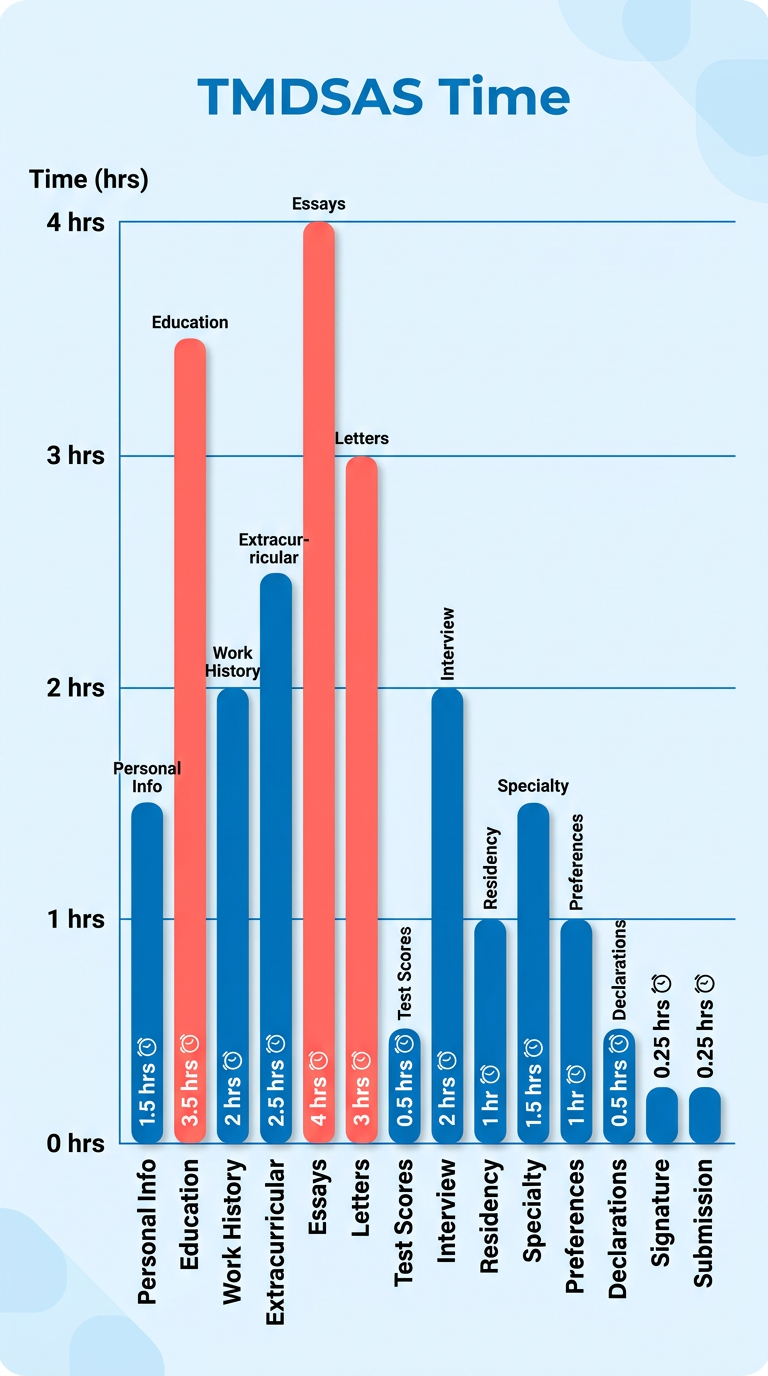
What Each Section Actually Demands
| Section | Difficulty | What to do before you open the portal |
|---|---|---|
| Personal Info + Photo | Easy | Prep a photo under 100KB in .jpg/.png (format specs here). |
| Education History | Easy | List every institution you attended. |
| Coursework | Hard | Mirror your transcript in a spreadsheet first — TMDSAS cross-checks it. Institution names and credit hours must be exact. |
| Activities | Hard | Finalize every description offline. They lock permanently on submit. |
| Essays | Medium | Draft a Texas-specific personal statement early, not during the open window. |
| Letters of Evaluation | Medium | Confirm evaluators use official letterhead and signatures. |
| Transcripts | Medium | Order fresh copies. Anything over a year old gets rejected. |
| Certification + Payment | Easy | Budget the flat $235 fee regardless of school count. |
How Long Does This Actually Take?
Plan on weeks, not days. TMDSAS provides no official time estimate, but the moving parts add up fast. Coursework and activities alone eat most of your hours, and the portal times out on inactivity, so saving frequently is a habit worth building from day one.
One applicant who worked from the official TMDSAS guide finished two full weeks ahead of the deadline, leaving room for revisions and advisor feedback. That buffer is the goal. Last-minute submission is not a strategy here.
On school selection: the centralized structure means you can add schools based on fit and academic alignment rather than per-school cost. Select broadly. The fee doesn't change.
Why the Activities Section Is Your Real Pacing Problem
Activity descriptions aren't a list of roles. They're reflective narratives, and developing them properly requires time you won't have if you start after May 1. Every description, hour count, and contact detail must be finalized before you open the live portal — because once you submit, nothing can be changed.
External documentation adds a second constraint. Supporting credentials have their own processing timelines, and a delay there stalls your verification regardless of how quickly you complete the portal itself.
Map these deadlines into your admissions calendar now. TMDSAS runs on its own timeline, separate from AMCAS. If you're working from a generic pre-med calendar, you're already planning around the wrong dates.
Why Timing Matters More Than Most Applicants Expect
Texas law reserves at least 90% of seats for Texas residents at public medical schools. You're competing against a concentrated in-state pool for a fixed number of spots, and every participating school receives the same application. Your strategic leverage is entirely in quality and timing.
The application opens May 1. Schools begin reviewing files as soon as they arrive in verified form. Early verified applicants get first access to interview bandwidth before calendars fill. A late submission doesn't disqualify you, but it costs you that window — and that window is real.
TMDSAS Runs Its Own Clock
TMDSAS operates completely independently from AMCAS and AACOMAS. If you're planning around AMCAS opening dates, you'll be late on TMDSAS. The two systems don't sync, and the standard pre-med timeline will mislead you.
Verification only begins once the processing office receives all required external components. If any of those items are delayed, your file sits in incomplete status. Managing those external dependencies alongside your portal work isn't optional preparation — it's what determines whether you get an early review.
Where Applications Actually Lose Time
The TMDSAS guide outlines what each section requires. It doesn't tell you where the bottlenecks are. Per the WithRinka section-by-section breakdown, the verification team conducts a detailed review of your academic history. Any mismatch between self-reported data and official records triggers manual review, which can meaningfully extend your processing time.
Treat the portal as a data-entry step, not a drafting environment. Build an offline spreadsheet that mirrors your transcript before you log in. When you're ready to enter data, it takes minutes rather than hours, and the risk of transcription errors under a live session clock drops significantly.
What a Synchronized Plan Actually Changes
A coordinated approach solves two problems at once. It aligns essay drafts, recommendation letter requests, and test score authorizations to a single readiness date. And it tells you which sections to finish first, not just what each section asks for.
"Using the resources provided in the guide can significantly reduce application stress." — TMDSAS application guide
Working from a section-by-section checklist rather than moving through the portal sequentially gives you a meaningful buffer — time for advisor review, revision, and the small corrections that protect your verification timeline.
If Texas programs are a real priority, this isn't optional prep. It's the submission strategy itself.
Mapping Your Timeline: Key Dates and What They Actually Mean
The window from May 1 to November 1 sounds generous. It isn't, once you account for verification queues and the parallel tracks running alongside your portal work. Applicants working from a generic medical school calendar almost always miscalculate their buffer on the sections that matter most.
Hard anchors: the application opens May 1, submissions are accepted starting May 15, and the deadline is November 1. Schools start reviewing files from the moment they arrive in verified form, and interview slots fill from the front of the cycle.
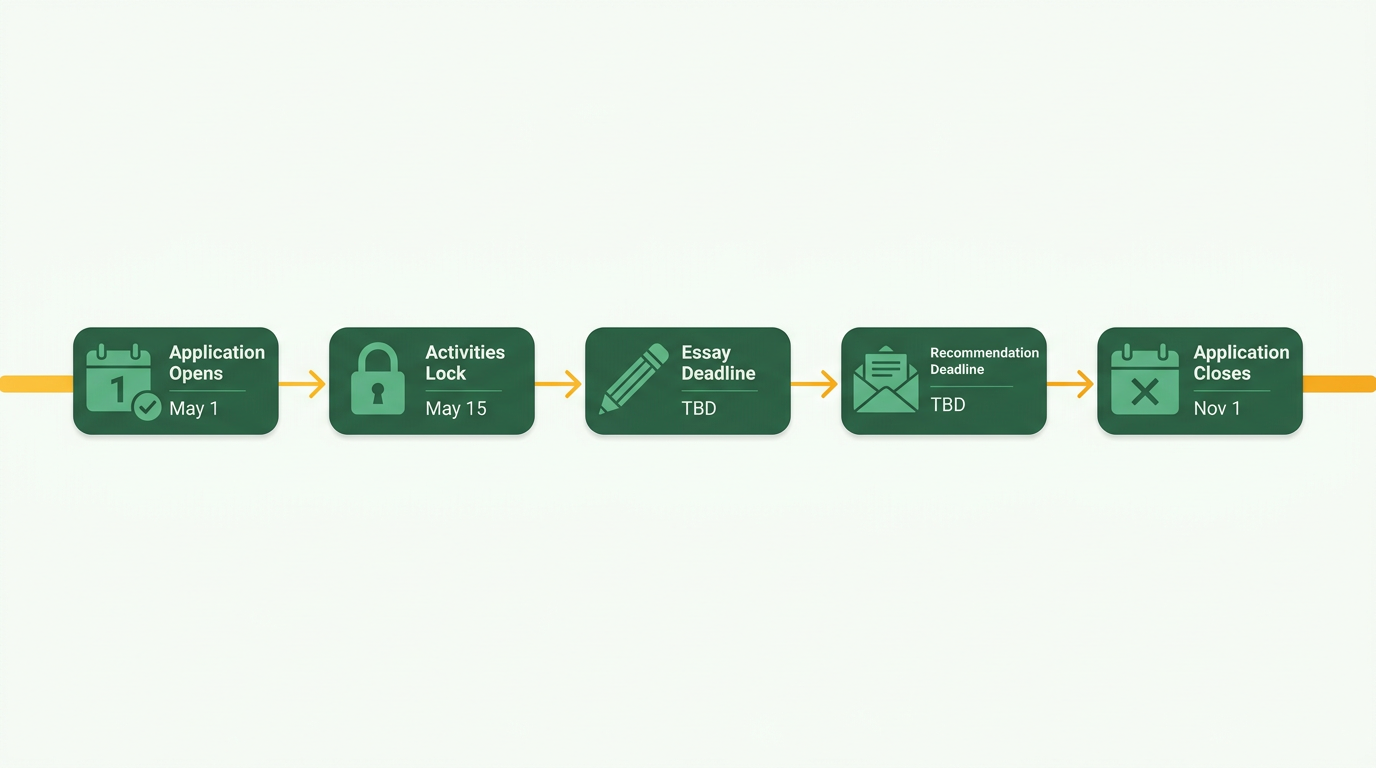
The Internal Deadlines That Actually Matter
- Account creation and school list finalized: Before May 1. Do this in April so you open the portal on day one.
- Education history and coursework (offline draft complete): May 1–10. Getting your academic record ready for verification at the start of the cycle, per the WithRinka breakdown, frees your remaining energy for essays and evaluator coordination.
- Essays drafted and reviewed: Complete drafts by June 1. Three weeks of revision before a late-June submission target.
- Target submission: June 15–30. That's the buffer-protected window we aim for with serious applicants.
The Two Parallel Tracks Most Applicants Forget
Standardized test scores don't transmit automatically. You must authorize their release through the testing agency's portal, and transmission isn't instantaneous. Handle this early so it doesn't hold up verification.
Official transcripts have their own processing clock. Some registrar offices take two to three weeks during peak periods. Factor in your institution's turnaround time, verify that your transcript meets TMDSAS requirements, and don't treat this as a single event attached to your portal submission. It's a separate calendar item with its own deadline, set at least a week before your target submit date. Same goes for MCAT score release.
Where Recommendation Letters Fit In
Letters run on the writer's schedule, not yours. Request them no later than April 1, ask for completion before June 1, and give recommenders direct links to TMDSAS submission instructions so they're not guessing at format requirements.
Build four weeks of buffer between your request and when you actually need letters in the system. A letter that arrives late holds up your entire submission, regardless of how polished everything else is.
One nuance: if you're reapplying with a strong verified application from a prior cycle and significant updates, the urgency of the earliest submission window is somewhat lower. For first-time applicants with a competitive target list, early June submission is the standard we hold students to.
Building Your Core Profile: Personal Info, Education History, and Residency
The Personal Information section looks simple. It's also where applicants waste the most time, because they show up to the portal without their materials ready.
Before opening the portal, have your core identification documents, Social Security number, and residency status ready. Prepare your digital headshot according to the portal's strict file specs. A non-compliant photo file on section one sets a frustrating tone for everything that follows.

What This Section Actually Asasks
The TMDSAS guide covers standard demographic fields: legal name, date of birth, contact details, citizenship status, and an optional preferred pronouns field. Fill in the pronouns field if you have a preference. Schools that ask for it want to use it.
Residency status gets more complicated than applicants expect. Texas regulations heavily favor in-state applicants, so accurate classification matters. If your status is at all ambiguous, you attended school out of state, or recently relocated, review the statutory guidelines TMDSAS uses to determine residency for tuition purposes. A general understanding of residency won't cut it here, and errors are difficult to correct after the fact.
How to Get Through Education History Without Errors
The verification team cross-references your self-reported academic history against your official transcripts, per the WithRinka breakdown. Minor discrepancies flag your file for manual correction, which pauses your progress through the cycle.
Build an offline spreadsheet before you touch the portal. Mirror your transcript row by row: institution, academic status code (FR, SO, JR, SR, GR), course name, credit hours, course type, grade. The portal is for data entry, not drafting. Working it like a drafting environment under a live session clock is exactly how transcription errors happen.
One nuance worth knowing from TMDSAS coursework guidance: incorrect course area codes won't penalize your application during processing. Misfiling a biology lab under the wrong category is harmless. Wrong credit hours, wrong institution, or an omitted course — those aren't. Focus your accuracy on the core data fields.
For dual-enrollment credits and online courses, list the specific institution that granted the college credit, even if the work was completed during high school. For multiple institutions, coordinate with each registrar's office early to ensure official records reach TMDSAS ahead of your target submission date.
The flat $235 processing fee covers all participating programs, so school selection is entirely about fit and academic alignment — not cost.
Building Your Activities and Extracurricular Narrative
The activities section has one policy that changes everything about how you approach it: per the TMDSAS official guide on biography and activities, you cannot modify entries once your application is submitted. Every description, hour count, and contact detail must be finalized before you begin the submission process.
Because schools start reviewing verified applications early in the cycle, your extracurricular narrative needs to be polished from day one. The decisions shaping how you present clinical, volunteer, and research experiences have to happen upstream, before you open the portal.
What the Section Actually Allows
Unlike some application systems, TMDSAS lets you document your full extracurricular history without a hard cap on entries. That flexibility is worth something — but only if each entry is high-quality and builds a coherent picture of your preparation.
Each activity falls into a single category, with narrow exceptions for healthcare and employment. Distinguish current activities (start date before the deadline) from planned ones (start date after). For ongoing work, TMDSAS calculates hours from what you've completed plus projected hours through the end date. Get those projections right before you submit. You won't be able to revise them.
Writing Descriptions That Hold Up
Admissions committees reading thousands of entries don't need a job description. They want to see that you processed the experience. The TMDSAS guide points toward exactly that — what you learned and your personal connection to each activity, not just what you did.
A description that works has three elements: what the role required, one specific skill or shift in perspective it produced, and why it matters to your path in medicine. Each element earns its sentence. "This experience taught me the importance of teamwork" appears in too many applications to register. Skip it.
Draft all activity descriptions in a separate document before the portal opens — columns or sections for category, date range, total hours, and description. When May 1 arrives, you're copying polished text, not writing under pressure. The two-week gap between opening and first submission isn't writing time. It's review and finalization time.
Where This Section Fits Your Broader Timeline
Treating activities as secondary is one of the most common mistakes we see. Waiting until the portal opens to start drafting pushes your verification date into the peak summer bottleneck. TMDSAS Director Enrique Hasso is explicit about the advantages of early verification — completing your file early positions you well when admissions committees begin scheduling interviews.
Aim to have all activity descriptions drafted and reviewed by late April. Use the first weeks of May for final quality checks, hour projection verification, and data entry. That sequence is what makes an early submission possible.
Getting Your Essays Right
The TMDSAS essay section has multiple distinct prompts, and each one is asking something different. Develop and refine all drafts offline before entering anything into the portal.
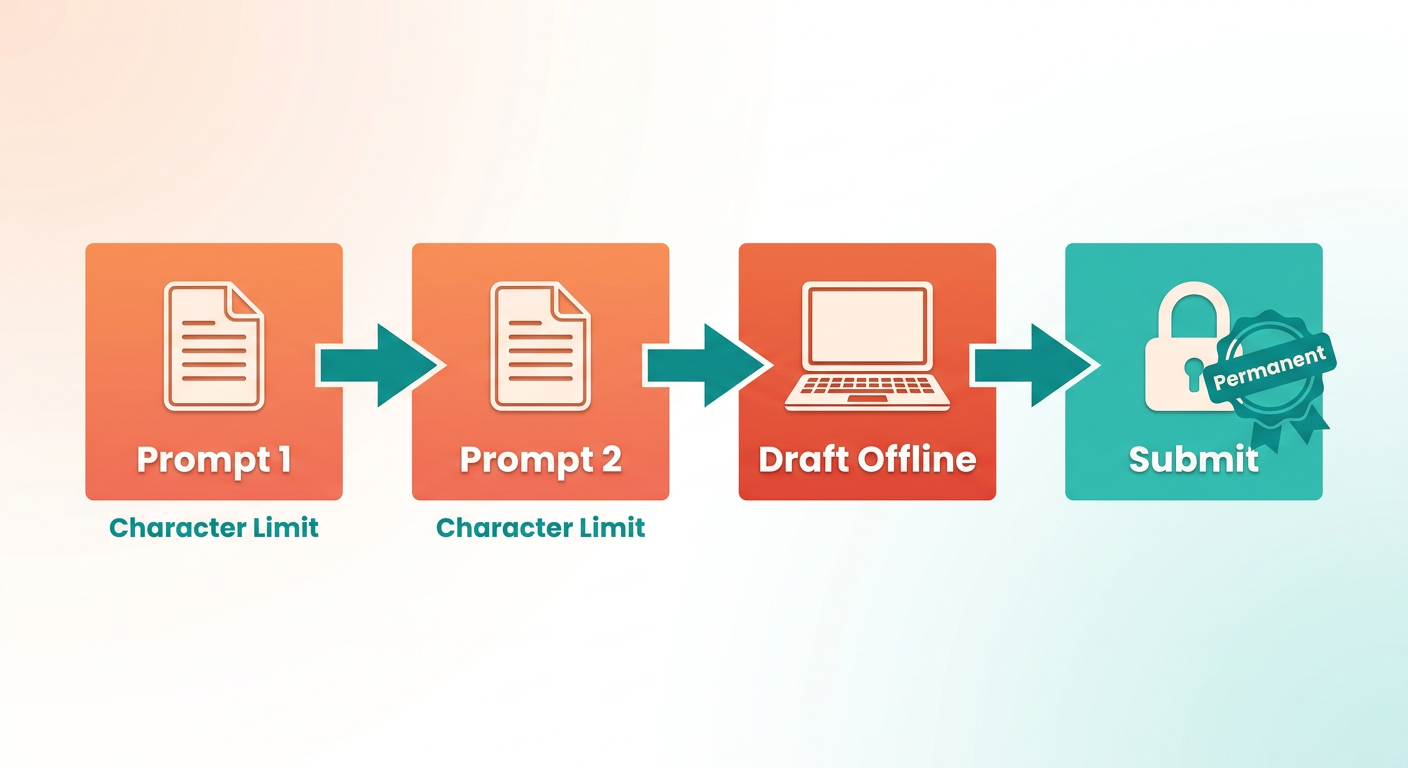
What the Personal Statement Is Actually For
The personal statement is not a summary of your activities list. It's where you explain why medicine in Texas. The most competitive submissions we review reflect something specific to this state — rural access gaps, underserved communities, a connection to a particular institution's mission. Generic "I want to help people" narratives read identically to every other application in the pile.
Admissions committees want your voice, not a polished-sounding version of what you think they want. That distinction matters more than most applicants realize.
A strong approach begins before drafting starts. Identify the moments that define your path: when you knew medicine was right, what tested that conviction, what clarified your specific direction. Those become the spine of the essay. Everything else is connective tissue.
The optional essay is worth taking seriously. Applicants who skip it almost always leave an opportunity on the table. If there's anything in your record that needs context, a gap, a low semester, a major shift, this is where you explain it on your own terms rather than leaving an admissions reader to guess.
How to Build Your Revision Timeline
Start drafts in May, not October. The verification queue and the essay section run on the same clock, and a late essay means a late verified application.
At Endurable Education, every student essay goes through multiple rounds of review: structural feedback, voice and specificity checks, and line-level refinement. Collapsing all of that into a single read almost always misses something a surface-level fix can't repair.
An applicant who finishes essays two weeks before the submission window opens has time to act on feedback. One who finishes the night before submits the best version they could produce under pressure. Those aren't the same thing.
Skip the optional essay only if your record is clean and your personal statement already covers everything that matters. If you're on the fence, write it. The word limit is modest, and a concise, honest optional statement adds context an admissions reader cannot infer on their own.
Managing Recommendations and Transcripts
This section runs on a separate clock from your portal work and depends entirely on other people's behavior. Getting ahead of both is what separates a clean verification from a stalled one.
What TMDSAS Requires for Letters of Evaluation
Letters must appear on official letterhead, carry the evaluator's signature, and be submitted directly through the portal or via an approved document service. Your recommenders upload to the system; you don't handle the letter.
The processing lag is what most applicants miss. Per the official post-submission guidance, letters submitted through the portal or a document delivery service require processing time after receipt. Request letters at least six weeks before your target submission date — not six weeks before November 1.
On format: letters uploaded in the wrong file type or exceeding size limits get rejected at the portal level. Before your recommenders submit anything, confirm the file is a standard PDF at a reasonable size. This is one of the most common reasons letters sit in limbo with no clear error message.
How to Ask Recommenders and Track What You've Sent
Start with a specific request email. Name the program (TMDSAS, Texas medical and dental schools), give the deadline you need them to hit (your personal buffer date, two to three weeks before the portal deadline — not the official November 1 cutoff), and attach the portal's letter instructions directly. Recommenders who work across multiple application systems often default to AMCAS-style submissions; spelling out that this is TMDSAS reduces format mismatches.
A simple tracking spreadsheet covers everything: recommender name, request date, portal upload link sent, confirmed receipt, letter status in the portal, and a follow-up date. The portal's Status section shows when a letter has been received and processed, so you can check without emailing your recommender repeatedly. Check it weekly once you're inside the processing window.
A polite reminder two weeks after your initial request, then again one week before your buffer deadline, is enough. If a letter hasn't appeared in the portal within the expected processing window after your recommender confirms submission, use the TMDSAS internal messaging system to flag it. That's the official communication channel with TMDSAS staff. Standard email won't reach the right people.
How Transcripts and Test Scores Fit the Timeline
Request official transcripts from every institution you attended as soon as the application opens. Some registrar offices need two to three weeks during peak periods. Factor in that turnaround time and verify that each transcript meets TMDSAS requirements before you count on it.
Test scores require active authorization through the testing agency's portal — transmission isn't automatic and isn't instantaneous. Handle this early.
Treat transcript submission and MCAT score release as separate calendar items with their own deadlines, set a week before your target submission date. Don't attach them to portal submission as a single event.
Tracking all three external components, letters, transcripts, and test scores, on a parallel schedule is what protects your verification timeline. These elements depend on organizations and systems outside your control. The only way to manage that is to start early enough that delays don't become your problem.
FAQ
When does the TMDSAS application open and close?
The application opens May 1, with submissions accepted starting May 15. The deadline is November 1 for medical and dental programs.
How much does TMDSAS cost?
There's a flat $235 fee regardless of how many participating Texas schools you select. You can add schools freely based on fit without incurring additional per-school charges.
How long does it take to complete the TMDSAS application?
Plan on several weeks of sustained effort. Coursework and activities sections alone are multi-hour undertakings, especially if you're building the offline prep work that makes accurate data entry possible.
Can I edit my activities section after submitting?
No. Per TMDSAS policy, activity descriptions lock permanently once you submit your application. Draft and finalize everything offline before you begin the submission process.
What's the difference between TMDSAS and AMCAS?
TMDSAS is the centralized application for Texas medical and dental schools; AMCAS is the primary application service for most other U.S. medical schools. They operate on completely separate timelines. TMDSAS opens May 1; AMCAS typically opens in late May. If you're applying to both, treat them as entirely independent processes.
What happens if my transcript is outdated?
TMDSAS rejects transcripts older than one year at the time of submission. Order fresh copies from every institution you attended well before your target submission date.
Do I need a Texas-specific personal statement?
Yes, and this matters more than most applicants initially realize. A recycled AMCAS essay that doesn't address why Texas, which programs, or what connects you to the state's healthcare landscape is a missed opportunity. TMDSAS admissions committees can tell the difference.
How early should I request letters of recommendation?
Request letters no later than April 1, with an ask for completion before June 1. Build four weeks of buffer between your request and when you actually need the letters in the system. A late letter holds up your entire application.
References
[1] TMDSAS Application Guide - https://www.tmdsas.com/application-guide/index.html
[2] TMDSAS Application Guide: How to Fill Out Your Application - https://www.inspiraadvantage.com/blog/tmdsas-application
[3] 2026/27 TMDSAS Application Guide (With Screenshots) - https://www.medschoolcoach.com/resource/tmdsas-guide
[4] TMDSAS Application Guide: All 14 Sections Explained - WithRinka - https://withrinka.com/tmdsas-application-guide-every-section-explained/
[5] Personal Biography & Activities - TMDSAS - https://www.tmdsas.com/application-guide/bio-activities.html
[6] Where to Start? An Overview of TMDSAS Applicant Resources - https://www.youtube.com/watch?v=EWGgiM4bVMI
[7] Coursework - TMDSAS - https://www.tmdsas.com/application-guide/coursework.html
[8] Next Steps After Submitting Your Application - TMDSAS - https://www.tmdsas.com/application-guide/after-submitting.html
[9] TMDSAS Application: The Ultimate Guide - https://www.shemmassianconsulting.com/blog/tmdsas-application