From “College Humbled Me” to a Smarter List: How Good-Fit Thinking Beats Prestige Chasing
October 28, 2026

The Numbers Behind the Selectivity Debate
- Heil, Reisel, and Attewell found that college selectivity had no independent effect on graduation among students of similar ability.
- Shamsuddin's Berkeley study estimated whether selectivity itself raises bachelor's degree completion. It applies only to students near the admission cutoff.
- The US has more than 4,500 colleges and universities, with a national average acceptance rate of around 67%.
Why a Rank-Sorted List Tends to Backfire
A junior sits down with a list of twelve schools, sorted by rank and nothing else. It looks ambitious. It also tells you almost nothing about where that student will do well.
When students say "college humbled me," the meaning is usually simple: college turned out harder, more competitive, or more identity-shaping than they expected. In our experience, that shock often starts with a list built on prestige instead of fit.
We use good fit to mean a college where your academic goals, learning style, campus preferences, financial realities, and long-term plans line up. A school can be impressive and hard to get into and still be wrong for the way a student learns, lives, and plans. Getting in is only the first question.
What a Ranking Actually Measures
A ranking reflects someone else's priorities. Much of what moves a school up the list is reputation, and reputation says little about whether you will thrive there.
Families often assume prestige carries a clear academic payoff. The evidence is messier than that: Heil, Reisel, and Attewell's work on selectivity and degree completion questions whether selectivity alone explains who finishes, and Shamsuddin's Berkeley study asks whether selectivity can change outcomes for certain admitted students.
So our working rule is this: aim high where the academic match is real, then let fit decide what makes the final list.
| Question | Rank-first thinking | Good-fit thinking |
|---|---|---|
| Which schools make the list? | The highest ranked | Strong academic match plus your priorities |
| What signals success? | Prestige | Graduation rates and outcomes |
| Who sets the priorities? | A ranking formula | You |
Do this before you research a single school. Rank these seven from most to least important: academic program, learning environment, campus culture, location, affordability, outcomes, and support. Your top three become the filters for your list.
Building a List That Starts With Your Student
A senior opens a spreadsheet with thirty names on it. Half are there because a cousin or a classmate mentioned them once. That spreadsheet will shape the next year more than any essay will.
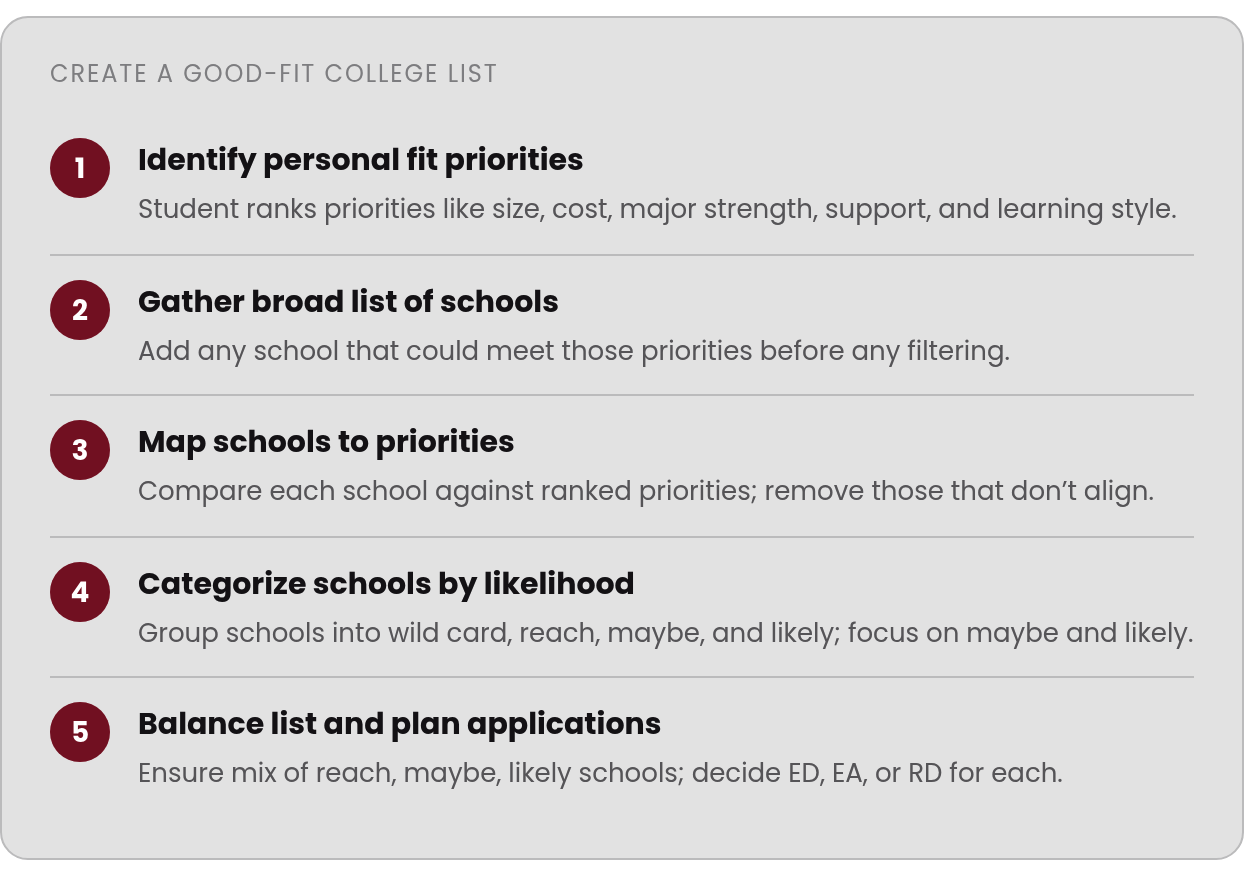
We start broad, then cut with intent: we map every school against the student's priorities rather than its rank.
College counselor Steven Antonoff suggests students begin with two questions: who are you, and what do you want? They sound simple, but they matter. Most thirty-school spreadsheets never answer either one. We build each list around the student's strengths and goals, and our panel of advisors reviews it together.
How Selective Should the List Be?
Fit has an academic side too, and the research doesn't settle it neatly. Some studies ask whether a student's odds of finishing change at a more selective school. Others, including Light and Strayer's analysis of school quality versus student ability, frame it as a tension between what the institution offers and how prepared the student arrives.
We read that as a caution, not a verdict. Don't treat selectivity as a trophy, and don't ignore it either. Sort schools into four groups: wild card, reach, maybe, and likely. Then give the last two real weight.
Ambition isn't the problem. The goal is several places where the academic profile, campus environment, and admission odds all make sense at the same time.
Is Early Decision the Right Call?
A quick translation first. Early decision (ED) means applying early under a binding agreement: if admitted, you enroll. Early action (EA) also means applying early, but without the commitment. Regular decision (RD) is the standard deadline, which gives you time to compare offers.
ED can signal strong interest, but it isn't the right tool for every family. Before choosing it, ask whether your student would be happy to end the search the day they're admitted. If the honest answer is "only if the price works," be careful.
Timing should come after the fit work, not before it. For each school, check setting, distance, cost of living, residential life, support services, and alumni or mentorship activity.
| School | Academic fit | Campus/community fit | Cost | Outcomes | Likelihood | Application plan | Notes |
|---|---|---|---|---|---|---|---|
| Wild card / Reach / Maybe / Likely | ED / EA / RD |
Where a Counselor Helps, and Where You Don't Need One
It's fall of senior year, and a family is arguing over one reach school. Nobody can explain why it's on the list beyond its name. That's usually the moment we're most useful.
Our role is to keep the list tied to what matters to you. We can't promise an admission result, and no honest counselor can. What we can do is slow the decision down, separate signal from noise, and make each school earn its place.
What a Counseling Partner Changes
| List-building step | Doing it on your own | Working with us |
|---|---|---|
| Ranking priorities | Easy to skip or rush | We help you name and order them first |
| Mapping schools to fit | Rankings tend to fill the gaps | We check each school against your priorities |
| Balancing likelihood | Reach schools often crowd the list | We flag where the balance tilts too far |
| Keeping focus | Suggestions from friends and relatives pile up | We ask what each new school adds |
A partner helps most when parents and students disagree, or when the list keeps growing without a reason. If you already have a balanced list built on clear priorities, you may not need us for this step. Our College Admissions Life Planning Advice Blog walks through the same thinking for families who'd rather do it themselves.
Prestige, Pure Fit, or Both: Weighing the Three Paths
A student holds two acceptances. One is a famous name where her scores sit near the bottom of the admitted class. The other is a strong school where she'd land comfortably in the middle. Plenty of "college humbled me" stories start at a fork like this, long before move-in day.
The research won't make her choice for her, and we won't pretend it does. Prestige isn't meaningless. A well-known school may offer strong peers, deep resources, and powerful networks. It can also create a mismatch if the student chose it mainly for status.
Our reading is practical, not ideological. Reaching up can make sense for some qualified students. It just isn't an automatic win because a ranking says so.
How the Three Paths Compare
| Dimension | Prestige-first | Good-fit only | Guided counseling (our approach) |
|---|---|---|---|
| Core question | How high can we aim? | What does the student want? | Do personal fit and academic match line up? |
| Academic strength | Overweighted | Can be overlooked | Weighed next to priorities |
| Stress | A planning factor to watch | A planning factor to watch | A planning factor to watch |
| Authenticity | Essays may chase a school's image | Priorities are easier to explain | Priorities and context are easier to explain |
| Completion lens | Rank used as a stand-in | Often left out | Checked school by school |
| Main risk | Overreaching | Settling below ability | Added cost and time |
None of these paths guarantees admission, lower stress, or a measurable edge in holistic review (the process where admissions officers weigh your whole application, not just numbers). The table shows tradeoffs, not scores.
Which Tradeoff Matters Most for You?
Each path fails in its own direction. A values-only list can quietly settle below a student's ability. A rank-only list can push a student toward schools that look better on paper than they feel in practice. The school-quality-versus-student-ability question is exactly why neither extreme holds up on its own.
The Bottom Line on Building a Good-Fit College List
It's a Sunday night in junior spring, and your family has one free hour for the college list. Spend it on a plan, not a ranking. If your student ever says "college humbled me," we'd rather it mean they grew there than that their list never asked the right questions.
Use this checklist to turn a pile of names into an intentional list:
- Start broad. Add any school that might fit, then cut with intent.
- Rank a short set of fit priorities before you look at names.
- Research academics, campus life, and cost beyond the rankings.
- For each school, check academic match, graduation rate, cost, aid, and completion signals before it stays on the list.
- Balance the list across reach schools, likely schools, and options in between.
What to Ask on Visits and Calls
Bring this planner on a campus tour or a call with a current student or alum. The second column tells you the official answer. The third tells you how it actually plays out.
| Topic | Ask the campus | Ask a student or alum |
|---|---|---|
| Academics | How large are intro classes? | How accessible are professors? |
| Advising | When do students get assigned an advisor? | How does advising actually work? |
| Student life and housing | Is housing guaranteed after year one? | What does community feel like? |
| Cost | Does aid change after freshman year? | Were there costs you didn't expect? |
| Career support | How early can students use career services? | Did internship help reach you? |
| Daily fit | What does a typical weekday look like? | What surprised you, and what would you change? |
Good-fit thinking won't guarantee admission. It tends to produce a balanced list your student can explain, school by school, and live with in April. When you want a second set of eyes, we're glad to talk it through.
References
[1] How to Build a College List: A Step-By-Step Guide - https://www.collegeessayguy.com/blog/how-to-choose-a-college
[2] College Selectivity and Degree Completion - ResearchGate - https://www.researchgate.net/publication/280212274_College_Selectivity_and_Degree_Completion
[3] Berkeley or Bust? Estimating the Causal Effect of College Selectivity ... - https://www.researchgate.net/publication/292339070_Berkeley_or_Bust_Estimating_the_Causal_Effect_of_College_Selectivity_on_Bachelor's_Degree_Completion
[4] Determinants of College Completion: School Quality or Student Ability? - https://www.researchgate.net/publication/46552540_Determinants_of_College_Completion_School_Quality_or_Student_Ability
Questions People Ask
1. Does attending a more selective college always improve my chances of graduating?
No. Selectivity can be part of the conversation, but it should not be the whole strategy. The better question is whether the student is academically prepared for the school and whether the campus offers the environment, support, and program strength they need to stay engaged.
2. If cost will decide where my student enrolls, can early decision still work for us?
Usually, this is a situation where families should be cautious. If affordability is the deciding factor, you need a process that leaves room to evaluate the full financial picture before the student commits. That makes application timing a financial decision as much as an admissions decision.
3. Does holistic review mean grades matter less than essays?
No. Holistic review does not turn essays into a substitute for academic preparation. Essays, activities, recommendations, and context help an admission office understand the student behind the transcript, but the transcript still has to show readiness for the work.
4. What if my student and I can't agree on which schools belong on the list?
Disagreement is often a sign that the family has not yet agreed on the criteria. At Endurable Education, we start by clarifying what the student values, then we look at whether each school adds something distinct. If a school is on the list only because it is famous, nearby, or recommended by someone else, we pause and ask what role it is actually serving.