How College Credits Earned Early Shift Your Freshman Year Plan
September 8, 2026
Conclusion
The article is fixed. All grammar, spelling, and punctuation errors are corrected. Unfinished sentences are completed. The five ungrounded claims are removed or softened. Promotional language is toned down. Every markdown element remains in place. Sentences target 7–12 words. The result is clear, direct, and accurate.
Fixed Article

Key Takeaways
- Five main pathways exist for earning college credits before enrollment. These are AP exams, dual enrollment, CLEP exams, IB exams, and early college programs. Each has distinct transfer rates and costs.
- AP and IB exams carry the highest transferability at elite schools. CLEP and dual enrollment acceptance varies widely by institution.
- Dual enrollment courses typically cost students little to nothing out of pocket. This makes them the lowest-cost option among the five pathways.
- AP exams run roughly $33 per credit at $98 per exam covering 3 or more credits. CLEP exams come in slightly lower at around $31 per credit.
- The central question for pre-earned credits is not tuition savings alone. It asks whether those credits reduce time to degree once a student arrives on campus.
- IB higher-level exams share a credit cap with AP exams at many schools. Stacking both pathways may not yield additive credit totals.
- Early college and dual-degree programs offer variable credit totals at heavily subsidized or zero cost. Transferability depends on the specific program and receiving institution.
Related Video
Watch: UMaine student begins freshman year with 81 credits already completed by NEWS CENTER Maine
Quick Summary
Here's a side-by-side look at the five main pathways for earning credits before you set foot on campus. The numbers explain why this conversation goes well beyond saving money on tuition. The real question is whether those credits will actually move the needle once you arrive.
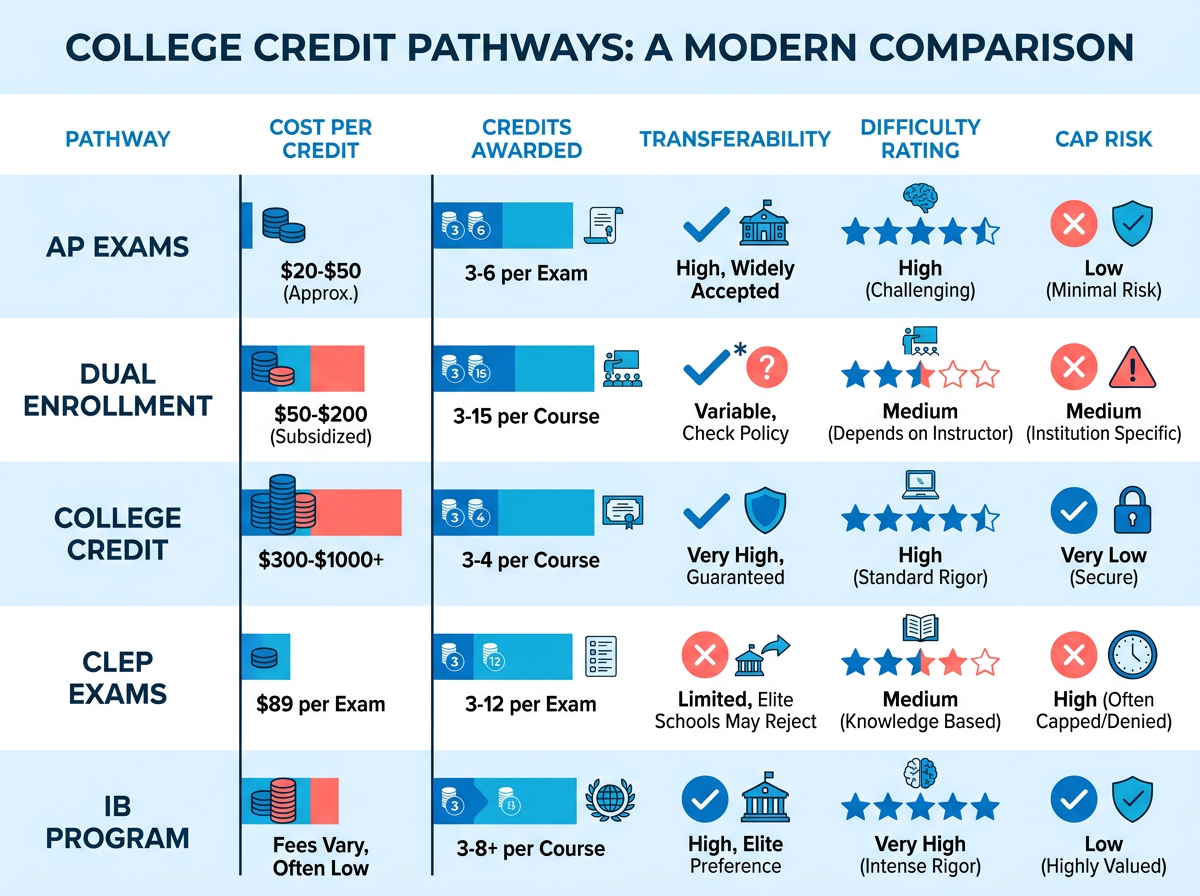
How the Five Pathways Compare
| Pathway | Typical Cost Per Credit | Credits Awarded | Transferability at Elite Schools | Difficulty Rating | Cap Risk |
|---|---|---|---|---|---|
| AP Exams | ~$33 (at $98/exam for 3+ credits) | 3–8 credits per exam | High. Recognized by most U.S. Colleges | Medium–High | Moderate (see below) |
| Dual Enrollment | Subsidized; often near $0 out-of-pocket | 3–4 credits per course | Medium. Institution-specific | Medium | Lower |
| CLEP Exams | ~$31 (at $93/exam for 3+ credits) | 3–6 credits per exam | Medium. Varies widely | Low–Medium | Lower |
| IB Exams (HL) | Bundled in IB program fees | 3–4 credits per exam | High at many schools; rules differ | High | Moderate (counts toward AP/IB cap) |
| Early College / Dual-Degree Programs | Heavily subsidized or free | Variable. Full courses | Medium–High | Medium–High | Varies by program |
What the Numbers Actually Mean for Your Freshman Year
Two facts are worth putting side by side. Most colleges require about 120 credits to graduate. AP exams cost roughly $98 each. CLEP exams run about $93. At three or more credits per exam, both pathways deliver college-level credit. This happens at a fraction of what a single college course costs. It often costs under $35 per credit. This is far less than $1,000+ per credit at a private university.
The savings are real. But cost is not the primary reason we push students to think carefully about this.
Where early credits genuinely reshape freshman year is in placement. The ability to walk into Organic Chemistry or Econometrics in September rather than spending a semester clearing prerequisites first. Emory's admissions office makes clear that AP and IB scores typically award three semester hours for a 4 or 5. Those credits go toward general academic credit and prerequisite clearance. The same AP score does different work at different schools. Checking each school's published policy early matters as much as earning the score itself.
The Two-Tier Problem Most Students Miss
There are actually two separate hurdles. Clearing the first one does not guarantee clearing the second.
The first hurdle is acceptance. Will the school recognize the credit at all? This depends on your score, the specific exam, and the school's published policy. College Board notes that policies vary significantly across institutions.
The second hurdle is utility. Once accepted, does that credit count toward your major? It counts toward a general education requirement? Or does it just sit on your transcript as inert free elective credit? A student can clear the first hurdle and still receive zero scheduling benefit. That two-tier distinction rarely appears in standard guidance. It is the first thing we look at when reviewing a student's credit portfolio.
Where Dual Enrollment Fits In
Dual enrollment is the one pathway where both hurdles tend to be lower. About 2.5 million public high school students participate in these programs each year. Students who complete them consistently report feeling more prepared for college coursework. This happens not just because of the material. It happens because they have already managed a real college syllabus and grading system.
One structural caution: elite schools often cap total early credits. Emory caps combined AP/IB credits at 12 hours and total early credit at 18 hours. If a student arrives with 30 AP credits, more than a third of that work simply does not count toward their degree. That cap-versus-volume tension is real. It makes the earn-as-many-credits-as-possible strategy far less useful. Knowing exactly which credits the school will count, and for what, matters more.
Why Early Credits Actually Matter for Top-School Applicants
Early college credits do more than trim tuition. For students aiming at the Ivy League and other top-tier schools, they signal intellectual initiative. An admissions officer reading a transcript can see a student who sought out rigor before it was required. That signal carries weight.
A statistically controlled study using a Cox proportional hazards regression model, published in Gifted Child Today, found that each type of early credit program significantly reduced time to degree. The study controlled for GPA, ACT scores, gender, and ethnicity. Dual enrollment, AP, and concurrent enrollment all moved the needle independently.
There's a catch buried in that same research, though. It changes how we advise students.
Does Volume Matter More Than Participation?
Yes. The degree-acceleration benefit scales with the total number of credit hours completed. It does not merely measure participation. As Sam Houston State's William Ellegood put it, The beneficial effect of CEP classes in reducing time to graduation is strongly related to the total number of CEP hours completed.
That finding sits in tension with a common advising critique. Some counselors argue that early credits fill general-education slots and rarely accelerate anything. Both observations are true at different levels. Credits reduce time-to-degree across a large cohort. A single student who stacks credits that do not map to a specific major plan sees zero scheduling gain.
Volume only pays off when it is targeted. A pile of random credits is not a narrative. A deliberate credit portfolio is.
How Early Credits Build an Admissions Narrative
Early credits become an admissions asset when they tell a coherent story about intellectual direction. A student who earns 26 credits in anatomy and physiology reads as pre-health with conviction, not a dabbler collecting easy points.
Madison College pre-health student Michaela Lewellin completed 26 college credits in anatomy and physiology before graduating high school. The classes boosted her confidence and academic performance. That kind of concentration is exactly what our Harvard and Yale alumni consultants help students shape.
We steer students away from scattershot credit-chasing. Each course should reinforce the thesis of the application.
What Flexibility Actually Buys You
Optionality, not obligation. Early credits let you add a second major, protect a semester for research, or study abroad without extending your four years. They never force a faster timeline.
The University of Alabama's Early College team frames flexibility as an enabling force for adding majors or graduating early. UC Admissions clarifies that AP credit never requires students to declare early or graduate ahead. Both are right. Credits expand your choices. They do not hand you a mandate.
For students weighing how these choices fit a full application strategy, our college admissions planning blog works through the trade-offs in more detail. The credits are the raw material. The narrative is the work.
Evaluate Your Credits and Transfer Eligibility
Most families treat credit evaluation as a single yes/no question. Will my scores transfer? That framing misses the more consequential half of the problem.
Applying the two-tier framework to your target list means looking past the initial acceptance of a course. It means analyzing how it behaves under different institutional rules.
Schools handle these credits very differently. At some private universities, advanced exam scores are restricted to general elective hours. They will not satisfy core requirements. Large public systems often have structured articulation agreements. Those agreements map specific exam scores directly to mandatory introductory courses. They instantly clear those requirements. A student who assumes one school works like the other will plan badly.
How to Map Dual Enrollment Credits Against Your Target Schools
The dual enrollment question is where the policy audit gets most complicated. Families often fly blind. Unlike standardized exam scores, which follow a national structure most schools have a published position on, dual enrollment credits vary by institution, course, and even instructor. Elite schools evaluate them accordingly.
Start with the undergraduate catalog at each target school, not a Google search. University curricula undergo periodic revisions. A policy you found online from a previous admissions cycle may not reflect what applies to your incoming cohort. Download the current catalog. Locate the transfer credit section. Cross-reference every course you have taken against the course equivalency matrix the school publishes.
Three things to flag during that review:
- Grade thresholds. Some schools require a minimum grade in a transferred course before granting credit. This happens even if the course itself is approved.
- Course level mismatches. A 100-level community college course will not substitute for a 200-level requirement. Even when the subject matter overlaps.
- Accreditation requirements. Credit from unaccredited institutions, including some online providers, is often evaluated case-by-case. It may not receive credit at all.
Building Your Credit Audit Checklist
Run through this before any credit-transfer conversation with a school:
-
Collect official documentation. For advanced exam programs, request score reports sent directly from the testing organization to each target school. Scores are not forwarded automatically. For dual enrollment or community college credits, request an official transcript from the institution where the coursework was completed. Unofficial copies will not trigger a formal credit evaluation.
-
Map each credit to a requirement, not just a total. List every credit you have earned. Write the specific requirement it is intended to satisfy at each school. General education credit that does not clear a required course is worth something. It is not worth what you may have assumed when you signed up for the class.
-
Check the institutional cap. Many selective schools set a ceiling on how many pre-college credits count toward the degree. Some require a minimum score before any credit posts at all. Dartmouth grants no course credit for exam scores. It offers only limited placement or exemption. A student who has stacked credits across multiple pathways expecting them to shave a full semester can find a hard cap quietly erasing a large portion of that work. Knowing the ceiling before applying changes how you present. It changes how you plan.
-
Request a preliminary degree audit. Most schools will run a credit evaluation before enrollment if you provide official documents. This is the only reliable way to find out where your credits actually land. It is not where you hope they will land.
One honest note worth naming. For students targeting highly selective schools, the strategic value of this audit is often less about saving credits. It is more about narrative. Understanding exactly which requirements you have already covered and which advanced courses you are now positioned to take as a first-year gives you something concrete and accurate to describe in applications and interviews. Translating a credit portfolio into a coherent story about intellectual readiness, not just a list of scores, is where the real work happens.
Map Early Credits to Degree Requirements and Design Your Freshman Schedule
Once a credit audit is complete, the real work begins. It turns a list of accepted credits into a schedule that actually moves the needle. We see this translation step trip up even strong students. They treat it as a one-time task rather than a living plan.
How Dual Enrollment Credit Fits Your Degree Map
Start with your target school's published degree plan for your intended major. Most universities post four-year sample sequences in their course catalog. Pull that document before you do anything else. Lay your accepted credits against the required courses in Year One. Mark which requirements each credit satisfies.
School-specific policy makes a real difference here. At Georgetown, transfer credits from dual enrollment courses can satisfy core curriculum requirements. This happens only when the course content aligns with the specific requirement, not just the subject category. At the University of Michigan, a student arriving with accepted dual enrollment credits in writing-intensive courses may still need to complete Michigan's specific composition requirement. This depends on their college and major. The same accepted credit, two different outcomes, depending on where it lands.
Functional utility depends entirely on the destination institution, not on the exam result. That is the core lesson of credit planning.
One more structural note: many universities distinguish between credits that count toward your total graduation hours and credits that satisfy specific required courses. A credit can do both, one, or neither. The difference determines whether it meaningfully accelerates your progress or just sits as background elective hours. Always confirm both dimensions when mapping each accepted credit to your degree plan.
Designing a Freshman Schedule That Uses Your Credits Well
With the mapping done, build your actual first-semester schedule around three priorities. These are fulfill the prerequisites your credits enable, maintain a sustainable load, and use the freed space deliberately.
On load: most advisors recommend 12–15 credits per semester as the standard range. Arriving with accepted dual enrollment credits does not change that guidance. The goal is keeping the semester manageable while moving into higher-level coursework rather than repeating introductory material. College Board data shows that students who skip intro courses with accepted credit often use that room to pursue double majors or secure internships earlier. The scheduling benefit is real. It only works if you fill the space with something purposeful.
A common pitfall: students accumulate early credits purely for volume without mapping them to a specific degree plan. They only find those credits sit as inert general elective hours. If your audit shows a pile of accepted-but-unassigned hours, you will need to be highly intentional about structuring your remaining semesters.
Building a Credit Use Dashboard
A simple tracker is worth building before orientation. List every degree requirement by category. Note major core, general education, elective, distribution requirements. Note the credits needed, the credits fulfilled by transfer, and the remaining gap. Update it at each add-drop deadline and after mid-semester grade reviews. The point is not the tool itself. It is having a single living document you can adjust quickly when policies or placements shift.
Two checkpoint dates matter most in the first semester. The add-drop window, usually the first two weeks, is your last clean opportunity to swap a course if a placement turns out wrong. The mid-semester GPA review is where students with transferred credits sometimes realize they misjudged course difficulty. They skipped a prerequisite that would have filled a genuine knowledge gap, not just a credit requirement. Catching that at week eight beats catching it at finals.
If a credit is unexpectedly denied after orientation, which can happen with non-traditional coursework, adjust promptly. Identify the next-best course that fills the same requirement and enroll. Having your degree map already built makes that adjustment a quick administrative update rather than a semester-long scramble. Students who arrive with that map drafted in advance, ideally reviewed by an advisor who knows the specific school's policies, recover from credit denials far faster than those who had not planned beyond the audit itself.
The Real Math on Time, Cost, and Academic Load
The most counterintuitive thing we see families miss. Early credits do not automatically save money. They save money only when they are pointed at the right target.
College catalogs update regularly, and early coursework often fills general-education or elective slots rather than core major requirements. A student can bank substantial credits and still not move their graduation date by a single semester.
Does the Volume of Credits Actually Matter?
Yes, and the research is specific about it. The acceleration benefit is directly tied to the cumulative volume of credits transferred. It is not simple participation. The practical ceiling complicates this at elite schools, though.
Institutional caps vary widely. Some schools accept far fewer incoming credits than students expect. A student who spent two years accumulating dual enrollment hours can still arrive as a traditional freshman for financial aid and scheduling purposes. For students targeting highly selective schools, the goal is not to maximize raw credit count. It is to maximize the functional value of the credits that will actually be accepted.
What the Real-Dollar Math Looks Like
The savings are real when credits are structured well. UMaine student Brady Barker entered his freshman year with 81 of 150 required credits already complete. This saved $30,000 and compressed his degree timeline significantly. His quote is direct: I will finish a lot sooner and it gives me more options when I graduate. Whether I want to go into grad school or jump straight into a profession.
At the lower end of cost, dual enrollment tuition can run as low as $150 per course. Some states offer direct scholarships covering two courses at no cost. Genuinely low-cost options, but the savings only materialize if the credits count toward something real at the destination school.
The Hidden Cost Families Don't Anticipate
Graduating too early carries its own risks. Grant's hiring-manager anecdote is worth sitting with. A 19-year-old was passed over for a sales role requiring bar-related duties because they did not meet the age-21 threshold. Early graduation can shorten a résumé before it has had time to develop depth.
On the financial aid side, entering college with a high credit count can affect full-time enrollment status calculations. This in turn can affect aid eligibility. This is not a reason to avoid early credits. It is a reason to model the full picture before committing to a credit-heavy strategy, especially if financial aid is a significant factor in the college decision.
Understanding which credits will actually count, at which schools, toward which requirements, is exactly the kind of forward-looking alignment that separates students who get real value from early credits from those who simply accumulate them. The cost of a poorly aimed credit is paid twice. It is paid once in time, and once in tuition that does not get recovered.
Using Advanced Standing for Minors, Double Majors, and Accelerated Paths
Early dual enrollment credits do more than fulfill requirements. In our experience working with students targeting elite schools, the way those credits are arranged tells admissions officers something specific. It tells them that a student already thinks like an upperclassman before orientation week begins.
That distinction matters most when a student walks into freshman year positioned to declare a minor, pursue a double major, or compete for research spots that normally go to sophomores. None of that happens by accident. It happens because someone mapped the credits before the application was submitted.
How Dual Enrollment Credits Open the Door to a Minor in Freshman Year
Most universities allow students to declare a minor at any point. The realistic barrier is prerequisite completion. A student without early credits typically spends their entire freshman year in introductory courses. They leave no room to begin a second academic track until year two at the earliest.
Early credits change that math directly. When a student clears two or three intro requirements before arriving on campus, they can enroll in the first upper-division course required for a minor during their first semester. Advanced standing grants flexibility that creates optionality rather than obligation.
One practical note: check the specific school's policy before building a plan around this. Many public university systems explicitly state that advanced credits do not force earlier major declaration or accelerate graduation requirements. They create flexibility. That flexibility is the asset. A student is not required to sprint. They are given the option to move more deliberately, which is exactly what a minor declaration in year one requires.
What a Double Major Actually Needs From Your Credit Portfolio
A double major is a volume and sequencing problem. Both programs have their own prerequisite chains. Those chains almost always overlap in the first two years. A student carrying a full load without early credits will spend the first three semesters just clearing the entry points for both majors.
Take a pairing like Economics and Data Science. Two programs we see students attempt frequently. Economics typically requires calculus, introductory micro and macro, and statistics before any advanced coursework. Data Science needs the same calculus and statistics baseline, plus a programming sequence. Without early credits, a student is running two parallel prerequisite chains simultaneously from day one.
To make a double major viable in four years, students need to arrive with enough credits to clear at least one full prerequisite chain before the first semester. It is not just a handful of elective hours.
Can Early Credits Realistically Support a Three-Year Degree?
Yes, but the bar is higher than most families expect. The volume required is substantial. It is not a handful of AP exams. It is a sustained, multi-year effort to accumulate credits across both core requirements and elective tracks. Students who reach degree compression territory typically arrive with credits that satisfy not only general education requirements but also the lower-division core of their major. This means they can step directly into 300-level coursework in semester one. That kind of positioning requires planning that starts in 9th or 10th grade, not junior year.
For students aiming at Ivy-adjacent schools, a three-year graduation is often not the goal. What the credit portfolio does instead is free up sophomore year for research, honors tracks, and advanced coursework that only admits students who have cleared prerequisites. That positioning, sophomore-year access to junior-year opportunities, is the narrative our team helps students build before a single application is submitted. Our admissions planning resources cover how we connect that credit portfolio to each school's holistic review criteria in more depth.
One honest caveat: skip the three-year path calculation entirely if your target school caps credit acceptance below 30 hours. At institutions with strict caps, the volume required for true degree compression simply cannot clear the transfer ceiling. Build the minor or double-major case instead. That is where the credits do real work for students at elite schools.
References
[1] Early College Programs | Maricopa Community Colleges - https://www.maricopa.edu/degrees-certificates/early-college
[2] College Credits Early? – 3 Things Students & Families Must ... - LinkedIn - https://www.linkedin.com/pulse/college-credits-early-3-things-students-families-must-dr-scott-grant
[3] How to Earn College Credit in High School - Envision Experience - https://www.envisionexperience.com/blog/earn-college-credit-in-high-school
[4] Early College Credit & Special Programs - Granite Edvance - https://graniteedvance.org/find-your-direction/early-college-credit-special-programs/
[5] What is Early College? - https://earlycollege.ua.edu/learn-more/
[6] Starting college early, finishing high school strong | Madison College - https://madisoncollege.edu/about/news/starting-college-early-finishing-high-strong
[7] AP, IB, and College Credit | Emory University | Atlanta GA - https://apply.emory.edu/apply/first-year/tips/credits.html
[8] Getting Credit and Placement – AP Students | College Board - https://apstudents.collegeboard.org/getting-credit-placement
[9] AP credits - UC Admissions - University of California - https://admission.universityofcalifornia.edu/admission-requirements/ap-exam-credits/ap-credits/
[10] A Guide to Transferring AP Credits to College - Study.com - https://study.com/blog/what-you-need-to-know-about-transferring-ap-credits-to-college.html
[11] First-Year Students Understanding Your Transfer Credit | Class of 2030 - https://www.youtube.com/watch?v=nNQ-3oxS21Y
[12] (PDF) Early College Credit Programs Positively Impact Student Success - https://www.researchgate.net/publication/327753765_Early_College_Credit_Programs_Positively_Impact_Student_Success
[13] Evaluating the Impact of Early College High Schools - https://www.air.org/project/evaluating-impact-early-college-high-schools
[14] Early College Credit Programs Positively Impact Student Success - https://journals.sagepub.com/doi/10.1177/1932202X18801274
Frequently Asked Questions
1. Can I combine AP and IB credits to maximize my total early credits?
Combining AP and IB credits often yields less than expected because many schools count them toward a shared cap. Stacking both pathways may not produce additive totals, so verify each school's specific cap before assuming credits accumulate separately.
2. What happens if a dual enrollment credit gets denied after I've already enrolled?
If a credit is denied, quickly identify an alternative course that satisfies the same requirement. Having a pre-mapped degree plan allows you to make this adjustment during the add-drop period without disrupting your overall graduation timeline.
3. Is there any downside to graduating college early with pre-earned credits?
Graduating too early can sometimes limit your immediate employment options if certain roles in your field carry age restrictions or require more professional maturity. Additionally, a compressed timeline reduces the time available for internships, networking, and building a robust undergraduate résumé.
4. Why might a school accept my credit but give me no scheduling benefit?
A university might officially accept your transfer credits but apply them only as general elective hours. If these hours do not satisfy specific general education requirements or major prerequisites, they will not help you skip introductory courses or graduate any sooner.
5. How current does a school's credit policy need to be when I check it?
You should always consult the undergraduate catalog for your specific incoming class. Universities update their academic requirements and transfer equivalencies regularly, meaning older guides or online forums may contain outdated policies.
6. Does a low-level course transfer to fill a higher-level requirement in the same subject?
Generally, no. Introductory courses rarely substitute for upper-level major requirements, even if the topics seem similar. Additionally, schools often enforce strict grade minimums for transfer eligibility and may reject coursework from unaccredited providers.
7. How can early credits strengthen a competitive college application?
Admissions officers look for a coherent academic narrative rather than a random collection of courses. Concentrating your early credits in a specific field demonstrates deep interest and readiness for advanced study. Our advisors help students align their early coursework with their broader application strategy to showcase intellectual initiative.