How Early Real‑World Experiences Strengthen College Applications
October 26, 2026

The Kitchen Table Decision
Late April. A high school junior sits at the kitchen table, laptop open to two tabs. One shows a prestigious summer debate camp—three weeks, impressive name recognition, promises to strengthen applications. The other shows an email from the city councilor's office: an unpaid internship, two days a week, researching local housing policy. Her mom leans over her shoulder. "The debate camp looks safer. You'd be with other high schoolers. Structured activities."
We see this conversation play out in families every spring. Parents worry about commute time, supervision, and SAT prep. Students see the camp brochure and assume the recognizable name matters more. Both miss the question that actually determines whether a summer experience strengthens a college application: can you sustain this work beyond the summer, does it connect to the academic direction you intend to pursue, and will it produce something concrete you can write about?
The stress is real. Recent surveys show 74% of students applying to college report high or very high stress during the process. Parents feel the weight of tuition costs and shrinking acceptance rates. Students scroll through college Instagram accounts and wonder how they'll compete.
The debate camp might be the right choice if the student plans to continue on the debate team through senior year and write a Common App essay about argumentation. But if debate gets dropped in the fall because the schedule conflicts with robotics club, that summer becomes a line item with no story behind it. The internship connects to an interest in urban planning and gives firsthand exposure to how policy research works—material the student can reference in supplemental essays and continue through a school-year volunteer role.
Top-tier colleges don't just want to see that you joined activities. They want evidence of sustained commitment over time. A summer experience that starts a thread you can keep pulling matters more than a prestigious camp that sits alone on your activities list. The question isn't whether the opportunity is safe or structured—it's whether it connects to what you'll keep doing.
Quick Answers
- Sustained commitment over multiple years matters more to admissions readers than prestigious single-summer camps that sit alone on activities lists.
- Strong activity descriptions explain what students taught, built, or changed rather than merely naming a program they attended.
- Part-time work can demonstrate responsibility, initiative, and problem-solving just as effectively as more expensive enrichment programs.
- Experiences become more useful in essays when students can explain how their thinking or approach changed afterward.
Finding Experiences That Actually Matter
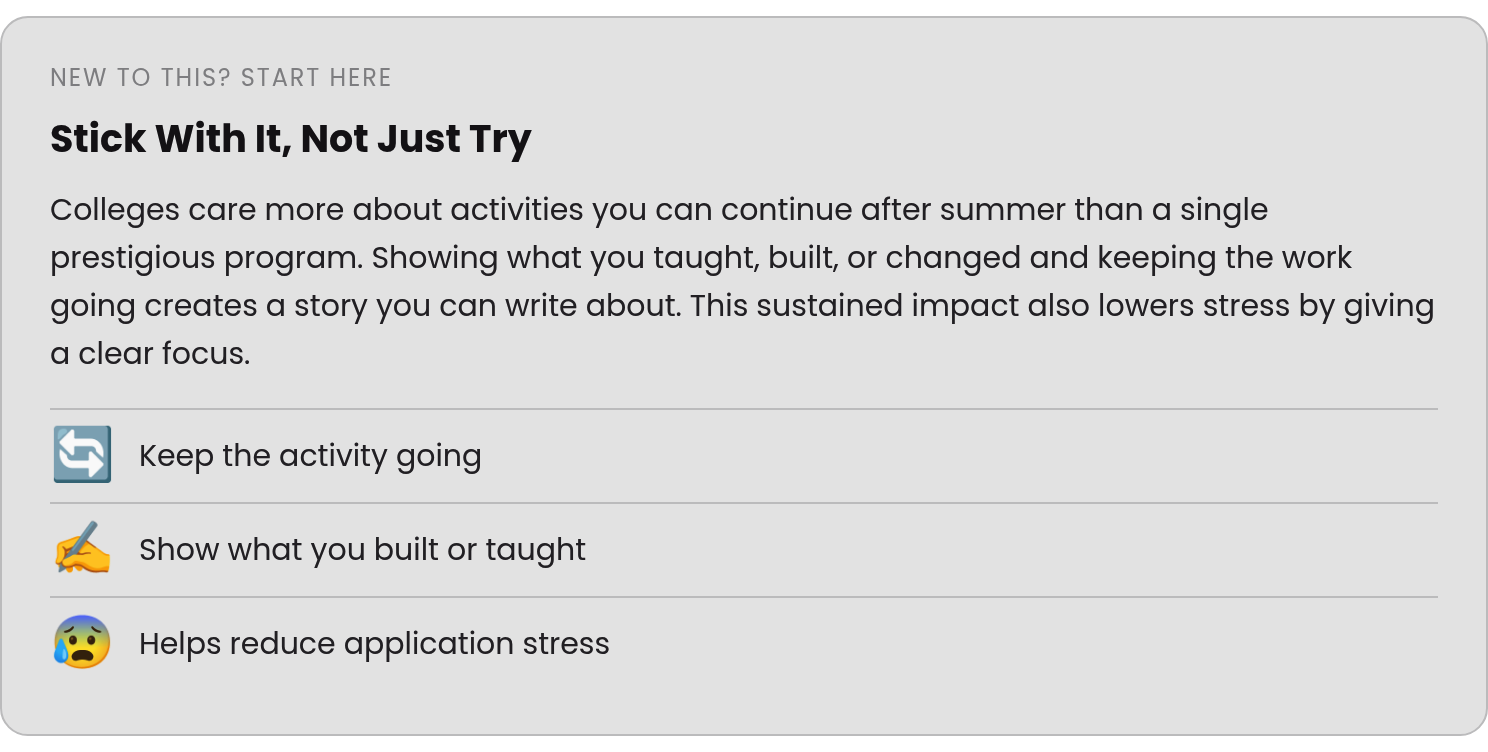
Families ask the same question every spring: which summer experience counts for admissions? Some college admissions consultants offer vague advice about "choosing something meaningful." Students default to the most prestigious-sounding option, then wonder why it didn't strengthen their application. The issue isn't the experience itself. Families often evaluate opportunities without understanding what admissions readers notice.
We use a source-backed framework: sustainability, connection to the intended academic direction, and concrete contribution; prestige is not a criterion. The National Association for College Admission Counseling reports that 44.3 percent of admission officers consider extracurricular activities moderately to considerably important, especially at selective schools. First, ask whether the student can sustain the commitment beyond a single summer. A six-week debate camp adds one line to the activities list. An internship that continues part-time during the school year produces depth.
Second, evaluate whether the experience connects to the academic direction the student intends to pursue and what the student will contribute to others. The strongest entries we've reviewed include a concrete outcome: trained new volunteers, published research findings, or organized a fundraiser with measurable results. NYU's admissions office notes that their model activity descriptions emphasize what the student taught or built, not just what they attended. A hospital volunteer who shadows doctors gains exposure. One who develops a patient education resource creates something an application reader can picture.
Third, consider accessibility and fit. For top-tier institutions, joining a club related to the student's interest isn't enough—they expect evidence of deep engagement. But that depth doesn't require expensive programs. Part-time work translates family documents, trains new cashiers, troubleshoots customer issues. These roles show responsibility and real-world problem-solving.
Skip experiences where the student can't answer: What did I teach someone? What can I keep doing? What specific outcome did I produce? Those questions separate resume padding from genuine community impact. The councilor's office internship beats the debate camp when it leads to research the student presents to a housing committee in September, not because internships outrank camps on some invisible rubric.
Writing Activities That Admissions Readers Can Process
After working with families to identify the right summer experience, we hit a second wall: students don't know how to translate what they did into a format admissions readers can actually process. Juniors return from meaningful internships or research positions, then stare at the Common App's activities section unable to condense ten weeks into a line that communicates anything beyond a job title. Too much advice focuses on selecting experiences but skips the documentation piece entirely, which means the work gets lost in translation.
The constraint is tighter than most families realize. College applications limit activity descriptions to a brief entry—roughly the length of a short social media post. Johns Hopkins and NYU both publish activity examples that emphasize specific, compact descriptions. Your student needs to capture their role, what they contributed, and what resulted from that contribution, all in a single readable sentence without acronyms or insider jargon that requires decoding.
Show Progression, Name Outcomes, Demonstrate Impact
Strong activity descriptions follow a pattern: they show progression in responsibility, name concrete outcomes, and demonstrate impact on others. An effective mock trial entry might note advancement from vice president to president, specify a competition result at a particular level, and mention training newer team members. That combination communicates growth, achievement, and contribution in a format readers can evaluate quickly.
Admissions guidance from selective universities highlights the same elements. Rather than listing a generic job title, successful entries specify the role, add what the student built or taught, and include measurable context where it exists. Schools independently emphasize one detail: training or mentoring others. Readers look for evidence you made the environment better for someone else, not just that you showed up.
The formula: role held, plus what you built or taught, plus quantifiable context where it exists. Skip filler verbs like "helped with" or "participated in." Use past tense for completed roles, present tense for ongoing ones.
Document Now, Not Later
Set up a simple log while the summer experience is happening. Record the month you started, your official title, hours per week, and one concrete task or outcome each week. Note when your responsibilities expanded. Save any emails where supervisors recognized your work. At application time, your student won't be reconstructing from memory—they'll have a document to pull from. That document also becomes the reference for recommendation letters, since the adults observing or writing about the experience often don't see the day-to-day work your student did. It can also help your student verify details later and draw specific material for essays and activity descriptions.
Turning Experience Into Essays
A junior returns from her city councilor internship in late August and opens the Common App. The first supplemental prompt asks her to describe a challenge she overcame. She stares at the screen. She researched housing policy, sat in meetings, drafted memos—but none of it felt like a "challenge" in the dramatic sense the question seemed to expect. Families we work with hit this same wall. Students choose meaningful experiences, then struggle to translate them into essay form because they don't understand what admissions readers actually want to see.
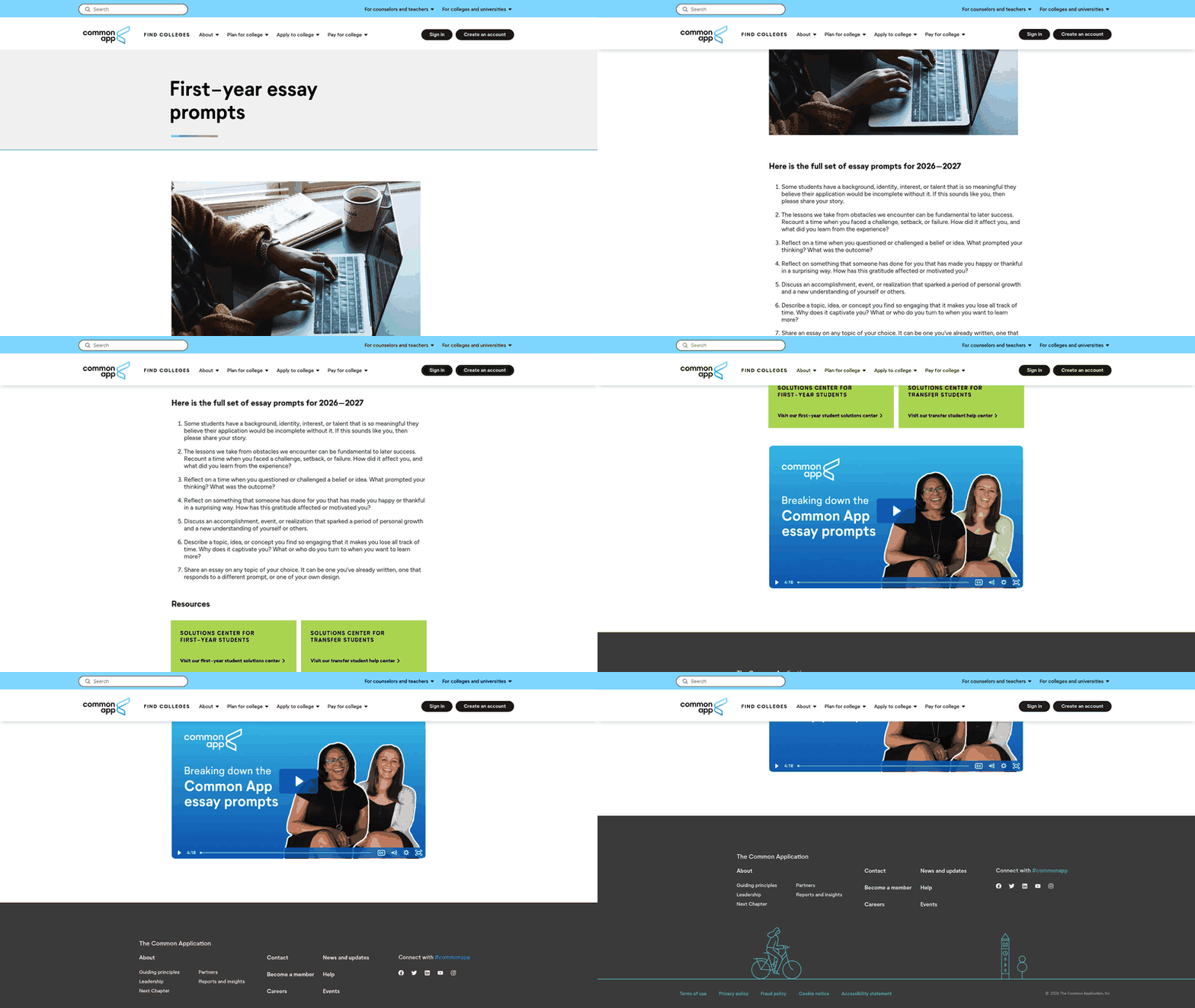
Colleges use what they call holistic review, which means they evaluate you as a whole person rather than ranking applications by GPA and test scores alone. A recent study by the National Association for College Admission Counseling found that admission officers consider extracurricular activities moderately to considerably important, especially at selective schools. Your essays and activity descriptions show admissions committees how you engage with the world, what you value, and how you might contribute on campus. An early experience—whether it's an internship, a sustained volunteer role, or an independent project—can supply the raw material for personal statements, supplemental essays, and interview answers. But the experience alone isn't enough. You need to frame it in a way that reveals growth.
Students make two mistakes when writing about early experiences. First, they summarize what they did without explaining what changed. Second, they reach for artificial drama—inventing a crisis or overstating conflict—when the real story is about noticing something new or adjusting how they approached a problem. The structure that tends to work is straightforward: context (what you walked into), action (what you chose to do and why), change (what shifted in your thinking or approach), and reflection (what you now understand differently). Johns Hopkins admissions offers a rewrite example that captures this—replace "worked at a grocery store" with "worked as a cashier, trained new employees, and helped support family expenses." The second version shows contribution and context.
That housing policy internship? The essay isn't about solving affordable housing. It's about the moment she realized local government moves slowly by design, not dysfunction, and how that realization changed the way she approached her school board advocacy work. The challenge wasn't external. It was adjusting her expectations and strategy. Admissions readers often value depth of reflection over scale of accomplishment.
References
[1] Summer Activities That Will Boost A College Application - https://summer.harvard.edu/blog/8-summer-activities-to-boost-college-applications/
[2] Activities That Help You Stand Out on Your College Application | TeenLife - https://www.teenlife.com/blog/activities-that-help-you-stand-out-on-your-college-application/
[3] Impactful Extracurricular Activities to Add to College Applications - https://www.stjohns.edu/news-media/johnnies-blog/impactful-extracurricular-activities-add-college-applications
[4] How to Build a Strong Activities List for Your College Application - https://apply.jhu.edu/hopkins-insider/how-to-build-a-strong-activities-list-for-your-college-application/
[5] Tips for Writing a Winning Activities Section - MEET NYU - https://meet.nyu.edu/advice/tips-for-writing-a-winning-activities-section/
FAQ
What if my student already attended a summer camp but didn't continue the activity afterward?
The experience can still matter if your student identifies a skill, question, or habit that carried into later work. Rather than presenting the camp as a standalone credential, connect it to the student's current interests and explain what they learned from the experience.
How do we evaluate unpaid internships against paid part-time work for application strength?
Compare the substance of the roles, not their labels. Look at the level of responsibility, the people affected by the student's work, and whether the student can describe a clear result. A paid position may offer stronger evidence than an unpaid one if it gave the student meaningful ownership, while an internship may be more useful when it connects to a sustained academic interest.
Should students focus deeply on one area or try multiple types of real-world experiences?
Selective schools generally respond well to depth, but students do not need to limit themselves to one interest. If your student genuinely has two strong interests, pursue both with enough continuity to show development. Scattered participation is less persuasive than a smaller set of experiences that produce visible growth.
What if the experience was meaningful but didn't produce a measurable outcome like dollars raised or people trained?
Focus on intellectual growth rather than external metrics. A student may discover that a familiar process works differently than expected, revise an assumption, and apply that insight in later work. Reflection carries weight when it connects the change in perspective to specific choices or actions afterward.