How to Sequence Dual Enrollment Credits That Replace Requirements, Not Pile Up as Electives
September 7, 2026

Key Takeaways
- Students who get real mileage from dual enrollment treat every credit as a requirement replacement from day one.
- Three things need to be in place before you register: a target major, each college's transfer credit policy, and a course-to-requirement crosswalk.
- General chemistry, calculus, and intro writing tend to count across many degree paths.
- Whether credits actually transfer depends on the receiving school's rules, which vary by institution and course.
- Some states publish course substitution crosswalks outright, like Ohio's College Credit Plus graduation crosswalk.
- Torn between two majors? Pull both prerequisite lists and find the overlapping courses.
- No state crosswalk exists for your school? Build your own map from the college catalog before you enroll.
Before you register: the setup that saves a semester
Skip the prep work and you end up with a transcript full of credits that don't apply to your degree. Without a roadmap, students keep taking courses the receiving school accepts only as general elective hours, not as direct equivalents.
Plan early, and every course you take moves toward graduation. Set the framework up front, and you avoid the classic trap of collecting credits for their own sake.
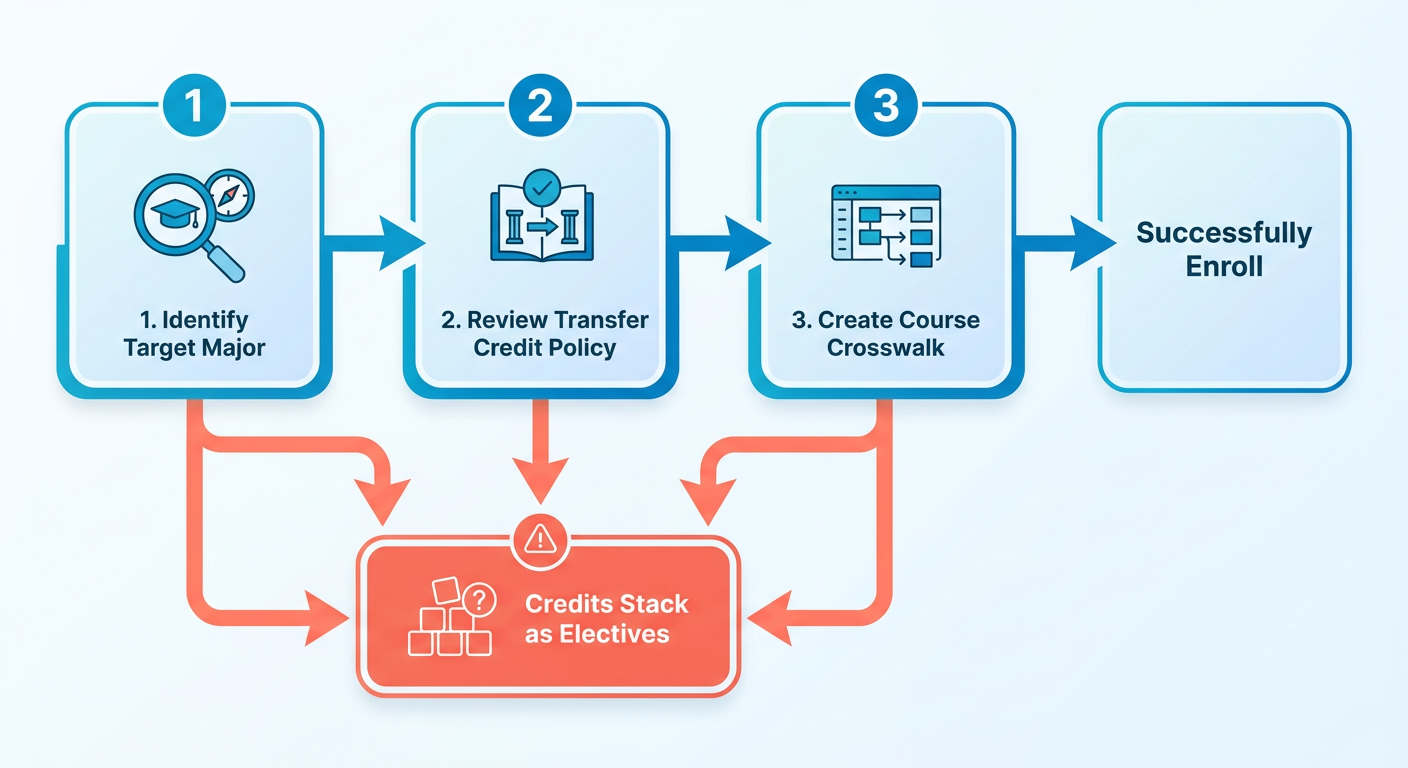
What you need before enrolling
Your intended major, or a shortlist of two. You cannot align coursework with requirements you have not defined. Torn between business administration and computer science? Look at the foundational requirements for both. Find the introductory courses that overlap, like basic statistics or public speaking, and you make progress on both fronts at once.
The transfer credit policy for each target college. Schools do not evaluate prior learning the same way. Many run public transfer equivalency portals where you type in the exact course code from your local college and see how it gets classified. Check this early, and you avoid the surprise later.
A course substitution crosswalk. This is your translation guide. When there is no state framework to lean on, cross-reference the high school graduation requirements against the college's general education curriculum yourself. The goal is one course that satisfies both.
Why sequencing trips people up
Prerequisites have an order, and getting it wrong burns a semester. You cannot always take an upper-level course before its introductory version. A common example: can History 110 come before History 102? It depends on how that department numbers and gates its courses.
Read the catalog descriptions, not just the titles. A "110" does not always come after a "102."
The setup checklist before you enroll:
- Confirm the major and pull its prerequisite list
- Verify transfer eligibility at each target college
- Locate a crosswalk or build one from the catalog
- Check prerequisite chains so you sequence in the right order
Lock those four in, and every course does double duty. At Endurable Education, we build customized plans that map a student's strengths and goals into long-term academic success.
Transfers vs. counts: the distinction that runs the whole thing
Dual enrollment lets high school students earn college credit before they graduate. Smart sequencing comes down to one idea: a credit that transfers is not the same as a credit that clears a requirement. As college advisor Nancy Delgado puts it in this TransferCredit analysis, "A credit that transfers is not the same thing as a credit that helps your degree plan."
That distinction is the whole game. Treat every dual enrollment course as a targeted requirement replacement, picked by working backward from your major's prerequisite list. Skip that step and the credits still transfer. They just land as electives you did not need.
What makes a credit "mapped"
A mapped credit satisfies a specific requirement at both the high school and college level. Three things decide whether a course earns that status: the requirement it targets, the sending school's accreditation, and the grade you earn.
Here's how the pieces fit:
| Component | What It Controls | The Failure If You Skip It |
|---|---|---|
| Target requirement | Whether the credit replaces a course or piles up | Credit becomes an elective |
| Accreditation | Whether the credit transfers at all | Non-accredited credit gets rejected |
| Minimum grade | Whether the credit posts to your transcript | A C or higher is often required |
| Course match | Whether content aligns with the receiving course | Partial or no credit awarded |
Credits from regionally accredited colleges transfer far more reliably, and many schools want a C or higher before a credit posts, per the same TransferCredit breakdown. One more caveat: older credits can expire. Some programs impose 5- or 10-year limits in fast-moving fields, so a course taken in ninth grade may not count toward a junior-year major requirement.
Does course sequence actually matter?
Sometimes. The honest answer splits into two buckets. Sequence matters for prerequisite chains and two-part courses. It is irrelevant for standalone classes.
This sequencing guide shows both sides. Taking Calculus I before Precalculus creates transfer headaches, and General Biology 1 must come before Biology 2. But the same source notes that many colleges award credit for non-duplicating courses regardless of order.
So sort your target courses into sequence-sensitive and sequence-agnostic before you register. Chain the sensitive ones correctly. Fit the agnostic ones wherever your schedule allows. Take both halves of a two-part course from the same college in the same academic year.
Why map before you enroll?
Because mapping after transfer is too late. A documented case makes the point: a student moving from Northern Virginia Community College to Virginia Commonwealth University completed 6 dual enrollment credits. One 3-credit English Composition course cleared a writing requirement. The other 3 credits became elective hours.
Both transferred. Only half advanced the degree. That is the pile-up failure, and it hits credits that transfer perfectly.
Map it right, and a single course discharges both the high school obligation and the college one. Line up graduation requirements against college general education categories, and you clear mandatory subjects like literature or social sciences while banking direct college equivalents.
Difficulty: moderate planning, not moderate coursework. Time estimate: two to three hours of mapping per target college before you enroll.
Building the plan, step by step
A credit-mapping plan takes four moves: pull the requirement list, match courses to it, check prerequisite order, then lock in your registration. Each move turns a course from a maybe-it-counts gamble into a confirmed requirement replacement. Here is how it works.
How do you build the crosswalk?
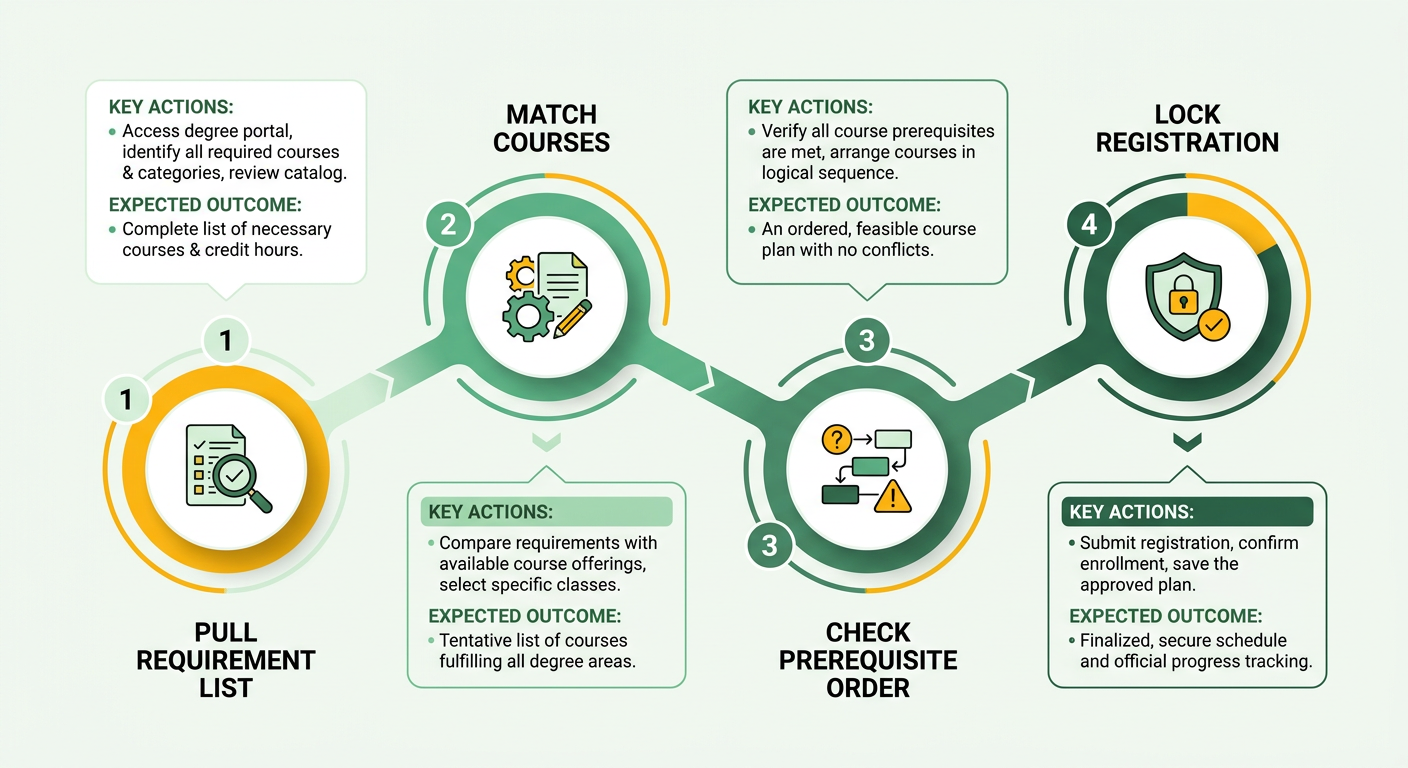
Start with your target college's degree requirement sheet for your major. Put each required course in a column, then list the dual enrollment course that could satisfy it beside it. This side-by-side crosswalk is the whole system. If a course has no requirement to sit next to, it is a candidate elective, not a priority.
Many state education departments publish templates showing how to line these up, illustrating how specific college courses substitute for high school graduation requirements. Your job is to reproduce that one-to-one clarity for your future college degree requirements.
Before you finalize the list, run each potential match through the receiving school's official transfer credit portal. A match that looks clean in your notes still has to check out against the university's live database of accepted course numbers.
Does course order matter?
Yes. Order matters as much as selection. Some college courses assume you have cleared a prerequisite, and taking them out of order can cost you the credit.
As the guide on course numbering and sequencing lays out, departments design their pathways differently. A higher course number does not automatically mean a prerequisite or a steeper difficulty curve. Reading the course descriptions in the catalog is the only way to confirm whether a sequence is mandatory.
Once your crosswalk is confirmed and your order is set, register in the sequence your plan calls for. Take the prerequisite course first, even if a later course fits this term better. Skip any course that does not map to a requirement. That single filter keeps your credits landing as replacements instead of stacking up as electives.
Working through these decisions builds real planning skills before the formal application process even starts. A structured approach to course selection is good practice for the self-directed grind of college itself.
Best practices for the double-clear
The strongest move in dual enrollment is a "double-dipping" credit that satisfies requirements at both levels at once. Line up your high school graduation checklist with your target college's general education requirements, and a single course clears two academic milestones off the same study hours.
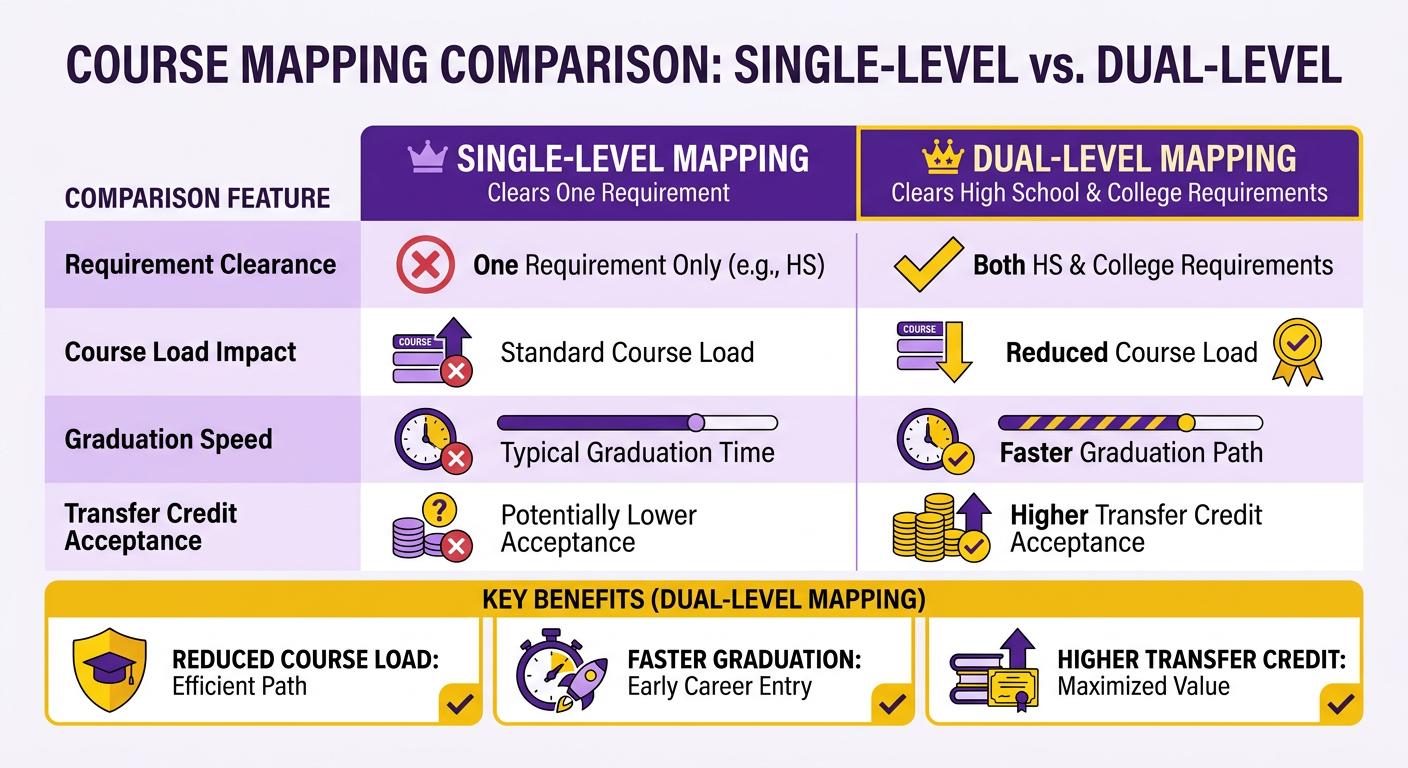
A truly optimized credit discharges both obligations. Anything less is a partial win. The rest of this section is about hitting that double-clear consistently and dodging the traps that turn good credits into filler.
How do you avoid the elective pile-up?
Name the target requirement before you register, not after your transcript posts. A credit that transfers cleanly can still land as an elective if you never mapped it to a specific requirement up front.
Build a one-page audit sheet before each enrollment window. Every course you are considering goes in the left column, and the exact named requirement it satisfies goes on the right. Any row with a blank right column is a course to cut or swap. This forces the mapping decision while you can still change your schedule, instead of after a registrar has already filed the credit as loose elective hours.
That is exactly why deliberate planning matters. Pre-assigning a named requirement to every course before you enroll is the surest way to keep credits from landing as orphan electives.
Which courses actually need sequencing?
Sequence matters for prerequisite chains and two-part courses, not for standalone ones. This is where students overthink or underthink it, so split your list into two buckets.
Sequence-sensitive courses: STEM pathways and multi-part sequences demand strict order. Try to take advanced coursework before the foundational introductory class, as the curriculum sequencing guide notes, and you can get transfer credit denied. Complete both parts of any year-long sequence at the same institution.
Sequence-agnostic courses: Standalone subjects like intro sociology or art history do not lean on prior college-level knowledge. Universities usually award credit for these non-duplicating courses no matter when you take them. Put your scheduling flexibility here, and keep your STEM sequences locked in order.
The apparent contradiction resolves cleanly. Sequence is critical for chains, irrelevant for singletons. Sort every course into one bucket, and you will know exactly where order counts.
The silent credit-killers
Two rules quietly void credits even when your mapping is perfect: grade minimums and expiration dates. Both are checkable before you enroll, so check them.
A "D" might earn high school graduation credit, but most universities enforce strict minimum grade thresholds for transfer eligibility, as the credit transfer analysis lays out. A low grade does not just disqualify the course from replacing a college requirement. It also plants a permanent college transcript with a low GPA before you have even finished high school.
Currency of knowledge is the other one. In fast-moving fields like computer science, IT, or nursing, universities often reject credits earned too far ahead of matriculation. If you are headed for a highly technical major, check whether the receiving department has a strict shelf-life policy on intro science and tech courses.
Keep every syllabus and course description. When a registrar sizes up a borderline match, that paperwork is what turns a maybe into a confirmed clear.
Troubleshooting
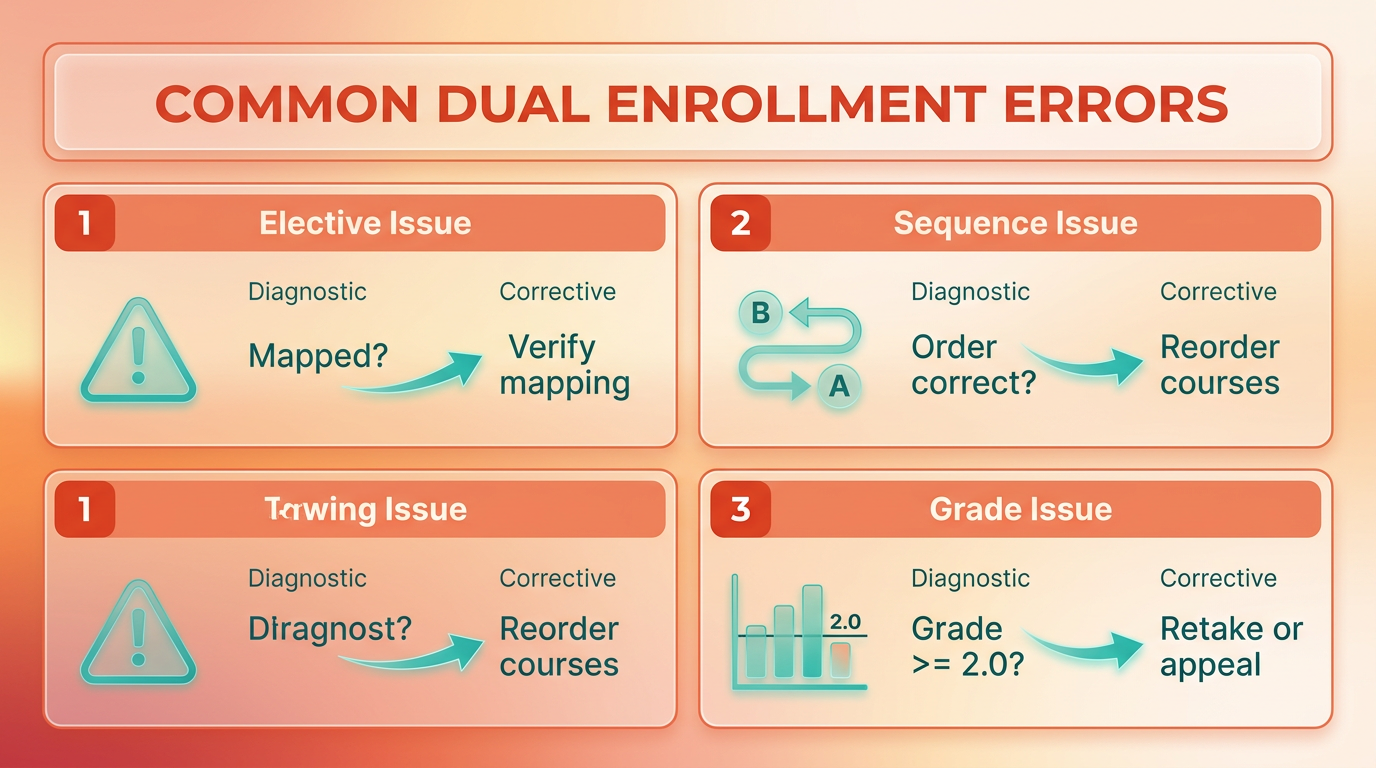
When dual enrollment credits go sideways, the failure almost always traces back to one of three errors: a credit that transferred but landed as an elective, a course taken out of sequence, or a grade too low to count. Each one is fixable if you catch it early. The trouble is most students only notice after the transcript posts, when it is too late to remap.
Every one of these is a planning failure, not a transcript accident. Debug them at the crosswalk stage, before you register.
Why did my credit land as an elective?
The most common failure: a course transfers cleanly but clears no named requirement. That is not a transfer problem. It is a mapping problem, and it happens before enrollment, not after.
Per this transfer evaluation guide, registrars default to awarding general elective hours when a course has no direct equivalent in their system. Take several introductory social science courses and you may find the hours get accepted while none of them satisfy the specific general education categories your degree requires.
The distinction matters because elective caps exist. Many degrees limit free electives to 12 or 15 hours, so once you hit that ceiling, extra elective credits stop counting toward graduation at all.
The fix: run each course against your major's requirement sheet before you sign up. If a course has no requirement to sit beside, treat it as a candidate elective, not a priority.
How do I debug a sequencing error?
Sequence errors only matter for chained courses. Take a two-part or prerequisite course out of order and you risk a transfer failure. Take a standalone course out of order and most colleges award the credit anyway.
This academic sequencing resource clears up the apparent conflict. When courses are built as sequential blocks, taking them out of order signals a lack of foundational prep, and universities deny the transfer credit. For non-sequential courses, order rarely comes up during evaluation.
Both are true. The distinction is course type. General Biology 1 and 2 form a chain, so order is non-negotiable. A standalone history survey is sequence-agnostic.
So sort every course on your crosswalk into "chained" or "standalone" before you register. For sequential courses, schedule both terms back to back at the same college.
What if my grade is too low to transfer?
Many colleges require a C or higher for credit to transfer. Universities enforce grade thresholds for transfer eligibility, so strong performance is not optional here. A student struggling in a dual enrollment class needs to get tutoring or academic support fast, because a subpar grade invalidates the entire mapping strategy.
And keep an eye on credit-age policies, especially in fast-changing departments.
Skip early dual enrollment in a fast-moving major if graduation sits far out. A freshman-year credit that expires before you finish the degree is a wasted seat.
What I'd actually do
Every dual enrollment credit should replace a specific requirement in your future major, not sit on your transcript as a generic elective. That is the whole argument here. Map each course backward from your college's degree sheet, and you turn a pile of credits into confirmed requirement replacements.
Planning before registration pays off. Line up your high school coursework with your future college curriculum, and every credit earns its keep, saving both time and tuition dollars once you are on campus.
What to do next
Start with one document: a two-column crosswalk. Your major's required courses on the left. The dual enrollment course that could satisfy each one on the right. Any course without a requirement beside it is an elective candidate, not a priority pick.
Then verify three things before you commit:
- Sequence validation. Make sure your planned course order matches the receiving department's academic progression.
- Academic standards. Confirm the exact grade requirements for the credit to be accepted at your target school.
- Official documentation. Get written confirmation or save screenshots of the transfer equivalency database for your records.
Where to get help building the map
Your high school counselor and the target college's registrar are your first stops. Many state education departments publish official equivalency guides showing how college courses line up with secondary school requirements. Use those public documents as templates for your own credit map.
For students aiming at highly competitive universities, a precise credit strategy is part of the game. At Endurable Education, we give families personalized guidance for these complicated transfer pathways. You can read more of our thinking on early academic planning on our blog. Prioritize requirement replacement over simple credit accumulation, and every course you take moves your degree forward.
References
[1] Dual Enrollment Credits Transfer to College - TransferCredit.org - https://www.transfercredit.org/blog/credits/dual-enrollment-credits-in-high-school-do-they-actually-transfer-to-college?srsltid=AfmBOooI6g9-CmhBd8LIyreKNSKiiWUBPL-2n8UnA9_JXNLveYXBziJg
[2] High School Graduation: Course Substitution Crosswalk - https://highered.ohio.gov/wps/portal/gov/odhe/initiatives/access-acceleration/college-credit-plus/ccp-resources-secondary-schools/ccp-secondary-crosswalk/ccp-hs-graduation-course-substitution-crosswalk
[3] Choosing the Right Course Sequence for Dual Enrollment Success - https://homeschoolingforcollegecredit.org/can-i-take-history-110-before-history-102/
Frequently Asked Questions
1. Can I transfer dual enrollment credits from a community college to a four-year university?
Yes, but transferability does not guarantee applicability. While most public four-year universities accept credits from accredited community colleges, they evaluate each course to determine whether it meets a specific degree requirement or simply counts as an elective. Many states have articulation agreements that guarantee credit transfer, but you still need to verify how those credits apply to your specific major.
2. What happens if I take dual enrollment courses before choosing a major?
If you are undecided, focus on the universal general education core. Most degree programs require foundational coursework in written communication, quantitative reasoning, and behavioral sciences. Prioritizing these broad categories ensures that your earned credits will satisfy core requirements regardless of the major you eventually declare.
3. Do older dual enrollment credits ever stop counting?
Yes, certain academic departments enforce currency requirements for transfer credits. This is particularly common in STEM and healthcare fields, where foundational knowledge changes rapidly. To avoid taking courses that might expire before you graduate, consult the academic catalog of your target institution to check for any time-limit restrictions on transfer coursework.
4. Does a higher course number always mean I should take it later?
Not necessarily. Course numbering systems are highly institutional and do not always indicate a strict linear sequence. A higher-numbered course may simply denote a specific sub-topic rather than an advanced level of difficulty. Always review the official course catalog to identify the actual prerequisites rather than relying on the course number alone.
5. What grade do I need to earn for a dual enrollment credit to count?
While high schools often award graduation credit for a "D," most universities require a higher standard for transfer eligibility. Typically, a grade of "C" or better is necessary for the credit to be recognized by the receiving institution. Earning a lower grade means you may have to retake the course at your four-year college.
6. How is a transferable credit different from one that clears a requirement?
A transferable credit is simply accepted by the university as part of your overall credit hour total, whereas a requirement-clearing credit directly satisfies a specific course obligation in your major. If your credits only transfer as general electives, they may quickly exceed the maximum elective allowance permitted by your degree program, rendering them useless for graduation.
7. How much time should I budget for mapping credits before enrolling?
Investing a few hours of research before registering can save you semesters of redundant coursework later. The process involves reviewing college catalogs, verifying transfer databases, and organizing your findings into a clear roadmap. Taking this step early ensures that your dual enrollment experience is both efficient and strategically aligned with your graduation goals.