How to Sequence Rigor, Tests, and Leadership Before Junior Fall
August 28, 2026
Clarifying editing scope and typo handlingPlanning concise and polished text editsRemoving AI-like phrasing and completing article

Key Takeaways
- Front-loading rigor, test prep, and leadership before junior fall prevents pileups.
- It lets junior year become deeper, not just busier.
- Colleges weigh course rigor more heavily than GPA or test scores.
- That makes demanding coursework the highest-impact, slowest-to-build factor.
- Test-prep score gains run about 4.3 points per month.
- This applies to students who start before June of junior year.
- Students who began prep in February scored 34.4 points higher.
- They outperformed students who waited until September of senior year.
- Spaced study beats cramming, and individual tutoring beats group hours.
- Rigor and real leadership cannot be added retroactively.
- Waiting permanently forfeits those points.
- The same effort buys more value when started early.
The one move that decides junior year: start early
If you're trying to figure out how to get into Ivy League schools, start earlier. The strongest move is front-loading rigor, test prep, and leadership before junior fall. Don't scramble to build all three during junior year. That shift turns junior year into deeper work, not broader chaos.
The logic is simple. Colleges weigh course rigor more heavily than GPA or test scores, according to this rising-junior timeline. The work with the biggest impact also takes the longest to build. Wait too long, and you cannot add two years of harder coursework. You also cannot create a meaningful leadership project overnight. That door closes.
Why early test prep wins more points
Early, spaced-out test prep is not just less stressful. It raises scores. Gains run about 4.3 points per month for students who start before June of junior year, per research on admissions test prep. Students who began in February scored 34.4 points higher than those who started in September of senior year.
That same research found distributed sessions beat clustered cramming. It also found individual tutoring outperforms group hours. The takeaway is simple: the same effort produces more points when it starts before junior fall. You are not just calmer. You are scoring higher for the same work.
The sources do create one real tension. One timeline says junior prep should protect mental health and authentic interests over score chasing. The test-prep data says early coaching meaningfully improves scores. Both are true. They do not conflict. Quiet prep in the prior summer protects junior-year time for rigor and leadership.
When each piece should start
Use your sophomore-year PSAT 10 score from March or April as your baseline. That test date is already on the calendar. Let it trigger the sequence. Then map the pieces by difficulty and timing.
| Current Status | Target Rigor | Test Schedule | Leadership Milestones | Est. Weekly Hours |
|---|---|---|---|---|
| Freshman | 1-2 honors classes (Easy) | PSAT practice, light diagnostics | Join clubs, find your lane (Easy) | 3-5 |
| Sophomore | First AP/IB courses (Medium) | PSAT 10 baseline (spring) | Take a committee or project role (Medium) | 6-8 |
| Summer before junior year | Preview AP content (Medium) | Begin distributed SAT/ACT prep | Launch a leadership project (Hard) | 8-10 |
| Junior fall | Peak AP/IB load (Hard) | Official SAT/ACT sittings | Scale impact, deepen role (Hard) | 10-12 |
One detail matters here: official SAT administrations contribute more to score gains than unofficial practice tests. Put real test dates on the calendar, not just mock exams.
What early sequencing actually buys you
It buys deeper impact, stronger recommendation letters, and less senior-year burnout. Early leadership roles let you build something real instead of just collecting a title. As MIT Admissions puts it, the activities that count should "delight and challenge you, rather than just those that look good on applications."
One exception: skip aggressive front-loading if a student is already overwhelmed. If grades are slipping, fix the current load first. For everyone else, procrastination is expensive. Late course changes and test retakes cost more and reduce your odds. At Endurable Education, our customized planning starts as early as 8th grade. That helps students sequence rigor, tests, and leadership from the start.
Take an honest inventory: rigor, scores, leadership
Before you build any plan for how to get into Ivy League schools, take a clear snapshot of your current standing. That means three separate audits: course rigor, test-score baseline, and leadership record. Do them before junior fall, while gaps are still fixable.
Every student we mentor starts here. The goal is not a grade. It is a data-driven starting line that tells you what to sequence next.
How to build a rigor scorecard
A rigor scorecard is a weighted tally of your hardest courses. It shows admissions readers how much academic challenge you've taken on. Officers do not just look at GPA. They ask whether you took the most demanding options at your school. That is why so many competitive programs value rigor above GPA and test scores.
Weight your courses by difficulty. Give AP and IB the highest weight. Then honors. Then dual-enrollment and independent projects that show self-directed depth. Tally what you've taken, and what your school offers that you have not touched yet.
The gaps matter more than the total. A common one we flag: strong humanities APs but no calculus, physics, or chemistry AP on the sheet. If you're eyeing STEM-heavy programs, that missing rigor is your first project.
Where your scores land against target schools
Pull each target school's 25th-75th percentile SAT and ACT ranges. Then compare your most recent score to them. Below the 25th percentile is a gap. Inside the middle 50%, you're competitive on paper.
Your score report from the PSAT 10, administered March 2 through April 30, 2026, gives you a detailed breakdown of subscores. Use that diagnostic data to find content gaps, like algebra or reading comprehension. Do not focus only on the composite.
Balancing prep with a demanding class schedule takes a shift in approach. Treat test prep as light, consistent weekly practice rather than a short-term intensive. Then it stops competing with coursework. Students who prepped over the summer before junior year often feel more in control once school starts. That makes space for rigor and mental health during the busy stretch.
What goes in a leadership inventory
A leadership inventory is a checklist of every position, its hours, and its measurable impact since freshman year. Compile it as an activities resume with roles and results spelled out. Focus on concrete contributions, not club memberships.
List each role. Add hours per week. Then write one impact metric per line: funds raised, members recruited, events run. Blank impact columns usually mean the title exists on paper only.
Depth beats titles. MIT Admissions and committees like them look for sustained engagement that shows curiosity and growth, not a stack of positions. A student interested in environmental science might skip the generic school club and instead design a local wetland restoration project. Document the hours and community volunteers involved. A focused, measurable commitment reads stronger than five scattered clubs.
Once all three audits are on paper, bring them to a counselor or teacher for a reality check. They can catch rigor gaps and score misreads you might miss. At Endurable, we help students turn these baseline audits into real milestones, so the profile matches what highly selective schools expect.
Set junior-year rigor and leadership targets
An audit only helps if you turn it into hard targets. Convert each gap into a SMART goal: specific, measurable, achievable, relevant, time-bound. For students figuring out Ivy League admissions, the deadline that matters most is junior fall, not application season.
Set three goal tracks in parallel: courses, test scores, and leadership. Each needs a number and a date. Vague intentions like "take harder classes" do not survive junior-year pressure. "Four AP courses on the transcript by the start of junior fall, weighted toward my intended major" does.
What rigor and test targets to set
A rigor target is a defined AP/IB count with a subject mix matched to your intended major. A prospective engineering applicant might aim for four APs by junior fall, front-loaded with Calculus, Physics, and Chemistry. A humanities student would weight toward history, language, and literature instead. The goal is a progression that shows upward momentum. Sara Harberson's game plan makes the point that admissions officers want to see you handle a heavier workload each year.
Ivy expectations are steeper than most selective state schools. State flagships often admit strong students with three or four APs. The top-5 privates expect a schedule that looks near-maximal for whatever your school offers. Build your Target School Matrix around that: required rigor level, average test scores, and the leadership profiles admitted students actually held.
For scores, set a milestone with a buffer. Aim SAT 1480-plus with Math around 750 if you're STEM-bound, and plan for one retake. Starting early also helps you master the exam's format and pacing. The admissions test-prep research points to long-term familiarity with test mechanics producing more consistent performance on test day, especially when tutoring is distributed rather than clustered.
This double focus on academics and testing does not have to end in burnout. A steady, low-intensity summer prep schedule can secure competitive scores without draining the energy you need for advanced classes. That aligns with the view that colleges value rigor over scores.
Leadership goals that actually count
Set a leadership goal hierarchy: position, project scope, then measurable outcome. Do not stop at "Club President." Name the project and the number attached to it: 40 members recruited, 200 service hours logged, one regional award. Outcomes are what admissions readers can verify.
Our mentoring focuses on helping students find and build genuine intellectual interests. Line up your extracurriculars with what you actually care about, and depth and authenticity show up naturally.
Fit shapes the mix. Deep STEM research reads strongly for engineering-heavy schools. Sustained civic leadership carries more weight elsewhere. Map your leadership goals to the schools on your matrix instead of chasing a generic profile.
Setting these targets early gives you a clear roadmap for the year. For a month-by-month breakdown of how to structure them, see our admissions planning blog. Lock the targets before junior fall, and the year becomes execution instead of scramble.
Build a sequenced master timeline
The fastest way to figure out Ivy League admissions without burning out is to build the calendar backward. Start from your junior-fall deadline. Work back to today, placing test dates, course enrollments, and leadership phases in the order that clears bandwidth instead of stacking it.
A structured timeline keeps everything organized. As Scott Webster of Clayborne Education notes, a clear plan helps families manage college-process logistics and stay focused on steady progress rather than last-minute deadlines.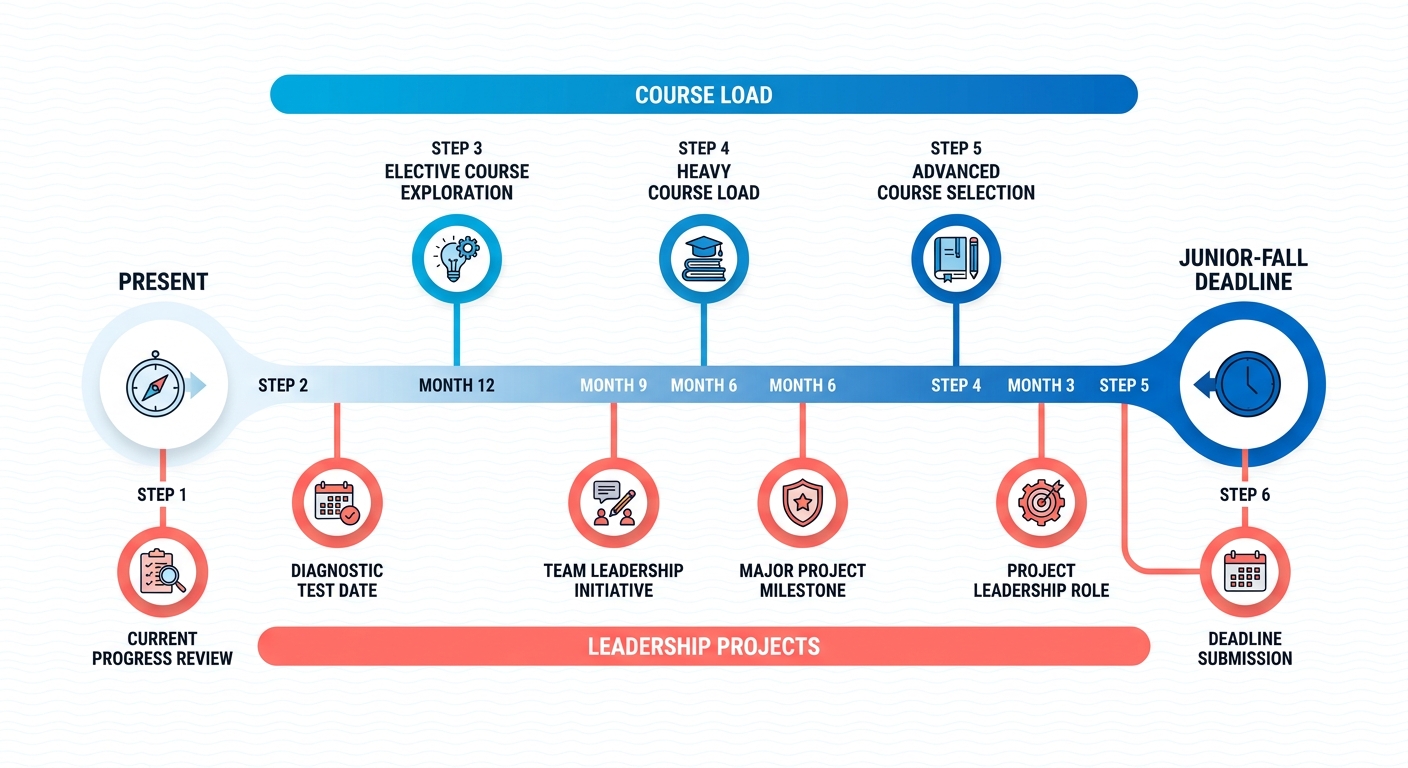
Anchor the timeline to real deadlines
Backward planning means mapping every milestone from your junior-fall finish line back to the present. Nothing collides that way.
Start with the dates you cannot move. Anchor the calendar to your spring PSAT 10 result and treat that score as your diagnostic baseline. It becomes the trigger that launches your prep sequence the following summer.
Then find your testing windows early. Registering for a first official exam in the spring, as Sara Harberson's game plan lays out, gives you a baseline score before summer and leaves time for targeted review. Mark the AP exam windows in May. Slot these fixed dates first. Everything else flows around them.
Why start test prep so early
Because spacing the work out beats cramming it in. Cognitive research on the spacing effect shows that study spread across weeks produces better long-term retention than massed sessions of the same length. That maps cleanly onto test prep: two hours a week over four months beats a weekend blitz right before test day.
Spreading prep over several months also helps you internalize test-taking strategies and content. Then the actual exam feels like an extension of practice instead of a high-stakes event. It also keeps prep from colliding with coursework, even at schools that value rigor over test scores.
How to sequence courses and leadership
Stagger your AP load so no single year buries you. Put AP Chemistry in tenth grade, AP Physics or AP Calculus BC in eleventh. Pacing challenges this way lets you adjust to college-level work without tanking your core subjects.
Run your leadership project in three phases:
- Ideation (summer): pick something that aligns with your genuine interests, not just what looks good on paper.
- Execution (fall): launch and lead. This is where the real work happens.
- Impact reporting (spring): measure results and log them for your activity record.
A student might spend the summer prepping for the August SAT or September ACT. That way, they enter junior year with their main testing handled and their fall clear for varsity athletics or theater.
Build the whole thing in a shared Google Calendar or a Trello board with milestone columns, buffer weeks, and a contingency slot for retakes. Leave room for personal responsibilities, family time, and rest. Those are not luxuries. They are what keeps you engaged over two years instead of two months.
Execute, track, refine: the junior-fall checklist
Once the plan is built, execution is where most families lose the thread. Figuring out Ivy League admissions is not about the perfect timeline. It is about catching drift early and correcting it before junior fall locks your options.
A consistent feedback loop makes that possible. Regular check-ins help you spot when the schedule becomes unmanageable and adjust before your grades take the hit.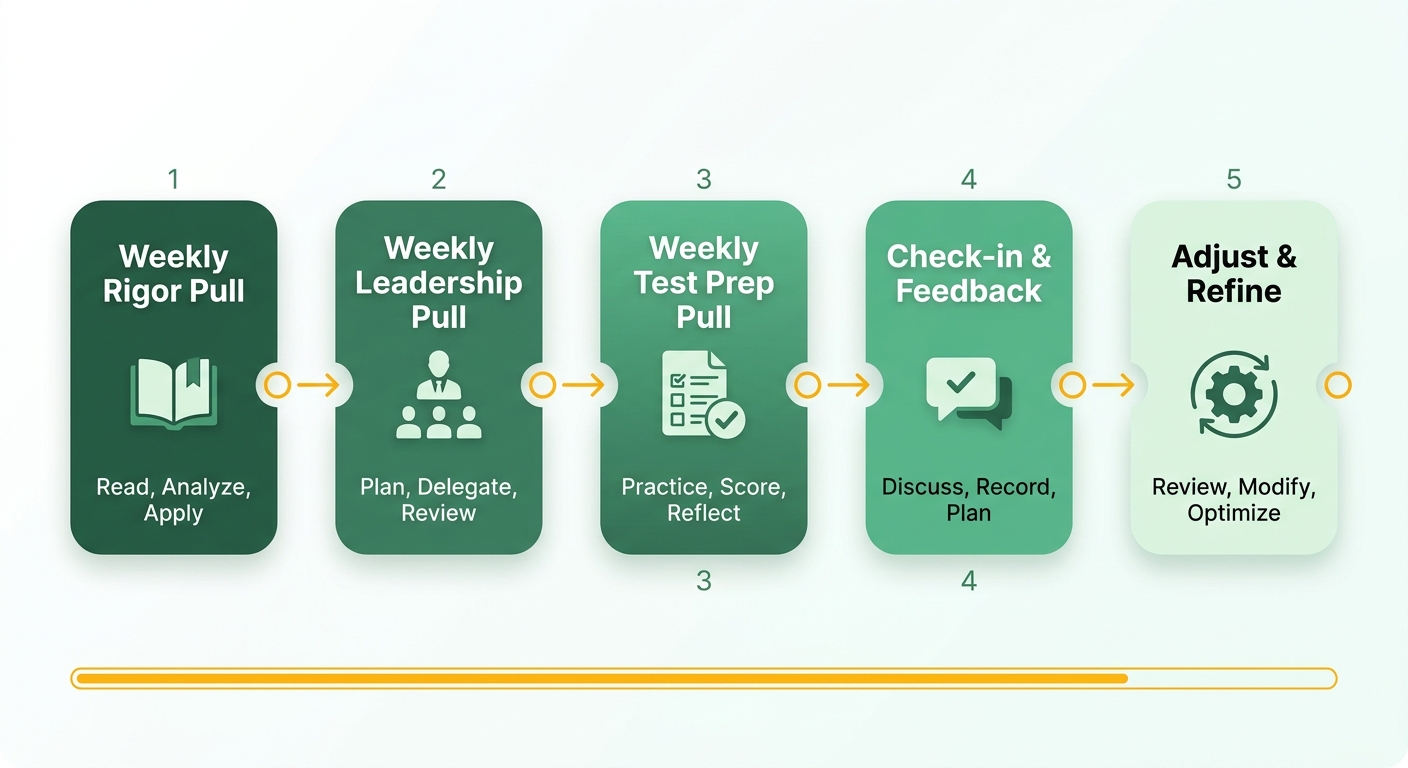
What your weekly "rigor pulse" tracks
A rigor pulse is a five-minute weekly review of current grades, upcoming assignment load, and AP exam readiness. The point is to catch a sliding grade in week three, not at the semester report card when it is already baked in.
Check three numbers each week. Your grade in every AP or honors course. The assignment volume over the next two weeks. Your readiness for any AP exam on the calendar. If a grade dips below target for two straight weeks, that is your trigger to act.
For test prep, watch the qualitative side, not just the composite. Review your official test administrations for error patterns, like pacing issues on reading passages or conceptual gaps in advanced math.
When to trigger an adjustment
Adjust when a metric misses target two review cycles in a row. The fix depends on which loop flagged it: add a buffer study block for a slipping grade, shift a leadership role that is eating too many hours, or re-plan a test date if practice scores stall.
Catching the trend early gives you room to move. If a subject needs more study time than planned, scale back a secondary commitment for a while to protect your core academics. Kept in balance, prep supports classroom work and leadership instead of pulling against them.
Your 10-item pre-junior-fall audit
Run this once, before junior fall begins. Every "no" becomes a project with a deadline.
- AP enrollment confirmed on your official schedule
- Counselor sign-off secured for your rigor plan
- At least one SAT or ACT registered on your target timeline
- Score target met, or a clear path to it
- Question-type mastery logged and tracked
- Leadership proposal approved by an advisor
- Impact hours and outcomes recorded, not just attendance
- Reflection notes written on each activity
- Activities tied to your genuine interests, not the crowd's
- Senior-year rigor roughed out, since colleges see those grades too
Tie the activities to what you actually care about, and the application tells a coherent story instead of reading like a checklist of disconnected wins.
References
[1] 2025 Timeline for Almost Rising Juniors and Seniors - https://admissionsmom.college/admissions-journey-timeline/2025-timeline-for-rising-juniors-and-seniors/
[2] A College Admissions Game Plan for Freshmen, Sophomores, and Juniors - https://www.saraharberson.com/blog/college-admissions-game-plan-freshmen-sophomores-juniors
[3] College Admissions Timeline for the Class of 2028 - Clayborne Education - https://clayborne.com/blog/college-admissions-timeline-class-of-2028/
[4] College Application & Admissions Timeline (AKA What Should I be ... - https://www.collegeessayguy.com/blog/college-application-timeline
[5] Preparing students for college admissions tests - https://www.researchgate.net/publication/282492223_Preparing_students_for_college_admissions_tests
Frequently Asked Questions
1. Does test-optional admissions mean I can skip early test prep entirely?
Test-optional policies do not remove the value of strong scores. A competitive score inside a school's middle 50% still strengthens your application. Early distributed prep also stays quiet in the background. It avoids crowding out coursework and keeps your options open.
2. What if my school offers very few AP or IB courses?
Colleges evaluate rigor relative to what your school offers. They expect a schedule that looks near-maximal for your options. If AP courses are limited, dual-enrollment classes and self-directed independent projects can fill the gap. Document them on your rigor scorecard so admissions readers see you pushed available limits.
3. Is it too late to start this sequence if I'm already a junior?
You cannot change your freshman and sophomore transcript. You can still optimize your remaining semesters. Focus on maximizing current course difficulty, register for the next available SAT or ACT sitting, and elevate an extracurricular with a specific, measurable project. Prioritizing quality over quantity is still your best path.
4. How is a rigor scorecard different from just calculating my GPA?
A GPA averages your grades across all classes. A rigor scorecard evaluates the academic weight of those courses. This audit helps you see your transcript through an admissions officer's eyes. It shows whether you challenged yourself with advanced coursework or left subject gaps relative to your intended major.
5. Should every student aggressively front-load rigor before junior fall?
No. If a student is struggling to maintain current grades, adding harder courses or intensive test prep will likely backfire. Academic stability and mental well-being come first. Front-loading works best for students who can take on more and spread milestones more evenly.
6. Why does individual tutoring beat group prep if the total hours are equal?
One-on-one instruction allows immediate, targeted feedback on your specific error patterns. Rather than moving at the average pace of a classroom, individual tutoring focuses on your unique skill gaps and pacing challenges. That makes each study hour more efficient.
7. How often should I check my progress once the plan is running?
A brief weekly check-in is ideal for staying on track. Monitor current grades and upcoming deadlines so you can spot downward trends early. If a grade or test score stays below target for two consecutive weeks, adjust your study habits or seek additional support.