How to Turn Applicant Into Admit: Lock Your Narrative Before Essays, Activities, and Recommenders
September 4, 2026

Key Takeaways
- Admissions officers spend 8 to 12 minutes on a first read, working through 30 to 40 files a day at peak.
- Roughly 80% of applicants to highly selective schools are already academically admissible. Grades are a threshold, not a differentiator.
- A coherent narrative ties activities, essays, and letters into one story.
- Readers move in a fixed order: activities list, personal essay, supplements, then recommendation letters.
- You have to lock the story before drafting a single essay.
- If your activities spike screams environmental science and your essay wanders elsewhere, readers see the seam immediately.
- The reading order is why the lock has to happen up front.
Why an 8-Minute Read Should Terrify You
Here’s the number that should change how you build your application. Admissions officers spend 8 to 12 minutes on their first read, moving through your file in a fixed order during a stretch where they handle 30 to 40 applications a day, according to this breakdown of the 8-minute review. Four years of high school, absorbed faster than a lunch break.
That window is why you need a locked narrative before a single essay draft exists. Around 80% of applicants to highly selective schools are already academically admissible, per College Essay Guy's guide. Grades get you in the door. What separates you is whether every section confirms the same story.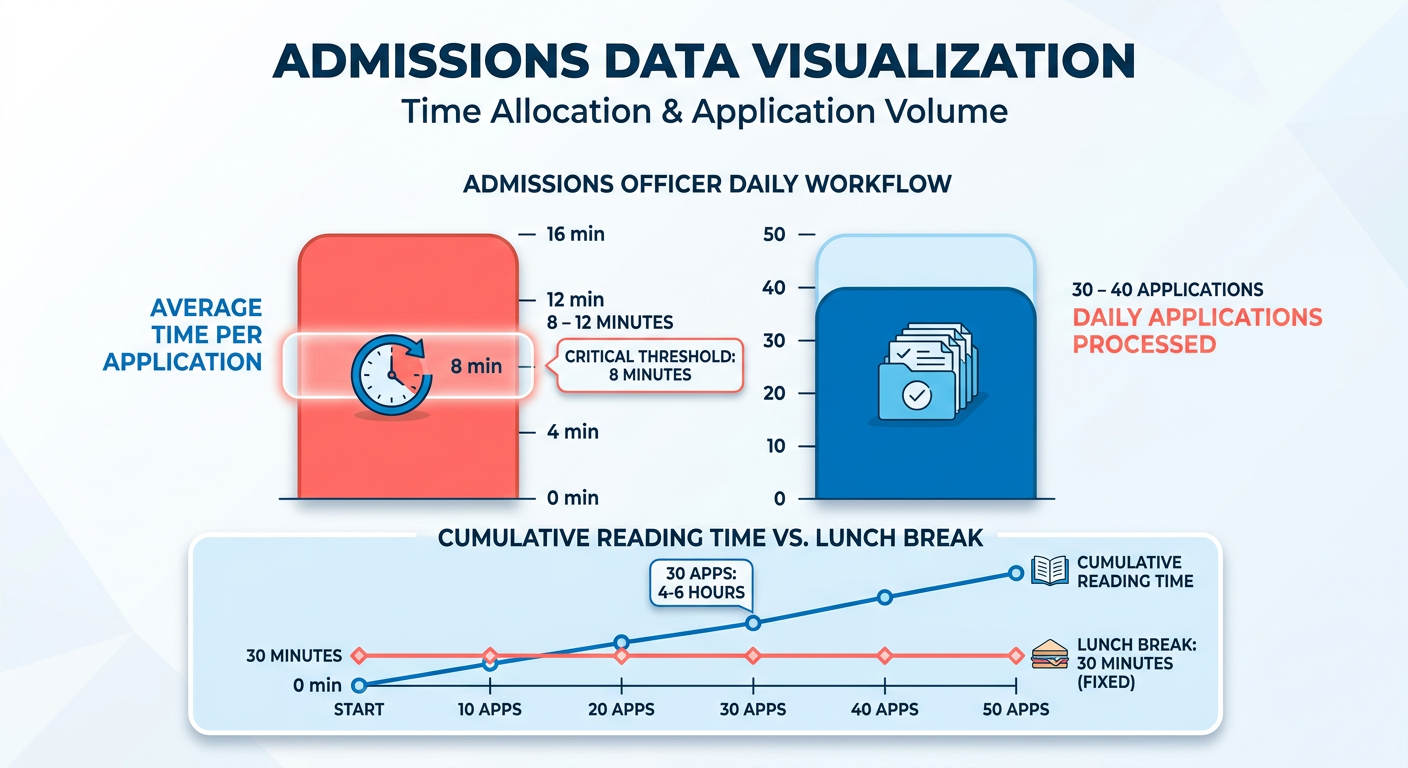
Why coherence decides the read
Alignment across your activities, essays, and letters leaves a reader with one memorable person. It gets decided before you draft, not while you write.
The reader's first impression of your extracurricular profile sets the expectation for your personal statement. If your activities point to a deep commitment to classical piano and your essay pivots to something unrelated, the jump creates friction. That friction appears fast in an already rushed read.
Our take: the reading sequence itself demands a pre-application lock. Forcing a connection late rarely works when the pieces were built in isolation. Set the story first, then build each component to confirm it.
Authenticity raises the stakes, it doesn't lower them
Two sources look like they disagree. Oriel says officers read essays for authenticity and self-awareness, not polished writing. Envision's essay guide frames the essay as a decisive differentiator at selective schools.
Both are right, and the tension is the point. The stakes are high because authenticity is what's judged. You can't wordsmith past a story that doesn't hang together. A locked narrative beats a beautiful sentence every time.
There's a second apparent conflict. Harvard's essay tips say don't restate achievements already visible elsewhere. Oriel says the essay should reflect your activities spike. The resolution: your essay confirms the theme without listing the activity. Alignment without repetition. That's what pre-locking makes possible.
What this actually asks of you
Difficulty: moderate. Time: expect several focused weeks before you draft anything.
| Element | What to lock first | Reader time spent |
|---|---|---|
| Activities list | Your central theme | ~2 minutes |
| Personal essay | Same theme, shown through story | 3-4 minutes |
| Supplements | Theme reinforced per school | 1-2 minutes |
| Recommenders | Briefed to echo the theme | 2-3 minutes |
Prerequisites: a real activities record, at least one recommender who knows your work, and an honest read on your through-line.
Skip the obsessive polishing pass if your narrative isn't locked yet. Fixing sentences before fixing coherence burns the time that matters. For more on sequencing the full timeline, our admissions and life planning blog goes deeper. Lock the story first. Everything else follows.
Core Concepts
Narrative lock means fixing the single story your application tells before you draft anything. It's a decision, not a document. Once locked, every essay topic, activity description, and recommender brief has to confirm that one thread. We do this first because the reader's process demands it.
The sequence is why. Admissions officers read files in a set progression, as Oriel's analysis lays out: academic index, then activities, personal essay, supplements, and recommendations.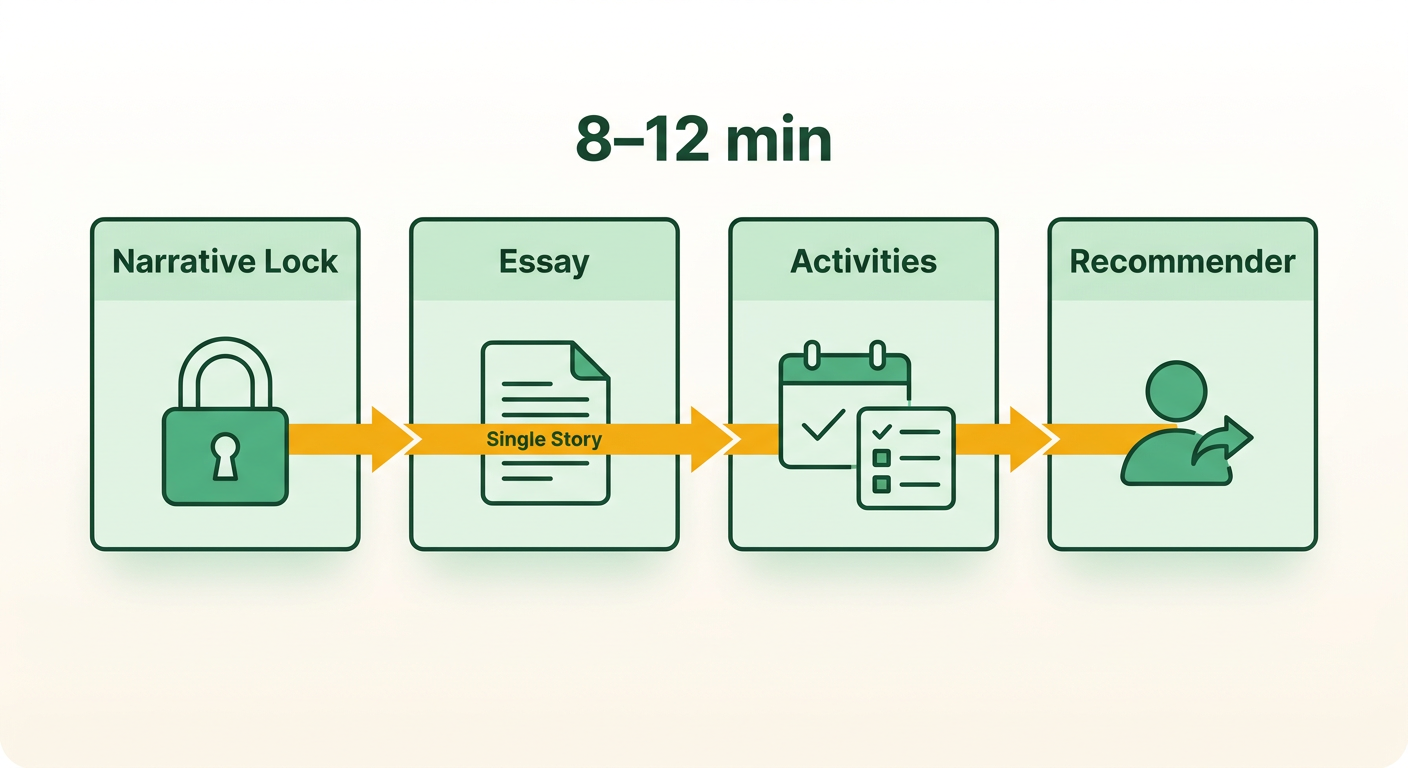
That order means the reader builds a mental model of you step by step. When your extracurricular profile establishes a clear focus and your personal statement introduces a completely different person, the pivot breaks that model. You never get to explain the disconnect. It just registers as noise.
The four parts that have to agree
A locked narrative has four moving parts. Think of them as one argument told from four angles, not four separate pitches.
- The academic index: your transcript and rigor, read in the first 90 seconds. A 3.8 at a demanding school reads differently than a 3.8 elsewhere, since regional readers know your high school.
- The activities list: your spike, the clear commitment that anchors the story. A student deep in community organizing should show a trajectory of local leadership, not a scattered pile of unrelated clubs.
- The personal essay: the 500 to 650 word statement that gives the theme its voice and shows self-awareness.
- The recommenders: teachers whose letters independently confirm the same thread from outside.
In our experience, these four don't align equally well after the fact. The transcript is fixed. The essay and recommenders are where misalignment usually shows up, because students draft them last and in isolation.
Why authenticity works against you if you fake it
Readers prioritize genuine self-reflection over polished prose. That's what makes the essay a real tool for advocacy, and also what makes it dangerous to fake.
Some resources stress that officers value honesty and self-awareness over stylistic perfection. Others point out the personal statement stays a primary differentiator at highly selective schools. Same reality from two angles: the essay is powerful because it reveals who you are. A polished but hollow essay can't beat a genuine, cohesive one.
Picture it in committee. Two applicants, nearly identical transcripts and scores, and the reader can only advocate for one. The deciding factor is rarely a stronger grade. It's the applicant whose file reads as one coherent person rather than a checklist. The narrative is what a reader repeats out loud when arguing your case to the room.
How the essay confirms without repeating
Official advice warns against rehashing accomplishments already clear on your resume, yet readers still want a personal statement that fits your overall profile. The way through is the motivation behind the work. Dig into the curiosity or the values driving what you do, and you add depth without duplicating your resume.
Lock the theme first. Then the essay, activities, and letters point the same direction before a single draft exists.
Step-by-Step Implementation
Locking your narrative is a five-step sequence you run before any drafting. Decide the single story first, then verify essays, activities, and recommenders all confirm it. Skip that order and you end up rewriting good essays that fight your activities.
This is the discipline our panel-based approach is built to enforce. Every student's essays get reviewed by at least two members of our team, so we can pressure-test whether a narrative is truly locked and every component points the same way before drafting begins. That extra layer of feedback forces the discipline most people skip.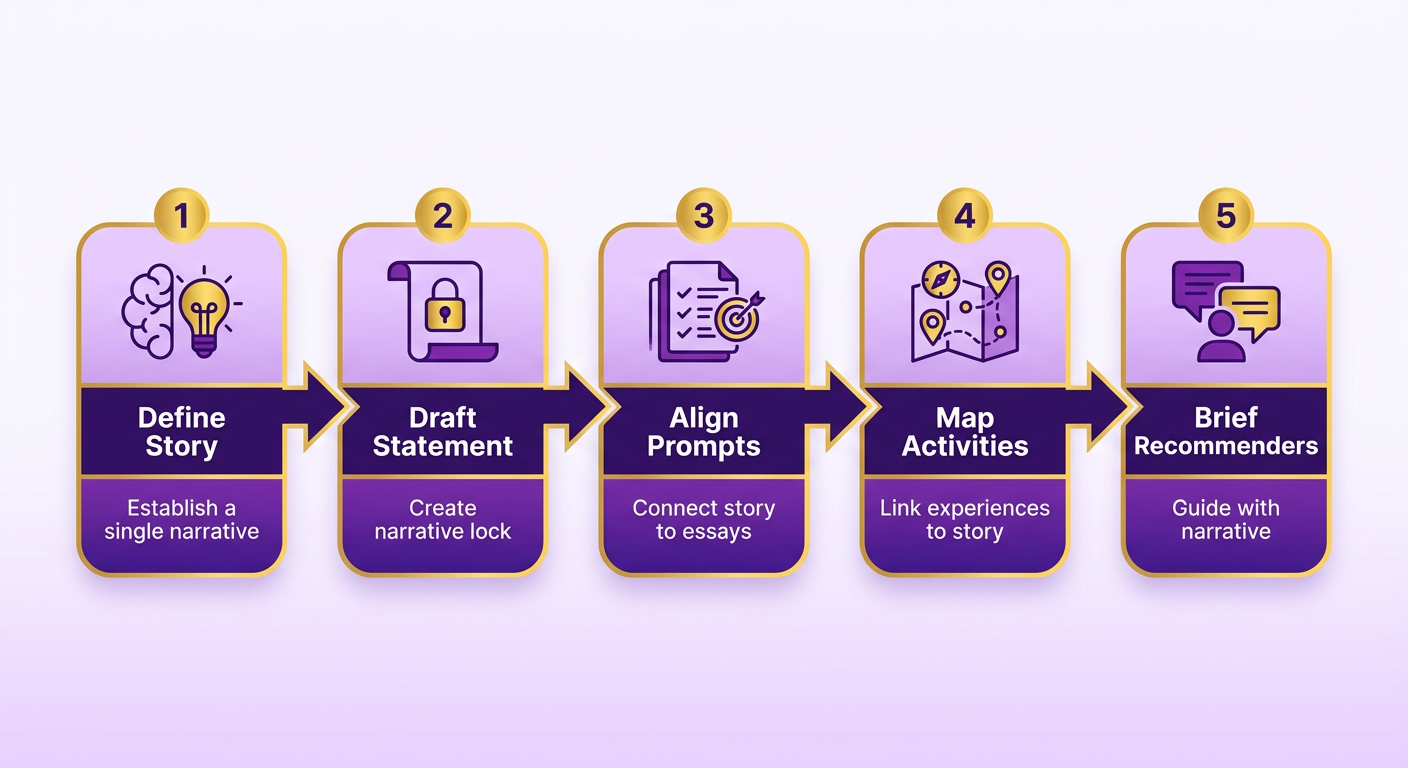
Set up the story before you write
Setup means picking one thread and stress-testing it against your file. List your activities, your intended essay topics, and who your recommenders are. Then ask the hard question: does a reader moving fast through the file see a consistent, recognizable person across every page?
This is where most files quietly fall apart. The common failure is spreading effort across five or six unrelated interests, so no single thread reads as authentic. Depth beats breadth. Readers remember the applicant who went deep on one commitment far more than the one who sampled everything.
So the thread has to do the differentiating. Pick the one value or interest your strongest activities already prove. Not the theme you wish were true. The one your file can defend.
Give each essay and activity a job
Configuration means assigning each component a job that confirms the locked thread. Your personal statement, the core of your writing portfolio as Envision's guide describes, carries the emotional center. Your activity essays and supplements handle proof and range.
Here's the mistake we catch most: summarizing an activity instead of reflecting on growth. An essay that lists responsibilities reads like a resume in prose. An essay about starting a club in an achievement-obsessed community, like the "Catalyzing Creativity Club" example, works because it reveals values, not because it names a title.
You don't need a hardship story either. A montage structure, like the "My Laptop Stickers" essay, connects ordinary experiences with unusual specificity. That flexibility only helps once your thread is locked. Otherwise, a montage just wanders.
Why it all comes down to your recommenders
Execution is where the sequence pays off, because recommenders are read last and cross-checked against everything before them. Your teachers confirm the story a reader already absorbed from your activities and essays.
That confirmation matters because officers use letters to verify the claims in your essays. When your self-reflection matches what your teachers independently observed, it validates the voice you presented, and in a pool where personal qualities carry heavy weight, that validation moves you.
Brief your teachers on your core themes before they write. Not to script them. To make sure the person they describe is the person your essays introduced. That's what turns an applicant into an admit.
Best Practices
The single biggest move you can make happens before you write anything: decide your one story, then make every section confirm it. At the most selective schools the deciding factor is rarely any single strong piece. It's whether a reader can absorb one consistent story in minutes.
We lock that story with clients before drafting begins. That pre-application discipline is what keeps a strong applicant from submitting three good pieces that quietly argue with each other. Below are the practices that make the lock hold.
Write for a reader moving in a fixed order
Align each section with the one before it, instead of chasing perfection in any single piece. Officers read your components in a specific order, as Oriel's guide details, so they naturally look for connections between your activities and your reflections.
A student whose profile centers on competitive debate should write an essay that lines up with the curiosity and advocacy those tournaments demonstrate, as the same breakdown notes.
Harvard's student perspectives say the personal statement should offer fresh insight rather than repeat facts from your resume. Lock your narrative early and your essay can explore the deeper motivation behind your achievements without duplicating the details.
The two pitfalls that waste your window
Chasing polish over authenticity, and summarizing activities instead of reflecting on them. Both burn the short window you get.
Essays carry real weight, as Envision Experience documents, but fixating on stylistic perfection is a mistake. Officers want a clear, authentic voice. Polishing prose on an incoherent narrative is a bad use of your prep time.
The second pitfall lives in activity essays. The most common mistake is summarizing what you did instead of what you learned. List-of-achievements writing tells the reader nothing your resume didn't already.
A few tips that compound
- Build micro-narratives that reveal character. You don't need a manufactured life crisis. A thematic structure built around everyday observations can show real intellectual depth and self-awareness.
- Pick topics that genuinely matter to you. Pretentious topics chosen only to impress committees tend to fall flat, as Harvard's student guide points out.
- Brief your recommenders on the locked theme. They can't confirm a story they were never told.
When to skip the heavy lock: if you're applying only to schools where academic index carries most of the weight, coherence matters less. For anyone targeting highly selective admissions, though, the lock is where the application becomes genuinely compelling. More on that discipline lives in our admissions strategy guides.
Troubleshooting
Most narrative problems trace back to the same root: the applicant started drafting before locking the story. When essays fight activities, or a letter confirms the wrong theme, that's not a writing problem. It's a sequencing problem. Fix the lock first and the symptoms clear.
Here are the failures we see most, and how to run them down.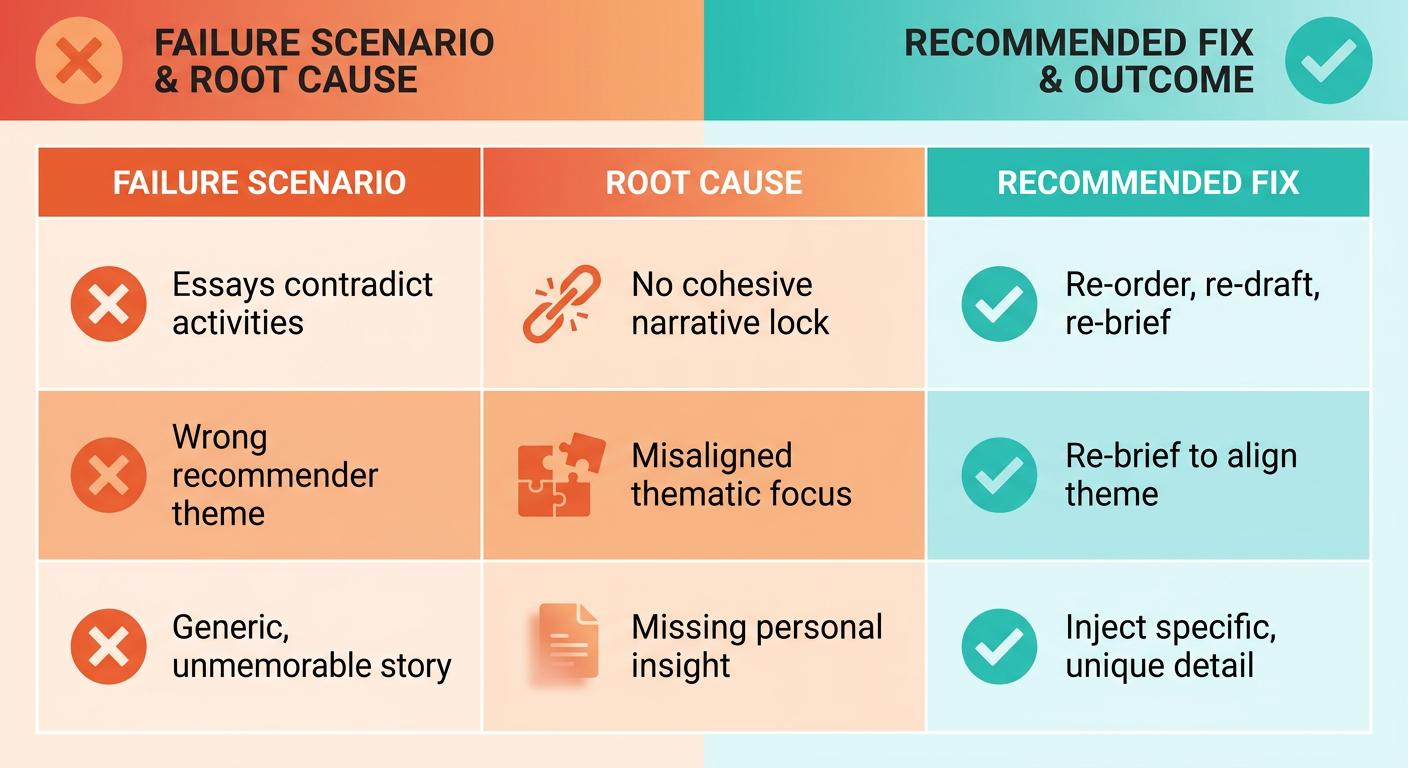
Why do my essay and activities contradict each other?
The cause: you locked nothing, so each section grew its own theme. This is the single most common break, and it shows up late, usually after three or four drafts already exist.
Diagnose it by reading only your activities list, then only your personal essay, and writing one sentence for each about what this applicant seems to care about. If the sentences don't match, your file is arguing with itself. A reader moving through in a fixed order will feel that friction inside their short window.
The fix isn't another rewrite. Go back to the single locked story and cut whatever doesn't confirm it. Trim the activity descriptions that point elsewhere. Reframe the essay only if the thread genuinely lives in your file. Don't invent a story your evidence can't support.
What if a recommender confirms the wrong theme?
The cause: your teacher wrote from their own read of you, not from the thread you locked. A strong letter pointing the wrong direction still weakens the file, because it breaks the confirmation the reader is checking for.
You can't edit a recommendation. You can brief it. Give each recommender a short, honest note on the one story your application tells and the specific moments that show it. Do this before they draft, not after.
This is where an outside, multi-perspective read earns its keep. External readers catch narrative drift early, so you can align every component before submission. Skip that step and you find out too late.
When to stop: if your file already tells one clean story in minutes, leave it alone. Over-editing a locked application reintroduces the very contradictions you just removed. See our planning resources for more.
What I'd Actually Tell You to Do
The whole point of locking your narrative is simple: fix one story before drafting, and the reader gets a file that confirms itself during that rapid first read. Every section points the same direction. That's what turns a strong file into an acceptance.
If you take one thing from this guide, make it the sequence. Decide your single story first. Then verify essays, activities, and recommenders all confirm it. Most applicants reverse that order and spend weeks rewriting good pieces that quietly argue with each other.
Your next move
Start with the lock, not the draft. Run your file through the five-step sequence before you write a word. Read your activities list alone, then your essay ideas alone, and write one sentence describing what each seems to be about. If those sentences don't match, you have a sequencing problem to fix now.
Brief your recommenders early. They confirm your theme from outside, and a teacher writing in September can't reinforce a story you finalize in November. Give them the one thread you locked, plus two concrete moments that prove it.
Skip this whole discipline in only one case: if your file is genuinely still forming. A sophomore building experiences doesn't need a locked narrative yet. That comes during the application phase, after the raw material exists.
Where to go from here
The pressure-test matters most right here. A single reviewer misses the contradictions their own draft created, so a second set of eyes catches the drift. Our collaborative review process is built for exactly that, keeping your narrative cohesive before you commit to final drafts.
For deeper reading on long-term planning and how narrative fits the wider application arc, our planning guides walk through the phases in more detail.
The work is front-loaded on purpose. Lock the story, align the pieces, then draft. Do it in that order and the reader does the rest.
References
[1] How Admissions Officers Read Your Application: 8-Minute Review - https://orieladmissions.com/how-admissions-officers-read-application-8-minute-review/
[2] College Bound: Activities and Recommendations on Your ... - https://admissions.nd.edu/visit-engage/stories-news/college-bound-activities-and-recommendations-on-the-your-application/
[3] My Very Unofficial Tips on Writing Your College Essay | Harvard - https://college.harvard.edu/student-life/student-stories/my-very-unofficial-tips-writing-your-college-essay
[4] How to Write a College Essay: The Ultimate Step-by-Step Guide - https://www.collegeessayguy.com/blog/how-to-write-a-college-essay
[5] How to Write a Personal Essay that Moves Admissions - https://www.stjohns.edu/news-media/johnnies-blog/personal-essay-tips-for-college-admissions
[6] How to Write a Compelling College Application Essay - https://www.envisionexperience.com/blog/how-to-write-a-compelling-college-application-essay
Frequently Asked Questions
1. When should I start locking my narrative if I'm still early in high school?
Early in high school, your focus should be on exploration and building a genuine track record. The narrative lock is a tool for the final application phase, once your activities and achievements are established. Use your underclassman years to pursue your interests deeply so that you have a rich foundation to draw from later.
2. What if I have genuine interests in two unrelated fields?
Commit to the area where you have demonstrated the most significant impact and sustained engagement. Admissions officers are more likely to remember a candidate with a clear, specialized focus than one with a broad but superficial list of activities. Select the theme that is most thoroughly supported by your actual track record.
3. Does a locked narrative mean writing about a dramatic hardship?
You do not need a dramatic life crisis to write a compelling essay. A thematic structure that connects everyday observations—such as analyzing the books on your shelf or the tools in your workspace—can be highly effective. This approach allows you to showcase your values through small, concrete details, provided those details align with your broader application theme.
4. How is briefing a recommender different from scripting one?
Briefing gives your teacher a short, honest note on the one story your application tells and specific moments that show it. Scripting dictates their words. The goal is ensuring the person they describe matches the person your essays introduced, since recommenders are read last and cross-checked against everything before them.
5. My essay reflects my activities theme but a reviewer says it's repetitive. What's wrong?
This issue occurs when you use your essay to list achievements rather than explain your perspective. The goal is to show how you think, not just what you have done. Your essay should complement your activities by exploring the intellectual or personal motivations behind them, ensuring the two sections support each other without repeating the same facts.
6. Can a strong recommendation letter actually hurt my application?
An inconsistent recommendation letter can create doubt in the reader's mind. For instance, if your application highlights your independent initiative as a researcher, but a teacher's letter describes you as someone who requires constant direction, the contradiction is immediately apparent. Providing your recommenders with a summary of your core themes helps prevent these discrepancies.
7. How does a review panel catch narrative problems a single editor misses?
When you work with only one reviewer, it is easy to develop blind spots to inconsistencies within the drafts. A multi-reader evaluation process introduces fresh perspectives that can identify subtle disconnects between your essays and your extracurricular profile. This pressure-testing ensures that your application reads as a unified, cohesive whole before submission.