How to Turn One Scene Into a Personal Statement That Reveals How You Think
September 15, 2026

Key Takeaways
- One vivid scene shows how a student thinks in real time. A list of accomplishments can't do that.
- Students with gaps, pivots, or non-traditional paths gain the most from a single scene that reveals curiosity or resilience, rather than an analytical defense of their choices.
- Concrete openers ("The summer I was twelve, I took apart the family washing machine") beat vague ones ("I have always loved science").
- The collegeessay.org guide warns that purely analytical essays leave the reader feeling they never really got to know the applicant.
- Sensory detail and reflection aren't two jobs. The scene should carry the analysis.
- Admissions officers spot authenticity fast. A genuine, specific moment persuades more than a polished résumé of wins.
- Depth separates a memorable applicant from a forgettable one. Breadth is the résumé's job.
Why one scene beats a highlight reel
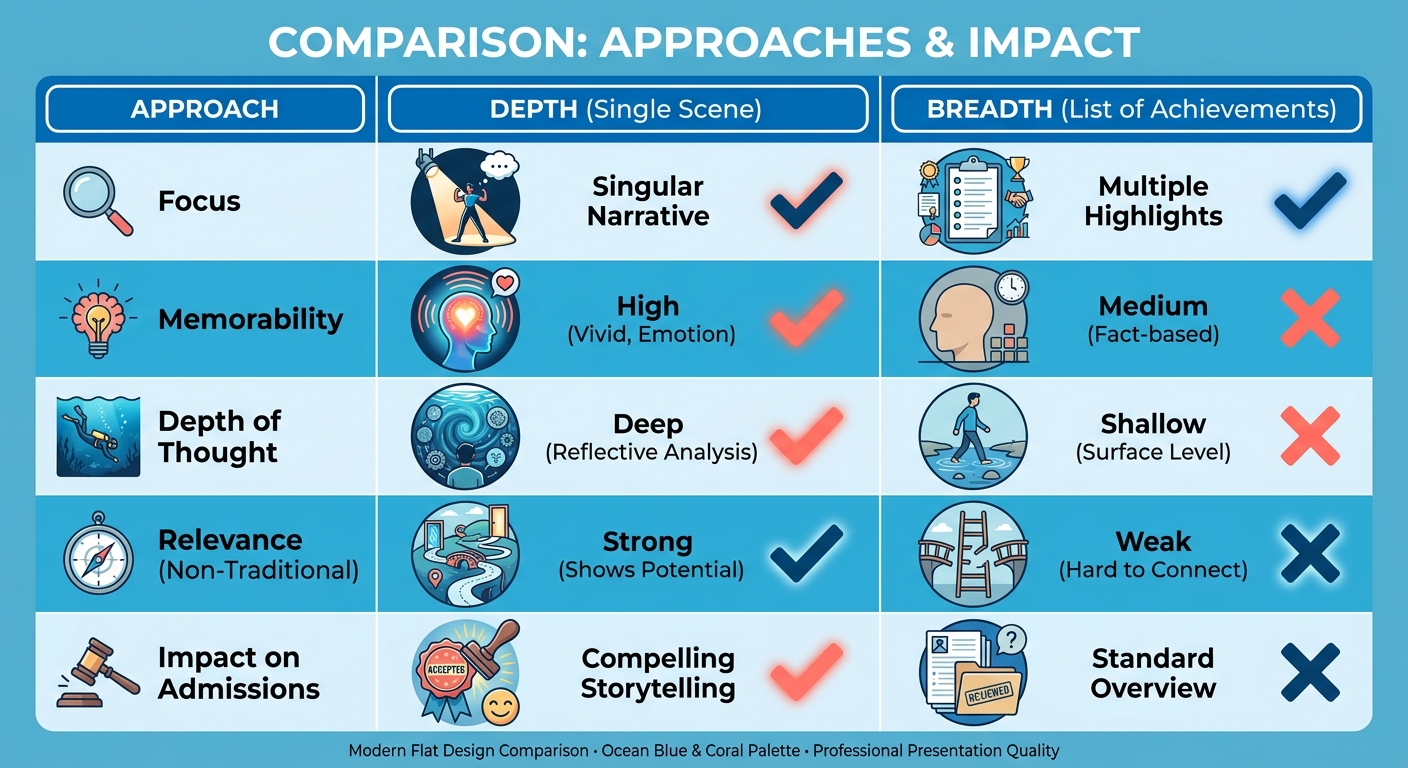
A single vivid scene shows admissions officers how you think in real time. That's the whole game. For a university personal statement, one lived moment does the work a résumé of achievements never can. It reveals depth, not breadth, and depth separates a memorable candidate from a forgettable one.
This matters most for students with non-traditional trajectories. If your record has a gap, a pivot, or an unconventional year, an analytical defense of those choices usually falls flat. A single scene surfaces the curiosity or resilience that actually drove your decisions.
Why does one scene reveal thinking better than a list?
A scene puts the reader inside a specific moment only you could have lived. The collegeessay.org guide sets a weak opener against a strong one. Weak: "I have always loved science." Strong: "The summer I was twelve, I took apart the family washing machine to find out why it made noise." One is a claim. The other shows a mind at work.
The trick is balancing narrative against analysis. That same guide warns that essays written purely from an analytical stance don't make the reader feel they know you. But a personal statement is supposed to reveal how you think. Sensory detail anchors your internal monologue so it never drifts into abstraction. Detail and insight aren't separate steps. They're one move.
What do admissions officers actually scan for?
Authenticity, and fast. Readers clock a generic opener inside the first sentence. The personal statement is the one place in the application where the reader hears your actual voice, walking into a moment that shows the values and motivations grades can't.
When someone is reading hundreds of these in a season, the essays built on an honest, unvarnished moment are the ones that stay distinct. Ethan Sawyer's read in the College Essay Guy guide lines up with this: the best essays leave the reader feeling closer to the writer.
Single scene or montage?
Admissions guidance splits into two camps here. The College Essay Guy guide describes a montage that thematically links several experiences. Harvard's essay resource argues the other way: show maturity through one or two formative experiences, because breadth is the résumé's job.
For non-traditional applicants, one scene gives you the most leverage. When the goal is establishing internal motivation, one fully explored event carries the whole narrative. A montage risks diluting your perspective right when depth is what you need. Save the montage for the rare case where no single experience captures your growth.
And mining one event thoroughly pays off past the 650-word Common App essay. The material you dig up in drafting feeds supplemental prompts and interview answers too. Our panel-review model tests a chosen scene against several reader perspectives. If you want more on sequencing all this, our admissions planning blog goes deeper.
Find the scene that shows how you actually think
The scene you pick has to show how your mind handles friction, not summarize what you've accomplished. Selection committees are looking for problem-solving under real conditions. Zeroing in on a specific instance lets applicants with unconventional paths show intellectual drive directly, without a narrated list of wins.
Picking the right moment means looking past the obvious milestones. A strong scene isolates a precise point of decision, curiosity, or failure. It hands the reader a lens into how you make choices, no self-congratulation required.
How do you surface a scene worth using?
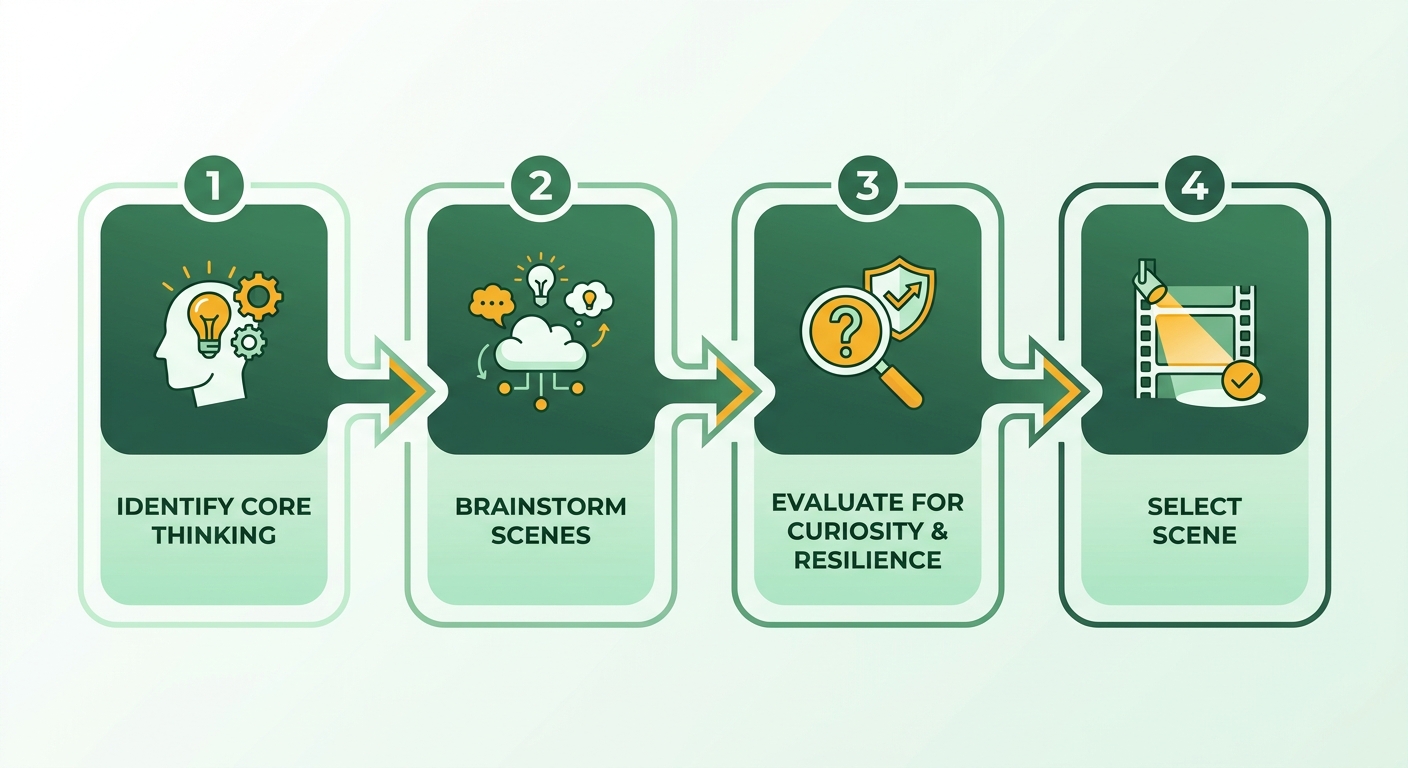
Start by naming three or four values you actually live by, not the ones that sound good on paper. Then ask questions that drag those values into concrete moments. When did you change your mind about something? When did you keep going after something broke?
Push past your first instinct. The anecdotes you tell over and over at family dinners rarely carry enough complexity. Generate a long list of candidate events. A common trap is settling on a high-level summary of a big project, so drafting several alternate setups keeps you from committing to a weak premise too early.
The Emory admission blog makes the point that memorable essays come from honest introspection, not from trying to sound admissions-worthy. Vulnerability and emotional honesty are where the real connection happens. If a moment feels constructed only to impress a committee, swap it for a more candid one.
What separates a strong scene from a weak one?
Judge each candidate against four tests. A scene earns its place when it has real stakes and reveals your agency, not just your circumstances.
- Conflict: Something is unresolved. You're deciding, struggling, or reconsidering in real time.
- Stakes: The outcome mattered to you. A reader can feel what you stood to lose.
- Personal agency: You act. You aren't only reacting to what happened around you.
- Only-you specificity: The moment is so particular no other applicant could have written it.
That last one is the sharpest filter. Compare "I am passionate about community service" with "rebuilding a broken ham radio to track local weather alerts during a storm." The first is a claim anyone could make. The second shows one person acting.
When should a values interview reshape your scene?
First drafts tend to fixate on external outcomes instead of internal processing. A values interview, where a mentor or advisor keeps asking why a particular event mattered, helps you find the true center of the story.
This step regularly reframes essays for candidates with non-traditional backgrounds. An applicant might set out to explain a gap year with an academic summary. Detailed questioning often reveals that a brief, unvarnished moment during that year illustrates their curiosity far better. For more on shaping non-linear application narratives, our admissions planning blog covers it.
Build the scene with sensory detail: the 21 Details technique
Sensory detail turns a remembered moment into something the reader can stand inside. Grounding the narrative in physical reality moves it from abstract statement to lived experience. Naming the objects, the sounds, the textures of a space anchors the account in a reality no one can mistake for generic.
Concrete detail also gives tangible evidence of engagement during non-traditional academic paths. Hours spent repairing discarded lab gear, or working through raw data from a self-directed study, show discipline without you having to announce it. Ethan Sawyer's guide frames the personal statement as the "heart" of the application, weighting character over static achievement. Precise sensory observation is how that character becomes visible.
What is the 21 Details technique?
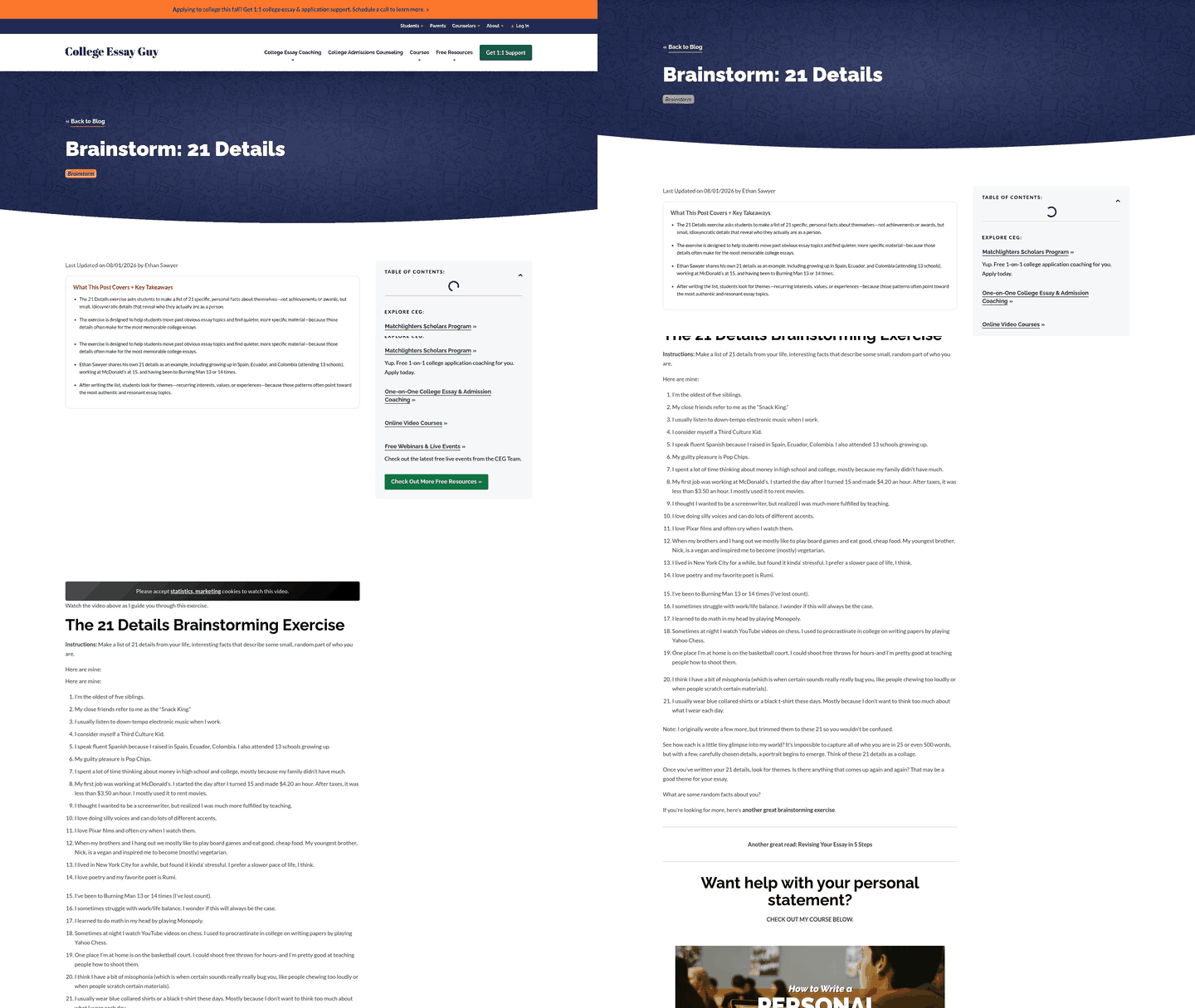
The 21 Details method is a brainstorm: list roughly twenty concrete, sensory specifics from a single scene before you write a word of prose. Objects, textures, sounds, smells, small actions. You generate more than you need, then keep the few that carry meaning.
The point isn't to cram all twenty-one into the final draft. It's to build a rich pool of authentic elements to pull from. Make sure the list spans more than one sense, not just what you saw. The smell of rosin-core solder, or the friction of a gear housing that won't budge, drops the reader straight into the moment.
How do you balance detail and reflection?
Anchor every reflective insight to a physical element in the scene. Concrete objects work as springboards for analysis. A worn hand tool or a corrupted data file isn't just scenery. It marks the exact point where a technical or conceptual problem forced a shift in your thinking.
Efficiency comes from making description and analysis do their work at the same time. When an object triggers a line of reasoning, you dodge the trap of spending half the essay on pure setting and the other half on disconnected philosophy. Every descriptive element has to earn its place by deepening what the reader understands about how you decide.
When should you cut a detail?
Cut any sensory marker that doesn't advance the narrative or reveal your thinking. With the 650-word Common App ceiling, every word has to pull weight. Decorative prose that exists only to set a mood is eating space you need for reflection.
Apply a strict utility test while editing: keep a detail only if it shows agency or introduces a key realization. If it does neither, cut it. That discipline keeps momentum up and word count down. For more on structuring focused narratives, our guides on the Endurable Education blog get into it.
Structure the narrative: single scene vs. montage, and the essay graph
For applicants navigating non-traditional trajectories, a single narrative structure has real advantages over a montage. Building around one central event gives you room to show critical thinking, where multi-scene structures tend to dilute a non-linear background.
Pick your structural model on purpose, after you've identified the essay's central insight. Structure should follow the core message, not the other way around.
What separates a single narrative from a montage?
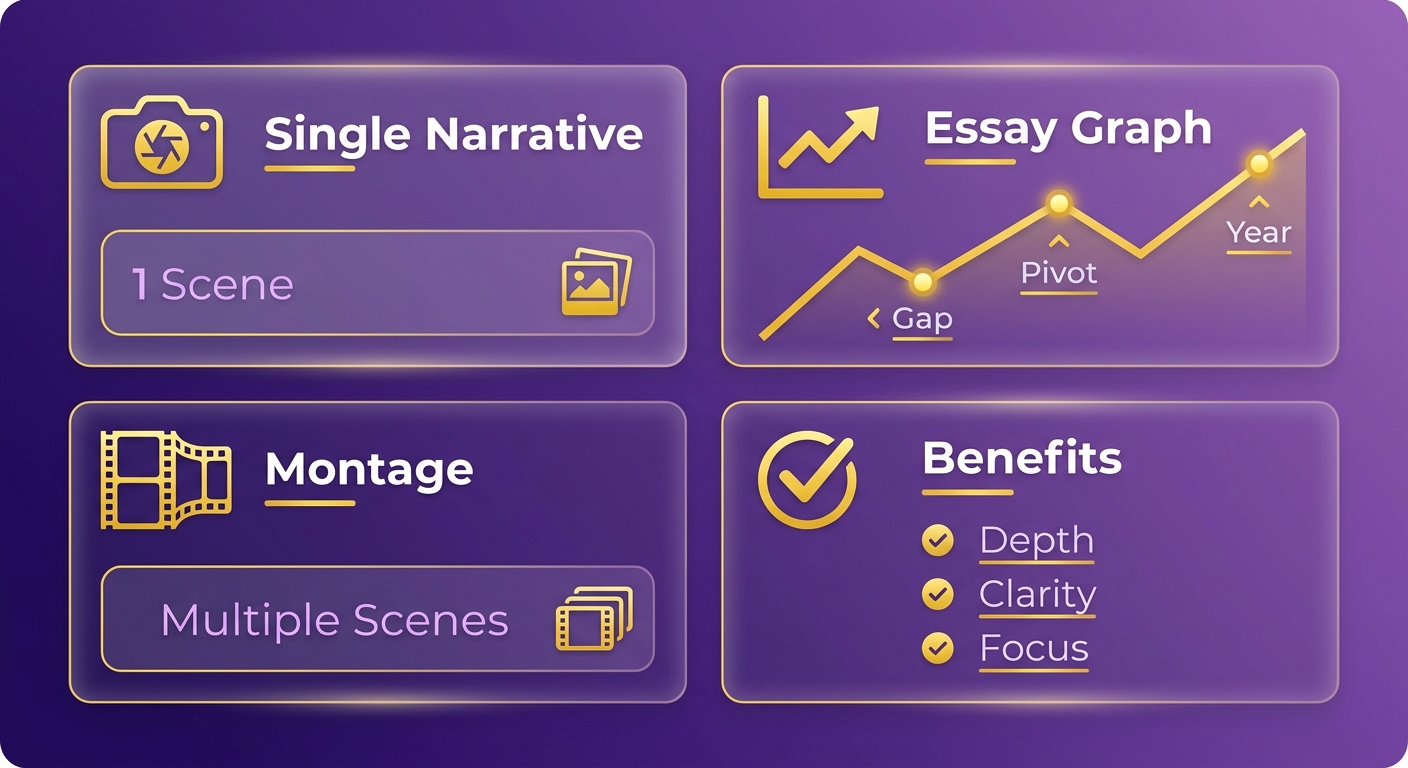
A single narrative traces one continuous line through one central event. It opens in the middle of the action, sets up the immediate challenge, and works through the shift in perspective that follows. A montage instead stitches together separate thematic snapshots across different timeframes to show a recurring trait.
If one scene holds enough depth to demonstrate your problem-solving, go with the unified structure. A montage can slide into a prose version of the résumé, which won't surface the analytical growth non-traditional backgrounds need to show. Use a montage only when no single event carries enough weight alone, but together they reveal a clear pattern of inquiry.
How do you map word count and pacing?
Spend your word count on purpose across four zones: hook, scene description, reflection, and future-goal connection. Rough targets: 10 to 15 percent for the opening hook, 30 to 40 percent for scene setting, 30 to 40 percent for reflection, and 10 to 15 percent for the forward-looking close.
+-------------------------------------------------------------------+
| HOOK (10-15%)                                                     |
| Immediate entry into the moment of action or decision             |
+-------------------------------------------------------------------+
| SCENE DESCRIPTION (30-40%)                                        |
| Concrete details, specific obstacles, and immediate choices        |
+-------------------------------------------------------------------+
| CRITICAL REFLECTION (30-40%)                                      |
| Analysis of thought process, cognitive shifts, and core insights  |
+-------------------------------------------------------------------+
| FUTURE-GOAL CONNECTION (10-15%)                                   |
| Forward-looking application of insights to target academic path   |
+-------------------------------------------------------------------+
Proportional mapping keeps the essay from tipping over. Applicants routinely burn too much space setting up context, then run out of room for analysis, and you get a story with no intellectual takeaway. Budgeting explicit space for reflection forces the text to answer what the experience actually shows about how you think.
How do you test whether the structure holds?
Run the draft against four checks before you finalize:
- Flow: Does each paragraph make the next one necessary?
- Emotional arc: Is there a real progression from initial confusion or conflict to resolution?
- Clarity: Can an outside reader sum up the central realization in one sentence?
- Single-scene test: If you remove a secondary anecdote, does the structure collapse? If the essay still stands, that anecdote was redundant. Cut it.
Take an applicant explaining a gap year spent teaching themselves software engineering. Writing up four separate project descriptions tends to fragment the narrative and block deep analysis. Consolidating onto one instance, like debugging a critical failure in a local open-source project, leaves room to show cognitive endurance. That lines up with Emory's admissions team, who stress highlighting what an experience means over reporting it in order.
Write a hook that shows your thinking, then land the future
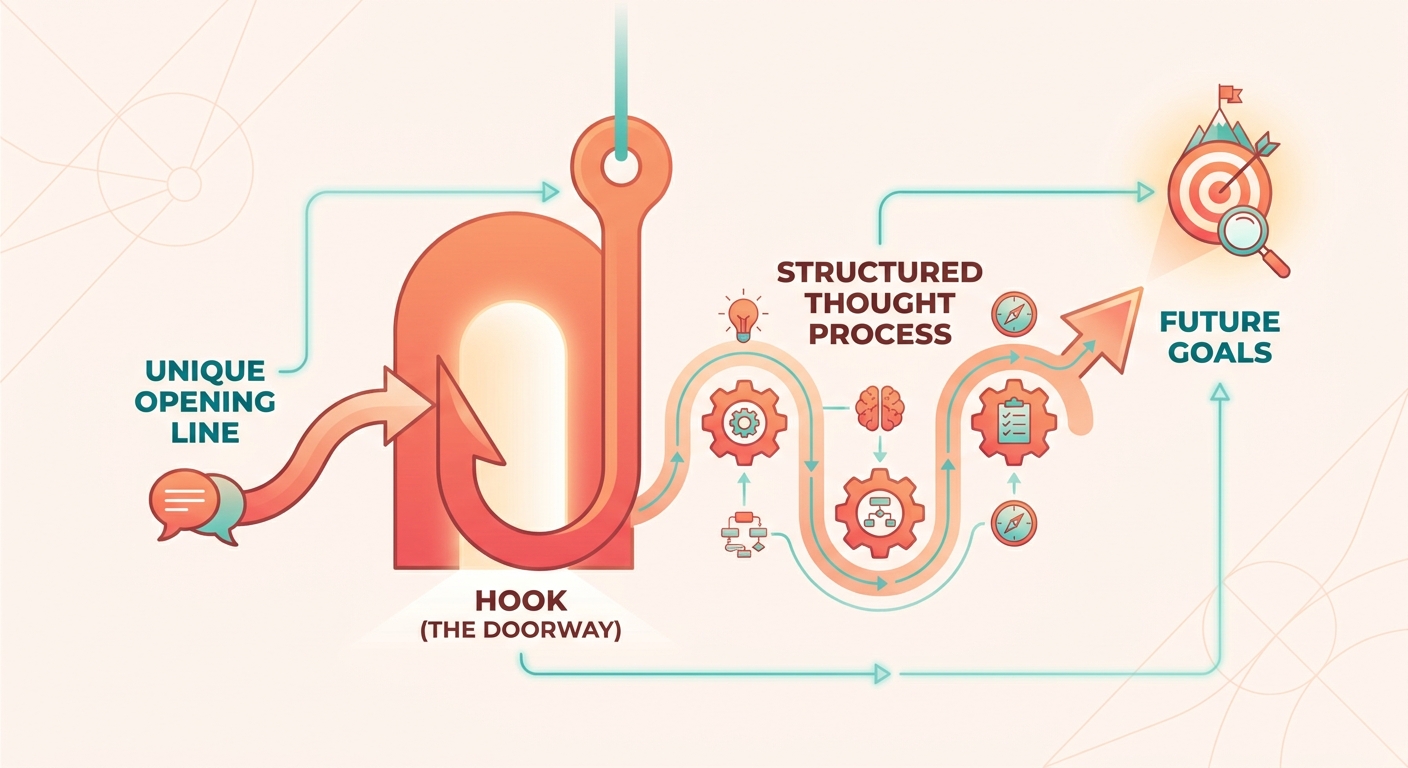
An opening line has to drop the reader into an active situation and set up your intellectual perspective at the same time. In a first sentence, the reader already senses whether the essay offers something fresh or falls back on a formula.
This entry point matters most when you're explaining an educational detour. A strong hook shows problem-solving in motion instead of stating qualifications in the abstract. Start with the action or the observation, not the preamble. An opening about a grandmother who ignored standard recipes and measured ingredients "until it looks right" instantly establishes an intuitive way of reading the world, before any formal analysis begins.
What makes an opening line reveal thinking?
A thinking-forward hook is a first sentence that shows a decision, a question, or a moment of noticing, so the reader watches your mind work instead of reading a summary of it.
Skip broad generalities and high-level academic manifestos. Ethan Sawyer's guide flags generic hooks and topic-first openings as some of the most common draft mistakes.
Keep the first sentences on real-time observation or execution. Save the retrospective evaluations for later, where takeaways actually have context to stand on.
How do you link the scene to a "why this school" paragraph?
Move from reflection to future goals by pulling the central insight out of your scene and tying it directly to what the school offers. Skip the formulaic transition ("I wish to enroll at X because"). The logic should follow naturally from the narrative.
A clean alignment runs in three phases:
- Insight: State the main realization about how you think, cleanly and briefly.
- Fit: Connect that specific way of thinking to particular programs, labs, or teaching approaches at the school.
- Trajectory: Show how that environment sets up your next stage, framing past non-linear experiences as deliberate preparation.
Stay inside the 650-word Common App limit. Keep the institutional references to a tight closing section so the core narrative stays front and center. For more on aligning personal narratives with long-term goals, our admissions and life planning blog covers it.
Polish for insight, uniqueness, and impact
Systematic revision is what takes a personal statement from a baseline narrative to something that carries an application. The goal in final editing is making sure every line shows how you evaluate ideas, cutting generic phrasing, and closing the loop between the ending and the opening scene.
For applicants with unconventional backgrounds, tight editing keeps the narrative sharp. Making sure the central scene clearly shows underlying curiosity stops the text from sliding into a passive summary.
What should your revision checklist actually test?
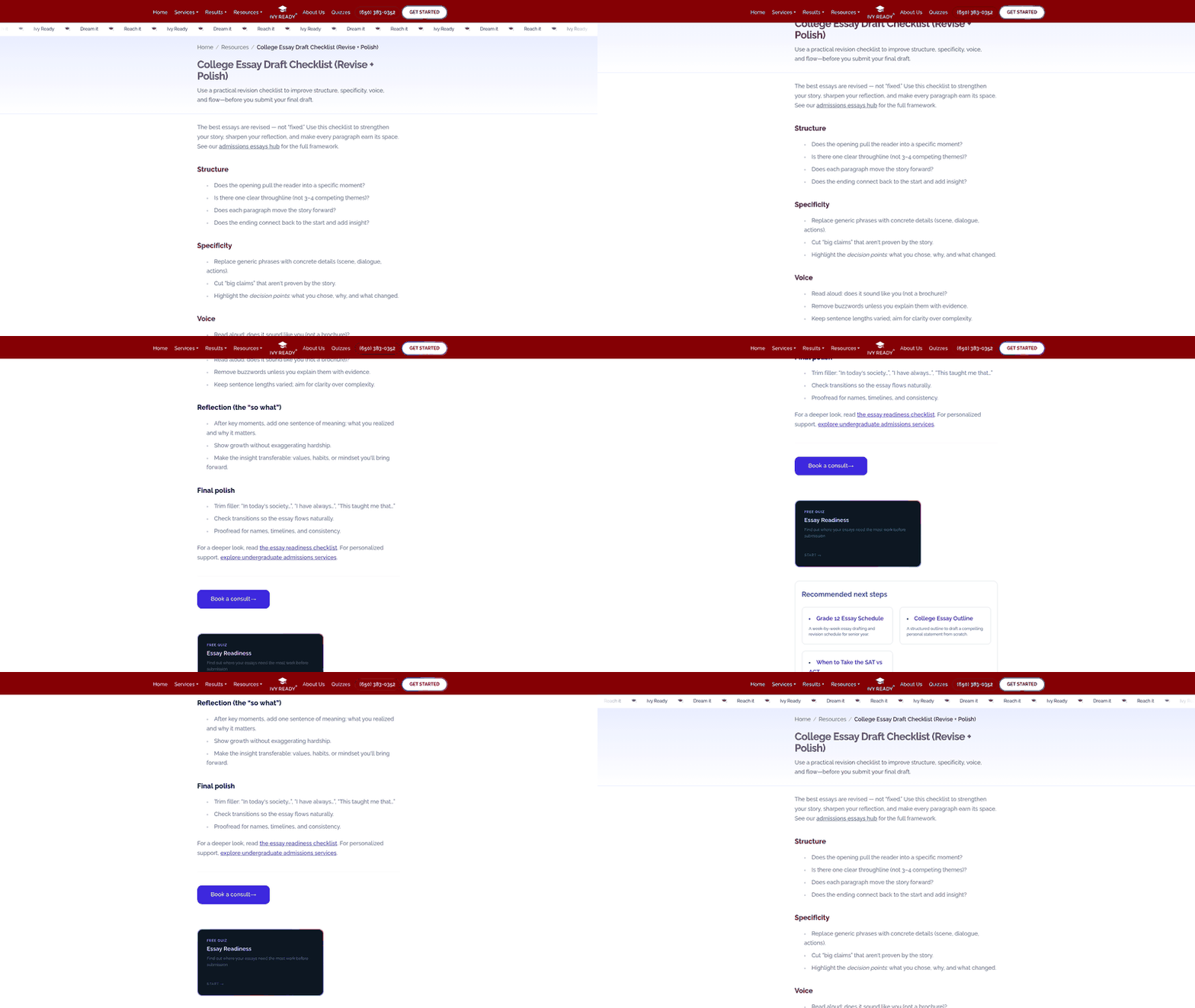
Read every paragraph for analytical depth, honest tone, and clear focus. Check that each section offers real insight into how you think, not just a recap of what happened.
Run these editing passes:
- Self over topic. Keep the focus on your internal processing, not the external subject. The setting stays secondary to your development.
- Insight over summary. Cut any phrasing that just restates accomplishments listed elsewhere in the application. The text should add depth, not repeat résumé data.
- Voice over formality. Keep it clear and conversational. Stiff, over-formal phrasing puts distance between you and the reader.
- Length discipline. Keep the word count inside the 250-to-650 range. Cut padding so the core insights hit harder.
Keep reflective passages tied to specific physical context. Conclusions floating free of the central scene lose their force and read as abstract assertions.
How do you test the essay for uniqueness?
Read it aloud and listen for whether the voice is actually yours. If big sections could belong to another applicant, add detail. Generic statements don't hold a reviewer's attention, so specificity has to run through the whole draft.
Hand the draft to readers who know how you work and ask whether the tone sounds like you. Authenticity comes from honest self-assessment, not from trying to project an ideal applicant. Outside readers catch artificial phrasing and performative sentiment fast.
How do you add a callback to your opening?
Bring back a key physical element or sensory detail from the opening scene in the final sentences, but framed through your changed perspective. That gives you closure without an explicit summary.
Skip the standard concluding formulas that restate your thesis. Revisit an object, setting, or phrase from the opening paragraph and use it to mark the shift in how you see things.
A well-executed callback proves the narrative actually went somewhere. Returning to the opening scene with deeper insight shows growth through the structure of the essay itself, not just by claiming it.
References
[1] How to Write a Personal Statement (Tips + Essay Examples) - https://www.collegeessayguy.com/blog/personal-statement
[2] Personal Statement: How to Write One That Gets Noticed - https://collegeessay.org/blog/personal-statement
[3] How to Write a Meaningful Personal Statement - Emory Admission Blog - https://blog.emoryadmission.com/2025/10/how-to-write-a-meaningful-personal-statement/
[4] Application Essays and Personal Statements - https://uraf.harvard.edu/resource/application-essays-and-personal-statements
Frequently Asked Questions
1. What if my scene feels too ordinary to write about?
Everyday moments often serve as the best foundations because precise execution outweighs dramatic events. A detailed focus on solving a minor technical challenge or managing an unexpected practical snag reveals more authentic thinking than a major life event described in generic terms. The primary criterion is specific, individual agency rather than external scale.
2. Can I use the same scene for supplemental essays and interviews?
The core insights developed while analyzing a primary scene can effectively inform secondary responses and interview answers. Once you have mapped the key details and cognitive shifts of an experience, aspects of that analysis can be adapted to answer shorter supplemental questions about problem-solving, intellectual curiosity, or personal resilience.
3. How many candidate scenes should I brainstorm before choosing?
Develop an extensive initial list of possibilities before selecting a final direction. Initial ideas often rely on familiar anecdotes that lack reflective depth. Generating multiple candidate scenarios allows you to bypass performative stories and select a moment that genuinely reflects your thought process.
4. What is the difference between a topic-focused and self-focused essay?
A topic-focused essay concentrates primarily on describing external events, technical subjects, or external organizations. A self-focused essay uses those external elements as background context to examine your decision-making, cognitive style, and personal growth. The focus must remain on the individual navigating the experience.
5. How much of my essay should be the "Why this school" section?
Reserve approximately 10 to 15 percent of the total word count for institutional alignment, typically in the concluding section. State your core analytical insight clearly, link that approach to specific academic features of the institution, and show how the program supports your future trajectory.
6. When does a montage actually make sense over a single scene?
A montage is effective when no individual event fully encapsulates your development, but three or four interconnected moments collectively demonstrate a clear pattern of inquiry. For candidates with non-traditional paths, single-scene structures generally provide greater narrative focus, avoiding the risk of reading like a superficial summary.
7. How do I know if my reflection section is too thin?
Test your draft by asking an external reader to state the primary intellectual takeaway in a single sentence after a single reading. If they cannot identify it immediately, expand the reflective analysis. Aim for 30 to 40 percent of the total word count to be dedicated to analyzing your thought process.