How to Turn Your Biggest Failure Into the Essay Admissions Readers Remember
September 1, 2026
Planning detailed grammar and style editsRefining sentence clarity and styleLightly polishing paragraphs for clarity****Planning article rewriting with facts retention

Key Takeaways
- A well-framed setback is one of the strongest cards an applicant can play.
- MIT admissions has said it wants students unafraid to fail.
- Failure essays humanize applicants whose files already look flawless.
- A negative narrative can overshadow every strength in an application.
- Admissions readers care more about your response than the challenge itself.
- High-achievers often get stuck among other straight-A applicants.
- The richest failure to write about is the one that changes you most.
Why Turning Your Biggest Failure Into a Memorable Admissions Essay Matters
Most applicants think failure is a liability. In our experience running college admissions consulting, it is often the opposite. A well-framed setback is one of the strongest cards a high-achieving student can play. The catch is that “well-framed” does most of the work.
Here is the tension we help students manage. Colleges value the ability to handle failure. MIT admissions has said it wants students who are not afraid to fail, because risk-taking builds resilience. But there is a real counterforce. A negative narrative can overshadow everything good in your story, which is why failure essays can backfire when they dwell on the wound instead of the growth.
Why Do Failure Essays Beat "All Good Grades"?
The short answer: a failure essay humanizes a student whose resume already reads as flawless. If your file is straight A's and full of activities, reviewers have no way to see how you think under pressure. A failure gives them that window.
This is the student we see benefit most. High-achievers often feel their application is impressive but forgettable. Their instinct is to lead with another win. That is exactly the crowd they blend into.
The essay is not a highlight reel. As the College Essay Guy guide frames it, admissions readers care far more about your response than the challenge itself. The setback is the setup. Your growth is the point.
What Counts As a "Big Enough" Failure?
The one with the richest transformation, not the most dramatic one. A compelling challenge does not have to be traumatic. It can be an internal conflict or a creative failure, as long as it produced real self-awareness.
Our take: choose your failure by growth potential, not severity. Run a quick root-cause test on each candidate setback. Which one, unpacked honestly, yields the deepest insight about who you are? That is your essay, even if it looks small on paper.
Both major cautions agree on one thing. Emotional manipulation fails. A “sob story” reads as a distinct mistake, and severity for its own sake triggers the same negativity bias that sinks weaker essays.
How Do You Beat the Negativity Bias?
Surface the strength early. Admissions officers spend only a few minutes per essay, and a negative opening can color everything that follows. Do not save the payoff for the final paragraph.
This is the mechanic that turns a liability into an asset. Combine the short reading time with negativity bias, and the conclusion writes itself: the arc has to signal transformation before a tired reviewer disengages. Our panel-review process exists for exactly this handoff point.
One student in this admissions account wrote about failing to meet her parents’ expectations, then realized her strengths as an introvert. That reframe earned her a full-tuition scholarship. The failure was the door. Her self-awareness was the room behind it.
Skip the failure essay if your only “setback” is manufactured, or if a dramatic hardship still feels raw and unresolved. A story you cannot yet see clearly will not read as growth. It reads as the wound, and that is the version that backfires.
Selecting the Most Impactful Failure
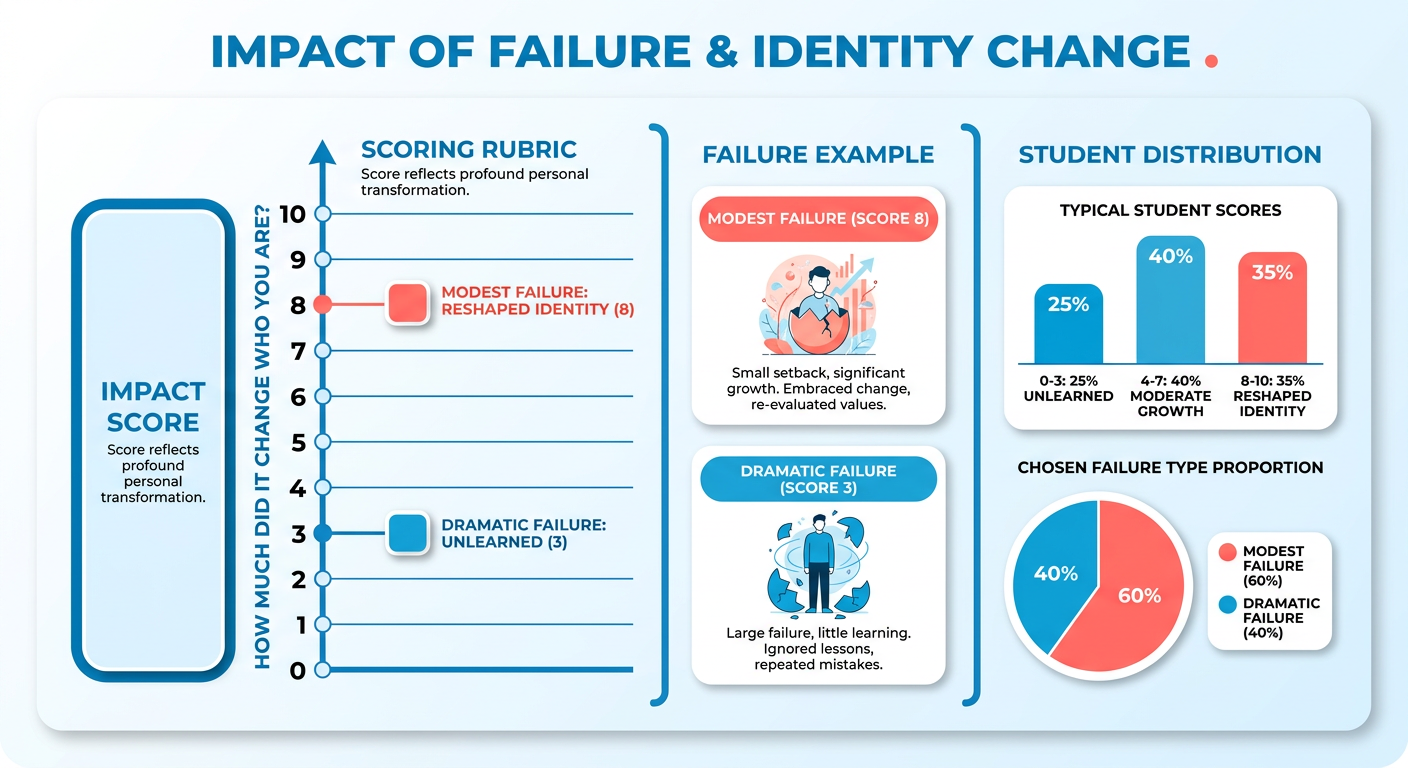
When evaluating potential essay topics, we focus on the scale of personal evolution rather than the scale of the event itself. In our consulting work, we score every candidate setback with one question: how much did it change who you are? A modest failure that reshaped your identity beats a spectacular one that taught you nothing.
This distinction matters because of the tight constraints of the application review process. As College Essay Advisors notes, you do not have room to explain a massive event and its meaning within 650 words. Pick the setback whose lesson you can surface quickly.
How Do You Brainstorm the Right Failures?
Start with a wide net, then narrow with a filter. We ask students to list setbacks across four zones: academic, extracurricular, personal, and family-related. Write down everything, even the small stuff.
Then run each one through the impact filter: did this failure change your identity, your goals, or a relationship that matters to you? If a candidate does not touch one of those three, cut it. A failure that left you exactly the same person makes for a flat essay.
In our one-on-one mentorship, we help students formalize this. You map each setback against the three impact zones, then rate the depth of self-awareness each one produced. The winner is usually not the one you expected.
Why Does a Small Failure Often Beat a Big One?
A smaller focus often allows for more nuanced reflection. College Essay Guy makes this point plainly: everyday struggles or artistic missteps can carry more weight than a headline-grade disaster. The depth of your self-analysis matters far more than the scale of the obstacle.
Two students, two setbacks. One writes about a dropped varsity soccer season after an injury. The other writes about a science fair project that fell apart the night before judging. The soccer story sounds bigger. But if the science fair collapse forced a genuine reckoning with why the student cut corners, that reflection wins.
We advise students to prioritize the depth of self-examination over the external drama of the event. Across the hundreds of case studies we have supported, the strongest essays hinge on a genuine turning point that reshaped the applicant’s trajectory. The internal shift is what matters; the event itself is merely the backdrop.
Which Failures Should You Skip?
Skip two categories entirely. First, the overly common setback. A failed test or one bad grade reads as generic, and generic essays get lost in a stack read at speed.
Second, skip the raw trauma story that arrives without growth. While institutions value applicants who demonstrate resilience under pressure, a narrative that dwells on pain without turning it into insight triggers a negative reaction. It reads as an unresolved grievance, causing readers to disengage.
The safe zone sits between those extremes: a failure real enough to sting, reflective enough to teach. That is the one your essay should carry. If you want a structured way to test your candidates, our college planning blog walks through the same filters we use in one-on-one review.
Dissecting the Failure: Root‑Cause Analysis
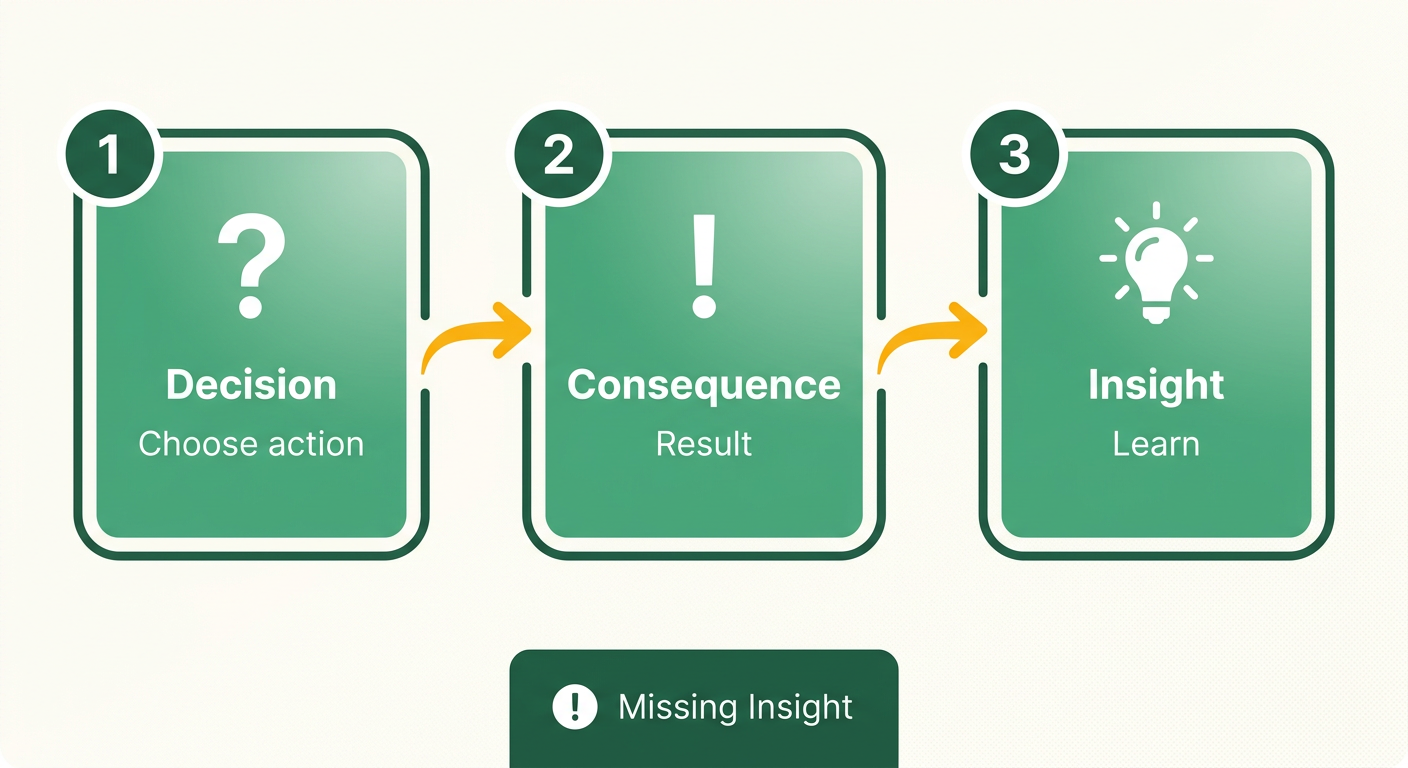
A failure essay lives or dies on causation. In our college admissions consulting work, the essays that score highest do not just describe what went wrong. They trace a clean chain from decision to consequence to insight. That chain convinces a reader you learned something instead of just surviving a bad week.
This analytical approach matters because of how admissions committees evaluate personal growth. They look for evidence of adaptability, but a setback essay only demonstrates that quality when the causal reasoning is visible. Without it, you are left with a story that just sounds like a bad outcome.
How Do You Run a 5‑Why on Your Own Failure?
The 5‑Why technique means asking “why did this happen?” five times in a row, with each answer feeding the next question. Adapted for personal reflection, it pushes you past the surface excuse and down to the choice or belief that actually caused the fallout. That deepest layer usually becomes your essay’s core insight.
Take a rejected research internship. Why did you get cut? Weak application. Why weak? You applied late. Why late? You doubted you were qualified. Why doubt? You had never pitched yourself to a stranger. Why not? You avoided anything where rejection was possible.
See what happened there. The story is no longer about an internship. It is about a pattern of playing it safe. That fifth answer is the material that shows growth, which is exactly what the revised Common App prompt rewards when it asks about obstacles and what you learned.
Separate What You Chose From What Happened To You
External factors are the circumstances you did not control. Internal choices are the decisions you made inside those circumstances. Admissions readers care almost entirely about the second category, because that is where character shows.
Split your failure into two columns. Late funding cut, a coach’s roster call, a family move: external. Choosing not to ask for help, procrastinating, refusing to adjust your approach: internal. Your essay should spend its weight on the internal column.
Then quantify the fallout honestly. Name the grade drop, the confidence hit, the team dynamic that soured. Specifics ground the story and stop it from drifting into vague self-pity, which is where these essays tend to backfire.
What Turns the Analysis Into an Essay?
The pivot is the moment of realization, the point where you saw the pattern and chose differently. In our experience mentoring students, essays that lay out a clear cause-and-effect chain consistently land harder than those that recount events without connecting them.
We build this through our collaborative, panel-based feedback during mentorship meetings. Drawing on advisors who graduated from schools like Harvard, Yale, and Princeton, we help students chart the setback, the root cause, the realization, and the forward-looking risk they are now willing to take.
Our take: connect that past risk to a future one. A student who once avoided pitching herself should end by naming the intellectual risk she will take in college. That framing turns failure from a closed chapter into evidence of who you are becoming. Our customized planning and regular check-ins are built to help you shape that arc.
Crafting a Compelling Narrative Arc
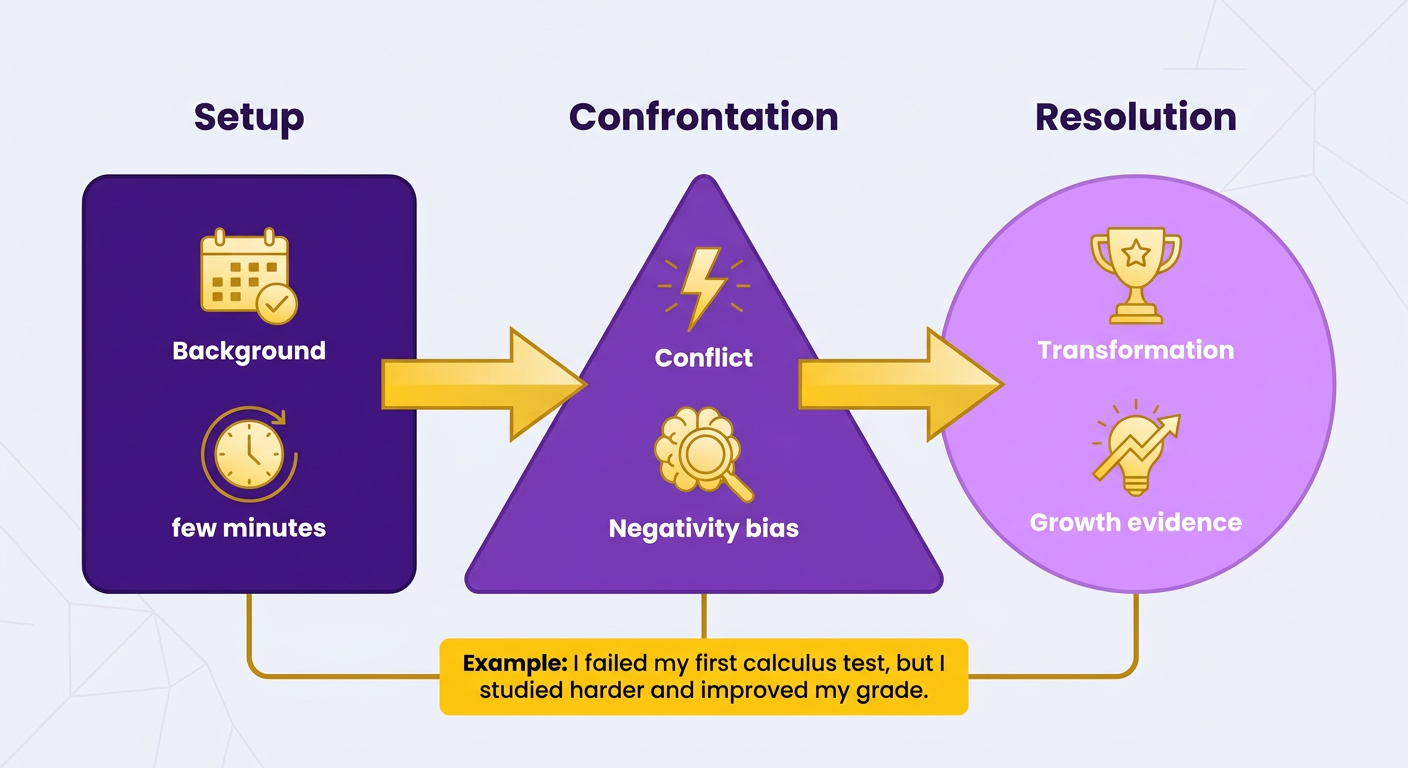
A failure essay needs a spine, and the strongest one is the classic three-act structure: setup, confrontation, resolution. In our college admissions consulting work, we treat this arc as the scaffolding that turns a setback into evidence of growth. Without it, you get a diary entry. With it, you get a story a reader remembers.
The stakes here are real. Reviewers work under tight time constraints, as noted in College Essay Advisors’ guidance, and a bleak opening can color their perception of the entire piece. So the arc has one job: surface transformation early, not in the last line.
How Do You Pace Each Act in 650 Words?
The short answer: roughly thirds. College Essay Guy recommends splitting the essay into challenges, actions, and lessons, with most of the word count on growth rather than the wound itself.
For a 650-word Common App essay, a sensible weighting gives the least space to the setup and the most to the pivot and resolution. That weighting is deliberate. The failure earns the least real estate; the response earns the most.
Our recommendation: because readers form impressions quickly, do not save your strength for the final paragraph. Plant a hint of who you became inside the setup, then pay it off at the end. This directly addresses the balance between showing intellectual risk-taking and avoiding a narrative that sounds overly self-pitying. Frame the arc as growth from the first line to keep the tone constructive.
What Makes a Hook Land in the First Sentence?
A strong hook uses a vivid image, a sensory detail, or a moment of tension that drops the reader mid-scene. Skip the “I have always believed” opener. Weak essays get skimmed, which leads readers to assume you lack commitment or capability.
Take a robotics team captain whose project fell apart at regionals. The setup opens on an empty lab at 11 p.m., parts scattered, a group chat gone silent. That is the vivid detail doing the work. No preamble.
The confrontation shows the applicant realizing their own role. Maybe they hoarded decisions and burned out their teammates. The mid-point pivot is the exact moment they choose differently: calling one member back, rebuilding on shared ownership. That decision is the heartbeat of the arc.
The resolution ties back to the opening image. The lab fills again. And it points forward to a future aspiration, echoing the advice to reflect on how the experience shaped your character.
How Do We Check Arc Coherence?
We put every draft through our collaborative panel approach, drawing on advisors who are graduates of top institutions to review the application from different perspectives. If a reader cannot name the setup, the pivot, and the payoff in one pass, the arc is broken and we rebuild it.
The panel also flags the two failure modes that sink these essays. First, the sympathy trap: essays that dwell on hardship without growth read as unresolved complaints, and the scale of the hardship is never the point. Second, a buried transformation that arrives too late.
Our stance is blunt here. If your resolution does not circle back to your hook, cut a paragraph of backstory and use the space to close the loop. A tight arc beats a dramatic one every time. Our team offers feedback on essays and applications through regular check-ins and collaborative support to help you get the wider application right.
Demonstrating Growth, Resilience, and Self‑Awareness
Growth is a claim, and admissions readers verify claims with evidence. The strongest failure essays do not announce that you grew. They show the specific things you did afterward. In our college admissions consulting work, this is where most drafts collapse: the student states the lesson but never proves it with action.
Colleges assess your response to failure through recommendation letters too, so your essay’s account has to match what teachers see. The subsequent action carries the narrative. College Essay Guy makes this explicit: readers prioritize your developmental trajectory over the details of the initial mistake.
How Do You Show Growth Instead of Telling It?
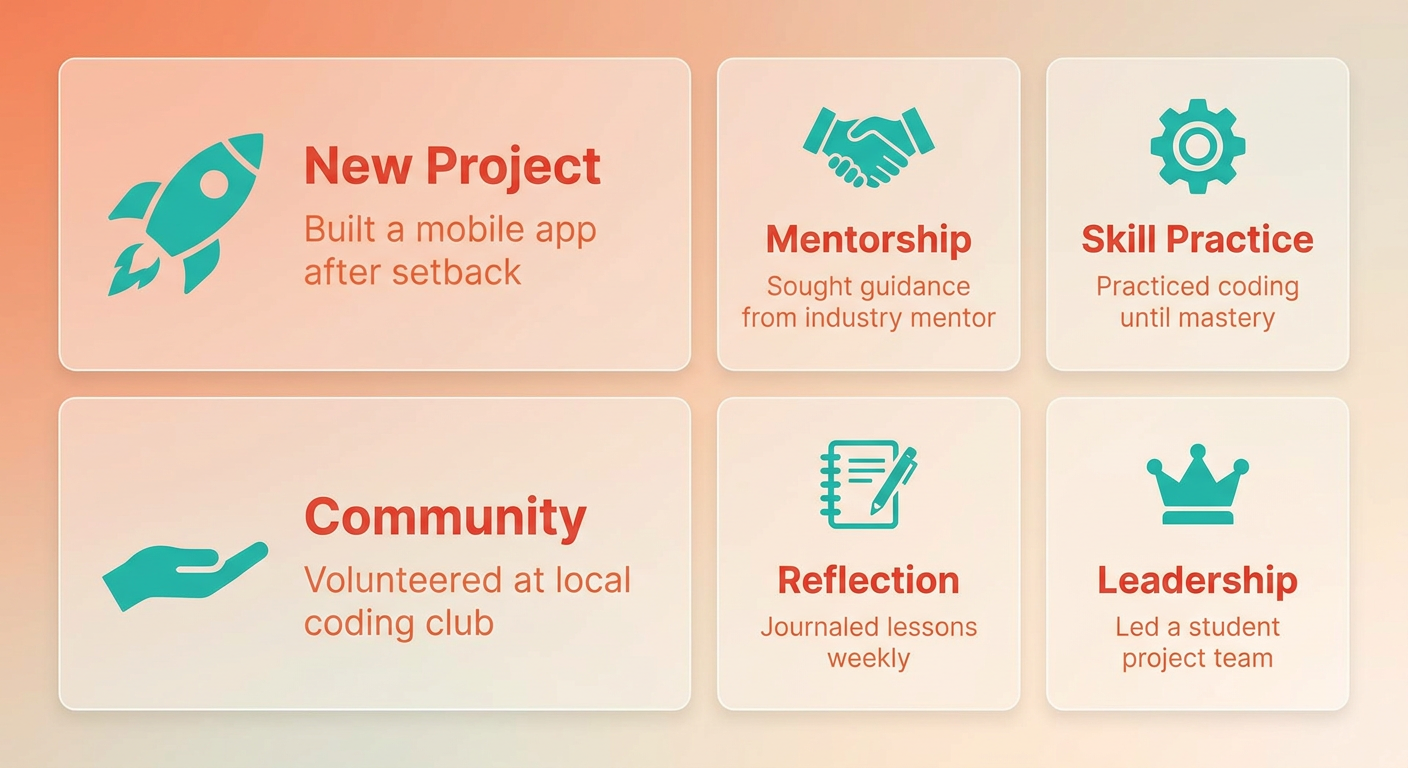
Show, don’t tell means replacing abstract lessons with concrete post-failure actions and results. Instead of writing “I became more resilient,” you name the peer-tutoring club you started, the number of students it served, and the grade you raised. Specifics are verifiable. Platitudes are not.
Here is a concrete pattern. A student bombed a regional math competition. The weak version says the loss “taught me perseverance.” The strong version: she founded a peer-tutoring club that grew to serve 120 students, then watched her own understanding deepen from teaching it.
That second version does two jobs at once. It proves the growth with a number, and it links the failure to a value: service. The College Essay Guy restaurant example works the same way. A student questioning their future finds direction in STEM and community leadership. The setback becomes a launchpad for a demonstrated commitment.
What Self-Reflection Language Actually Signals
Self-reflection language shows you understand your own change, but only when tied to evidence. Phrases like “I realized” and “I learned that” work when they sit next to a concrete action. They fail when they float alone as vague summary.
The revised Common App prompt rewards exactly this reflection over recounting. But reflection has a trap. Readers review applications at high speed, so a paragraph of pure introspection with no anchor reads as filler. Pair every “I realized” with a “so I did.”
Our take: the reflection and the evidence have to interlock. In this admissions case, a student’s breakthrough came when she stopped trying to force a loud leadership style and instead embraced her natural analytical strengths. The insight landed because it directly changed how she organized her next project, proving her self-awareness was functional, not just theoretical.
Link the Growth to a Broader Value
The last move is connecting your post-failure action to a value colleges recruit for: service, curiosity, or leadership. This is what turns a personal story into a signal about the community member you will be. A raised GPA proves discipline. A club that serves 120 students proves you build things for other people.
Through our customized mentorship and regular check-ins, we help students build meaningful experiences and skills that show up on resumes and activity lists, because progress you can point to is progress you can prove. When you can point to a leadership role, a measurable community impact, and a skill you built from scratch, the reader has three independent confirmations that the growth was real. That is the difference between a story readers believe and one they remember. For more on aligning your story with what reviewers value, see our college admissions and life planning blog.
Polishing the Essay: Language, Detail, and Avoiding Clichés
Polishing is where a good failure essay becomes a memorable one. In our college admissions consulting work, this final pass is about three things: sharpening the language, adding concrete sensory detail, and cutting the clichés that make readers stop taking you seriously. With limited reading time per file, every sentence has to earn its place.
The stakes are concrete. Weak, unpolished essays get skimmed, and skimming leads to assumptions about your commitment or capability, as Wordvice notes through consultant Randi Heathman. A single tired phrase signals a rushed writer. Our editing protocol exists to remove those signals before a reader ever reaches one.
How Do You Fix Flat, Passive Language?
Start with your verbs. Passive constructions bury the person doing the work, which is fatal in a failure essay where the whole point is showing what YOU did. “The team was let down by my decision” hides you. “I let my team down” names you.
Run a quick audit. Highlight every “was,” “were,” and “had been,” then rewrite each one so a subject performs an action. Swap weak verbs for precise ones: not “I did badly on the test” but “I bombed the exam by twelve points.”
Then add sensory detail. One sight, one sound, one physical sensation anchors a moment in the reader’s memory. The buzz of a scoreboard, the smell of a hospital hallway, the weight of a rejection email open on your screen. Detail is what separates a story a reader remembers from a superficial narrative they dismiss.
Which Clichés Should You Cut?
Cut every phrase that could appear in a thousand other essays. “I learned the value of hard work.” “It was a turning point.” “This experience made me who I am today.” These are placeholders, not insights.
Replace them with specifics. Instead of “I learned the value of hard work,” write what you actually did: “I spent four weekends recoding our debate team’s research database from scratch.” Data-driven language proves the lesson instead of announcing it. The growth should be visible in the actions, not stated in a summary line.
This also solves the problem of negativity bias. Concrete, forward-looking details keep the essay’s energy pointed at growth, ensuring the reader focuses on your development rather than the initial setback.
Connecting Your Lesson to the School and Final Review
Before you submit, connect your lesson to the school. Through our collaborative, panel-based review, we help students trace a clear line from the lesson learned to a major or field, then to a specific campus opportunity, and finally to its career impact. Name a real professor, a specific research lab, or a named club at the target school. Vague admiration reads as filler; a named resource reads as intent.
Then run two rounds of peer review. First, a teacher or mentor for substance. Second, a non-academic friend who will flag anything that sounds fake or forced. Fresh eyes catch clichés you have gone blind to.
Finish with a hard checklist: under the 650-word limit, directly answers the prompt, zero grammar errors, and an opening line strong enough to survive a skim. Get those right and your setback stops being a liability.
References
[1] Bad College Essay Examples: 5 Essay Mistakes To Avoid - Wordvice - https://wordvice.com/blog/5-college-admissions-essay-mistakes-to-avoid/
[2] Obstacle, Challenge, Setback, or Failure in Common App Essay - https://www.getyourselfintocollege.com/2013/05/why-colleges-want-you-to-write-about-failure-in-your-college-application-essay/
[3] How to Write an Overcoming Challenges Essay - https://www.collegeessayguy.com/blog/overcoming-challenges-essay
[4] Common App Essays: Writing About Setbacks and Failure - https://www.collegeessayadvisors.com/video-tutorial/guide-to-the-2021-22-common-app-essays-writing-about-setbacks-and-failure-prompt-2/
Frequently Asked Questions
1. Should I write about a failure if my school specifically asks about my "greatest achievement"?
Match your essay to the prompt asked. A failure essay fits obstacle, challenge, or setback prompts like Common App Prompt 2. For an achievement prompt, lead with the accomplishment, though you can reference a setback you overcame within it as supporting context.
2. Can I write about a failure that happened years ago, like in middle school?
An older failure works if the growth remained relevant and shaped who you are now. Age matters less than transformation depth. However, admissions readers often prefer recent examples that connect to your current trajectory, since they signal ongoing self-awareness rather than a distant, closed chapter.
3. What if two people share responsibility for the failure, like a group project?
Focus your essay on your specific internal choices, not the shared blame. Distinguish between the circumstances you could not influence and the decisions you actively made, then own your choices honestly. Readers care about your personal agency, so spending words assigning fault to teammates weakens the reflection they actually want to see.
4. How is a failure essay different from an essay about overcoming an obstacle outside my control?
A failure centers on your own decision or mistake, while an obstacle involves external circumstances you did not cause, like illness or a family move. Both reward growth, but failure essays uniquely show accountability, revealing how you think when the fault is genuinely yours.
5. My failure feels too small to fill 650 words. What do I do?
A small failure gains depth through root-cause analysis, not padding. Trace the surface event down to the underlying belief or behavioral pattern that caused it. That deeper insight, combined with your concrete post-failure actions, provides substance a dramatic-but-shallow event never could.
6. Will one failure essay make my whole application look negative?
One well-framed failure essay strengthens an application rather than weakening it, because it provides a realistic window into your character. The key is surfacing transformation early and weighting most words on growth. A negative tone only takes over when the narrative stays stuck on the setback itself rather than your constructive recovery.
7. How can I tell if my failure story still feels too raw to write about?
A story feels too raw if you cannot yet articulate what you learned or see the event clearly. Unresolved setbacks read as open wounds, triggering a skeptical reaction from readers. Choose a challenge you have processed enough to explain the pattern behind it and the changed action it produced.