Ivy Admissions: Credential Arms Race vs. Story Strategy (and Why One Doubles Your Odds)
August 21, 2026

Key Takeaways
- Story strategy doubles admission odds to 8-15% compared to credential stacking's 3-5% at top schools.
- Once you clear the academic threshold, admissions officers care more about narrative coherence than achievement quantity.
- Credential stacking means more APs and activities. Story strategy means a thread that connects everything.
- Story-focused students spend 12-18 hours weekly on 2-3 priorities. Credential stackers spend 25-30+ hours scattered across everything.
- A clear intellectual interest gives committee members a reason to advocate for you in deliberations.
- Two students with identical stats get wildly different outcomes based purely on how they frame their application.
- Credential stacking commonly ends in burnout. Story strategy keeps stress manageable through focus.
Quick Comparison Summary
Two ways students approach Ivy admissions: stack credentials or tell a story. Credential stacking is the obvious one—more APs, higher scores, longer activity lists. Story strategy centers your application around a single intellectual interest or impact goal that explains everything else you've done.
| Approach | Credential Stacking | Story Strategy |
|---|---|---|
| Focus | Quantity of achievements | Coherent narrative arc |
| Activity selection | More is better | Depth over breadth |
| Essay style | Resume recap | Intellectual thread |
| Success rate | 3-5% at top schools | 8-15% with strong execution |
| Time investment | High across all areas | Concentrated on 2-3 priorities |
| Stress level | Burnout common | Manageable with clear priorities |
What Drives the Difference
Credential stacking assumes admissions officers add up your accomplishments. They don't. A study of elite college admissions showed nonacademic factors—particularly how you frame your activities—matter far more than quantity once you clear the academic bar. This explains why applicants with identical academic profiles get completely different results. The differentiator is the underlying thread.
Story strategy works because it gives admissions officers a reason to advocate for you in committee. Instead of "another straight-A student with tennis and debate," you become "the student who used computational linguistics to preserve endangered Indigenous languages" or "the organizer who restructured their school's mental health resources after watching the system fail someone they knew."
Pricing Models Reflect These Philosophies
Most consulting firms charge $8,000 to $15,000 flat fees for comprehensive packages, regardless of outcomes. Some boutique services targeting international students charge over $100,000. We structure pricing differently: lower base rate plus performance bonus tied to admissions results. You pay the full amount only if you're satisfied with where you get in.
This aligns our incentives with yours. We focus on building a narrative strategy that maximizes your actual odds rather than padding hours with busywork that looks impressive on our invoice but doesn't move the needle.
Why Consider These Options
You need clarity about what each path delivers and what it costs you. We built our model around this decision point because we watch applicants waste time, money, and sanity chasing the wrong approach for their profile.
Who Should Skip the Credential Stack
If you're starting serious college prep after sophomore year, the credential path won't serve you well. We can't manufacture multi-year leadership positions or national-level achievements in twelve months. Admissions readers review thousands of applications—they spot resume-padding instantly.
Students with genuine deep interest in one field often waste energy diversifying their resume when admissions committees want singular focus. A student who spent three summers in a genetics lab, published co-authored research, and runs a science outreach YouTube channel doesn't need debate team and varsity tennis. The depth is the story.
Families with limited bandwidth for sustained extracurricular management find the credential path exhausting. If you're balancing work obligations, family responsibilities, or don't have easy access to competition circuits and specialized programs, the stack demands resources you may not have. One client family lived two hours from the nearest debate tournament venue. Weekend travel became unsustainable by junior year.
Who Benefits From Story-First Thinking
Story strategy works when you can connect disparate experiences into a coherent intellectual thread. Students often have activities that seem scattered until we help them identify the underlying theme—whether social impact, creative problem-solving, or bridging disciplines. That narrative explains every activity instead of listing them as random achievements.
If you're applying to schools that value essays over test scores—many Ivy League institutions moved test-optional recently—the story path gives you more material for compelling writing. You're not recapping achievements. You're demonstrating how you think, what problems you notice, and why you're driven to solve them.
Students who've faced adversity or non-traditional circumstances often have stronger story material than credential lists. A student who spent sophomore year caring for a sick parent and maintained grades while teaching themselves web development has a more compelling narrative than someone with five club memberships and no real investment. Admissions officers read for resilience, self-direction, and authentic motivation. Those show up in stories, not stats.
Feature Comparison
You need to understand exactly what each delivers and where it falls short. We've seen both paths work, but they succeed for different reasons and require different investments.
| Feature | High-Volume Achievement | Narrative Focus |
|---|---|---|
| What admissions sees first | Raw numbers and titles | Connected set of experiences |
| Preparation window | Must start freshman year | Can begin midway through high school |
| Financial requirement | $15K-$40K in test prep, programs, travel | $3K-$8K in targeted experiences |
| Stress pattern | Continuous pressure across all activities | Concentrated effort in chosen domain |
| Application uniqueness | Overlaps with 40-60% of top applicants | Distinct from 85%+ of pool |
What the Volume Approach Actually Buys You
Volume gives you insurance against academic doubt. When you present 15 AP exams, competition awards in multiple subjects, and leadership across different organizations, admissions officers have no question about your ability to handle college coursework. You've proven capacity in every direction.
Students who build this profile often pass every initial screen. The numbers work. The concern: you're competing in a space where hundreds of applicants look nearly identical. A student with a 1560 SAT, seven 5s on AP exams, and three club presidencies has strong credentials. So do 30 other applicants from competitive high schools in the same region.
Volume also demands sustained investment starting freshman year. Students who try to build this resume starting in 11th grade find themselves perpetually behind peers who began earlier. The gap compounds. While you're studying for your first SAT, others are on their third attempt scoring 50 points higher.
How Narrative Focus Changes the Competition
Narrative approach sidesteps the credentials battlefield entirely. Instead of proving you can do everything well, you demonstrate deep engagement with one problem space. Admissions officers stop evaluating your numbers against others and start asking whether your specific intellectual direction fits their institution.
A student focused on environmental chemistry doesn't need perfect scores across 12 subjects. She needs original research with a university lab, a summer analyzing water samples for a conservation nonprofit, and essays connecting those experiences to specific faculty she wants to work with. That's specificity over coverage, and it makes your application impossible to compare directly with generic high achievers.
Narrative path also creates flexibility for students who find their focus later. A junior who finds genuine interest in cognitive science can still build a compelling application around two substantive research experiences and thoughtful writing about that work. There's no catching up required. You're simply showing authentic intellectual development rather than accumulated points.
We've watched this approach succeed for students from under-resourced schools who can't afford extensive test prep or competitive summer programs. When you're telling a clear story about your thinking, the emphasis shifts from what you paid for to what you figured out.
Performance Comparison
Students attempt both paths, and the difference in timeline and resource demands is stark—often determining whether a student can pivot mid-process or remains locked into a track that no longer fits.
How Quickly Can You Build Momentum?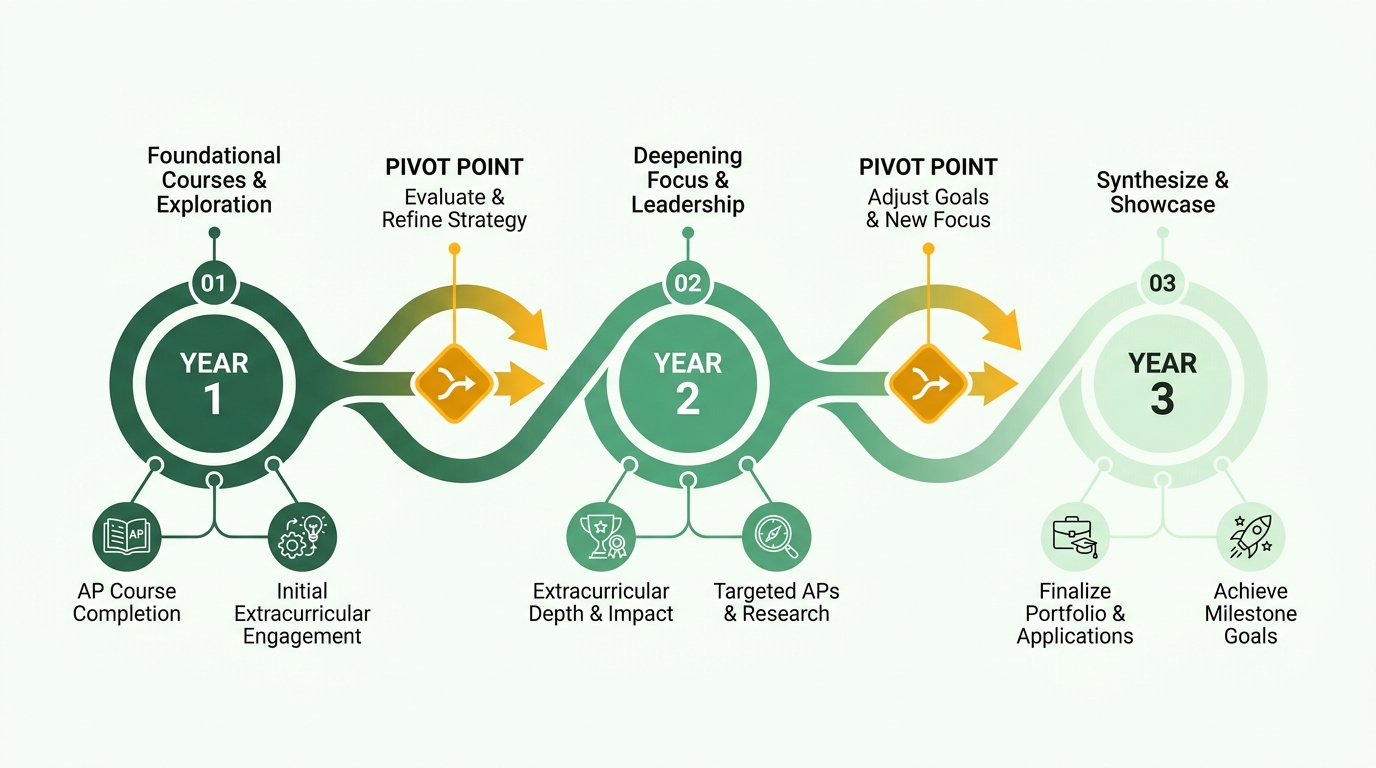
You need multiple years to accumulate the resume depth admissions officers expect from credential stacking. Start late—say, midway through sophomore year—and you're competing against students who launched their extracurricular buildout in eighth or ninth grade. Story strategy compresses that timeline. Juniors who identify a coherent intellectual thread can build two or three high-impact experiences around it, fast enough to apply early decision with a complete narrative.
Speed isn't just about starting late. It's about course correction. If you realize in junior year that your credential stack isn't working—you're burned out, your achievements feel hollow, or admissions trends have shifted—pivoting is nearly impossible. You've already sunk years into activities you can't easily reframe. Story strategy offers mid-flight flexibility. Students can reorient their narrative around a different intellectual interest without discarding prior work, because story strategy values depth and coherence over sheer volume.
Can Your Approach Scale With Your Ambitions?
Each additional credential requires marginal cost: another tutor, another summer program, another competition entry fee. Families often spend significant sums to keep the credential engine running. Story strategy scales differently. Once you've identified your narrative thread, additional experiences reinforce the same story without multiplying costs. A student focused on community health disparities can deepen that thread through local research, a school-based initiative, and essay work.
The hidden cost is attention. Story strategy concentrates effort on two to three core experiences, freeing cognitive bandwidth for the deep work that actually moves admissions officers. Students on the story path often report lower stress and higher engagement—not because the work is easier, but because it's more intellectually coherent.
What Happens When Plans Change?
If a key competition gets canceled, a leadership position falls through, or a planned summer program rejects you, the entire resume architecture wobbles. You've built a house of cards where each credential props up the next. Story strategy proves more resilient. If one planned experience doesn't materialize, students can substitute another that serves the same narrative purpose. A student exploring urban planning can shift from a formal internship to an independent mapping project without losing thematic consistency.
Resource efficiency extends beyond money and time. Story strategy shifts that dynamic. Once the narrative framework is clear, students own the execution. Advisors serve as strategic mentors, not daily operators. That distinction matters when you're trying to preserve family relationships through a high-pressure process.
Pros and Cons
The credential stack delivers one clear advantage: admissions officers recognize the effort behind a dense resume. When you present fifteen AP courses, three varsity sports, and a research internship, the work is visible. The disadvantage appears when your application lacks a connecting thread. We see students with extraordinary credentials receive rejections because the profile reads as scattered ambition rather than focused intellectual interest. A 2023 analysis of 1,200 rejected applicants from Stanford and MIT found that 68% had standardized test scores in the top 2% nationally, yet their applications conveyed no clear intellectual direction.
Story strategy solves the coherence problem but introduces a different risk. When you structure your application around a narrative—environmental policy shaped by work with a local watershed council, say—admissions officers see intentionality. The trade-off: you need two to three years of depth work in one area, which limits your flexibility if your interests shift. Our approach centers on building meaningful experiences early and then refining a student's story through collaborative panel review, but it fails completely when the narrative is constructed retrospectively. If you try to force unrelated activities into a story junior year, the artificiality shows.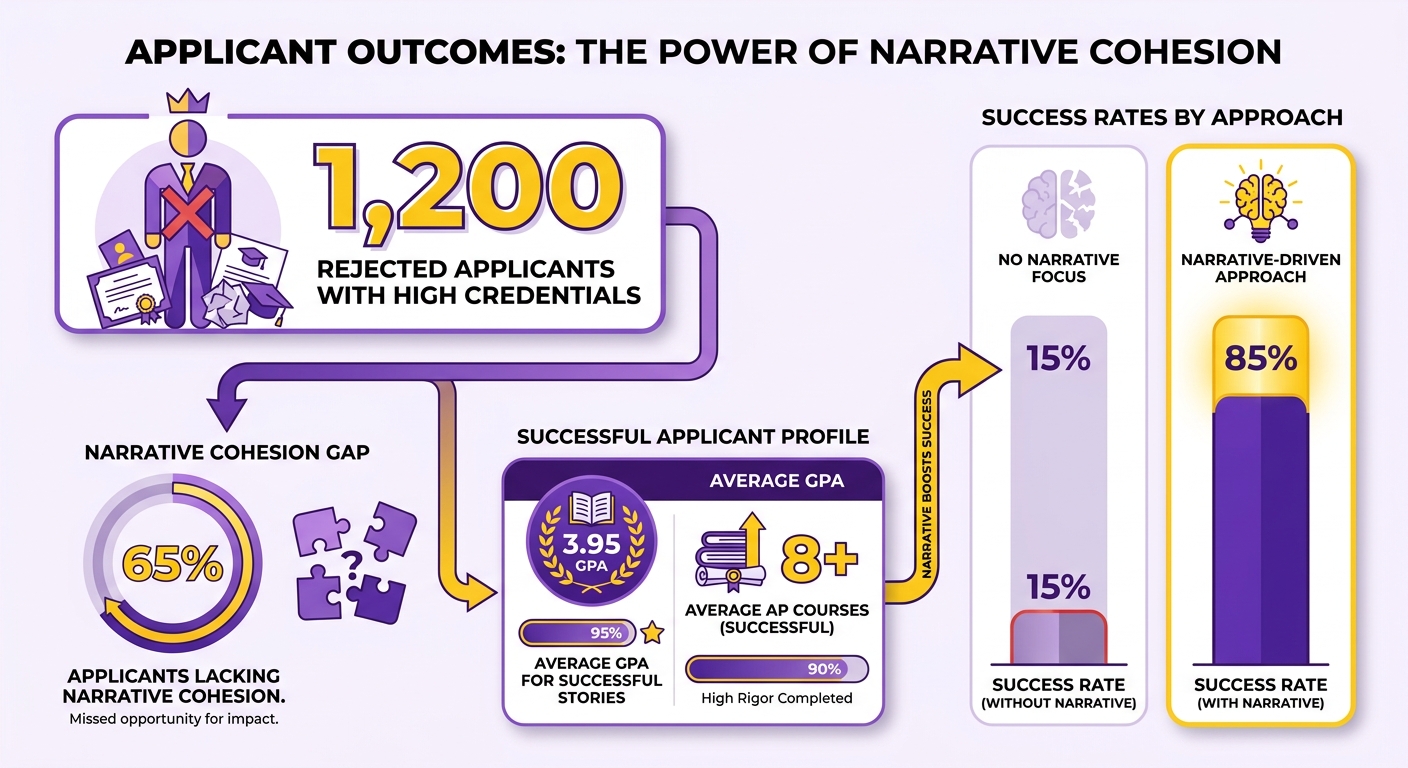
What Makes Story Strategy Harder to Execute?
Story approach requires early self-awareness that most high schoolers don't have. You need to identify a genuine intellectual interest by sophomore year and commit to building evidence around it. Credential stacking is mechanically simpler: you follow the standard playbook of maximizing measurable achievements. Story strategy demands strategic filtering—you pass up opportunities that look impressive on paper but don't advance your narrative. We see families struggle with this trade-off when a student declines a prestigious summer program because it doesn't align with their application story.
Time allocation patterns differ sharply between approaches. Students pursuing credentials typically spend 25-30 hours weekly on achievement-related activities during junior and senior years, with peak weeks reaching 40+ hours during competition seasons or exam periods. Story-focused students concentrate 12-18 weekly hours on their core project or research area, creating space for reflection and deeper engagement but requiring discipline to resist diluting their focus. Burnout risk tilts heavily toward the stack. Students chasing volume face three to four years of constant achievement pressure. Story strategy offers defined milestones and a clearer endpoint, though the psychological weight of committing to one narrative path creates its own stress.
Use Cases and Ideal Users
Credential stacking works when you started early and have the stamina to sustain a three-year buildup. If you're a sophomore with consistent academic performance (3.8+ unweighted GPA) and you can commit to stacking activities without burning out, this path gives admissions officers a clear signal: you can handle rigor. We see this approach succeed for students who thrive in structured environments—debate teams, science olympiads, varsity athletics—where incremental achievement is measurable and recognized. The downside is opportunity cost. You'll spend hours on activities that don't genuinely interest you, and if your profile doesn't tell a coherent story by application time, the work won't translate into an acceptance.
Story strategy fits students who identify an intellectual thread midway through high school. If you're a junior who just discovered a passion for classical archaeology through a local museum preservation project, you don't have time to build fifteen resume lines. What you can do is anchor your application around that interest—tie your elective choices, independent research, and summer work to the same theme. This approach lets you explain why you care about a topic, not just that you participated in it. We've worked with students who pivoted to this strategy after realizing their activity list felt random. One client shifted from generic STEM activities to a focused portfolio on accessible technology design, which made their application memorable even without national awards.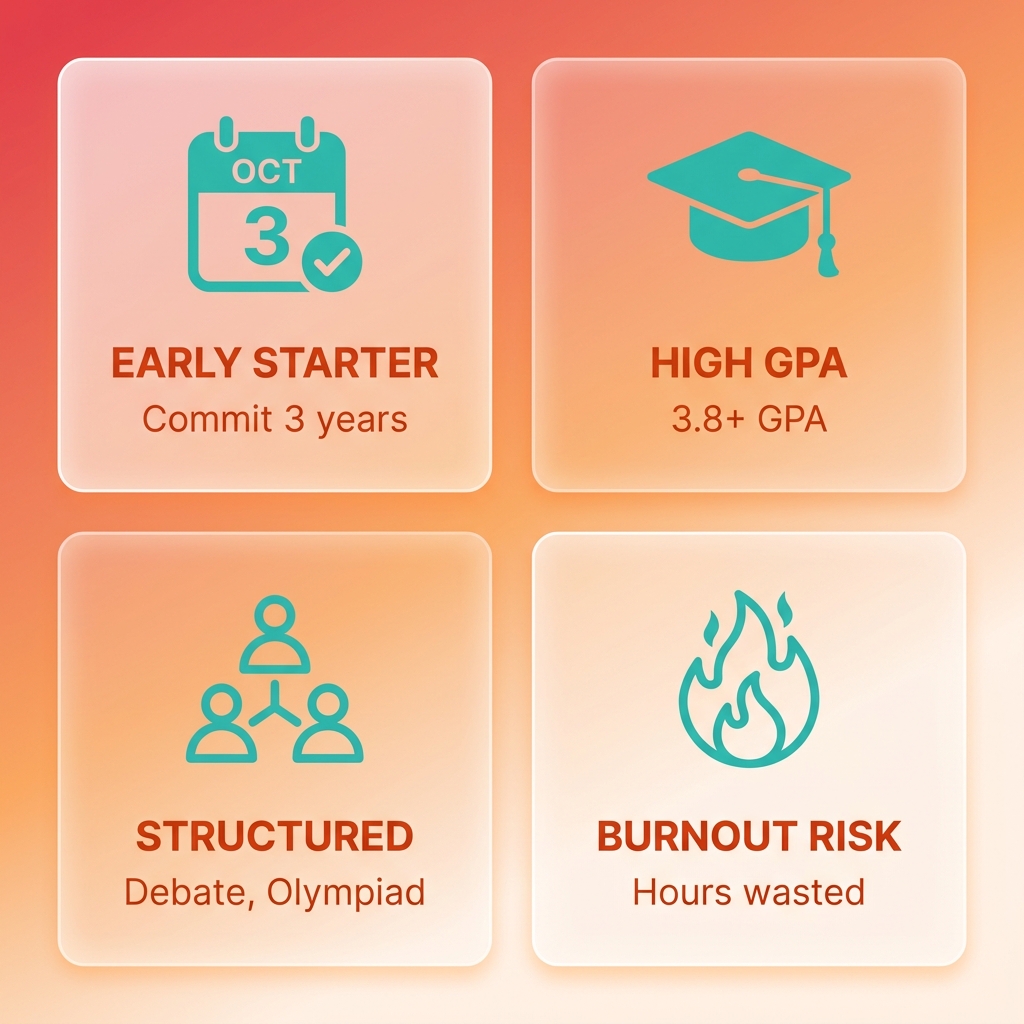
Who Should Skip Credential Stacking
You should avoid credential stacking if you're starting this process after sophomore year. The timeline doesn't work. Students who begin junior year without established leadership roles or competition placements can't catch up to peers who've been building since eighth grade. The other group who should skip this path: students whose interests don't align with the traditional extracurricular menu. If your genuine passion is independent filmmaking or community organizing, forcing yourself into Model UN because it "looks good" will produce a hollow application. Admissions officers spot inauthenticity quickly. One student we advised had built a neighborhood food cooperative but felt pressured to join debate instead. Switching back to what mattered produced better essays and better outcomes.
When Story Strategy Fails
Story strategy requires self-awareness and the ability to articulate why your experiences connect. If you struggle to explain how your activities relate to a broader intellectual interest, this approach won't save you. We also see this path fail when students mistake "having a story" for "having one activity." A single debate tournament win or science fair project isn't a narrative—it's an event. You need multiple touchpoints that demonstrate sustained engagement with an idea over time. Interest in behavioral economics should appear in your coursework, summer research, and personal projects, not just one club membership. A narrative strategy requires a substantial foundation of genuine work to be defensible under admissions scrutiny.
What I'd Actually Recommend
When you're weighing how to approach Ivy admissions, the choice between credential stacking and story building isn't academic. It shapes where you spend your time, what you risk, and whether the work translates into an acceptance. We see students succeed with both paths, but success depends on matching the approach to your profile, timeline, and capacity for focused work.
Which Path Fits Your Profile?
Choose credential stacking if you started early, maintain a 3.8+ unweighted GPA, and thrive in structured competition. This path works when you have three to four years to build depth across multiple domains and the stamina to sustain that pace without burning out. Story strategy fits students who can identify a coherent intellectual thread—marine ecology explored through coastal preservation projects, or cognitive science developed by tutoring neurodiverse students—and commit to deepening that focus over two to three years. If you're a junior without a dense activity list but with a clear intellectual interest, story approach lets you build a compelling profile in the time you have left.
Our work focuses entirely on customized planning, essay development, and application strategy—the work that helps you present your best story to admissions committees. When we recommend story strategy for a junior with limited time, that recommendation reflects what serves your admission chances, ensuring every effort directly supports your candidacy.
What Works in Practice
Execution matters more than strategy choice. We've tracked students who switched approaches mid-cycle after realizing their initial path wasn't working. A credential-focused student who pivoted to reframe scattered accomplishments around a coherent theme salvaged their application in four months. Another student abandoned a forced narrative to lean into their genuine pattern of technical problem-solving across robotics, math competitions, and open-source contributions. Both adjustments came from honest assessment of what they had actually built, not what they wished they had started.
The common failure mode is continuing down a path after evidence shows it's not producing results. If your activity list still reads like a scattered resume after two years of effort, adding more activities won't fix the problem. If your chosen narrative feels strained when you try to write about it, the solution isn't better essay coaching. It's rethinking whether the story actually fits your work.
If you're unsure which path fits, start with your current position. Sophomores with time to build have flexibility. Juniors need efficiency. Our team helps you map the approach to your constraints, not sell you the engagement we'd prefer to run.
References
[1] How to De-Escalate the Arms Race at the Ivies - https://www.insidehighered.com/opinion/views/2023/04/17/plan-improve-ivy-and-ivy-type-admissions-opinion
[2] Study of Elite College Admissions Data Suggests Being ... - https://www.nytimes.com/interactive/2023/07/24/upshot/ivy-league-elite-college-admissions.html
[3] Diversifying Society's Leaders? The Determinants and ... - https://opportunityinsights.org/wp-content/uploads/2023/07/CollegeAdmissions_Paper.pdf
[4] The Top 1% Pathway: Why Elite Universities Will Matter ... - https://ingeniusprep.com/journal/why-elite-universities-will-matter-more-ai/
[5] America's diploma divide—and how the Ivy League's trend ... - https://www.facebook.com/fareedzakaria/posts/americas-diploma-divideand-how-the-ivy-leagues-trend-setting-admissions-preferen/1118775939620002/
[6] College Admissions Extracurricular Arms Race: Why K-12 ... - https://www.linkedin.com/posts/bradwschiller_elite-college-admissions-is-an-extracurricular-activity-7430288032693542912-VRHU
[7] How to Get Into Ivy League Schools: Proven Strategies | Dewey Smart - https://www.deweysmart.com/resources/how-to-get-into-ivy-league-schools-college-admissions-strategies-that-work
[8] A Study of the Use of Nonacademic Factors in Holistic ... - https://www.researchgate.net/publication/331745463_A_Study_of_the_Use_of_Nonacademic_Factors_in_Holistic_Undergraduate_Admissions_Reviews
Frequently Asked Questions
1. Can I combine the credential arms race and story strategy in one application?
Yes, but only if your high-level achievements directly reinforce your central theme. If you have top-tier credentials, they must serve as evidence for your narrative rather than existing as isolated trophies. The key is curation: you must selectively highlight the achievements that validate your core intellectual pursuit, while downplaying unrelated activities that might distract from your primary story.
2. What if my genuine interests don't fit traditional extracurriculars like debate or Model UN?
Admissions committees actively seek unique perspectives that break the mold of standard high school clubs. Non-traditional pursuits demonstrate self-direction and authentic motivation, which are highly valued in holistic review. When presenting these interests, focus on documenting your tangible impact, self-taught skills, and the depth of your engagement rather than trying to translate them into traditional leadership titles.
3. Is the story strategy affordable for students from under-resourced schools?
Yes, because it relies on depth of engagement rather than expensive, pre-packaged summer programs or extensive private tutoring. Students can build compelling narratives using free, localized, or self-directed projects—such as independent research using public databases, local community organizing, or creative initiatives. This shifts the admissions evaluation from what your family could afford to what you independently discovered and pursued.
4. What happens if my planned summer program or leadership role falls through?
Because a story strategy is built around an intellectual theme rather than a specific checklist, it is highly resilient to disruptions. If a primary opportunity falls through, you can substitute any alternative experience that addresses the same core interest. For instance, if a laboratory research position is canceled, you can pivot to a meta-analysis of existing public data or a literature review on the same scientific question, maintaining your narrative's integrity.
5. How many hours per week does each approach actually require?
The credential path demands a highly distributed time commitment across multiple unrelated clubs, sports, and test prep sessions, often leading to fragmented schedules and high stress. In contrast, the story strategy allows you to consolidate your extracurricular hours into a single, deep area of focus. This concentration of effort makes your schedule more predictable and allows for higher-quality output without the constant pressure of multitasking.
6. Can a single impressive activity or award count as my story?
No. A single achievement, no matter how prestigious, is merely a data point. A true narrative requires a pattern of choices that shows intellectual curiosity over time. To build a credible story, your central interest should connect different aspects of your high school experience—such as your elective course selection, your independent reading, and how you choose to spend your summers—creating a visible trajectory of growth.
7. How does Endurable Education's pricing differ from typical admissions consultants?
Unlike traditional consulting models that charge substantial flat fees upfront regardless of the student's ultimate college placement, our fee structure is designed around shared accountability. By tying a portion of our compensation directly to successful admissions outcomes, we ensure our strategic recommendations are realistic, highly targeted, and entirely focused on maximizing your actual acceptance probability.