Specialized Excellence vs Well-Rounded Resume: Which Profile Ivies Actually Prefer
October 21, 2026

Key Takeaways
- Harvard's admissions officers could fill an incoming class five times over with students qualified on paper to handle the work.
- Top colleges build well-rounded classes out of students with sharply defined strengths, not out of individual students who tried a bit of everything.
- Admissions officers keep repeating one observation: meaningful impact in more than one or two areas is genuinely hard, and quality of involvement outweighs the length of the activity list.
- Nick Strohl, former Director of Admissions at Yale, warns that spreading thin across too many extracurriculars works against a student, because deep impact rarely happens past one or two areas.
- The profiles that hold up combine demanding coursework, a visible spike in one or two areas, and supporting activities that reinforce a single theme.
- Zak Harris, a former admissions officer, notes that students with excellent academics and nothing else are often waitlisted or denied at highly competitive schools.
Quick Summary
By junior year, the activity list turns into a negotiation. Something has to give: two clubs, a sport, the Saturday volunteer shift that never became more than a shift. The real question underneath is whether cutting is the right move at all.
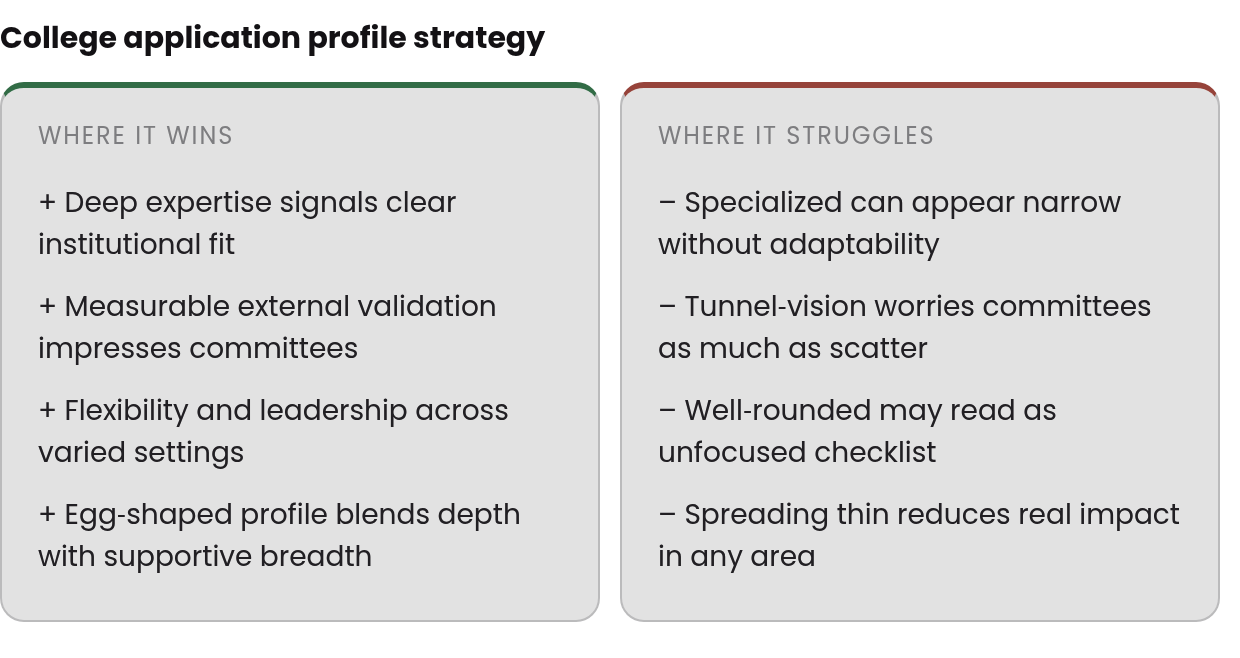
The admissions commentary has been consistent on this for years. Top colleges no longer build a class out of well-rounded generalists. They assemble a cohort of specialists who will staff the Russian literature archive, run the neuroscience lab, and fill the concert hall. Ten activities with no through-line tell a reader that you'll sample campus and then move on.
Specialization has a failure mode of its own. A file that reads as tunnel vision worries a committee as much as a scattered one. The profiles that hold up blend clear depth in one or two areas with purposeful breadth pointing at the same theme. A biochemistry student who sculpts anatomical models and studies psychology isn't padding an application; those interests amplify a health-and-wellness story.
Officers say one thing often enough to be taken literally: real impact in more than one or two areas is hard. They weigh what you did with a commitment far above how many commitments you listed.
Specialized vs. well-rounded, in the officers' own words
| Profile Type | Core Strength | Common Pitfall | When It Works |
|---|---|---|---|
| Specialized | Deep expertise in one field; clear institutional fit; measurable external validation, such as selective recognition, advanced work, or unusually strong outputs | Can appear narrow if the student shows no adaptability or broader intellectual curiosity | STEM research with serious faculty mentorship, music performance at conservatory level, policy work with regional legislative impact |
| Well-Rounded | Solid academics across all subjects; demonstrates flexibility and leadership in varied settings | Reads as a checklist without focus; spreads the student too thin to make real impact in any area | Smaller liberal arts colleges that value generalists; students who can tie disparate activities to a single narrative arc |
| Egg-Shaped | Combines rigorous academics with a clear spike, plus supporting activities that reinforce the theme | Requires early planning; harder to pivot late if the narrative has not been building over time | Most Ivy League applicants: a biology researcher who also leads health equity outreach, or an AI developer who teaches coding to underserved students |
Zak Harris, a former admissions officer, is blunt about the academic-only file: "students with only excellent academics are often waitlisted or denied from schools that are very competitive."
The shape of that table matches what we've seen across hundreds of cases. Colleges shifted toward specialized students for a reason that stops being mysterious once you've sat on the other side of the desk: a list of disconnected activities tells a reader less about who you are than sustained work toward mastery does.
None of that means picking a lane and dropping everything else. Frame the profile depth-first, and breadth becomes context instead of decoration.
Why the depth question decides more than families expect
Grades and scores do one job well. They establish that you can handle the work. What they rarely do is give a committee a reason to argue for you over thousands of applicants who are equally prepared. The room needs an answer to a blunt question, and it's the one an admissions counselor keeps returning to: "What will this student bring to our community?"
The old well-rounded ideal assumed colleges wanted individual students who could do everything. In practice, committees build a well-rounded class by combining students with sharply defined strengths. When a reader opens your file, they're imagining you in a specific place: a lab, an ensemble, an archive, a fellowship, a student organization that has been limping along for three years.
That reframing is usually where families relax a little. Nobody is asking you to prove you're good at everything. You're being asked to prove you'll use something.
Does every student actually need a spike?
Nick Strohl, former Director of Admissions at Yale, draws the line carefully: "Academically, successful applicants to top colleges are expected to be excellent students in just about every subject area, so 'well-roundedness' academically is helpful. There should be a clear academic focus on a future major or cluster of majors."
Read that twice. Academic range stays expected. Extracurricular range is what gets less persuasive when it keeps a student from leaving a visible mark anywhere.
Parents tend to raise two worries here: burnout, and closing doors too early. Both are fair when a student is forcing themselves into a lane that doesn't fit. The more common risk in the files we read is the opposite one. A student who is excellent in class and has no sustained direction outside it hands the committee very little to defend beyond readiness.
Authenticity still governs. The strongest applications read as true, intentional and coherent, not engineered to fit a mold. If your interests genuinely fan out, own that and connect the dots. Purposeful exploration and scattered résumé-building look different on the page, and a reader can tell which one they're holding.
How a committee actually reads depth and breadth
There is no published rubric, and no scoring sheet with a depth column and a breadth column. Strohl's standard is closer to the truth than any matrix. What a committee does, file by file, is ask what you'd add to a cohort that already contains a virtuoso violinist and a state-level policy intern.
What depth signals to the person holding your file
The shift from well-rounded to specialized gets misread constantly. It's not an instruction to drop every interest but one. Admissions offices optimize for class-level variety rather than individual breadth, which means your strengths are weighed against what the incoming class is missing.
Strong applicants make that comparison easy. A reader can picture the seminar you'd lift, the research group you'd join, the publication you'd revive, the initiative you'd expand.
The structure of the process explains why this matters. Once a pool holds far more qualified students than seats, academic metrics stop separating one file from the next. Former officers describe hunting for a singular hook: a food delivery system for the food insecure, AI research classifying Renaissance paintings, math work with a university mentor. Your hook doesn't need to appear in every activity. It should anchor most of them.
When breadth helps instead of hurting
Depth without context can read as flat. The "egg-shaped" profile, a term InGenius Prep uses for a strong core surrounded by supporting interests, works when the secondary activities add a dimension to the same story rather than scattering it.
Narrative coherence is the entire difference between a breadth profile and a checklist. Your secondary commitments should deepen the primary strength.
Then there's the plain quantity problem. Two leadership roles where you launched something with measurable results carry more weight than six memberships with nothing to show. Committees aren't counting hours. They're asking what came of them. If the honest answer is attendance, the reader notices.
The specialization camp and the authenticity camp aren't actually at war, either. Officers aren't working from one universal checklist. A student whose real interests cluster around public health should own that depth. A student who loves theater, environmental policy, and computer science needs to show how those threads connect, rather than force a spike that feels manufactured.
The spike route, and what it actually takes
Extracurriculars used to be boxes to check. The turn toward "pointy" applicants, students whose records show unusual commitment, initiative, and fit with specific campus resources, is now explicit at the most selective schools. Building that profile isn't a formula. It's evidence that you'll engage with what the college already has: language immersion fellowships, rare-book archives, lab access that's hard to find anywhere else.
A purely well-rounded approach can signal the opposite. Breadth at surface level makes it hard to believe you'll go deep enough to contribute once you arrive.
What a real spike looks like in practice
A real spike rarely appears in senior year. It accumulates, and it gets approached from different angles so that it has dimension.
Environmental policy is a clean example. A student leads the school's climate action club, interns with a local government sustainability office running waste audits, and takes advanced coursework in environmental science and economics. Each piece carries weight the others can't. The club shows leadership, the internship supplies real-world context, the coursework proves the student can handle the intellectual side.
Where students get it wrong
The most common error we see is a specialty chosen for competitive optics rather than interest. A biochemistry spike built because "STEM looks competitive" collapses the moment the essays reveal no curiosity about the science itself. Readers spot a manufactured hook quickly, because the connective tissue is missing: no teacher recommendation mentioning your after-class questions, no summer spent voluntarily in a lab, no personal statement explaining why the work matters to you.
The second error is confusing participation with impact. Joining is not leading. We ask students what specific outcome their work produced. A fundraiser that met a defined community need. A tutoring program with steady attendance and a curriculum someone actually wrote. Research published with a faculty mentor. Titles impress less than results do.
One more piece of honesty for the families who need it: if your student is genuinely a polymath with interests in unrelated fields, skip the spike. Forcing a narrow mold on that student backfires, and the file reads worse for the pressure.
The breadth route: when a wide résumé holds up
A student who captains debate, organizes community health screenings, and chairs the environmental action committee isn't automatically diluting anything. That can be a leadership record across domains. What decides it is whether those commitments show responsibility, initiative, and a pattern a reader can follow.
Admissions officers do warn, fairly directly, that trying to be well-rounded by joining too many extracurriculars can hurt a student by spreading them too thin. Breadth survives scrutiny only when the activities are substantive enough to hold up. A single appearance at a service event doesn't sit the same as managing logistics, recruiting volunteers, and solving a real problem for a defined group of people.
So concentrate your hours where you hold real responsibility: building a curriculum for other students, running a team budget, securing outside funding for a project.
Then use the supplements. Those are the short, school-specific essays inside each application, and they're the natural place to draw a line through service leadership, athletic captaincy, and academic initiative so it reads as one story about how you move groups toward a goal. Without that line, three strong activities can still read as three separate interests nobody knows how to advocate for.
The bottom line on depth vs. breadth
Begin by mapping what you already have against what committees actually weigh. At Endurable Education, that mapping happens in the first consultation, because a plan built around your real record looks nothing like a plan built around a template.
Which path fits where you're starting from
Two years of robotics competition leadership plus published engineering research is momentum, and momentum is worth doubling down on. Committees recognize that kind of external validation. A sophomore with scattered interests and no trajectory sits somewhere else entirely. Forcing a spike from there tends to backfire, for the same reason officers keep flagging: spreading across too many activities stops you from making a genuine dent in any one of them.
Timeline decides more than most families expect. A credible spike needs a long stretch of steady work to produce the artifacts that count: peer-reviewed research, a functioning prototype, measurable community outcomes. That's part of why we push the planning phase well before junior year, sometimes as early as eighth grade, so what gets written into the application reflects work that already happened.
Leadership opportunity changes the arithmetic too. A student who can step into an existing organization and scale it, growing membership, widening reach, producing outcomes someone can measure, is showing the builder-level impact Spark Admissions highlights as the difference between participation and execution. That route is often easier to reach through breadth than by starting a research project from scratch.
The trap at the other end is tunnel vision. A pure specialist can look narrow, with nothing showing collaboration across disciplines or leadership outside a comfort zone. The profiles that hold up best carry a clear core plus secondary interests that give it range. A neuroscience researcher who also captains the debate team, and uses both to think about how the brain handles argument and persuasion, has a spine and a personality.
References
[1] The Myth of the Well-Rounded Student: Colleges Want Specialists - https://www.ivywise.com/ivywise-knowledgebase/the-myth-of-the-well-rounded-student-colleges-want-specialists/
[2] Do Colleges Want Well-Rounded Applicants? - Ivy Coach - https://www.ivycoach.com/the-ivy-coach-blog/college-admissions/well-rounded-college-applicants/
[3] Well-Rounded vs Pointed Student: Which Profile Wins? - InGenius Prep - https://ingeniusprep.com/blog/well-rounded-vs-pointed-students-is-it-better-to-be-egg-shaped/
[4] Is it better to be "well rounded" or "specialized"? - Career Village - https://www.careervillage.org/questions/26899/is-it-better-to-be-well-rounded-or-specialized
[5] The spike vs. starfish debate misses the point. Admissions ... - https://www.facebook.com/admittedlypodcast/posts/the-spike-vs-starfish-debate-misses-the-pointadmissions-officers-are-not-working/949770054728458/
[6] What Makes an Ivy League Applicant Stand Out? - Spark Admissions - https://www.sparkadmissions.com/blog/what-makes-an-ivy-league-applicant-stand-out/
FAQ
Is it too late to build a genuine spike if I'm already a junior?
Junior year is tight but not closed. What you cannot do is bolt on a manufactured specialty in a single semester—committees read that as packaging. Look instead for depth you already hold: a sustained commitment, a leadership pattern, or a project that can still be extended with real substance. The most practical move is to refine and deepen what is already credible, not invent a new identity.
Once I choose a spike, should I drop my other clubs?
Cutting everything rarely helps. Keep the activities that support your main story, show another useful side of your character, or give you a meaningful leadership role. Release the ones that only occupy space. A selective activity list usually reads stronger than a crowded one.
Do I need a national award or published research to be taken seriously as a specialist?
No. Recognition can help, but committees are also looking for seriousness, initiative, and evidence that your work mattered to someone beyond you. A specialist profile can be persuasive when teachers, essays, activities, and outcomes all point to sustained engagement with the same field or problem.
Do these depth-first rules apply at smaller liberal arts colleges too?
Less uniformly. Smaller liberal arts colleges often value generalists who show flexibility and leadership across varied settings, so a breadth-heavy profile can read as genuine fit there rather than as a checklist. The depth-first logic is strongest at highly selective schools, where strong academics already clear the first hurdle.