The 4 Non-Academic Signals That Separate Ivy Admits From Ivy Rejections
August 31, 2026
Planning comprehensive line edits****Refining promotional tone and readability

Key Takeaways
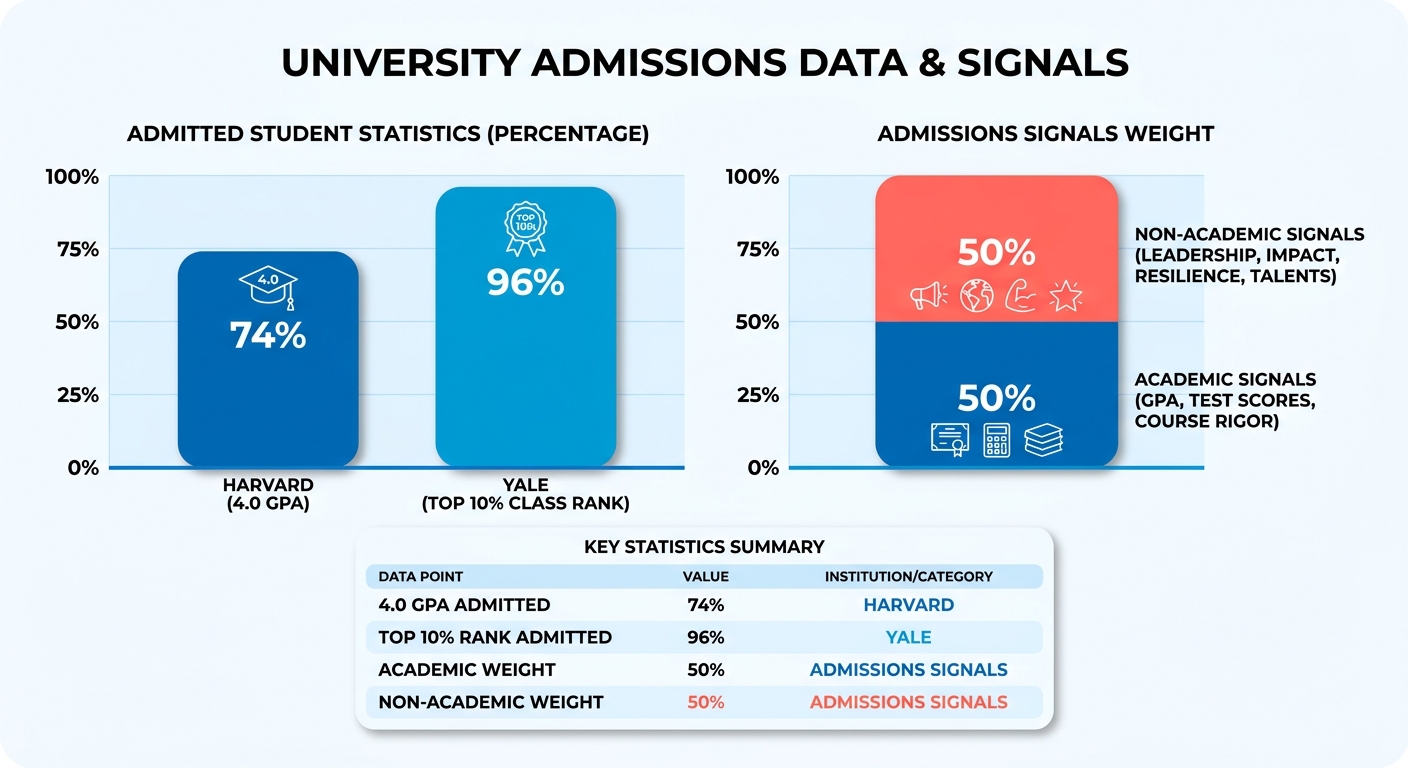
- At Harvard, 74% of admitted students held a 4.0 GPA, which makes the transcript nearly useless as a differentiator.
- Roughly 400,000 applicants compete for just 15,000 to 17,000 Ivy League seats each cycle.
- About 95% of Ivy admits come from the top decile of their high school class.
- At Yale, 96% of admits ranked within the top tenth of their graduating class.
- Non-academic signals only decide the case after applicants clear the academic gate in elite pools.
- Holistic-review research ranks non-academic factors third overall, behind academics and context, and finds they matter most at less selective schools.
- Former admissions officers and formal studies seem to disagree because academics work as a gate, not a tiebreaker.
The uncomfortable math behind your transcript
Here is the part of Ivy admissions nobody wants to say out loud: grades no longer separate admits from rejects. At Harvard, 74% of admitted students carried a 4.0 GPA. At Yale, 96% sat in the top tenth of their class. When nearly everyone in the pool looks academically identical, the transcript stops working as a tiebreaker.
That compression is why non-academic signals decide the marginal case. Roughly 400,000 students compete for 15,000 to 17,000 seats, and 95% of admits come from the top decile. Once you're inside that qualified pool, non-academic signals become the differentiator. Our life-preparation phase is designed for exactly this: helping students build real experiences and skills so a committee sees the person, not just the GPA.
Are non-academic factors really the deciding vote?
The research looks contradictory at first, and you should know why. A study of nonacademic factors in holistic reviews ranks these factors only third, behind academics and context, and finds they matter most at less selective schools. Former admissions officers say the opposite about elite pools.
Both are true. Academics are the gate you have to clear. But among applicants who have already cleared it, non-academic signals become the whole ballgame. How you communicate about yourself is often what separates one strong applicant from another.
Our view is simple: academics are just the entry ticket. That is not a slogan. It follows from grade inflation flattening academic differences.
Why depth beats a long activity list
Too many signals backfire. Listing fifteen clubs reads as thin involvement, not range. The nonacademic factor hierarchy ranks performance factors, demonstrated engagement, specialized knowledge, and goal-setting above grit and resilience narratives. Most students underinvest in exactly the highest-value signals.
Take the Harvard admit who paired math and science excellence with sustained work on healthcare access. One deep line, not ten shallow ones. Mentorship helps by identifying which of your current commitments carries real weight, then sharpening how you present it.
What should you actually prioritize?
Put demonstrated talent and leadership first. Use narrative to connect them, not replace them.
- Lead with a performance signal, a built prototype, a competition result, or real specialized knowledge, since it ranks above every other non-academic factor.
- Cut activities that add breadth but no depth. Committees read a padded list as low commitment.
- Build one coherent narrative that ties academics and activities together, because how you communicate about yourself is what separates admits.
- Start cultivating signals early so senior year is refinement, not a scramble.
One honest carve-out: some non-academic advantages, like legacy and athlete recruitment, entrench privilege and aren't accessible to most families. We do not pretend otherwise. Our focus is the meritocratic half of the equation: genuine impact and authentic narrative, which any student can build regardless of who their parents know.
Signal 1 – Leadership & Initiative
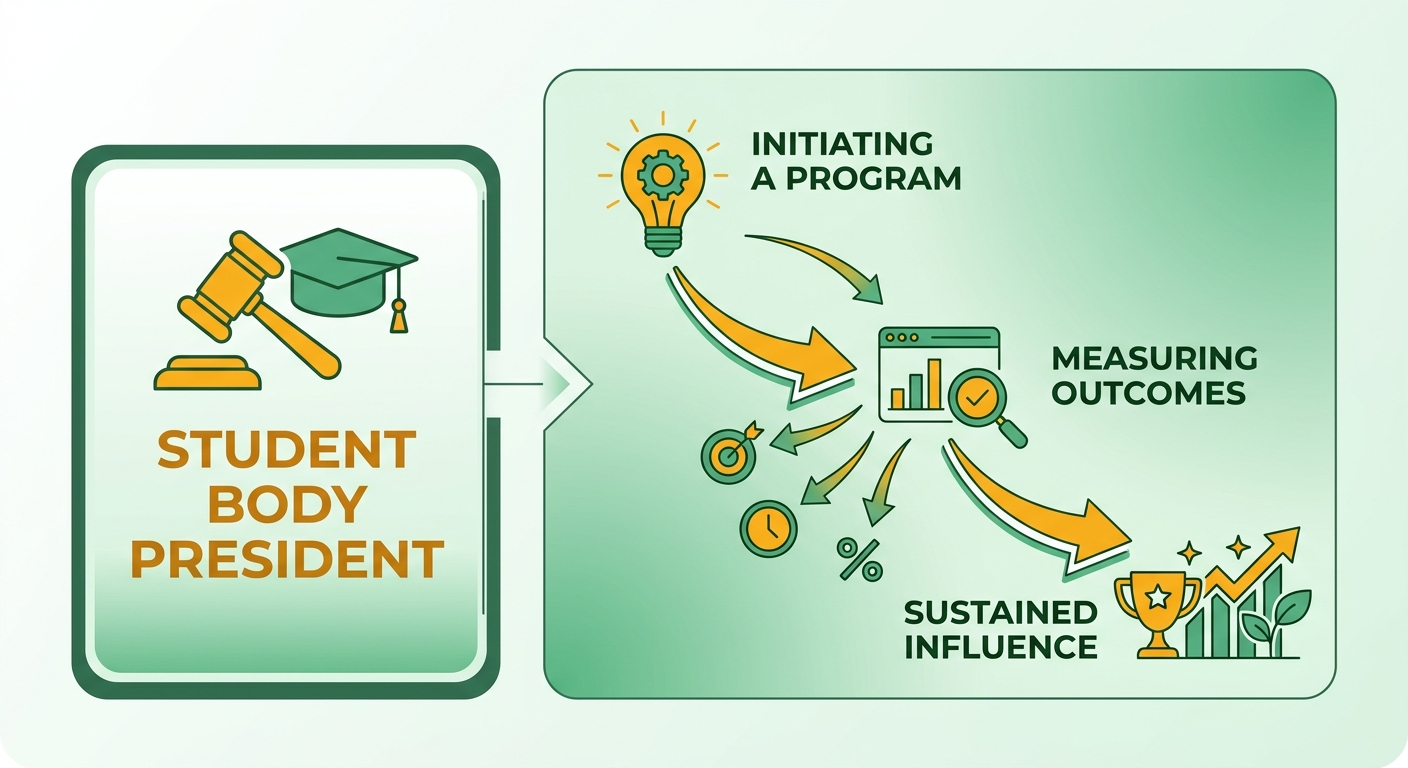
Leadership in Ivy terms means sustained influence with measurable outcomes, not a title on a résumé. Committees separate the student body president who ran three meetings from the one who redirected school policy or grew a program's reach. This distinction decides your file.
Reviewers do not treat all activities equally. They look for evidence of goal-setting and execution. A student who can organize others and carry out a vision gives the committee a clear performance signal, one that carried substantial weight in a study of over 300 admissions professionals.
What counts as real leadership vs. a title?
Real leadership produces a documented result that benefits others. A nominal title usually yields nothing you can verify. So your file should focus on the depth of a single, impactful project rather than a superficial pile of roles.
An applicant who takes a local interest and scales it into a regional program shows the kind of initiative that stands out. The value is in the measurable expansion and the organizational problems solved, not the prestige of the title. When someone lists a long string of titles with no record of execution, committees read it fast as file-padding, and it weakens the whole candidacy.
- Trade quantity for depth. One program you built and sustained beats six clubs you joined. Committees read padding as filler.
- Attach a number to every leadership claim. Participants served, funds raised, policy changed, awards earned. Vague impact reads as no impact.
- Show continuity. A one-semester project signals a résumé grab. A multi-year effort signals authentic initiative.
How do you document leadership that sways a committee?
Document it with specific metrics in the Common App activities section, plus a personal statement that shows how you think, not just what you did. Numbers prove scale. The essay proves character.
The activities section rewards precision. "Founded a school-wide sustainability program" is weak. "Founded a sustainability program adopted across the district, cutting cafeteria waste and recruiting 40 student volunteers" is a performance signal a committee can weigh. The wildfire-detection prototype recognized at an international engineering fair works the same way. The award is the proof.
Your personal statement carries the human layer. A former Harvard officer wanted "the human being behind the transcript." Use the essay to show judgment and motivation, and let the activities list carry the hard metrics.
- Lead each activity line with the outcome, not the role. Start with what changed, then name your position.
- Reserve one leadership story for the personal statement. Pick the effort that reveals how you think under pressure.
- Foreground performance over grit. Resilience narratives rank lower than demonstrated impact; build your file in that order.
One honest carve-out: if your leadership is genuinely nominal, do not manufacture a story around it. Committees detect inflated claims fast, and a thin narrative hurts more than an honest one. Build the real thing first, then document it. At Endurable Education, we start with real, sustained impact through customized planning tailored to each student's strengths, then help you document it precisely. It is the same approach behind our track record of placing over 65% of our students at Top 10 and Ivy League schools.
Signal 2 – Community Impact & Service
Service is where community engagement gets misread most often. Instead of logging volunteer hours, strong applicants build sustainable initiatives that keep running without them. That shows organizational capability and a real commitment to long-term community development, which carries far more weight than passive participation.
In the research on non-academic factors, self-directed community contributions are highly valued when they show demonstrated impact: partnerships formed, people reached, and results you can name. A soup-kitchen shift does not clear that bar. A program you designed and ran does.
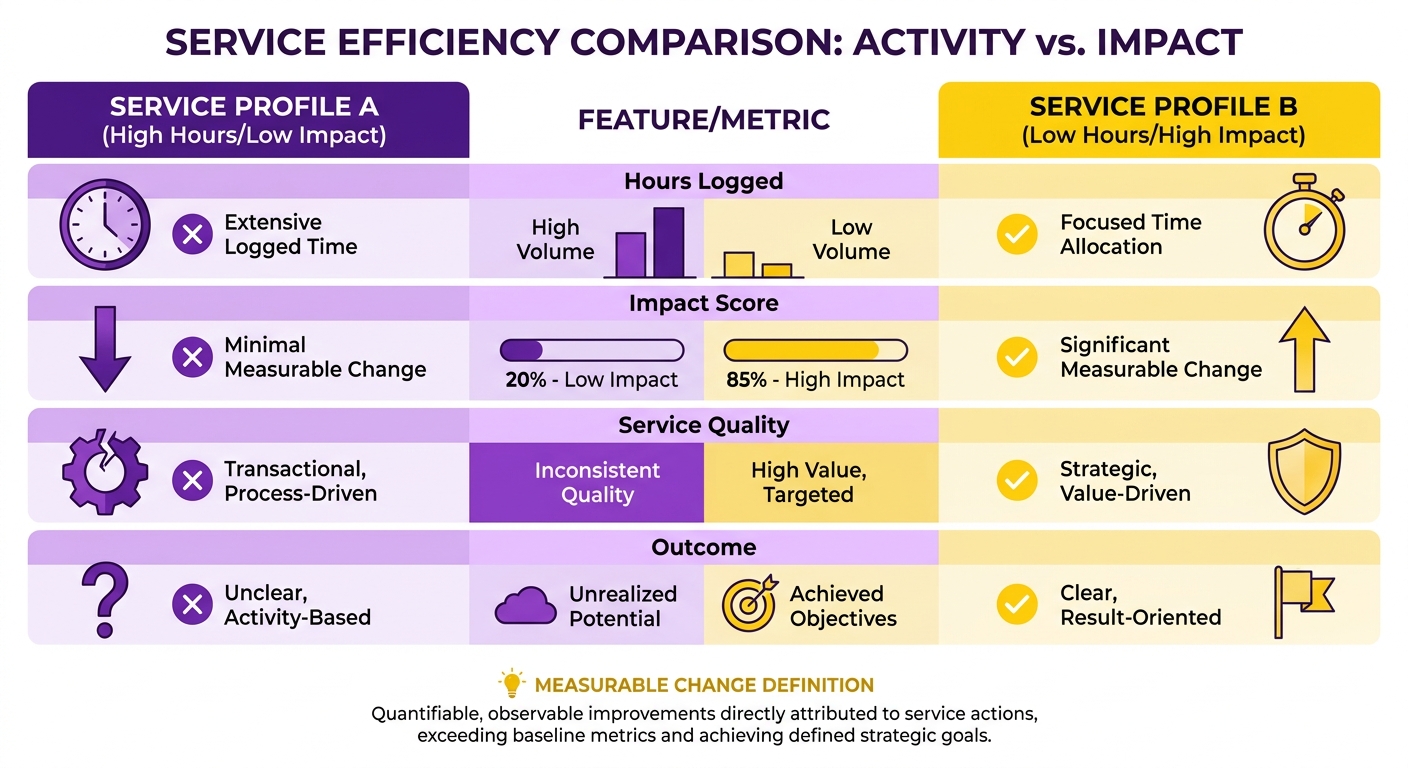
Officers look for sustained, self-directed involvement because it signals genuine interest rather than strategic box-checking. As the admissions guide notes, long-term commitment lets students build deeper expertise and work through complex challenges. That gives a much clearer picture of what a student might contribute on campus than a string of disconnected, short-term activities.
What separates service from volunteering?
Service means taking ownership of an initiative to address a specific community need. Volunteering usually means filling a role in a program someone else runs. Officers tell them apart by looking for personal agency. As Crimson's guide notes, authentic engagement reveals an applicant's values and motivation, while a superficial list of volunteer hours often reads as transactional.
Use these tests to separate the two in your own file.
- Longevity: Did you sustain this over years, or was it a one-summer résumé line? Duration signals real commitment over box-checking.
- Initiative: Did you create or redirect the effort, or just fill a role? Founding a free coding bootcamp for under-resourced schools beats attending one.
- Partnership: Did you build relationships with real community organizations? A disaster-relief fundraiser tied to named local shelters carries weight a bake sale never will.
Which metrics actually prove impact?
Lead with numbers officers can verify. Vague claims of "helping the community" die on the page. A fundraiser that generated $30K for local shelters, or a tutoring program that moved test scores, does not.
Track these from day one, because you cannot reconstruct them later.
- People reached: How many students, families, or residents did your work touch? Scale shows reach beyond your immediate circle.
- Tangible results: Meals served, scores improved, dollars raised. Concrete outcomes convert effort into a performance signal.
- Partnerships formed: Named organizations validate that your work existed outside your own claims.
How do you reflect this in your application?
Split the quantitative data from the qualitative narrative. Put the verifiable metrics in the activities sections, which frees the personal statement and interviews to focus on your motivations and reflections. For more on organizing these components, see our admissions planning blog.
Signal 3 – Personal Growth & Resilience
Resilience, in admissions terms, means a documented arc: a real setback, honest reflection about it, and a concrete achievement that followed. Not the setback alone. The recovery is the signal.
This one is nuanced, and you have to handle it carefully. In holistic evaluation, personal narratives work best when they frame concrete achievements rather than replace them. A growth story should always point toward a tangible outcome, showing how getting through an obstacle let you build something lasting.
What counts as a resilience narrative for admissions?
Resilience narrative: a story where you name a challenge, show what you changed in response, and point to a measurable result that came after.
Three shapes tend to land. Academic recovery, where a low grade sophomore year becomes a documented turnaround. Cultural transition, where you adapted across languages or countries. Managing a family health crisis while holding an extracurricular commitment steady. According to a former Yale admissions officer, the key is presenting these with self-awareness and maturity. The strongest narratives do not dwell on the setback; they focus on the specific actions you took and the growth that followed.
How do you frame resilience without sounding like a victim?
Lead with agency. Focus on the decision you made, the skill you built, and the goal you're aiming at next. The setback is context, not the subject.
Linking adversity directly to problem-solving or leadership pulls the narrative up from an account of hardship to a demonstration of capability. That matches what committees look for in the nonacademic-factors study: evidence of constructive action.
Skip the resilience essay entirely if your setback is minor. A dropped grade you recovered in one term is not a growth arc. Force one there and it reads as manufactured, and readers who screen thousands of files catch it fast.
Where to embed resilience signals in your application
Use the checklist below to place these signals where they reinforce your stronger material instead of competing with it.
- Anchor the Personal Insight section to agency, not the wound. Write the recovery and the lesson, then close on a forward-looking goal.
- Show sustained involvement in the Activities section through the hard stretch. A commitment you held while managing a crisis proves resilience without a sentence of narration.
- Link the challenge to a named skill. Vague "I grew" language stalls; "I learned to run a schedule under pressure" advances the file.
- Cross-check against your performance signals. If the resilience story crowds out your leadership or talent evidence, cut it back. Grit supports; it does not lead.
Building a balanced narrative takes careful editing to keep the tone objective and focused on growth. An experienced advisor can flag where the narrative sounds overly defensive or self-pitying, so you can refine it toward agency. For more on sequencing these signals across a full application, see our admissions planning blog.
Signal 4 – Unique Talents & Passions
A signature strength is a talent developed deeply enough that outside institutions validate it: a published paper, a national title, or revenue in the bank. It is a strong non-academic signal because it gives objective proof of specialized knowledge and mastery. External validation immediately separates your file from ones with more general interests, and it maps directly to what the holistic-admissions research calls performance factors.
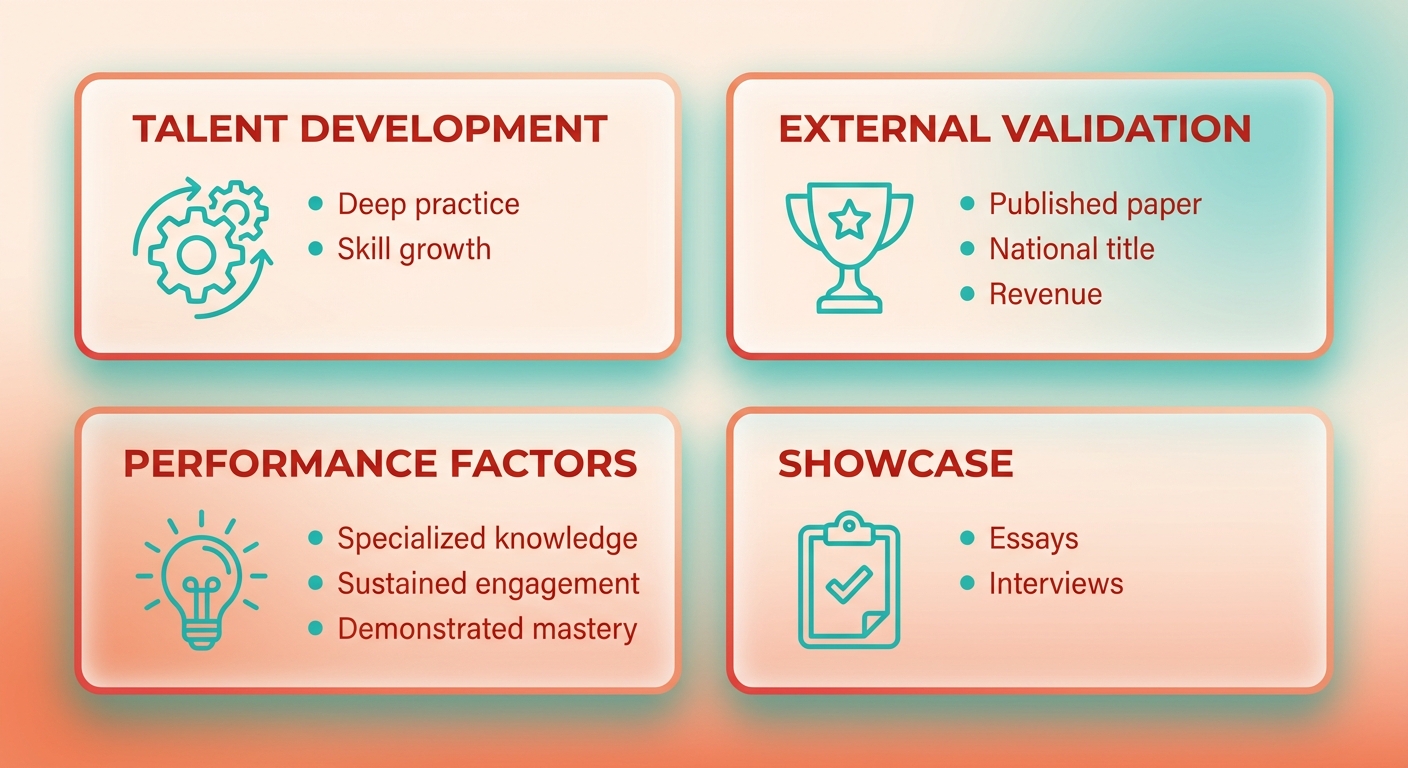
In highly selective pools, officers look for a defining capability that sets an applicant apart from other academically qualified candidates. As the Crimson guide on Ivy admissions puts it, a clear, well-defined area of expertise gives your application a focal point and makes your profile far more memorable.
What counts as a signature strength?
Signature strength: a distinctive talent backed by sustained practice, external validation, and standing within its community. The three tests matter together. Practice without validation reads as a hobby. Validation without depth reads as luck.
That mix of depth and outside recognition is what turns a personal interest into a real application asset. A student who runs independent scientific research and presents the findings at a regional symposium shows exactly this. The external review confirms the work meets professional standards, giving officers independent verification of the talent and the effort behind it.
- Show external validation. Awards, publications, or paying customers prove your talent cleared a bar someone else set, not just a teacher's grade.
- Prove sustained depth. Years of practice separate a genuine strength from a résumé line added senior fall.
- Demonstrate community leadership. Running a competition, editing a journal, or mentoring younger competitors shows you shape the niche, not just show up in it.
How do you balance talent with academic rigor?
Your talent cannot come at the cost of your transcript. A signature strength amplifies a strong academic file; it never rescues a weak one. Nearly half of graduates now hold A averages, so a 4.0 in a low-rigor course load reads very differently than the same GPA across five AP classes.
You see the synergy in strong applications. One of our students built an Alzheimer's diagnostic that is 99% cheaper and faster than traditional methods; another developed an affordable skin cancer prevention approach. In both cases, rigorous academics and a deep, externally validated passion reinforced each other. Neither carried the file alone.
- Keep rigor visible. Your talent should read as additive, so protect the AP-heavy transcript that signals you can handle Ivy coursework.
- Connect the talent to your academic story. A cohesive narrative beats two impressive but disconnected credentials.
Where should you place a signature strength?
Placement decides whether committees notice your talent at all. Use the "Additional Information" box for portfolio links, recording URLs, or publication citations. Then weave the passion into a supplemental prompt where it answers a real question, never as a bolted-on brag.
Present these achievements clearly, and they get the attention they deserve. Let your primary talent get buried in a standard activities list, and it disappears. Strategic placement shows the committee the full scope of your work.
- Link your portfolio. Give the reader one click to your paper, recording, or product page.
- Integrate, don't append. Fold the talent into an essay answer so it deepens your story instead of padding it.
References
[1] Why Students With Perfect 4.0 GPAs Get Rejected From The Ivy League - https://www.forbes.com/sites/christopherrim/2026/05/07/thousands-of-students-with-perfect-40-gpas-get-rejected-from-the-ivy-league-every-year-heres-why/
[2] Diversifying Society's Leaders? The Determinants and... - https://opportunityinsights.org/paper/collegeadmissions/
[3] How To Get Into An Ivy League School? The Essential Guide - https://www.crimsoneducation.org/us/blog/how-to-get-into-an-ivy-league-school
[4] A Study of the Use of Nonacademic Factors in Holistic... - https://www.researchgate.net/publication/331745463_A_Study_of_the_Use_of_Nonacademic_Factors_in_Holistic_Undergraduate_Admissions_Reviews
Frequently Asked Questions
1. If academics are just table stakes, can strong non-academic signals compensate for a weak transcript?
No. Academic performance remains the primary filter in elite admissions. Non-academic signals are used to differentiate among candidates who have already demonstrated complete academic readiness; they cannot compensate for a transcript that does not meet the institution's academic threshold.
2. Should I skip a resilience essay if my biggest setback was minor?
Yes. If the challenge was a minor setback, attempting to frame it as a major growth narrative can appear exaggerated to experienced admissions readers. It is far more effective to use that space to highlight active achievements, such as leadership initiatives or specialized talents, which carry greater weight.
3. How many extracurriculars should I list on the Common App?
Quality is far more important than quantity. Admissions committees prefer to see deep, sustained commitment to a few key areas rather than superficial participation in a long list of organizations. Focusing on two or three meaningful activities allows you to demonstrate real impact and leadership.
4. What's the difference between community service and volunteering for admissions?
The distinction lies in leadership and ownership. Volunteering typically involves contributing time to an existing program managed by others. Community service that impacts admissions decisions involves taking the initiative to identify a community need, design a response, and manage the execution of that project.
5. Where should I put hard metrics versus personal narrative in my application?
Quantitative data—such as hours, budgets, or participant numbers—belongs in the activities list and additional information sections where it can be clearly cataloged. The personal statement and supplemental essays should focus on your motivations, reflections, and personal perspective, providing context to those numbers.
6. Do legacy and athletic recruitment advantages make merit-based signals pointless?
No. While institutional priorities like athletic recruitment and legacy status influence a portion of the class, a significant percentage of seats are filled through the standard holistic review process. Developing strong, authentic non-academic signals remains the most effective pathway for the majority of applicants to secure admission.
7. How early should I start building non-academic signals?
Ideally, you should begin developing these interests early in your high school career. Building a deep portfolio of work, establishing community partnerships, or achieving high-level recognition takes time. Starting early ensures that your involvement is genuine and documented, rather than appearing rushed in the months leading up to application deadlines.