The 75% Rule Behind "College Will Humble You" for Strong Applicants
September 5, 2026

Key Takeaways
- At the most selective schools, over 80% of applicants are academically admissible. So the admitted class is full of former top-rankers, and almost everyone loses the rank they carried in.
- The big-fish-little-pond effect describes something odd: equally capable students report lower academic self-concepts in high-ability schools than in weaker ones.
- Roughly 25% of academic self-concept's effect on school performance traces back to this comparison-driven effect.
- The students who ranked highest in high school struggle most. The recalibration hits hardest when your whole identity was "the smart one."
- "College will humble you" signals a shift in reference point, not an actual decline in ability.
- The effect is malleable. Students who understand it beforehand can blunt its drag on their grades.
- Left unchecked, peer comparison during a rough first semester can quietly lower grades, not just bruise confidence.
Why This Matters
When people say "college will humble you," they're describing arithmetic. You move from a high school where you ranked at the top into a class where nearly everyone did too. The phrase captures a real shift in your frame of reference, not a drop in your ability. Understanding that early changes how you read your first hard semester.
Here's the math. At the most selective schools, over 80% of applicants are academically admissible, so admitted students walk into a pond packed with former top-rankers. Your old rank evaporates. That's the humbling, and it's completely predictable.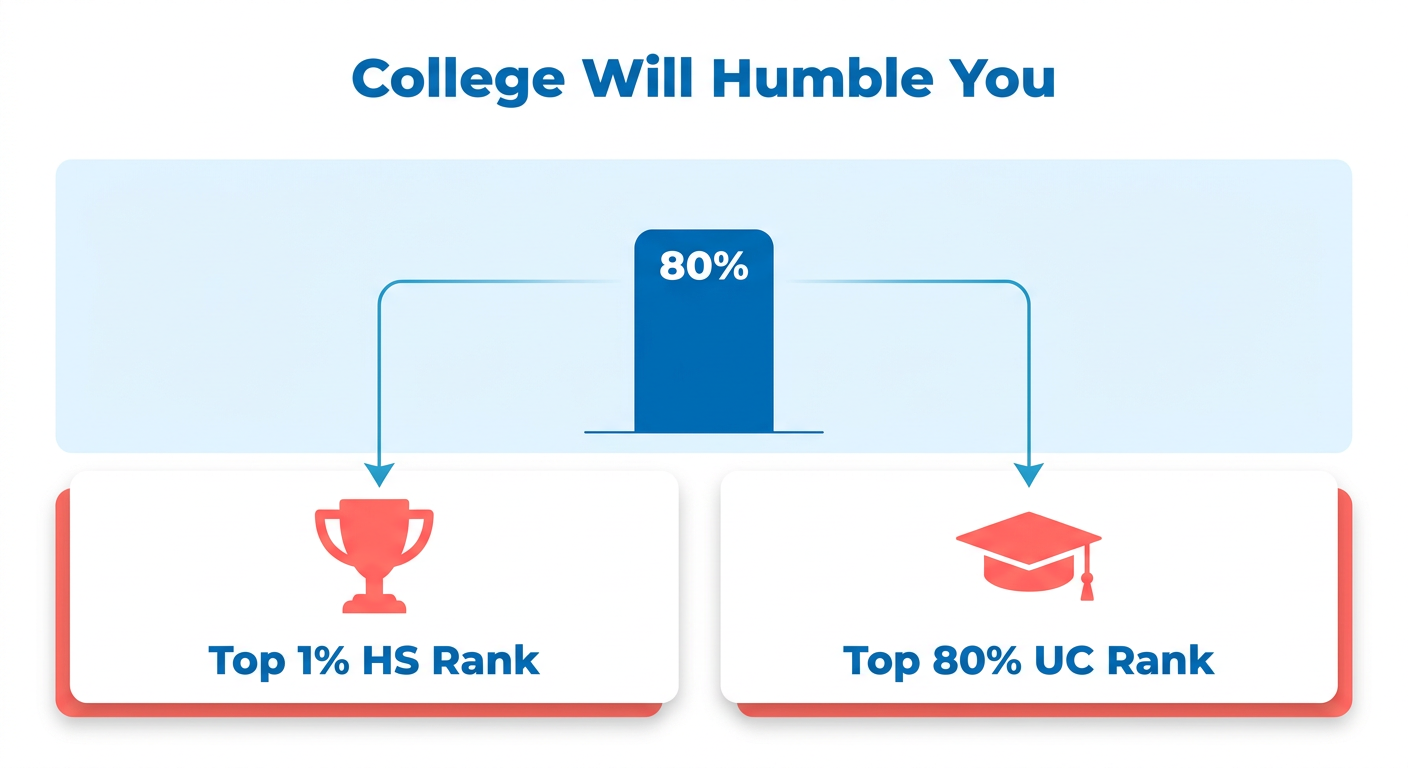
What "College Will Humble You" Actually Means
It means your academic self-concept gets recalibrated against a stronger peer group, even when your real ability hasn't budged. Psychologists call this the big-fish-little-pond effect (BFLPE). Equally able students report lower self-concepts in high-ability schools than in low-ability ones.
The effect isn't trivial. About 25% of the effect of academic self-concept on school performance traces back to the BFLPE. So the humbling isn't just a feeling. Let the comparison run unchecked, and it can quietly drag your grades down.
The students who struggle most are the ones who ranked highest before. When your identity was "the smart one," the recalibration hits harder. Knowing that in advance is the whole point of this piece.
Why You Want to Learn This Before You Enroll
Because the BFLPE is malleable, not fixed. It runs entirely through comparison, which means you can change how you compare. That's the difference between fleeing selective schools and surviving them well.
Two research threads point the way. First, intellectual humility predicts mastery behaviors after failure. High school students with more intellectual humility reported higher mastery responses after failing a quiz, across five studies with 1,074 participants. Second, deliberately chosen upward comparisons can raise self-concept instead of crushing it.
There's a real tension worth naming. One analysis of college students found that keeping social media ties to high school peers protected self-evaluations. But that clashes with humbly engaging the harder pond. Our read: clinging to your old frame protects your ego short-term; engaging the new one protects your learning. For freshman year, pick growth.
Who Should Skip This
Skip this framing if you're heading somewhere you'll genuinely be near the top. The BFLPE cuts both ways, and a strong big-fish position is a real asset. Don't manufacture a crisis that isn't coming.
Here's a quick map before we get tactical.
| Element | Detail |
|---|---|
| Difficulty | Moderate: mostly mindset, some habit change |
| Time to internalize | One semester of deliberate practice |
| Prerequisites | Honest self-assessment; willingness to seek feedback |
| Solves | Grade slippage, impostor feelings, list-building errors |
| Best applied | Before enrollment, then across your first year |
The payoff is concrete. You'll read your first tough grade as data, not verdict. And when you build your college list, you'll widen it past reach schools with clear eyes, knowing terrific grades and scores don't guarantee terrific odds.
Core Concepts
The mechanism behind "college will humble you" has a name in educational psychology: the big-fish-little-pond effect. Equally able students report lower academic self-concept in high-ability schools than in low-ability ones, per H.W. Marsh's foundational work. Your ability doesn't drop. Your reference group changes.
That's the whole meaning of the phrase, stated plainly. Concentrate strong students in one room and most of them lose the class rank they carried in high school. The humbling isn't a verdict on you. It's arithmetic.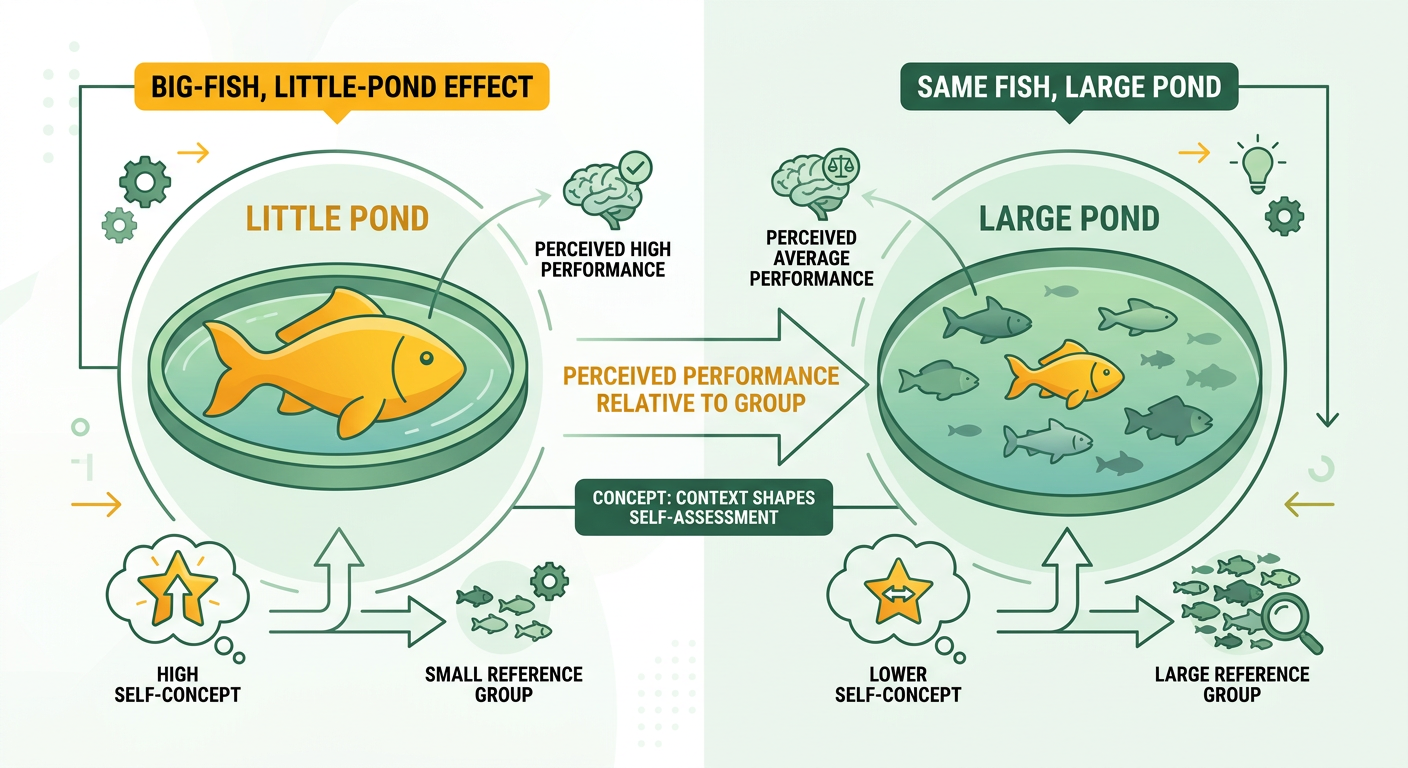
What the Effect Does to Real Grades
The frame-of-reference effect touches actual grades, not just how you feel. Marsh's reanalysis of the Youth in Transition data found equally able students tend to earn higher grades in lower-ability schools. And it compounds: studies tracking students across multiple years show the self-concept gap widening as the comparison keeps running.
Read that twice. Self-concept isn't a soft, decorative variable. It feeds back into how you perform. When your view of yourself drops because everyone around you is sharp, your measurable output can follow it down.
That's why the humbling stings in two places at once. Your confidence takes a hit, and the grades that once came easily now sit in the middle of a tougher curve.
Why It Hits Strong Applicants Hardest
The students most vulnerable are the ones who ranked highest before. A former valedictorian who never sat below the top of a class has the furthest to fall when the whole room is built from other valedictorians. The pond is packed with big fish, and the old reference points are gone.
The competition also isn't local anymore. As college admissions writer Ethan Sawyer puts it:
"The competition isn't just from your high school, state, region… It's from all around the world."
This reframes the whole experience as a design feature, not a personal failure. Admissions offices deliberately assemble rooms of high performers. The self-concept dip that follows is the predictable output of that sorting, not evidence you were overrated.
Can You Choose Your Pond on Purpose?
Yes, and it's a legitimate strategy. The BFLPE hits lower-ranked students within a class hardest, per research clarifying social comparison. So where you land inside the distribution matters as much as the prestige on the diploma.
This connects to a practical admissions point. Strong-but-not-recruited applicants often fare better applying Early Decision than Regular, and colleges reward students who read as "pointed" rather than broadly well-rounded. Choosing a school where your strengths make you a bigger fish can protect both your self-concept and your GPA.
We don't tell every student to trade down for rank. If a demanding program genuinely fits your goals, the challenge is worth it. But treat the "best" name on the list as one input, not the whole equation. Widen your list, understand each school's priorities, and pick the pond where you'll actually swim.
Skip this reasoning if your kid thrives on being the underdog. Some students perform better with tougher peers pushing them. Know which one you're raising before you build the list.
Step-by-Step Implementation
Understanding the "college will humble you" meaning is step one. Turning it into a plan is where most strong applicants stall. This section walks through the setup, the tuning, and the execution of a system that keeps your self-concept intact when your rank disappears.
The goal is simple. Treat the frame-of-reference shift as a known variable, not a surprise. Set up your first two years so a recalibrated ranking doesn't read as failure.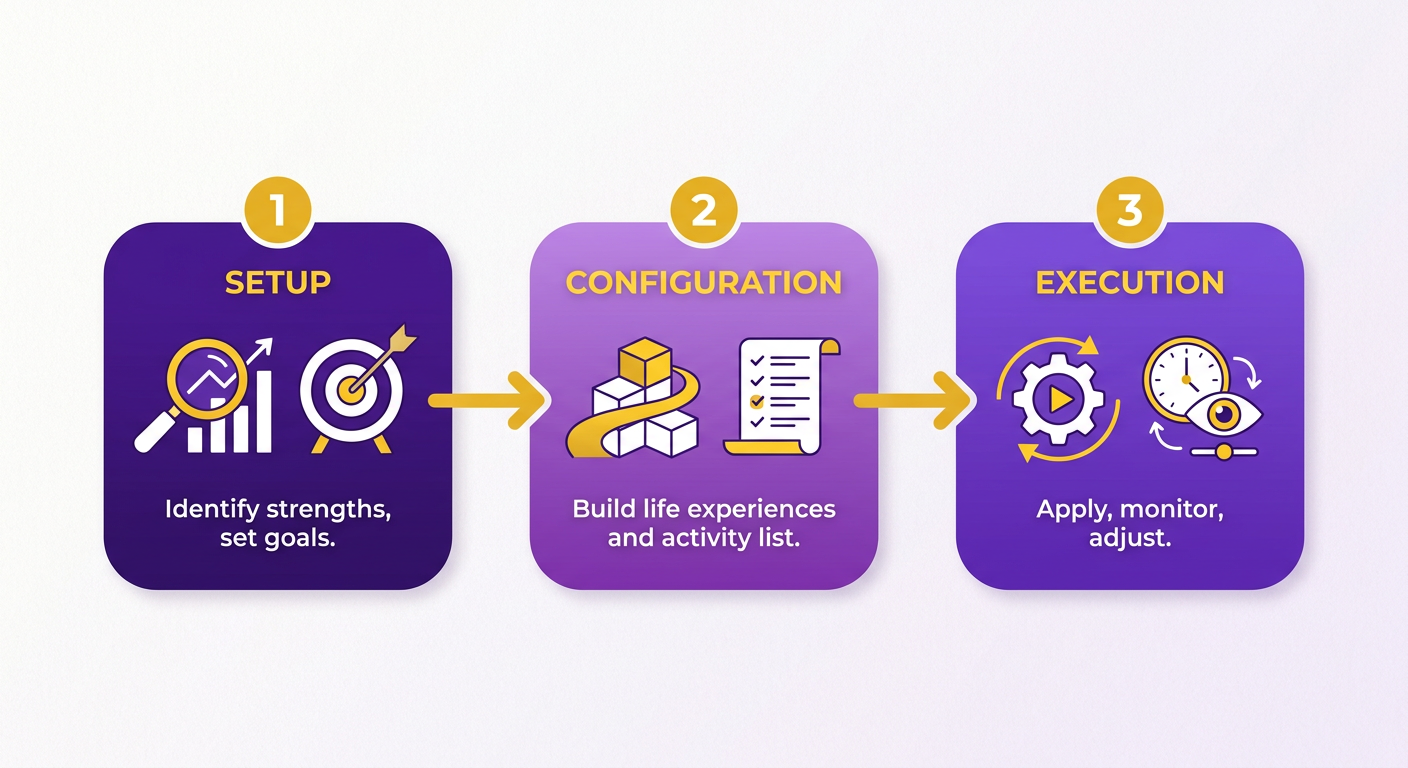
Setting Up Before the Humbling Hits
Setup means picking your reference group on purpose, before your first hard semester starts. Your daily environment drives your self-evaluation. Choose which peers matter, and you blunt the drop before it lands.
Three moves:
- Acknowledge the shift. Write down that you're now studying alongside peers who also excelled where they came from. A B+ in a room this strong is not a decline.
- Separate ability from rank. Your skill didn't change on move-in day. Only the comparison group did.
- Pick a work metric, not a rank metric. Track mastery of concepts, not your position against classmates.
Tuning Your Response to Lower Grades
Configuration is the ongoing tuning you do each term as grades come back. Keep the check-in interval short: review after every graded assignment, not just at midterms. Waiting for a final report gives a low number weeks to harden into a story about your ability. A tight loop catches the artifact early, while it's still just data.
Here's the loop. When a grade lands lower than your high school average, log it without a story attached. Ask one question: did I understand the material, or not? If yes, the number is a ranking artifact. If no, you have a concrete gap to close.
This is where creative applicants especially need discipline. A weaker term doesn't have to define your file. Through customized planning and collaborative panel review, our team helps students frame a slow first year as context rather than a verdict, refining their story so they show their best across applications, essays, and interviews.
Execution
Run the loop every term. Name the pond, log grades without stories, fix real gaps, leave rank artifacts alone. Do it for two years, and the humbling becomes math you already priced in.
Best Practices
The best way to survive the humbling is to change how you compare, not to run from the pond that causes it. Students hear the "college will humble you" meaning and conclude they should aim lower to stay a big fish. Wrong lesson. The frame-of-reference drop is driven by comparison, which means it's malleable if you handle comparison deliberately.
Here's the upside. Because the effect runs through how you compare yourself to peers, you get to steer it. Below are the practices we recommend, plus where each one backfires.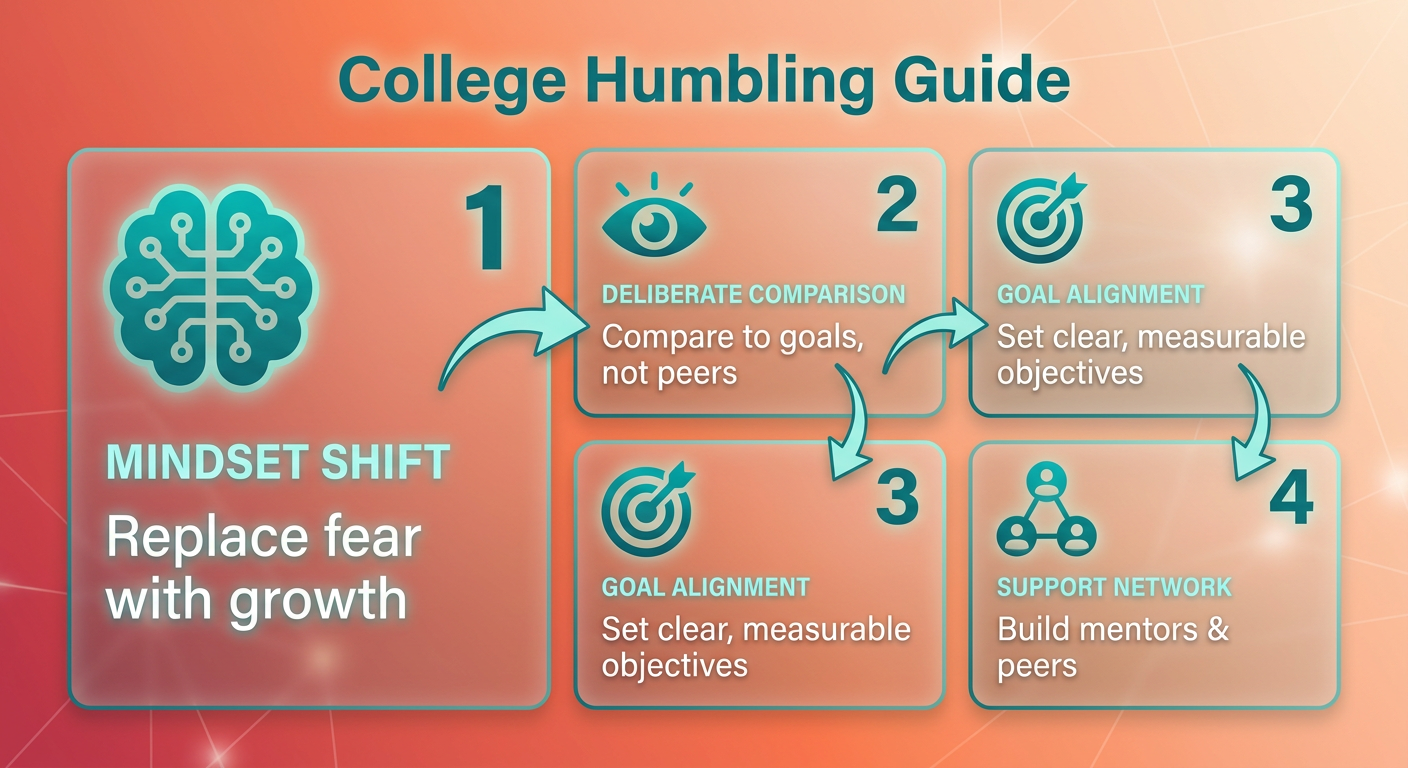
Handling the Feeling Without Fleeing to an Easier School
Convert failure into effort instead of a verdict. Intellectual humility, meaning openness to your own limits and to corrective feedback, predicts more effortful learning after you stumble. It correlates strongly with mastery behaviors even after accounting for growth mindset and gender.
The mechanism is concrete. When students hit academic setbacks, those with higher intellectual humility focus on active recovery rather than self-doubt. Tenelle Porter, who ran the work, put it plainly:
"Those who embrace challenge and persist through difficulty tend to learn more and achieve at higher levels." - Tenelle Porter
So when your first hard midterm lands below your old standard, treat the feedback as data. Read the comments. Redo the problems. That's the humility-to-mastery loop working for you.
The Coping-Strategy Tension Worth Knowing
Protecting your self-esteem and protecting your learning can pull in opposite directions. Staying tight with your old peer group can buffer your self-esteem for a while. Clinging to a familiar, highly favorable frame of reference feels protective during a hard transition.
But that clashes with the humility research above, which says you learn most by engaging the harder pond head-on. Use both, for different jobs. Keep a few old-school friends for emotional ballast on bad weeks. Don't let that circle become your academic yardstick, or you'll dodge the corrective feedback that drives real gains.
Where to Skip This Advice
Skip the "just aim lower to stay a big fish" instinct. The habit that trips students up is treating one class rank as proof of ability. A meta-analysis of the big-fish-little-pond effect drew on more than 100,000 students across dozens of countries and found the same pattern everywhere: lower academic self-concept in stronger schools. That drop is a comparison artifact, not a measure of what you can do.
The pitfall we see most is the student who reads that lower self-concept as a signal to retreat. The fix is to separate your self-rating from your standing in the room. Track your own progress week over week instead of your rank against classmates, and the arithmetic stops feeling like a judgment.
The humbling is arithmetic, not a verdict, and comparison is the lever you control.
Troubleshooting
When students misread the college experience, the fix is almost always the same. They treat a recalibrated rank as proof they don't belong. That misreading is the bug. Here are the common failure modes and how to debug them before they cost you a semester.
Most errors here are interpretation errors, not effort errors. You're not underperforming. You're reading a normal frame-of-reference shift as a personal verdict. Spot the pattern and the correction is fast.
Why the Feeling Turns Into a Downward Spiral
The spiral starts when a lower rank triggers withdrawal instead of effort. You compare yourself to the strongest peers, feel outclassed, then pull back from office hours, study groups, and hard classes. That withdrawal drops your actual performance, which confirms the fear. The loop feeds itself.
Debug it by checking what you did after your last bad grade. Did you seek help or hide? If you went quiet, that's the fault line. Watch for avoidance, not the grade itself.
The fix is to re-enter the room you fled. Book the office hours. Ask the question you think is stupid. Treat confusion as a task to solve, not a status to hide, and you break the spiral at its source.
Common Errors and Fast Fixes
-
Error: reading your new rank as your ceiling. Your rank changed because your reference group changed, not because your ability dropped. Fix: track your absolute learning, not your position in the curve.
-
Error: escaping the pressure by seeking out easier environments. Because self-evaluation is relative, changing schools just resets the comparison group without touching the underlying habit of relative self-worth. Fix: stay engaged and focus on absolute skill acquisition.
-
Error: hiding weak spots instead of naming them. Silent students stall. Fix: name the gap out loud to an instructor or peer.
When your struggle is a real skills gap, not a frame-of-reference illusion, skip the reframing and get concrete tutoring instead. Reframing a genuine deficit just delays the work.
Conclusion
The "college will humble you" meaning comes down to one thing: your rank changes, not your worth. You enter a fiercely competitive class, your old standing shifts, and that transition only feels like failure if you let it. It isn't. It's the predictable math of a stronger reference group.
So what do you do with that once you understand it? You treat the recalibration as a known event and plan around it. The students who thrive don't dodge the harder pond. They change how they compare, and they keep showing up when the comparison stings.
Your Next Steps After Understanding the Humbling
Start before the first hard semester, not after. The frame-of-reference shift is easier to blunt when you've chosen your reference group and your response to setbacks in advance. Wait until a bad grade lands and you're reacting instead of steering.
A short checklist:
- Pick your yardstick on purpose. Measure progress against your past self, not the strongest person in the seminar.
- Convert a low grade into effort. Treat a hard result as data about your study system, not a verdict on your ability.
- Stay in the room. Office hours, study groups, and hard classes are where you recover. Withdrawal is the actual failure mode.
- Name the effect out loud. When you feel outclassed, remind yourself it's arithmetic, not evidence.
When to Ignore This Advice
Don't downgrade your academic goals just to protect your ego. That trade lowers your ceiling to protect a feeling that fades within a semester or two. The humbling passes. A weaker peer group and thinner opportunities don't.
One caveat: if a genuinely toxic environment is harming your health, the fix is support and resources, not reframing. Reframing is for the normal recalibration, not for real distress.
Long-term planning is where this gets easier, and starting early matters most. At Endurable Education we work with students as far back as 8th grade, partly because the habits that survive a stronger pond take years, not weeks. The goal isn't a perfect first semester. It's a self-concept sturdy enough to hold when your rank moves.
References
[1] A Guide to “Standard Strong” in College Admissions - https://www.collegeessayguy.com/blog/guide-to-standard-strong
[2] Intellectual humility predicts mastery behaviors when learning - https://www.sciencedirect.com/science/article/abs/pii/S1041608020300686
[3] Clarifying the role of social comparison in the big-fish-little ... - https://pubmed.ncbi.nlm.nih.gov/19586246/
[4] (PDF) Clarifying the Role of Social Comparison in the Big-Fish–Little ... - https://www.researchgate.net/publication/26655637_Clarifying_the_Role_of_Social_Comparison_in_the_Big-Fish-Little-Pond_Effect_BFLPE_An_Integrative_Study
[5] Social Comparison Effects on Academic Self-Concepts—Which ... - https://pmc.ncbi.nlm.nih.gov/articles/PMC9281383/
[6] The Big-Fish-Little-Pond Effect on the Four Facets of Academic Self ... - PMC - https://pmc.ncbi.nlm.nih.gov/articles/PMC6062938/
[7] (PDF) Longitudinal Multilevel Models of the Big-Fish-Little-Pond Effect on ... - https://www.researchgate.net/publication/12609074_Longitudinal_Multilevel_Models_of_the_Big-Fish-Little-Pond_Effect_on_Academic_Self-Concept_Counterbalancing_Contrast_and_Reflected-Glory_Effects_in_Hong_Kong_Schools
[8] The big-fish-little-pond effect on academic self-concept. - DOI - http://dx.doi.org/10.1037//0022-0663.79.3.280
[9] The Big-Fish-Little-Pond Effect on Academic Self-Concept - PMC - NIH - https://pmc.ncbi.nlm.nih.gov/articles/PMC6124391/
[10] (PDF) The Big-fish–little-pond-effect Stands Up to Critical Scrutiny - https://www.researchgate.net/publication/225776264_The_Big-fish-little-pond-effect_Stands_Up_to_Critical_Scrutiny_Implications_for_Theory_Methodology_and_Future_Research
[11] Influence of social comparisons, big fish little pond effect, and social ... - https://repositories.lib.utexas.edu/items/d6f9ccce-e85f-4a79-8998-fe24dcc76a0d
[12] [PDF] Clarifying the role of social comparison in the big-fish ... - HAL - https://amu.hal.science/hal-01472529/document
Frequently Asked Questions
1. Does the big-fish-little-pond effect fade over time, or does it get worse?
The impact of peer comparison tends to accumulate over time. When a student does not actively manage their academic self-concept, early setbacks can create a negative feedback loop that persists throughout their college career. Addressing this mindset during your transition prevents a temporary adjustment from becoming a long-term academic drag.
2. Is transferring to a less selective school a smart way to escape the humbling?
Transferring rarely solves the underlying issue. Since academic self-concept is shaped by immediate peers, you will encounter similar comparative pressures in any new environment. Sacrificing long-term academic opportunities to avoid short-term discomfort usually compromises your broader goals.
3. How is this different from impostor syndrome?
Impostor syndrome involves doubting genuine ability, while the humbling is a frame-of-reference shift where ability never changed. Your rank dropped because everyone around you also ranked at the top, not because you were overrated. Treating a normal recalibration as evidence of fraud is the misreading to avoid.
4. What if my lower grades reflect a real skills gap, not just a comparison artifact?
If your struggle stems from a lack of prerequisite knowledge rather than relative grading curves, shift your focus to academic support. Diagnose whether you are missing foundational concepts or struggling with the format of college exams. In these cases, seek out tutoring, study groups, or professor feedback immediately.
5. Should I cut ties with my high school friends when I start college?
No, but separate your social support from your academic benchmarks. Maintaining connections with old friends provides valuable emotional stability during a major life transition. Use these relationships for personal support, while fully engaging with your new classmates to drive your academic growth.
6. Does intellectual humility mean lowering my expectations or confidence?
Not at all. It simply means recognizing the limits of your current knowledge and remaining open to feedback. Students who practice this trait view academic setbacks as diagnostic data rather than personal failures, allowing them to adapt their study habits and improve their performance.
7. When should I start preparing for this shift?
The ideal time to prepare is during high school, particularly when researching colleges and building your application list. Developing a resilient academic mindset and learning to value growth over relative rank takes time. Establishing these habits early ensures you can navigate highly competitive environments successfully from day one.