The Ivy Admissions Constraint Check: Impact, Risk-Taking, and Recommender Proof
August 24, 2026

Key Takeaways
- Ivy admissions uses holistic review. Officers weigh three signals: impact, risk-taking, and recommender proof.
- Applications to highly selective colleges rose 26% between 2019 and 2022. They climbed another 4% during the 2024-2025 cycle. Seat counts stayed the same.
- A UC Berkeley pilot found that recommendation letters raised admission rates by roughly 5 percentage points. The larger boost went to applicants who were already strong.
- The NBER study concluded that letters did not meaningfully change applicant diversity. They still lifted admission rates overall.
- A separate analysis of 95,326 applicants examined whether letters reinforce or challenge class stratification in American high schools.
- A Constraint Check provides a decision framework. It identifies which signal is weakening your application.
- Recommender proof means documented, context-rich evidence from a teacher or counselor.
Why a Constraint Check beats another "be well-rounded" speech
Holistic review examines your impact, risk-taking, and recommender proof. These signals suggest what you may contribute on campus. A Constraint Check asks where you stand across all three. Most students skip this step while pursuing how to get into an Ivy League school.
Applications to highly selective colleges rose 26% between 2019 and 2022. They rose another 4% in the 2024-2025 cycle, according to CollegeData's breakdown. More applicants competed for the same number of seats. A framework that identifies your weakest constraint can guide your preparation.
Why recommender proof gets its own constraint
Recommender proof is documented, context-rich evidence from a teacher or counselor. It deserves separate attention because letters can affect admissions results. A UC Berkeley pilot, discussed in the NBER working paper, found that letters lifted admission rates by about 5 percentage points overall. The effect was larger for applicants who were already strong.
The research points in two directions. The NBER study found that letters favored stronger applicants. It also found that letters did not meaningfully affect diversity. A separate analysis of 95,326 applicants found that officers gave higher ratings to students from high-challenge contexts. Public-school students still rated below private-school peers with equal readiness.
These studies measure different outcomes. One tracks the admission lift from submitting a letter. The other tracks how officers rate the letter's content. Both findings can be true.
- Quality plus context beats quantity. If recommenders are limited, shape one strong letter. It should document your circumstances and cite specific evidence. For an underrepresented applicant, this may be the highest-return step. Ratings rise with context, even when raw admission gains favor stronger applications.
- Brief your recommender on your context. The 95,326-applicant study connected higher ratings to College Board market indices. A letter that names your school's constraints can add useful context.
How impact and risk-taking fit together
Impact is a measurable contribution to a community. Risk-taking means choosing difficult, self-directed work over safe box-checking. Together, they address a concern raised by a former Cornell admission officer in the CollegeData piece: many applications show no tangible passion.
Skip the elite-activity arms race if time or family support is limited. Research on cultural capital found that wealthy and white students are 7 to 20 times more likely to reach "exceptional" extracurricular benchmarks. They often have more access to specialization and support.
For a constrained student, risk-taking is not a personality quirk. It can substitute for resources. A genuinely novel, self-defined project can outweigh a polished but generic activity.
- Engineer one high-impact original project. Novelty can substitute for the money and coaching wealthier applicants use to appear exceptional.
- Map each activity against class balance and institutional priorities. Fortuna's admissions insiders note that decisions consider growth and character, not box-checking. Our planning starts as early as 8th grade. We help sequence these efforts through high school with regular check-ins and panel reviews of activity lists.
The three pillars, and how committees actually read them
The Constraint Check has three pillars: Impact, Risk-Taking, and Recommender Proof. Each includes subcriteria and a rough 0-to-10 scoring band. The bands reflect how Ivy committees read applications. If you want how to get into an Ivy League school with limited support, this matrix identifies which pillar needs attention first.
The matrix supports triangulation. Highly selective decisions are made by consensus in committee. Relying on one standout element creates a fragile application. Each part should support the others.
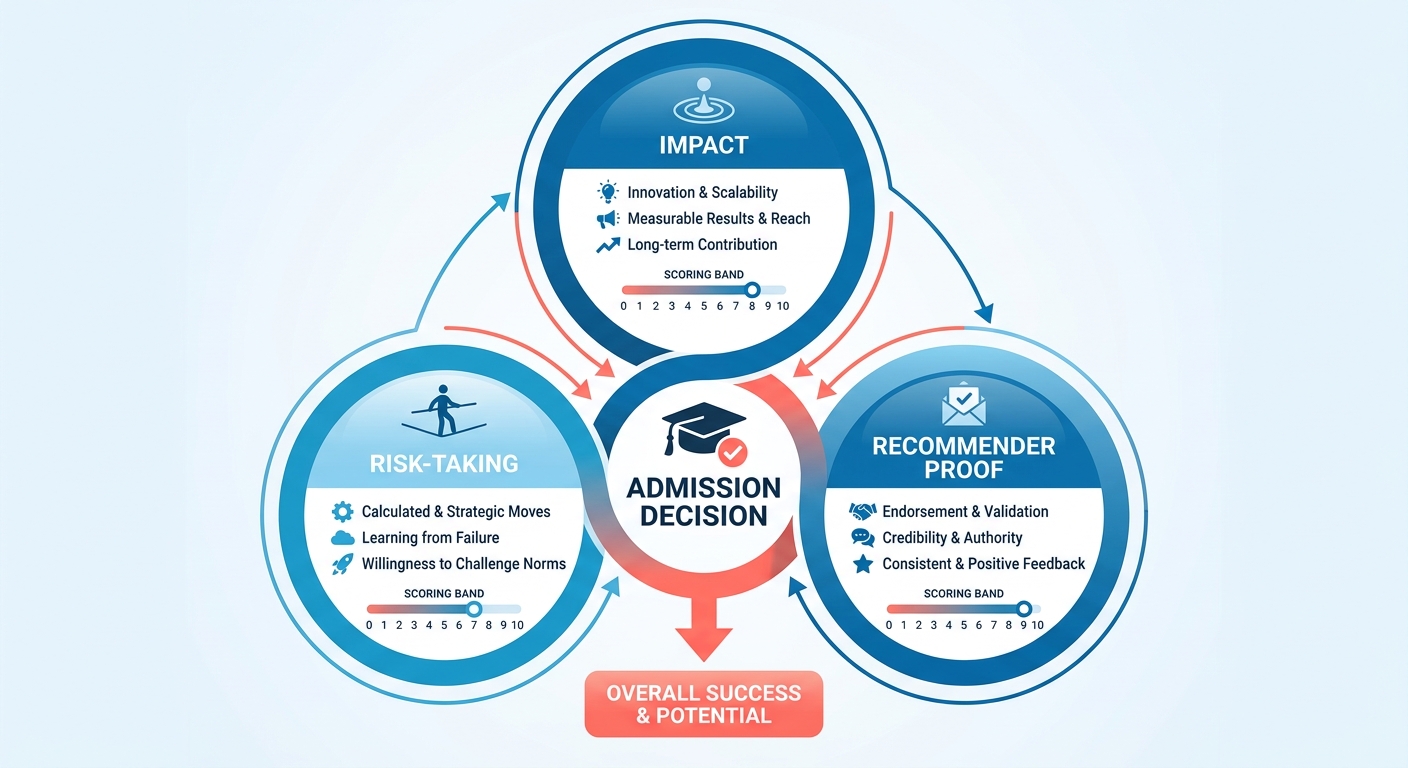
Scoring the Impact pillar
Impact measures the contribution you made through depth, outcomes, and leadership. Aim for ≥8/10 to appear "high-impact." Depth matters more than breadth. One deep project with numbers can outweigh five shallow memberships.
- Document measurable outcomes: dollars raised, students tutored, attendance growth, or published work. Committees want evidence of execution, not vague interest.
- Favor local leadership with hard metrics over vague national titles. Myth #1 is false: a county-level initiative with proven results can score as high as a national award.
Use careful framing when describing these activities. A sustained project often reads stronger than several one-semester roles. Officers may view duration as evidence of commitment. Show the full arc: where the project started, what changed, and where it stood when you left. A quantified before-and-after is stronger than a title alone.
What actually counts as risk-taking
Risk-Taking measures initiative and originality, not shock value. Myth #2 is false: risk depends on how far you moved beyond your resources, not on controversy. An independent initiative can show curiosity and execution without requiring an expensive external program.
- Build one original project that would not exist without you. Novelty can offset the resource advantage wealthier peers purchase.
- Show meaningful scale, not a weekend gesture.
Why one great letter isn't enough
Recommender Proof consists of specific, context-rich letters that support your narrative. Myth #3 is false: one glowing letter rarely carries an application. Committees seek validation across multiple touchpoints. If recommenders do not reinforce your core themes, readers may question self-reported achievements. This matters especially for students from underrepresented backgrounds. Outside validation can counterbalance biases in standardized metrics.
- Prioritize quality plus context over quantity. With limited recommenders, shape one letter around your circumstances and specific evidence.
- Give each recommender quantitative anecdotes that match your application. This helps readers see one consistent narrative.
Quantifying impact: the benchmarks Ivy readers respond to
Impact is the pillar many students misunderstand. It can determine whether an officer sees a contributor or a box-checker. If you are considering how to get into an Ivy League school under real constraints, measure impact against clear benchmarks. Log each data point to show growth over time.
Traditional extracurricular paths favor students with access to outside resources. Competing on those terms can backfire. Define impact through local problem-solving and self-directed initiatives. These activities show resourcefulness and agency.
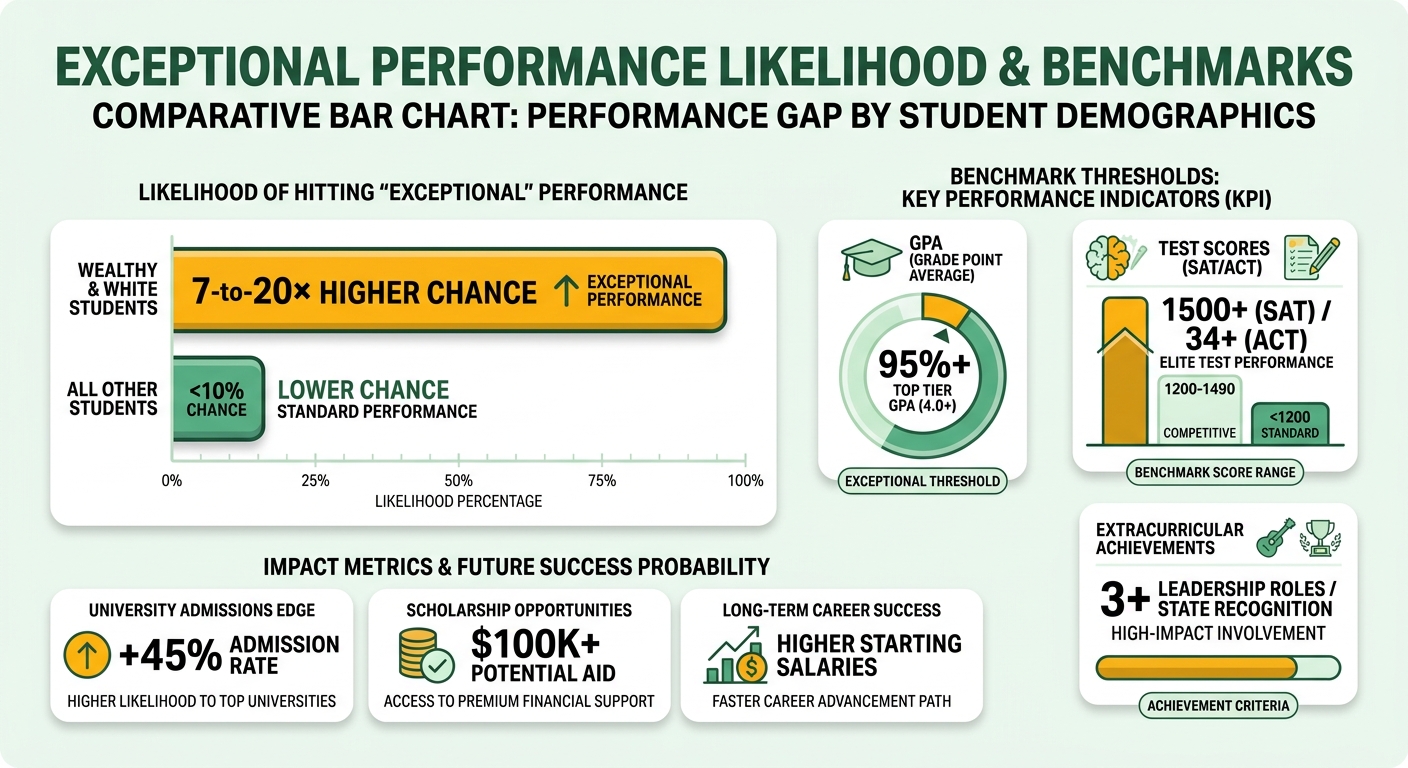
Which academic benchmarks signal high impact
Academic impact is the rigor and achievement shown by your coursework. Committees want sustained excellence, not one strong semester. Consistency across the transcript remains a primary readiness signal.
- Log a weighted GPA of 3.9 or higher. This signals that you met the rigor bar rather than relying on easy courses.
- Take 10 or more AP, IB, or college-level courses to show you exhausted your school's offerings.
- Record any national or state competition medals. These provide third-party evidence of ability.
How to measure extracurricular impact
Extracurricular impact combines measurable outcomes with sustained leadership. Prioritize activities with quantifiable results and roles you held long enough to shape. These are the signals readers weigh most.
- Hold at least two leadership titles for two or more years each. Longevity suggests commitment rather than resume padding.
- Attach a hard number to every activity, such as 1,200+ volunteers mobilized or $45K raised. The numbers make outcomes clear.
- Use regular check-ins with a mentor to test each activity and identify its weakest line before submission.
Reframing your activity list requires an objective review. Examine each commitment from several angles. You may find modest activities that can grow into meaningful work. Each line should support one coherent narrative of leadership and initiative.
Turning a modest activity into high impact
The most useful step is often scaling something you already run. Inventing something unrelated is not required. A school club that hosts a regional conference shows meaningful growth. Officers reward that progression.
- Expand a club into a regional event to show you can build beyond your campus.
- Document the before-and-after numbers so readers see the trajectory, not only the endpoint.
- Frame the work as a character-and-growth narrative. Holistic readers value this dimension, and it does not require family money.
A focused, well-documented project can be an efficient part of a college planning strategy. It can help you show intellectual vitality while working within conventional barriers.
Recommendation proof: getting specific, evidence-based letters
In highly selective admissions, recommendation letters provide qualitative support for your claims. Do not chase quantity. Shape the letters you submit around specific, contextual evidence. One letter describing your circumstances and intellectual contributions can outweigh several thin endorsements.
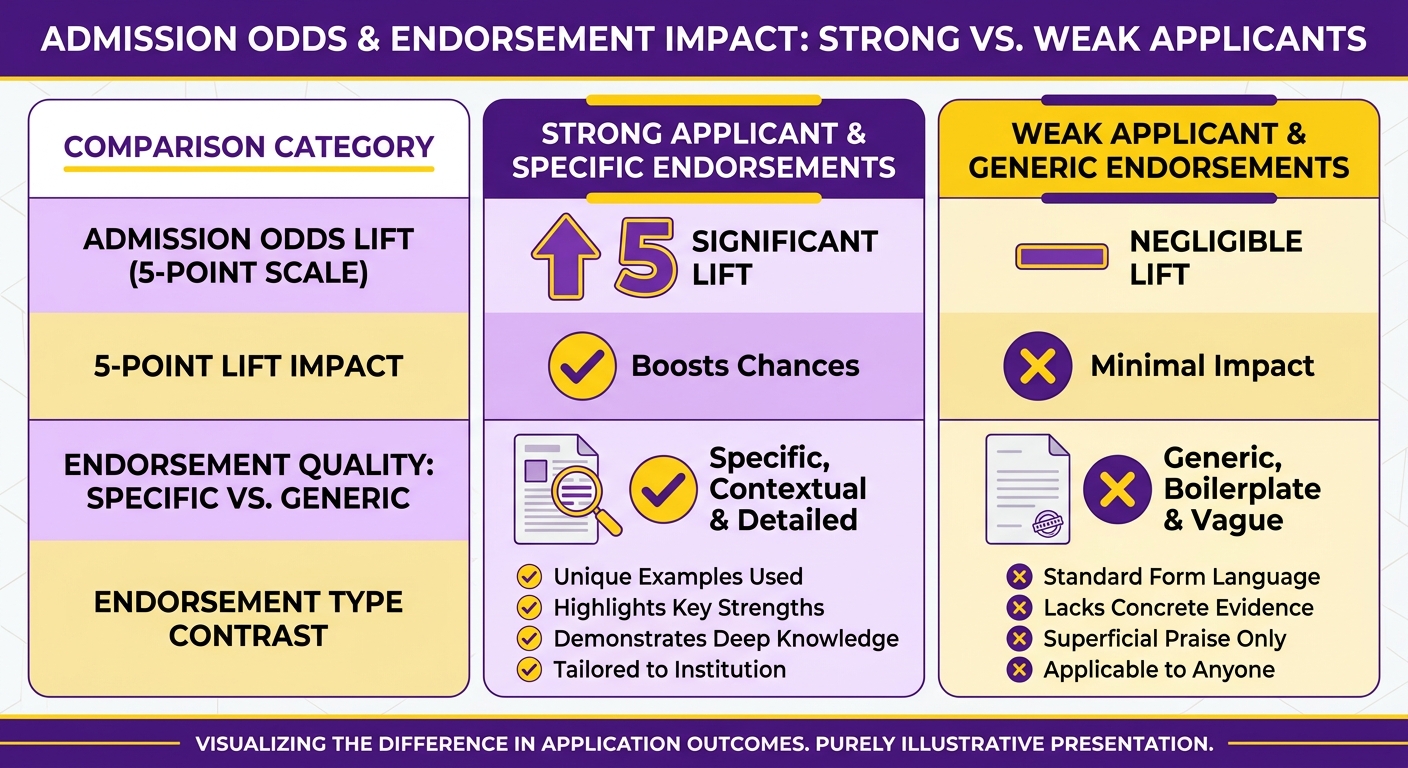
Why generic praise fails
Generic praise fails because it reads as a box-check, not proof. "Hardworking and kind" gives the committee no usable data. Recommenders need concrete examples and anecdotes showing curiosity and leadership. Provide clear, measurable milestones from their classrooms. This gives them evidence for a stronger letter.
- Build a one-page Proof-Packet for each recommender: three metrics, two anecdotes, and one direct quote from your work.
- Supply context your teacher cannot see: family constraints, hours worked, and limited resources. This can raise the officer's rating.
- Replace adjectives with outcomes. "Increased club membership by 250% over two years" provides evidence; "great leader" does not.
Who should write which letter
Match the recommender to the pillar you need proven. A core-subject teacher can document Impact. A project mentor can document Risk-Taking. A supervisor can document leadership. With limited recommenders, choose someone who can address your weakest pillar with evidence.
Allen Cheng of Prep Scholar stated the standard plainly: "To get into a top school, you need to demonstrate the ability to succeed in the future by achieving great things now," per CollegeData. Your letter should show the "now."
- Choose one recommender per pillar, rather than two who repeat the same story.
- Request letters the summer before senior year with an 8-week lead time. This prevents rushed drafts.
- Follow up at week four with the Proof-Packet attached again. Keep the message brief.
How to audit a draft letter
Audit every draft for specificity, context, and Constraint-Check alignment. A letter with a data appendix can move a recommendation score from 6 to 9 out of 10. Concrete evidence creates that change, not warmer wording.
Your letters and essays should work together. A systematic review flags vague language and checks that each component supports the same narrative. Our admissions and life-planning blog includes detailed application-timeline guides.
- Underline every claim without a number or example. Ask for supporting evidence.
- Confirm that the letter names your school's context. This helps officers evaluate your work against real constraints.
- Check that the strongest paragraph maps to your weakest Constraint-Check pillar.
Skip the packet-and-audit process only when a recommender knows your data thoroughly. That is rare. Most drafts benefit from the evidence you provide.
Timeline and checklist: building the Constraint Check into your plan
Effective preparation requires regular progress reviews. Waiting until senior year leaves less time for adjustment. A structured timeline lets each pillar, Impact, Risk, and Recommender Proof, build over time. It also helps manage academic demands while developing your profile.
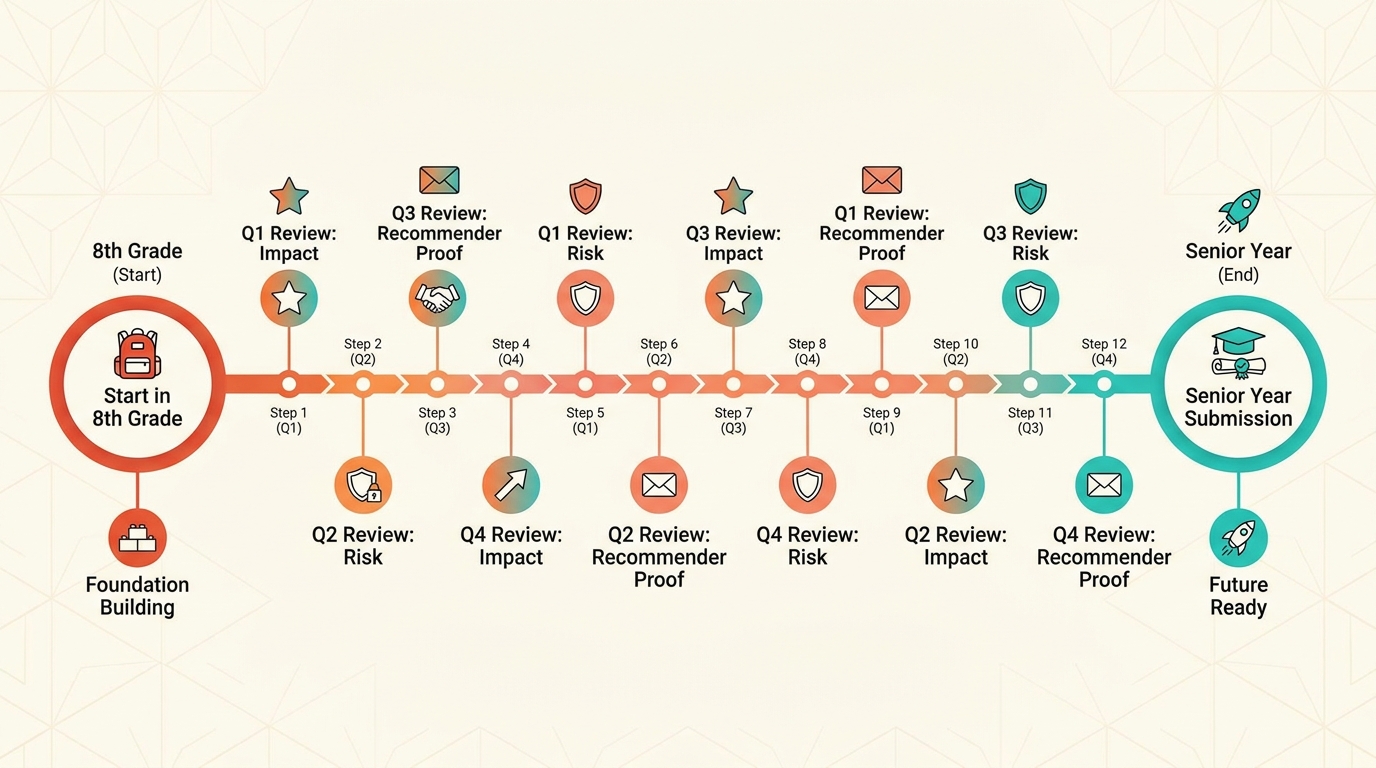
Your year-by-year milestones
Each grade has one anchor goal. Complete it before moving on, because these steps build on one another.
- 8th grade. Identify your passion. Choose one area you would pursue without prompting. This can connect your project, essays, and recommender's story later.
- 9th grade. Start data-tracking. Log hours, outcomes, and measurable results weekly. Early logs demonstrate growth over time.
- 10th grade. Launch your signature project. Turn your interest into something with a visible effect: a club, study, or small venture. This provides risk-taking evidence and recommender material.
- 11th grade. Deepen and document. Push the project to its most ambitious version. Begin assembling your recommendation packet so teachers can write with specifics.
- 12th grade. Package and apply. Convert three years of logs into your activity list, essays, and endorsements.
How to run quarterly reviews
Each quarter, score yourself from 0 to 10 on every pillar. Then choose one adjustment. This reveals weak areas while you can still address them.
- Update your quarterly impact score and compare it with last quarter. A flat score means you should change tactics.
- Check your project's risk level for stalled progress or overly safe choices.
- Build contingency now. Identify a backup project and an alternative recommender before you need them.
Skip the quarterly schedule only if senior year has already begun. In that case, complete the full review once. Direct your remaining effort toward the lowest-scoring pillar.
References
[1] NBER working paper on letters of recommendation - https://www.nber.org/system/files/working_papers/w30940/w30940.pdf
[2] How Ivy League Schools Review Applications - https://fortunaadmissions.com/how-ivy-league-schools-review-applications/
[3] How to Stand Out to Ivy League Colleges and Other Top Schools - https://www.collegedata.com/resources/getting-in/how-to-stand-out-to-ivy-league-colleges-and-other-top-schools
[4] Quantitative analysis of admission officer assessments - https://www.researchgate.net/publication/382097944_The_role_of_letters_of_recommendation_in_perpetuating_or_challenging_the_social_stratification_of_American_secondary_schools_a_quantitative_analysis_of_admission_officer_assessments_in_highly_selectiv
[5] Cultural Capital and Opportunities for Exceptionalism: Bias in University Admissions - https://www.researchgate.net/publication/352335805_Cultural_Capital_and_Opportunities_for_Exceptionalism_Bias_in_University_Admissions
Frequently Asked Questions
1. If letters of recommendation only add about 5 percentage points, should I bother asking for strong ones?
Yes. Recommendation letters provide qualitative support for your achievements. Overall admission statistics show modest shifts. A detailed letter can provide context about your school and personal challenges. It can also affect how officers rate your readiness and character.
2. Can a public-school student overcome the private-school rating gap through recommendations alone?
Recommendations alone cannot eliminate institutional disparities. They can add important context to your application. Combine strong letters with a self-directed, high-impact project. This gives your application several supporting signals.
3. What if I'm already a senior and skipped the 8th-grade planning runway?
Start with an immediate assessment of your three pillars: Impact, Risk-Taking, and Recommender Proof. Identify the weakest area. Use your remaining time to address that gap. A targeted adjustment can improve your application's overall cohesion.
4. Is a national award always more impressive than a local project?
Not necessarily. Admissions committees value depth, sustained commitment, and measurable local outcomes. A documented local project can show growth and community benefits. It may be more compelling than passive membership in a national organization.
5. How far in advance should I request recommendation letters, and how do I follow up?
Make requests during the summer before senior year. Give recommenders ample time to write. Provide a structured summary of achievements and academic milestones. Follow up midway through the process with a brief check-in and your academic resume.
6. Does risk-taking mean choosing controversial or shocking activities?
No. In admissions, risk-taking means intellectual curiosity and self-directed work. It shows agency and resourcefulness. Examples include an independent study or community project. Controversial topics are not required.
7. How does Endurable Education's panel review differ from a single college counselor?
A collaborative review evaluates your application from multiple perspectives. This approach can reveal blind spots and remove vague language. It also checks that essays, recommendations, and other materials support one unified narrative.