The Recommendation Letter That Sealed a Stanford Acceptance
August 2, 2026

Key Takeaways
- A Berkeley pilot study found that a one-standard-deviation jump in letter strength raised admission odds by 7% for marginal applicants.
- Letters matter most for bubble candidates and barely move clear admits or denials.
- Across the board, letters track student performance only weakly, around r ≈ .15 in a large meta-analysis.
- Letters and personal statements correlate at .41, which means both documents function as roughly the same admissions signal.
- Test scores and letters correlate at just .08, so the two measure almost entirely different things.
- Brief your recommender on your personal statement themes so both documents point the same direction.
- First-generation and underrepresented students get the biggest payoff from a deliberate, coordinated letter plan.
What a recommendation letter actually does
Less than the myth, more than the skeptics claim. A Berkeley pilot study found that a one-standard-deviation jump in letter strength raised a student's admission probability by 7%, and lifted the reader score by about a fifth of the distance from "Possible" to "Yes."
That effect lands where you'd want it to. Berkeley only invited students who were marginal for admission to submit letters. So the letter counts most when a decision is genuinely up for grabs. Clear admit or clear deny, and it barely registers. On the bubble, it can seal the file.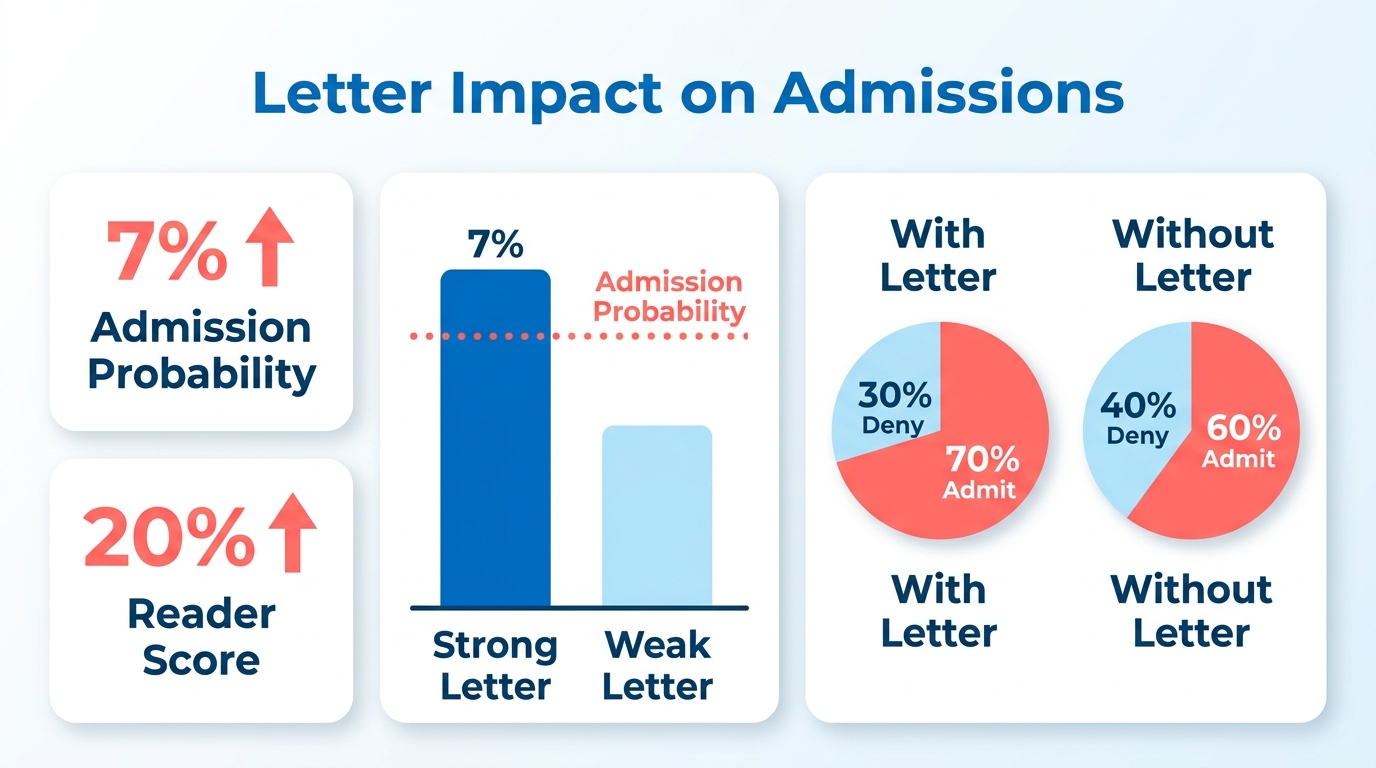
Zoom out and the picture stays modest but real. A large meta-analysis found letters correlate only weakly with performance overall, around r ≈ .15. If your energy is better spent on your essays or your coursework, spend it there. But the same analysis found letters correlate .41 with personal statements and just .08 with test scores.
Read those two numbers together and a rule falls out: your letter and your essay are basically the same signal. Brief your recommender on your personal statement themes, and the two reinforce each other. Leave them disconnected, and you get quiet dissonance that weakens both.
Who gains the most from a coordinated plan
First-generation and underrepresented applicants gain the most, because they're fighting a disadvantage no single study captures on its own. Counselor letters for these students run shorter on academic content, even when written by the same counselor. Private-school letters run about 20% longer.
Then it compounds. Berkeley found readers pay less attention to letter strength for underrepresented students, and letter evaluation is already noisy, at roughly .40 inter-rater reliability. Thinner letters, discounted weighting, inconsistent reading. Three failure modes stacked on top of each other.
This is exactly where a structured briefing earns its keep. Harvard's dean of admissions, William Fitzsimmons, reads letters for character and leadership. Give your recommender clear, organized context, and academic depth makes it into the letter regardless of how buried the counselor is. Hand them specific details about what you actually did, and they can write the kind of letter selective offices reward.
Picking the right recommender
The best recommender is someone who has worked with you closely and recently, and who can point to specific moments where your character showed up. Title and prestige matter far less than depth of contact. The Knight-Hennessy Scholars program says it plainly: "The strongest letters come from individuals who have interacted closely and recently with the applicant."
Students who get into highly selective schools tend to make the same call: they pick recommenders who know them well over recommenders with impressive titles. Closeness over clout is what fills a letter with real insight instead of polite, generic praise.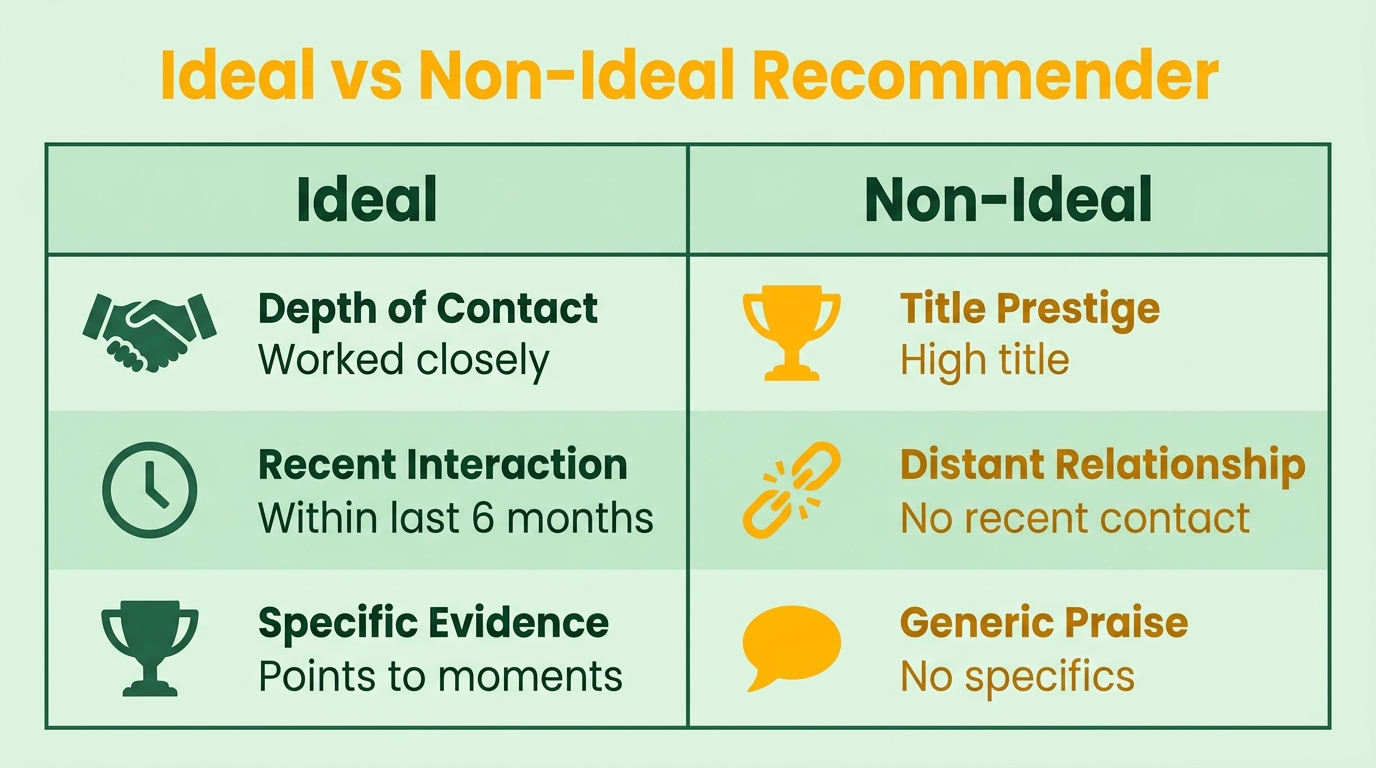
What the right fit looks like
A teacher or mentor who has watched you grow up close, can cite concrete examples, and can speak to how you think, not just what you scored. Stanford asks for two letters from different high school teachers, ideally from 11th or 12th grade in core subjects, with an optional third from someone who adds a genuinely new angle.
There's a tension here worth resolving. Selective programs keep saying relationship depth beats status. Yet Stanford's graduate admissions requires at least one letter from a university professor. Both are right, at different tiers. For first-year applicants, the teacher who knows you beats the department chair who barely does. For graduate and fellowship applications, institutional role sets a floor. Above that floor, relationship depth still decides everything.
Why the briefing is the high-leverage step
Choosing well is only half the job. The other half is handing your recommender enough material that their letter carries academic weight, not just warmth. Most families underestimate this part, and the research on what readers reward shows why.
Admissions officers respond to concrete detail, not adjectives. A recommender who writes "she rebuilt her lab procedure after three failed trials" tells a reader far more than one who calls a student "hardworking and bright." Specific anecdotes tied to how a student thinks are what separate a letter that moves a file from one that just fills a slot. Generic praise reads as the default setting, and readers discount it fast.
So a structured briefing packet does real work. Give recommenders specific academic milestones and project details, and the letter comes back dense with evidence instead of leaning on assumptions or a rushed skim.
How to ask
Ask early, ask in person, and hand over supporting material. Give your recommender your resume, a short note on the themes in your personal statement, and reminders of specific projects. One hard line from Stanford's graduate guidance: recommenders must be the sole authors. Drafting the letter yourself is a boundary you don't cross.
You want your essays and your letters telling one story about the same person. When they line up, they present a coherent picture of your intellectual interests. When they drift, the reader is left guessing. For more on coordinating these pieces, see our admissions planning blog.
Working with your recommender on the draft
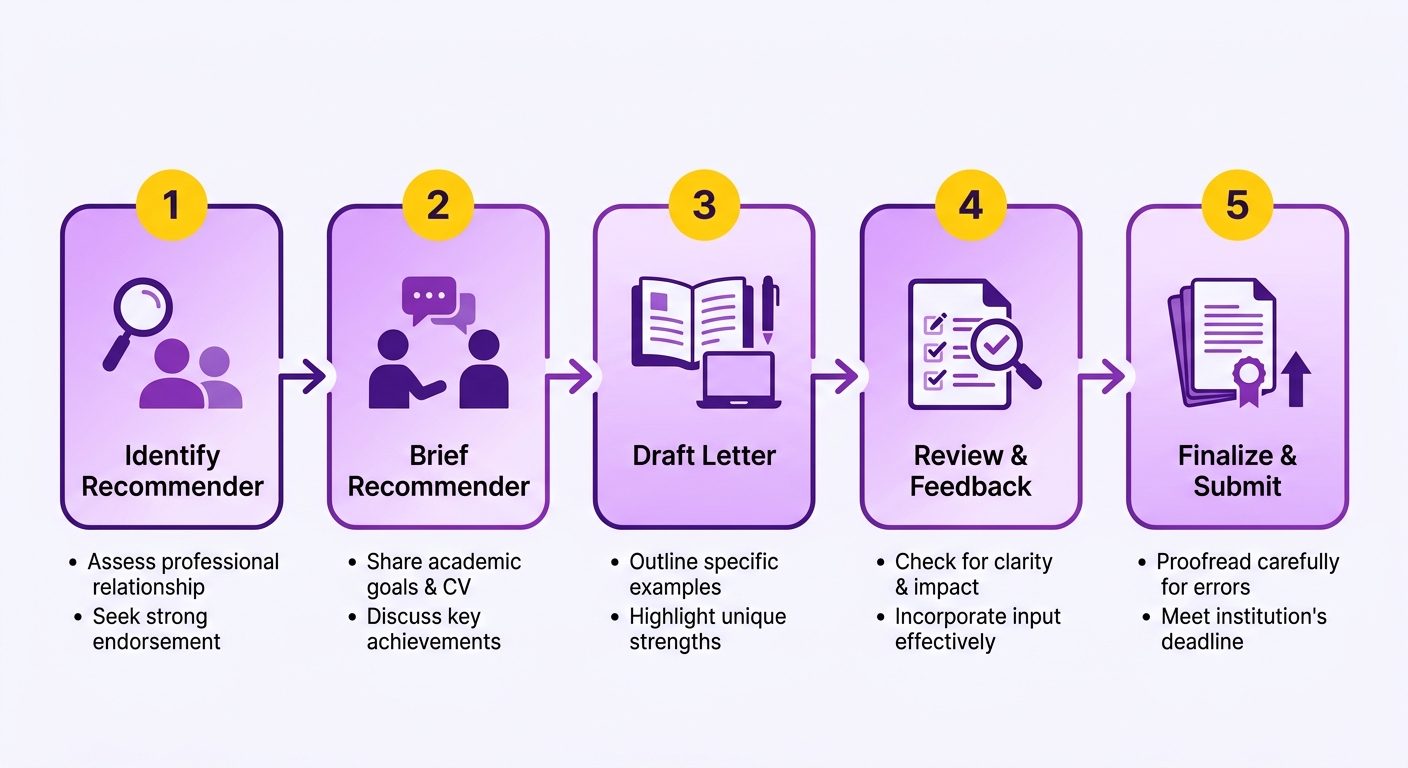
Good collaboration respects the line between giving context and writing the text. You never draft any part of the letter. What you can do is supply the raw material. That split keeps the letter fully authentic while still packing in the specifics a busy teacher might otherwise forget.
What you can hand over without crossing the line
Facts, themes, and evidence. Not prose. A safe briefing packet is a resume, a brag sheet with specific classroom moments, and a short note on the academic themes running through your application. It should jog the teacher's memory about your work in their class, not summarize your whole high school career. As Kati Sweaney at Reed College points out, concrete evidence is what steers a writer away from generic praise toward specific examples.
Why the letter should echo your essay
To an admissions reader, the two read as one continuous story about the same person. The meta-analysis on admissions letters found that two independent recommenders describing the same applicant agree only weakly, with inter-writer reliability around .28. That gap tells you how differently two teachers can frame the same student, and why a shared brief matters.
Point your recommender at your core themes, and you head off conflicting narratives. If your essay is about independent research and your letter is all about classroom compliance, the message thins out. Line them up and they work together. That coordination matters most for students whose counselors carry huge rosters, where a brief is often the only thing keeping academic detail in the letter at all.
When to skip the heavy briefing
Skip the deep briefing if a teacher already knows your work cold and writes strong letters by habit. Over-briefing that person adds friction and can flatten a voice that was warm to begin with.
But for a teacher who taught 150 students this year, a one-page memo is the difference between generic and specific. Ask early, share your materials, then step back and let them write.
Making academic strength and leadership land
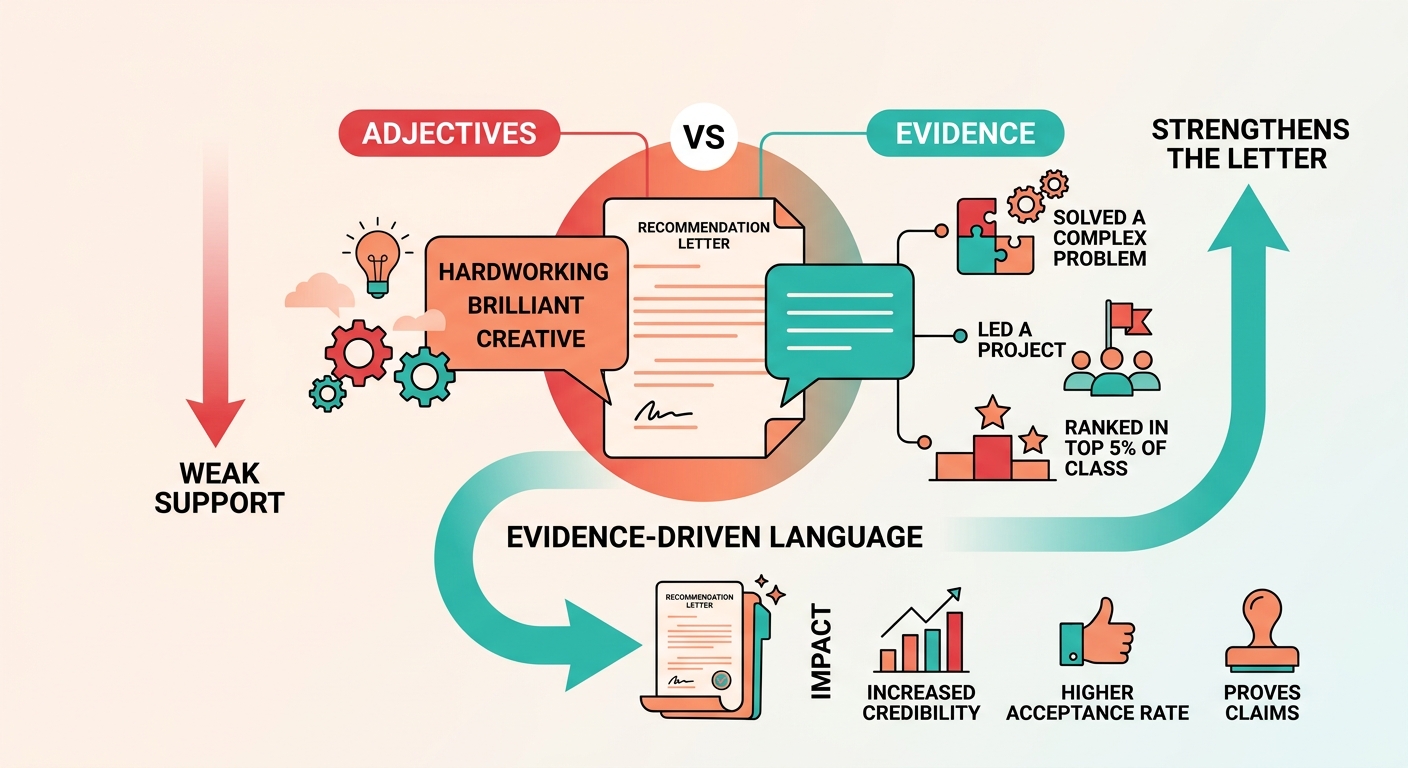
Academic strength reads best when a recommender swaps vague adjectives for concrete evidence. Instead of calling a student "brilliant," an effective letter names a specific problem the student solved, a sharp question they asked, or a real contribution they made to a discussion.
That matters because your metrics alone don't separate you. One applicant who was accepted at every Ivy they applied to credited two teachers who wrote past the transcript. An AP Chemistry teacher tied specific lab work to personal qualities. An AP English teacher wrote about independence of thought and leadership. Neither letter restated a GPA. When UCLA fields over 135,000 applications in a year, your file needs a human voice the numbers can't provide.
What makes academic praise convincing
The single strongest line a recommender can write is comparative, not absolute. "Top three students in fifteen years of teaching" carries more weight than "one of the best." The reason: the meta-analysis found narrative prose predicts outcomes less well than letters coded for favorability or peer ranking. Stanford's own graduate application even asks recommenders to rank applicants against peers.
So the most useful thing you can do is nudge recommenders to place you inside a specific, historical cohort of students they've taught. That turns subjective praise into a benchmark a reader can actually use.
How to show leadership without a title
Leadership shows up in your influence on other people, not in a line on your resume. Give recommenders anecdotes where you changed a group's dynamic, like reframing a stalled project or pulling a struggling classmate through. A concrete scene of character and collaboration beats a list of officer positions every time.
Tailoring the plan to your goals
Your recommendation strategy should track your actual academic goals. Prioritize recommenders who can speak honestly to both your intellectual depth and your character. And don't push for a comparative ranking a recommender can't give you sincerely, because a forced comparison from someone who barely knows you reads as hollow. Authenticity and detail beat superficial praise, always.
Aligning the letter with what Stanford reads for
Stanford reads letters to see how a student's character and intellectual energy fit its campus. Because the office values real insight into your abilities over a recommender's title, alignment has to come from concrete evidence, not generic adjectives. A strong letter shows how you think, ask questions, and work with others, rather than reciting your honors.
How to figure out what Stanford values
Look at the specific questions Stanford asks evaluators. Across undergraduate, transfer, and graduate applications, the university keeps asking recent instructors for detailed reads on academic potential and personal growth. That structure tells you Stanford wants a candid, well-calibrated take on your intellectual trajectory, not a highlight reel.
The language that signals fit
Comparative, highly specific language. When a recommender can honestly place your work in context, explaining how you stack up against other high achievers they've taught, the reader gets a benchmark they can trust. Steer recommenders toward honest, evidence-based comparisons of your relative standing rather than blanket praise.
Where applicants get the tier wrong
Know the requirements for your tier. Undergraduate admissions prioritize deep relationships with high school teachers. Transfer and graduate programs have firm requirements for academic references from university faculty. Once you clear those structural requirements, the depth of your relationship with the writer is what makes the letter feel real. A recommender who can speak directly to your academic engagement is the most effective way to set your file apart.
Case study: the letter that sealed the yes
The letters that lift a Stanford application tend to share a deliberate structure. In pools where thousands of applicants present near-identical metrics, a well-built letter is a genuine differentiator. It adds a qualitative layer to an otherwise quantitative file and gives admissions officers a clear window into how a student actually operates.
What made the sealing letter work
The most effective letters read like detailed witness statements, not generic character references. They turn broad claims into scenes a reader can picture. A history teacher might describe how a student spent weeks in local archives to resolve a contradiction between two primary sources for a term paper. That single anecdote shows curiosity, persistence, and research skill far more convincingly than the word "dedicated."
How hard each piece is to get right
Not every component takes the same effort. The hardest is the ranking statement, because it asks a recommender to honestly compare you against years of students. The easiest is factual accuracy, which a good brag sheet handles. Here's how the pieces stack up.
| Letter component | What it proves to Stanford | Who supplies input | Difficulty (1-5) | Prep time |
|---|---|---|---|---|
| Specific witnessed moment | Character in motion | Student brief + teacher memory | 3 | 1-2 hours |
| Peer ranking | Rarity of the trait | Recommender only | 5 | 30-60 min |
| Tie to Stanford's values | Community fit | Guided alignment | 4 | 1 hour |
| Factual accuracy | Credibility | Student brag sheet | 1 | 45 min |
| Independent authorship | Compliance with rules | Recommender only | 2 | Ongoing |
What students and recommenders should take away
The split is simple: the student supplies the context, the recommender supplies the judgment. Share your resume and application themes so the letter and your essays tell one story. But don't over-direct. Try to script the letter and you get a forced tone that readers catch instantly. Prepare clear, organized background material so your recommender has everything they need to write in their own voice. Start that coordination about a month out, and you'll get a polished, genuine result.
Mistakes that quietly sink a good letter
The most common mistake is treating the letter as an afterthought, giving the writer little notice and less context. Strong applicants start the conversation early so recommenders have time to think. The next most common error is chasing prestige over familiarity. Some tiers do require specific academic roles, but the depth of your connection with the writer is still what moves a letter from generic to memorable.
The traps that weaken a strong letter
The length trap first: a longer letter is not a better letter. Research on high school counselor letters shows the extra length often goes to listing activities and biography rather than to judgments about how a student thinks and works. Extra paragraphs read as padding, and a reader skimming hundreds of files feels that padding fast.
This tracks with the broader finding that structured, evidence-based evaluations outperform unstructured narrative praise. Density beats length. A tight letter that details one academic challenge you overcame and places your performance against your peers does more than several pages of compliments.
Final tips
For students, a structured briefing packet is the highest-value thing you can offer. It puts specific academic milestones in front of a busy instructor and keeps them off the generic template. For recommenders, the most valuable move is to anchor the letter in one specific classroom observation of the student's intellectual character, backed by clear evidence.
Why proofreading is the last mile
Proofreading protects everything above it. A letter with the wrong college name, a mismatched pronoun, or a stray typo signals a rushed relationship, and readers notice. Recommenders should read the final draft aloud once and check that every claim points to real evidence. Students should confirm submission through the Common Application well before the deadline. A clean, specific, honest letter is the version that seals the yes.
References
[1] Transcript, School Report and Recommendations - https://admission.stanford.edu/apply/first-year/forms.html
[2] Letters of Recommendation - https://admission.stanford.edu/apply/transfer/evals.html
[3] Recommendations - Stanford Graduate Admissions - https://gradadmissions.stanford.edu/apply/recommendations
[4] A Complete Guide to Stanford Letters of Recommendation - https://www.ivywise.com/blog/a-complete-guide-to-stanford-letters-of-recommendation/
[5] How to Write a Recommendation Letter for a Student: Teacher's Guide ... - https://www.collegeessayguy.com/blog/how-to-write-a-recommendation-letter
[6] Recommendation Letters - Knight-Hennessy Scholars - https://knight-hennessy.stanford.edu/admission/preparing-your-applications/recommendation-letters
[7] These 2 Recommendation Letters Got Me Into Harvard + the Ivy League - https://blog.prepscholar.com/teacher-recommendation-letters-that-got-me-into-harvard-and-the-ivy-league
[8] Ten simple rules for writing compelling recommendation letters - https://pubmed.ncbi.nlm.nih.gov/33630854/
[9] A Meta‐analysis of Letters of Recommendation in College ... - https://www.researchgate.net/publication/260406102_A_Meta-analysis_of_Letters_of_Recommendation_in_College_and_Graduate_Admissions_Reasons_for_hope
[10] Letters of Recommendation by High School Counselors in ... - https://www.researchgate.net/publication/393416608_Letters_of_Recommendation_by_High_School_Counselors_in_Selective_College_Admissions_Differences_by_Race_and_Socioeconomic_Status_in_Letter_Length_and_Topics_Discussed
[11] A pilot study of letters of recommendation - https://www.researchgate.net/publication/362345335_Qualitative_information_in_undergraduate_admissions_A_pilot_study_of_letters_of_recommendation
Frequently Asked Questions
1. What if the teacher who knows me best teaches an elective, not a core subject?
If your strongest relationship is with an elective teacher, their recommendation can be highly valuable as an optional supplemental letter. However, to meet core application requirements, your primary academic recommendations must still come from instructors in core subject areas who taught you in the upper high school grades.
2. Can a weak recommendation letter actively damage an application, or does it just fail to help?
A weak or generic letter can indeed harm an application, particularly by creating a disconnect between a student's self-reported achievements and the teacher's lack of specific detail. This lack of alignment is especially critical for applicants on the admissions bubble, where every component of the file is scrutinized closely.
3. If letters and personal statements share a high statistical correlation, doesn't that make one of them redundant?
While there is substantial statistical overlap in what these documents measure, they should be viewed as complementary rather than redundant. When coordinated effectively, they reinforce a consistent narrative about your intellectual goals. Without this alignment, they can present conflicting signals that dilute the overall impact of your application.
4. Is there a risk that over-briefing a recommender makes the letter sound like the student wrote it?
Yes, providing too much structured scripting can strip away the writer's natural voice, making the letter feel artificial. A deep briefing is most useful when a teacher manages many students and needs help recalling specific achievements. If a recommender already knows you well, they simply need basic context and key milestones rather than a highly detailed outline.
5. For graduate applicants, does relationship depth still matter once the professor requirement is met?
Meeting the formal requirement for a faculty reference is only the first step. Once that baseline is established, the depth of your academic relationship with the professor determines the letter's credibility. A reference from a faculty member who can provide a detailed, comparative assessment of your research potential is far more influential than a perfunctory letter from a prominent department head.
6. How do you invite a recommender to include a comparative ranking without putting them in an uncomfortable position?
You can frame this request around the standard evaluation criteria used by highly selective universities, which frequently ask recommenders to assess applicants relative to their peers. By asking the recommender if they feel comfortable contextualizing your performance within their teaching history, you allow them to provide this valuable perspective naturally and honestly.
7. Does the coordinated briefing strategy only matter for first-generation and underrepresented applicants?
While this strategy is particularly impactful for applicants who may face systemic disparities in counselor workloads, it is highly beneficial for any candidate. Because a compelling, detailed recommendation letter significantly enhances an application's competitiveness, coordinating with your recommenders is a valuable practice for any student navigating a highly selective admissions process.