The Recommendation Request Email That Made Teachers Say Yes
September 7, 2026

Key Takeaways
- Requesting a recommendation letter takes about two hours over six to eight weeks. The email itself takes under 30 minutes.
- Drafting the email takes 20 to 30 minutes per recommender, so timing matters more than wording.
- Most applications ask for one to three letters, so you'll repeat this process during each cycle.
- Recommenders need four things: an updated resume, your deadlines, submission instructions, and a clear reason you picked them.
- The request is low-difficulty because the right teacher and the right timing matter more than polished prose.
- William James College guidance is blunt: include the due date, the purpose, and personal details about your history with the recommender.
- Student mistakes here usually come from bad timing and poor targeting, not weak writing.
Quick Summary
Asking an Ivy-League alumni teacher for a recommendation letter takes about two hours over a six-to-eight-week runway. The email itself takes under 30 minutes to draft. Everything else is lead time, prep material, and picking the right person. Difficulty is low. Students usually miss on timing and targeting, not prose.
Here's the work at a glance before you write a single word.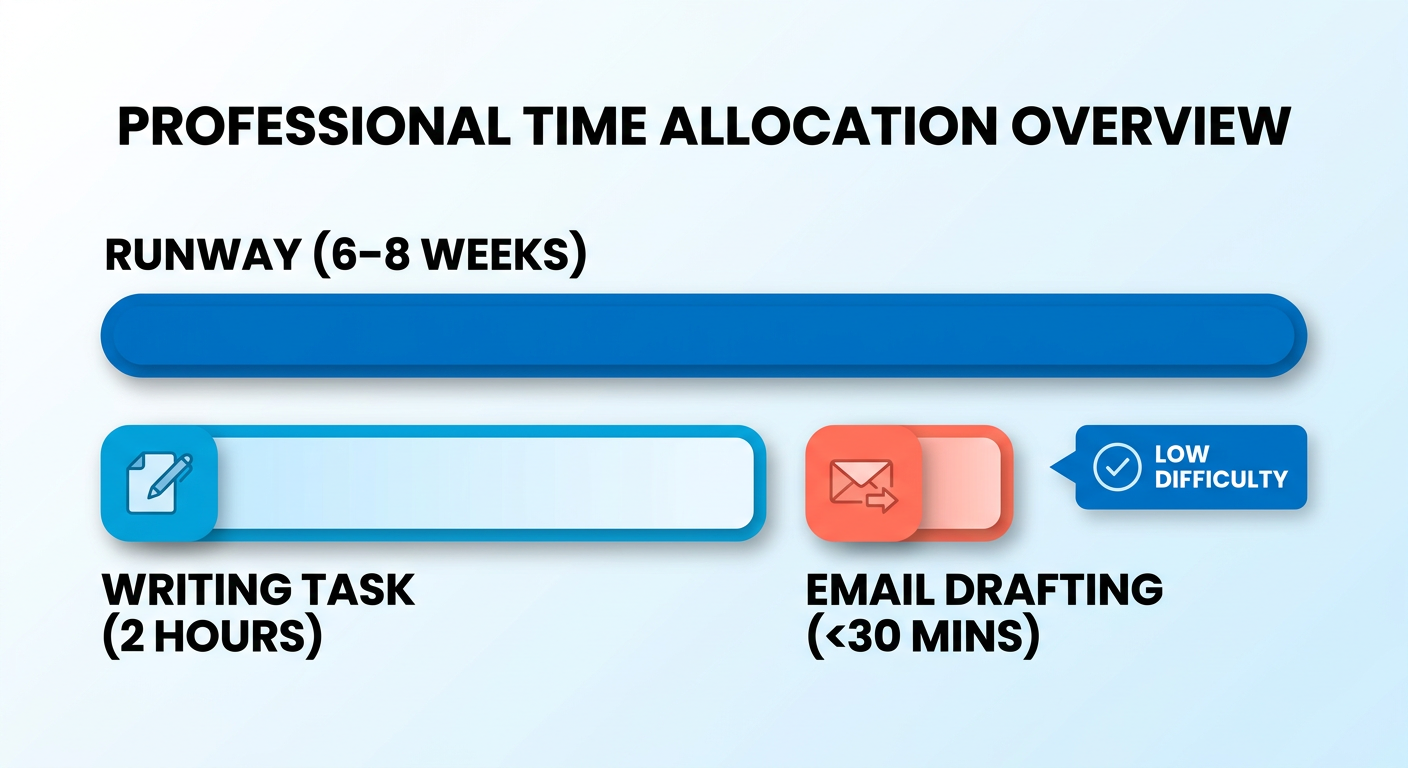
What the request actually involves
Send a personalized email that gives your recommender the deadline, the context, and the raw material for a specific letter. Applications usually ask for one to three letters, so you'll repeat this process more than once.
| Element | At a glance |
|---|---|
| Time to draft email | 20–30 minutes per recommender |
| Total lead time | 6–8 weeks before the deadline |
| Difficulty | Low (targeting and timing matter more than wording) |
| Prerequisites | Updated resume, "why you" reason, deadline list, submission details |
| Letters needed | 1–3 for most applications |
The prep matters more than the email. A recommender needs your updated resume, your deadlines, submission instructions, and a clear reason you picked them.
How far ahead should you ask?
Ask 6 to 8 weeks out for Ivy-alumni teachers. The sources disagree on the exact window, and the gap matters. ACT's college guidance says 4 to 6 weeks. Career-services advice pushes to 6 to 8. Coursera points to the end of junior year.
Our take: err toward the longer window. A Harvard or Yale grad who has read thousands of applications writes a denser, more specific letter, and that takes time. Give them room and you get a better product.
Timing beats wording. A polished email sent late still loses to a plain one sent early. The highest-return move here is calendar discipline, not sentence-crafting. Most students reverse that order and obsess over phrasing.
What makes the Ivy-alumni angle different
Your "why you" reason isn't just flattery. It's the anchor the letter gets built on. When you tell an alumni teacher you value their read on a selective-admissions journey, you give them the exact anecdote they need.
That justification becomes raw material. It flatters credibly, and it saves them work. A strong letter, as ACT puts it, "adds depth to your application and helps decision-makers see why you're a great fit." Alumni teachers know that voice firsthand because they lived it.
Skip heavy personalization if your recommender barely knows you. A generic "why you" reason reads as manufactured, and elite readers catch it fast. Better to pick a teacher who genuinely knows your work than to dress up a weak fit.
For deeper strategy on recommender selection, our team of Harvard and Yale graduates offers mentorship through the full application process, including which teachers to target and when to ask.
Why this beats polishing your essay for the tenth time
The recommendation letter you get from an Ivy-League alumni teacher can outweigh your personal essay in an admissions read. Yet most students spend weeks polishing the essay and fire off the request in ten careless minutes. That imbalance is backward, and fixing it is the whole point.
After years of coaching students through selective admissions, here's our read: the email that lands the letter is a more important piece of writing than almost anything else in the application. A teacher letter speaks to your character in ways grades can't, which is why letters are often required for both college and scholarship applications.
Why the recommender's vantage point changes everything
An Ivy-League alumni teacher has sat on the other side of the exact process you're entering. They know what a Harvard or Yale reader scans for, and your email can either tap that knowledge or waste it.
When you signal in your request that you value their specific vantage point, you do two things at once. You flatter credibly, and you give them the anchor for a personalized letter. This is where ACT's advice, that strong letters use specific examples instead of general praise, pays off. Your "why you" justification becomes their raw material.
Generic recommenders write generic letters. A teacher who understands the elite-admissions hierarchy firsthand can calibrate a letter to what those committees actually reward.
How much lead time elite recommenders really need
Give an Ivy-alumni teacher six to eight weeks, not four. The longer window matches how these recommenders actually work.
Standard timelines suggest a shorter four-to-six-week window, but elite recommenders often juggle dozens of requests at once. Pushing your ask to six to eight weeks ahead gets your letter drafted before teacher burnout sets in at the peak of application season.
The four-to-six-week floor is the bare minimum for a routine letter. Teachers who write detailed, example-rich letters put real hours into each student, and the elite-alumni recommenders you want are exactly the ones writing the longest, most specific letters. Err toward the longer runway.
Who you should even be asking
Pick teachers who know you well from junior or senior year. Familiarity beats title every time.
Students who ask their junior or senior-year teachers tend to get more personalized letters, and that matters more than the recommender's alma mater on its own. An Ivy-alumni teacher who barely remembers you writes a thinner letter than a devoted teacher who watched you grow.
The ideal case combines both: a teacher who knows you deeply and carries elite-school credibility can vouch for you in a language admissions readers trust. Coaches and community leaders can add a character perspective too, but the teacher letter stays the anchor.
Committees look for authentic advocacy, not prestigious signatures. If you have to choose between a distant Ivy alum and a teacher who has watched your intellectual growth daily, take the educator who can speak to your resilience, curiosity, and classroom leadership.
Prerequisites
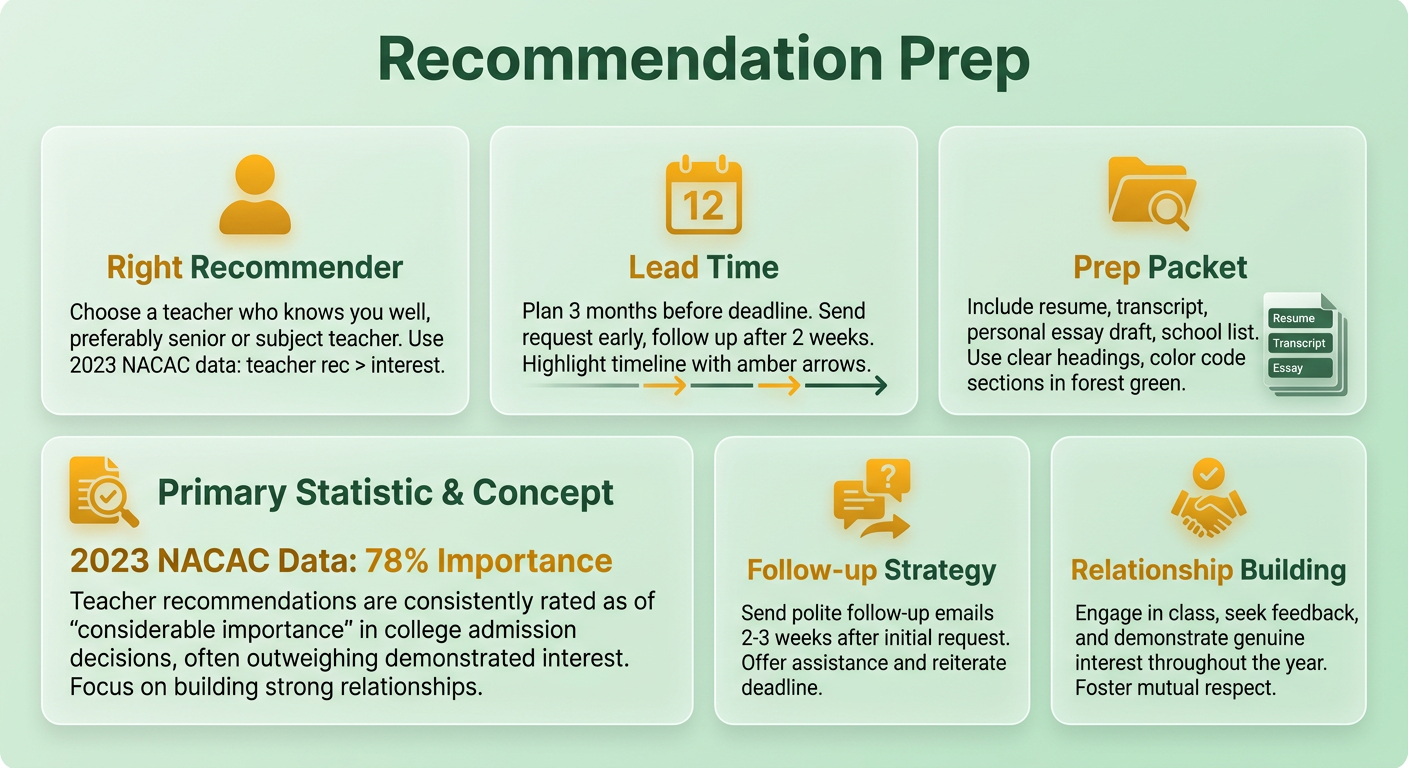
Before you draft a single line, you need three things in place: the right recommender, enough lead time, and a prep packet the teacher can actually use. Miss any one and even a perfect email falls flat. This setup decides whether an Ivy-alumni teacher says yes with enthusiasm or writes something generic.
Preparing the materials in advance also respects your recommender's time. Organize your academic history and goals before you ask, and you make it easy for a busy teacher to say yes. When they sit down to write, they can focus on your character and achievements instead of hunting down basic details.
Who you should actually ask
A core-subject teacher who knows your work and, ideally, understands the selective-admissions bar firsthand. The Bridge to College guide says your first two letters should come from English, Math, Science, or Social Studies teachers, with an optional third from a mentor who knows you well.
Build a short list of names, not one. Career-services advisors suggest a few backup recommenders in case your top choice is swamped or declines.
When you can, aim for teachers with firsthand experience in highly selective environments. They know how to frame your academic record in a way that reads well to elite committees, which helps in a competitive pool.
How much lead time you need
Give elite recommenders room to plan their writing schedule. Standard ACT guidance sets a baseline, but Martin Walsh, a former Stanford assistant dean of admission, recommends 90 days' notice for highly competitive programs. That extended window matters most if you're applying early action or early decision, when teacher workloads peak.
A generous buffer is essential for an alumni teacher writing a detailed, personalized letter. These recommenders put significant effort into building a narrative around your strengths. A rushed ask forces them onto a generic template, which defeats the point of targeting them.
Skip the long runway only if you're chasing a late-breaking scholarship deadline. In that case, a direct, apologetic ask with everything the teacher needs beats staying silent.
What goes in your prep packet
Organize your academic history into a clean, easy-to-scan format. The ACT and William James College guides both stress that structured information prevents administrative delays and lets the writer focus on your character.
Add one thing the templates skip: a specific reflection on your time in their classroom. Naming a particular project or discussion that sparked your interest helps the teacher recall your participation. Building these academic connections early is a cornerstone of long-term college planning, and it pays off when application season arrives.
Step-by-Step Implementation
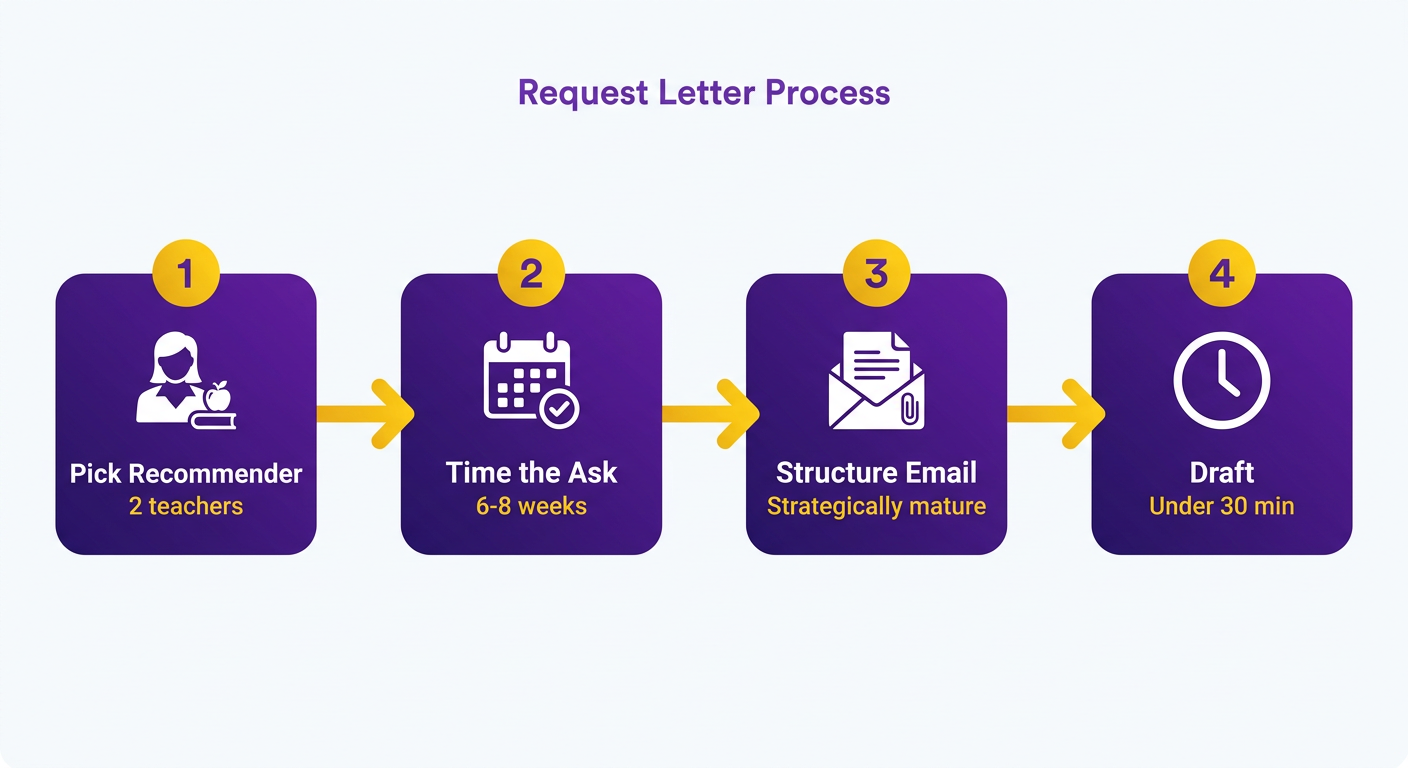
Building a request letter that lands with an Ivy-alumni teacher follows a clear sequence: pick the right recommender, time the ask, then structure the email so it reads as strategically mature. The draft itself takes under 30 minutes once your prep packet is ready. Here's the order that works.
Get the sequence wrong and even a polite request falls flat. An elite-school-trained reader notices a rushed timeline or a vague ask immediately. Treat each step below as load-bearing.
Who to target, and when
Pick educators who can speak to your academic abilities in fields tied to your intended major. Reaching out early gets you commitments before teachers hit their self-imposed limits for the semester.
Aim for a mix that reflects your academic interests. The Bridge to College guide suggests choosing teachers from different disciplines to show your range. Recent instructors help too, since they can speak to your most advanced coursework and current intellectual maturity.
For calendar planning, think about the school year's natural bottlenecks. Making contact well before the standard 4-to-6-week baseline keeps your request from getting buried under grading and the college-application rush.
Popular teachers often cap the number of recommendations they'll write to protect the quality of their output. Asking early shows you respect their workload and sets a collaborative tone for the whole process.
How to structure the email itself
Use a three-part architecture. Open with a confident, direct ask. Follow with deference and context. Close with an explicit decline option that lets the teacher say no cleanly.
Pragmatics research on faculty email requests found that effective asks combine direct and indirect politeness, rather than defaulting to soft indirectness. Student-facing guides say the same thing more plainly: be concise and confident, because teachers are often eager to help.
Both are right, and for an elite-school reader the calibration is the whole game. Confidence in the ask signals you value your own candidacy. The explicit "no pressure if your plate is full" line signals you respect their time. Get this register wrong and it reads as inappropriate, not merely awkward.
What goes in the prep packet
Give them a curated selection of your academic highlights. Instead of a generic list, focus on two or three key milestones, like a hard research paper or a breakthrough in a tough lab, that show intellectual curiosity and persistence.
Those details give the writer concrete evidence to reference. When you highlight specific classroom moments, they can build a narrative with real examples of your engagement instead of digging through old gradebooks.
A well-organized packet also signals you're ready for what comes next. Committees value that kind of foresight, and it's a theme we come back to on our admissions planning blog: presenting yourself as a mature, self-directed candidate.
Best Practices
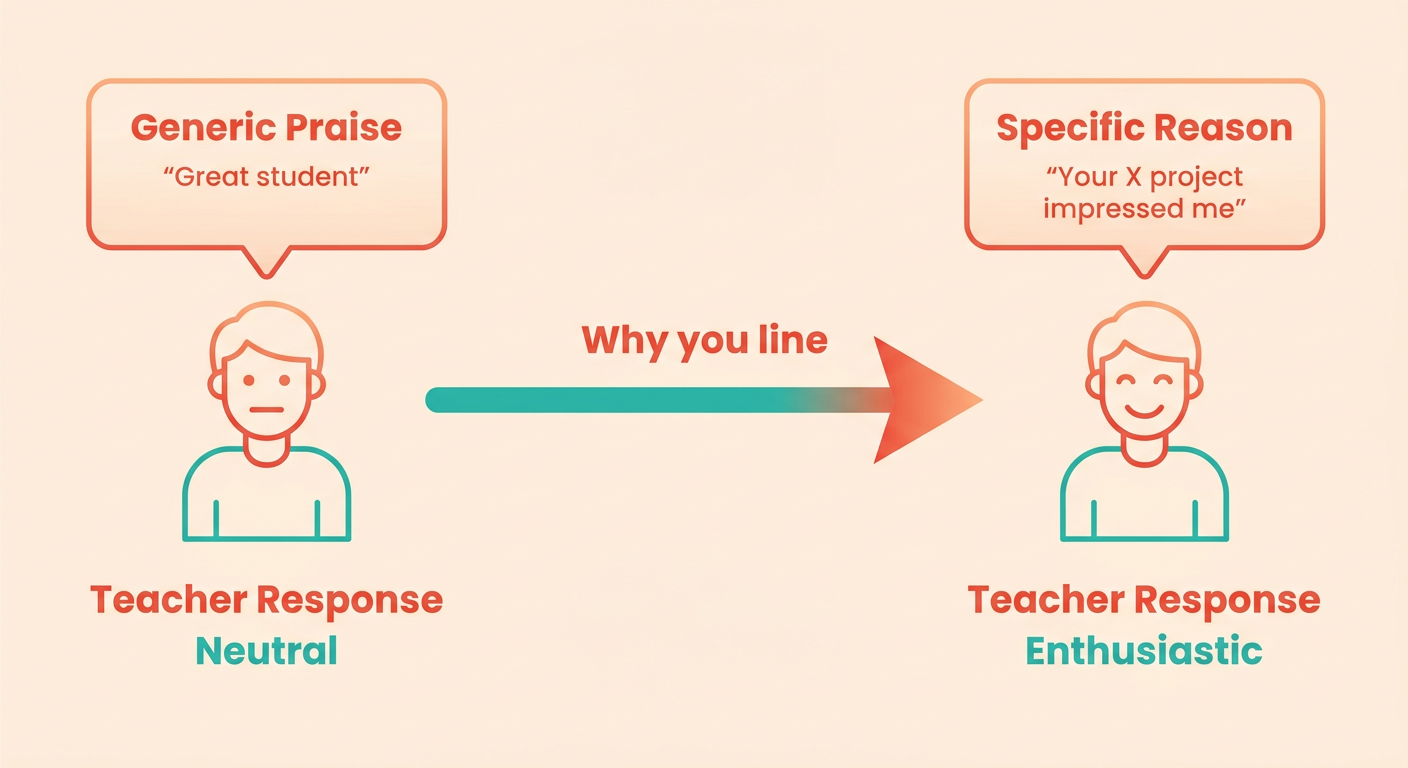
The biggest lever in a request letter is a genuine connection with your writer. A teacher who has written dozens of these can tell sincere appreciation from superficial flattery in a sentence. Point to a specific aspect of their teaching or a particular classroom discussion that actually shaped your academic path.
That opening sets the standard for the letter itself. Lead with clear, focused details and you nudge your recommender to do the same, in line with college planning advice that favors substance over vague compliments.
What to optimize first
Operational efficiency over perfect prose. Getting your request in before your teacher's schedule fills up matters far more than agonizing over every sentence. Standard timelines give you a rough guideline, but securing your spot early is the surest way to a thoughtful, unhurried response.
A generous timeline matters most for recommenders who understand the nuances of highly selective admissions. A rushed request suggests you didn't plan; an early ask gives them time to build a compelling narrative around your potential.
Targeting matters just as much. Your primary letters should come from teachers who have graded your work in core subjects. Choose the educator who has seen your intellectual growth firsthand over the one with the more impressive alma mater.
The common pitfalls
A frequent mistake is treating the request email as a casual chore. It's a formal piece of academic correspondence that reflects your communication skills and your respect for professional boundaries. How you approach your recommenders can shape how strongly they advocate for you.
The tone takes some balance. Respectful without being overly apologetic, clear without sounding demanding. Research on academic communication points to clear, polite requests as the most effective, while student guides remind us that teachers are generally eager to help.
Both are right. Be confident in the ask, precise in the phrasing. For a formal, elite-school-trained reader, that means a clear, direct request wrapped in genuinely specific context. Over-groveling reads as unsure; blunt demands read as entitled.
How to give them raw material
Hand your recommender specific, usable memories. Instead of making them recall everything about your performance, offer a short summary of a key classroom moment where you overcame a challenge or worked well with peers.
Lay out the logistics clearly. A structured list of deadlines and submission portals prevents confusion and lets your recommender focus on the content of the letter, as standard application checklists advise.
Authenticity is the ceiling. If you don't have a strong connection with a particular teacher, no amount of background packet will fix it. Build genuine relationships across your high school years. That's the real foundation of a well-planned application.
What I'd actually tell you to do
The whole point of a strong request letter is that it does most of the work before your teacher opens a blank document. Get the recommender, the runway, and the prep packet right, and the email becomes the easy part. That's the sequence we coach, and it holds up especially well with Ivy-alumni teachers who read these emails through an elite-school lens.
Here's the one-line version to carry with you. Pick early, ask early, and give them raw material. A request that names a specific reason you chose that teacher, respects a six-to-eight-week runway, and hands over a usable prep packet is the one that gets an enthusiastic yes and a detailed letter.
What to do next
Start with your list, not your draft. Figure out which educators best understand your academic abilities. Build a simple tracking sheet with their names, submission deadlines, and the materials you need to compile before reaching out.
Then compile the documents. Update your resume and draft a concise summary of your academic goals. Files organized and ready to attach means a clean handoff from your email to the actual writing.
Then write the email. Keep it under 30 minutes. Lead with the deadline and the "why you" line, attach the packet, and close by making it easy to decline gracefully if they can't commit.
Where to go deeper
Skip the extra reading if your list and runway are already set. You don't need more articles. You need to send the email. Over-researching the perfect phrasing is the most common way students burn the six weeks that actually matter.
If you want the wider view on how these letters fit your full admissions plan, our team writes about timing, targeting, and positioning across the application on the Endurable Education blog. That's where to connect this one email to the bigger strategy.
Now go send it.
References
[1] How to Ask for a Letter of Recommendation for College: Step ... - https://www.collegeessayguy.com/blog/how-to-ask-for-a-letter-of-recommendation
[2] How to Ask for a Letter of Recommendation (Template + Tips) - https://www.coursera.org/articles/how-to-ask-for-a-letter-of-recommendation-template-tips
[3] How to Ask for a Letter of Recommendation for College - ACT - https://www.act.org/content/act/en/students-and-parents/college-planning-resources/applying-to-college/how-to-request-letters-of-recommendation.html
[4] Asking for a Letter of Recommendation – Bridge to College - https://voices.uchicago.edu/bridgetocollege/2020/05/28/132/
[6] How to Ask for a Letter of Recommendation - Career Services - https://career.eoss.asu.edu/blog/2022/09/15/how-to-ask-for-a-letter-of-recommendation-2/
[7] How to Ask for a Letter of Recommendation - https://www.williamjames.edu/news/how-to-ask-for-a-letter-of-recommendation.html
[8] Letters of Recommendation Email Template | Sacred Heart Online - https://onlineprograms.sacredheart.edu/application-central/letters-of-recommendation-email-template/
[9] Teaching to write e-mail requests to faculty - ResearchGate - https://www.researchgate.net/publication/285009370_Please_write_a_recommendation_letter_Teaching_to_write_e-mail_requests_to_faculty
Frequently Asked Questions
1. Can I ask the same teacher for letters to multiple colleges at once?
Yes. Most application portals, such as the Common App, let recommenders upload one letter for all your selected colleges. To keep this simple, give your teacher a full list of target schools and deadlines in your initial prep packet.
2. What should I do if my only Ivy-alumni teacher barely knows me?
Choose relationship depth over prestige. Admissions officers want detailed insight into your classroom engagement, curiosity, and character. A teacher who knows you well can give specific anecdotes, while a distant alumnus can only offer generic praise.
3. What happens if I have a late-breaking scholarship deadline and can't give six weeks?
In urgent situations, be direct and respectful. Reach out immediately with a polite message explaining the sudden opportunity. To reduce the burden, provide a complete prep packet right away and offer to answer any questions in person.
4. Should my letters all come from academic teachers, or can I include a coach or mentor?
Academic recommendations should stay the priority because they address classroom performance and intellectual ability. Non-academic recommenders can add useful context on leadership, teamwork, and character. Use those letters to highlight parts of your personality that do not show up in class.
5. Why should I build a short list of recommenders instead of asking just one?
A list of potential recommenders is basic contingency planning. Teachers have demanding schedules and limits on how many letters they can write each term. Backup options let you pivot quickly if your first choice is unavailable.
6. How is a recommendation request email different from an admissions essay in importance?
Your personal essay tells your story. A recommendation letter gives outside confirmation of your character and academic achievements. Admissions committees use these letters to verify the qualities you claim. A careful request email helps your recommender provide that support.
7. What if I want expert help choosing which teachers to target?
Choosing among teachers while tracking college expectations can be difficult. Professional guidance can help you assess your relationships with different instructors and identify who can write the strongest advocacy. Our team provides personalized strategy sessions to help you map out your outreach, so every part of your application works together.