What Admissions Readers Look For in Your Personal Statement's First Two Minutes
September 15, 2026

Key Takeaways
- Admissions staff at Russell Group universities spend an average of just 90 seconds on each personal statement, according to a Hepi survey.
- A 650-word essay takes roughly two minutes to read aloud, so a reader who stops at 90 seconds never reaches the ending.
- University College London took over 76,000 applications last year, about 2,500 hours of reading at two minutes each.
- For most readers, the opening functions as the entire essay, not a warm-up for the real content.
- UK Russell Group admissions are grade-driven and fast; US top-35 review is holistic and gives the essay real weight.
- A memorable essay can give students with lower exam stats a competitive edge in holistic US admissions.
- Treat the first two minutes as a micro-essay pitch, drafted and tested on its own, because that's how quickly readers decide.
The first two minutes are the whole game
The math behind your personal statement for university points to something uncomfortable: readers barely read it. A Hepi survey reported by the Guardian found admissions staff at Russell Group universities spend an average of 90 seconds per statement. University College London took over 76,000 applications last year. At two minutes each, that's 2,500 hours of reading.
Look at the timing. A 650-word essay runs about two minutes read aloud. If the reader stops at 90 seconds, they never finish it. So the opening isn't a warm-up for the main text. For most readers, the opening is the essay. Treat your first two minutes as a micro-essay pitch. Draft and test it as its own stage.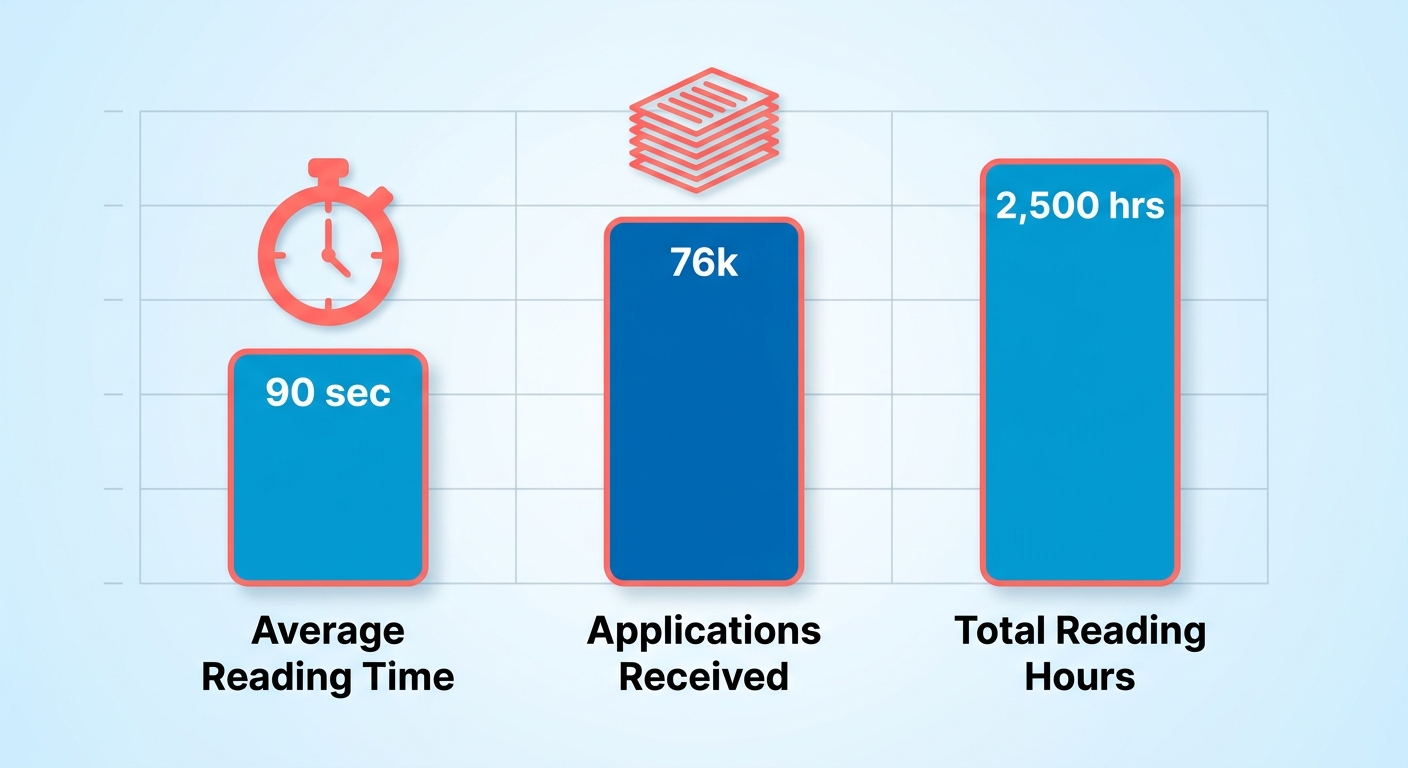
Does the opening really outweigh the rest?
In holistic US admissions, yes. The systems differ sharply by region. The Guardian piece argues UK decisions lean primarily on exam grades, not the personal statement. A college writing guide counters that a memorable essay gives students with lower stats a real edge.
Both are true, in their own systems. UK Russell Group review is grade-driven and fast. US top-35 review is holistic, and the essay carries real weight. But even inside a rapid UK read, the opening sets the tone because there's so little reading time. When an office fields tens of thousands of applications in a cycle, your first lines compete against reader fatigue.
What the first two minutes have to deliver
Four things need to land right away: a hook, a hint of your values, an authentic voice, and a clear fit with the school. Test these early, and the essay builds momentum instead of stalling.
- Open with a specific scene, not a thesis. JRA Educational Consulting gives an example that opens mid-dialogue: "That's alright, no one was expecting a good score," a teacher says. Concrete moments beat abstract claims.
- Signal a value in the first paragraph. Emory's team stresses tying reflection to what the school actually cares about. Re-pitch the same hook per school; you're writing for one specific committee, not a generic audience.
- Sound like a person, not an applicant. As a Collegewise counselor put it, a strong statement lets the reader connect with a person, not just another applicant.
- Show agency, not a sob story. Officers prefer resilience over pity. Frame hardship around what you did about it.
The make-or-break mistakes
The fastest way to lose a skimming reader is a slow start. Clichéd opening lines, throat-clearing preamble, and generic values that could fit any school all read as noise on a first glance. Settle on a clear concept for your hook before you draft. Keep one central focus, and save final polish for after the body is done.
Write a hook that earns the next sentence
Your hook has one job: earn the next sentence. In a brief review window, the opening line decides whether a reader leans in or moves on. That is why you build it deliberately before the rest of the narrative. A strong personal statement for university doesn't warm up. It drops the reader into an active scene.
The best openings show a person in action rather than a résumé summary. That fourth-grade teacher's dismissal works because it puts you straight into a point of tension. That tension pulls the reader forward.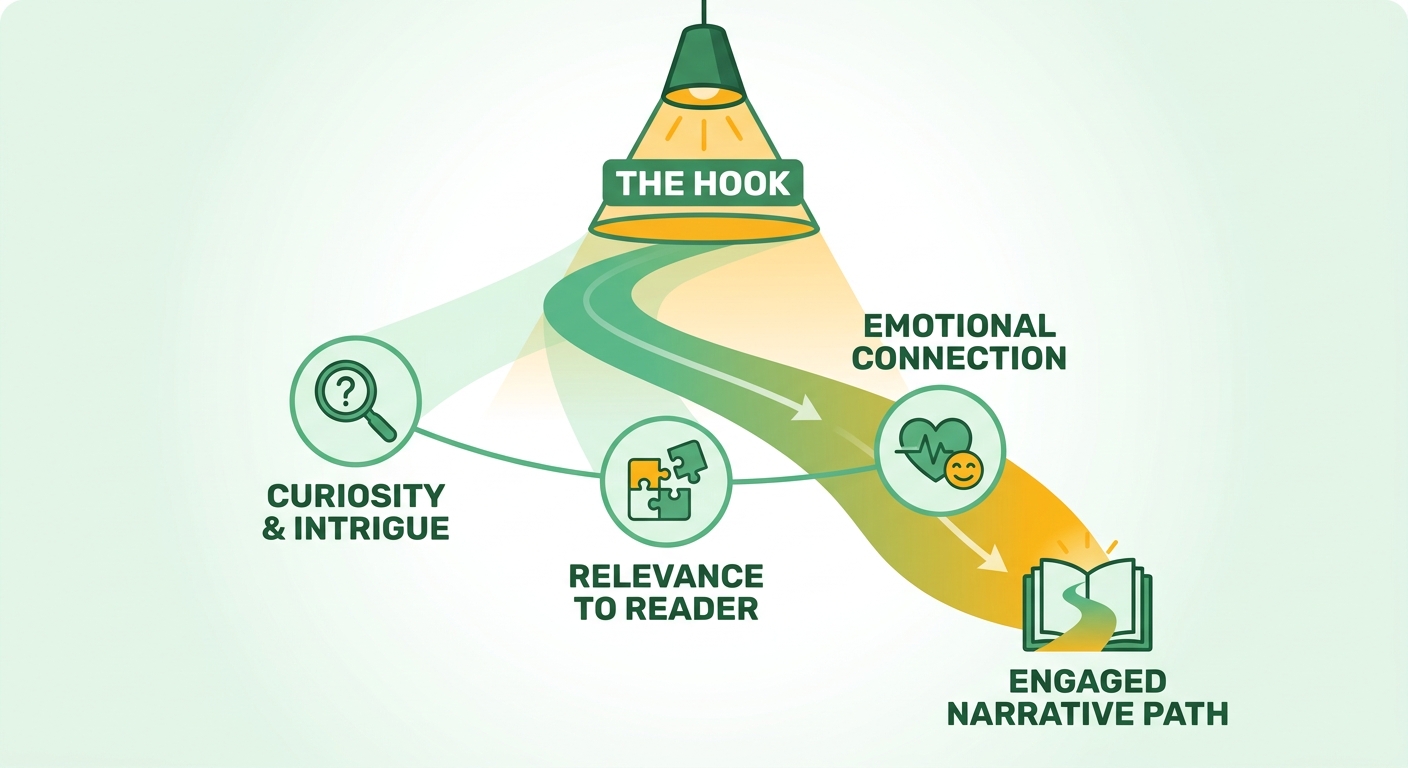
Story-first or statement-first?
Story-first openings almost always win. A scene with sensory detail and specific stakes creates connection right away; an abstract thesis makes the reader wait.
Dr. Mark Butt, who reads over 3,000 statements a year at Emory, makes the same case: honest storytelling beats reporting. Reporting summarizes facts. Storytelling invites the reader into a formative moment.
The way to hold both is simple. Define the core premise early so you have direction, then polish the sentences last so the hook flows into the body paragraphs.
- Open in a specific scene with a clear stake, not a static summary. Scenes create the velocity that keeps a reader going.
- Lead with active verbs and concrete sensory details. Specific observation carries experience further than broad generalization.
- Pick an anecdote that's personal but broadly resonant. Shared moments can create shared meaning.
The hook pitfalls to cut
Cut clichés, over-dramatic openings, and unreflective hardship stories. Writing Classes notes that officers prefer resilience and agency over pity. Active problem-solving signals maturity; exaggeration creates distance.
- Delete generic quotes and dictionary definitions. Readers see hundreds of these; they signal a writer without an original angle.
- Swap trauma-for-effect for genuine growth. The India-trip essay that sparked a passion for environmental justice works because it focuses on the insight that emerged, not on the discomfort.
- Test the first line against a specific school's mission. Tailoring it makes the hook land with each committee's stated priorities.
A quick brainstorm prompt
Start with a brain dump. List ten moments where you surprised yourself, then find the one with a clear before-and-after shift.
- Write three alternate opening lines for the same moment and read each aloud. The one that feels most natural spoken points toward your pitch.
- Run the opening past someone objective before you draft the body. A good hook communicates intent to a reader who knows nothing about your background.
Put your values on the page early
Readers decide within the first minutes whether an essay belongs to a distinct person or a generic applicant profile. For a personal statement for university, your core values need to show from the start.
Getting values up front takes structured revision. Having each statement read by at least two people gives you a balanced check that the key themes come through from the first line.
What committees actually look for
Committees weigh personal values against the school's mission. The CollegeEssayGuy framework names four qualities every strong essay shows: Values, Vulnerability, Insight, and Craft. Establishing values early speaks to the committee's central question: how does this applicant fit our community?
Institutional guidance says the same thing over and over: alignment. Officers recommend studying each school's profile and grounding your experiences in the traits that school values. Reframing the context of your opening lets the same core experience speak to different priorities, research focus versus service orientation, for instance.
How to find your one or two core values
Name the values before you pick the scenes. One or two primary traits keep the narrative focused; a single essay can't demonstrate five distinct values inside the word limit, as the Collegewise guide points out.
Show values through action, not assertion. The Writing Classes breakdown points to a student who took on his mother's responsibilities during her recovery. He let the situation show his perseverance instead of announcing it.
- Name two core values first, then choose your evidence. Knowing the traits guides scene selection, so actions can carry the character work.
- Align the opening with the school's priorities. Researching each program helps you frame experiences against its academic and community values.
- Show a value in a tight scene under 150 words. A focused narrative, like a student's Hajj journey or a leadership challenge, proves character faster than abstract summary.
- Cut any claim your experience doesn't back up. Assertions without evidence don't stick with a reader.
If a draft already opens on a clear, honest moment that carries character, don't over-engineer it. The bigger risk is turning the opening into a passive list of accomplishments, which loses the reader early.
Keep your voice yours
Readers spot a manufactured tone fast. Over-editing tends to sand a personal statement for university down to something impersonal. The goal is to protect the perspective that makes the application distinct.
The best writing comes from honest reflection, not reporting. Prose that reads like a catalogued résumé feels detached; writing that shows genuine reflection keeps the reader with you.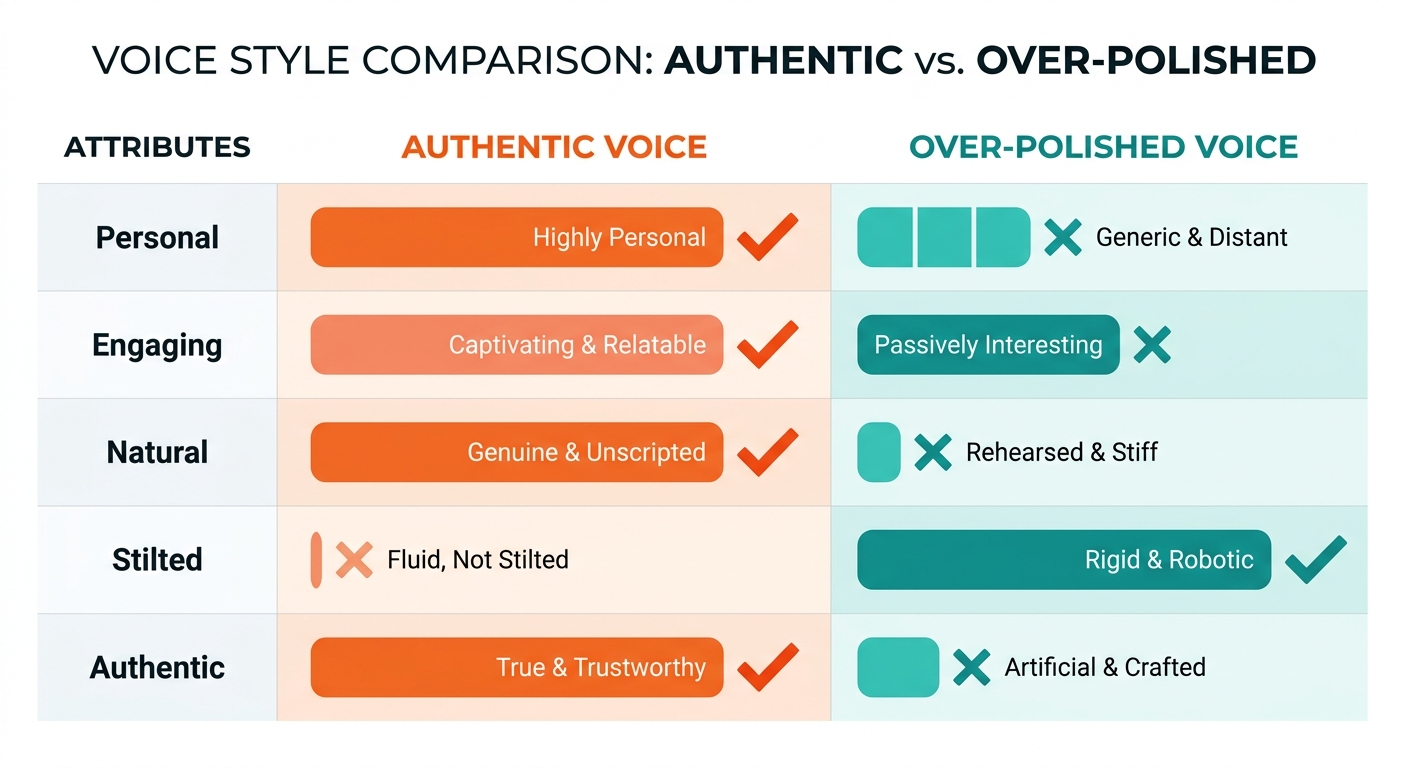
An authentic voice in the opening sets the register for everything after it. Focus early revision on vocal clarity, and the later paragraphs build on a credible foundation.
Keeping a natural voice under heavy editing
Too much editing strips out the specific observations that give writing character. You want an essay tailored to your perspective, one that lets a reader connect with a person, not just another applicant.
- Read your opening aloud before any structural edits. Phrasing that feels unnatural spoken usually means you've over-polished.
- Keep the distinct, specific details. A UPenn essay tied a student's love of bubble tea to FBLA leadership, and that odd, specific detail is exactly what built authenticity.
- Keep peer reviews narrow in scope so they clarify intent without flattening your phrasing.
- Compare drafts as you go. If a later version trades personal tone for formal syntax, revert to the simpler phrasing.
Prompts that surface a perspective only you have
Authentic voice comes from experiences specific to your background. A brain dump gives you raw, unpolished material you can shape into a distinct point of view.
- Ask: "What role do you fill in your community?" This surfaces family dynamics, cultural context, or personal pursuits that shape how you see things.
- Look for moments that demanded unexpected leadership. A guide on covering a parent's responsibilities during surgery notes that stepping up during a family crisis shows maturity without leaning on drama.
- Identify values you held under pressure. The CollegeEssayGuy framework reads essays across Values, Vulnerability, Insight, and Craft, and recommends leading with your primary commitments.
Ground the perspective in your own decisions. As admissions resources on resilience and agency over sob stories emphasize, impact comes from action and reflection, not from the circumstances alone.
Does your voice need to match the school?
Adapting tone to a school's priorities gives a strong opening more mileage. Guidance keeps pointing to the same move: connect personal reflection to what the school values. Authenticity here means speaking your real experience directly to a specific academic audience.
- Weigh the opening against each school's mission statement before you finalize.
- Get feedback from more than one reader to confirm your voice lands across different evaluation criteria.
Editing, clarity, and peer feedback that actually helps
Refining the first paragraphs of a personal statement for university is a different job from drafting. Once the opening pitch works, editing should protect the narrative, not rebuild the structure.
A clear order saves effort: clarity first, then stronger verbs, then cut redundant phrasing, then outside feedback. Polishing sentences you may end up cutting just slows you down.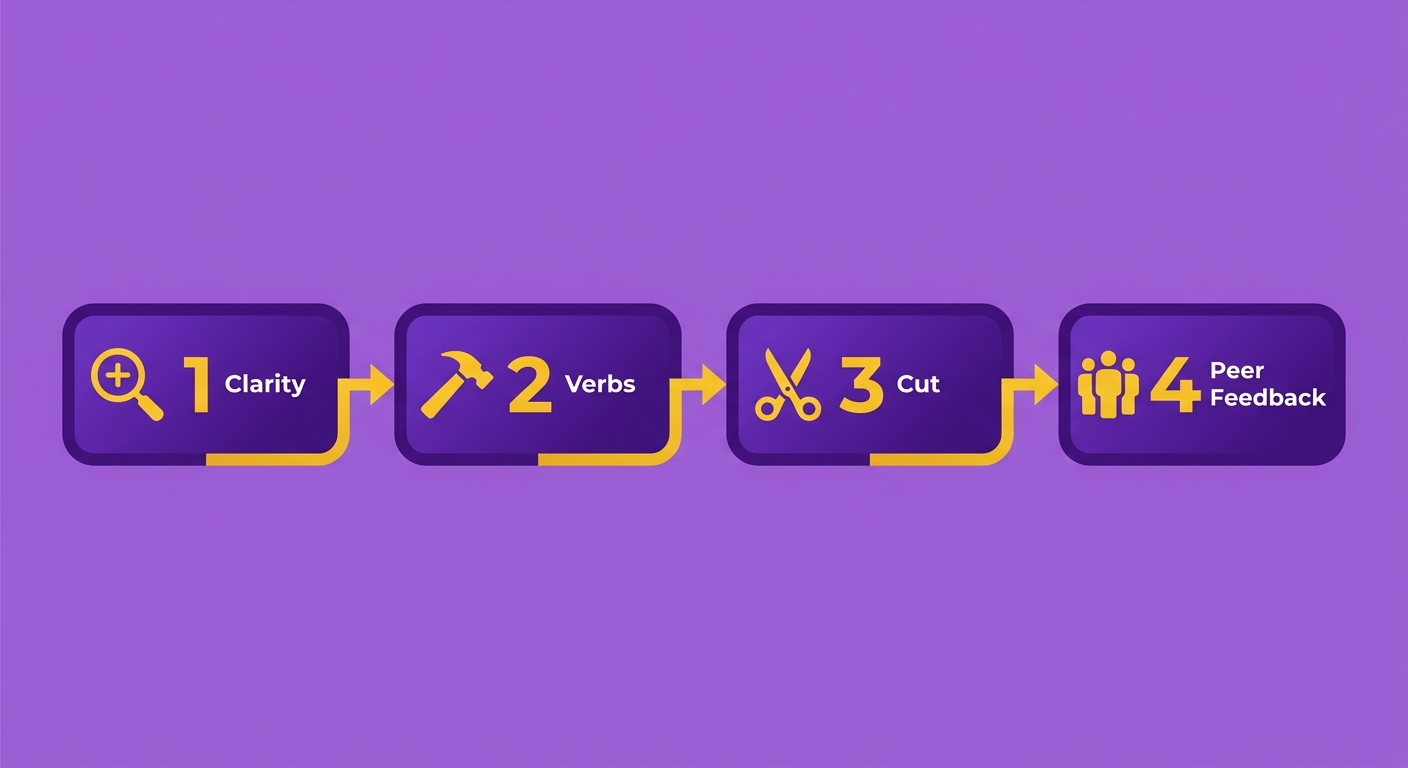
A first-two-minutes editing checklist
Spend your editing energy on the lines a reader hits first. The opening paragraph and its transition set expectations for the rest.
- Clarity check. Read the opening aloud. Any sentence that needs several pauses should be shortened to keep momentum.
- Verb audit. Look at the verbs in the first paragraph. Replace passive constructions with active verbs that put the action on you.
- Redundancy pass. Cut repetitive phrasing. Inside a tight word count, lean opening lines buy you space.
- Concrete-over-abstract test. Swap general statements of enthusiasm for specific examples that show commitment through action.
Aiming peer feedback at the opening
Give reviewers specific questions, not a vague request for opinions. Targeted questions tell you whether the opening is doing its job.
- Ask: "After the first two sentences, do you want to keep reading? Why or why not?"
- Ask: "Based only on the opening, what do you think this essay is about?"
- Ask: "Whose voice does this sound like, mine or a generic applicant?"
Multiple readers catch different problems. One can focus only on hook clarity, while another reads the whole draft cold to confirm the opening actually reflects what follows.
References
[1] UK university staff only read students' personal statements for two minutes - https://www.theguardian.com/education/2023/jun/15/uk-university-staff-only-read-students-personal-statements-for-two-minutes
[2] How to Write the Personal Statement for College Applications - https://www.writingclasses.com/toolbox/articles/how-to-write-the-personal-statement-for-college-applications
[3] What is a Personal Statement? A Complete Guide (2026-2027) - https://collegewise.com/blog/personal-statement
[4] How to Write a Meaningful Personal Statement - Emory Admission Blog - https://blog.emoryadmission.com/2025/10/how-to-write-a-meaningful-personal-statement/
[6] Personal Statement: Opening - JRA Educational Consulting - https://www.jraeducationalconsulting.com/blog/the-opening-line-on-your-college-application-personal-statement
Frequently Asked Questions
1. How long should my personal statement be to fit the two-minute read?
Aim for roughly 650 words, which corresponds to two minutes of spoken reading. Because evaluators skim quickly, structure your opening paragraph and initial transition so that essential context is conveyed within the first 90 seconds.
2. Does the two-minute rule apply the same way to UK and US applications?
The rule reflects different operational pressures. UK Russell Group evaluations prioritize exam qualifications in a high-volume system. US top-35 holistic reviews weigh personal essays alongside academic records, allowing a well-crafted narrative to differentiate applicants with similar credentials.
3. Should I write my opening line first or last?
Develop the underlying concept first, but finalize the precise wording last. Establishing the hook early provides narrative direction, while completing the final edit after writing the body text ensures structural alignment between your opening and your main arguments.
4. What if my most compelling story is about a genuine hardship?
Focus the narrative on proactive responses rather than the difficulty itself. Admissions officers value evidence of personal growth and problem-solving, so emphasize the actions taken and insights gained rather than lingering on initial obstacles.
5. How many reviewers should read my personal statement?
Limit active feedback to two trusted readers. Involving too many reviewers can dilute personal writing style into generic phrasing. A two-reader review allows one person to check opening engagement while another verifies overall structural coherence.
6. What questions should I ask a peer reviewer about my opening?
Direct reviewers with targeted prompts, such as asking whether the opening lines make them want to continue, what primary theme they expect based on the first paragraph, and whether the writing matches your authentic speaking voice.
7. How do I show my values without sounding like an achievement list?
Identify one or two core values and illustrate them through a focused, concrete scene under 150 words. Demonstrating character through specific actions proves maturity far more effectively than compiling a summary of positions or awards.