What Former Admissions Officers Notice in Your File That Rankings Miss
August 29, 2026

Key Takeaways
- An admissions officer spends roughly 10 to 12 minutes on your file, and they're reading to find a reason to say yes, not a reason to cut you.
- Only 18.9% of colleges call the essay "considerably important." Meanwhile, 76.8% put heavy weight on grades in rigorous courses. The transcript still runs the table.
- Holistic review judges the whole person in context. It can quietly punish families who chase rankings instead of making meaningful academic choices.
- A 3.7 can beat a 3.9. The signals in the file matter more than the raw number.
- Course selection made in 9th and 10th grade outweighs any senior-year scramble to polish an application.
- Recommendation letters with specific, credible detail survive the fast read. Vague praise evaporates.
- Rankings tell you where a school sits. They tell you nothing about the signals that actually decide admissions.
What rankings can't tell you about who gets in
Rankings tell you where a school sits. They tell you nothing about why one applicant with a slightly lower GPA takes the seat over another with a near-perfect transcript. That gap comes down to signals most college admissions consulting, the kind built on rankings, never teaches you to read.
Start with the pace. Files get read fast, according to a former admissions officer's account and a former AO's breakdown of the process. In that short window, readers make quick calls. A letter that gives concrete detail about what a student actually did, day to day, lands immediately. Generic praise gets forgotten before the next file loads.
Why holistic review rewards signals over rank
Holistic review looks at the whole file, the whole person, and the applicant's context, as the University of Miami explains. That's where rank-chasing families lose ground. Data from this former officer's analysis shows most institutions prioritize long-term academic performance over any single piece of the application.
So the choices that move the needle happen well before senior year. Families over-invest in raw AP volume and title-collecting instead of academic depth.
Our take: a letter that narrates sustained behavior over two or three years says more about leadership than any office a student lists. Officers read leadership as committed action, not roster titles. That's the depth rankings miss, and it's why we start with students as early as 8th grade, building real experiences before the application phase begins.
- Audit course rigor early. Depth in fewer subjects reads stronger than a padded AP count officers see through in seconds.
- Feed your recommenders specific anecdotes. In one former AO comparison, Application A won a seat on a personal essay showing a concrete moment of growth; Application B, identical grades but vague letters, was rejected.
- Provide your context. First-generation applicants and students at under-resourced schools can show strong potential once officers understand their circumstances (holistic review at Miami).
Who benefits most from reading these signals
International students, applicants from low-profile schools, and students with non-traditional strengths gain the most. Holistic review is supposed to help them. It doesn't always.
There's a real contradiction here. Miami frames context as the great equalizer. Yet research on course-rigor evaluation found officers were less likely to understand low-resourced schools' course offerings, which can penalize the exact students holistic review claims to help.
Our judgment: holistic fairness depends entirely on whether the reader understands your school. When they don't, your file has to supply that context itself. A letter that spells out what "advanced" meant at your school does the officer's homework for them.
- Name your school's ceiling in your file. If you took the hardest three courses available, say so. Don't assume the officer knows.
- Skip the title padding. Families read leadership as offices held; officers read it as demonstrated commitment over time.
That's the work we do differently. We build plans around each student's strengths, and every student's essays get reviewed by at least two people on our team for a range of perspectives. More on how we think about this in our admissions and life-planning blog.
The academic profile behind the number
Rankings measure a school's reputation. They tell an admissions officer nothing about whether your GPA came from a course load that pushed you or one you coasted through. That gap is where the real reading happens, and it's the part most college admissions consulting never bothers to map.
Here's the piece that matters. Officers read rigor through the lens of your school's own offerings, and a strong letter is often the only document that translates that context in your favor. When a letter names the hardest sequence your school offers and confirms you took it, it hands the reader a signal a transcript can't carry alone.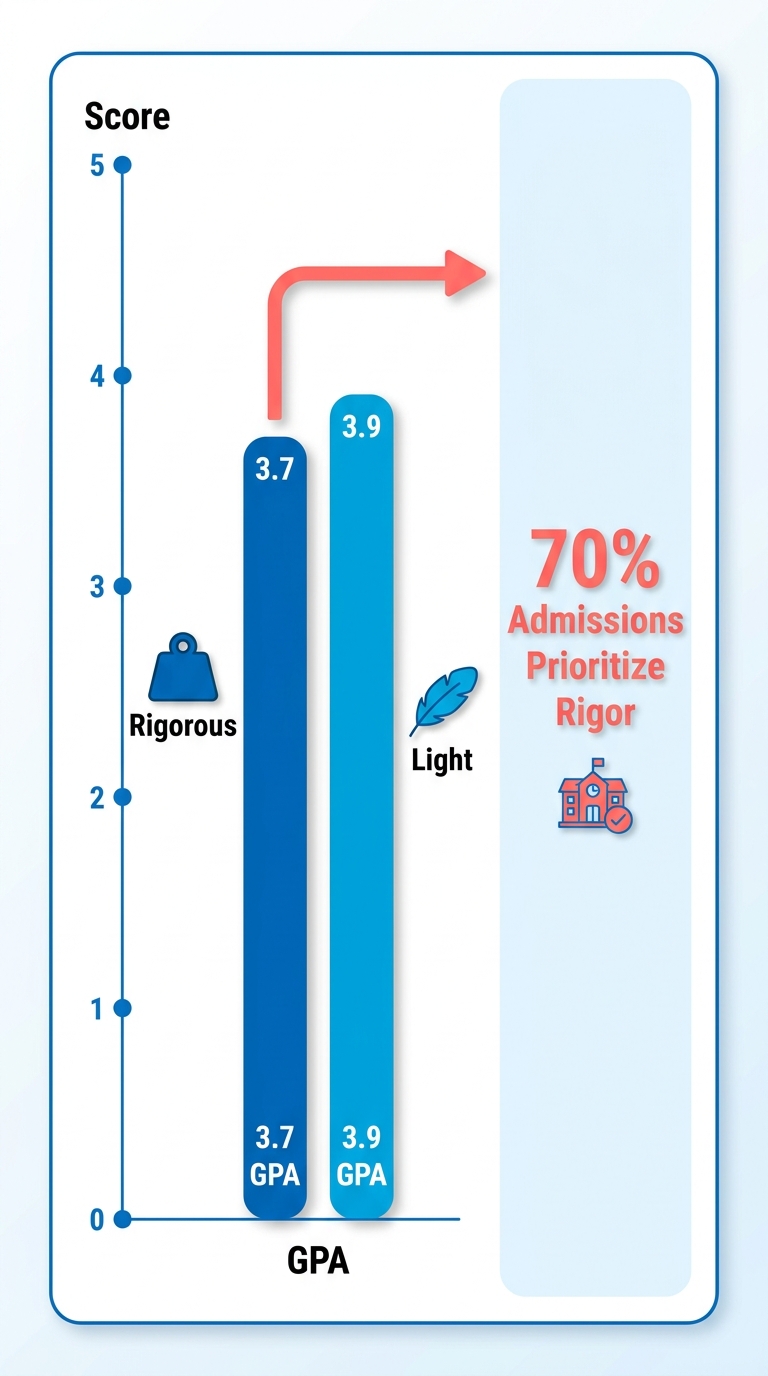
How officers actually judge course rigor
Officers judge rigor against what your school offers, not a universal scale. A student who took every AP available beats a student at a wealthier school who skipped half of theirs. But that only works if the reader understands your school's menu.
That's the catch. The same course-rigor research shows readers default to standardized assumptions when a school profile is unfamiliar. The shortcut can penalize students from non-traditional backgrounds, which is why proactive clarification matters so much.
Our take: this is where a teacher's letter earns its keep. A counselor or teacher who writes "this was the most demanding independent project our department has ever approved" supplies the context the officer doesn't have.
- Map rigor against your school profile. List every advanced course your school offers, then confirm your transcript reflects the hardest realistic path through it.
- Brief a recommender on rigor context. Give your letter-writer the specifics of what you took relative to what existed, so they can state it plainly.
Why a 3.6 sometimes beats a 4.0
A 3.6 with an upward climb and heavy rigor often outreads a flat 4.0 from a low-rigor school. Because files move so fast, readers need to spot the positive fast. A clear upward trend line gives them an immediate, compelling story.
Trajectory beats a single number. A rough freshman year followed by three years of climbing grades tells a growth story. Officers reward the arc, especially when a recommender narrates the turnaround.
- Document your grade trajectory. Flag any recovery after a hard start so a teacher can speak to the effort behind it.
- Check the school profile appendix. Know your school-wide GPA distribution and whether grades report weighted or unweighted, since officers read your number against that spread.
The academic depth checklist we use
We built this because titles and raw scores register weakly on a fast read. Readers look for evidence of curiosity and initiative beyond the basic classroom requirements, as one former AO's breakdown of the process describes.
- Identify one self-directed academic project a recommender can describe in concrete detail. The strongest cases involve a student who built something meaningful over time, the kind of sustained work that speaks for itself.
- Match every claimed strength to a witness. For each depth point, name the teacher who saw it happen over years, not the office you held for months.
Skip the checklist obsession if your school already offers rich context in its profile and your recommenders know you well. For anyone attending a school an officer won't recognize, this mapping is the difference between a file that reads clearly and one that gets misjudged.
Extracurriculars: depth over the ten-club résumé
Depth beats breadth, and the numbers back it up. In our own admissions work, the single biggest wasted effort we see is the ten-club résumé built to look busy. A three-year leadership arc reads far stronger than ten one-off memberships, because it gives a reader something to believe in during a fast file review.
Here's what most families miss. A file showing the same commitment deepening year over year builds a story an officer can trust, and a letter that narrates that arc hands the reader a reason to say yes. A list of titles does not. Sustained involvement is what turns a busy résumé into a coherent case for who you are.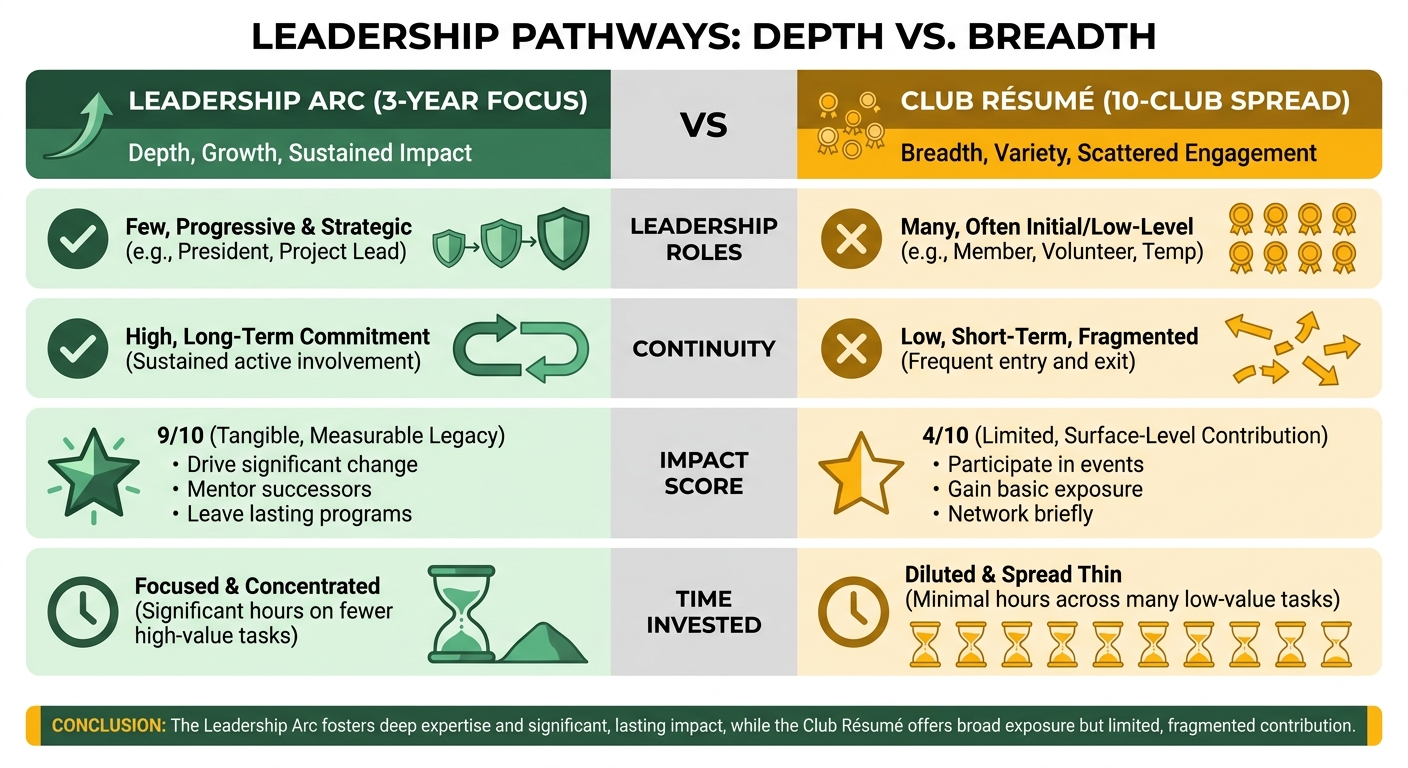
Why sustained involvement beats a long activity list
Sustained involvement wins because it lets a third party vouch for behavior over time. A recommender who watched you show up for three years can describe initiative, problem-solving, and growth in specifics. That's the kind of detail that survives a rushed read, the concrete evidence former admissions officers look for when they're splitting hairs between strong applicants.
Our take: leadership is not a title, it's a documented pattern. When a teacher's letter says you rebuilt a failing program and names what changed, that's a signal an activity list can't carry. Titles are cheap. Witnessed behavior is not.
- Pick your two deepest activities and confirm each has an adult who can speak to your growth over multiple years, not a single event.
- Ask whether your recommender can name a specific problem you solved. If they can't, the involvement wasn't visible enough yet.
- Cut activities you can't attach a story to. A shorter, believable list beats a padded one every time.
How to measure real impact
Impact needs both a number and a witness. Quantifiable outcomes like 200 students served or $10,000 raised give scale. Qualitative change, confirmed by a mentor or community member, gives credibility. Officers weigh nonacademic factors alongside grades, per a study of over 300 admissions professionals, so both halves matter.
Take an art-focused student who turns a school mural into a city-wide youth mentorship program. The bullet point says "led mural project." The narrative says "grew a one-wall project into a program mentoring dozens of younger students across the city." One of those earns a recommender's endorsement. That's the version that supports a top-tier file.
- Attach one hard number to each major activity. Students reached, dollars raised, hours run.
- Pair every number with a person who can confirm it in a letter or interview.
- Translate vague verbs ("participated," "helped") into outcomes. Measurable results turn bland bullet points into a narrative about what you actually did.
What fit signals to look for
Fit means your depth aligns with a target school's signature strengths. A robotics obsession reads differently for a school known for engineering competitions than a generic "STEM interest." Alignment gives your recommender a natural reason to connect your work to that program's culture.
Skip the fit-chasing if it forces you into activities you don't care about. Officers bring their own read to a file, and a manufactured interest rarely survives contact with a specific letter. Our advice: deepen what's real, then point it at the right schools.
Personal narrative and essays
Your essay's job is to show a piece of your character that numbers can't. Both the essay and your letters have to offer distinct, memorable insights that survive a rapid read, without trading genuine voice for over-polished prose.
Here's the link to leadership most families miss. A letter validates leadership by narrating sustained behavior over time. A strong essay does the mirror version. It shows the reader the internal reasoning behind that behavior. When both documents point at the same real moment, the file stops reading like a list and starts reading like a person.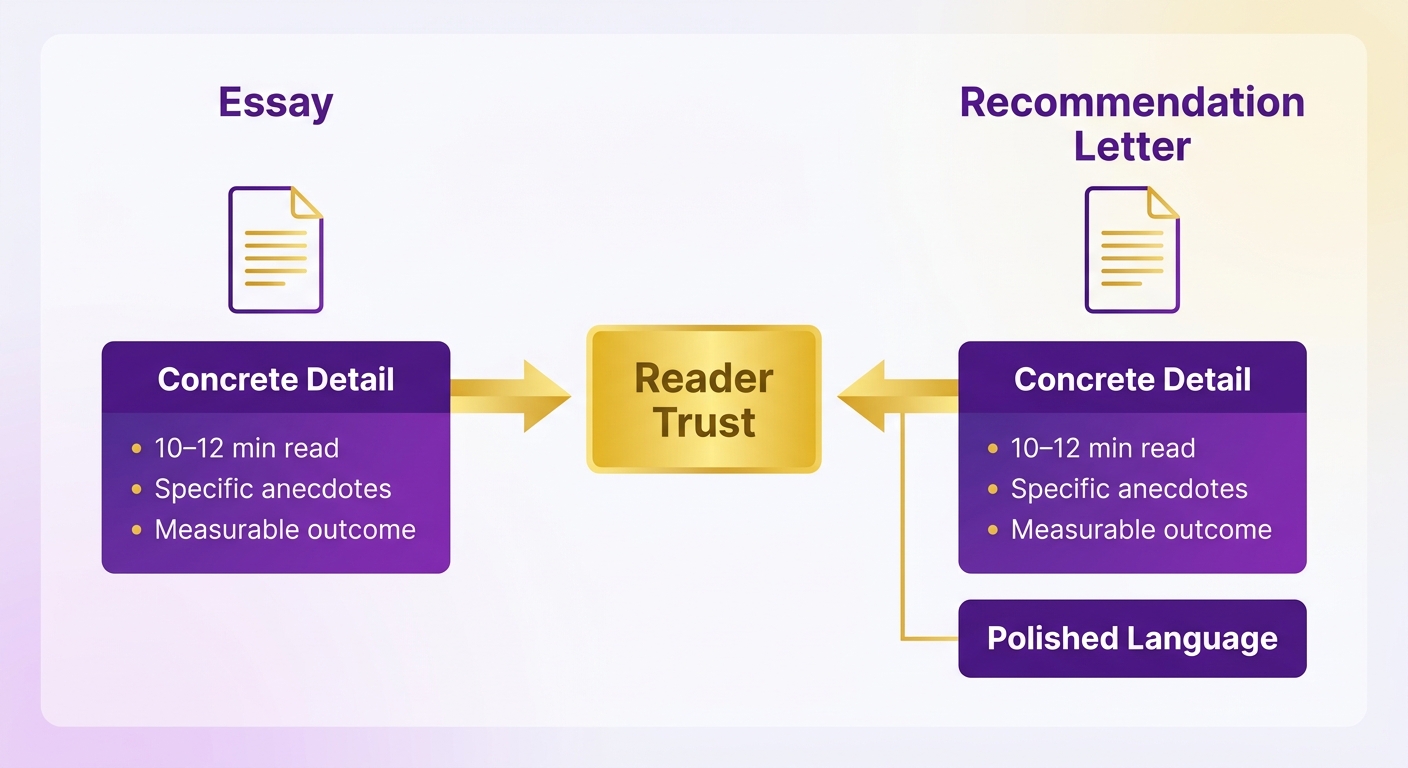
One caution first. Essays leak more than voice. An analysis of AI in holistic review found essays carry demographic signals a reader can predict with 79% accuracy for gender and 74% for income. Our take: the "personal" remedy for score bias introduces its own bias, so your job is to control what the reader takes away, not to over-explain who you are.
How to write in an authentic voice
Authentic voice means concrete, personal specifics only you could have written. Admissions officers reward genuine, specific storytelling over generic statements, as former AO Tillie Gottlieb emphasizes. Two applicants with identical grades split on this alone.
- Cut the "college-admission-ese." Replace abstract virtue words with one concrete scene the reader can picture.
- Anchor the essay in a real moment of growth. That same AO's breakdown stresses how a narrative of personal development gives readers the qualitative depth they need to advocate for you.
- Read it aloud. If a sentence could appear in a stranger's file, delete it.
Does your essay show self-awareness and fit?
Self-awareness and fit are what turn a nice story into a reason to admit. Reflect on a failure honestly, then link that growth to something specific about the program. Vague admiration for a school reads as noise in a fast review.
- Name a real setback and what changed in your thinking, not a humble-brag disguised as failure.
- Tie your story to a specific professor, lab, or course. A supplement that connects a student's renewable-energy research to a named campus energy lab reads as genuine interest, and demonstrated interest influences decisions.
- Provide context for any challenge. Holistic review weighs circumstance, so a mid-year school move or limited course access belongs on the page, not in your head.
Run every draft through one filter: does an opening hook pull the reader in, does a narrative arc carry them, and does a forward-looking closing line give them something to flag? Our review process checks drafts on exactly those three axes.
Recommendations and third-party validation
A recommendation letter earns its place by giving external proof of your character and academic drive. In a fast read, generic praise doesn't register but concrete detail does, and that's the part most college admissions consulting never teaches families to engineer.
The study of nonacademic factors shows those attributes, while secondary to grades, act as real differentiators. Combined with a former admissions officer's account, our take is clear: a letter that supplies specific evidence of sustained behavior is what makes your potential legible on a fast read.
Who should actually write your letter
Choose the recommender who watched you grow, not the one with the fanciest title. A department head who barely knows you writes a thinner letter than a teacher who saw you struggle and improve over two years. Officers read leadership as years of genuine commitment, so the writer who can narrate that arc matters more than seniority.
- Pick teachers who can name a specific turning point in your growth, not just confirm your grade.
- Prioritize a recommender who saw sustained effort over one who saw a single strong performance.
- Line up an external validator when your metrics are soft. That study ranks contextual and nonacademic input as real, if secondary, factors, so a community leader or employer can offset a weaker number.
How to get concrete anecdotes into a letter
The strongest letters carry numbers, project titles, and named outcomes, because those survive a fast read where adjectives evaporate. A line that says "she built a working prototype and presented it to the school board" beats a paragraph of warm generalities every time.
- Give each recommender a highlight sheet with two or three specific moments they witnessed.
- Ask for measurable outcomes: an amount raised, a team size led, a project that shipped.
- Point every letter at behavior over time, since sustained commitment is what officers read as leadership potential.
Why alignment beats volume
Alignment means your letters, essays, and activities all point at the same real story instead of three disconnected impressions. When a physics teacher's letter names the same project your essay explores, the file stops reading like a list and starts reading like a person. The holistic-review research also warns that officers lack a consistent definition of the process, so a coherent narrative gives inconsistent readers a stable thing to grab.
Our collaborative approach syncs what each recommender emphasizes with the applicant's central theme. We map each writer's talking points to specific claims your file already makes elsewhere, so the presentation stays unified.
- Brief recommenders early, before they draft, so their content reinforces your narrative instead of drifting from it.
- Check that no two letters make the identical point. Redundancy wastes a reader's limited minutes.
- Confirm each letter validates a claim your essays or activities already raise.
Skip external validators entirely if your academic file is already strong and self-evident. Adding a community letter to a transcript that speaks for itself just dilutes the read.
Contextual factors and the committee read
The second read is where your file stops being numbers and starts being a story. This is the committee stage, and it's where ranking-driven college admissions consulting falls apart. Beyond raw academic metrics, committees weigh contextual factors like family background and school environment, per the study of nonacademic factors. That middle tier is the blind spot rankings never touch.
Here's the link. A recommendation letter is often the only document that supplies the context an officer needs to read your file fairly. When your school profile shows limited offerings, a letter confirming you took the hardest path available hands the committee a leadership signal your transcript can't.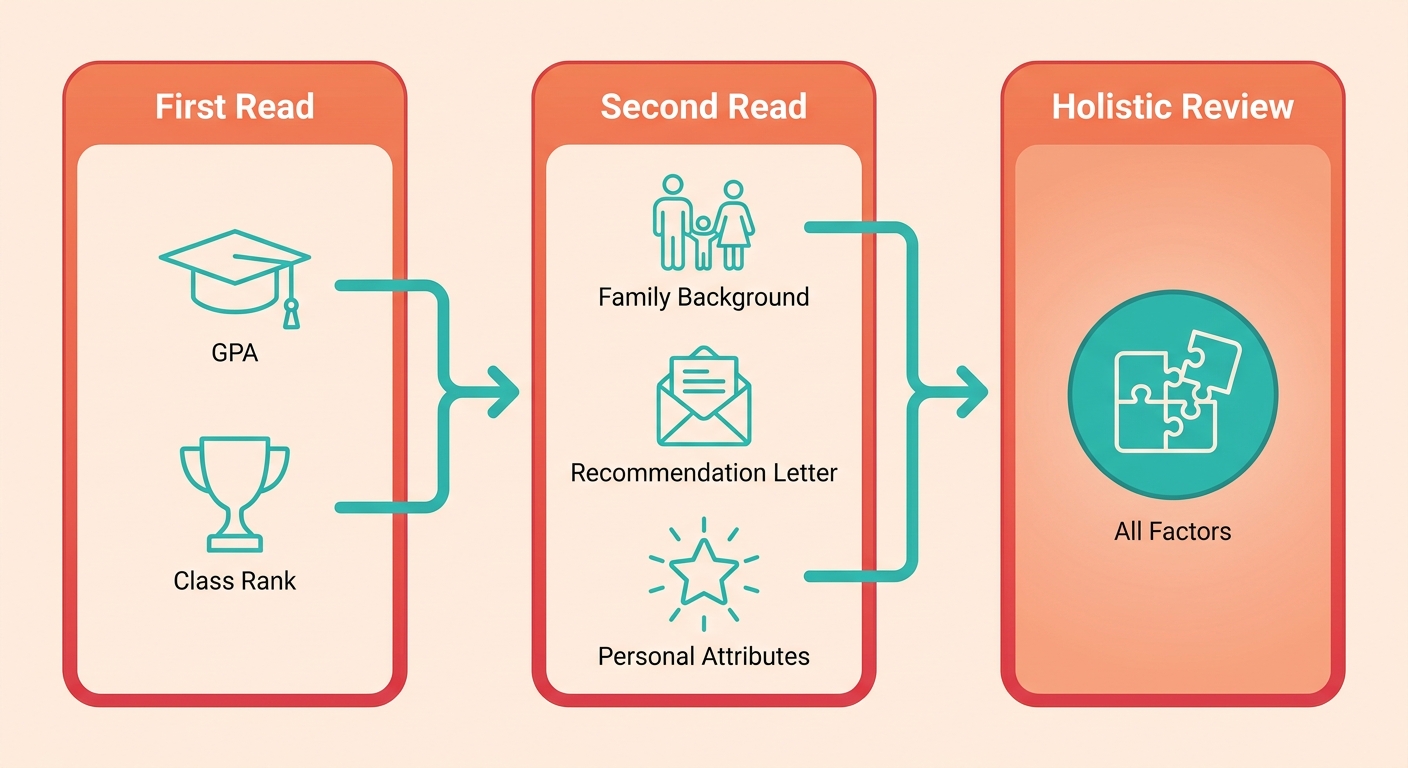
How officers normalize a low-resource school
Officers judge you against your school's ceiling, not a national one. The University of Miami's explanation of holistic review confirms officers factor in limited educational opportunities and circumstances like relocation. But this fairness has a catch worth naming.
The same process can penalize you. The course-rigor research notes readers often struggle to accurately assess non-standard curricula. Our take: holistic review helps only when the reader knows your context. When they don't, a letter that spells out what your school does and doesn't offer becomes the fix.
- Confirm your counselor's school profile names the hardest available course sequence, so officers can normalize your rigor accurately.
- Ask whether your recommendation letter states what opportunities your school lacked, not just the ones you seized.
What belongs in the Additional Information section
Use the Additional Information section to clarify a gap, then stop. The rule is add, not explain away. A one-year transfer, a family illness, a relocation. Name what happened, note how you responded, and let the committee draw the resilience conclusion themselves.
A student who transferred schools for a year during a family relocation is the classic case. A flat gap looks like a red flag. A two-sentence entry framing it as adaptation reads as growth. That's the difference between a file the committee argues over and one they wave through.
Our mentorship helps students draft these entries so all the materials present a cohesive narrative. The goal is a clean signal, not a paragraph of over-explaining that reads as excuse-making.
- Explain any transcript gap in two or three sentences that state fact plus response, never a page of justification.
- Cut anything that reads defensively. If the entry sounds like an apology, it's working against you.
Why the committee read rewards coherence
The committee looks for narrative coherence, the thing numbers can't show. When two readers disagree, a file often moves to a full committee vote, where your application competes as a story someone has to defend out loud. A former admissions officer's account describes readers building a case for each applicant they advance. A letter that echoes your context and your growth hands that advocate a ready argument.
- Check that your recommendation letter, essay, and Additional Information entry present a unified narrative, so the committee reads one person, not three disconnected documents.
Skip elaborate contextual framing if your file has no real gap to explain. Manufacturing adversity backfires. Officers read files all day and spot a stretch instantly.
References
[1] What a Former Admissions Officer Knows That Others Don't - https://ingeniusprep.com/blog/what-a-former-admissions-officer-knows/
[2] Why Has College Admissions Become So Impersonal? - https://www.saraharberson.com/blog/why-has-college-admissions-become-so-impersonal
[3] How college applications are evaluated: advice from a ... - https://www.collegeadvisor.com/resources/how-college-applications-are-evaluated-advice-from-a-former-admissions-officer/
[4] Do College Counselors Need to be Former Admissions ... - https://collegewise.com/blog/do-college-counselors-need-to-be-former-admissions-officers
[5] What Do Admissions Officers ACTUALLY Look For? (Former AO ... - https://www.youtube.com/watch?v=UWkl_2Xqq9o
[6] [PDF] What is Holistic Review in College Admissions? - personal.umich.edu - https://www-personal.umich.edu/~bastedo/policybriefs/Bastedo-holisticreview.pdf
[7] What Does Holistic Admission Really Mean - University of Miami News - https://news.miami.edu/admissions/stories/2019/04/holistic-review-jay-jacobs.html
[8] (PDF) AI and Holistic Review: Informing Human Reading in ... - https://www.researchgate.net/publication/338064642_AI_and_Holistic_Review_Informing_Human_Reading_in_College_Admissions
[9] A Study of the Use of Nonacademic Factors in Holistic ... - https://www.researchgate.net/publication/331745463_A_Study_of_the_Use_of_Nonacademic_Factors_in_Holistic_Undergraduate_Admissions_Reviews
[10] “They're Outside of the Process”: How Admissions Officers ... - https://www.researchgate.net/publication/394928618_They're_Outside_of_the_Process_How_Admissions_Officers_Maintain_Inequality_When_Evaluating_Course_Rigor_Through_Holistic_Admissions
Frequently Asked Questions
1. Should I retake a class to fix a low freshman grade, or leave the upward trend visible?
Leave an upward trend visible when possible. Demonstrating academic recovery over subsequent semesters highlights resilience and adaptability. Admissions committees value a clear positive trajectory, particularly when a teacher's letter can speak to the focus and determination that drove the improvement.
2. What if my school doesn't offer many AP or advanced courses?
You are evaluated within the context of your local environment. Focus on taking the most challenging courses available to you, and ensure your school profile or counselor recommendation explicitly outlines those limitations so readers understand your achievements.
3. Does submitting extra recommendation letters from prominent people help?
Extra letters from prominent individuals who lack direct experience working with you often dilute the impact of your file. A teacher who has observed your daily academic engagement over several terms provides far more valuable insights. If your transcript and core letters already present a clear, strong case, additional endorsements are unnecessary.
4. Can a well-written essay compensate for lower grades?
An essay is a critical component of a holistic review, but it cannot entirely offset a weak academic record. Admissions committees prioritize long-term classroom performance and course rigor above all else. While a compelling narrative provides essential personal context, your academic foundation remains the primary factor in the decision.
5. Is it risky that my essay reveals personal details about my background?
Your background is a key part of your unique perspective. Rather than worrying about demographic indicators, focus on maintaining control of your narrative. Anchor your writing in a specific, personal experience that demonstrates your intellectual curiosity and problem-solving abilities.
6. How early should I start planning if I want to build a strong file?
Developing a compelling academic and extracurricular profile is a multi-year process. Early preparation allows you to explore interests deeply and select courses strategically. Starting this process early ensures that your commitments are genuine and well-documented, rather than rushed during your senior year.
7. Why would ten club memberships hurt rather than help my application?
Admissions readers easily spot superficial involvement designed solely to pad a resume. They value sustained engagement and measurable impact over a long list of passive memberships. Focusing on a few key areas allows you to make a meaningful contribution that recommenders can enthusiastically validate.