What Frank Bruni Gets Right About "College Will Humble You" and College Admissions
September 4, 2026

Key Takeaways
- Frank Bruni's core argument: where you go to college matters far less than what you do once you're there.
- Top schools reject 70 to 95% of applicants each spring. That rejection is the "humbling" Bruni writes about.
- College enrollment among 18- to 24-year-olds jumped 32% from 2001 to 2011, packing more applicants into the same fixed number of elite seats.
- Peter Hart got turned away by elite schools, thrived at Indiana University, and later earned his MBA at Harvard. Admissions outcomes aren't destiny.
- Jenna Leahy scored in the low 600s on the SAT, was rejected by top schools, and went on to found a charter school in Phoenix.
- "College will humble you" points toward perspective and growth, not defeat.
- Three groups benefit most from this reframing: students chasing purpose, debt-wary parents, and counselors who need a story beyond "get in or fail."
Why Bruni's Point Lands
When Frank Bruni says "college will humble you," he means the admissions process strips away the illusion that one acceptance letter measures your worth. The phrase is about perspective and growth, not defeat. His larger claim: where you go matters far less than what you do once you get there. And the data backs him.
The admissions landscape has shifted hard over the last two decades. More applicants chasing a static number of elite seats has turned the spring decision window into an annual exercise in collective anxiety. An AFSA review of Bruni's work notes that enrollment among 18- to 24-year-olds rose 32% between 2001 and 2011. That crush is exactly what produces the humbling Bruni describes, with 70 to 95% of applicants rejected at top schools each spring.
Who this actually helps
Three groups gain the most: students chasing purpose over pedigree, parents wary of debt, and counselors who need a story that isn't just "get in or fail." The reframe turns rejection into redirection.
Bruni's profiles make the point through people. One student turned a low-600 SAT score and a stack of elite rejections into a teaching career, then founded a charter school in Phoenix. Another pivoted from a large state university to a top-tier graduate program. The name on the diploma didn't decide their arc. Personal drive outlasted the initial decision every time.
Does an elite degree actually pay off?
The evidence looks contradictory at first. A 2015 study found Ivy graduates earn more than twice as much as other grads a decade out. Yet another study found the SAT scores of the schools that rejected applicants predict earnings better than the scores of the schools they actually attended.
Both are true. Our read: the earnings gap is real, but it traces back to who these students already are, not the diploma they hold. Ambition and rigor drive the paycheck. Prestige tuition just drives the debt. You can chase the first without paying for the second.
That distinction cuts deepest for first-generation students, and it's the trade-off Bruni's analysis skips. NACAC's polling shows 58% of students didn't apply to their dream school because of perceived barriers, and 62% equate selectivity with quality. The students least likely to have prestige-network access are also the most likely to pre-filter themselves out and overvalue a brand they can't cash in. Meanwhile, 85% of business leaders value field-relevant knowledge over the college name, with only 9% rating prestige as very important. Students are optimizing for a signal the labor market barely reads.
The decision rule Bruni never states
Aim high; you don't have to attend high. A first-gen student can capture the ambition signal at a modest college by chasing the most demanding programs and real mentorship there. That decouples the earnings driver from the debt driver.
Skip the prestige premium when the aid math doesn't work. As Bruni puts it, "Education is about so very much more than the onramp to college or than college itself," in his interview with Your Teen. For a family weighing debt against a name, that's the whole ballgame.
The Prestige Myth: Why Success Isn't Tied to the Logo
"College will humble you" doesn't mean you failed. It means the diploma you chased was never the thing driving your future earnings in the first place. Here's the evidence that pedigree and success are only loosely linked.
Start with what employers actually reward. Hiring managers consistently rank demonstrated skill and relevant experience above the name on a transcript, while students keep treating prestige as a proxy for quality. The signal students work hardest to send is one the market barely reads.
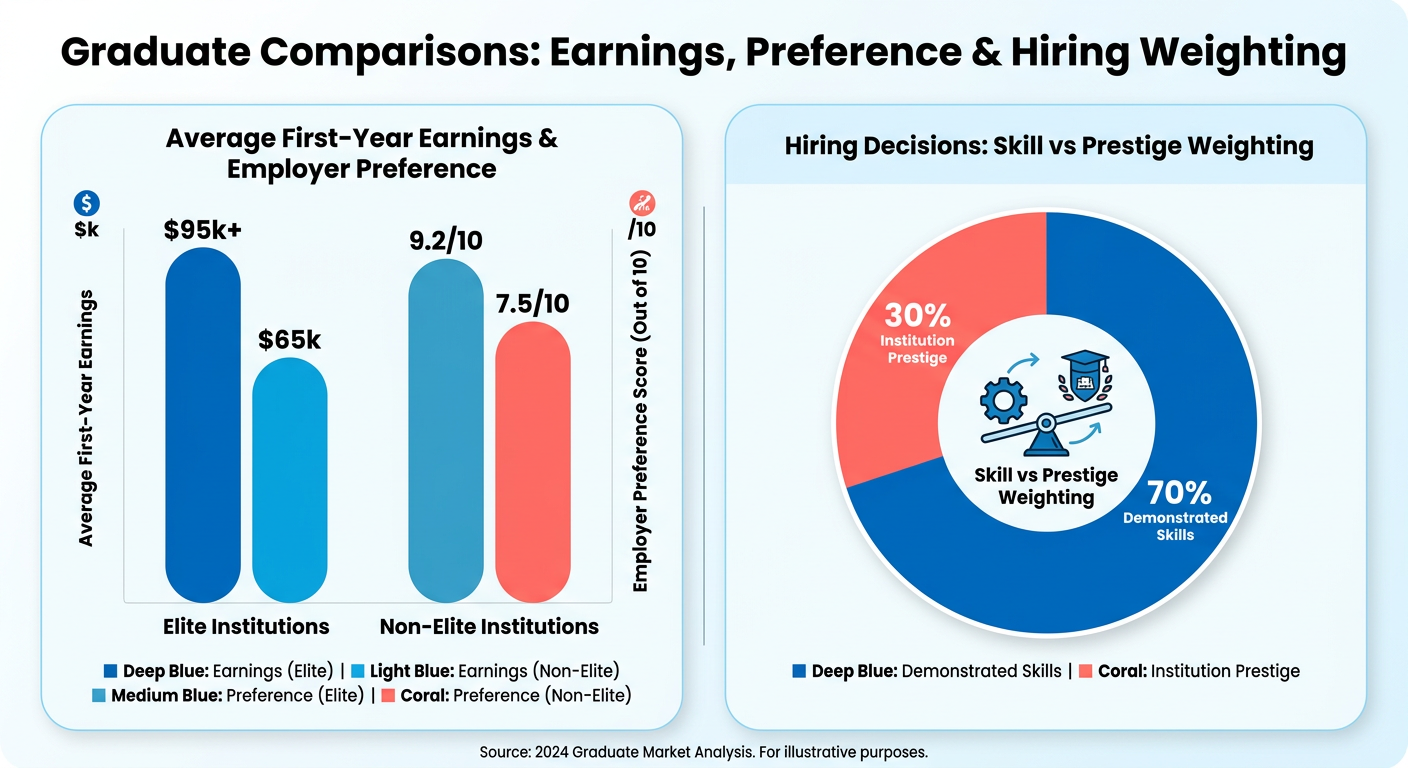
Does the Ivy earnings premium hold up?
Correlation gets mistaken for causation here all the time. Look closely at applicant behavior, and the pattern of self-selection—students who apply to highly selective schools in the first place—predicts long-term financial success better than the school they land at. The drive to seek out challenge is the real constant, which is exactly the counter-finding Bruni cites.
You can act on that. An ambitious student can chase honors programs, research fellowships, and direct faculty mentorship at a less selective institution. Engage with the most rigorous opportunities locally, and you replicate the intellectual environment of an elite school without the price tag.
Who has actually thrived without the name?
Plenty of high-impact careers started on unremarkable campuses. Minding the Campus notes that Dick Parsons, who ran Time Warner, went to the University of Hawaii and says he learned little in class but gained the life experience that mattered. The same piece points out that plenty of MacArthur grant recipients graduated from lesser-known colleges.
Sam Altman went further, saying Stanford "has not had a really great track record" while praising Waterloo for producing founders. When the president of a top startup accelerator says pedigree doesn't correlate with building anything, that should reset your priors.
Why this matters most for first-generation students
First-generation students often carry the heaviest debt loads for the smallest return, since they lack the family safety net that lets wealthier peers treat an expensive degree as a low-risk bet. Federal data shows first-gen students borrow more and default at higher rates than their continuing-generation classmates. The students most likely to overpay for a name are often the same ones with the least prestige-network access to make that name pay off.
For a first-gen student, the modest-college choice isn't a consolation prize. It's frequently the higher-expected-value bet, precisely because employers pay for field knowledge, not pedigree. That's why our planning starts as early as 8th grade with a life-preparation phase, building meaningful experiences and skills before a single application is written, so a strong candidate can pursue the most demanding programs and mentors wherever they enroll.
For families weighing this year over year, our college planning blog walks through the numbers case by case.
The Humbling Trap: When an Over-Achieving Campus Stifles Growth
Ask what "college will humble you" means on an elite campus, and the answer is uncomfortable. Landing at a top school doesn't end the pressure. It often multiplies it. The humbling continues after the acceptance letter, sometimes at a cost to the very curiosity and confidence that got you in.
Here's the trap. A student who was the top performer at home suddenly sits in a room where everyone was the top performer at home. That comparison can flatten ambition instead of fueling it. Bruni notes that 60% of Cornell students still express regret about not attending an even more elite school, years after graduating. Prestige rarely satisfies. It just relocates the goalposts.
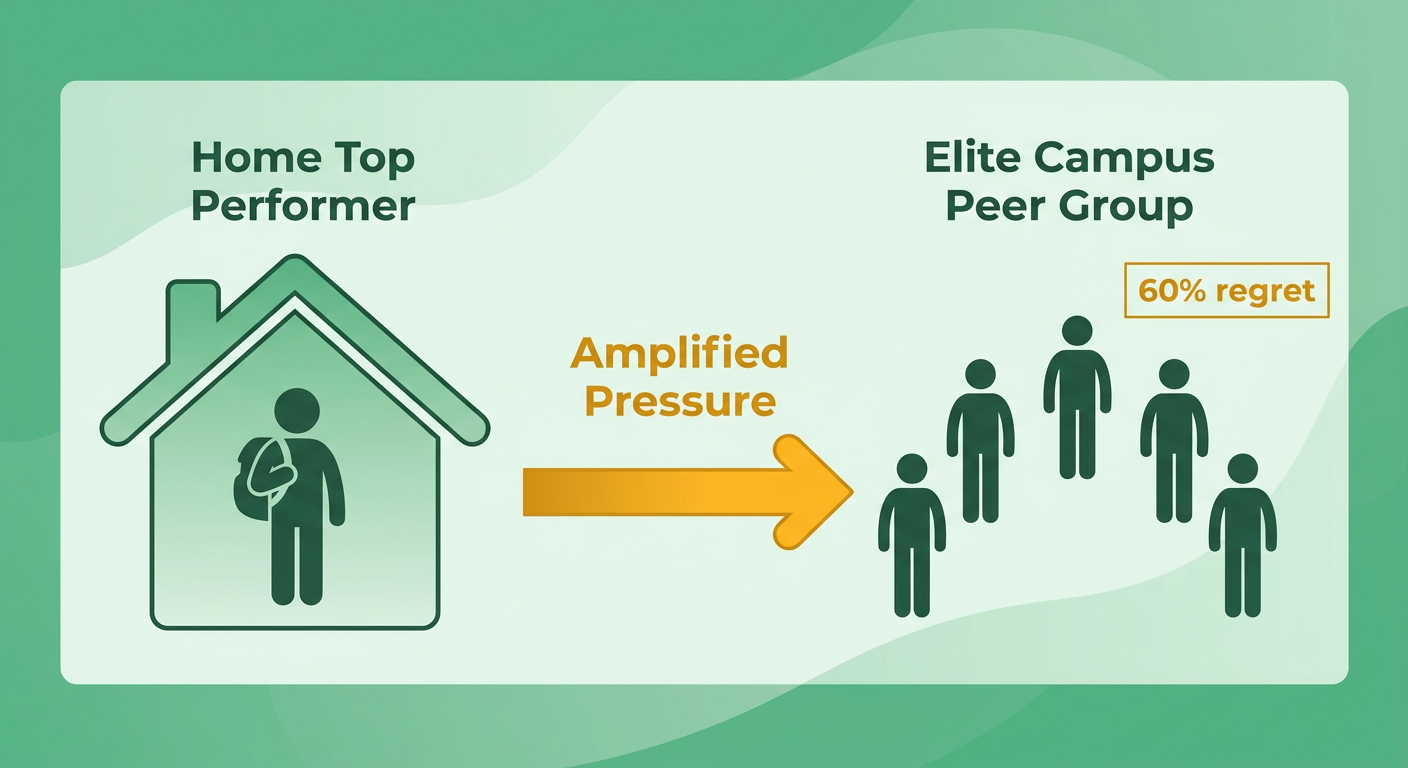
Why does it cut deeper on elite campuses?
Because these environments reward comparison over growth. When your whole peer group is exceptional, being merely good starts to feel like failing. That erodes the intrinsic motivation that actually drives learning.
We see this in our mentorship work. Students who chased the brand name often arrive already primed to measure themselves against peers rather than against their own progress. The result is a quiet spiral: strong students who once loved a subject start avoiding hard classes to protect their standing. So when the environment humbles them, they read it as proof they don't belong, not as a normal part of growth.
When financial expectations run sky-high, the pressure to secure an immediate return gets worse. It shows up as academic risk aversion, students steering clear of challenging electives or unfamiliar disciplines just to protect their GPA. A Commonweal analysis flags this pattern, and it lines up with the rejecting-school SAT finding: exploration gives way to GPA preservation.
What should first-gen students take from this?
The over-achieving environment offers you less than it costs you if you can't access its network. Chase rigor and mentorship, not the logo.
For first-generation students, a hyper-competitive peer environment can also breed social isolation. A supportive, less-pressured campus often lets these students build stronger, more direct relationships with faculty who can champion their academic and professional goals. Those personal advocates frequently prove far more valuable than a generic institutional brand.
It happens the other way too. Students who transfer out of an Ivy where they felt invisible and into a strong liberal-arts college often watch their engagement climb alongside their grades. That kind of rebound is common when the environment finally matches the temperament.
Matching ambition to fit
We tailor planning to each student's strengths and goals, so ambition gets matched to the right environment rather than the biggest name. A place that challenges a student but never lets them be seen breeds the burnout Bruni warns about.
We look for environments where a student can stand out rather than blend into a hyper-competitive crowd. When a campus culture fits a student's learning style, academic engagement and well-being tend to follow. In our experience, the match matters more than the ranking. More on balancing drive and well-being on our college life planning blog.
Family Pressure and Early Specialization: What It Actually Costs
When parents ask what "college will humble you" means for their family, we tell them the humbling often starts years before any acceptance letter. It starts the moment a 14-year-old is told their entire future rides on one talent and one school. Applied that early, the pressure tends to backfire.
Here's the tension we see up close. Students believe prestige is everything; the people who hire them don't. Families pour years into a single credential, then watch the teenager show up to college drained rather than driven. The cost isn't only tuition. It's the curiosity and stamina that early over-specialization quietly burns off, long before an admissions officer ever weighs in.
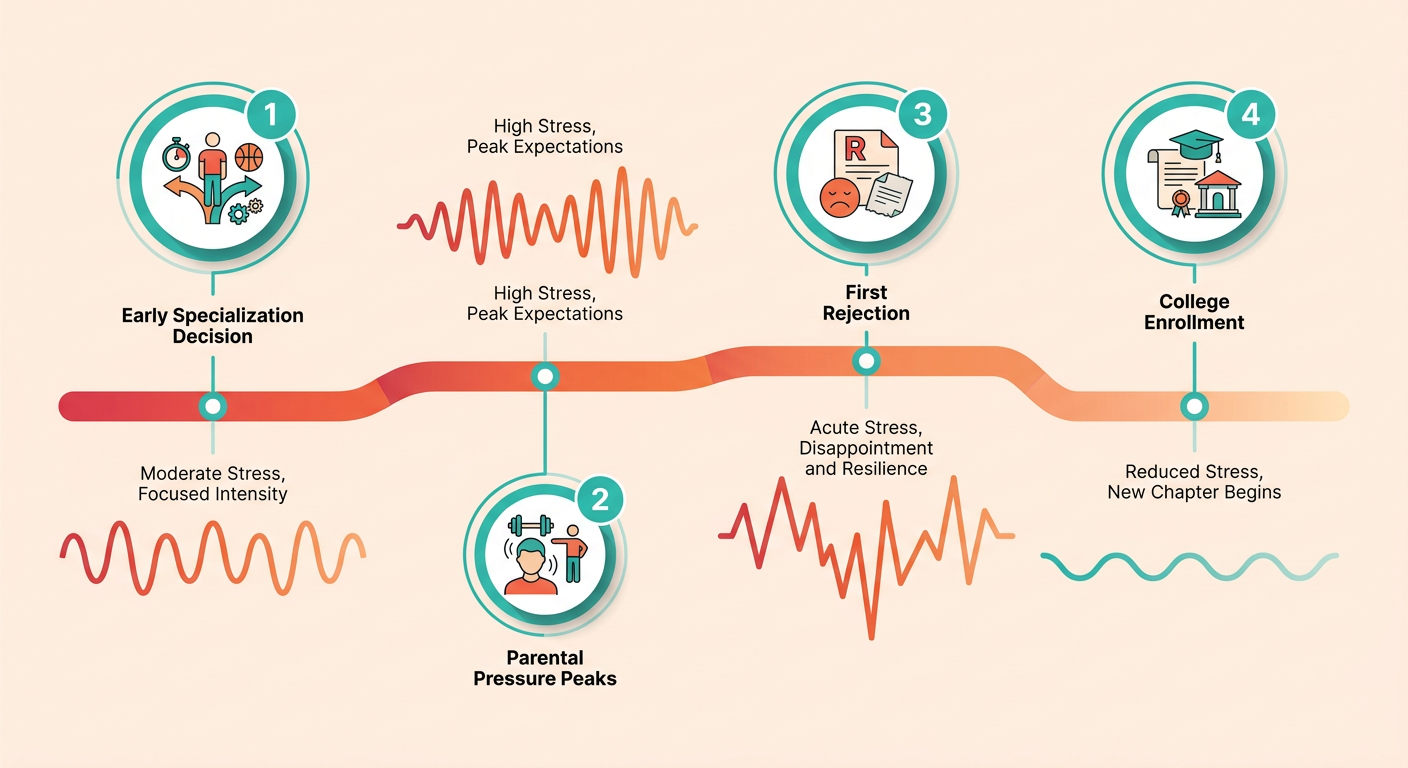
Does early specialization actually help admissions?
Early specialization is a bet, not a strategy. Pushing a child into one narrow talent at 12 assumes admissions officers reward depth over range. Often they reward neither in any predictable way. A student with a 4.0 GPA and a nationally accomplished equestrian record still got rejected from her top choices, as Bruni recounts.
That unpredictability is what makes the burnout risk so costly. We've watched families invest a decade in a single sport or instrument, only for the teenager to walk away exhausted at 16. The talent that was supposed to open doors instead closed off the curiosity that makes a strong applicant in the first place.
A broader foundation lets students pivot when their interests shift, and they usually do. A student who arrives at college with a range of intellectual curiosities rather than a single track is better equipped for the rigor and the options in front of them. That's the same pattern behind the students rejected by elite schools who thrived at less selective ones: they arrived open, adaptable, and hungry to explore.
Why the prestige pressure hits first-gen families hardest
First-generation students carry a compounding penalty, and parental pressure makes it worse. They're the most likely to pre-filter themselves out and the most likely to overvalue a prestige they can't work through a network. That combination turns family ambition into a trap.
Look at what the specialization gamble actually costs these households. Committing early to one expensive sport or activity often means travel fees, private coaching, and equipment that stretch a family budget for years, all wagered on an admissions payoff that may never come. With no alumni network to fall back on, a rejection or a burned-out teenager leaves a first-gen family with the sunk cost and none of the connections that were supposed to justify it.
Focus instead on local, high-quality academic opportunities rather than expensive, specialized extracurriculars, and families preserve real financial resources. The student gets to develop genuine academic interests without carrying the sense that the family's stability rides on a single admissions outcome.
The life-prep phase: build skills before you specialize
We push for a structured period of exploration during the early high school years. Instead of locking into one discipline, students build foundational skills: writing, public speaking, project management, across a variety of subjects. That builds a resilient profile that stands out for depth of character rather than narrow specialization.
Here's how we frame it for families:
- Breadth first. Sample several serious interests before narrowing. Range is a hedge against burnout and rejection.
- Rigor over brand. Chase demanding coursework and real mentorship, not a logo.
- Skip the ultra-early lock-in. Committing a 13-year-old to one path rarely pays off. The evidence for it just isn't there.
We've seen this breadth-first approach pay off across our applicant classes, whose members have collectively earned over $1 million in scholarships. The lesson Bruni keeps returning to holds here too: where you go matters far less than who you become on the way. For more on structuring these years, our college admissions planning blog goes deeper.
Practical Strategies: Explore, Accept Rejection, Build Resilience
Ask any student what "college will humble you" means in practice, and the honest answer is this: the process forces you to decouple your self-worth from a verdict you cannot control. Our job is to build the skills and the temperament that make that humbling productive instead of paralyzing. This is the tactical version of Bruni's advice, grounded in the mentorship we run through the application phase.
A strategic application list has to account for how unpredictable highly selective admissions really are. When acceptance rates sit in the single digits, even exceptionally qualified applicants get rejected for institutional priorities that have nothing to do with individual merit, as Bruni recounts. Diversifying your list is the practical response to that volatility, and it shows in our results: our students average 5+ admissions each.
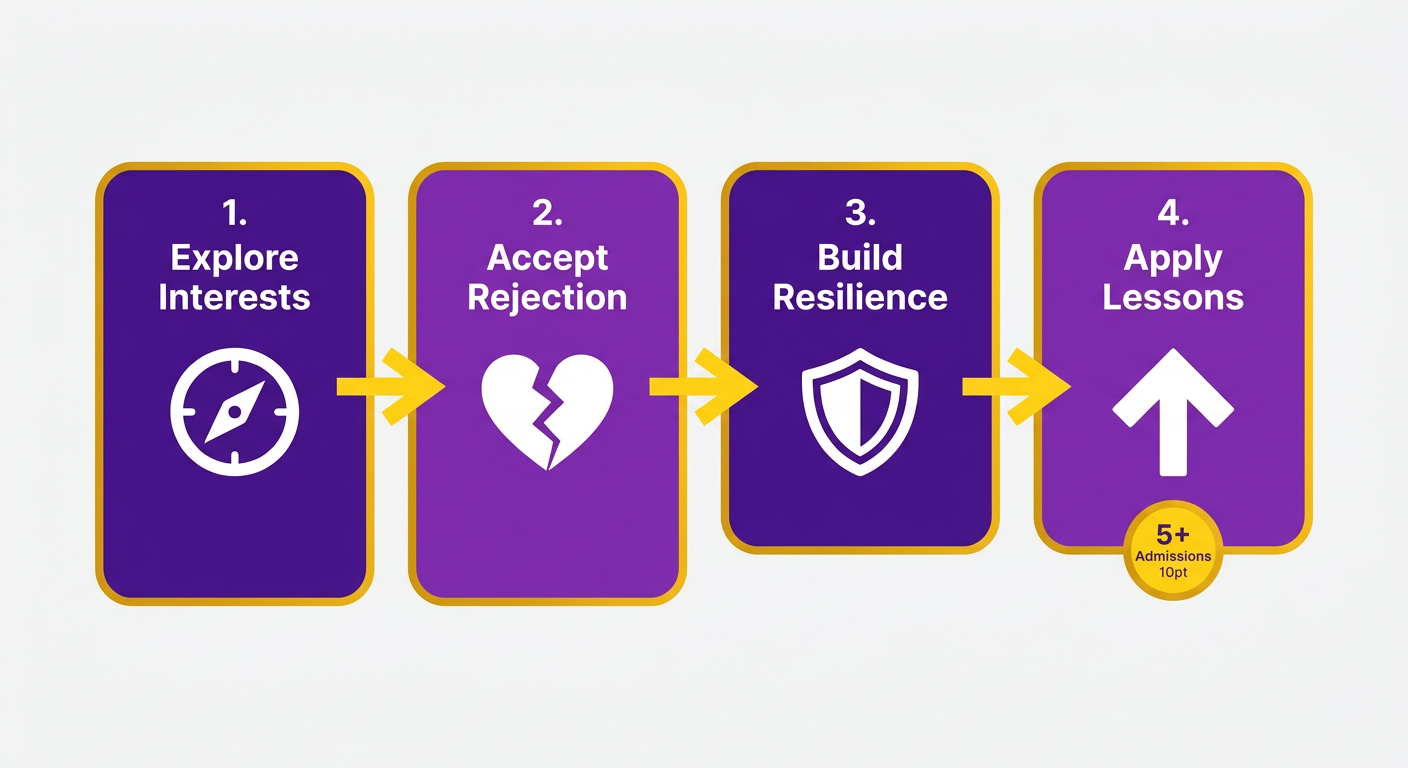
From exploration to execution
Our method moves students from broad exploration into targeted execution. Once a student has a solid foundation of interests, we shift to the tactical work of the application, making sure their experiences come through clearly and authentically.
- Self-assessment. Run a values inventory before you touch a school list. What work would you do unpaid? Naming your motivations early keeps you from silently crossing off schools before you've weighed them honestly — exactly the trap quiet self-doubt sets for strong candidates.
- Build and contribute. Ship something demonstrable. A hackathon project or a real role at a local nonprofit both work. The point is field-relevant proof: a portfolio, a published result, a role with real responsibility beats a longer list of passive memberships every time.
- Fit list. Score each school on rigor, mentorship access, and cost, not brand.
- Polish and plan for rejection. Essays, interviews, and a written rejection-response plan you draft before decisions land.
What does the rejection data really tell you?
Reframing rejection puts agency back in the student's hands. When you understand that long-term professional success comes from personal characteristics rather than institutional prestige, as Bruni cites a study to show, a rejection letter loses its power to define your worth. The focus shifts back to finding an environment that supports real engagement and growth, rather than assuming Ivy graduates out-earn peers on the strength of the brand alone. Pursue challenging opportunities wherever you enroll; your own effort and engagement dictate the outcome.
Resilience through collaboration and check-ins
We treat each rejection as data, not a grade on your worth. Our panel approach means every application and essay gets diverse perspectives, and regular check-ins keep students on track so no single "no" dominates the view.
Track four metrics: GPA trend, leadership hours, recommendation strength, and skill development. Students who can see the whole board, which is what our admissions planning work is built to give them, stop mistaking one letter for a life sentence.
Guiding Parents: Steady Support, Managed Expectations
When parents ask what "college will humble you" means for their role, our answer is blunt: the humbling is easier on your child when you stop treating one acceptance as a verdict on your parenting. Your job is to lower the stakes, not raise them. That single shift does more for a student's outcomes than any application tweak.
Here's the tension we work with daily. Students read prestige as proof of quality, while the people who actually do the hiring weigh what a graduate can do. That gap is well documented, and Bruni makes the case that a brand name signals far less to employers than students assume. Push prestige, and you push your child toward a signal the labor market barely rewards.
What should parents actually say? A 5-question script
The goal: replace "Where do you want to get in?" with questions that surface goals and values. That reframes the conversation away from the name on the diploma and toward what your child wants to build.
Ask these five, one per week, no follow-up pressure:
- What did you learn this week that you couldn't stop thinking about? Finds genuine curiosity, the thing Bruni argues real education protects.
- If prestige didn't exist, which schools would still interest you? Exposes fit versus brand.
- What kind of people do you want around you? Environment shapes growth more than rankings.
- What would you regret NOT trying in college? Surfaces ambition without tethering it to one campus.
- What does "success" look like to you at 30? Detaches the four-year decision from a lifetime.
Elite vs. mid-tier: what does the cost-benefit show?
Short answer: chasing a name-brand diploma on borrowed money is the wrong bet, especially for families weighing long-term financial health.
Look at the debt side of the ledger. Federal data puts average student loan debt at roughly $37,000 per borrower, and the sticker premium at the most selective schools can push a family well past that. A less expensive institution offering significant merit aid can give a student the financial freedom to pursue unpaid internships, graduate study, or a venture of their own after graduation — which matters, since Bruni cites research showing individual capability remains the primary driver of long-term earnings. Bruni's own advice to middle-class families is to weigh merit scholarships over default prestige.
A weekly stress check-in
When to use it: any week your child seems withdrawn, sleeps poorly, or snaps at application talk. Skip formal check-ins for a kid who's genuinely fine. Forced monitoring backfires.
Run four quick reads: Are they sleeping? Eating normally? Talking about anything besides college? Laughing? Two or more "no" answers, and it's time to pull back on the process, not push harder.
When the pressure drops and a student refocuses on genuine fit rather than one brand-name target, applying becomes something they can sustain. That's the humbling working in your favor, and it's why our process emphasizes building a foundation of personal interests and resilience long before deadlines arrive.
For families who want structure, we build regular check-ins and feedback sessions into our mentorship, and you can explore our blog for tips and updates on admissions and life planning. Use them to calibrate your expectations before your child ever hits submit.
Putting Bruni's Principles to Work in Counseling
Bruni's philosophy is easy to admire and hard to operationalize. "College will humble you" only becomes useful when a counseling practice turns it into a repeatable method. That's what we've built our process around.
Here's the gap we work to close. Students treat a school's rejection rate as a proxy for the education inside it, ranking a list by how hard it is to get in rather than by what a graduate walks away knowing. Our job is to stop students from optimizing for a signal admissions offices control and employers rarely check. We point that perception gap out on day one.
How does panel-approach counseling reduce bias?
A multi-advisor review keeps school lists and application strategies honest. That collaborative oversight helps offset an individual counselor's pull toward specific brands, and it produces a more balanced, realistic set of target schools for each student.
It matters most for first-generation students, who benefit from a structured second read to sanity-check their choices. When several advisors weigh in, a student is less likely to silently cross off ambitious programs before an admissions office ever sees them, and less likely to submit a list stacked entirely with reaches.
Curriculum mapping and data-driven profiling
We line up extracurriculars with a student's genuine curiosities rather than resume optics. That way the profile reflects authentic engagement, which admissions committees value in students who'll actually contribute to campus. It lines up with the finding Bruni cites, that the SAT scores of the schools that rejected an applicant are strong indicators of future capability. Focus on those qualitative signals and counselors can help families look past the Ivy earnings premium toward the student's own development.
For students from underrepresented backgrounds, the same strategy means finding institutions with robust support systems and active faculty mentorship, so the educational investment actually pays.
The life-prep to application pipeline
Our timeline puts personal development ahead of tactical application prep. Start with self-discovery and skill-building, and students approach the application with a clear sense of purpose and a defined set of goals.
That sequence matches what happened to the students rejected from Ivy League schools who thrived at less prestigious ones, gaining mentorship they might not have found in a crowded elite cohort. Fit produces engagement, and engagement produces outcomes.
A best-practice checklist for counselors
Use this during discovery calls and list-building:
- Ask "what humbles you?" early. It surfaces authentic interest faster than "where do you want to go?"
- Build peer review into list-building. Collaborative oversight catches prestige bias before it hardens.
- Map activities to interest, not resume optics. Depth in a field beats a scattered list of impressive titles.
- Recommend by outcome data, not rank. Pull mentorship access and program rigor, not just selectivity.
- Discuss financial and network realities plainly. Make sure families understand the long-term value of avoiding excessive debt.
Skip the panel approach for a student with a clear, well-supported plan and a realistic list. The overhead isn't worth it there. For everyone else pre-filtering themselves out, it's the fix.
Where This Leaves You
Here's the whole point of "college will humble you," distilled: the humbling isn't the punishment, it's the information. It tells you a single admissions verdict was never a fair measure of your worth or your future. Once that lands, the game changes shape.
We've walked through seven ideas that make the humbling productive. Fast recap, because together they form a decision framework Bruni gestures at but never fully builds.
The seven takeaways
- Prestige is a weak signal. Employers reward what you can do, not where you sat while learning to do it. Optimize for the skill the market pays for.
- Rejection is often a redirect. Bruni's rebound stories show students turned away from top schools building richer lives elsewhere.
- Cast a wide net. Elite admissions are close to a lottery once you clear the bar, so volume absorbs the randomness.
- Decouple self-worth from the verdict. The verdict isn't yours to control.
- Parents lower the stakes, not raise them. Your calm is a resource your child spends during the process.
- Aim high; don't obsess over attending high.
- Explore before you specialize. Education, as Bruni puts it, "is about so very much more than the onramp to college."
Why humility is a strategic advantage for first-gen students
For first-generation students, a pragmatic approach to college selection pays off over the long run. Look past the branding and focus on individual capability, as another study Bruni cites demonstrates, and the perceived necessity of an elite school shrinks. That lets a family decide on actual educational value and financial sustainability instead of a logo.
From there, the move is to prioritize academic rigor and direct mentorship over prestige. Engage with demanding coursework and seek out faculty advocates at a more affordable school, and strong professional outcomes follow without the crushing debt.
It matters because first-gen students carry a hidden penalty. They borrow more and default at higher rates than their continuing-generation peers, so a costly bet on prestige lands hardest on exactly the families least able to absorb it. Many also pre-filter themselves out of ambitious programs, then overvalue a prestige they can't cash in. Choosing the modest college on purpose, and pushing hard inside it, is frequently the higher-expected-value bet.
Where you go from here
Start with an initial consultation. We'll assess your needs and goals, and map your net, your reach schools, and your genuine fit schools together.
From there, our customized planning turns these seven takeaways into concrete next actions for your family, with strategies built around your student's strengths and goals.
Finally, join our alumni network. The mentorship doesn't stop at an acceptance letter. Because the real work, as every student learns, starts the day you arrive.
References
[1] Frank Bruni Takes On College Admissions Insanity - Afsa.org - https://afsa.org/frank-bruni-takes-college-admissions-insanity
[2] Opinion | How to Survive the College Admissions Madness - https://www.nytimes.com/2015/03/15/opinion/sunday/frank-bruni-how-to-survive-the-college-admissions-madness.html
[3] Frank Bruni - Where You Go Is Not Who You'll Be - YouTube - https://www.youtube.com/watch?v=SgN20O3VYgQ
[4] College Admissions Advice from Author Frank Bruni - https://yourteenmag.com/teens-college/qa-with-frank-bruni
[5] NOT IN AN ELITE COLLEGE? NO WORRIES! - Minding The Campus - https://mindingthecampus.org/2015/04/22/not-in-an-elite-college-no-worries/
[6] The College-Admissions Frenzy | Commonweal Magazine - https://www.commonwealmagazine.org/college-admissions-frenzy
[7] Poll reveals student experiences and perceptions in college application ... - https://www.nacacnet.org/poll-reveals-student-experiences-perceptions-in-college-application-process/
Frequently Asked Questions
1. Should I skip applying to elite schools entirely if I'm a first-generation student?
Applying to highly selective institutions is a valuable exercise, but enrollment decisions should be guided by financial feasibility. Students should evaluate financial aid packages carefully and consider whether the long-term debt associated with a specific brand is justified by the local opportunities and support systems available.
2. How many colleges should a student apply to given how random admissions can be?
A balanced list typically includes a range of target, reach, and safety schools to account for the unpredictability of the admissions process. By distributing applications strategically across different tiers of selectivity, students can secure multiple viable options and ensure they have strong choices when final decisions are made.
3. What's the difference between merit scholarships and prestige when picking a school?
Merit scholarships offer direct financial relief, allowing students to graduate with minimal debt. In contrast, pursuing a prestigious brand often requires paying full sticker price. For many career paths, graduating debt-free from a strong regional program provides a more solid financial foundation than carrying heavy debt from a highly selective school.
4. My child feels like a failure after a rejection. How should I respond?
Help your child reframe the outcome by emphasizing that admissions decisions are often administrative rather than personal. Focus the conversation on their ongoing interests and goals, and encourage them to look forward to the opportunities available at the institutions that have welcomed them.
5. Can attending an elite college actually hurt a student?
Highly competitive environments can sometimes foster a culture of intense peer comparison, which may lead to academic anxiety or risk aversion. When students focus excessively on maintaining their relative standing among exceptional peers, they may become less willing to take intellectual risks or explore unfamiliar subjects.
6. When should college planning actually begin?
Early high school is an ideal time to focus on personal growth, academic curiosity, and foundational skill-building. Rather than focusing immediately on college applications, students benefit most from exploring a wide range of interests and developing a strong sense of self-direction before entering the formal application cycle.
7. Does the study saying rejecting schools predict earnings mean rejections are good?
The study highlights that the personal qualities—such as ambition, drive, and academic capability—that lead a student to apply to highly selective schools are the primary drivers of long-term success. The rejection itself is not the cause of success; rather, the willingness to challenge oneself is the key indicator of future achievement.