What Ivy Counselors Charge, and When the Fee Actually Pays Off
August 15, 2026
What Ivy Counselors Charge and When the Fee Actually Pays Off

Key Takeaways
- College counseling spans four tiers: $150–$350/hour sessions to packages exceeding $500,000
- Most families spend $4,000–$12,000 on comprehensive packages covering the full application cycle
- IvyWise charges $29,500–$76,875 for standard programs; unlimited packages reach $100,000
- Command Education charges $120,000 annually (roughly $500,000 by graduation) and limits enrollment to 200 students
- Comprehensive packages ($5,000–$15,000) include timeline management, essay development, and list refinement
- Six-figure fees typically carry no outcome guarantees. Families pay premium prices without accountability.
- Geography drives pricing. Major metros charge 40–60% more than national averages.
The Real Question Isn't "Should We Hire?"
The private counseling market ranges from targeted hourly check-ins to multi-year advisory programs exceeding half a million dollars. The value split is clear: most families need standard support for the standard cycle. Boutique firms serving ultra-competitive applicants charge accordingly.
Our model sits between those extremes. Transparent base pricing comes with a bonus tied to outcomes. No six-figure retainer collected upfront. No risk transfer onto families who have the least information to assess fit.
The Four-Tier Breakdown
Entry-level options work for families needing targeted help: essay review, interview prep. Comprehensive packages cover timeline management, essay development, list refinement. Premium boutique firms like IvyWise charge high-end rates, with unlimited packages reaching six figures. Command Education caps enrollment to maintain exclusivity and charges premium annual fees.
Geography matters. A $10,000 package in suburban Ohio costs $16,000 in Manhattan. IvyWise requires a multi-step consultation starting at $1,350 just to get a quote. No published price list, no refund policy. All financial risk transfers to families at the moment they know the least.
| Counselor Tier | Price Range | Time Commitment | Success Indicators | Best For |
|---|---|---|---|---|
| Hourly/À La Carte | $150–$350/hr | 10–20 hours | Self-directed students | Essay review, interview prep |
| Comprehensive Packages | $5,000–$15,000 | 40–80 hours | 70%+ Top 35 admit rate | Full application support |
| Premium Boutique | $15,000–$50,000 | 100+ hours | 90%+ four-year graduation | Highly selective schools |
| Ultra-Premium | $50,000–$500,000 | Unlimited | 65%+ Top 10 + Ivy League | Single-digit acceptance rates |
| Endurable Education | Base + outcome bonus | Customized | 65%+ Top 10 + Ivy League | ROI-focused families |
When Premium Fees Make Sense
Counseling creates measurable ROI for families targeting schools with sub-15% acceptance rates. A family spending $8,000 who gains admission to a school offering $15,000 more in annual aid sees a $52,000 return over four years. Students working with consultants transfer less, avoiding the $12,000–$26,000 cost per semester of delayed graduation. Some consultants report over 90% of students graduate within four years, far better than the national six-year average. We've helped students earn over $1 million in scholarships. Many families view merit awards as a significant return.
Skip high-priced counseling if your student has a 3.3 GPA and 1150 SAT targeting state flagships. The evidence doesn't support premium fees for mainstream applications. The national student-to-counselor ratio sits at 405:1, making personalized advice scarce, but that scarcity doesn't automatically justify ultra-premium pricing.
The industry's open secret: claimed success rates reflect selection bias more than counselor impact. PrepScholar reports 6.1x higher Ivy admission rates. HelloCollege claims 10x boosts to Top 50 schools. These firms work with already-strong candidates who likely would have secured strong outcomes anyway. One independent review put it plainly: "A five-figure counseling relationship is as much a bet on a specific counselor's fit and communication style as it is a purchase of expertise."
Time Investment and Process Reality
Comprehensive counseling requires 40–80 hours of student time across 18–24 months. Premium packages demanding 100+ hours start as early as 8th grade, building extracurricular profiles years before applications open. The application process itself, managing 8–12 deadlines, drafting 15–20 supplemental essays, and preparing for interviews, creates significant stress even with professional support.
Families report collaborative essay development as most time-intensive. We use a panel review approach where multiple advisors provide feedback. No repetitive revision cycles. Our customized planning clarifies each student's unique strengths early, allowing us to develop strategies that align with their authentic story.
"My college counselor recommended I apply to Lehigh University. With Endurable Education, I ended up getting into Princeton."
The difficulty rating shifts with support. Managing financial aid forms, understanding demonstrated interest policies, and decoding holistic review without guidance creates confusion that leads families to overapply (15+ schools) or miss strategic opportunities. Harvard's acceptance rate dropped to 3.5% for the Class of 2027, down from 16% in 1980. You're competing against students whose families invested early.
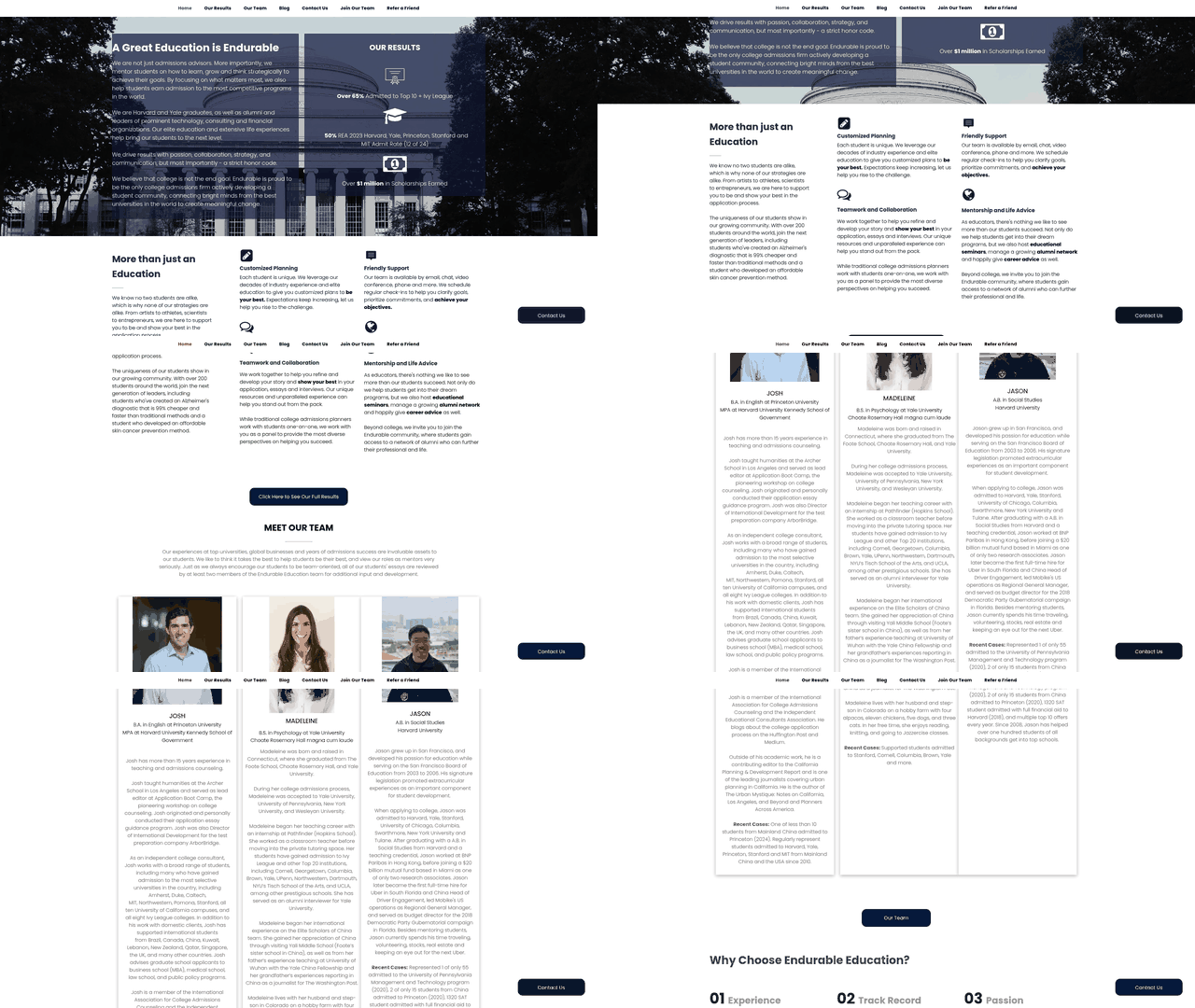
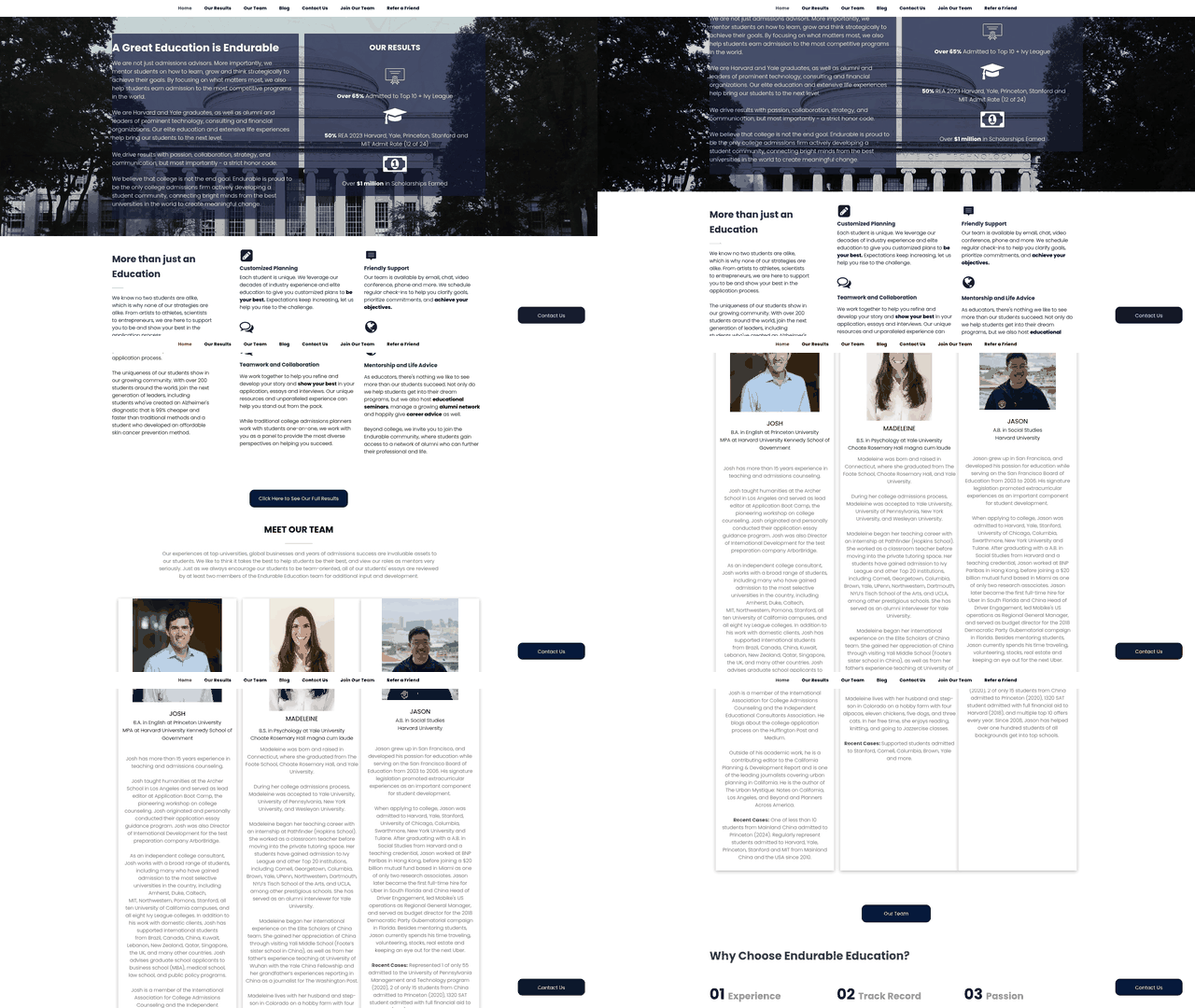
Our track record: over 65% of our students gain admission to Top 10 and Ivy League schools. We achieve this through mentorship focused on showing your authentic best, not manufacturing a fake profile. Our performance-based structure aligns our incentives with your family's goals.
Why Counselors Exist (and What You're Actually Buying)
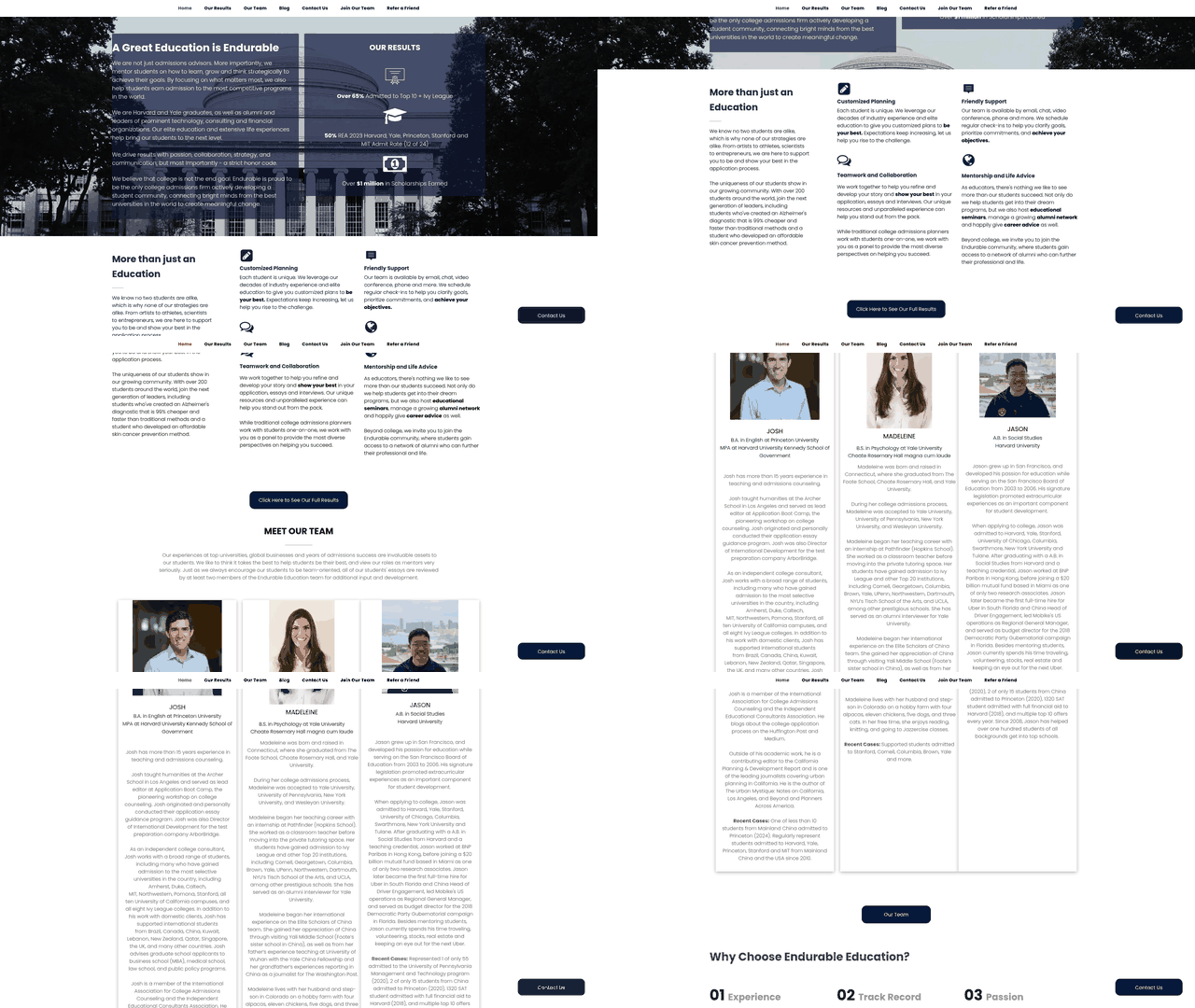
A good counselor addresses a critical resource gap. School counselors are stretched too thin to provide deep attention. For applicants targeting highly selective institutions, this lack of guidance means missing subtle positioning opportunities.
Demand for private counseling keeps climbing. But the harder question isn't "should we?"—it's "what are we actually paying for?"
What Problems Counselors Actually Solve
The real value is judgment under uncertainty. Strong applicants usually have the grades and scores. What they lack is a coherent story: which activities to deepen, which essay angle reveals something true, and how to position a spike so an admissions officer remembers it.
Post-COVID, guidance got expensive fast. Tutoring and counseling rates rose roughly 30% annually at some firms. Top coaches bill up to $1,600/hour. Junior staff run around $290. Families pay a premium for scarce senior attention.
Do Harvard and Yale Credentials Matter?
They're table stakes. Premium firms market Ivy insider access as the core value. DeweySmart's pricing analysis cites Harvard GSE research suggesting deep process knowledge matters more than the specific school a counselor attended.
Alumni backing signals credibility. It doesn't guarantee results. That's why our team's academic pedigree is just the baseline. What protects your investment is how we structure our partnership, ensuring compensation is tied to the quality of our guidance.
Structure matters because it shifts risk. In hourly models, every strategic revision or extended essay session adds to your tab. Package deals cap the bleeding but still collect payment upfront whether your student gets in or not. Outcome-aligned fees mean the counselor has skin in the game.
Who Benefits From This Model
High-achieving students who need positioning, not hand-holding, get the most from outcome-aligned pricing. So do families burned by opaque six-figure retainers. The issue isn't premium pricing itself. It's paying for effort rather than results.
Some families report satisfaction with traditional models when counselors provide weekly check-ins and detailed feedback. But the value flips for students who need fewer touchpoints and sharper strategic calls. If your student executes independently and guidance is about direction, paying by the hour for reassurance becomes expensive overhead.
Skip a premium consultant if your target schools have generous acceptance rates and your student has a clear plan. But for competitive applicants, tying our fee to your result is the honest middle path. For more on planning the full arc, see our college admissions planning blog.
What Premium Ivy Consultants Actually Charge
Where a consultant sits on the pricing spectrum tells you what you're buying. Below is how fees break down at the premium end, where numbers get eye-watering fast.
The Pricing Structures
Premium Ivy consulting runs from low five figures into seven figures, depending on the firm and engagement length. What drives the spread is structure. Pricing takes three shapes: hourly billing, a flat package covering a single cycle, or a multi-year retainer starting freshman or sophomore year.
Hourly billing rewards families wanting targeted help, but senior counselors at elite firms charge steep per-session rates. Lakhani Coaching's tiered model shows how the same firm splits work between junior staff and top coaches at very different rates. Flat packages fold an entire cycle into one number, typically paid upfront before any work happens. Retainers sit at the extreme end: the Ivy Coach lawsuit exposed a case where a family paid $750,000 before walking away. Identical titles can hide radically different billing logic.
Why Pricing Opacity Hurts Families
Opaque pricing shifts all financial risk onto the party with the least information. When boutique firms withhold details until after an expensive initial consultation, families commit significant resources before knowing if the counselor is a good fit.
This makes the initial matching highly speculative. Families gamble on personal chemistry and communication style without clear terms.
When a firm collects the same fee regardless of the student's final destination, incentives point the wrong way. We believe in shared accountability, where final cost is directly influenced by the quality and success of the partnership.
Where Real ROI Comes From
The return isn't just the acceptance letter. It's the fit. A well-matched student is far more likely to thrive, avoiding the disruption of transferring. Independent research on top consultants suggests professional guidance helps students identify environments where they'll succeed long-term, protecting the family's broader educational investment.
Be skeptical of flashy marketing claims promising massive multipliers for acceptance rates. These statistics often reflect selection bias. Highly motivated students with stellar profiles are the ones most likely to seek high-end advisory services.
Skip six-figure counseling if your student isn't targeting highly selective schools. Industry insiders admit private advisory services are not a necessity for every applicant. For families who do compete at that level, our customized planning focuses on authentic positioning and strategic execution.
When to Hire for Maximum Impact
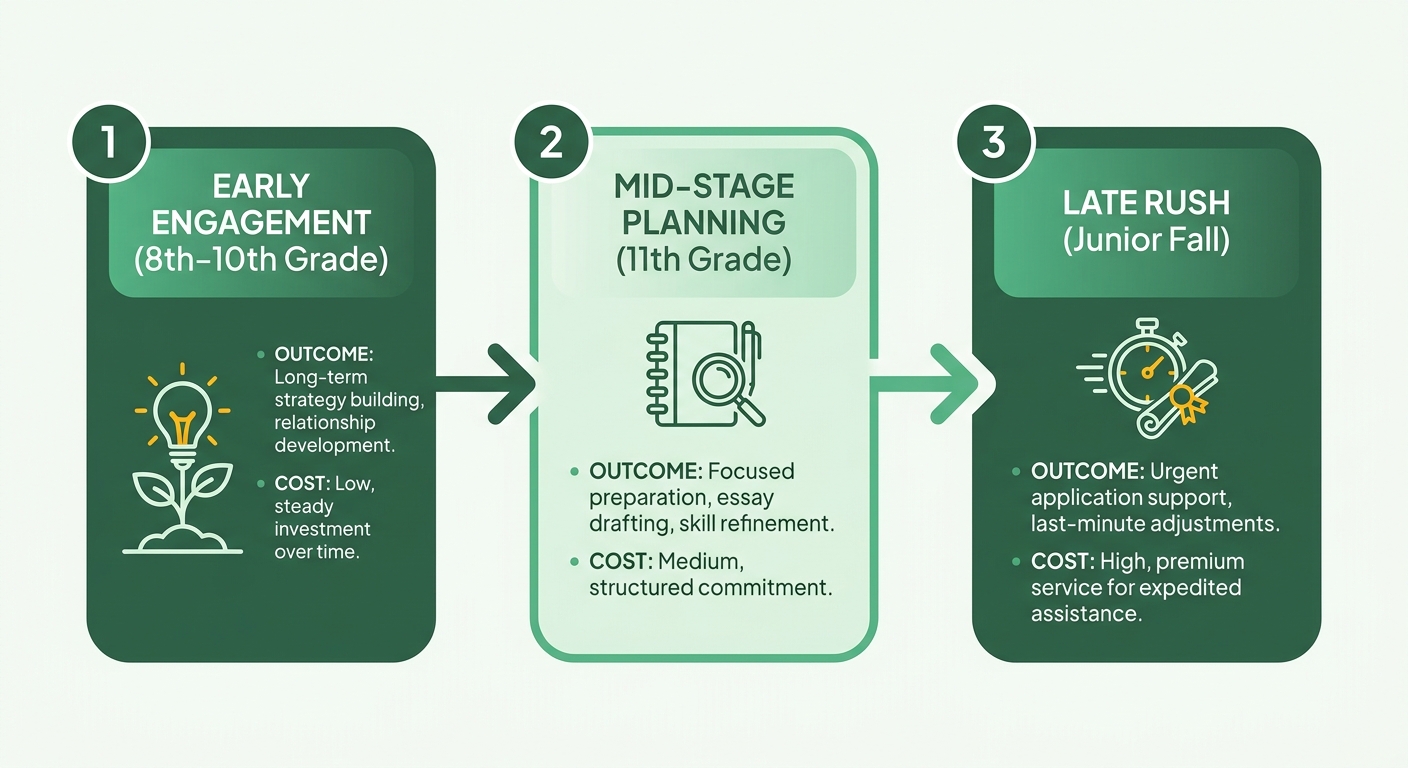
The question most families get wrong isn't whether to hire a counselor, it's when. Timing determines whether you're building a strategy or patching holes. We see families wait until junior fall, then scramble to hire premium counselors at $30,000+ because the stakes feel urgent. Start earlier, and you control the timeline.
Our model focuses on long-term development. A student who starts early gains years of compounding advantages: extracurricular shaping, course sequencing, and testing strategy that build the meaningful experiences the strongest applications are made of.
Freshman to Junior: When Strategy Actually Works
Hiring a counselor during freshman or sophomore year lets you build the profile colleges want before application deadlines force compromises. This is when you have time to test AP course loads, pivot from weak extracurriculars, and map summer programs that signal genuine intellectual curiosity rather than résumé-stuffing.
Counseling during these years costs the same per hour as junior-year consulting, but the ROI compounds. A student who switches from treasurer of three clubs to founding one meaningful organization sophomore year has two years to demonstrate leadership depth. The same pivot in senior fall reads as desperation.
We spend freshman and sophomore sessions on course rigor calibration and activity pruning. Most students arrive with too many surface-level commitments. Our job is to identify the two or three threads that could become a cohesive narrative by application time, then map the milestones that prove sustained engagement. Early work is where a profile's foundation gets set, and a rushed junior-year version cannot replicate it. This proactive approach increases the likelihood of a successful outcome and aligns with our performance-based philosophy.
The caveat: if your student isn't self-motivated yet, freshman-year consulting can feel like pushing a boulder uphill. We've seen packages where the student ghosts every assignment and the family's money buys frustration. Save the investment until the student shows readiness. That might be sophomore spring instead of freshman fall. A motivated sophomore will outperform a dragging freshman every time.
Junior Year: The Last Chance to Shape Outcomes
Junior fall is the final window where a counselor can meaningfully alter your application strength. After winter break, you're executing a strategy, not building one. Testing, course selection, and activity depth are mostly locked. Hiring in junior spring or summer still helps, essay editing, school list refinement, interview prep, but the ceiling drops.
Families targeting schools with single-digit acceptance rates often hire here. A stronger application can move a student from a standard offer to a merit package worth tens of thousands over four years, turning a modest consulting fee into a substantial net gain. Our pricing model reflects this focus, keeping upfront costs manageable while ensuring our incentives remain tied to your satisfaction with the final results.
The risk at this stage is overpaying for false urgency. Premium firms pitch expensive junior-year packages by emphasizing how little time remains. That's true, but it's also a sales tactic. If your student has strong grades, solid test scores, and at least one deep extracurricular, comprehensive counseling can deliver comparable results without inflated panic-driven pricing.
Senior Year: Execution, Not Strategy
By senior fall, you're hiring for polish, not transformation. A consultant can sharpen essays, optimize the school list, and coach interview performance. But GPA, course rigor, and activity depth are locked. Some premium consultants still charge massive flat fees for senior-year packages, which industry experts criticize as excessive. Senior-year support should be billed at hourly or lower package rates unless the family is managing a highly specialized situation like recruited athletics or international applications.
Our senior-year support covers essay strategy, application review, and interview prep. Every student's essays are reviewed by at least two team members. While we still align our final compensation with your satisfaction, we always advise families that starting earlier yields far more transformative results because there is actual runway to shape the profile.
The one exception: students with legacy hooks or recruited athlete status. These cases justify senior-year consulting even at premium rates because the strategy shifts from profile-building to procedural navigation. Knowing which coaches to contact, how to time legacy signals, and when to commit ED can be worth five figures if the family is targeting a school where the student has a structural advantage. For everyone else, senior fall is too late for transformation. You're buying editing, not outcomes.
Comparing Consulting Fees to College Tuition
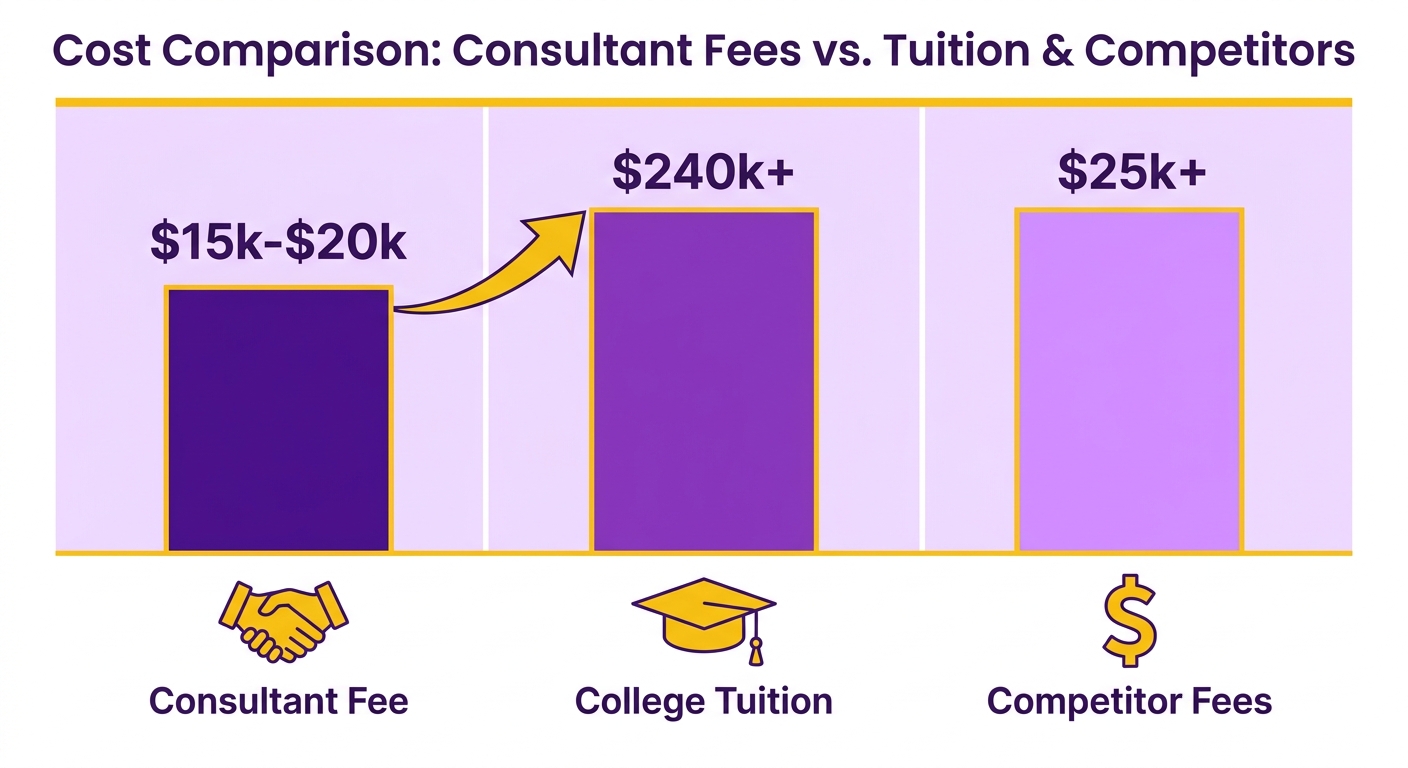
The math on a counselor starts to make sense when you place the fee next to four years of tuition. Private universities now average $60,420 per year for tuition, fees, and room and board. A family targeting elite schools is already budgeting $240,000+ over four years. We structure our pricing to keep upfront costs reasonable compared to this massive long-term commitment. By keeping initial fees accessible and tying our success to your satisfaction, we ensure your investment is aligned with the value we provide.
What Ultra-Premium Firms Deliver
Ultra-premium consultants operate in a different financial universe. High-end boutique programs easily reach six figures. At those price points, families are paying a significant percentage of total college costs before acceptance letters arrive. That's a massive upfront bet with zero accountability if the outcome disappoints.
Pricing opacity makes the gamble worse. Some firms require a multi-step consultation before providing a quote, leaving families in the dark about the final bill. When high-profile disputes over massive fees make headlines, it highlights how vulnerable families are when they sign contracts with no clear pricing caps or refund policies.
This creates a severe risk imbalance. Families shoulder all the financial downside while the consultant gets paid regardless of fit or outcome. We believe a healthier partnership requires the advisor to share in that risk.
When the Fee Pays for Itself
The clearest ROI comes from financial aid optimization and merit scholarship navigation. A stronger application can secure institutional merit aid that far exceeds the initial cost of advisory services. Beyond direct dollar savings, proper college fit reduces the likelihood of expensive remedial coursework—roughly 40% of college freshmen take at least one remedial course, costing families $1,300 to $2,800 in non-credit tuition charges.
The harder-to-quantify return is fit and timely graduation. Graduating on schedule rather than taking five or six years saves a family tens of thousands in tuition and avoids delayed career earnings. However, when evaluating outcomes, families must look past flashy marketing claims. Assertions of massive acceptance multipliers often obscure selection bias: the students hiring these firms are already highly competitive candidates.
We focus on ensuring a strong candidate's voice is heard clearly by admissions committees. Our team's firsthand experience with highly selective institutions allows us to translate complex institutional priorities into concrete application strategies. This expertise helps us guide families toward realistic, high-value choices rather than chasing prestige for its own sake.
When to Skip the Consultant
Not every family needs paid counseling. If a student is targeting schools with high acceptance rates where admissions decisions are primarily numbers-driven, the marginal benefit of hiring a consultant is minimal. The application process is straightforward, and outcomes are highly predictable based on GPA and test scores alone.
You also don't need a consultant if your student already has strong self-advocacy skills and a realistic college list. Some students thrive on independent research and don't need someone managing timelines or second-guessing essay drafts. Even prominent industry figures acknowledge that with common sense and careful planning, many families can navigate this process entirely on their own.
In those cases, the cost of counseling starts to look reasonable compared to the cost of a mismatched college choice or a wasted application cycle. We see our role as judgment under uncertainty, helping you make high-stakes decisions when the information is incomplete and the timeline is unforgiving.
Vetting Credentials and Track Record
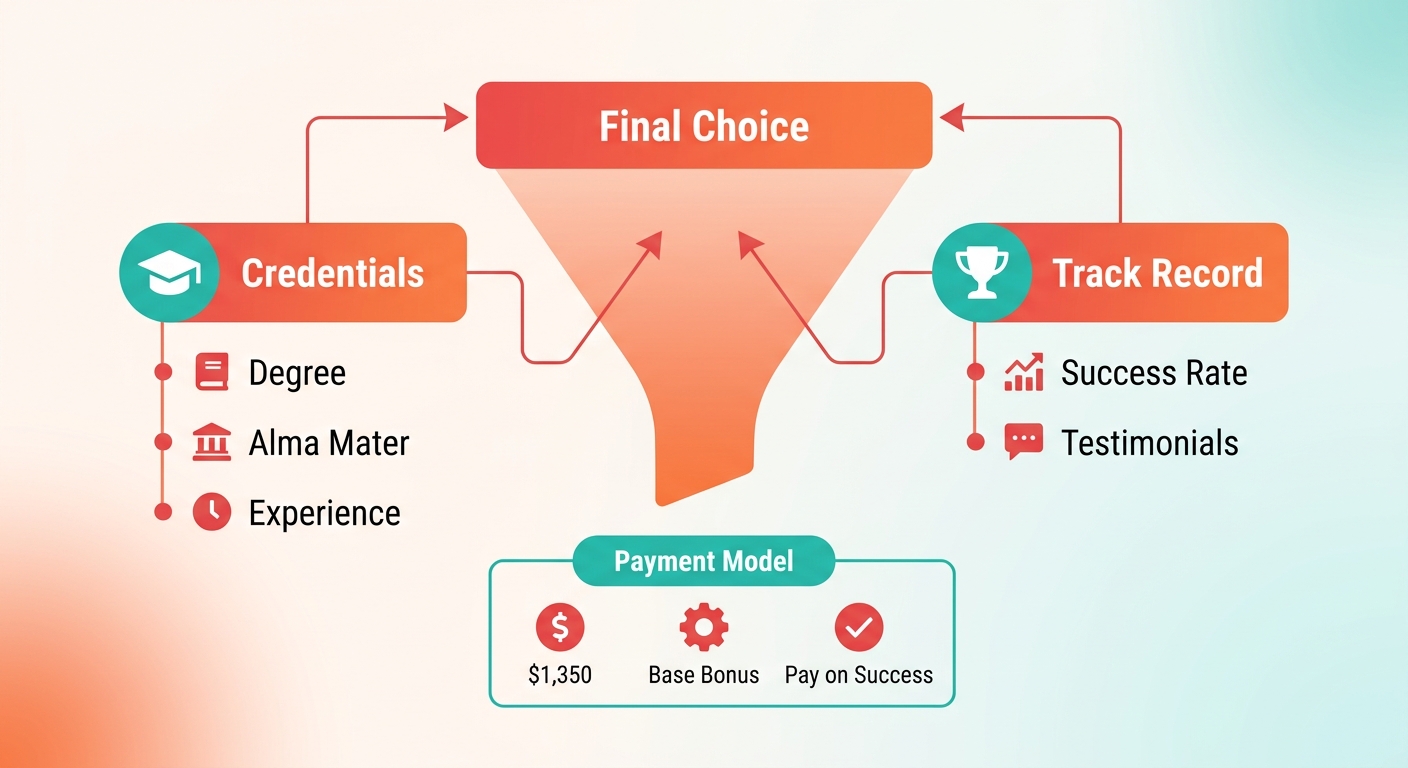
The best way to vet a counselor is to separate what they promise from what they can prove. Credentials and track record tell you which side of that line a firm sits on. Start with two questions: who actually does the work, and how do they get paid?
Pricing opacity makes both questions hard to answer. When firms require significant financial commitments upfront before establishing a clear working relationship, the family carries all the risk. We believe in a more transparent approach where fees are clearly defined and structured around mutual satisfaction.
What Credentials Actually Matter
Credentials that matter are direct admissions experience and verifiable outcomes. One parent forum flatly warns families to avoid any counselor with "Ivy" in its name, because the label signals marketing, not results.
Ask who sits across the table from your student. At many premium firms, working directly with the founder costs more, and junior staff handle the rest. Ask how long each advisor has done this work, whether they have read applications from inside an admissions office, and how many students they take on per cycle. A counselor juggling dozens of families cannot give yours real attention. Our team is built on Harvard and Yale alumni who have lived the process they coach, and we cap our caseloads so no student becomes a line item.
Checking Track Record
Read the claimed numbers with a skeptical eye. While some firms cite near-perfect acceptance rates or massive admission multipliers, and Empowerly cites 98% admission to Top 100 colleges, these figures often reflect the baseline strength of their applicant pool rather than value added by the consultant.
The more honest signal is what happens after acceptance. Ask for references from families a few years out, and ask whether their students stayed at the schools they enrolled in and finished on time. Fit predicts those outcomes better than any admit-rate headline. That's the ROI we anchor to.
Red Flags and Finding Fit
The clearest red flag is a guaranteed-admission promise. Ethical consultants will never guarantee an outcome at highly selective schools, as the process is inherently holistic and unpredictable. Any firm that promises a backdoor entry or uses high-pressure sales tactics should be avoided.
| Factor | Ultra-premium firms | Endurable Education |
|---|---|---|
| Pricing transparency | Custom quote, no published list | Base + bonus structure |
| Payment risk | Full fee upfront | Bonus tied to satisfaction |
| Who advises | Founder costs extra | Harvard/Yale alumni team |
Skip the six-figure firms if you only need essay review or timeline support. But if you want strategy tied to outcomes rather than billable hours, judge the fit on communication style and how a consultant explains its fee. If they can't explain it clearly, that tells you enough.
References
[1] Private College Counselor Fees & Cost - Ivy Coach - https://www.ivycoach.com/the-ivy-coach-blog/college-admissions/fees-college-consultants/
[2] Why parents will pay $500,000 for Ivy League admissions consulting - https://www.cnbc.com/2024/10/18/why-parents-will-pay-500000-for-ivy-league-admissions-consulting.html
[3] IvyWise Cost 2026: What $50000 College Counseling Actually Gets ... - https://www.findmyorbit.com/blog/ivywise-cost-2026
[4] 7 Best College Admissions Consultants Ranking for 2026 - https://research.com/universities-colleges/best-college-admissions-consultants-ranking
[5] Suit reveals elite college consultants charged a family $1.5 million - https://www.insidehighered.com/admissions/article/2018/02/12/suit-reveals-elite-college-consultants-charged-family-15-million
[6] How Much Does College Admissions Consulting Cost? A ... - https://www.deweysmart.com/resources/how-much-does-college-admissions-consulting-cost-2026-pricing-guide
[7] Ivy Dean, Ivy Wise, College Counselors - Parents Forum - https://talk.collegeconfidential.com/t/ivy-dean-ivy-wise-college-counselors/3504831
Frequently Asked Questions
1. What's the difference between a flat package and a multi-year retainer?
A flat package covers a specific application cycle for a set fee, usually paid upfront. A multi-year retainer is a long-term agreement starting as early as freshman year to guide a student's entire high school profile. Retainers are significantly more expensive because they cover multiple years of continuous strategic planning and profile building.
2. Should I hire a premium consultant if my student targets state flagships?
Generally, no. If your student is targeting schools with high acceptance rates where admissions are primarily based on clear GPA and test score thresholds, premium consulting is rarely necessary. These services are designed for highly selective, holistic admissions processes where applicants need to differentiate themselves among thousands of similarly qualified peers.
3. Can I get a refund if a premium firm isn't a good fit?
Refund policies vary widely, but many premium boutique firms have strict no-refund policies once a contract is signed. Because of this, it is critical to review the contract terms carefully and ensure you have a strong rapport with the specific counselor who will be working with your student before making a financial commitment.
4. Does a counselor's Harvard or Yale degree guarantee better results?
An elite degree signals that the counselor understands the academic and extracurricular standards of top-tier institutions firsthand. However, a degree alone does not guarantee success. Effective counseling requires deep knowledge of the admissions process, strong communication skills, and the ability to mentor teenagers effectively.
5. Why should I be skeptical of advertised success-rate multipliers?
Many firms that advertise near-perfect acceptance rates or massive multipliers work primarily with students who already have top-tier grades, test scores, and extracurricular profiles. These students are highly likely to gain admission to competitive schools on their own merits, making it difficult to isolate the actual impact of the consultant.
6. When is senior-year consulting worth premium rates?
Senior-year support is best used for execution: polishing essays, refining the school list, and preparing for interviews. Premium rates are rarely justified at this late stage unless a student is navigating highly complex, time-sensitive processes such as athletic recruitment, artistic portfolio submissions, or legacy considerations.
7. How does the base-plus-bonus model reduce my financial risk?
Unlike traditional models that require massive upfront payments regardless of the final outcome, a performance-aligned structure keeps initial costs lower. By tying a portion of the compensation to your satisfaction with the results, the financial risk is shared, ensuring the advisory team remains fully committed to your student's success.