What Ivy League Readers Flag in the First 90 Seconds of Your Application
August 30, 2026

Key Takeaways
- An Ivy reader forms a lasting impression of your file in under 90 seconds, and that first read totals under 15 minutes.
- Committees rarely reopen full files. They work from the first reader's ratings and notes, so that early impression becomes the permanent summary.
- Academics eat the biggest slice of the scan, roughly 12-15 seconds of the 90-second sweep.
- The header gets only 5-7 seconds, so a bold name and school placement anchor your file to a known level of rigor.
- Activities pull about 10-12 seconds; essay and recommendation snippets get 8-10 combined.
- Anything below the fold fights for leftover attention. Placement decides whether an achievement gets read at all.
- Front-loading your strongest signals matters more than most applicants think, because early impressions frame how everyone downstream reads the rest.
How Ivy readers scan your file in 90 seconds
Here's the uncomfortable part of how Ivy admissions actually work: a reader forms an impression of your file in under 90 seconds, and that impression tends to stick. The first read at selective colleges runs less than 15 minutes total, but the opening scan sets the frame for everything after.
This is one reason we run every student's application through a two-reader panel before it goes anywhere near submit. When committees meet, they usually don't reopen the whole file. They work from the first reader's ratings and notes. Your 90-second impression becomes the summary later decision-makers act on. That's why front-loading your strongest signals matters more than most applicants realize.
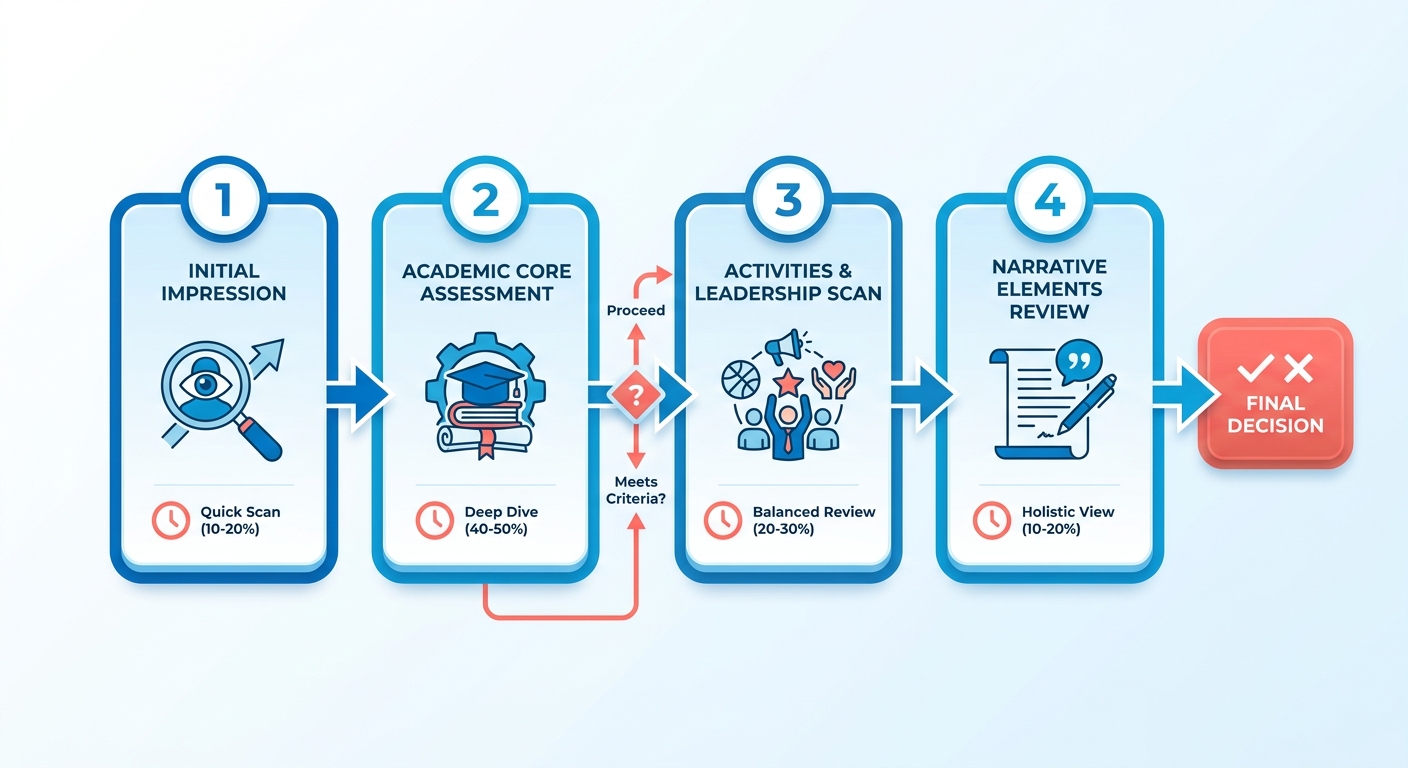
Where those 90 seconds actually go
Readers move top-down through a predictable order: roughly 5-7 seconds on your header, 12-15 on academics, 10-12 on activities, and 8-10 on essay and recommendation snippets. Everything below the fold competes for whatever attention is left. Where you place a signal decides whether it gets read.
- Lead with name and school in bold. The reader anchors your file to your high school's known rigor in the first few seconds. Make it unmissable.
- Put GPA, rank, and rigor above test scores. Each applicant gets an academic score built from GPA, course rigor, and test scores. Readers hunt for these first.
- Compress your activity block into scannable bullets. Paragraphs force the reader to synthesize under pressure. Bullets hand them a clean summary.
What layout gets you flagged "high-potential"
A clean, focused layout reads as an organized applicant, and that framing sticks through the primacy effect. First impressions anchor how a reader weighs everything else. A cluttered file with inconsistent fonts and cramped margins signals disorganization before a single word registers.
- Keep formatting consistent throughout. Mismatched fonts and uneven spacing quietly tell the reader you didn't proofread. That doubt colors the whole read.
- Front-load one core theme, not five scattered interests. Focus produces a memorable one-line note. Well-roundedness forces the reader to guess your story.
- Give them a PDF-friendly file. Many schools use digital dashboards, but readers still lean on clean PDFs for fast top-down scans.
And skip the design flourishes. Fancy graphics, color blocks, and creative fonts don't get you flagged for a deep read. They slow the scan and make readers work harder to find your academic score.
One honest caution on the numbers. For all the scoring rubrics, the process stays qualitative and subjective. Admissions officers are real people who bring emotion into the read. A clean layout gets you into deep-read mode. Your story is what keeps you there. For more on building that focused narrative, our college admissions blog goes deeper.
Academics: GPA, rigor, and test scores
The academic core is what a reader scores first, and that score gets compressed into a single rating that follows your file into committee. Princeton assigns a 5-point academic rating, and once that number is set, the committee often works from it rather than reopening your transcript. That's the mechanics of it: the first reader's academic score is durable, so you front-load the signals that push it up fast.
Most families miss this next part. A reader doesn't have time to hunt. If your GPA, rigor, and scores aren't legible in the opening scan, the reader improvises a summary, and an improvised summary is rarely generous.
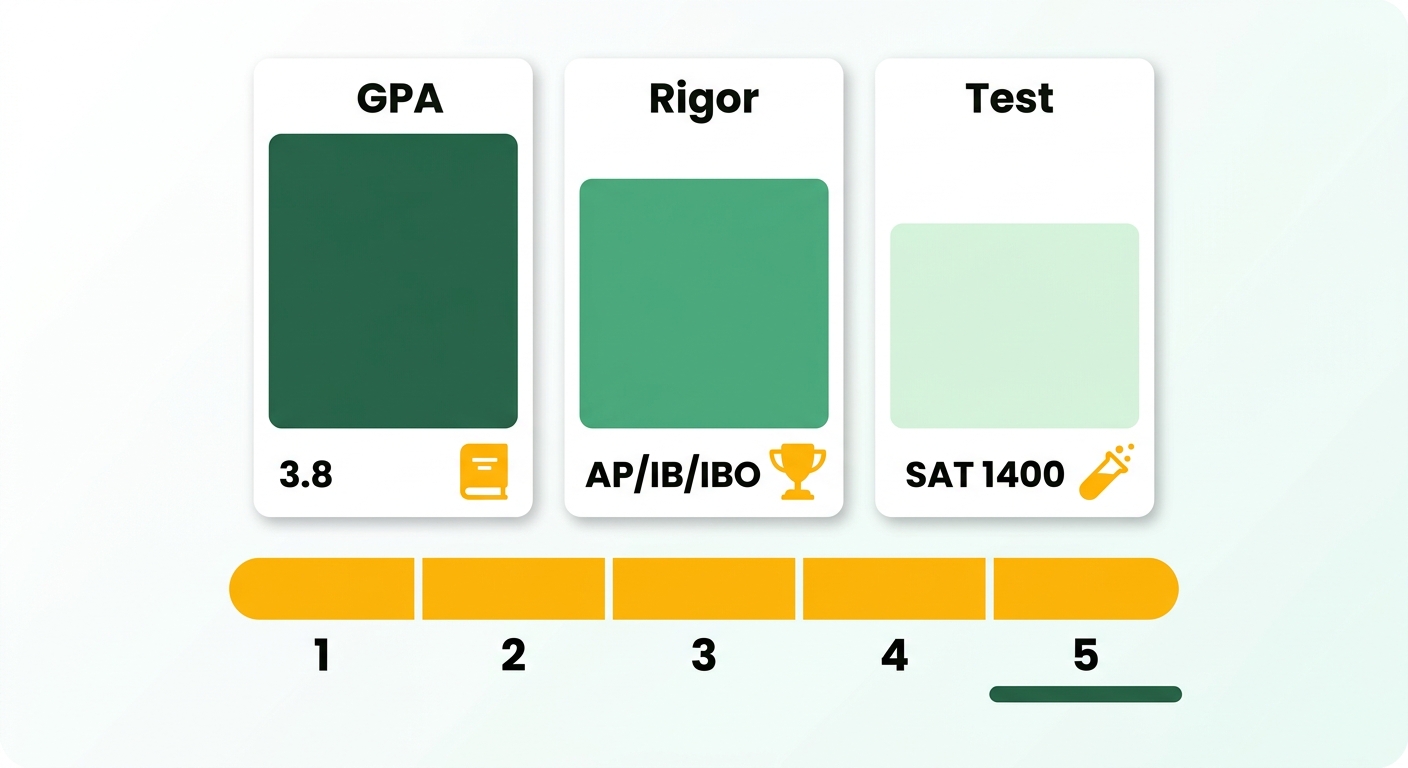
How readers normalize GPA and rank
Readers normalize your GPA against your school's profile, not a national curve. A weighted 3.9 at a school that caps rigor reads differently than a 3.9 at a school offering 25 APs. Because the academic score blends GPA, rigor, and test scores, context does quiet work behind the number.
Class rank matters less than the story rank tells. If your school reports it, a top-decile placement confirms you took the hardest path available. If your school suppresses rank, the reader leans harder on rigor to figure out where you stand.
Never assume the reader knows your school. State the context yourself in one line so the reader doesn't have to reconstruct it under time pressure.
What scores and rigor trigger a green light
Strong Ivy-range academics cluster around a 1480+ SAT or 33+ ACT paired with the hardest rigor available. These aren't cutoffs. Princeton's 4.5% acceptance rate in the 2024-2025 cycle means plenty of high scorers get declined. But below these bands, the academic rating alone rarely clears the first hurdle.
Rigor gets read as both a count and a trajectory. Reviewers scan for AP/IB density, honors sequences, dual-enrollment, and independent study, then check whether you kept climbing senior year.
- Take the hardest courses your school offers so the reader records "most demanding" instead of guessing your ceiling.
- Report test scores only when they land in-band (1480+ SAT, 33+ ACT). A borderline score adds noise, not signal.
- Flag independent research or dual-enrollment as evidence you went looking for rigor past the standard menu.
A reader recognizes an applicant with a 3.9 GPA who ran a high-level research project. The GPA isn't perfect, but the research reframes the profile as someone who works past the syllabus. That focused signal reads faster and stronger than a scattered set of activities, which is exactly why the advice runs toward a few deep interests over a long list.
The quick win: an Academic Highlights box
Add a one-line "Academic Highlights" note at the top of your transcript page. Something like: "12 APs, 3 dual-enrollment courses, independent research in molecular biology, top-decile rank." That hands the reader their summary instead of forcing them to build one.
We build each student a plan to catch where the academic core reads strong and where it reads weak while there's still time to act. Weak in one area is survivable. Illegible across all three is not.
Activities and leadership
Your activity block gets scanned, not read. A reader spends seconds on it, looking for three things stacked in order: how long you stuck with something, whether you led it, and what changed because you did. The reader wants a one-line summary to jot down and carry into committee.
Why does that summary matter so much? Admissions officers lean on these first impressions to pitch your case during group deliberations. Whatever your activities signal in those opening seconds becomes the note later decision-makers act on. Front-loading isn't vanity. It's survival.
The three signals readers rank first
Readers scan your list against a three-tier hierarchy: commitment, leadership, impact. Depth beats breadth every time. A sustained project produces a clean, memorable line a reader can capture fast. A scattered list forces synthesis under time pressure and risks a vague note.
That's the mechanical reason behind the standard advice to build a few core interests. A focused profile reads itself. A long list of one-off events does not.
- Commitment. Show multi-year involvement in your top activities. Two or three years in one pursuit signals grit a reader trusts more than ten single-semester clubs.
- Leadership. Bold your title so it catches the eye in the first pass. "Captain," "Founder," or "President" tells the reader you drove the work, not just showed up.
- Impact. Lead with a quantifiable outcome. Numbers give the reader something concrete to write down instead of an adjective they'll forget.
The mental math readers run
Think of it as hours × role × outcome. A national-level robotics captain who logged hundreds of hours, held a real title, and shipped a measurable result scores high on all three. Ten casual memberships score near zero, no matter how long the list looks.
The first read runs fast and folds into a single non-academic rating. The reader has no time to hunt for your best line. So if your strongest activity isn't obvious in your first two entries, you've buried it.
- Embed metrics without clutter. Write "Raised $4,200 for local shelter, 150% of goal" instead of "helped fundraise." One number does more than three sentences.
- Format for the scan. Bold leadership titles, use bullets for achievements, and put your highest-impact activity first. The reader reads top-down and rarely reaches the bottom.
Aligning activities with what Ivy readers reward
Sort each activity against the values Ivy readers reward: leadership, service, scholarship, talent. The goal is coverage without dilution. You want your top entries hitting distinct values, not repeating the same one four times.
Map first, then cut. If three activities all say "service" and none says "scholarship," you have a gap the reader will notice. Getting a second set of eyes on this before submission consistently produces a cleaner first-read note.
- Assign one value per activity. Tag each entry with its dominant signal so your list reads as a balanced portfolio, not a pile.
- Cut the redundant. Drop the fourth activity that repeats a value you already own. A shorter, sharper list scans better than a padded one.
Essays, supplements, and recommendations
Your essays get sampled, not read, in the first pass. A reader skims the opening two or three sentences of your personal statement, checks whether your supplemental answers match the prompt, and scans recommendation letters for one concrete detail. That sample becomes the narrative note that follows your file into committee and shapes how the room reads your personal qualities.

This is the part families underestimate most. The academic score is quantitative and hard to move late. Your narrative is qualitative, and the read itself is subjective and impression-driven. A Dartmouth admissions officer once called the process more subjective than expected. That subjectivity is your opening, if you front-load the right signals.
What readers want from your essay opening
A reader decides whether to keep reading based on your first two or three sentences, so those lines have to carry voice, not throat-clearing. Officers are looking for a genuine human connection in the text. A flat opener wastes the seconds when they're most engaged.
- Lead with a specific moment, not a thesis statement. A concrete image or line of dialogue reads as authentic voice. A summary of your character reads as a cover letter.
- Cut the warm-up paragraph entirely. Most essays get stronger when you delete the first paragraph and start at sentence three. That's usually where the real story begins.
- Match your voice to your activity block. If the reader already jotted a one-line summary of you, your essay opening should confirm it, not contradict it.
How to handle supplemental essays
"Why us?" prompts get scanned for keyword matches against the specific school, and a generic answer gets flagged fast. The summary a reader captures depends on a clean, focused profile. Scattered answers force synthesis under time pressure, and rushed synthesis produces a vague note.
- Name specific programs, courses, or faculty in "Why X?" answers. Readers scan for proof you researched their school. A response you could paste into any college's form signals nothing.
- Tie each supplement back to one or two core interests. A focused profile is faster to summarize, which is the whole reason the deep-interest strategy works.
- Put your strongest excerpt on page one of the supplemental PDF. If a reader only skims the top, make sure the top is your best line.
Why letters get skimmed for anecdotes, not adjectives
Readers hunt for one concrete anecdote in a letter, not adjectives. "Hardworking and kind" gets skipped. A teacher describing a specific moment gets underlined and carried into committee, the same way a student's personal challenges shaped the file in IvyWise's own committee example.
- Give recommenders one or two specific stories to reference. A short brag sheet turns generic praise into a quotable moment a reader can lift.
- Choose teachers who saw you struggle and adapt, not just earn A's. Growth anecdotes read as evidence. Grades are already scored elsewhere.
Our review process puts your essays, "Why X?" answers, and letters in front of more than one reader, which is the point: a single advisor sees one story, a panel catches the gaps. If your profile doesn't yield a clear, immediate summary, we work it until it does.
Red flags and a 5-day fix
A red flag is anything that forces a reader to slow down, squint, or struggle to summarize your profile. Since committees lean on the first reader's ratings and notes as their primary guide, a flag caught early becomes a durable obstacle that trails you into the room. Fixing these seven is the fastest, highest-use move you can make.
The good news: most flags are presentation problems, not talent problems. You can clear them in a focused sprint.
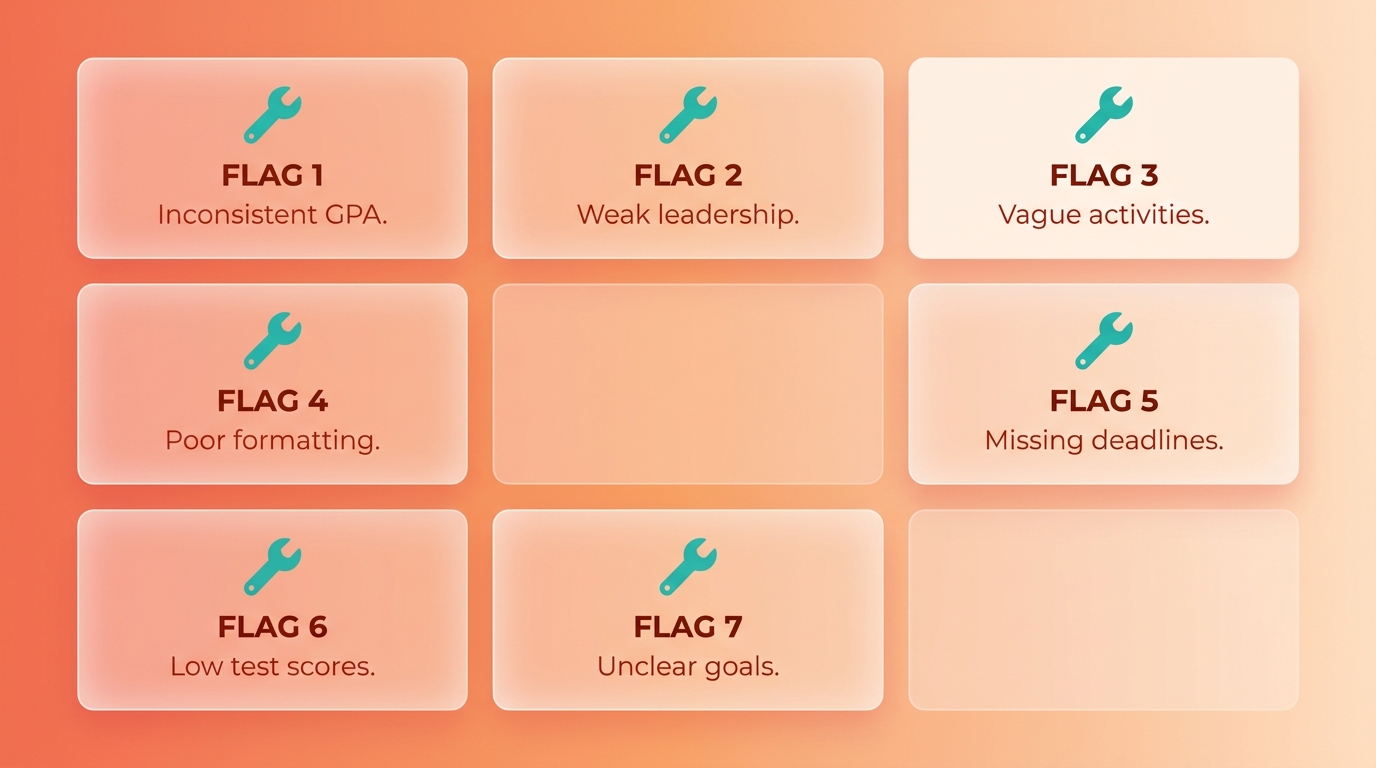
The seven flags readers catch first
Each one makes the reader's job harder than it needs to be. Each one has a fast fix.
- Inconsistent formatting. Mixed fonts and ragged margins make a file look careless before a single word is read. Lock everything to one clean template with uniform spacing.
- Vague activity leadership. "Member, Science Club" tells a reader nothing. Add a one-line descriptor of your role and title so the reader can jot a clean summary.
- GPA/rigor mismatch. A reader who doesn't know your school improvises, and improvised context is rarely generous. Add a brief note on your grading scale and how many APs your school actually offers.
- Generic essay opening. An abstract first sentence gets skimmed past. Replace it with one concrete, sensory detail that pulls the reader into the scene.
- Recycled recommender adjectives. Three letters calling you "hardworking" read as one flat note. Ask each recommender for one specific story only they can tell.
- Over-crowded first page. Ten thin entries bury your two strong ones. Prune the low-impact items or push them to an appendix so your best signals surface first.
- No quantifiable outcomes. "Tutored students" is forgettable. "Tutored 15 students weekly, raising average test scores by 12%" is not. Add numbers, percentages, or rankings wherever they're true.
Why focus beats breadth, one more time: a scattered profile forces the reader to synthesize under time pressure, which produces a vague note. IvyWise and PrepMaven point the same direction. The data favors depth of commitment over a long list of minor activities, and the fast qualitative read is why. A focused file writes its own one-line summary.
Fixing it in a 5-day sprint
Run the fixes in order, one category per day. This sequence moves the cheapest, most durable signals first.
- Day 1 — Formatting audit. Standardize fonts, margins, and spacing across every document. Fastest flag to kill, and the one readers notice instantly.
- Day 2 — Activity refinement. Add a leadership descriptor and a quantified outcome to your top five entries. Cut or demote the rest.
- Day 3 — Academic context. Write a two-sentence note on your grading scale and course availability so no reader has to guess.
- Day 4 — Essay hook rewrite. Replace your opening with a concrete detail. Read the first three sentences aloud and cut anything abstract.
- Day 5 — Reviewer simulation. Have two people scan your file for 90 seconds, then tell you the one-line summary they'd carry into committee. If it's wrong or blank, you still have a flag.
That last step matters most. When a student clears three of these flags at once, the file stops fighting the reader and starts feeding them a clean summary. That shift, not a new achievement, is often what moves a borderline file forward.
References
[1] Admissions Committee: The Review Process - IvyWise - https://www.ivywise.com/ivywise-knowledgebase/how-the-admissions-committee-review-process-works/
[2] How Colleges Read Your Application: A 4 Step Process | PrepMaven - https://prepmaven.com/blog/applying/how-colleges-read-your-application-a-4-step-process/
Frequently Asked Questions
1. Does submitting a resume or portfolio alongside my application help with the 90-second scan?
Extra documents can hurt if they crowd your first page or add clutter that slows the reader. Since reviewers prioritize the primary application pages, additional materials can dilute your core message. Focus on a clean, standard layout that allows your academic achievements to stand out immediately without requiring extra clicks.
2. What if my high school doesn't offer many AP or IB courses?
Admissions officers evaluate your course selection strictly within the boundaries of what your school provides. If your school caps advanced classes, taking the maximum available load signals top-tier ambition. Clearly noting these institutional limits on your application ensures your academic drive is evaluated fairly within your local context.
3. Should I still report a test score that falls just below the 1480 SAT band?
In a test-optional environment, submitting a score that sits below the typical middle-50% range of admitted students can weaken an otherwise strong academic profile. If your score does not reinforce your high GPA, withholding it may prevent unnecessary doubts about your academic readiness during the initial review.
4. My strongest activity happens to be listed fifth. Does order really matter that much?
Order determines whether an achievement gets read at all. Because readers scan activity lists from top to bottom under tight time constraints, they rarely focus on items near the end of the list. Placing your most significant leadership role and quantifiable impact at the very top ensures it is captured in their initial notes.
5. How is fixing red flags different from adding new achievements to my application?
While adding achievements takes months of effort, resolving presentation issues can be done in days and has an immediate impact. Eliminating formatting inconsistencies and vague descriptions removes friction for the reader. This clarity allows your existing achievements to shine, which can be the deciding factor for a borderline file.
6. Can a single strong essay compensate for a weaker academic rating?
While a compelling personal narrative can elevate an application, it rarely overrides a low academic score. Admissions readers use essays to understand your character and perspective, but they establish academic viability first. A strong essay works best as a differentiator among academically qualified candidates rather than a replacement for academic rigor.
7. Why does having two mentors review my file matter more than one advisor?
A single reviewer is susceptible to individual bias and may overlook subtle gaps in your narrative. Having multiple experienced eyes evaluate your application simulates the actual admissions committee environment. This collaborative review helps identify mixed messaging or unclear achievements before your file is officially submitted.