What Your Dual Enrollment Transcript Really Tells Admissions Officers
September 6, 2026

Key Takeaways
- If your high school offers no AP, IB, or honors track, a dual enrollment transcript can stand in as your entire academic profile.
- College coursework fills the gap left by a school with no rigor rankings, no AP catalog, and no counselor narrative.
- A college grade proves academic ability in a way a high school grade alone can't.
- Officers read transcripts for specific signals: course rigor and grade trends over time.
- Sequenced deliberately, your college courses read as an intentional path instead of a scattered pile of classes.
- If your school already produces a strong profile, this approach won't move the needle much.
- A few common mistakes can quietly undercut an otherwise strong record.
Quick Overview
A dual enrollment transcript can serve as a full academic profile for students whose high schools don't produce one. No AP courses, no rigor rankings, no counselor narrative? College-level coursework fills that gap. The core idea running through this guide: your college transcript tells admissions officers a story your high school can't.
What this guide covers
We walk through how officers actually read a transcript, why dual enrollment grades carry weight, and how to frame your college coursework so it reads as one coherent story. Actionable steps, not theory. You'll leave knowing what your transcript signals and how to sharpen that signal.
| Detail | At a Glance |
|---|---|
| Best for | Students at schools with no AP, IB, or honors track |
| Time to read | About 12–15 minutes |
| Difficulty | Beginner-friendly; no prior admissions knowledge needed |
| Core angle | Using college transcripts as your high school profile |
Sections covered:
- How officers review transcripts — the exact things they look for, from course rigor to grade trends.
- Why college coursework counts — what a college grade signals that a high school grade can't.
- Building your narrative — sequencing courses so your transcript reads as a deliberate path.
- Common mistakes — where students undercut an otherwise strong record.
Who should skip this guide
If your high school already produces a detailed profile with AP offerings, honors weighting, and a strong counselor letter, most of this won't change your application. Your existing record already carries the rigor signal.
This guide earns its place when your school gives officers little to work with. That's where a college transcript stops being a supplement and becomes your primary academic evidence. We wrote it for students who need their coursework to speak for a school that stays silent.
Why This Guide Matters
At small, new, or non-traditional schools, the standard metrics, class rank, a deep AP catalog, often don't exist. In those environments, a strong dual enrollment record becomes an independent benchmark of what you can do.
Most admissions advice assumes you attend a school with a known transcript format and a track record of sending kids to competitive colleges. If yours doesn't, your dual-enrollment grades become your proof of rigor. This guide teaches you to frame them that way.
Who this guide is for
This is for students whose high school transcript can't speak for itself. Homeschoolers. Kids at brand-new charter schools. Students at tiny rural programs. Anyone whose school offers no honors or AP track. If an admissions officer would struggle to gauge your rigor from your school alone, you're the reader we're writing for.
If you already have a robust school profile, our broader admissions and life planning blog covers other strategies worth your time.
What you'll learn
How officers actually read a transcript, and where college grades sit in that read. Which course choices signal real rigor. How to sequence classes so they tell a story. How to present the whole record cleanly.
By the end, you'll have a framework to turn a stack of community college grades into a coherent narrative — the context a standard high school profile normally supplies, showing officers you're ready for college-level work before they reach your essays.
The document that does the heavy lifting
A dual enrollment transcript is a record of college-level courses you took while still in high school, graded on a college scale and issued by the college itself. For students whose high schools produce thin or nonexistent profiles, this document carries the load. It shows an officer your rigor, your subject choices, and your grades in one clean package.
The transcript is the single most important document in your application. Officers read all four years of it, and they read it against your school's profile to judge how hard you pushed relative to what was available. No profile means nothing to read your grades against. College coursework fixes that by giving officers a benchmark that doesn't depend on your high school's offerings.
What officers actually evaluate
Two things, above all: how well you did, and how ambitious your choices were. Rigor beats volume. Five hard classes beat eight easy ones.
Here's the part our team hammers on: officers judge rigor relative to what your school offers. They know a small or new school can't stock a full AP catalog. That's your opening. When your school can't supply rigor, your college transcript supplies it directly. A calculus or biology course from an accredited college needs no translation and no school profile to make sense.
How the pieces fit together
Think of your college transcript as three layers stacked. Each answers a question an officer would otherwise ask your counselor.
- Course selection — which subjects did you choose, and do they build toward a focus? This shows intellectual direction.
- Grades — how did you perform under college-level expectations? This is your proof of readiness.
- Progression — do your courses get harder over time? Officers read all four years, so an upward arc reads as momentum.
Plan the required courses early so you have room for advanced ones later. That sequencing is what makes the narrative hold together.
Getting Started
Start by pulling your official college transcript from every institution where you took dual enrollment courses. This is your foundation. Before you can frame your college coursework as a profile, you need to see exactly what officers will see.
Request the transcript directly from the registrar at each college. Community colleges and universities issue these separately from your high school, so two institutions means two records to gather. Order them early. Registrars can take a week or more, and you don't want this blocking your application.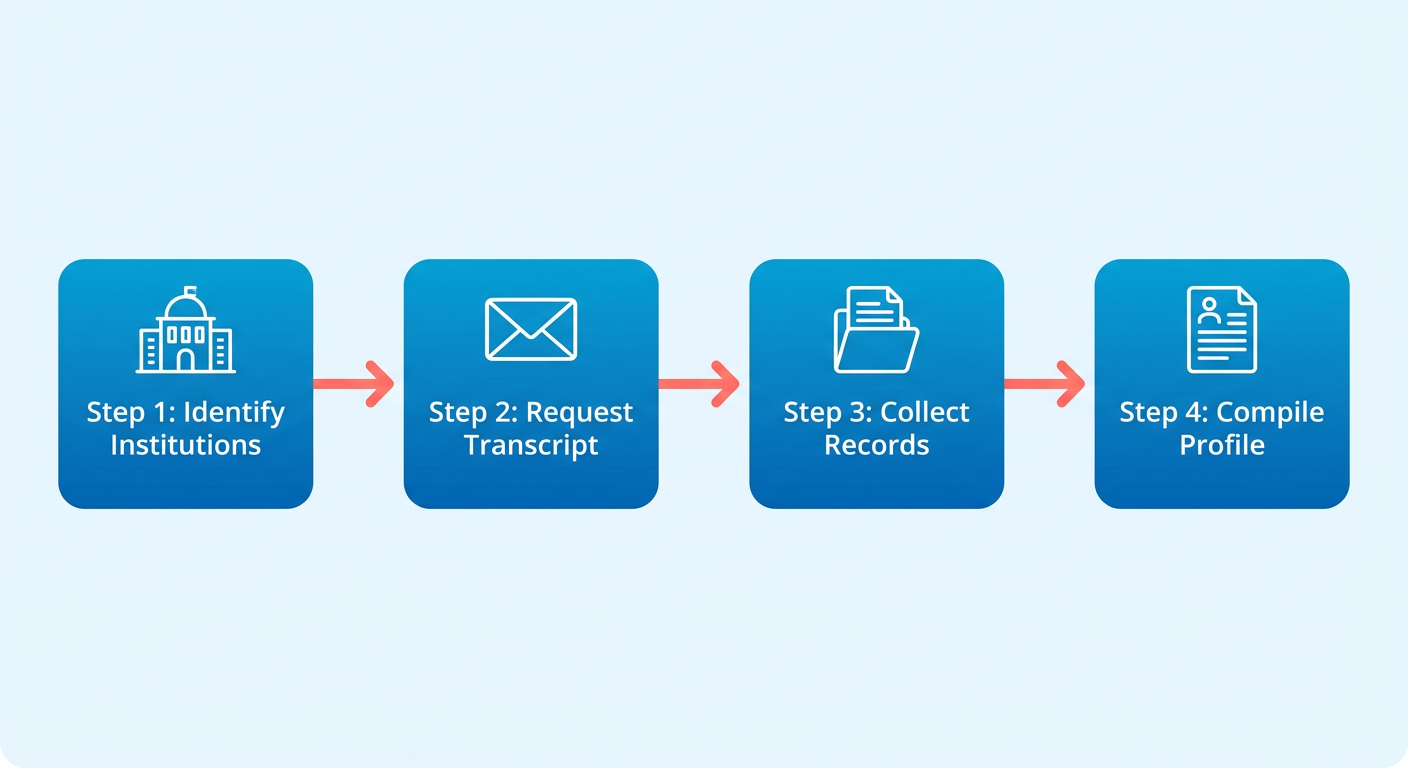
What to check first
Read your transcript the way an officer will. Course titles, grades, and credit hours side by side. Ask: does this tell a clear academic story, or does it look like a scattered list of electives?
Officers read for rigor and direction. English Composition, then Calculus, then a second-semester science sequence signals a student building toward something. A run of one-off courses with no throughline signals drift. Your job in this phase is to spot which one you have.
Check three things on every transcript:
- Course level and title. Transferable college course, or remedial one? Transferable courses carry the weight.
- Your grades. College grades on a college scale. They stand in for the rigor rankings your high school never produced.
- Credit hours. These show how much college-level work you actually completed, not just how many class names you collected.
Mapping your coursework into a narrative
List every course by subject area, then look for the pattern. Group your classes and see where your depth is. Three math courses tell a different story than three unrelated intro classes.
This grouping becomes your profile. When your high school offers no AP track and no counselor summary, this map is what an officer reads to understand who you are academically.
If your courses are scattered and you still have terms left, use them to build depth in one or two areas. Fastest way to turn a thin record into a coherent one.
What the transcript actually does for you
A dual enrollment transcript does three jobs at once: it proves rigor, shows your subject interests, and delivers grades on a scale officers already trust. For students without a strong high school profile, those three functions replace what a counselor letter and a school profile normally supply.
It works less like a list of classes and more like a working profile. Here's what that profile delivers.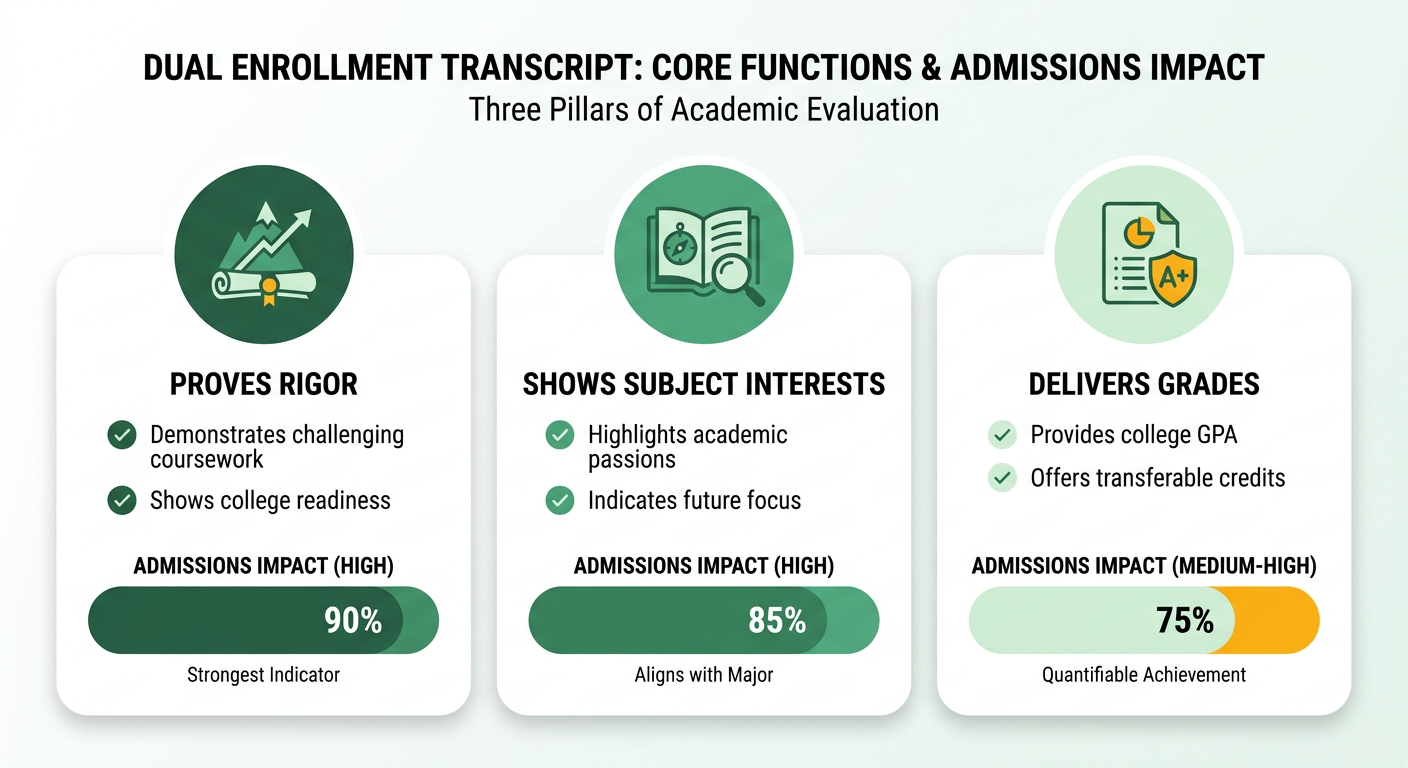
What a dual enrollment transcript shows officers
Rigor. Officers weigh how hard you pushed against what your school offered. When your high school offers nothing advanced, college courses become the clearest rigor signal available. A calculus or biology grade earned at a college reads as harder than the same subject in a standard high school class.
That matters because officers judge course selection, not just count. Three tough college classes in one subject area show focus. A scatter of easy electives shows the opposite. Course choices that read with intent reflect the kind of planning we build with each student.
How these functions line up
The power shows up when the three functions line up into one story. Your grades confirm you can handle the work. Your course choices show what you care about. The college scale gives officers a benchmark they can read without knowing your high school. Together they answer the question a thin high school profile leaves open: how will this student perform in our classrooms?
Subject narrative — a cluster of courses in one field tells officers your academic direction before you write a word about it.
Grade proof — college grades carry weight because they're graded by college faculty, not your home school.
Context replacement — the transcript itself supplies the context your school profile can't.
Aligned, these elements leave no doubt about your preparation and focus.
Sequencing for maximum signal
Once your transcript reads as a coherent profile, you can start optimizing how it lands. This is where students with a strong dual enrollment record pull ahead. The goal shifts from filling gaps to shaping a deliberate academic story.
Think of it as sequencing. Officers read a transcript for trajectory, not just grades. A record that climbs in difficulty over time says more than a flat one, even at the same GPA.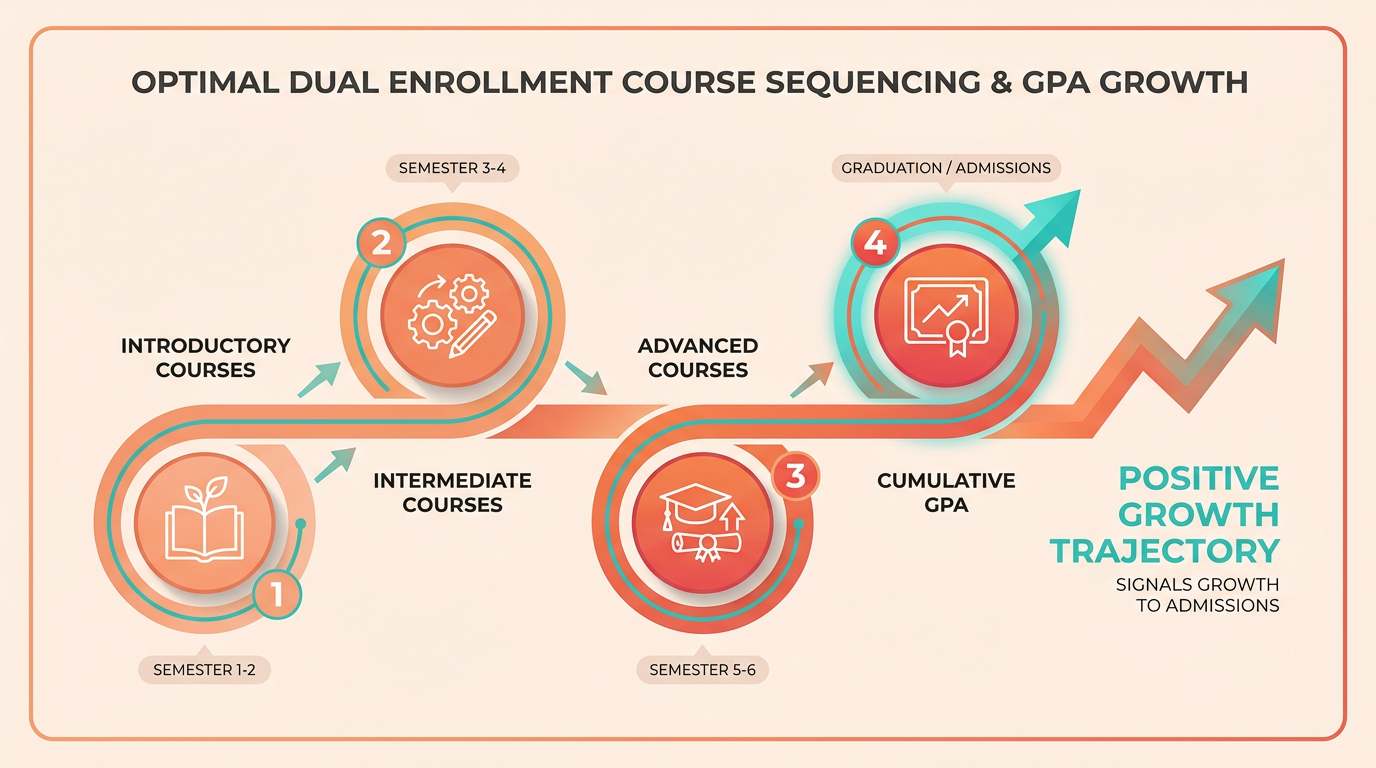
How to sequence courses for signal
Build a clear upward arc. Start with foundational college courses and move toward higher-level work in your intended major. When an officer sees introductory composition followed by a sophomore-level literature seminar, the progression reads as intent, not luck.
A student aiming for engineering who stacks calculus, physics, and a programming course tells a sharper story than one with a random spread. Depth signals direction. Direction signals a student who knows why they're in the room.
The pattern that works:
- Anchor courses — two or three classes in your intended field, ideally rising in level.
- Breadth courses — one or two outside your focus to show range.
- Momentum — later semesters harder than earlier ones.
Framing moves that actually help
Pair the transcript with context an officer can't get elsewhere. Your college coursework proves rigor, but a short counselor note or your own essay can explain why you chose a college course over a nonexistent AP track. That framing turns raw grades into a decision.
Name the constraint. If your school offered nothing advanced, say so plainly somewhere in the application. Officers read your record against what was available. When you make the gap explicit, your college courses stop looking like a bonus and start looking like the whole point.
Skip the optimization games if you're taking one or two dual-enrollment classes for genuine interest. This deeper sequencing only pays off when college coursework is doing the heavy lifting in your profile.
Best Practices
The best practice with a dual enrollment record is simple: treat it like a document an officer will read against nothing else. When your high school produces no profile, your college transcript carries the full weight of proving who you are academically. So build it to stand alone.
That means grades matter everywhere, not just in your intended major. Officers read all four years and expect good grades across the board, electives included. A B in a college art class next to A's in your STEM courses still reads as a dip. Aim for consistency.
Making a transcript read cleanly
Take your foundational and prerequisite classes first, then climb. Early planning means you meet the prerequisites for advanced classes, so your transcript shows a deliberate path instead of a scramble.
Keep your course titles legible to an outsider. An officer skimming your record shouldn't have to decode abbreviations or catalog numbers. If a title is vague, your application's additional information section is where you translate it into plain terms.
Don't chase volume for its own sake. Admissions offices consistently prioritize rigor over raw course count. A focused sequence of core subjects shows deeper commitment than a pile of intro electives. Depth signals intent.
When to skip extra courses
Skip piling on more classes if your grades are slipping. A lighter load with strong marks tells a better story than a heavy one with cracks. Officers read the pattern, and a downward grade trend undercuts everything else the transcript is trying to say.
Also skip courses that scatter your focus. If you're aiming for a specific field, random electives outside it dilute the narrative. We help students map coursework to their goals, so every class earns its place on the page.
The pattern that wins: focused, rising, well-graded, and reading as a plan. That's what fills the gap your school left.
Comparison with Alternatives
A dual enrollment transcript isn't the only way to prove rigor. AP exams, IB diplomas, and honors coursework all do similar work. But for students whose high schools offer none of those, college coursework wins on one point: it comes with a real grade from a real institution, not just a test score.
Here's how we weigh the main options when a student's school produces a thin profile.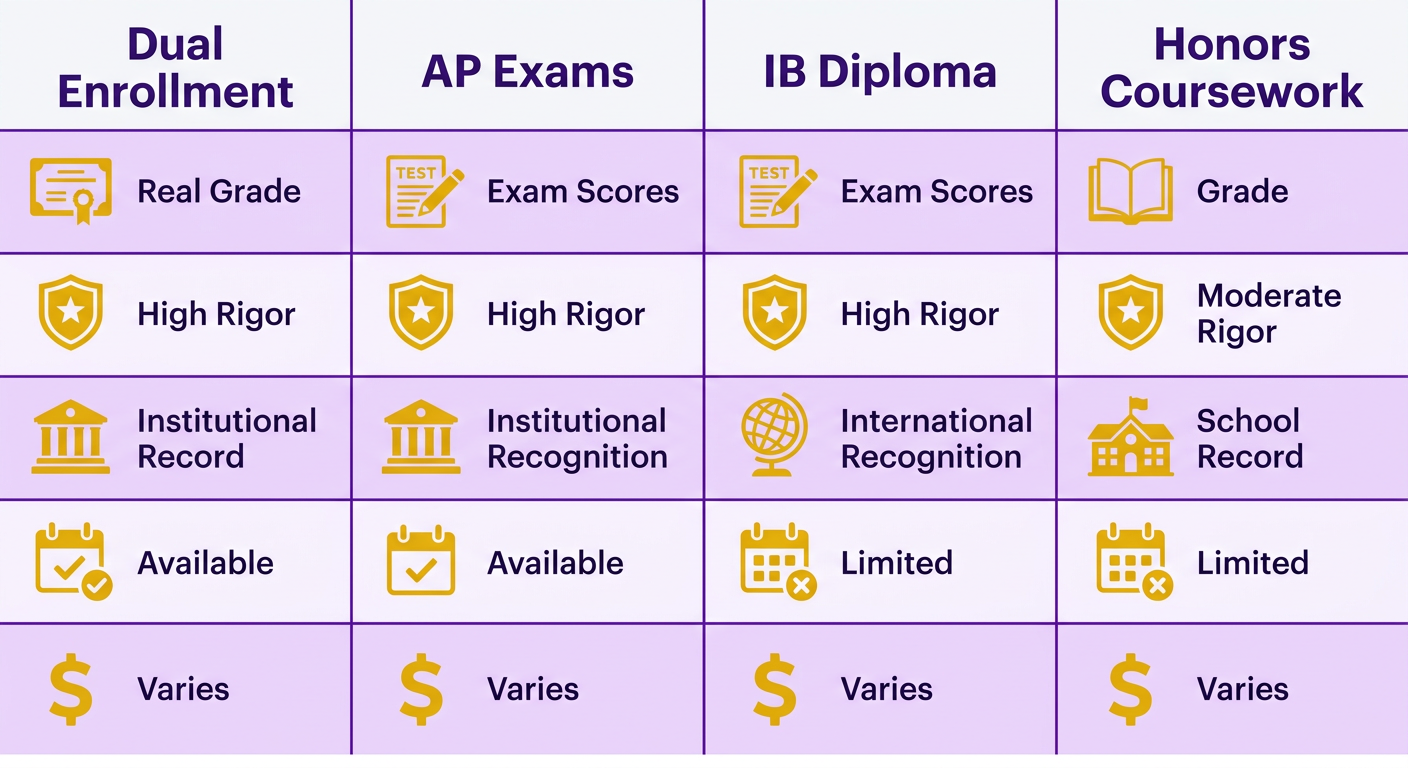
How it stacks up against AP and IB
Dual enrollment gives you a graded college transcript. AP and IB give you exam scores. That difference matters most for students at schools without strong profiles, because a college transcript carries an institutional record an officer can read directly.
AP works well when your school offers the courses and you test strongly. A 5 on the AP Calculus exam signals mastery cleanly. But the score sits apart from your grade, and if your school offers no AP classes, you're self-studying with no coursework to show for it.
IB is powerful but locked to schools that run the program. If yours doesn't, it's off the table entirely. That's the gap college coursework fills. You don't need your high school to offer anything.
When to choose dual enrollment
Choose it when your high school produces no profile an officer can read your grades against. No AP offerings, no class rank, no counselor narrative — a college transcript becomes your strongest proof of rigor.
Drop the either-or thinking if your school already runs a full AP or IB slate. In that case, layer college courses on top for subjects your school can't teach, not as a replacement.
We also steer students away from stacking easy college electives just to inflate credit counts. Colleges look at your entire high school career for sustained engagement, not a sudden burst of hard classes. A pile of low-rigor courses reads worse than a tight sequence of demanding ones.
For students building an academic story from scratch, dual enrollment does what no exam score can. It hands officers a ready narrative in a format they already trust.
Troubleshooting
Most problems with a dual enrollment transcript trace back to one thing: the document doesn't read as a story on its own. When your high school gives officers no profile to compare against, every gap and inconsistency shows up bare. Here's how we fix the issues we see most.
Why does my transcript look like a random list?
The most common problem is scattered course selection with no throughline. An officer opens the transcript and sees intro psychology, a random math course, and an art elective with nothing connecting them. Nothing signals intent.
Fix it by grouping and framing. In your application, name your academic focus and point to the two or three courses that support it. If your record already has stray classes, don't hide them. Reframe the strongest ones as your core and let the rest read as exploration.
If the courses genuinely don't cohere yet, take one more targeted class before you apply. A single sophomore-level course in your intended field can turn a scattered list into a direction.
How do I handle a low grade or a withdrawal?
A withdrawal or a low grade on a college transcript is permanent, and officers will see it. Unlike a high school without a profile, the college registrar records everything. You can't quietly drop a class off the record after the fact.
Address it head-on. If a semester dipped because of a real disruption, the additional information section is where that context belongs. State what happened in two sentences. Don't over-explain.
For a dual enrollment withdrawal, the better move is prevention. Drop before the withdrawal deadline so it never posts, not after.
What if I have transcripts from two colleges?
Two separate transcripts can fragment your narrative. Each registrar issues its own record, so an officer has to assemble the full picture. That's friction you don't want.
Solve it in your application, not the transcripts. Summarize your full college coursework in one place so the officer reads a single arc. When your record is doing the work your high school can't, that clarity matters.
Resources and Tools
The tools that matter most here are free and already in your hands: your college registrar, your course catalog, and a simple tracking spreadsheet. No paid software. You need to see your record the way an officer will and shape it before you hit submit.
Start with the course catalog at every college where you took classes. That's where you find the official descriptions explaining what a title like "BIO 101" actually covers. Officers may not know your specific college, so pulling the catalog description helps you translate a dual enrollment course into plain proof of rigor inside your application.
Tools that help you organize
The best tool is a one-page tracking sheet listing every college course, its grade, credit hours, and the intended-major connection. Build it in any spreadsheet. This single view lets you spot gaps in your arc and catch stray electives that break your throughline before an officer does.
Add three columns: course title, why it fits your focus, and catalog description. When you write your application, this sheet becomes your reference for framing each class as part of a coherent story.
Your college registrar is the other essential. Order official transcripts early from each institution and keep a personal copy on hand. Registrars run slow, and a delayed transcript can stall your whole application.
Where to learn more
Read admissions blogs that explain how officers actually evaluate transcripts, not just what to take. The mechanics of transcript review matter more when your high school gives officers nothing to compare against.
At Endurable Education, we design strategies around the coursework and experiences each student actually has, translating a unique record into a coherent application story. Skip the generic checklists that assume you attend a school with AP tracks and a known transcript format. Build your profile from the coursework you have, and lean on mentorship that adapts to your strengths and goals.
Conclusion
Your dual enrollment transcript is your academic profile when your high school doesn't produce one. That's the whole argument. When there's no AP roster, no class rank, and no counselor narrative, your college coursework becomes the document officers read to understand who you are academically.
Every section here was built around that one idea. You learned how officers read a transcript, why college grades carry institutional weight, and how to sequence courses so they tell a clear story instead of listing random classes.
What to do next
Pull your official transcripts and read them the way an officer will. Then shape the record into a narrative with a visible focus and an upward arc. Those two moves do most of the work.
The short version of the plan:
- Gather every official transcript from each college where you took courses. Order early so registrar delays don't block your application.
- Name your academic focus and point to the two or three courses that prove it. Don't leave officers to guess.
- Build an upward arc. Foundational courses first, higher-level work in your intended field later.
- Keep grades consistent everywhere, electives included. A dip in one class reads as a dip when there's no profile to soften it.
- Translate course titles using the official catalog descriptions so an officer who doesn't know your college still sees the rigor.
Where to learn more
Read real admissions guidance and stress-test your own record against it. Our team writes regularly about profile-building for students at schools that don't fit the standard mold. You'll find more on our college admissions and life planning blog.
Your transcript already tells a story. Your job is to make sure it's the one you want read.
References
[1] How do College Admission Officers Review High School Transcripts? - https://www.virtualcollegecounselors.com/post/how-do-college-admission-officers-review-high-school-transcripts
[2] How Do College Admissions Officers Evaluate Transcripts? - IvyWise - https://www.ivywise.com/blog/college-admissions-transcripts/
[3] The Impact of Dual Enrollment on College Application Choice and ... - https://www.nacep.org/resource-center/the-impact-of-dual-enrollment-on-college-application-choice-and-admission-success/
Frequently Asked Questions
1. Do colleges accept dual enrollment credits toward my degree, or just for admissions?
Credit transfer depends on the receiving college's policies, which differ from how admissions officers weigh your transcript for rigor. This guide focuses on the admissions signal your college coursework sends, not credit acceptance. Check each target school's transfer policy separately, since a course that impresses admissions may not always count toward graduation.
2. Should I self-study AP exams if my school offers no AP classes?
Self-studying for AP exams allows you to demonstrate subject mastery through a standardized test score. However, dual enrollment provides a continuous, graded academic record over a full semester, offering admissions officers a broader look at your classroom performance.
3. Will a single low grade in a non-major course hurt my application?
While admissions officers look for overall academic strength, a lower grade in an elective can still impact your cumulative GPA. If a specific circumstance led to a lower mark, use the additional information section of your application to provide brief, objective context.
4. How many dual enrollment courses should I take?
Focus on quality and progression rather than sheer volume. A sequence of three or four courses that build upon one another in a specific field shows much more academic purpose than a large number of unrelated introductory classes.
5. What happens if my dual enrollment courses came from two different colleges?
You will need to request official transcripts from both institutions to be sent to your target colleges. To prevent your academic history from appearing fragmented, use your application's coursework section to present these classes as a single, chronological timeline.
6. How do I explain a course title like "BIO 101" that an officer won't recognize?
You can clarify course content by referencing the official syllabus or catalog details. If a title is highly technical or ambiguous, use the application's designated space to briefly explain the core topics covered, ensuring the level of rigor is clear.
7. When is this dual enrollment strategy not worth my effort?
If you are taking college classes purely to explore a personal interest rather than to establish academic rigor, you do not need to worry about complex course sequencing. In those cases, simply enjoy the learning experience without pressure to build a comprehensive profile.