When Hardship Changes Your Story: "College Will Humble You" and the Additional Information Section
September 2, 2026

Key Takeaways
- A reviewer may spend under a minute on your file, so any context must land quickly and read cleanly.
- "College will humble you" isn't a slogan about suffering. It's about honesty: does this circumstance actually need explaining, or are you proving how hard your road was?
- The Additional Information section is optional space for context that fits nowhere else, like medical leave, caregiving, or an unusual grading system.
- Thomas Caleel's warning is worth remembering: a hardship common to many applicants may not be worth writing about at all.
- Susan Tree, a former admissions officer, sees the section as a tool for telling applicants apart, not for pleading a case.
- The Coalition for College treats it as narrative space for hardships like illness or family tragedy that reshape a record.
- Real humility sometimes means leaving the box blank. A blank box has never sunk an application.
Why the Additional Information Section Carries More Weight Than You Think
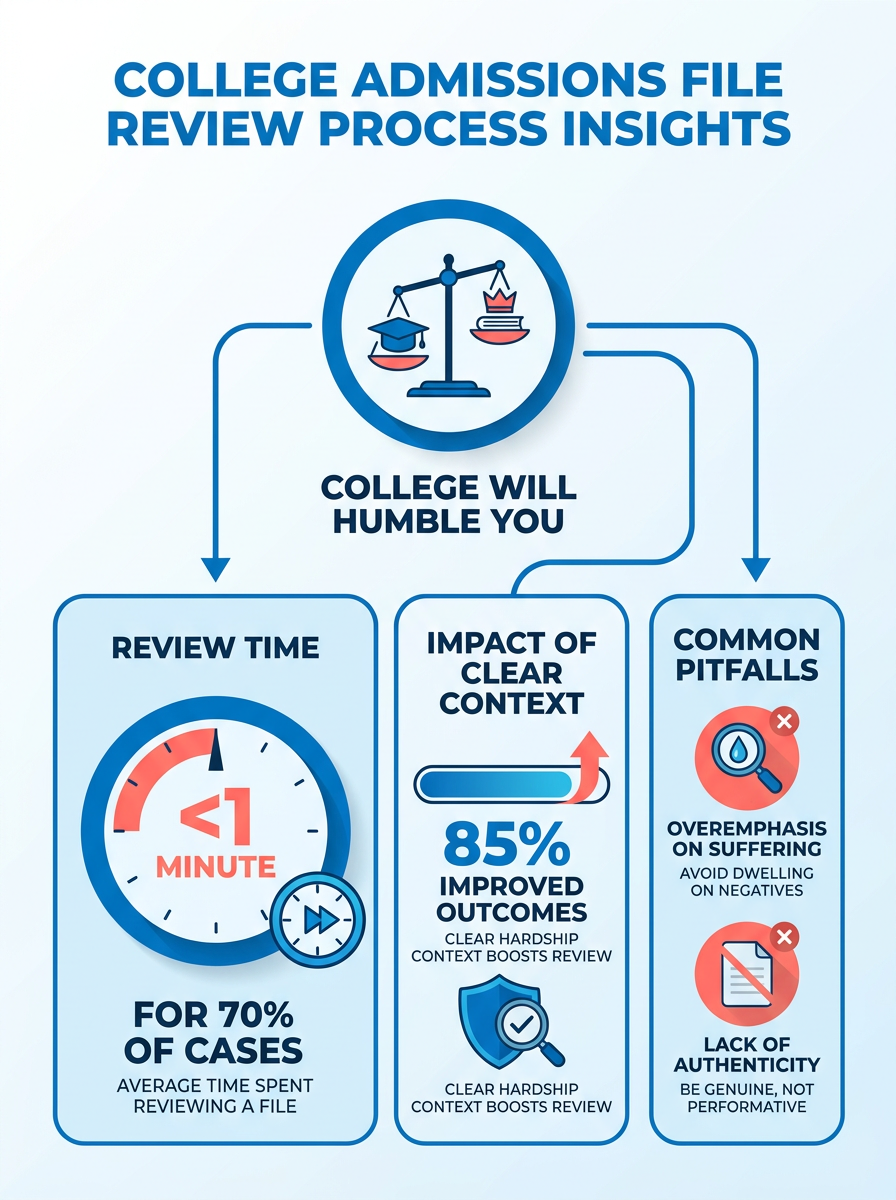
Admissions officers read fast. Under a minute per file, then they move on. So whatever context you add has to land quickly and read cleanly, or it won't register.
That's where "college will humble you" earns its keep. It's not about suffering. It's about being ruthless with yourself about what actually distinguishes your record. Thomas Caleel, quoted in this breakdown of the section, warns that a hardship common to many applicants may not be worth writing about at all. Humility, in our experience, is knowing when to say nothing.
What the section is actually for
Additional Information (AI): optional space to explain context that doesn't fit elsewhere in your application, like a medical leave, a family obligation, or an unusual grading system.
The section exists to distinguish you, not to plead your case. Susan Tree, a former admissions officer cited in College Essay Guy's guide, frames its purpose as helping reviewers tell applicants apart. The Coalition for College describes it as narrative space for hardships, illness, or family tragedy that appear nowhere else in the file.
Who gets the most out of it? First-generation students, international applicants, low-resource students, athletes, and artists. A performer can list roles and productions. A caregiver can explain why the activities list looks thin. As Ivy Scholars puts it, "the more opportunities you have, the more they expect of you." Context levels that expectation.
The 2025 word-count cut changed the strategy
The box shrank, and that reshapes everything. For the 2025-26 cycle, the Additional Information section dropped from 650 words to 300, per Shemmassian Consulting, while a separate 250-word Challenges and Circumstances question split off. Transfer applicants get 1,500 characters.
Toss any 650-word advice you've been carrying. This split isn't cosmetic. It forces you to separate what happened to you from what you did about it. The old one-long-resilience-essay play no longer fits. Now you build a hardship story across two boxes, factual and tight.
When to actually use it
Use the AI section when a real gap needs context: a grade drop tied to a documented medical or family event, a caregiving role, financial limits that shrank your activities, or a self-directed project buried in the activities list.
Skip it when nothing meaningful needs explaining. A blank box has never hurt an application, as College Essay Mentor notes. And there's a real conflict to resolve here: Yale suggests routing special circumstances through the Counselor Recommendation instead, while Coalition treats the AI section as the natural home for personal hardship. Our call: if your counselor knows the story and can tell it credibly, delegate it. If the context is first-hand and personal, you tell it. Whoever can speak with the most authority gets the box.
Building a Hardship Story That Actually Earns Its Space
A strong hardship story starts with an uncomfortable question: does your circumstance actually change how your record should be read? That's the real self-assessment. Objectivity isn't downplaying pain. It's judging whether your academic trajectory needs outside clarification to be read fairly.
Most students don't need this section. Current guidelines are clear that leaving it empty is a perfectly standard choice with zero negative weight. Draft an explanation only when the context gives a necessary lens on your academic record, not to recount general difficulties.
The two-question self-audit
Self-audit: a short test that checks whether an event clears both the impact and insight bar before you write a single sentence. Ask two things. Did this measurably affect my grades, activities, or opportunities? Did I act, not just endure?
Answer no to either and stop. The video guide above pushes you toward events that genuinely altered your educational path, not the usual high school hurdles. Carrying significant family responsibilities or handling a sudden school transition, as the Ivy Scholars analysis discusses, is the kind of structural disruption that earns a spot. A rough quarter in one class doesn't.
Where each half of the story goes
The two-box format changes your architecture. Treat it as sorting: facts in one place, meaning in the other. In the first prompt, stay matter-of-fact, with dates and specific events. In the second, pivot fully to your response, the academic recovery, and where you're headed.
The separation is a feature, not a cage. It keeps students from drowning in the emotional details of a crisis and forces a clean move to the resolution. Readers can trace your resilience when the timeline and the growth sit apart.
One warning. Don't repeat anything already covered elsewhere in your file. Matt DeGreeff, dean of college counseling at Middlesex School, advises against restating information the reader already has.
You, or your counselor?
Sometimes the answer is neither box. Schools split on this: some highly selective ones would rather counselors handle sensitive explanations, while other platforms design their prompts specifically for student-led disclosure.
Here's how we settle it. If your counselor can offer objective, third-party validation of your circumstances, that carries real credibility. If the situation needs personal nuance only you can articulate, you draft it.
Tone checklist before you submit:
- Be factual and concise. Give clear context that helps readers weigh your achievements fairly, without leaning on emotional appeals.
- Include specifics: dates, the length of a medical leave, the exact grade affected.
- End with one clear line on what you learned. Selective readers want self-awareness, not self-pity.
For international students, cultural humility matters too. A relocation story lands best when it explains the disruption plainly instead of dramatizing it. We cover more application strategy on our admissions planning blog.
Making the Hardship Thread Hold Across the Whole File
A hardship theme only works when it shows up consistently across the whole application, not just the essay. The current layout makes coordination harder, since the objective circumstances and your personal growth now live in separate, non-overlapping prompts.
That division demands tight alignment. Every component, from your transcript to your recommendation letters, should present one timeline with no gaps or contradictions. Our team treats the resume, activity list, recommendations, and interview as one story told four ways.
Echoing the growth in your resume and activity list
Use action verbs that show what you built after a setback, not just that a setback happened. Instead of "member of tutoring club," write "led a tutoring program after a family relocation, serving 40 students over two years." That single line signals both the barrier and the response.
Quantify the impact. Hours, participants, and outcomes do the persuading for you. The Ivy Scholars resource stresses that committees weigh your achievements against the resources and environment you actually had. Keep descriptions focused and direct, in line with the streamlined formatting the Coalition guide recommends.
Should the counselor tell it instead?
Sometimes, yes. It depends on the school. Some institutional guides compiled by College Essay Advisors point toward counselor recommendations for external context, while platforms like the Coalition give students dedicated space for these narratives.
Our read: coordinate closely with your counselor. If they'll cover the institutional or logistical side, you can spend your personal sections entirely on the academic recovery. Either way, brief your teachers and counselor on the hardship angle. Don't script them. Give them one clear fact and let them phrase it their way, so the alignment reads as genuine rather than staged.
Prepping the interview answer
Have one tight response ready for "Tell me about a challenge." Forty seconds, plain language, echoing the framing from your essay without reciting it word for word.
The aim is consistency across four data points: essay, additional info, recommendation, and interview. This is where our panel approach earns its keep. Instead of working one-on-one, we review your application as a team, with every essay read by at least two members of the Endurable Education panel. That review looks for one thing: does the hardship show up the same way everywhere?
Consistency is what makes a hardship thread persuasive. When the essay covers the recovery mindset, the activity list quantifies the hours a student took on, and a recommendation confirms the same growth without parroting the essay, every piece points one direction. Our decades of experience across hundreds of cases, from artists to athletes, help students carry that through all of it.
One caveat. If your hardship is minor, spreading it everywhere just amplifies something that won't distinguish you. Skip the whole exercise. For more on building a coherent application arc, see our admissions planning blog.
What This Looks Like in Real Files
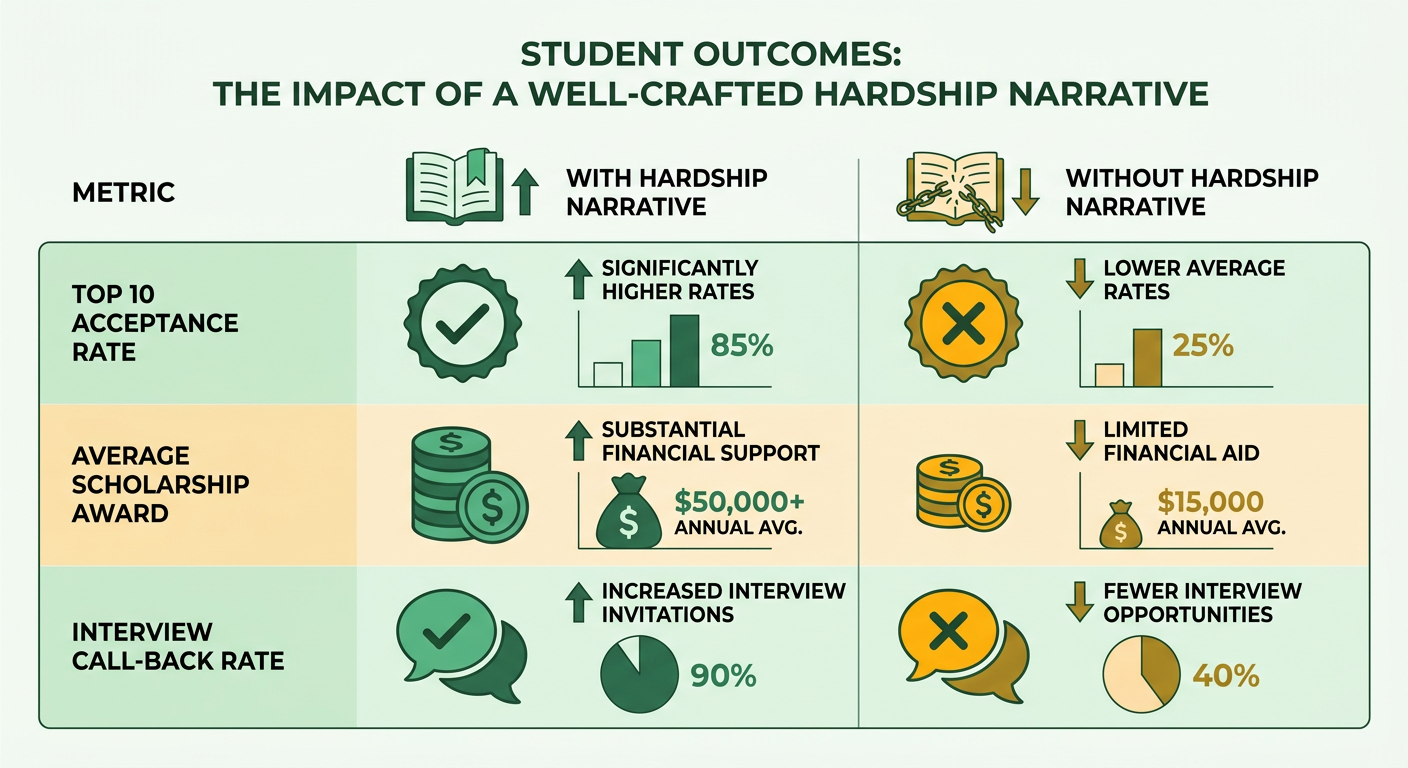
The best way to understand the balance between vulnerability and objectivity is to watch it play out in real applications. The same lesson keeps surfacing: presenting a challenge well is about precision, not confession. Students who nail that balance give admissions officers clear, reliable context they can absorb in that first quick pass.
Here's how the Additional Information section can work without ever tipping into pity-seeking. Each example shows the value of clear, objective framing.
Explaining a GPA dip to a top school
When a hardship drags down sophomore grades, hiding it is the wrong move. Over a long planning timeline, we help students map the story across the file so a dip reads as circumstance, not decline.
The AI section states the facts plainly, then points to the recovery in a later year. No dramatics. When the grades rebound, the context lands and the file holds together. That honesty is the whole point.
Turning a transition into a growth theme
Students moving between different education systems often worry the switch will read as weakness. We build the narrative around growth, not apology.
The AI section can briefly disclose an external factor that affected a timeline. It gives reviewers a clean reason for the sequence without asking for sympathy. Context in, drama out.
An athlete's setback, reframed
We work with students from all backgrounds, artists and athletes included. When a setback limits competition, rather than mourn the lost stats, the essay and AI section can lean into the community service or other pursuits that filled that time.
The setback explains the record. The other work shows the person. Together they read as one honest thread.
Our workflow: Our multi-reader review polishes sensitive narratives for tone, helping students avoid over-explaining while presenting their circumstances with maximum clarity.
Take-away checklist:
- State facts, skip drama. Context, not confession.
- Show recovery, not just the setback.
- Keep one thread running across every component.
- Cut anything a reviewer doesn't need to fairly read your record.
Action Plan: From First Reflection to Final Submission
A 12-month timeline moves students from first reflection to a polished, structured submission. Starting early lets you ask the strategic questions before deadlines set in: does your record actually need outside clarification, or can your achievements speak for themselves?
Plenty of students who scrutinize their profiles decide the strongest move is leaving this optional space blank. That's a strategic outcome, not a failure. Current guides keep reinforcing that the section is only for context you can't communicate anywhere else.
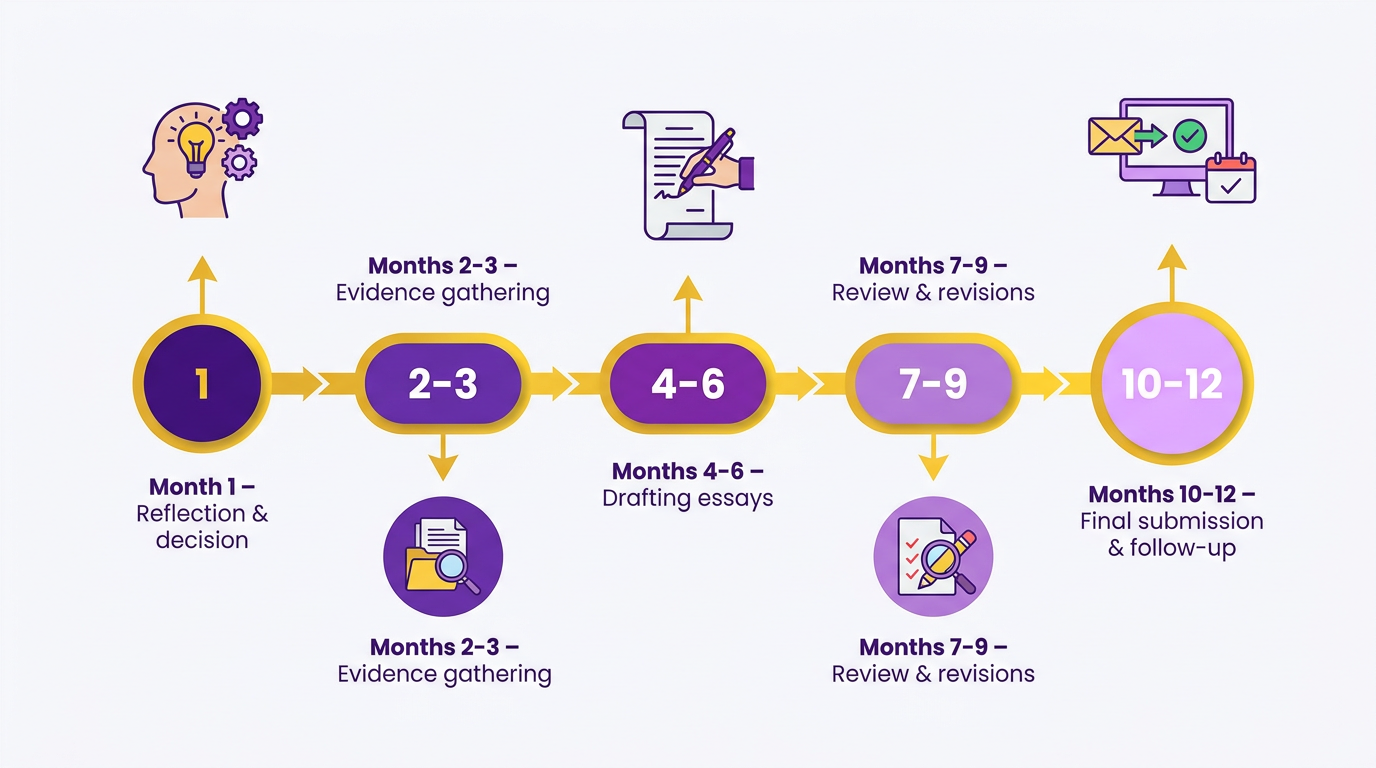
Your month-by-month milestones
Milestone plan: a five-phase schedule spread across a year, each phase with one deliverable. Small steps, no rushed drafts, the common pitfall the video breakdown flags.
- Months 1-2 (Self-audit): Test whether your event clears both the impact and insight bar. If it doesn't, stop here.
- Months 3-4 (First draft): Write factually, not emotionally. College Essay Guy's resources stress objective clarity that helps readers weigh your file fairly.
- Months 5-6 (Peer review): Hand it to someone who doesn't know your story. Ask what still confuses them.
- Months 7-9 (AI section split): Divide the narrative into the two prompts, objective circumstances in the first and your response in the second, per Shemmassian's structural breakdown.
- Months 10-12 (Final edit): Cut every sentence that repeats the rest of your application.
You or your counselor?
Sometimes the Additional Information box is the wrong channel. Some admissions offices prefer counselor-led explanations, while platforms like the Coalition encourage students to self-report personal challenges.
Our read: coordinate with your counselor for a complementary split. If they can validate the logistical or school-wide impact, let their recommendation carry those details so your personal sections stay focused on your own growth.
Your final checklist
Run these five checks before you hit submit. Each one catches a mistake we've watched wreck otherwise-strong files.
- Word count. Hold your drafts to the current, shorter limits. The generous counts of past cycles are gone.
- Redundancy scan. Delete anything already stated in your essay, activities, or resume. Reviewers hate reading the same fact twice.
- Cross-check the split. Keep the objective timeline and your personal reflection in their separate, non-overlapping sections.
- Recommendation brief. If your counselor is carrying part of the story, brief them on exactly what to cover.
- The blank test. Read the section, then imagine it gone. If nothing is lost, cut it.
Track three simple metrics as you go: hours logged, word count trending down, and how many redundancy flags each review round catches. When those flags hit zero, you're done.
References
[2] How to Use the Common App Additional Information Section - https://www.ivyscholars.com/what-is-the-additional-info-section/
[3] Additional Information Guide | Coalition for College - https://www.coalitionforcollegeaccess.org/mycoalition-counselor-all/utilizing-the-additional-information-section
[4] Additional Information Essay: When and How to Use It - https://www.collegeessayadvisors.com/the-additional-information-essay/
[5] How to Use the Common App Additional Information Section ... - https://www.shemmassianconsulting.com/blog/common-app-additional-information-section
[6] How to ACTUALLY Use the Common App Additional Info ... - YouTube - https://www.youtube.com/watch?v=qAv8dc-N_4s
[7] How to Write Common App Additional Information Section: 2026 Guide - https://www.collegeessaymentor.com/post/common-app-additional-information
Frequently Asked Questions
1. Does leaving the Additional Information section blank hurt my application?
Not at all. Admissions officers view a blank section as a straightforward, complete application that does not need extra explanation. Leaving it empty is often the most strategic choice, since it keeps your primary essays and achievements central.
2. What if my hardship is something many applicants also faced?
If your challenge is common, it is often best to address it briefly in your main essays or activities list rather than use a separate section. Focus on your specific response or on details that set your situation apart.
3. What if my counselor and I both mention the same circumstance?
To avoid redundancy, coordinate with your counselor to divide the narrative. Your counselor can provide the official, institutional context, such as school-wide disruptions or grading policy changes, while you use your personal sections to describe your recovery and academic growth.
4. How does the 2025-26 word count change affect older advice?
The transition to shorter, split prompts means older, essay-style advice is no longer practical. Instead of writing a long resilience essay, you must now use a concise writing style that fits the current application cycle.
5. Where does "what happened" go versus "what I did about it"?
The objective details of your situation, such as dates, medical timelines, or logistical changes, should go in the designated challenges prompt. Your personal reflection, academic recovery, and future goals should stay in the additional information prompt.
6. How should international students frame a relocation story?
International applicants should focus on the practical differences between educational systems, such as grading scales or curriculum structures. Keep the explanation objective and informative, helping admissions officers understand the transition without dramatic language.
7. How does Endurable Education review hardship narratives?
Our team-based evaluation process focuses on tone consistency and eliminating redundant information across all application components. We analyze how your personal statements, activities, and counselor recommendations work together to present a clear, unified narrative.