Why 1600s Get Rejected and 1450s Get Likely Letters: How Ivy Admissions Actually Decides
August 24, 2026

Key Takeaways
- Ivy admissions weigh far more than test scores. A 1450 with a compelling story sometimes gets a likely letter while a 1600 gets a thin envelope.
- Flat-fee consulting packages usually run $80,000 to $200,000, and premium independent consultants charge north of $150,000.
- A flat-fee firm gets paid the same whether your student lands at a school ranked #5 or #20. Once you sign, there's no financial reason for extra effort.
- Base-plus-bonus models pair a lower upfront fee with a payout tied to real outcomes — admissions tiers, scholarships, competitive program acceptances.
- Families on base-plus-bonus arrangements report more counselor engagement during the brutal stretches, like supplemental essay season.
- School counselors and community programs cost close to nothing. That's a stark contrast to six-figure private fees.
- How your advisor gets paid shapes outcomes more than most parents realize, and it often matters more than the name on the door.
How the Options Actually Compare
Getting into the Ivy League isn't a single-path contest, and that shows the moment you compare how families approach support. Some hire independent consultants charging upward of $150,000. Others lean on community programs or their school counselor. The trade-offs come down to three things: how intense the support is, the advisor's track record, and how they get paid.
We've watched families agonize over whether to pay premium rates for a brand-name firm or work with a smaller team that ties its pay to results. Both models have merit. But the incentive structure matters more than most parents realize.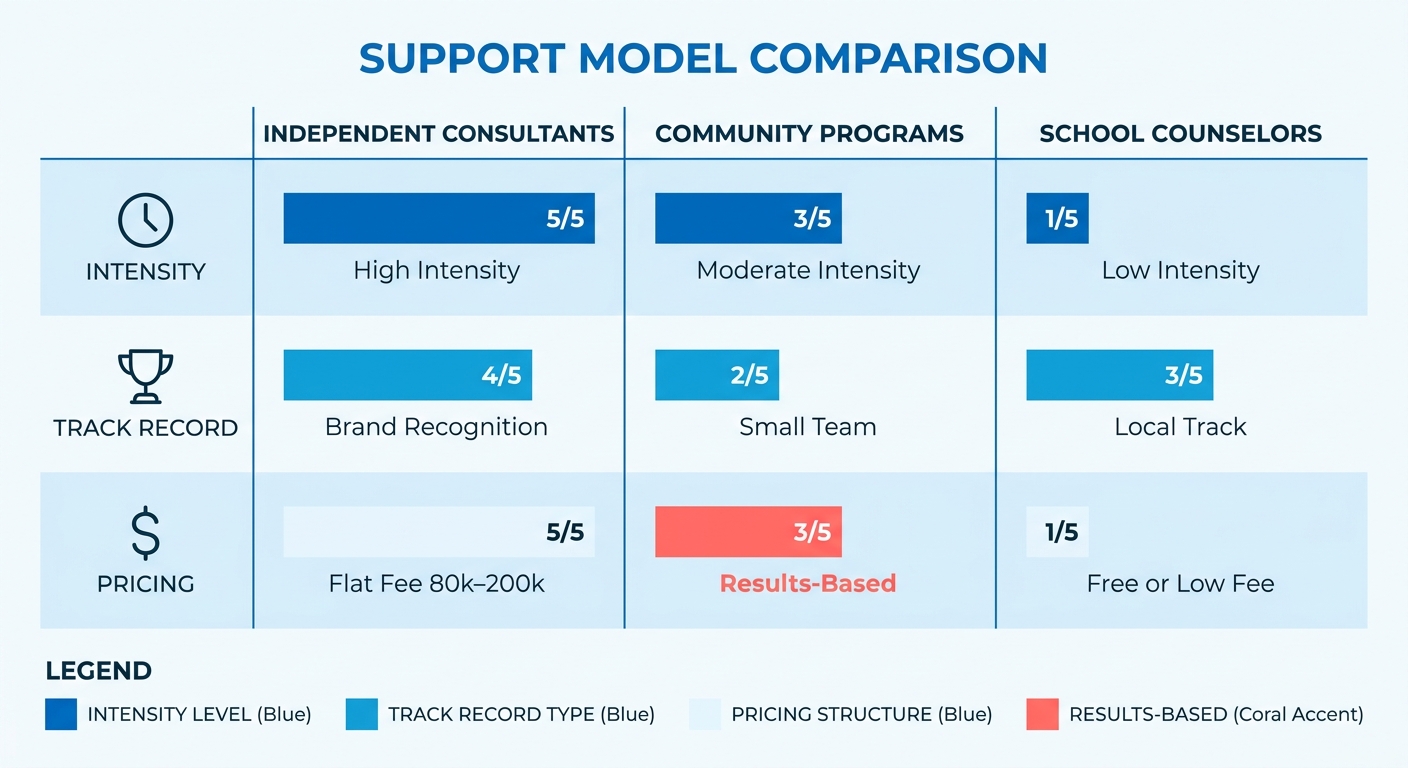
What Sets the Consulting Models Apart
Flat-fee consulting usually runs $80,000–$200,000 for a full package. You're paying for brand recognition and a structured timeline. But advisor turnover can be high, and once you've signed, nothing built into the deal pushes the counselor to go the extra mile. If your child lands at a lower-tier target instead of the dream school, the firm collects the same fee either way.
Base-plus-bonus models split the cost. A lower upfront base covers core advising, and a bonus kicks in only when the student hits agreed-upon milestones: admission to specific tiers, scholarship offers, competitive program acceptances. That ties the advisor's paycheck to your outcome. It's less common in the U.S. market, but families who've used it report more engagement from their counselors during crunch periods like supplemental essay rounds.
School counselors and community programs cost little to nothing, but they operate at scale. A typical high school counselor manages hundreds of students. They're great for procedural work, deadlines, transcript requests, but rarely have the bandwidth for iterative essay feedback or strategic positioning.
| Model | Typical Cost | Advisor Focus | Best For |
|---|---|---|---|
| Flat-fee premium firm | $80K–$200K | Brand, structured timeline | Families prioritizing perceived prestige |
| Base + bonus | Lower base + performance tier | Outcome-driven, high engagement | Families wanting aligned incentives |
| School counselor | Free | Procedural compliance | Students with strong self-direction |
| Community program | Low cost | Group workshops, peer support | Budget-conscious families, early starters |
The bonus threshold is where base-plus-bonus consulting earns or loses trust. Vague terms like "top school" invite disputes. Clear definitions, "Ivy League admit," "top-10 national university," "merit scholarship of a specified amount," keep both sides honest through the final decision round.
Why Bother Weighing This at All
Figuring out how to get into the Ivy League isn't really a question of which consultant has the fanciest office. It's a question of which support model fits your family's risk tolerance and your student's actual starting point. That's the decision most parents skip past.
We built our base-plus-bonus model around a simple observation. Families paying six-figure flat fees carry all the risk upfront, whether or not the student lands an offer. A model that ties part of our pay to results shifts some of that risk onto us. We think that's how it should work.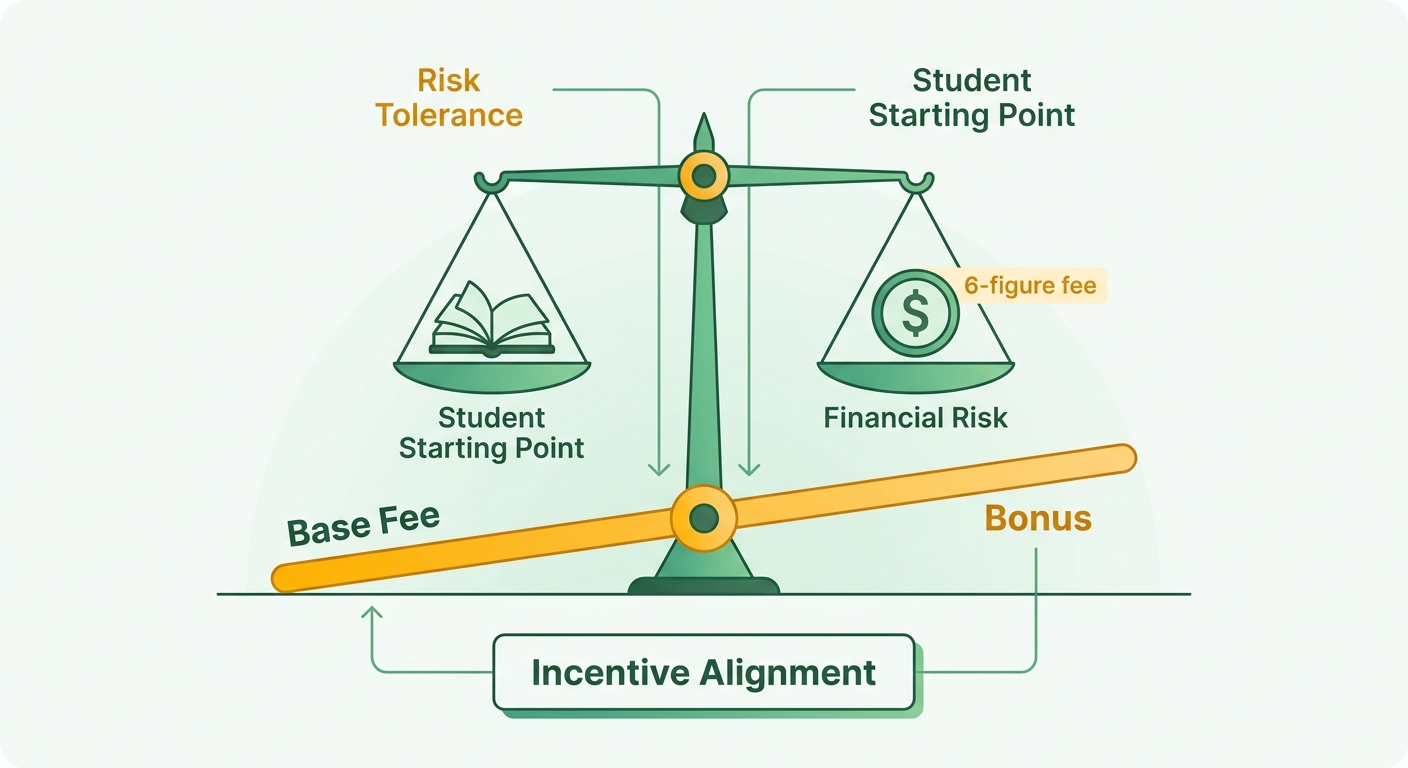
When a Base-Plus-Bonus Model Actually Helps
Base-plus-bonus consulting works best for families who want aligned incentives and can't stomach paying full premium price before seeing anything. You pay a lower base for the ongoing work, then a bonus only when admissions goals are met. Skip it if your student is a near-lock at a target school. You'd be paying for upside you don't need.
The trade-off is real, so we'll name it plainly. Our base runs lower than a brand-name flat fee, but the bonus can push the total higher for the students who succeed. If your child gets in, you pay more than the base implied. If they don't, you've paid far less than a flat-fee firm would have charged.
| Factor | Flat-Fee Firm | Base-Plus-Bonus (Our Model) | School Counselor |
|---|---|---|---|
| Upfront cost | High | Lower | Free |
| Incentive alignment | Weak | Strong | Neutral |
| Total cost if admitted | Fixed | Higher | Free |
| Total cost if rejected | Fixed (no refund) | Lowest | Free |
| Application review | Varies | Every essay reviewed by 2+ team members | Very high |
Who Should Think Hard About This
This model fits if you have a genuinely competitive applicant and want an advisor whose payout depends on your outcome. It's a poor fit for families seeking light-touch essay review, or students still building their academic foundation.
We're direct about that carve-out because a mismatched engagement helps no one. For families in the middle, the strong candidate who still needs strategy, positioning, and honest feedback, the aligned-incentive structure earns its keep. Every engagement starts with an initial consultation to assess a student's needs and goals, so we can be honest about fit before anyone commits.
What You're Really Comparing
Most families shopping for admissions support end up comparing three models: traditional flat-fee consultants, school counselors, and performance-aligned firms like ours. The differences matter more than the price tags suggest. The model you choose decides who carries the risk if your student doesn't land an offer.
The Three Models, Side by Side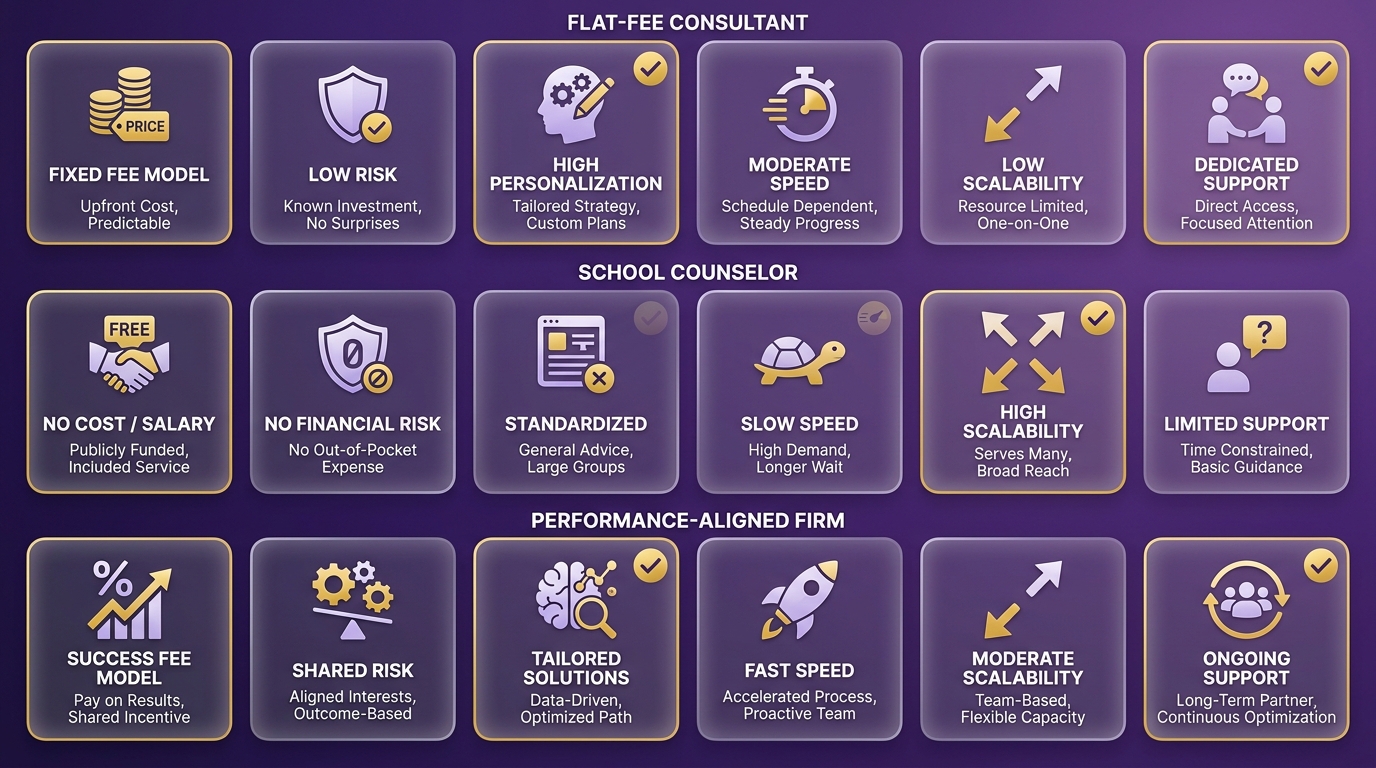
Traditional consultants collect their entire fee upfront, before a single decision letter arrives, admit or not. School counselors are free but typically manage massive cohorts, leaving little room for the tailored strategy competitive applicants need. Our base-plus-bonus model splits the difference: a lower upfront base, then a bonus tied to a happiness guarantee, so you pay our full fare only if you're satisfied.
The structural difference shows up in how each model handles risk. Flat-fee firms get paid regardless of outcome, so the incentive is to sign clients and deliver the service, not necessarily to push for admits. School counselors do their best with impossible caseloads, but nobody's paying them to spend hours on one application. We tie part of our pay to your satisfaction, which keeps us motivated long-term. In fact, most of our business comes from satisfied clients referring their friends and family.
Here's what that looks like in practice. A flat-fee consultant meeting with many families has already banked every dollar by the time your student submits. If an essay needs a fourth rewrite in November, the financial reason to keep going is gone. A counselor splitting attention across hundreds of seniors might review your application once, briefly. Our model keeps us engaged through the final round, because our full payment depends on you being glad you hired us.
The Trade-Offs You Should Know
Flat-fee firms deliver polish and structure. If you want a recognizable name and a proven system, they provide that. But you're betting a large sum on a process, not a result. School counselors offer familiarity and zero cost, yet they can't dedicate the hours needed to shape a competitive Ivy application.
We built our model for families who want aligned incentives without paying full premium upfront. The lower base keeps your risk manageable. The satisfaction bonus means we're motivated to find the profile gaps that actually move decisions, not just check boxes. You're not paying us to look busy. You're paying us to help your student show their best.
Who Can Actually Move Fast Enough
Speed and scalability separate the three models more than most families expect. Under tight deadlines, the question isn't only who gives good advice. It's who can move fast enough to matter when the clock runs out.
Flat-fee firms scale by hiring. They take on many families, assign junior associates to most of them, and reserve senior advisors for a handful of premium accounts. That works if you land a strong advisor. It backfires when your student gets passed to someone learning on the job.
How Fast Each Model Responds
Response speed matters most in the final six weeks before deadlines. That's when essay revisions pile up and a slow turnaround costs a student real drafts. Free school counselors, stretched thin, simply can't hit that pace. Our team is reachable by email, chat, video, and phone, with regular check-ins scheduled to keep students on track through crunch time.
Our base-plus-bonus structure keeps our standard prices lower than competitors' because we put our resources into active, high-touch communication. That's the trade-off baked into a transparent model: the efficiency is designed to keep our team accessible when you need us most.
| Factor | Flat-Fee Firms | School Counselors | Our Base-Plus-Bonus Model |
|---|---|---|---|
| Turnaround speed | Fast for premium tier, slow for others | Slow (overloaded) | Fast (multi-channel, regular check-ins) |
| Caseload per advisor | High | Hundreds of seniors | Multi-advisor review |
| Scales to many families | Yes, via junior staff | No | Yes, worldwide community of 200+ |
| Resource focus | Spread across tiers | Spread thin | Customized to each student |
Which Model Uses Its Resources Best
The best resource fit depends on your student's starting point. A high-scoring applicant who needs light polishing rarely needs concentrated senior attention. A student rebuilding a weak narrative does.
That's our honest carve-out. If your student is already a clean admit on paper and just wants a second reader, a flat-fee brand or even a sharp school counselor may serve you fine. Skip the premium intensity you won't use.
Where our model earns its keep is the messy middle. Students with real potential and real gaps get customized plans built on their strengths, through a collaborative process that brings multiple readers to every draft. Deeper work, and pay that follows results.
The Trade-Offs You Can't See on the Price Sheet
Every support model carries a cost you don't see on the price sheet. The real question isn't which firm looks best. It's which set of trade-offs you can actually live with once decisions arrive.
We've watched families pick the wrong model for the right reasons. A parent hires the priciest flat-fee firm because the brand feels safe, then discovers the risk never left their side. Others chase a free counselor and lose the personalized strategy a competitive applicant needs. Our base-plus-bonus approach solves one problem and creates another, so let's be straight about both.
The Real Trade-offs of Each Model
Flat-fee consulting buys predictability and brand recognition, but you carry all the financial risk before a single decision lands. Base-plus-bonus shifts risk onto the advisor, though it works best for families comfortable with a variable final cost. School counselors cost nothing but stretch across hundreds of students.
| Factor | Flat-Fee Firms | Base-Plus-Bonus (Us) | School Counselors |
|---|---|---|---|
| Upfront cost | Highest | Lower base | Free |
| Who carries risk | You | Shared | You |
| Advisor incentive | Paid regardless | Tied to satisfaction | Overloaded |
| Cost predictability | Fixed | Variable | Free |
| Personalized strategy | Depends on tier | High | Limited |
The honest weakness of our model is the variable cost. Because the final price depends on which milestones get hit, the total isn't fixed from day one. Some families hate that uncertainty. We get it.
When to Skip a Performance-Aligned Model
Skip base-plus-bonus if you need a fixed, budgeted total from day one. Families on rigid financial plans often sleep better knowing the exact number upfront, even if it means carrying the risk themselves.
Skip it too if your student's academic and extracurricular profile already makes them an exceptionally strong candidate for their target schools. When the odds are highly favorable from the start, tying a bonus to an outcome that was likely anyway just adds cost. The model earns its keep for students facing real uncertainty, not for those coasting toward a yes.
Our take: aligned incentives beat brand names for most families in the murky middle. If that's you, the trade-off favors us.
Who Each Model Is Actually For
The right consulting model depends on where your student starts and how much financial risk your family can absorb. A base-plus-bonus model fits some situations perfectly and makes zero sense for others. We'd rather tell you which is which than sell you a package you don't need.
When families ask us how to get admitted without gambling six figures on an uncertain outcome, the answer starts with an honest look at the student's profile. A high-scorer with a spiky, compelling story is a very different bet than a lower-scorer hoping for a moonshot. The model that serves each isn't the same.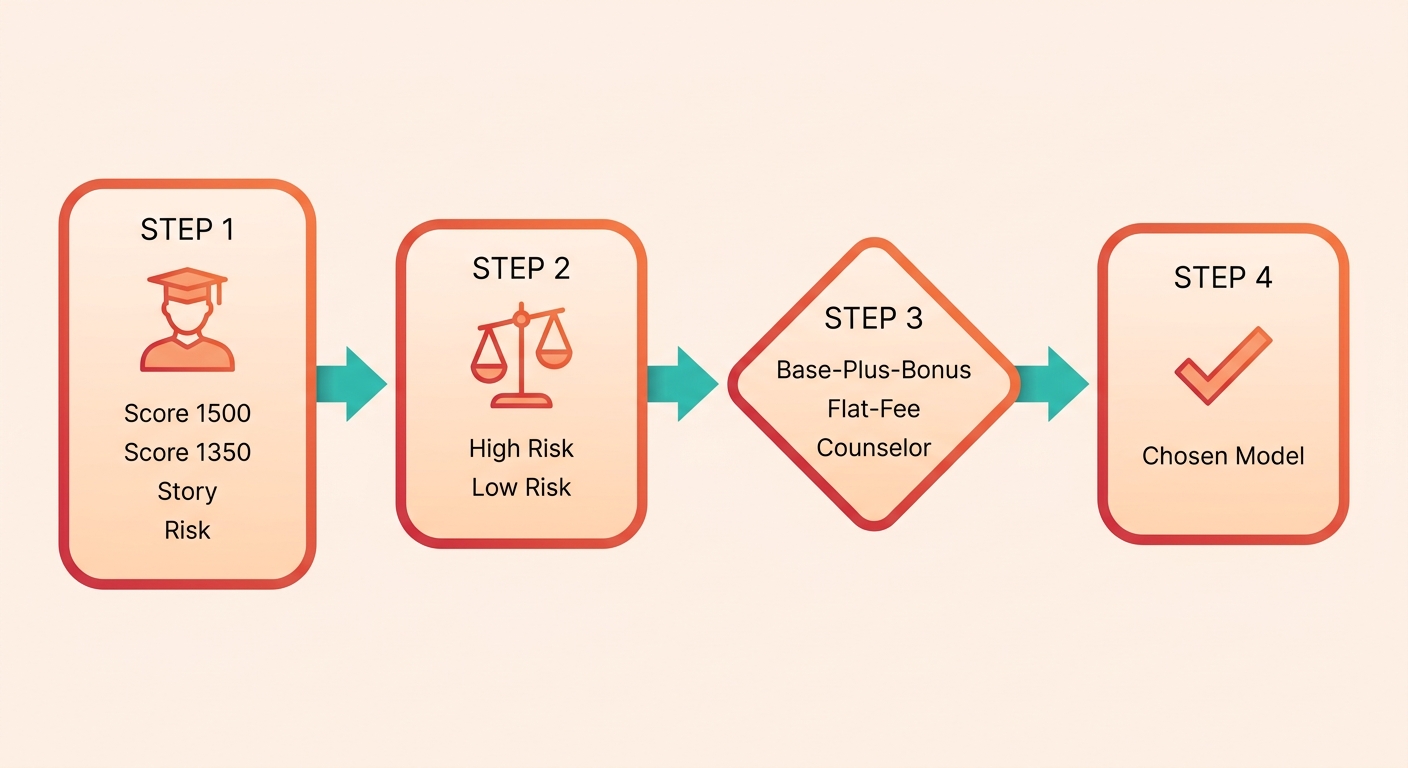
Who Benefits Most From Base-Plus-Bonus
It fits families with genuinely competitive applicants who want our incentives tied to theirs. If your student already has the scores, the rigor, and a distinct angle, a bonus structure means we win when you win. That alignment matters most when the outcome is realistically within reach.
We see it work best for middle-class and upper-middle-class families who can't stomach paying full premium upfront but still want senior-level attention. The lower base keeps the door open. The bonus keeps us motivated through the final essay grind.
When to Skip This Model
Skip a bonus-based model if your student's profile isn't yet Ivy-competitive. If the foundation needs two years of building, you're better off with steady, flat-fee coaching focused on development, not an outcome bet nobody can fairly price. Paying for a bonus tied to a long-shot admit helps no one.
Skip it too if a free school counselor genuinely covers your needs. Some students with strong self-direction don't need intensive outside support at all.
| Situation | Best Model |
|---|---|
| Competitive applicant, risk-averse family | Base-plus-bonus |
| Profile needs 2+ years of building | Flat-fee developmental coaching |
| Strong self-directed student | School counselor |
| Brand-name reassurance above all | Flat-fee premium firm |
For families weighing these trade-offs early, our admissions and life-planning blog walks through profile-building before any consulting decision makes sense.
What I'd Actually Tell a Family
Getting admitted comes down to two things you can't fake: a genuinely competitive profile and a support model whose incentives match yours. A perfect test score with no personal narrative loses to a slightly lower score backed by a compelling story, and no consultant fixes that gap in the final month. Pick your support based on where your student actually stands, not on which firm feels safest.
That's the whole argument. The score is a threshold, not a trophy. Once you clear it, the decision shifts to strategy and risk. And risk is exactly where the consulting model you choose starts to matter.
Which Model Wins for Your Situation
Match the model to your student's profile and your family's tolerance for paying before you see results.
| Scenario | Best Choice | Why |
|---|---|---|
| Competitive applicant, want aligned risk | Base-plus-bonus (ours) | Lower base, with a bonus triggered only on successful admission milestones |
| Brand matters more than risk | Flat-fee firm | Predictable process, name recognition, all risk stays with you |
| Strong self-starter, tight budget | School counselor | Free, but thin on tailored strategy |
| Moonshot with a weak profile | Skip premium consulting | No model buys admission; fix the profile first |
Our honest carve-out: if your student's profile isn't already competitive, don't pay us or anyone else six figures chasing a long shot. The base-plus-bonus model only makes sense when there's real, satisfying work to be done. For an applicant with a modest SAT hoping a consultant can perform miracles, that money is better spent elsewhere.
Our Final Take
We built our model for one type of family: those with a genuinely competitive student who refuse to carry all the financial risk upfront. The base-plus-bonus structure keeps upfront costs manageable while keeping our goals aligned with yours. If that's you, aligned incentives beat brand names every time.
If you want predictability above all and the budget doesn't sting, a flat-fee firm is a fair choice. And for a strong self-starter, a good counselor plus discipline can carry you far.
Want more on building the profile that clears the threshold? Our educational resources dig into the strategic work that happens before any consultant enters the picture.
References
[1] Why Do Ivy League Colleges Reject Some Students With ... - https://www.forbes.com/sites/marlenacorcoran/2026/02/27/why-do-ivy-league-colleges-reject-some-students-with-perfect-scores/
[2] A Study of the Use of Nonacademic Factors in Holistic ... - https://www.researchgate.net/publication/331745463_A_Study_of_the_Use_of_Nonacademic_Factors_in_Holistic_Undergraduate_Admissions_Reviews
[3] Merit and Competition in Selective College Admissions - https://www.researchgate.net/publication/236704765_Merit_and_Competition_in_Selective_College_Admissions
[4] The impact of legacy status on undergraduate admissions ... - https://www.researchgate.net/publication/227414369_The_impact_of_legacy_status_on_undergraduate_admissions_at_elite_colleges_and_universities
[5] Admission Preferences for Minority Students, Athletes, and ... - https://www.researchgate.net/publication/4746371_Admission_Preferences_for_Minority_Students_Athletes_and_Legacies_at_Elite_Universities
Frequently Asked Questions
1. How do I define a fair bonus threshold in a base-plus-bonus consulting contract?
Use precise, objective milestones instead of subjective terms. Contracts should rely on verifiable outcomes, such as acceptance into specific athletic conferences, designated institutional tiers, or concrete financial aid awards. Avoiding ambiguous descriptors ensures that both the family and the advisory team have a shared, indisputable standard of success when decision letters arrive.
2. If my child gets rejected everywhere, what do I actually pay under a base-plus-bonus model?
You pay only the lower base rate, with no bonus triggered because milestones weren't met. This is the lowest total cost across models when outcomes fall short. Traditional flat-fee firms charge their entire premium rate regardless of the outcome and offer no refunds, meaning your family carries the full financial risk of rejection.
3. Can a school counselor realistically replace a private consultant for a competitive applicant?
For highly self-directed students, a school counselor combined with personal discipline can be incredibly effective. However, school counselors typically manage massive student cohorts, which limits their role primarily to administrative tasks like submitting transcripts and verifying deadlines. They rarely have the individual bandwidth required for the deep, iterative essay coaching and highly customized positioning that a competitive Ivy League application demands.
4. Does a higher test score guarantee better admissions odds at Ivy League schools?
Standardized test scores act as a threshold rather than a guarantee. Highly selective admissions offices utilize holistic review processes that heavily weigh nonacademic factors. Consequently, an applicant with a slightly lower score but a highly distinctive, compelling personal narrative frequently secures admission over a candidate with a perfect score who lacks a clear, unique angle. Once you clear the academic baseline, your overall strategy and positioning drive outcomes far more than incremental score increases.
5. I'm on a strict budget with a fixed number in mind. Which model fits me?
If you require absolute predictability, a flat-fee arrangement or relying on school resources is generally the best fit. While flat-fee models require you to assume all the financial risk upfront, they provide a single, unchanging cost. Base-plus-bonus structures introduce variable pricing that scales based on success, which may not align with rigid, pre-allocated educational budgets.
6. My student needs two more years of academic development. Is premium consulting worth it now?
It is generally best to avoid outcome-based bonus models when a student is still in the early stages of high school. At this phase, the focus should be on academic growth, course selection, and extracurricular exploration rather than immediate admissions results. Steady developmental coaching or utilizing school-provided guidance is far more appropriate for long-term profile building.
7. How many people actually review my essays under an aligned-incentive model?
Our aligned-incentive model utilizes a collaborative review process where multiple experienced advisors evaluate each draft. This multi-perspective approach ensures that your essays are polished and strategically aligned with what admissions committees look for. This stands in contrast to large flat-fee firms where a single junior associate might handle your entire file, or school counselors who simply lack the time for deep editorial reviews.