Why "College Will Humble You" Hits Harder in the 2026-2027 Common App Cycle
September 3, 2026

Key Takeaways
- The 2026-2027 Common App essay prompts are unchanged from last cycle. The format stayed the same.
- The essay carries more weight every year as acceptance rates drop.
- More than half the field crowds into two prompts: 28% pick "Topic of your choice," 23% pick "Facing adversity."
- The essay is where the humbling stings most, because everything else is a number or list.
- One Common App submission reaches over 900 member colleges. That is a lot riding on one shared essay.
- College Essay Guy suggests using at least 500 of your 650 words. Fall short of that, and you usually cut needed reflection.
- The "safest" prompts are the hardest ones to stand out in.
What "college will humble you" actually means
"College will humble you" is the moment high-school certainty stops working. You realize your grades, class rank, and trophies guarantee nothing against applicants who all look strong on paper.
Students feel this most sharply during the essay. It is where warnings about selectivity become a blank page.
What's different about the 2026-2027 cycle?
The pressure moved from the tools to the context. The prompts for the 2026-2027 cycle match previous years exactly, so you cannot stand out on novelty. You have to frame your story more deeply.
The real difficulty this year is execution. With a static format, admissions officers compare your work against years of past essays. That raises the bar for originality.
The specs stay standard. That broad reach, over 900 member colleges, means one draft has to work for small liberal arts colleges and large research universities alike.
Why the "safe" prompts are the crowded ones
Prompt choice clusters hard. According to Admittedly's guide, most submissions funnel into just two options. That creates a bottleneck where readers wade through thousands of essays built on the same theme.
That reframes advice you've heard everywhere. Plenty of experts insist the prompt matters less than the story. As Thomas Caleel puts it in Admittedly's guide, "the quality of the story matters, not the prompt you choose."
Our take: that advice cuts against the herd. When so many applicants gravitate toward the same prompts, picking a less common one can signal, right away, that you are willing to step off the predictable path. A stronger story often comes from ignoring what everyone else is doing.
Is the essay the deciding factor?
The sources disagree, and the disagreement is useful. One camp treats the essay as the strategic lever for standing out as admissions tightens. The other, including College Essay Guy's breakdown, plays down strategy in favor of authentic voice.
We reconcile it this way: the essay is high-stakes because the right strategy is story depth, not prompt selection. Ethan Sawyer describes the essay's job as letting colleges "know about the wide range of skills, qualities, values, and interests that have shaped who you are today."
This section is for any student, parent, or counselor who finds the format simple but the outcome impossible. The takeaway is a mindset shift. Stop asking which prompt is safest. Start asking which story only you can tell. That is the humbling, and it is also the opening. For more on framing your application over four years, see our college admissions planning blog.
Getting started without spinning your wheels
Understanding the humbling is one thing. Acting on it is another. The setup is simple: pick your prompt, know your word limit, and reflect before you write.
The good news this cycle is that nothing structural changed. Because the prompts are identical, you can study successful essays from past years to see what works. The real challenge is making your voice stand out when the parameters are the same for every applicant.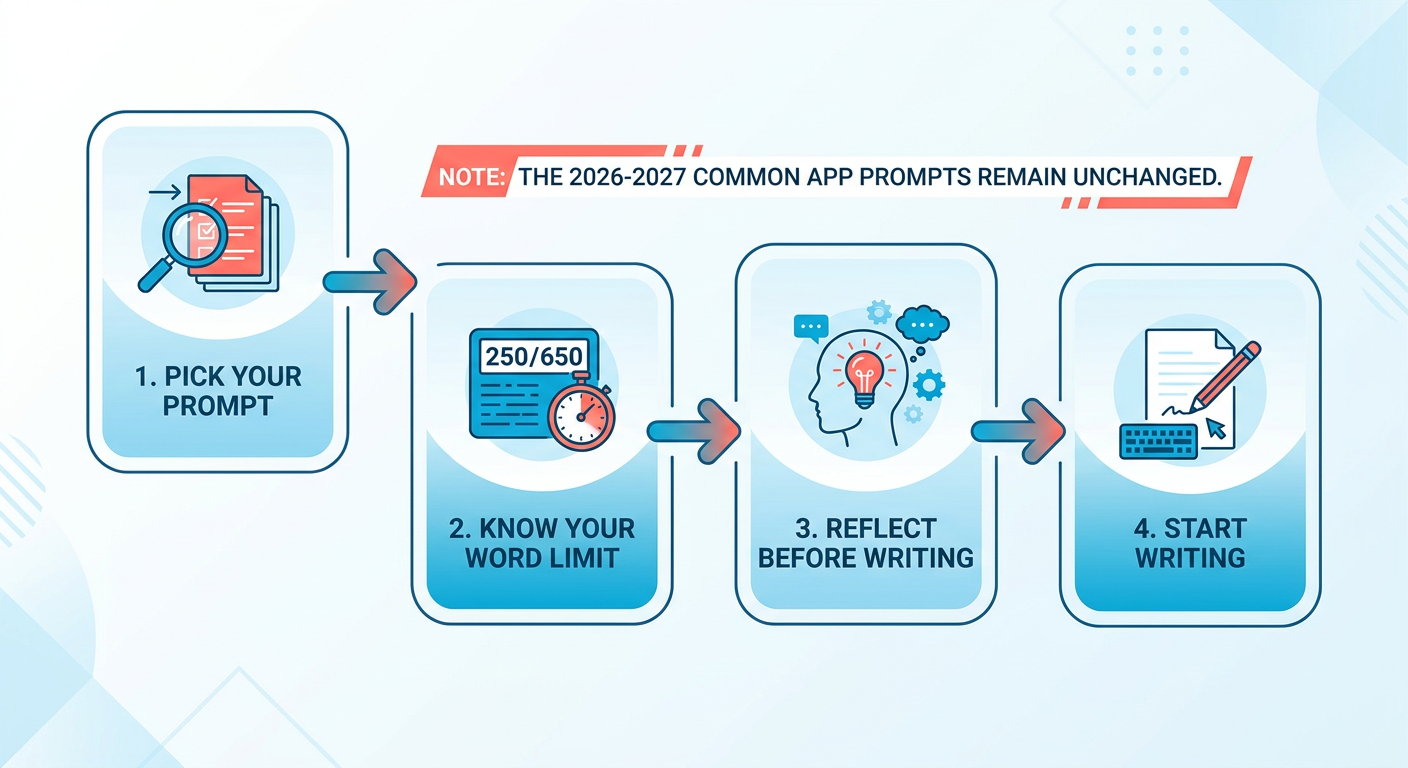
What are the first steps?
Three basics: the seven prompts, the word count, and a brainstorm. The Common App has seven prompts, each designed to pull a personal story out of you. Your essay has to fit the platform's length limits, and we push students to make every word count by refining the story with feedback from at least two people on our team.
Your setup checklist:
- Read all seven prompts once. Don't pick yet. Just absorb them.
- Block out reflection time. Focus on real personal growth, not on matching a specific prompt.
- Brainstorm before drafting. Map your core values, key transitions, and the perspective only you bring to campus.
- Create your account early. Responses carry over between cycles, so nothing's lost if you start now.
Setting up early gives you a clear view of the interface and requirements, so you can plan your timeline before the autumn rush.
Should you pick the "safe" prompt?
No. Going with the most common choices usually works against you. When a big share of the field piles into a couple of popular prompts, readers see the same story shapes over and over, and your voice has a harder time breaking through.
The advice to focus on the narrative instead of the prompt helps you break from the herd. Rather than gaming the system with an "easy" prompt, dig deeper into your own experiences so the story holds up regardless of category.
Sources split on how strategic to get. Some guides emphasize the essay's role in tipping the scale at highly selective schools; others play down prompt strategy in favor of authentic story. Our read: both are right. The essay is high-stakes because the real work is story depth, not prompt selection.
What does "getting started" actually look like?
Reflection, not typing. Admittedly's guidance is to spend more time reflecting on your experiences than describing them. Students who focus on genuine growth tend to write essays that land better with committees.
Skip the prompt-hunting spiral. Don't burn your first week hopping between prompts looking for the "winning" one. That energy belongs in your brainstorm. Once you know your story, the prompt that fits it becomes obvious.
The numbers behind prompt choice
The humbling shows up in the data on how students pick prompts. Popularity clusters hard, leaving five prompts to share the small remainder of the applicant pool.
And here's the part most students miss: when you pick the most common option, you've handed the reader a harder job. Now they have to find your perspective in a stack of near-identical setups.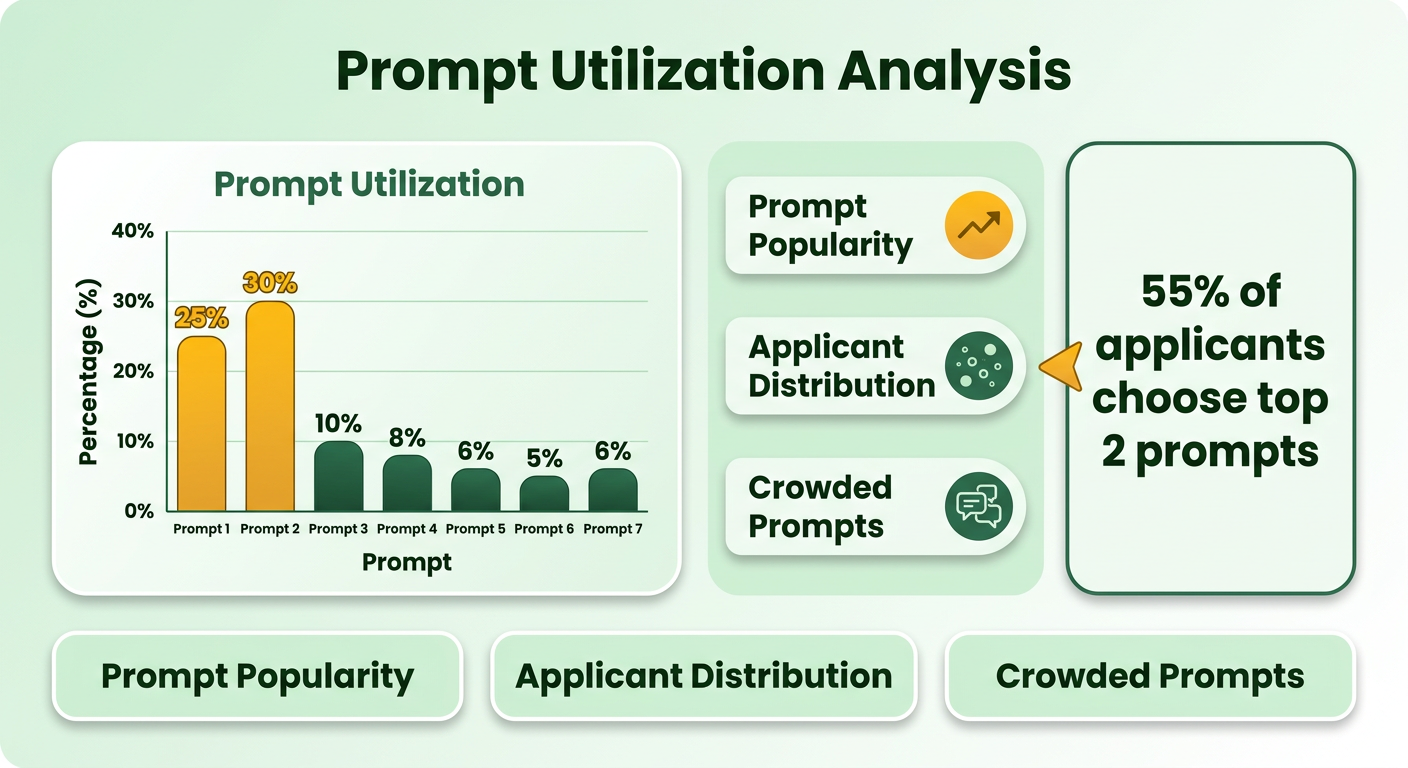
What are the seven prompts actually testing?
Each prompt pulls out something different, but they all test the same skill: self-awareness. Seven prompts cover identity, challenge, gratitude, and growth, and every one is built to reveal how you think about your experiences, not how well you can describe them.
The prompts stayed frozen this cycle for a reason. Change here is rare. The organization keeps a consistent set of questions so applicants planning over multiple years get equity and predictability.
That stability is a gift. You can study real essays instead of guessing at a new format. The pressure is not the prompt anymore. It is the depth you bring to it.
Does the prompt you pick actually matter?
The sources split here, and the split is worth sitting with. Some advisors frame the essay as a critical differentiator in selective pools; others argue execution of the narrative is the only thing that truly moves readers.
Our take: both are right, and they resolve into one rule. Strategy should be about story depth, not prompt gaming.
But watch what the crowding data does to the "prompt doesn't matter" advice. If most applicants funnel into a handful of prompts, choosing a less-traveled one gives your reader fewer direct comparisons. Ignoring the prompt actually cuts against the herd, which is exactly where you want to be.
What helps you stand out?
Two things work quietly in your favor. First, the platform rolls over your information if you start before senior year. Reflect early, and your drafts wait for you.
Second, the prompts reward reflection over description. Focus on the internal shift, not the external event. A "Facing adversity" essay that only narrates the hard thing reads flat. One that shows what the experience changed in you earns its place.
That's the whole game in one line. The tools are identical for every applicant. What separates the accepted essays we study every year is whether you did the harder work of self-examination the blank page demands. For students weighing where their story fits, our college admissions planning blog digs into that work.
Writing humble without writing weak
The best way to act on the humbling is to stop trying to sound impressive and start trying to sound specific. Humility on the page is not weakness. It reads as honesty, and honesty separates a memorable essay from a forgettable one.
The pattern holds across the strongest applications we work on. Students who write about a small, real moment beat the ones who narrate their whole résumé. The essay rewards depth over coverage every time.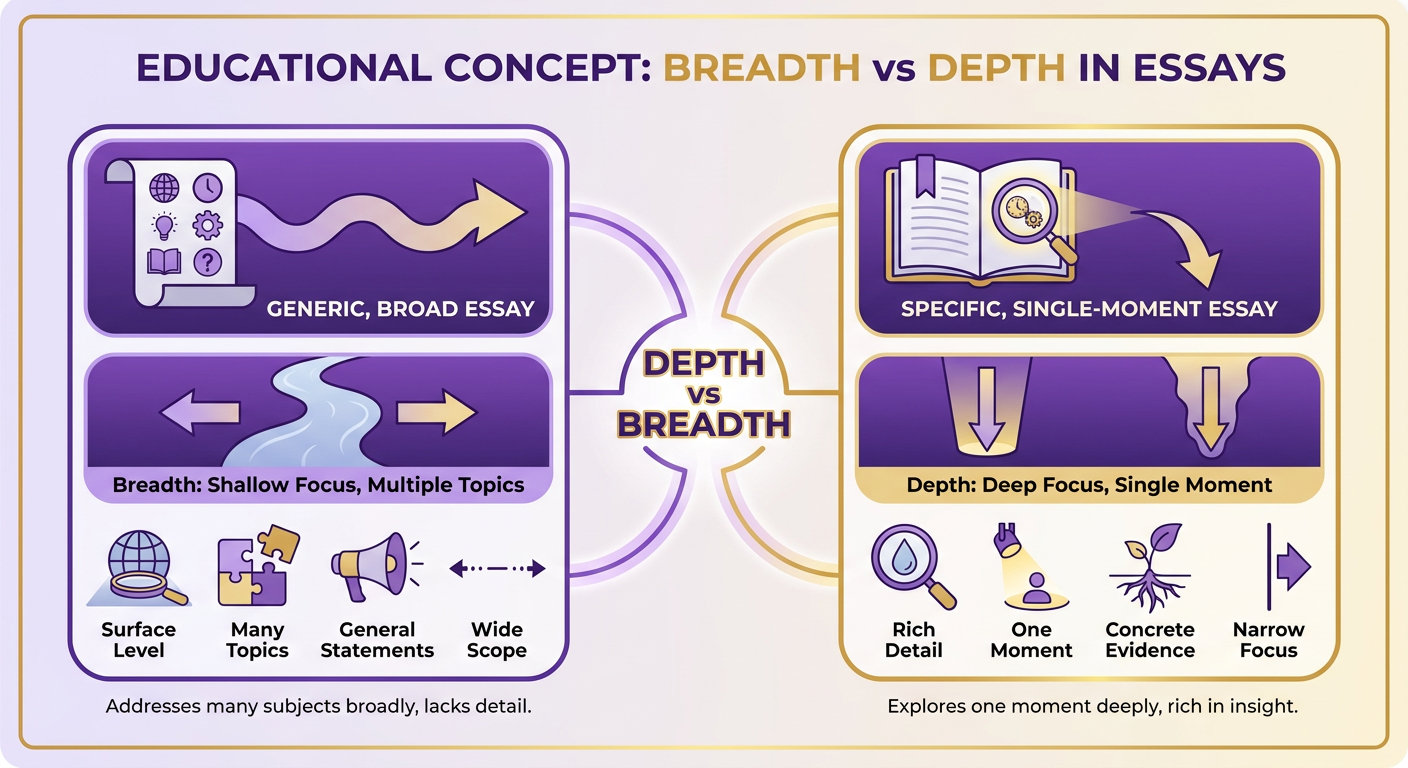
What does humility look like on the page?
Reflection, not recitation. As PrepMaven's Common App guide puts it, the prompts are built to pull out personal growth, not a list of accomplishments. Show what you learned, and you answer the question the reader is asking.
At Endurable Education, our team works with each student as a panel, so multiple perspectives shape the final draft. The Common App essay is where you show your best and let your personality come through.
Notice the word unique. A story only becomes unique when you write it in a voice no one else could fake. No two students are alike, which is why none of our strategies are either.
Patterns that consistently work
Pick the moment, not the milestone. A single conversation or failure gives you room to reflect. A four-year highlight reel gives you none.
Show the before and after. Growth needs a starting point. If you never admit what you got wrong, the reader has nothing to measure against.
Read real examples first. PrepMaven points to 35 real personal statements that earned spots at schools like Princeton, Harvard, and Yale. Study how those writers handle vulnerability before you draft.
When should you skip the humble angle?
Skip it if the "lesson" feels manufactured. Readers spot a fake epiphany instantly, and a forced humble ending lands worse than no ending at all.
If your genuine story is about confidence, write that. The point was never to perform modesty. It was to write something true. For more on building an application that holds together, our team keeps practical guidance on the blog.
When your story belongs somewhere else
The Common App essay is not your only option. Part of the humbling is knowing when to route your story elsewhere. Some students get more mileage from a supplemental essay, the additional information section, or a different prompt entirely. The personal statement can't carry everything.
So how do you decide where a story belongs? You match the story to the space that fits it.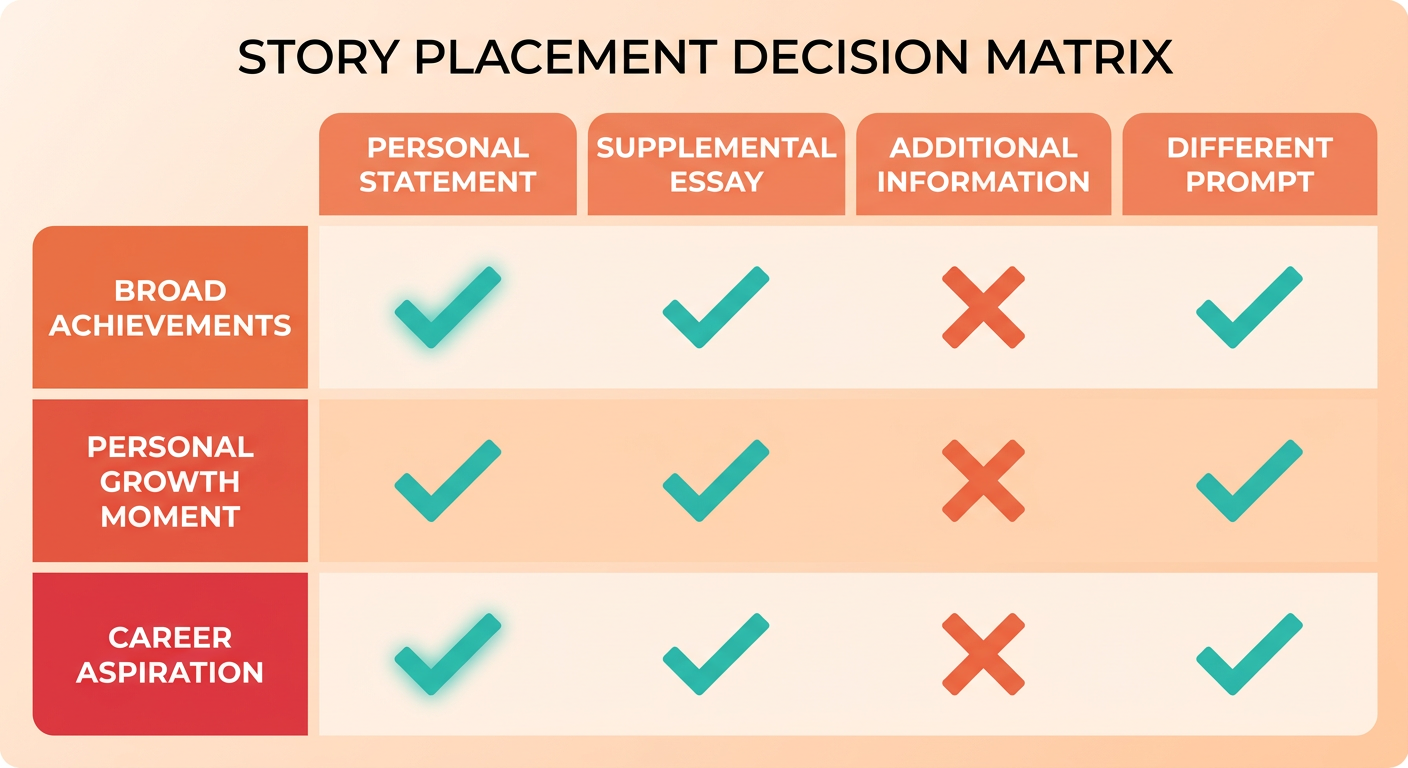
Supplement or main essay?
Use a supplement when the story is school-specific. The main essay shows who you are across every application you send. A supplement answers why you and one particular school fit. Forcing a "why this college" narrative into your personal statement wastes both.
Students burn their best material in the wrong slot all the time. A passion for a niche research program belongs in a supplement, not your 650 words. Save the personal statement for the trait that shows up everywhere you go.
If a story only makes sense in one application, it is a supplement. If it explains you regardless of the school, it is the main essay.
What about the additional information section?
Use additional info for context, not narrative. A gap in your transcript, a family circumstance, an interrupted semester. These need explanation, not storytelling. Cramming them into your personal statement turns reflection into an excuse letter.
The humbling part here is restraint. Not every hardship earns a place in your main essay. Some belong in a plain, factual note that gives the reader context without asking them to feel something.
When should you skip "Topic of your choice"?
Skip the open prompt when you're using it to dodge focus. The freedom feels safe, but it often produces the most unfocused drafts we read. A structured prompt forces a lens; the open one lets you wander.
Pick the open prompt only when a specific story genuinely doesn't fit the other six. That's rare. If you're choosing it out of relief, choose a real prompt instead.
Sequencing all these pieces is exactly the work our team handles through customized planning and regular check-ins. Visit our blog for more tips.
Troubleshooting a draft that isn't working
Most essay problems trace back to the same root. Students try to sound like the applicant they think admissions wants, not the one they actually are. That gap is where the humbling shows up in practice: your first draft usually sounds like everyone else's.
When a draft feels flat, the fix is almost never a bigger vocabulary or a grander topic. It's specificity. Students rescue weak essays by zooming in on one real moment instead of summarizing a whole year.
Why does my essay sound generic?
Generic essays happen when you write about a category instead of a scene. "Volunteering taught me empathy" is a category. The afternoon you actually spent, the thing someone said, the moment you got it wrong first — that's a scene. Readers remember scenes.
Watch for these:
- The résumé essay: You list accomplishments the rest of your application already covers. Cut them. The essay is for what the numbers can't show.
- The thesaurus draft: Fancy words hide your voice instead of sharpening it. Write it the way you'd explain it to a friend.
- The tidy lesson: You wrap up with a neat moral that sounds rehearsed. Real reflection is messier and more honest.
How do I fix a draft that isn't working?
Read it out loud. If a sentence sounds like a college brochure, it's not you. Cut anything you wouldn't actually say. This one pass catches most of the stiffness that makes essays forgettable.
Then check your ratio. Strong personal statements spend more words on reflection than on plot. If two-thirds of your draft is "what happened" and only a sliver is "what it meant," rebalance toward meaning.
When you're truly stuck, change prompts. Sometimes the story is fine but the frame is wrong. A stubborn draft often loosens the moment you stop forcing it into a prompt that doesn't fit.
When to stop revising: once your essay sounds like you and says something only you could say. Past that point, more edits usually flatten the voice you worked to find.
Resources and tools worth your time
Once the humbling sinks in, the next question is practical: what tools actually help you write the essay? Fewer than you think. The prompts, real example essays, and a brainstorm document carry most of the work.
Here's what makes it easier. You don't have to build a toolkit from scratch. Because the prompts match previous years, every guide and sample from the last cycle still applies. That stability is your biggest advantage.
What resources actually help?
Start with three: the official prompts, a set of real accepted essays, and a structure template. Everything else is optional.
Real example essays. Reading essays that worked teaches more than any rulebook. Johns Hopkins publishes its Essays That Worked collection each year, with admissions officers annotating why specific paragraphs succeeded. Seeing a reader's own notes shows you what actually registers on the other side of the desk.
Structure templates. Most strong essays follow one of two shapes. Narrative works for a single arc. Montage works when several small moments reveal a pattern. Either gives you a frame without forcing your story into a mold.
How do you use your word count and prompt choice?
Treat the low end of the word limit as a warning sign, not a target. Writing well short of the ceiling usually means you cut needed reflection. The extra room exists for depth. Use it.
On prompt choice, the advice splits again. Some guides treat the essay as your primary tool for standing out in a crowded field. Others argue the prompt barely matters next to story quality.
Our take: both are right, and they point the same direction. The winning move is story depth, not prompt gaming. Chasing a "strategic" prompt is wasted energy. Chasing a specific, honest moment is not. The crowding data backs this up. When you pick the most popular option, you make the reader's job of finding you harder.
What separates strong applicants?
Reuse your reflection across the whole application. The same core story that anchors your personal statement can seed your supplemental essays, your activities descriptions, even your interview answers. One round of honest thinking pays off many times.
Treat the essay as one part of a system, not a standalone document. Its job is to show the committee the sides of your character and curiosity that do not show up on a transcript. That framing keeps you writing about a person, not a prompt.
Want structured feedback on where your draft lands? Our approach puts multiple advisors on your work. Skip outside editing help for a routine draft. Bring it in when you've genuinely lost sight of whether your own voice survived the revisions.
What I'd actually tell a student
The humbling comes down to one shift: your record gets you to the starting line, but it does not finish the race. The essay does. That is the whole arc of this cycle, and it is why the humbling lands harder now than it used to.
The students who accept this early write better essays. They stop defending their résumé and start showing a real self on the page. The pressure has not changed the toolkit. It has changed what the toolkit has to prove.
What should you do next?
Pick your prompt, then write the worst draft you're willing to write. A rough first pass beats a blank page every time. The goal of draft one is to find your moment, not to impress anyone.
A simple order of operations that works:
- Brainstorm before you outline. List small, specific memories, not big themes.
- Draft fast, edit slow. Get the whole thing down, then cut to the scene that matters.
- Read it out loud. Listen to the rhythm so it sounds like a person, not a brochure.
- Get one honest reader. Someone who'll tell you where it goes generic.
Skip the fancy vocabulary and the grand life-lesson ending. Neither saves a flat essay. Specificity does.
Where should you keep learning?
Go back to the seven official prompts and read them slowly, one at a time. Then read real accepted essays until you can feel the difference between a scene and a summary. That contrast teaches more than any checklist.
If you want ongoing guidance on the full application, not just the personal statement, our team writes regularly at the Endurable Education blog. The essay is one piece. The bigger work is fitting it into a coherent story across every part of your application.
The humbling was never the point. It is the doorway. Once your certainty drops, you finally have room to write something true, and that is the essay that gets read twice.
References
[1] Announcing the 2026–2027 Common App essay prompts - https://www.commonapp.org/blog/announcing-2026-2027-common-app-essay-prompts/
[2] The 2026-2027 Common App Prompts (and 7 Example Essays ... - https://www.collegeessayguy.com/blog/common-app-essay-prompts
[3] 2026–2027 Common App Prompts: How to Answer Each - PrepMaven - https://prepmaven.com/blog/applying/common-app-essay-prompts/
[4] The 2026-2027 Common App Essay Prompts: An Expert Guide | Admittedly - https://admittedly.co/common-app-essay-prompts-2026-2027/
[5] 2026-27 Common App Essay Prompts: Expert Guide and Tips - https://www.collegeessayadvisors.com/portfolio-items/common-application-essay-prompts-guide/
Frequently Asked Questions
1. Can I reuse the same essay for different colleges through the Common App?
Yes, the platform is designed so that your primary personal statement is automatically distributed to every institution on your list. Because of this broad reach, school-specific anecdotes should be reserved for supplemental essays. Save your main essay for a core personal trait that you want every admissions officer to see, regardless of which school they represent.
2. What word count should I aim for if the limit is 650?
Treat the lower end of the range as a warning sign, not a target. Writing well short of the maximum limit usually means you have cut the reflective analysis that admissions officers value most. Aim to use the vast majority of the available space, focusing the extra room on deepening your self-examination rather than adding more plot details.
3. How is the "Facing adversity" prompt different from just describing a hardship?
The prompt tests self-awareness, not the difficulty itself. An essay that only narrates the hard thing reads flat, while one showing what the experience changed in you earns its place. Focus on the internal shift—how your perspective, values, or coping mechanisms evolved—rather than spending the entire word count detailing the obstacle itself.
4. When should I use the additional information section instead of my essay?
Use the additional information section for context, not narrative. Factual anomalies in your academic record or unexpected life disruptions need a straightforward, objective explanation rather than a dramatic narrative. Keeping these details in a separate, concise note allows your main essay to remain focused on your personal growth and character.
5. Do the essay prompts change every year?
While the organization reviews the questions annually, major structural changes are exceedingly rare. The current set of options has remained consistent for several cycles. This stability is highly beneficial for applicants, as it allows you to study successful historical examples and plan your writing strategy well in advance of the official application launch.
6. Why does my essay sound generic even after multiple edits?
Generic essays usually suffer from broad generalizations rather than specific, lived moments. Instead of summarizing a broad theme or a long-term activity, focus on a single, highly detailed interaction or decision. Review your draft to ensure your unique voice is present, and shift the balance of the text so that you spend more time analyzing your thoughts than describing the setting.
7. Is choosing a less popular prompt actually a smart strategy?
Selecting a less common prompt can help your application stand out by offering admissions officers a refreshing change of pace. However, this should never come at the expense of your narrative. The most effective strategy is to focus entirely on the depth and honesty of your personal story, allowing the prompt selection to follow naturally from the content you write.