Why Early Decision Can Teach the Real Meaning of "College Will Humble You"
September 6, 2026

Key Takeaways
- Early Decision asks a 17-year-old to declare certainty about a "dream school" that college later complicates.
- Middlebury's class of 2027 admitted 34.02% of early applicants versus 7.2% in Regular Decision.
- Penn took 14.85% of its early pool versus 4.45% through Regular Decision. That gap is significant.
- The binding structure means you commit before comparing a single financial aid offer.
- ED runs on two tracks, ED I and ED II, each with its own timeline.
- The higher admit rate is a real advantage. It comes with a non-negotiable promise to attend.
- The deeper lesson of ED appears in rejection, when the "dream school" premise proves incomplete.
Quick Overview
When people say college will humble you, they usually mean reality outpaces expectation. With Early Decision, that humbling starts before you unpack a single box. It begins the instant you make a binding commitment to one school and wait for an outcome you can't control.
This guide follows that lesson through the mechanics of ED. The short version: the process teaches that the certainty you were forced to declare was never fully yours. We'll walk through how ED works, why the numbers look so tempting, and where the real character-building happens.
What Does This Guide Cover?
The full arc of Early Decision, from acceptance-rate math to the emotional aftermath. Each section builds toward one argument: the binding structure asks you to bet on a "dream school" premise that experience later undoes.
| Section | What You'll Learn | Difficulty |
|---|---|---|
| ED Mechanics | Binding rules, ED I vs. ED II timelines | Beginner |
| The Numbers | Why early admit rates run 2-3x higher | Intermediate |
| The Financial Gamble | Why ED limits aid comparison | Intermediate |
| The Humbling | What rejection and the "dream school" myth teach | Advanced |
Time to read: roughly 12-15 minutes. Difficulty: intermediate, no prior admissions knowledge required.
Why Do the Numbers Look So Good?
Early admit rates consistently beat Regular Decision rates at the most selective schools. IvyWise's Early Decision guide frames applying early as a primary lever for showing serious interest, which colleges reward with higher acceptance percentages.
That gap is a deliberate institutional choice. Crimson Education's class of 2030 analysis shows elite schools now filling 40-60% of their incoming class through ED rounds, at acceptance rates two to three times higher than regular pools.
As schools expand binding options and push commitment earlier, they also accelerate the achievement-culture pressure that research on elite admissions links to real harm. The higher odds come bundled with an earlier, heavier financial gamble.
Where's the Real Humbling?
Not in rejection itself. It's in discovering that the premise of a single "perfect" school is flawed to begin with. Traditional advice assumes there's one dream school worth a binding bet. A student reflecting in a CollegiateParent essay argues the opposite: any school can become the right fit.
For applicants with a clear, long-standing first choice, the early round is a logical path. For those chasing a certainty they don't actually feel yet, waiting for ED II or Regular Decision may serve them better. ED forces a commitment to a single fit. The actual college experience tends to reveal that fit is something you build over time, not something you discover on one campus. This guide unpacks that reframe, which also shapes how we approach admissions strategy on our admissions blog.
Why This Guide Matters
When students ask us what "college will humble you" actually points to, we tell them the humbling starts earlier than most expect. In our experience, Early Decision is where the lesson lands hardest. It asks a teenager to make a binding commitment to a certainty that was never fully theirs.
This guide exists because ED gets framed as pure strategy. The numbers are real, but they hide a personal reckoning most families never plan for. That reckoning is the truest version of what "college will humble you" means in practice.
What Will You Actually Learn Here?
How ED works, why the acceptance-rate gap is so tempting, and where the emotional cost hides. Each section gives you both the mechanics and the mindset. The goal is a decision you can defend even if the answer is no.
The advantage isn't a myth, but it comes with strings that rarely make the headline. ED applicants commit to a single school before they see a single financial aid letter. The odds boost arrives with a real loss of flexibility. That trade-off is exactly what the raw admit-rate comparisons leave out, and it's why we treat the emotional and financial stakes as central, not a footnote.
New pathways like the University of Chicago's Summer Session Early Notification push commitment even earlier. Every new binding slot moves the financial gamble and the achievement-culture pressure forward in a student's life. That's not a neutral convenience. It asks kids to declare a singular fit before they've had time to test whether any singular fit even exists.
Who Is This Guide For?
Students weighing a binding first choice, and the parents and counselors guiding them. If you have one clear top school and every material ready, ED can genuinely double your odds. If you're not there yet, this guide will show you why waiting protects you.
For families weighing the money, the binding commitment demands a real understanding of how a school calculates need. Because you commit before receiving comparative offers, the decision requires early alignment between a student's academic goals and a family's financial boundaries. You have to weigh aid offers side by side before you can't anymore.
The deepest lesson sits underneath all the strategy. An early rejection can be a genuine catalyst for growth, forcing applicants to decouple their identity from one institution's verdict. The binding structure asks you to project your entire future onto one campus. The reality of higher education is that students find fulfillment across a wide range of environments. Discovering that your potential is not bound to a single brand name is a powerful thing to learn at 17.
If you want the strategic frame behind these choices, our customized planning helps you build an application that works in any round. No two students are alike, so none of our strategies are either. We draw on decades of experience to develop your story across essays, applications, and interviews.
The Mechanics of a Binding Commitment
When students ask us what the humbling in Early Decision really comes down to, we point them to the architecture of the round itself. ED is a binding commitment: you apply to one school, and if accepted, you withdraw every other application and send a nonrefundable deposit before May 1. The College Board's counselor resources spell out that finality clearly.
That structure is where the humbling begins. You declare certainty about a single school, then hand the decision to people you'll never meet. Roughly 450 colleges offer some early plan, but ED is the only one that locks you in before you've seen a single competing offer.
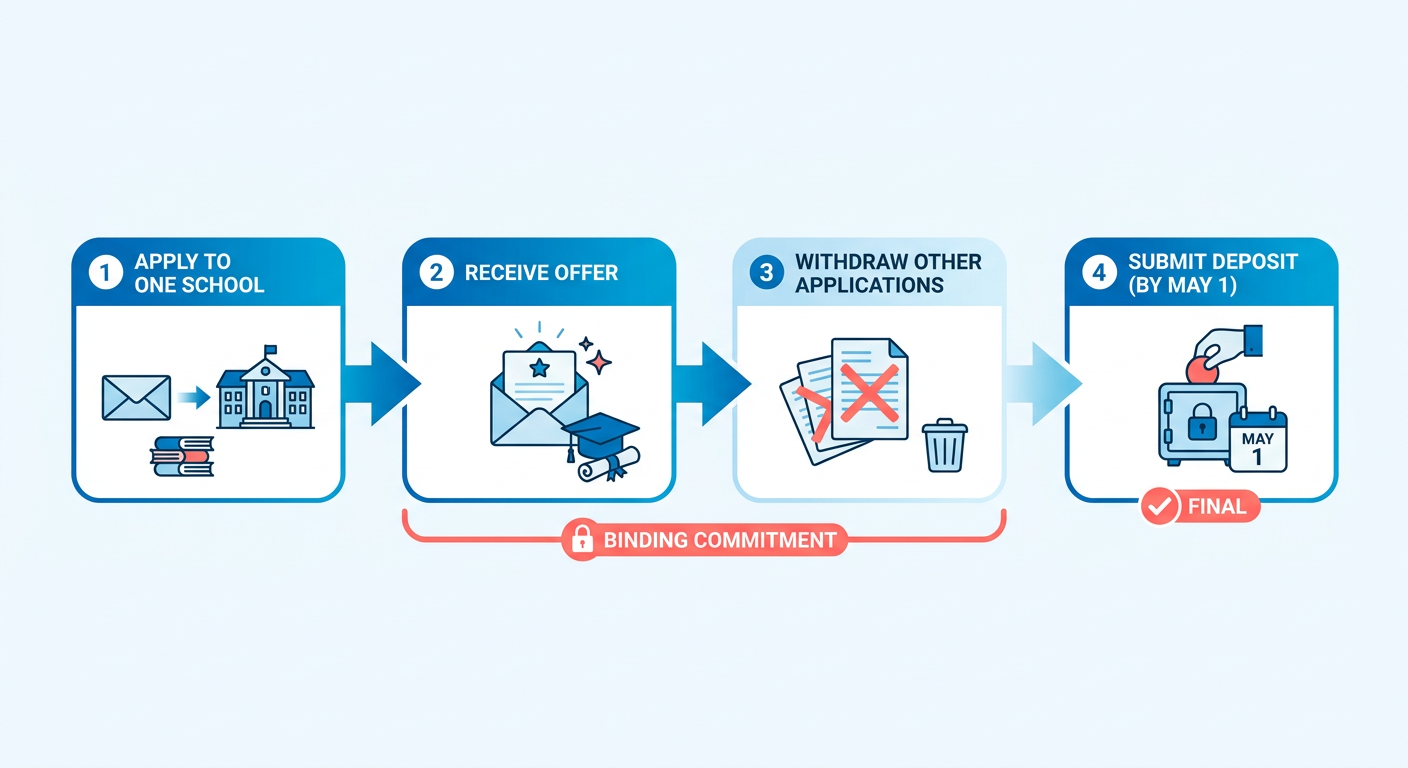
Early Decision vs. Early Action: What's the Difference?
Early Decision: a binding early-round application to one first-choice college. Early Action: a nonbinding early round that lets you apply to several schools and weigh offers later. The IvyWise guide calls applying early "the most effective way to show your commitment to the institution."
Decisions usually land by mid-December. Many schools now run two ED cycles: ED I with a November 1 deadline, and ED II with a January deadline and February results, as Crimson Education outlines. ED II exists for students who miss a first-choice early round or get deferred and pivot.
Why Are Early Decision Acceptance Rates So Much Higher?
The rate gap is real. At Northwestern, the Collegewise full guide reports a 24% ED admit rate against a 5% Regular Decision rate, with ED filling about 53% of the class. Duke's early round has admitted a share roughly triple its regular rate in recent cycles, and many selective schools now fill close to half their class before January.
But most families miss the mechanism behind that number. The advantage is partly a supply-and-demand artifact, not pure merit. Colleges struggle to hit enrollment targets and prize the yield certainty ED guarantees, which is why College Transitions notes that ED applicants look more appealing to admissions offices.
The higher odds reward you for solving the college's enrollment puzzle as much as for being more qualified than the regular pool. That's the quiet second lesson: even winning in the early round shows admissions runs on institutional needs as much as individual merit.
When Should You Skip Early Decision?
Run the financial math before you commit. Colleges technically allow you to break the binding agreement if the aid package is demonstrably unworkable, but doing so is complicated and stressful. You'd need to prove the school's net price calculator was inaccurate, or that your family's finances changed dramatically after you submitted. For families who have to compare actual aid awards to make college viable, that's a real structural risk.
The sources conflict here, and both are right depending on your money. College Transitions treats the rate advantage as a genuine strategic perk. A research paper on the ED process argues it structurally rewards wealthy applicants and traps those who need to compare aid. The perk is real. Who can safely use it is not evenly distributed.
Apply ED only when you're certain about the school and your family can pay without comparing offers. If either condition is shaky, wait. The higher odds aren't worth locking into a number you can't afford.
Getting Started
Start your Early Decision setup by picking one school you'd attend without seeing a single competing offer. That's the whole test. If you can't commit before comparing acceptances or aid packages, ED isn't your round yet. The humbling shows up right here, at the first step, when you realize the certainty ED demands is harder to feel than to fake.
The setup has three moving parts: choosing the school, assembling the file early, and understanding the binding math. Get those in order and you avoid the most painful version of this, the one where you commit for the wrong reasons.
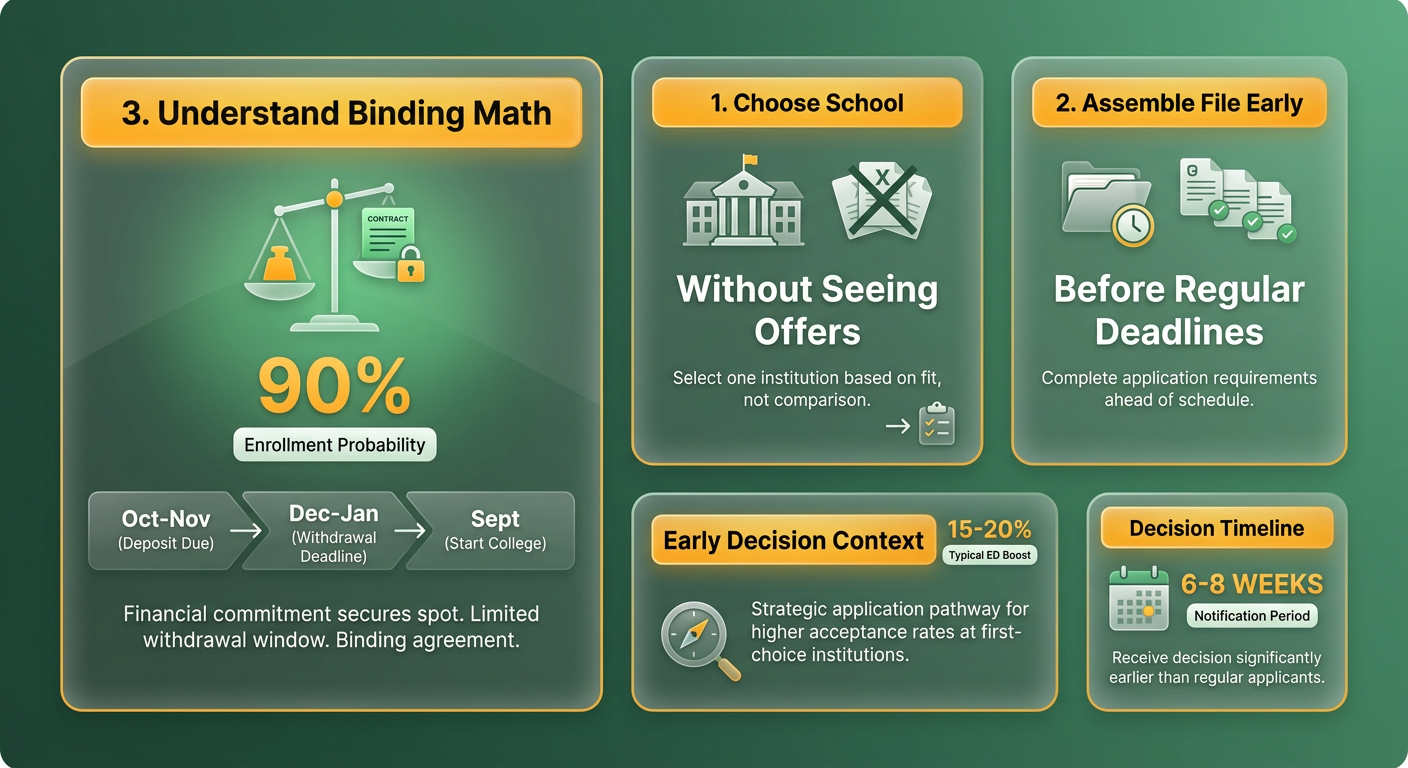
How Do You Set Up an Early Decision Application?
ED setup means locking your first-choice school, finishing every application material by the November deadline, and accepting that admission is non-negotiable. If admitted, you withdraw all other applications and send a nonrefundable deposit before May 1, as the College Board's counselor resources lay out.
Start earlier than you think you need to. ED files are usually due in November, and some schools run two rounds, ED I and ED II, per College Essay Guy's breakdown. That gives you a second deadline if your first choice falls through, but the readiness bar doesn't move. Essays, recommendations, and testing all need to be done months before regular applicants even start.
Run the financial math before signing the agreement. Lee Ann Backlund, a dean of admission and financial aid, advises families to use each school's Net Price Calculator to estimate real costs, as recommended in IvyWise's guide. Because the binding agreement stops you from comparing final aid letters in the spring, those early estimates are your primary tool for confirming the school is a realistic financial option.
Is the Acceptance-Rate Gap Worth It?
The gap is real but oversold. ED acceptance rates run above Regular Decision because the early pool is smaller and self-selecting. Build your file around fit, not the statistical bump. The odds only help if the school genuinely belongs at the top of your list.
Some colleges fill over half their incoming class through early applications, which is exactly why the odds tilt. But odds aren't fit, and a strong early rate at the wrong school helps no one.
The pressure to declare a single perfect match, as discussed in a CollegiateParent reflection, can distort how students present themselves. Forced to commit early, applicants often write essays tailored to what they think a specific school wants to hear rather than sharing their actual experiences. Approaching the application with the understanding that several colleges could offer a fulfilling path tends to produce more genuine writing, which strengthens the file regardless of round.
What the Acceptance-Rate Gap Actually Measures
The clearest version of what college will humble you means shows up in the acceptance-rate math. The gap between early and regular admission is real, but it doesn't measure what most families think. It measures how badly a school needs your certainty.
The binding commitment is the whole point. Colleges prize the yield certainty a signed ED agreement guarantees, and the higher admit rate rewards you for solving their enrollment problem. That's not a rounding error. It's a strategy.
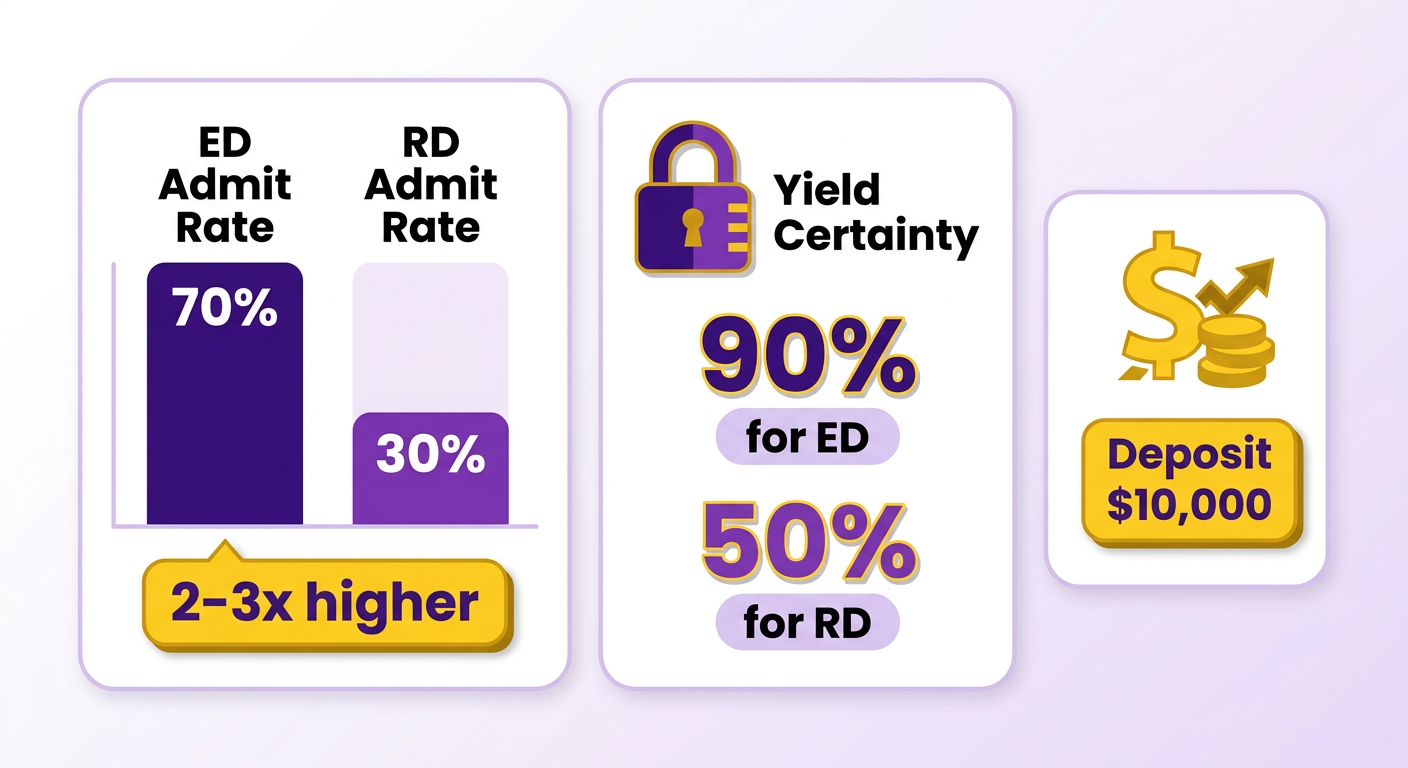
Why the Yield Number Drives Everything
ED acceptance rates run two to three times higher than Regular Decision because the pool is smaller, more committed, and easier to convert into enrolled students. The advantage is partly a supply-and-demand artifact, not a pure measure of merit.
The gap reflects how heavily colleges lean on "yield," the percentage of admitted students who actually enroll. Because ED applicants are bound to attend, their yield runs near 100%. That predictability lets admissions offices lock in a big chunk of the class early, stabilizing their enrollment models and protecting their selectivity metrics. The result is often a much higher share of early applicants admitted, sometimes around 21% versus roughly 6% in the regular round.
This can breed a strange kind of imposter syndrome once students arrive. Realizing the early acceptance was shaped by institutional enrollment strategy, not pure academic validation, is a sobering introduction to how higher education really works.
Is the ED Advantage a Perk or a Trap?
The strategic benefit of ED is tied to a family's financial leverage. Some analyses treat the early round as a clear advantage for applicants. It can also limit merit-based scholarships, because the binding commitment cuts your ability to compare aid packages across schools.
Once the student has committed, the school has less incentive to offer competitive merit awards to secure the enrollment. Students who qualify for substantial need-based aid may see a consistent net price. Those relying on merit scholarships to bridge the gap often find the binding round less advantageous.
What Does the Expanding ED Machine Signal?
Elite schools keep expanding their early programs, some now offering binding options for transfers and specific majors, part of the trend where over 450 colleges offer some early plan.
That pressure forces students to make major life decisions with less time to reflect. When the timeline accelerates, teenagers have to define their academic identity and long-term goals before they've fully lived their senior year, which shrinks the space for organic growth and exploration.
What Happens After You Win
The deepest lesson in what college will humble you means shows up after you win. The ED acceptance feels like proof of merit. Then you learn the higher admit rate rewarded something else: your willingness to hand the college its enrollment certainty.
The humbling here is doubly true. Even the students who "beat" the process find a system driven by institutional strategy rather than a clean meritocracy. That reframe is the advanced skill worth building before you apply.
Is the ED Advantage Really About Merit?
The early round works as a risk-management tool for universities. Admissions offices operate under intense pressure to hit precise enrollment and revenue targets. A binding commitment lets them secure a predictable baseline of enrolled students, cutting the volatility of the spring cycle.
As College Transitions' data analysis puts it, "College admissions offices will be sweating every bit as much as college applicants during this college application season." The higher acceptance rate reflects that mutual dependence, rewarding applicants willing to eliminate the university's enrollment risk.
Who Can Safely Use the ED Advantage?
The early-round pool is structurally different from the regular pool. Some resources, like College Transitions' data analysis, frame the early round as a strategic edge. Others, like IvyWise's early round analysis, flag the drawback of losing the ability to compare aid packages.
Because the binding commitment requires families to accept a financial package without comparison, the ED pool naturally skews toward students who don't need financial aid or whose families can absorb unexpected costs. So the edge is real, but it operates within a system that favors applicants with more financial flexibility, leaving families who must compare offers to fight it out in the more competitive regular round.
Does One "Dream School" Even Exist?
The hunt for a single 'perfect' college overlooks how students actually adapt. The binding nature of ED encourages a "maximizing" mindset, where applicants believe there's only one place they can succeed.
Psychological research on student satisfaction suggests adaptability and engagement matter far more to college success than the specific brand of the institution. A student's own reflection on ED notes that students find fulfillment across a variety of campuses. Once there, they build their own communities, discover new interests, and shape their environment. "Fit" turns out to be an active process of engagement, not a static quality of a campus.
Best Practices
The best way to survive Early Decision is to build your plan around the humbling before it arrives, not after. The lesson we keep coming back to with students: the certainty ED demands is borrowed, so your strategy has to protect you for the moment reality takes it back. Treat the binding commitment as a financial and emotional decision first, a strategic one second.
Here's what we see work.
What If the ED Aid Offer Doesn't Work?
Know how to handle an insufficient aid offer before you're staring at one. If you apply ED and the package isn't viable, your first step is to contact the financial aid office immediately and start an appeal. You'll need documented evidence of financial hardship or a change in income.
Some sources, like College Transitions, highlight the early round as a clear strategic edge. An academic analysis of the ED process argues that edge structurally rewards students who can afford to skip the comparison. Colleges will work with families in good faith, but they can't always match the hypothetical offers you might have gotten elsewhere. That's why entering the binding round without a clear financial baseline, as the College Board's counselor guidance cautions, is a real risk.
How Do You Prepare for a Possible ED Rejection?
Keep working on your other applications all through the fall. A common mistake is halting all Regular Decision work once the ED application goes out in November. If a rejection or deferral arrives in mid-December, students are often left with two weeks to finish dozens of prompts under enormous stress.
Keep drafting essays for a balanced list of target and safety schools, as discussed in a CollegiateParent essay on applying ED, which emphasizes building resilience through the process. You protect your timeline and your emotional footing at once. You end up with strong, thoughtful options ready to launch if the early decision doesn't go your way.
Only Commit If You Truly Would Attend
Let academic and cultural alignment drive the commitment, not prestige. The binding agreement is a serious ethical and legal contract, as IvyWise's admissions team emphasizes, and it's the line between a smart bet and a trap.
Before signing, research the specific department, curriculum, and campus culture of your chosen school. If your motivation runs mostly on the school's ranking or the status of an early acceptance, you can find yourself locked into an environment that doesn't match your actual day-to-day needs as a student.
Comparison with Alternatives
Early Decision is one of three early paths, and choosing between them is where the humbling stops being abstract and starts costing you real options. Each path trades something different. ED trades flexibility for a higher admit rate. Early Action keeps your freedom but gives up the yield signal colleges reward. Regular Decision keeps everything open and lets the odds fall where they may.
The humbling here is discovering that no single path is strictly better. What you gain in one column, you pay for in another.
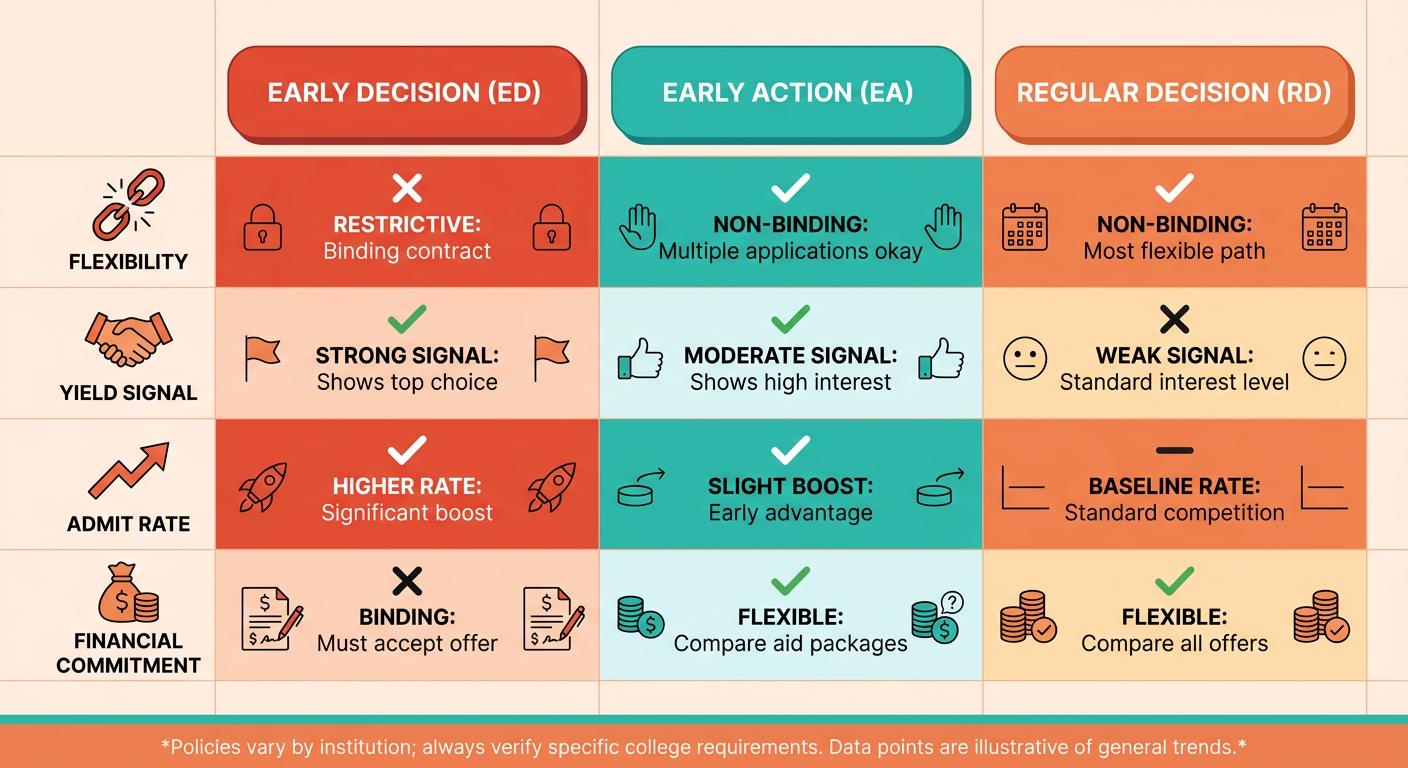
How Does ED Compare to Early Action and Regular Decision?
ED is binding, Early Action is not, and Regular Decision gives you the widest room to compare. The College Board's counselor guidance is blunt: ED locks you to one school and demands a nonrefundable deposit, while EA lets you apply early to multiple schools and decide later.
There's a fourth wrinkle: some schools offer Single-Choice or Restrictive Early Action, which bars you from applying early elsewhere without the binding commitment. Read each policy carefully, because the labels overlap but the obligations don't.
| Path | Binding? | Compare aid? | Admit-rate edge |
|---|---|---|---|
| Early Decision | Yes | No | Highest |
| Early Action | No | Yes | Modest |
| Regular Decision | No | Yes | Baseline |
If you can name one school you'd attend without hesitation and without needing to compare financial packages, ED is highly effective. For everything else, starting with Early Action preserves your options.
Is the ED Admit-Rate Edge Worth the Trade?
Weigh the statistical advantage against the loss of negotiating power. The gap in acceptance rates is significant, as College Transitions data shows. But applying through non-binding Early Action lets you get early decisions while keeping your options open.
That preserved choice matters, because research on the ED process suggests the binding round can limit opportunities for families who need to negotiate financial aid. The higher rate only helps if the resulting package is one your family can comfortably accept without comparison.
What Common Mistake Trips Up the Comparison?
Don't ignore your own hesitation. If you find yourself struggling to sign the ED agreement, as discussed in IvyWise's early round analysis, treat that hesitation as data.
It usually means you aren't ready to foreclose other options. Choosing Early Action or Regular Decision lets you keep researching schools, visiting campuses, and refining your preferences, so your final choice rests on real reflection rather than an artificial deadline.
References
[1] What Applying Early Decision Taught Me - CollegiateParent - https://collegiateparent.com/high-school/what-applying-early-decision-taught-me/
[2] How Early Decision Works: A Guide to the Early Rounds - IvyWise - https://www.ivywise.com/blog/application-strategy-learn-how-early-decision-works/
[3] Early Decision and Early Action - College Board Counselor Resources - https://counselors.collegeboard.org/college-application/early-decision-action
[4] Early Decision Acceptance Rates For Class of 2030 - Crimson Education - https://www.crimsoneducation.org/us/blog/early-decision-acceptance-rates
[5] How to Decide Whether to Apply Early Action (EA) or Early Decision (ED) - https://www.collegeessayguy.com/blog/early-action-early-decision-colleges
[6] Early Action and Early Decision vs. Regular Decision Admission Rates - https://www.collegetransitions.com/dataverse/early-vs-regular-decision-admission-rates/
[7] Early Action vs. Early Decision vs. Regular Decision: Full Guide - https://collegewise.com/blog/early-action-early-decision-regular-decision-full-guide
[8] Opinion | Should Colleges End Early Decision? - The New York Times - https://www.nytimes.com/2025/12/26/opinion/colleges-early-decision-fairness.html
[9] [PDF] The Impact of The Early Decision Process on College Admission ... - https://terra-docs.s3.us-east-2.amazonaws.com/IJHSR/Articles/volume6-issue5/IJHSR_2024_65_67.pdf
[10] The negative consequences of achievement culture for students ... - https://www.researchgate.net/publication/292970617_Extreme_pressure_The_negative_consequences_of_achievement_culture_for_students_during_the_elite_admissions_process
Frequently Asked Questions
1. Can you back out of an Early Decision agreement if you change your mind?
Early Decision is a binding commitment, so backing out is only defensible for genuine financial reasons. If accepted, you must withdraw all other applications and send a nonrefundable deposit before May 1. Non-financial regret does not release you, which is why certainty about the school matters before you sign.
2. What happens if I'm deferred from ED I instead of accepted or rejected?
A deferral moves your application into the Regular Decision pool for reconsideration, and it also frees you to pivot toward ED II elsewhere. ED II runs on a January deadline with February results, giving deferred students a second binding early option at a different first-choice school.
3. Is Early Action the same as Early Decision for boosting my odds?
Early Action is nonbinding, letting you apply early to several schools and compare offers later, while Early Decision locks you into one school. Early Action carries less commitment but typically doesn't deliver the same admit-rate boost, since colleges reward the yield certainty only binding ED guarantees.
4. Does applying ED make sense if I need to compare financial aid packages?
No. If comparing financial aid packages is necessary for your family, you should avoid Early Decision. Because ED is binding, you must accept the financial aid package offered by the school without knowing what other institutions would have provided. Applying through Early Action or Regular Decision allows you to compare multiple financial aid awards side by side before making a final commitment.
5. If ED acceptance rates are 2-3x higher, does that mean I'm more qualified?
The higher rate partly reflects supply and demand, not superior merit. Colleges prize the enrollment certainty a binding commitment guarantees and price that into the odds. You're rewarded for solving their yield problem, not for being two to three times more qualified than April's Regular Decision applicants.
6. How early should I start preparing an ED application?
Begin months before regular applicants start. ED files are usually due November 1 for ED I, so essays, recommendations, and testing must be finished well ahead. Starting early also protects you if your first choice falls through, since ED II offers a January deadline for a second attempt.
7. How do I protect myself emotionally if my ED application is rejected?
Build a full slate of completed applications before submitting ED, and treat the "dream school" idea as flexible rather than fixed. Refusing to tie your self-worth to one verdict matters most, since students consistently find that fit is something you build at many campuses, not one.