Why Ivy Admissions Committees Read Applications Backwards (and How to Structure Yours)
August 26, 2026

Key Takeaways
- Ivy admissions officers read applications backwards, hitting your activities and awards before they ever reach your name or personal essay.
- Princeton drew 39,644 applications at a 4.5% acceptance rate, Harvard 56,937 at 3.5%, and Stanford 51,733 at 4.1%.
- Most top-35 schools admit in the 15-20% range, far kinder than the roughly 1-in-20 odds at the Ivies.
- A first read runs about 15 minutes, and it lands on activities and awards first, not the personal statement.
- Dr. Michele Hernandez, a former Dartmouth officer, puts total review time at 45 minutes or less.
- The backward read front-loads hard credentials, so a rushed reader meets your strongest signal first.
- Your "no-brainer" hook belongs at the bottom of the page, where an officer's eyes land first.
Why the Backward Read Should Change Your Whole Strategy
Ivy officers read your file backwards. Activities and awards first, then your name, then your essay. That fact should reshape how you think about getting into a top school. Your strongest credential belongs at the bottom of the page, not buried in a narrative arc you hope they read top to bottom.
The volume forces it. When tens of thousands of qualified files hit a single office, a straight top-to-bottom read isn't practical. This four-step breakdown of how colleges read applications lays out a process built to filter fast. Once acceptance rates fall into the single digits, the order in which an officer works through your file stops being trivia and becomes strategy.
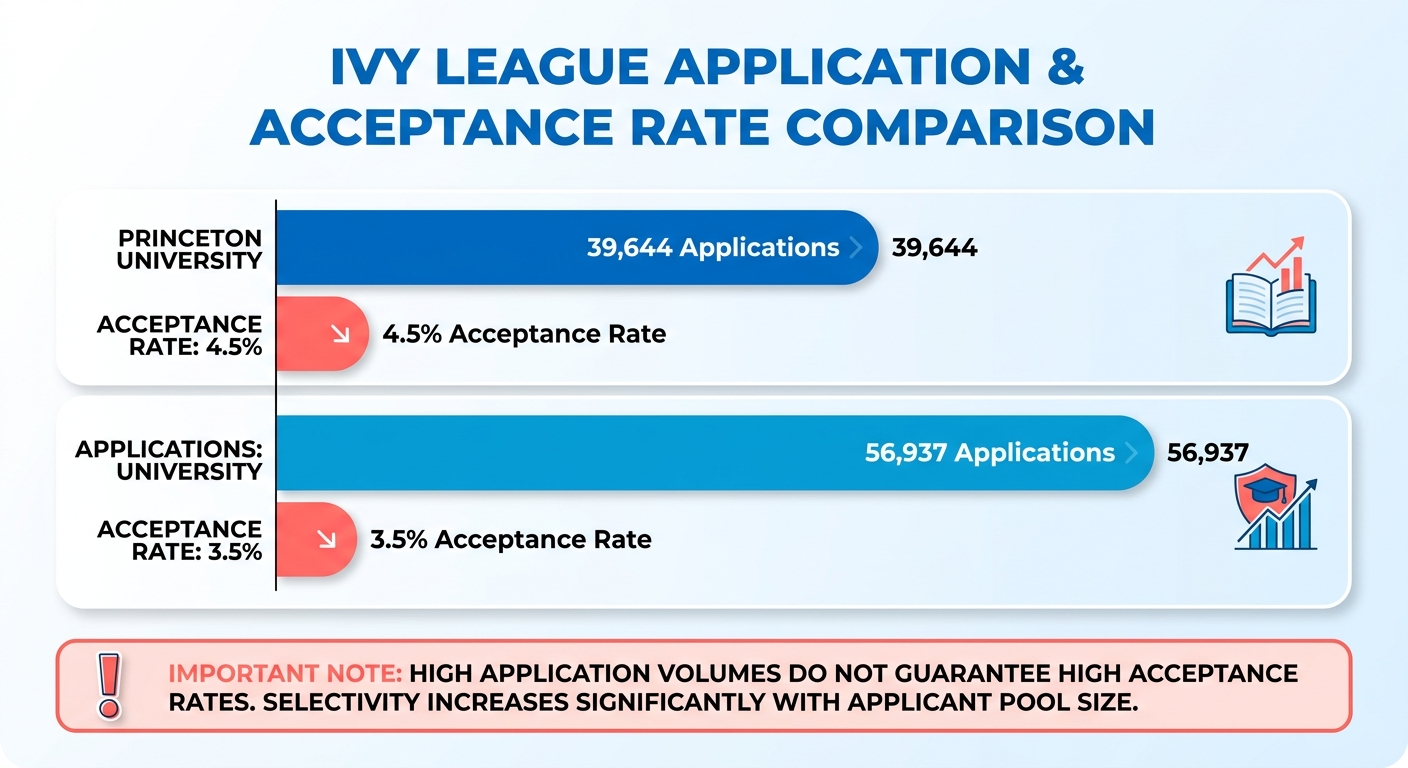
Why the order flips your approach
Starting with the activities list lets a reader gauge your achievements before your self-narrative can color the picture. That first scan, described in a former Dartmouth officer's account, means your most objective, high-impact wins have to stand out immediately. If a reader has to wait until the essay to figure out what you did, the lukewarm impression may already be set.
Dr. Michele Hernandez, a former Dartmouth admissions officer, said it plainly:
"Your stage-time is 45 minutes or less, so you must be a no-brainer ADMIT with grades and test scores, compelling in your writing and high impact in your activities." - Dr. Michele Hernandez
Pair that rushed timeline with the "well-rounded specialist" preference IvyWise describes, and the takeaway is hard to miss. Your specialist signal has to be clear in the activities list itself. Don't count on the essay to connect the dots. The list gets read first, so your primary area has to be unmistakable from the start.
Who this actually helps
High-achievers with real extracurricular depth win the most here, because a signature achievement anchors the whole file. Applications move from first reader to second reader to committee. A strong opening credential does double duty: it wins the first impression, and it gives later readers a defensible reason to fight for you in committee.
The second and third reads exist to correct the subjectivity of a rushed first pass. That's your opening. A clear anchor near the end of the file gives each later reader an argument they can repeat.
But skip the backward-read obsession if your file is thin. No amount of clever ordering fixes weak grades or shallow activities. Grades are still the single most important factor, IvyWise confirms. Structure amplifies substance. It can't manufacture it.
The contradiction worth knowing
Sources disagree on early rounds. One Ivy office account says early decision allows more thorough reviews, with 45-50% of a class filled that way. Another reading-process guide stresses how rushed that first file review is.
Both are true. "Thorough" means fewer files per officer in early rounds, not more minutes per file. So apply early if your credentials peak by fall, and put your best work where the backward reader finds it first. This is exactly the kind of sequencing our team pressure-tests with students during the application phase, when we work as a panel to help you show your best across the application, essays, and interviews.
How Committee-Based Evaluation (CBE) Actually Works
Committee-Based Evaluation is a group review model. Several admissions officers read and discuss the same file together instead of one officer deciding alone. It's the core mechanism behind how Ivy decisions get made. Instead of a single-reader verdict, the norm at large public universities, you get a shared, argued-over rating.
The pipeline is built to reach consensus. Your file moves through several stages of evaluation before the full group makes a final call, as this account of an Ivy admissions office lays out. Compare that to a public flagship, where every UCLA application gets two reads before a decision but without the same committee debate over how the class fits together.
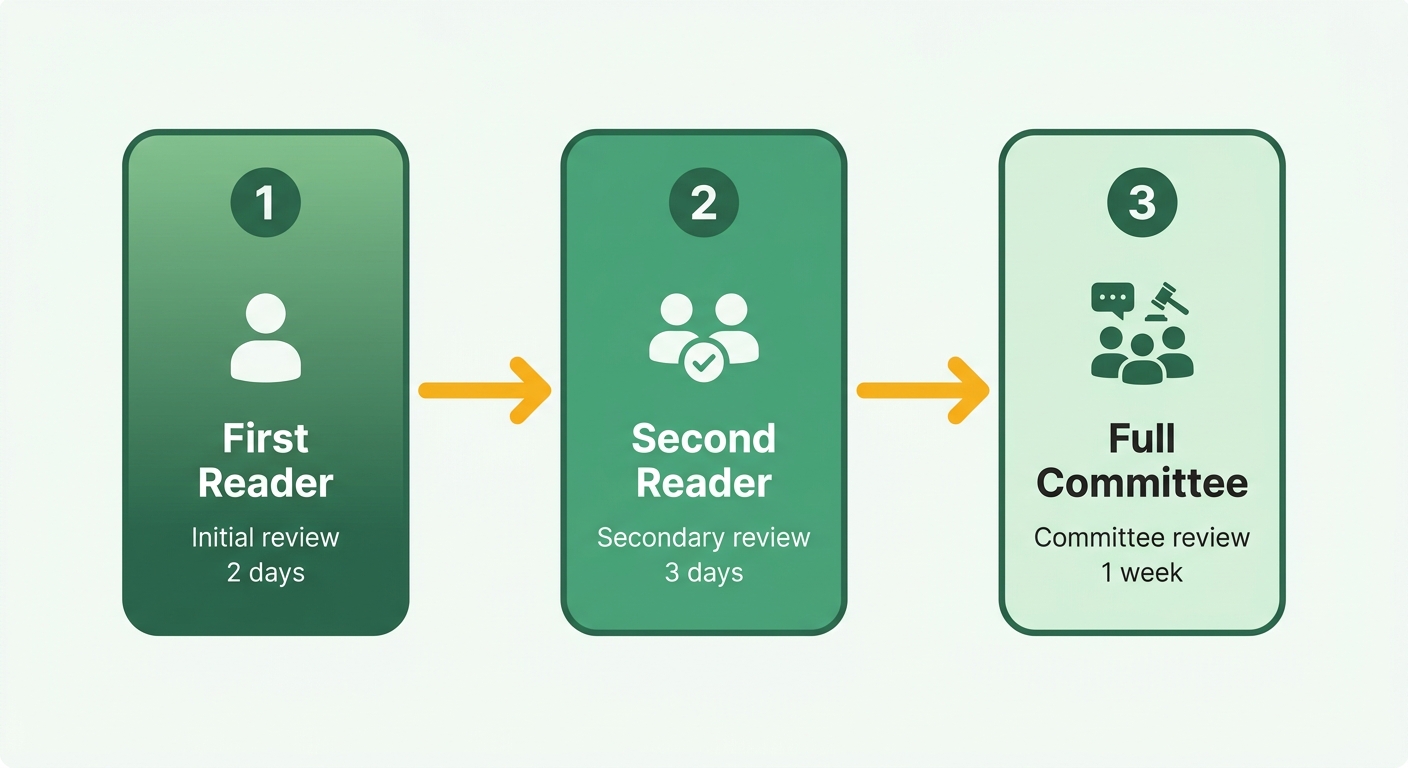
What sets CBE apart from single-officer reads
In CBE, no one advocates for your file unless a reader chooses to. That advocacy comes from a file-lead who presents your case to the room. A specialist may weigh in on academics, and the committee weighs your file against the class it's trying to build.
That class-building math matters more than most applicants realize. A typical Ivy class runs 17-20% recruited athletes, 8-12% minority students, and 10-15% legacies, per the behind-the-scenes breakdown. Your file competes for the seats that are left, and the committee reads it with those buckets already in mind.
Why the first read sets the tone
Because that initial review is so fast, the impression formed in the first few minutes anchors every conversation that follows. The same rapid pattern shows up at Duke, where the first reader spends roughly 15 minutes forming a judgment on GPA and scores.
That pace is exactly why the later reads carry so much weight. Early-decision rounds ease the congestion a little, but the constraint holds: the first reader's notes shape how the file gets presented to the rest of the committee. A well-structured file makes sure those notes point at your strengths.
The timing matters for strategy. ED filled 43% of Dartmouth's Class of 2019, so applying early buys you a reader with more bandwidth, not a longer clock.
How to structure your file for a committee
Organize it so your primary area of expertise is obvious in the activities and awards sections. When the committee reviews your credentials, they should spot your core contribution before they ever open your personal statement.
The bar to earn committee advocacy is high. Your academic profile has to clear the initial threshold on its own, leaving the group to focus on your impact and your narrative during the discussion.
A clear, defining achievement is a gift to your advocate in the room. It gives the file-lead a concrete, memorable point to champion during the debate. To help build that clarity, our team simulates the collaborative read by evaluating your materials from several angles at once. For more on building that escalating story, see our admissions planning blog.
Build Your Application to Lead the Backward Read
When the read starts with your activities list, the priority is simple: position your most significant achievements for immediate impact. Designing around this pattern means putting your most compelling work where it lands first, instead of trusting a traditional chronological build to get you there.
Placement matters because that first pass through your academic and extracurricular profile happens fast, as the four-step breakdown details. Pair that with the institutional preference for focused expertise over broad, shallow participation, as IvyWise describes, and your primary area has to be apparent at a glance. A smart layout keeps your best credentials from getting lost in a quick scan.
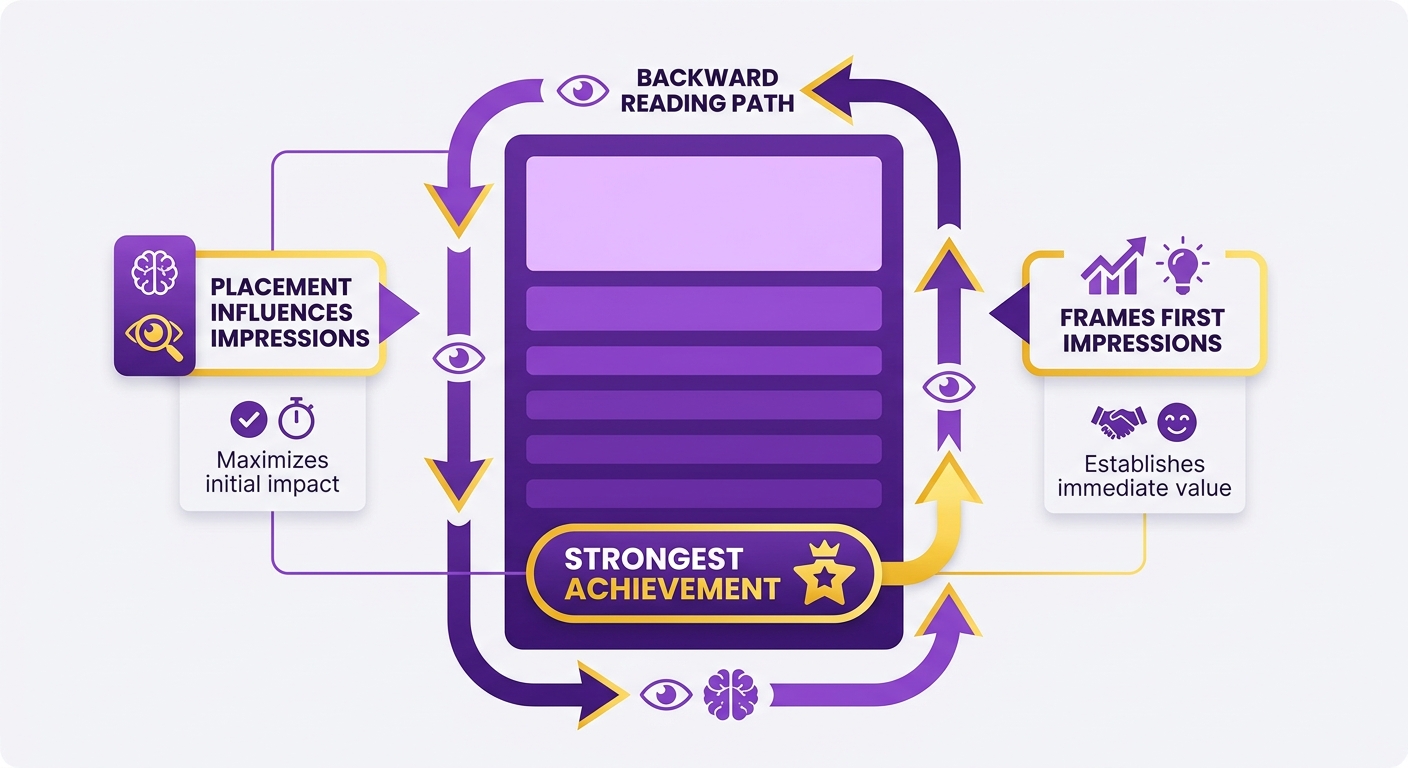
How to order your activities list
Put your most distinctive, impact-driven experience last, so it lands closest to the officer's entry point into your file. Reverse the instinct to lead with your longest-running activity. Point readers toward a finish, not away from it.
We coach students to rank each entry by two things: measurable impact and distinctiveness. The activity with the clearest outcome goes at the bottom. A student aiming at engineering might close with a science-fair result or a research role rather than a generic club membership, the defined-interest approach officers reward.
Use bolding on the leadership title or the outcome number so the eye catches it during a fast scan. Guide the read. Don't make them hunt.
How to handle the essay and word counts
Open your essay with a hook that nods to what the officer just read, then build toward a final paragraph that ties back to your signature activity. The essay should feel like the payoff of the file, not a detour. Since the later reads exist to correct a subjective first pass, a strong closing anchor gives a second reader something concrete to defend in committee.
Keep early supplemental sections tight, around 150 to 200 words each. That preserves space and attention for the signature story at the bottom. Officers reportedly spend close to 45% of their review time on the last two pages, so every word there earns more.
One caution. Don't write your essay about your single biggest activity if it already dominates your list. IvyWise notes a rock-climbing standout should write about a different facet of their life to round out the picture.
Finding your keystone achievement
Our planning work helps students figure out which single achievement carries the most weight, then position it at the file's high-visibility end. We pressure-test that sequencing and refine the story from multiple perspectives. A humanities applicant, for instance, might place a self-published history journal or a regional debate championship at the very end of the list to leave a lasting impression.
Most files fail here not from weak content but from weak sequencing. Skip this rework only if your list has no standout to promote. If you have one, move it. To see how this fits into your multi-year timeline, explore our admissions planning blog.
Recommendation Letters and Interviews: Feeding the Backward Flow
Recommendation letters and interviews are the two parts of your file you don't write yourself. That makes them the hardest to control and the easiest to waste. To fit a backward-reading process, treat both as reinforcement for the story you're already telling, not separate performances. They should echo the bottom of your file, not introduce a new theme.
The pipeline reality: the process leans heavily on external validation early in the sequence, as this account of an Ivy admissions office lays out. Recommenders often get evaluated before the essay is fully analyzed. So a teacher's language can prime the officer to look for your signature theme before they ever reach it in your own words.
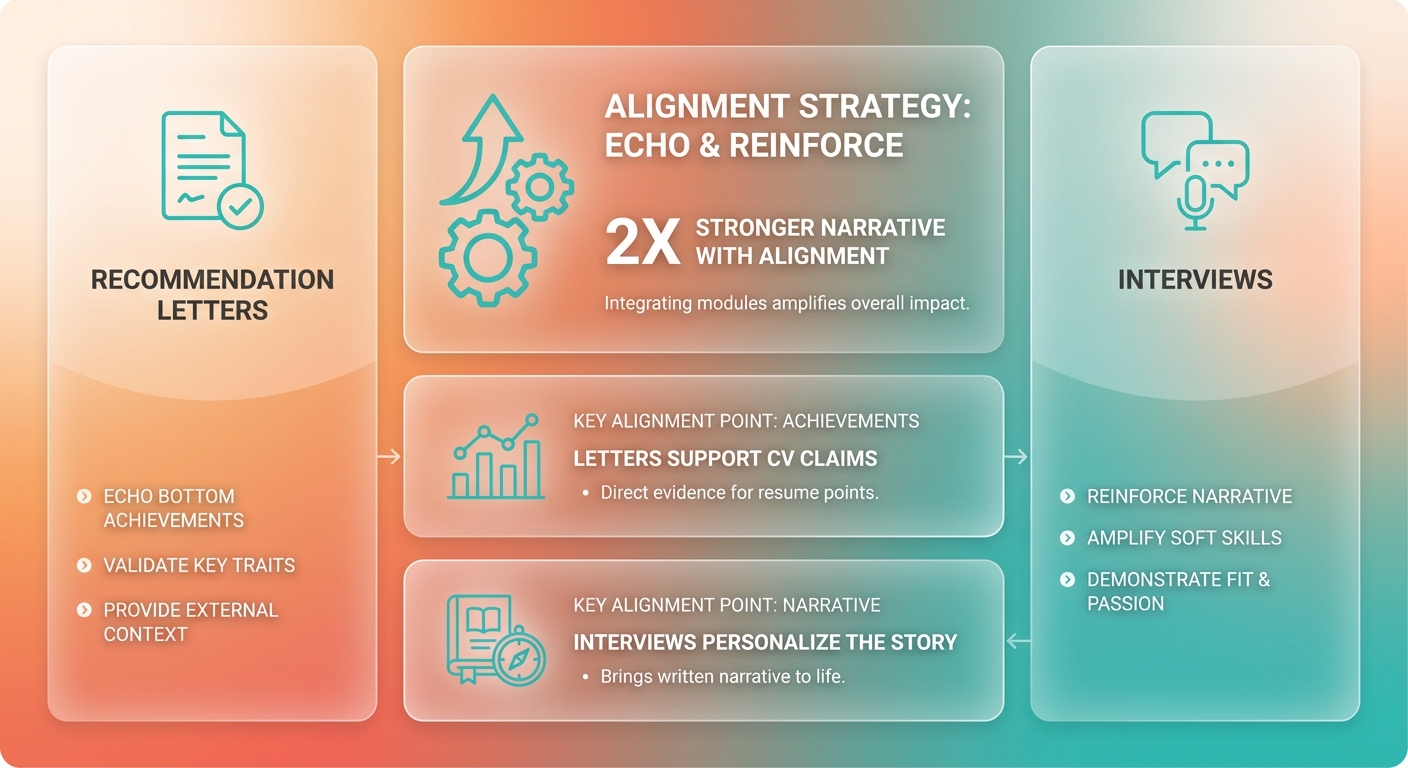
How recommenders can set up your signature narrative
Give your recommenders a signature theme sheet. It's a one-page brief that names your keystone achievement and the two or three specific words you want their letters to reinforce. The goal is simple: their vocabulary should rhyme with your final pages.
Committees look for deep, focused expertise, not a scattered list of hobbies, as IvyWise explains. Your recommender's job is to confirm that specific signal with a concrete story, not to list a dozen unrelated strengths.
A prompt we hand students to give their teachers reads like this: "When you describe my work in your class, could you anchor it to my research on [specific project] and use one specific moment where you saw me push past a setback? That's the through-line the rest of my application builds toward." That directs the letter without scripting it.
When Ivy interviews happen, and how to use them
Most Ivy interviews happen after the file review has already begun, so the interview is your chance to echo the bottom-page story, not tell it fresh. The officer or alum already has an impression. Your job is to confirm the anchor, not muddy it with a new angle.
A consistent signature theme across your letters, essay, and interview gives committee members a single, unified idea to advocate for. And keep in mind: most alumni interviewers submit a short written report scored on a simple scale, often just a few sentences. A single memorable theme carries far more than a laundry list they'll never fully capture on paper.
Rehearse answers that reference the exact language from your final essay paragraph. If your closing line frames your work as "translating field data into policy," say a version of that phrase in the interview. Repetition across formats is what makes a theme stick.
Where Endurable Education fits
Our interview coaching maps every talking point back to the concluding theme of your file. We run mock interviews where students practice pulling their answers toward the signature activity, so the alum's write-up reinforces what the officer already flagged. For more on managing your application timeline, visit our admissions planning blog.
One caveat: skip the theme-sheet approach if your recommender barely knows you. A forced, over-coached letter reads worse than an honest, specific one from a teacher who saw your actual work.
References
[1] Behind the Scenes in an Ivy League Admissions Office - https://toptieradmissions.com/behind-scenes-ivy-league-admissions-office/
[2] How Colleges Read Your Application: A 4 Step Process - https://prepmaven.com/blog/applying/how-colleges-read-your-application-a-4-step-process/
[3] 3 Things Admissions Officers Look for in Students | IvyWise - https://www.ivywise.com/ivywise-knowledgebase/3-things-admissions-officers-look-for-in-students/
Frequently Asked Questions
1. Does the backwards read apply to all colleges or just Ivy League schools?
While strategic ordering is beneficial for any selective application, it is most critical at highly competitive institutions where acceptance rates are in the single digits. At schools with more forgiving admission rates, a standard chronological structure is less likely to disadvantage you, but a backwards-compatible layout still ensures your best achievements are noticed first.
2. What if I don't have a single standout achievement to place at the bottom?
If your extracurricular profile lacks a clear focal point, prioritize building depth before worrying about layout. No structural adjustment can compensate for a lack of sustained engagement or academic foundational strength. Focus on developing a clear area of expertise through your coursework and projects first.
3. Should I write my personal essay about my strongest activity?
It is usually best to avoid centering your essay on an activity that is already fully detailed in your list. Instead, use the essay to reveal a different dimension of your personality or intellectual curiosity that complements your primary achievements, ensuring your application feels multi-dimensional rather than repetitive.
4. How is Committee-Based Evaluation different from a public university review?
Unlike large public universities that often rely on independent, standardized point systems to process high volumes of applications, CBE involves a collaborative group discussion. In this model, admissions officers must actively debate and build consensus around which candidates best fit the specific institutional needs of the incoming class.
5. Does applying early decision give officers more time on my application?
Applying early does not increase the minutes spent on your individual file, but it does mean officers are reviewing applications before fatigue sets in from the regular decision rush. This early timeline offers a less congested review environment, making it easier for a well-structured file to capture and hold a reader's attention.
6. How should I brief my recommenders to support my file?
Provide your recommenders with a brief summary of your academic goals and key projects. This helps them write letters that naturally align with the core themes of your application. However, avoid over-scripting their input; a genuine, personal recommendation from a teacher who knows your work is always more effective than a highly managed one.
7. How long do admissions officers actually spend reviewing my whole application?
The entire multi-stage review process is highly consolidated, with the initial scan occurring in just a few minutes. Because readers allocate a significant portion of their attention to the activities and credentials sections, structuring your file to highlight your most impactful achievements immediately is essential for making a lasting impression.