Why Students Say “College Humbled Me”: 5 Better-Fit Lessons for Your College List
October 28, 2026

Quick Summary
Every fall, "college humbled me" trends as students realize their reach school was out of reach—or worse, that their safety school is where they actually belong. Usually that happens because they built lists around prestige instead of asking harder questions about fit.
A balanced list forces that honest assessment before you hit submit. Most students do well with 8–12 schools, but the distribution matters more than the count.
Understanding reach, match, and safety categories
Lesson 1: Define the categories honestly. Reach schools are where admission is unlikely but possible. Your academic profile sits below the typical admitted student, or the acceptance rate is single-digit brutal. Very selective schools stay reaches for nearly everyone, even if your stats are perfect.
Match schools are where you're competitive based on your profile. Your stats align with admitted students. Nothing's guaranteed, but you're in the right ballpark.
Safety schools are where admission is highly likely and the net price after aid is workable. Your stats exceed the typical admit. A safety only works if you'd actually enroll and you've verified affordability—not if you're treating it as insurance you'll never use.
Quick Summary Table: College List Balance
| Category | Admission Likelihood | Your Academic Fit | Recommended Number | Reality Check |
|---|---|---|---|---|
| Reach | Unlikely but possible | Below typical admitted student profile | 2–3 schools | Highly selective schools reject most qualified applicants |
| Match | Likely to be competitive | Aligns with typical admitted student profile | 4–5 schools | Realistic odds, but outcomes vary by major and aid |
| Safety | Highly likely | Exceeds typical admitted student profile | 2–3 schools | Must be schools you'd actually choose to attend and verified as affordable |
Research shows that students who undermatch—by enrolling somewhere they're dramatically overqualified—face measurably worse career outcomes and earnings than matched peers. But applying to 15 schools with no genuine interest spreads your essay quality thin and burns application fees.
Balance means every school serves a purpose. The humbling moment should arrive during list construction, not after rejection letters or freshman fall. When reach schools reject you and matches feel financially out of reach, the list wasn't grounded in reality from the start.
What You Need to Know
- Research suggests many CEOs at America's top 100 companies attended non-Ivy League schools, which challenges prestige-driven admission strategies.
- A safety school must be both likely to admit you and affordable after aid; an admit you can't afford is not a safety.
- A balanced college list typically includes 8–12 schools split among 2–3 reach, 4–5 match, and 2–3 safety options.
- U.S. News rankings weight subjective peer-assessment surveys heavily rather than measuring actual student outcomes.
Why the "college humbled me" moment happens
Lesson 2: Treat the "college humbled me" moment as a list-construction warning. When it trends each fall, it reflects a student realizing that their freshman-year reach school was further out of reach than they thought. That realization is useful. It's also late. The shock usually began with list-building choices made months earlier, when prestige drove decisions and self-assessment took a back seat.
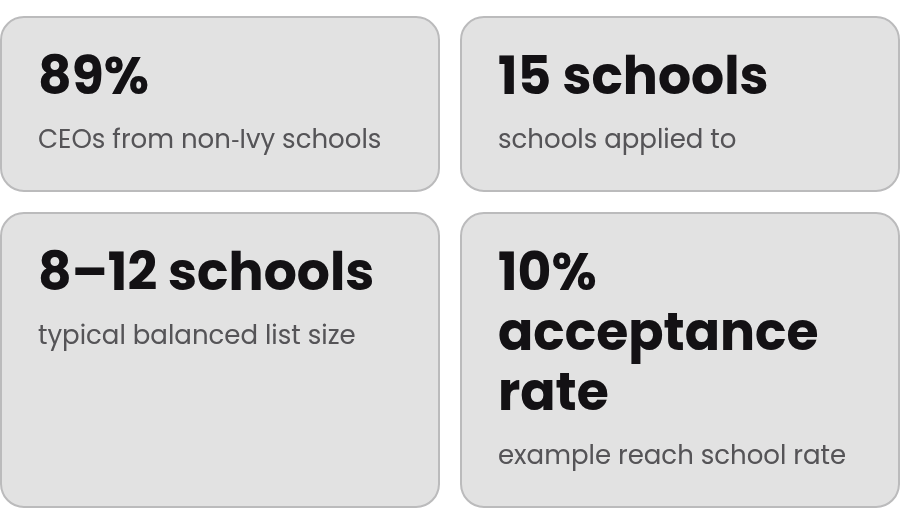
We see this pattern repeatedly: families anchor their lists around brand-name schools without questioning whether those brands actually predict success. Eighty-nine percent of CEOs at the top 100 U.S. companies attended non-Ivy League schools. The Ivy credential is neither necessary nor sufficient for reaching the top of your field. Major employers like Google have shifted away from prestige-based hiring toward demonstrated skills and relevant experience.
Rankings measure reputation, not fit
The U.S. News methodology reveals why treating rankings as gospel is a mistake. A peer-assessment survey is a major part of their formula, where college administrators rate other schools based on perceived academic reputation. That's subjective opinion, not outcome data. It doesn't tell you whether you'll thrive in the environment, connect with professors, or graduate on time.
Rankings function as one input among many when building a list. They're not worthless—selectivity and resources do matter—but they can't replace the work of matching academic programs, campus culture, and financial reality to your actual priorities.
Over-indexing on ultra-selective reaches where acceptance rates have declined across higher education burns application energy with minimal return.
The goal is finding schools in the middle tier: places that challenge you without being statistical long shots, where your profile matches the enrolled student body, and where you'd genuinely enroll if admitted. That's the fit-over-brand framework in practice. Build your list around those schools, and the difficult realization becomes proactive self-awareness instead of reactive disappointment.
Align academic goals with realistic expectations
The "college humbled me" lesson arrives at one of two moments: during list construction, when honest self-assessment forces you to rethink your reach schools, or during freshman fall, when you realize you aimed too low or too high. The first timing prevents disappointment. The second creates it.
Lesson 3: Build the list from your data, not from branding. Start by comparing your academic profile to each school's middle-50% range—the 25th to 75th percentile of admitted students' GPAs and test scores. If your stats land at or above the 75th percentile and the acceptance rate exceeds 70%, that school is usually a safety. Stats between the 25th and 75th percentiles, with acceptance rates around 40–70%, usually make it a match. Below the 25th percentile or with acceptance rates under 25%? That's often a reach.
Here's where most families go wrong: they compare to the wrong data. A university's overall admit rate tells you little if you're applying to a capacity-limited program like engineering or nursing. Competitive majors often maintain separate application processes with substantially different admission standards than the university's published rate. Business programs frequently require a separate application with higher standards. The job isn't finding a magic cutoff—it's documenting what admission unit you're actually applying to and what remains uncertain.
A balanced list usually includes 8–12 applications split roughly as 2–3 safeties, 4–5 matches, and 2–3 reaches. That distribution matters more than the total count. The rule: every school on the list must be somewhere you would genuinely attend if accepted and afford after aid. A safety you'd never choose is a placeholder, not a safety.
Lesson 4: Treat financial safety as probable admission plus verified affordability. Start with a school's published aid policies and a realistic net price after aid. If a match school's net price leaves a gap your family cannot cover, it cannot function as a true match on your list. That doesn't make it an admissions reach—it makes it unaffordable. Students who live near colleges or need to control costs may have fewer realistic choices, even when their academic record is strong. A geographically convenient option can be valuable, but it should still offer credible academic and career support rather than serving as an automatic fallback. The same logic applies to program-level admission rates: a university's overall admit rate may hide a far more selective major. The humbling happens when you realize a school with a 10% acceptance rate is a reach for everyone, regardless of your stats. High-achieving students who need to control costs may need a different mix: fewer sub-10% reaches, more likely schools with strong aid and program fit. Students who undermatch may leave better-matched opportunities unexplored. Accept that reality during list construction rather than after rejection letters arrive.
What to do after a humbling admission result
Lesson 5: Treat a difficult result as useful signal, not a verdict on your worth. Whether it's an early decision rejection or a March notification that stings, you have a decision point. You can spiral, or you can revise the list around what it actually needed. Revising your list isn't about lowering your sights. It's about sharpening your criteria.
Start by revisiting what you actually want from the next four years: program depth in your major, campus culture that fits your learning style, class sizes that let you engage with faculty, and career outcomes that connect to your goals. A rejection may reveal that the school was evaluating priorities differently from the way you were.
A structured re-evaluation puts fit ahead of brand recognition. Pull out the schools you applied to and score each one on factors you can verify: retention rates in your intended major, alumni networks in your target industry, campus visit impressions if you have them, and cost after aid. If a school's only appeal was its name, drop it. If a school you wrote off as a safety actually delivers strong outcomes in your field, move it up.
Steps for reshaping your list mid-cycle:
- Identify three non-negotiable program or campus features based on what you now know about yourself.
- Research graduation and job-placement rates for your major at each school, not overall institutional rankings.
- Re-score each school on a simple 1–5 fit scale across academics, culture, cost, and career support.
- Replace any reach school that was purely prestige-driven with a reach that offers a specific program advantage.
- Confirm you have at least two schools where your stats sit at or above the 75th percentile, you'd genuinely enroll, and the net price after aid is workable.
Rejection clarifies priorities faster than any workshop. Use it.
References
[1] How to Find Your Best Fit College - The Princeton Review - https://www.princetonreview.com/college-advice/find-your-best-fit-college
[2] Tools for Success: Finding Your Best-Fit College - YouTube - https://www.youtube.com/watch?v=ANLD5CEGwIM
[3] Great Private Colleges for the Underachiever - CollegeXpress - https://www.collegexpress.com/lists/list/great-private-colleges-for-the-underachiever/688/
[4] Finding The Best Fit College - Raise Me Community - https://www.raise.me/blog/finding-the-best-fit-college/
[5] Find Your Fit - BigFuture - College Board - https://bigfuture.collegeboard.org/plan-for-college/find-your-fit
[6] What Are Likely, Target, and Reach Colleges? | Sara Harberson - https://www.facebook.com/saraharberson/videos/what-are-likely-target-and-reach-colleges-collegeadmissions-collegelist-applying/1170809270552488/
[7] How to Make a College List with Safety, Match, and Reach Schools - https://www.appily.com/guidance/articles/finding-your-college/what-are-safety-reach-and-match-schools
[8] How to Build a College List: A Step-By-Step Guide - https://www.collegeessayguy.com/blog/how-to-choose-a-college
[9] How to Build Your College List: Reach, Match, and Safety Schools ... - https://www.stjohns.edu/news-media/johnnies-blog/how-build-your-college-list-safety-match-and-reach-schools-explained
[10] How to Build a Balanced College List: Safety, Match & Reach - https://www.pathfindersadvisors.com/how-to-build-a-balanced-college-list-safety-match-and-reach-schools-explained/
[11] Likely/Level/Reach: How to Create the Best College List for You - Scoir - https://www.scoir.com/blog/college-list-likely-level-reach
[12] Reach, Target, and Safety: Build a Balanced College List | Ivy Ready - https://ivyready.com/blog/reach-target-safety-college-list
[13] Safety, Target, & Reach Schools: How to Find the Right Ones - https://blog.collegevine.com/the-college-list-decoded-safeties-targets-and-reaches
[14] (PDF) College Match and Undermatch: Assessing Student Preferences ... - https://www.researchgate.net/publication/320995148_College_Match_and_Undermatch_Assessing_Student_Preferences_College_Proximity_and_Inequality_in_Post-College_Outcomes
Questions People Ask
How do I balance list categories when my match schools are financially out of reach?
Financial fit determines whether a school belongs on your list at all, not which category it occupies. If a match school's net price after aid exceeds what your family can afford, it doesn't become an admissions reach; it becomes unaffordable. Build that part of your list around schools where both academic profile and verified financial aid packages align with reality.
Should I apply to fewer reach schools if highly selective programs reject most qualified applicants?
A smaller reach group can make sense when each application requires substantial supplemental work. Use the remaining time to investigate programs, compare aid policies, and strengthen applications to colleges where your academic interests are a clear match. The point is not to eliminate ambition; it is to avoid letting unlikely outcomes dominate the entire process.
What specific signs indicate I'm undermatching rather than building a sensible safety tier?
Look for a pattern rather than one unusually comfortable option. If your academic record sits well above the published profile at nearly every college and you are avoiding schools with stronger opportunities solely because admission feels uncertain, the list may be too conservative. A genuine safety should still provide a setting, program, and cost you would accept.
Can a school move from safety to match mid-cycle if admission standards shift?
Admission standards rarely change dramatically within a single application cycle. Your classification can change, however, when better research reveals that your intended major has its own review process or that the published institutional figures do not describe your applicant pool. Recheck the relevant department before finalizing the list.