How College Admissions Consultants Decode Holistic Review by Selectivity Tier
October 26, 2026

It's fall of senior year. Your list has several schools that admit fewer than one applicant in twenty, your transcript is strong, and your scores are where they should be. So are the transcripts and scores of nearly everyone else applying. That's the moment most families start asking what "holistic review" actually means.
The Short Version
- Acceptance rates at ultra-selective colleges are extremely low. Nearly every applicant clears the academic bar, so narrative often decides outcomes.
- The U.S. independent admissions consulting market grew rapidly over the past decade.
- Colleges admitting fewer than 15% of applicants make up the highly selective tier, where factors beyond GPA and scores carry substantial weight.
- Readers may value a B in AP Calculus BC over an A in standard calculus. A job that helps support your family can carry as much weight as a club presidency.
What We'd Recommend Before You Build Your List
Holistic review means a college evaluates the whole applicant, not just test scores and GPA. That sounds simple. In practice, it varies a lot from one institution to the next, and that variation is what we plan around.
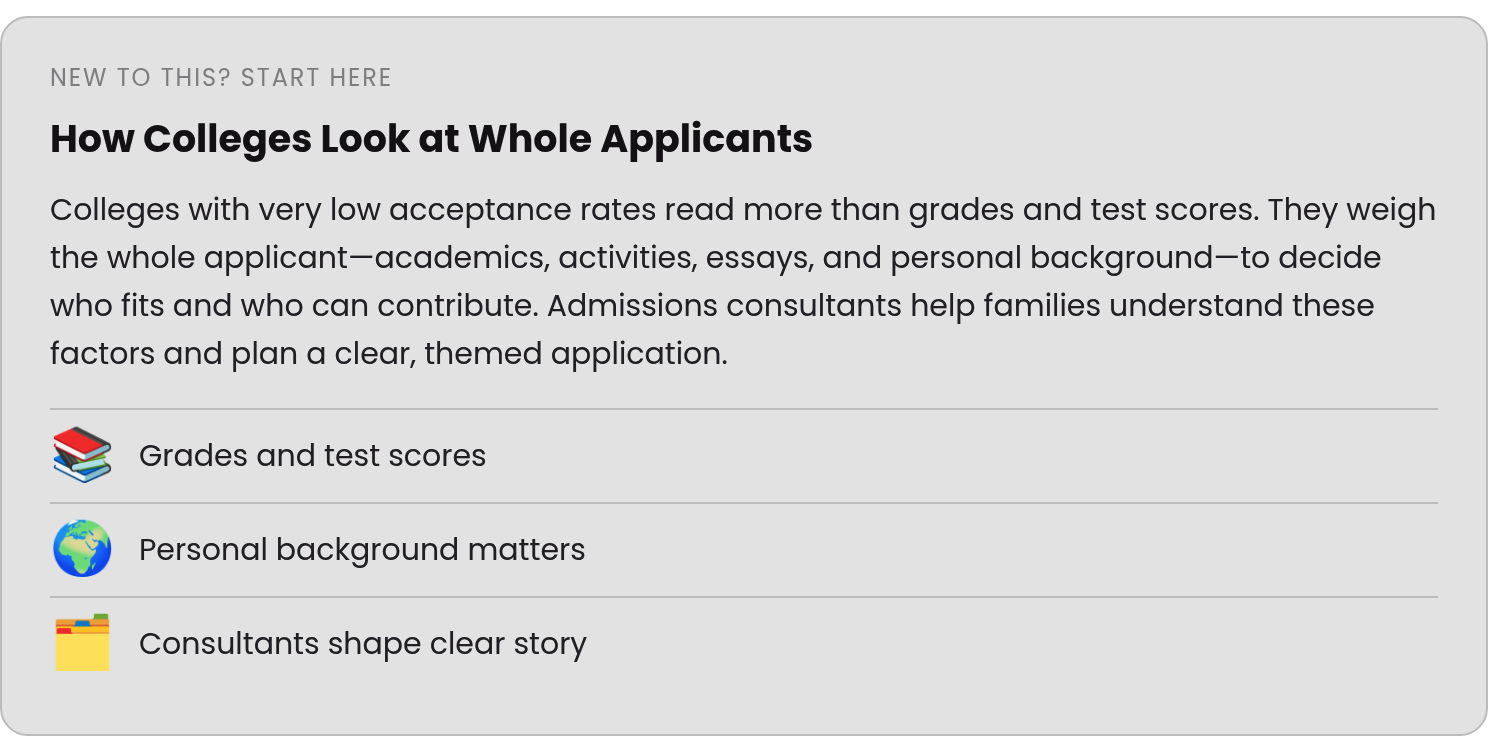
Our advice: stop thinking in fixed GPA cutoffs and start thinking in selectivity tiers. We anchor our work to documented selectivity benchmarks. Once a reader decides you're academically ready, holistic factors can meaningfully change how the rest of your file is read. Our team includes graduates of Harvard, Yale, and Princeton, and we've been guiding students through this process for more than 15 years.
What Changes From Tier to Tier
At reach schools (the colleges where admission is a long shot even for strong applicants), we look at how your story carries across activities, essays, and recommendations. Course rigor matters, but readers often look past the letter grade. They ask what courses your school offered, what you chose to attempt, and how your transcript fits that context. Real responsibility outside school can strengthen a file, but only if the application makes it clear to the reader.
At target and safety schools (where your numbers sit at or above the typical admit), academic metrics produce more predictable outcomes. Narrative still matters there. We help students stand apart from similarly qualified applicants by grouping activities around a few coherent themes. Then we write essays that extend those themes instead of introducing a new, unrelated accomplishment.
How We Put Context Into an Application
We review the activity list and resume before anyone drafts an essay. The goal is a clear throughline: what you've done, why it matters, and how it connects to where you're headed. That structure helps a reader understand your choices and your growth within the opportunities you actually had.
For seniors, we concentrate on the fall window. That means timeline planning, essay scheduling, activity-list review, interview prep, and supplement strategy (supplements are the school-specific essays many colleges add on top of the main personal statement), so nothing slips during a compressed deadline season. More than 50% of our students are admitted to top 10 and Ivy League schools, and almost all are admitted to Top 35 colleges. We read those numbers as a sign that structured preparation helps. They aren't a guarantee, and no honest firm should present them as one.
Why Two Strong Applicants Get Different Answers
Two seniors with similarly strong transcripts and test scores apply to the same highly selective college. One gets in. One doesn't. Most colleges describe their process as holistic review, meaning readers weigh the whole application. You might expect that to make outcomes predictable. It often doesn't.
Families rarely come to us confused about what holistic review claims to be. They come because they don't know what it means at each selectivity tier. At the most selective universities, admissions officers have said publicly that they could fill their classes several times over with academically qualified applicants. Top grades and scores get you read seriously. They don't get you in.
Holistic Review Means Different Things to Different Readers
Researchers have openly asked what we are talking about when we talk about holistic review. In practice, the term can mean reading every document in the file. It can mean judging character and likely contribution. It can mean weighing the circumstances a student grew up in. Which emphasis a reader brings can shape how the same application lands.
That inconsistency is a big part of why the consulting market has grown. Many selective schools put more than one reader on each file and then discuss borderline cases in committee. Your application has to hold up under several sets of priorities at once. Families aren't really paying for essay edits. They're paying to understand how selective committees read, and to present their student accordingly.
So we don't hand anyone a fixed checklist. We start with an initial consultation and build a plan around your strengths and goals.
Context Can Shift Outcomes, Depending on the Reader
Researchers have studied what happens when admissions officers get contextual information about an applicant's high school and neighborhood. The useful takeaway for families: context can matter, but how much tends to depend on how a given reader approaches the file.
Here's where it gets practical. A demanding course load taken at a less-resourced school may be read differently from the same grade pattern at a school with extensive support. That's true only at colleges whose readers weigh context heavily, though. Without tier-specific insight, families often fall back on generic strategies that don't match how competitive committees actually decide.
That's also why we like starting early. As early as 8th grade, our life preparation phase encourages students to build experiences and skills that show up clearly on a resume and activity list. Context is much easier for a reader to see when the record already tells a coherent story.
How Readers Weigh a File at Each Tier
Take two juniors (an illustration, not a real case). One has spent several semesters of independent research chasing one narrow academic question. The other has broad campus involvement, with awards scattered across unrelated activities. Which file reads stronger depends heavily on how the reader defines "holistic."
We start with that definition because colleges don't share one. The College Board's guide describes holistic review as weighing multiple, often intersecting factors: academic, nonacademic, and contextual. Together, those factors reflect what an applicant has accomplished in light of their background. In practice, readers tend to use three lenses:
- Whole file: reading every component of the application.
- Whole person: judging character, motivation, and potential contribution.
- Whole context: measuring achievement against the opportunities a student actually had.
The same guide frames the review as two questions. Can this student succeed and thrive here? Can they add to their classmates' experience, in and out of the classroom? Your file can hinge on which lens its reader brings, and on how clearly you answer both questions.
Academics Anchor Every Tier; Context Shapes the Rest
Holistic review is a cornerstone of admissions at schools with very different selectivity. The College Board notes that each school's mission shapes it, so the balance of academic, nonacademic, and contextual factors shifts from campus to campus. Outcomes often feel unpredictable as a result, a point this explainer on holistic admissions makes well. We think both observations hold. When academic records don't separate applicants, the softer factors often end up deciding.
Context also changes how activities read. A long activity list can reflect access as much as initiative, and readers who weigh background tend to notice. For our second junior, we wouldn't suggest piling on more titles. We'd focus on building depth in a few areas so the list shows commitment rather than volume.
Essays Carry the Whole-Person Evidence
Your personal statement and supplements are where character and contribution show up in your own voice. We treat them as evidence of fit and of what you'd bring to campus, not as a formatting exercise. You'll see people sell tier-specific word counts or prompt formulas. The evidence doesn't support them, so we don't offer them.
The College Board stresses integrity in holistic review: rigor, consistency, and fairness, backed by multiple reviews and clear protocols. Our panel approach works in a similar spirit. Several advisors review each application and essay, so your story gets tested against more than one kind of reader before a college ever sees it. The practical lesson for you is simpler. Explain your circumstances clearly. A reader can't weigh context they never see.
How to Vet Any Admissions Consultant (Including Us)
You're on your third intro call this month, and every firm sounds the same. Each promises holistic insight, a dedicated team, and a strong record at the most selective schools. Slow down before you sign anything. How a consultant structures its team and pricing tells you more than any polished pitch.
Fees in this market run from hourly strategy sessions to ultra-premium, multi-year advisory packages. A higher price doesn't automatically buy tier-aware judgment. What you pay for should map to how review actually works at the specific schools on your list.
One Advisor or a Panel Is a Design Choice, Not Proof
One-to-one consulting gives you a single, consistent voice who knows your file deeply. Panel models put several readers on the same application, which can catch blind spots the way multiple admissions readers often do. No evidence shows that either design produces better admissions outcomes. That includes ours. Treat any firm's panel claim as something to verify, not something to accept on faith.
Ask these questions in every consultation:
- Tier logic: How does your advice change for a reach school compared with a likely or target school?
- Outcome data: Are results broken out by selectivity tier, drawn only from your own students, and explained with a clear method?
- Team structure: Who reads my essays, and how many people review the final file before submission?
- Pricing incentives: What does the fee cover, and does any part depend on where I'm admitted?
Hold our numbers to the same standard. If a firm answers the outcome question with a single headline multiplier and no methodology, walk away. And remember that even good answers to all four questions can't remove the uncertainty built into a 3.6% admit rate. The right consultant tends to make your application clearer and your list smarter. Nobody can promise a decision. For a longer checklist, see our guide on questions to ask before paying an admissions consultant.
References
[2] [PDF] Understanding Holistic Review in Higher Education Admissions - https://highered.collegeboard.org/media/pdf/understanding-holistic-review-he-admissions.pdf
[3] What is Holistic Admissions? Meaning, Process & How Colleges Decide - https://collegewise.com/blog/holistic-admissions-process
[4] What Do Colleges Really Mean by Holistic Review? - IvyWise - https://www.ivywise.com/blog/holistic-review/
[5] 'Rich Dad, Poor Lad': How do Large Language Models ... - https://arxiv.org/html/2509.16400v1
[6] Admitting Students in Context: Field Experiments on ... - https://www.researchgate.net/publication/360071080_Admitting_Students_in_Context_Field_Experiments_on_Information_Dashboards_in_College_Admissions
[7] What are We Talking About When We Talk About Holistic Review ... - https://www.researchgate.net/publication/324761859_What_are_We_Talking_About_When_We_Talk_About_Holistic_Review_Selective_College_Admissions_and_its_Effects_on_Low-SES_Students
[8] Holistic Admissions in Higher Education: Challenges and Promise - https://www.researchgate.net/publication/362162300_Holistic_Admissions_in_Higher_Education_Challenges_and_Promise
[9] A Study of the Use of Nonacademic Factors in Holistic Undergraduate ... - https://www.researchgate.net/publication/331745463_A_Study_of_the_Use_of_Nonacademic_Factors_in_Holistic_Undergraduate_Admissions_Reviews
[10] Michael N. Bastedo's research works | Concordia University Ann Arbor ... - https://www.researchgate.net/scientific-contributions/Michael-N-Bastedo-78973486
Frequently Asked Questions
1. Should I take a harder class if I might earn a lower grade in it?
A tougher course can help your application even when the grade dips slightly, but the tradeoff has to be reasonable. Many readers value rigor, especially when the choice shows intellectual ambition and fits the student's larger academic pattern. It shouldn't come at the cost of a transcript that falls apart.
2. Will a part-time job hurt me if I have fewer extracurricular activities?
A part-time job doesn't have to weaken your file. What matters is whether the application explains the commitment clearly: your hours, your responsibilities, and what the experience reveals about maturity, reliability, or family context. A short activity list built on real commitment often reads as depth, while a long list can sometimes reflect access more than initiative.
3. Is holistic review only relevant at the most selective colleges?
No. Holistic review appears across a wide range of colleges, but its influence changes by tier. At highly selective schools, the nonacademic and contextual parts of the file may become decisive once academic readiness is clear. At target and safety schools, grades and scores tend to make results more predictable, though a coherent theme can still distinguish you from similar applicants.
4. Does a panel of consultants guarantee better results than a single advisor?
No consulting structure guarantees better results. A single advisor gives you one consistent voice who knows your file well. A panel, like the approach we use at Endurable, gives the application more than one internal read before submission. Whichever you choose, ask how the advice changes by tier and how outcome data is calculated.