How to Build Your Admissions Story: List, Narrative, Essays, Then Supplements
October 15, 2026

TL;DR
- Admissions officers piece together who you are from the fragments you give them. Coherence across those fragments matters as much as the achievements themselves.
- Your activities list isn't a résumé. It's the opening scene of a story your essays will finish.
- Short activity descriptions reward specificity and verbs, not generic club titles.
- Build your application in sequence: activities list, then narrative arc, then personal statement, then supplements tailored to each school.
Quick Summary
You're facing multiple application portals, each one demanding its own version of your story. These include activity lists with character limits, a personal statement capped at 650 words, and school-specific supplements that vary in length and tone. The constraints feel arbitrary until you recognize what they actually do: they force you to make choices about what matters most, and those choices reveal more about you than any open-ended prompt ever could.
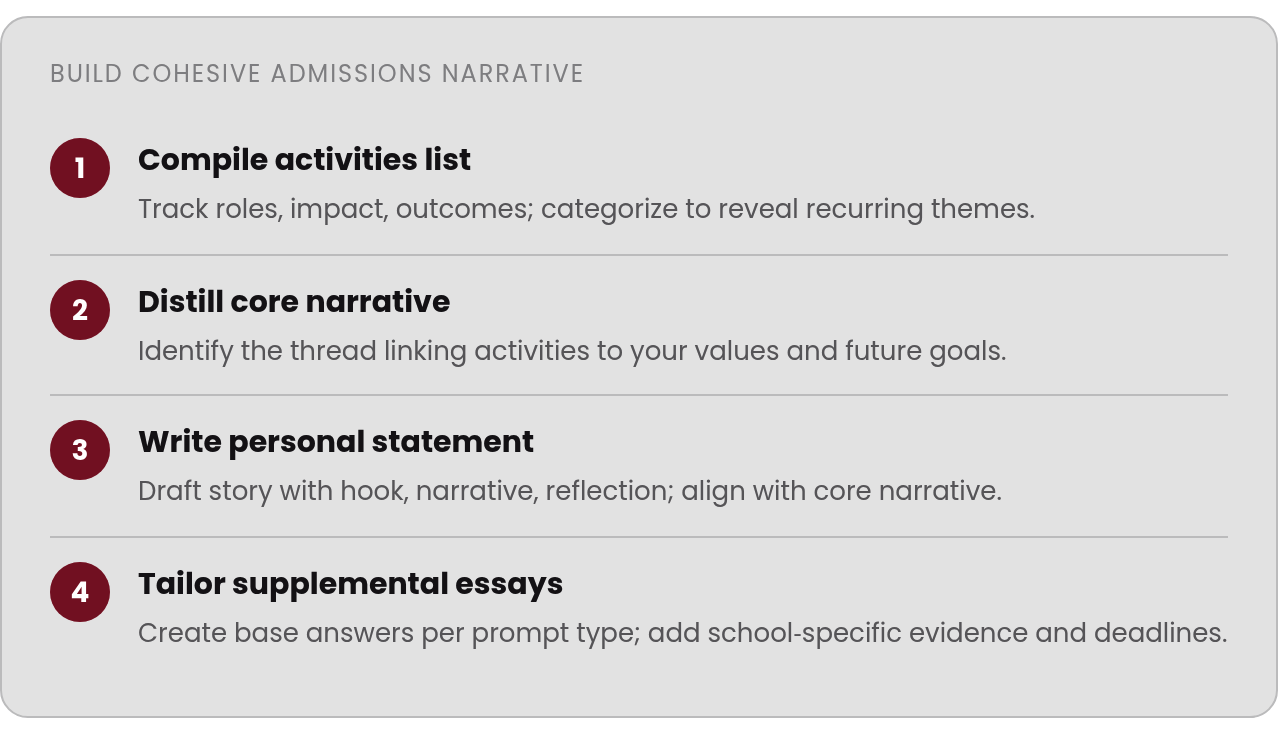
Most students treat each piece as its own isolated task, but that sequence misses the structure. Your application is a four-part workflow: start with the activities list to inventory what you've done, build a core narrative to decide which experiences carry the most weight, draft the personal statement to develop one thread in depth, then customize supplements to show each college why their campus is where that thread continues.
What the Application Constraints Actually Measure
Most platforms give you limited space to describe your activities, so you're forced to prioritize. If an activity feeds your soul, list it prominently, even if it wasn't your longest-running commitment. Short description fields create the second forced choice. Put "Member of Key Club" next to "recruited volunteers, served students, program adopted district-wide." The first is a label; the second uses the constrained field to show actions, scope, and results. Every character becomes a trade-off between generic credentials and differentiated impact, so spend each one where it moves the story forward.
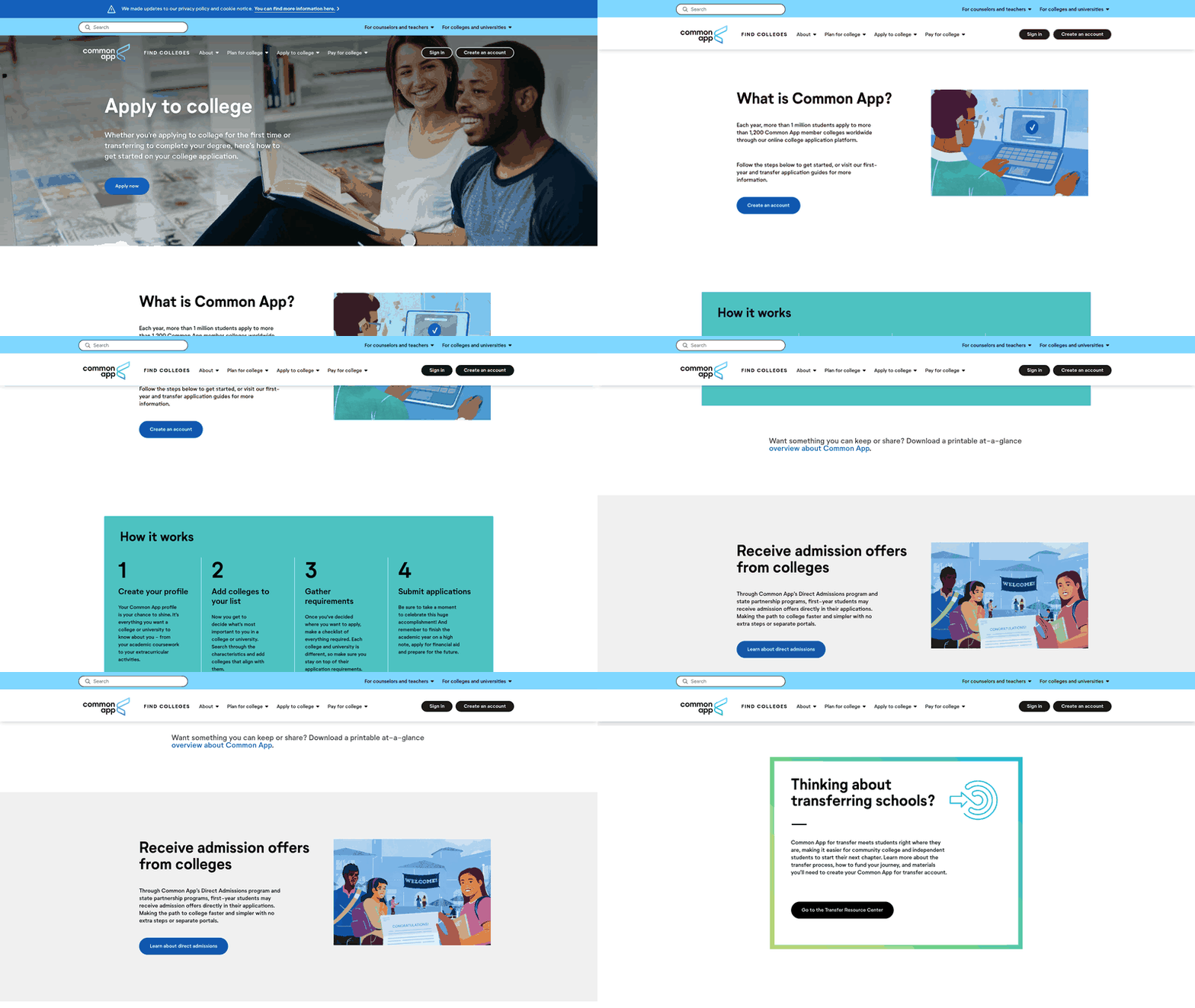
The personal statement isn't an English essay with a thesis and conclusion. It's editorial storytelling that lets admissions readers see you as a person they'd want on campus. Supplemental essays then tailor that story to each school's values, programs, and community.
Why Building Your Admissions Story Matters
Every year students with near-perfect GPAs watch their decisions arrive with confusion: accepted at one top-tier campus, rejected from another with a lower median GPA. The difference rarely comes down to a tenth of a grade point. Test-optional and test-blind policies have spread across selective universities, shifting weight away from standardized scores and toward the other pieces of your file. Admissions outcomes can feel inconsistent even among selective campuses, but this isn't randomness. It's holistic review.
We see families anchor on numbers because numbers feel controllable. You can calculate exactly what a 94 versus a 96 does to your weighted GPA. But admissions officers work under tight time constraints, and in that compressed window they're reconstructing who you are from fragments: your activity list, short activity descriptions, a personal statement, and a handful of supplements that vary by school. The transcript establishes baseline academic competence. The narrative determines whether you become a person they can picture contributing to their campus.
Constraints are scaffolding, not obstacles
Major application platforms assume the activity you place first carries special meaning. That assumption creates immediate strategic tension: do you lead with the club where you logged the most hours, or with the project that best explains your values and direction? The real question isn't how many activities you list. It's which activities build a thread the reader can follow across your application.
Students who master this process recognize that the activity list isn't inventory. It's Act One of a four-part story. When your top entry connects forward to the core essay and backward to a specific supplement prompt about intellectual vitality, you've turned a brief description into a navigation system for a rushed reader. The constraints aren't limiting your authenticity. They're forcing you to identify what actually matters before you draft a single word.
Distill a Core Narrative
We see students treat their activities list as a résumé to fill, their personal statement as an English assignment, and their supplements as afterthoughts. That approach misses the architecture. These constraints create a narrative sequence: the activities list establishes what you do, the personal statement reveals why you do it, and the supplements prove you've thought about where that work leads next.
Your Activities List Is Act One
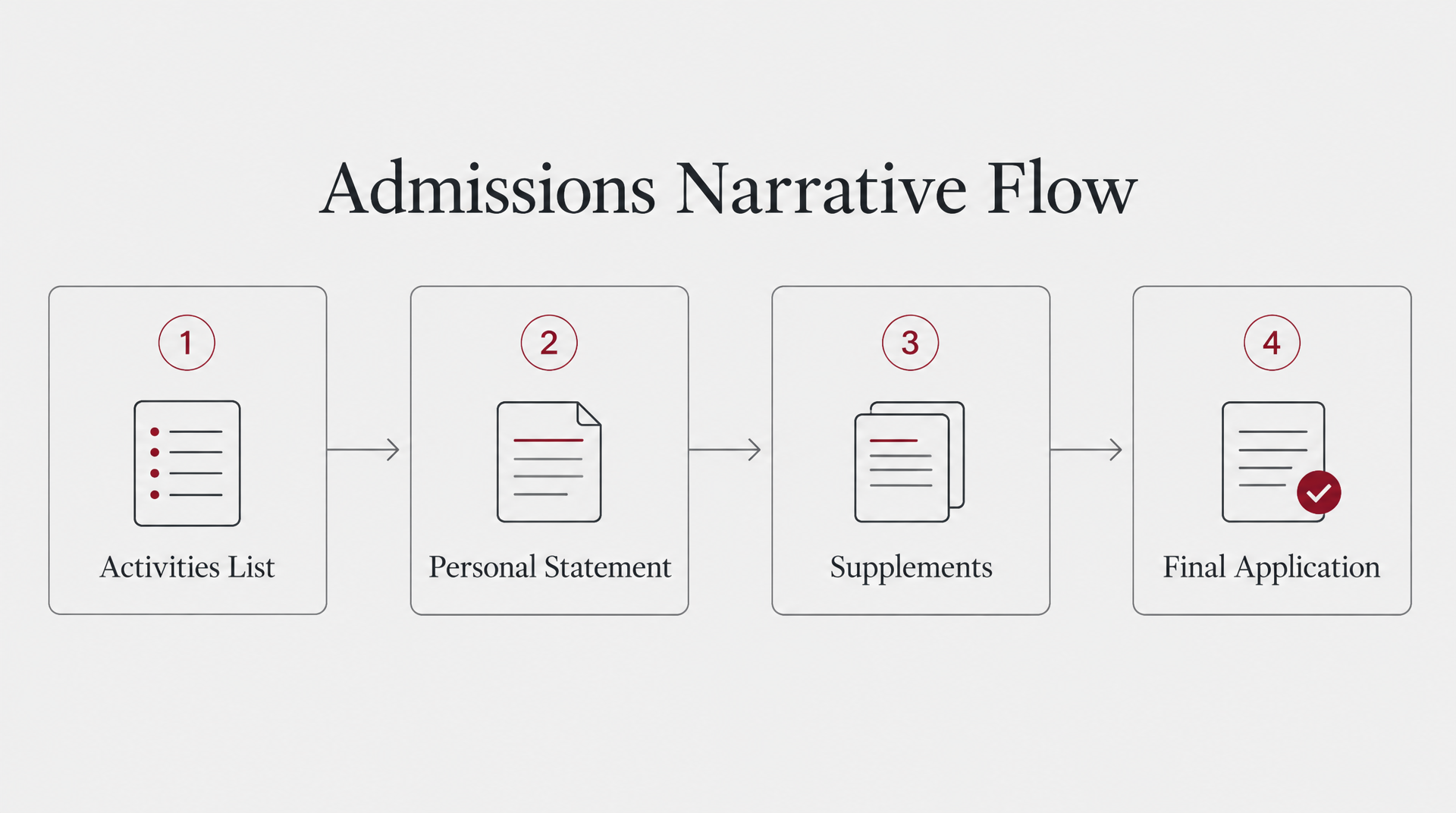
The Common App gives you exactly ten slots for activities and assumes slot one is your most meaningful commitment. That ordering matters. Admissions readers form their first impression of who you are beyond grades when they scan the activities list, often within minutes of opening your file. Most students default to chronological order or rank by hours logged. Neither strategy works. Counselors report that students consistently ask for a "magic number" of activities to list, but the better test is whether each activity supports the same thread.
Start with a simple tracking template organized around the ten slots. For each activity, record your role, time commitment, specific responsibilities, measurable outcomes, and what the experience taught you about yourself. The description field is short, which means every word is a trade-off. Strong descriptions show scope, impact, and growth rather than just listing titles. "Editor-in-Chief, school newspaper" tells less than "Led 15-person editorial team, increased digital readership 240% through investigative series on district budget gaps, work cited by local media and school board."
Categorize your activities by leadership, depth of commitment, duration, and connection to your future goals. Then audit: does this list reveal recurring themes? If slot one shows four years of robotics team leadership, slot three documents an independent machine learning project, and slot seven lists a summer coding internship, the list tells a coherent story before the reader reaches your essay. If your top slots show babysitting, a sport you quit sophomore year, and a mission trip, the narrative scatters.
The most time-intensive activity doesn't have to land in slot one. Something you did for just a few weeks annually can be more meaningful if it connects to the values and intellectual curiosity your essay will unpack. The activities list is where that first-person story begins.
The 650-Word Personal Statement Makes the List Human
Your Common App personal statement has a single job: help admissions readers see you as a person they want on their campus. That means the essay can't just restate what's already in your activities list. Admissions officers at selective schools read thousands of essays each cycle, and the memorable ones aren't the ones with the most impressive credentials. They're the ones with the clearest structure and the most specific, authentic voice.
Structure your essay around three parts: a 50- to 75-word hook that drops the reader into a specific moment, a 450- to 500-word story-and-reflection core that alternates between what happened and what it meant, and a brief forward-looking close. Because admissions readers often form early impressions within minutes of opening a file, that 50- to 75-word hook has outsized value: it decides whether the reader leans in or skims. The hook isn't a thesis statement or a sweeping claim about who you are. It's a scene. "The first time I saw a cell divide under a microscope, I forgot I was supposed to be taking notes" beats "I have always been passionate about science." The first shows. The second tells.
The story-and-reflection section is where you prove the activities list wasn't just padding. Pick one moment that explains why you care about the work you do, whether that's research, an art form, or a way of seeing the world. A smaller, honest story will almost always outperform a "big" but generic one. A student who writes about making her grandmother's recipes as cultural preservation becomes extraordinary when that essay also clarifies why she founded a cultural heritage organization or why language and belonging drive everything she does. The personal story and the application narrative aren't separate. The best essays make them one.
Story alone isn't enough. Admissions readers care most about what you learned, how you think, and how you interpret experiences. That reflective layer—the "what it meant" sentences woven through your narrative—is what turns writing into an admissions essay. Your essay should sound like you on your most thoughtful day, not like you're trying to sound older or more formal. Avoid forced vocabulary. Skip the five-paragraph English-essay structure. Personal statements don't need a thesis and a conclusion that sums everything up.
Test whether your activities list supports your core narrative by reading both side by side. Does the essay deepen what the list already showed, or does it introduce a completely unrelated version of yourself? If your activities list is all STEM research and your essay is about playing violin, the application reads as disjointed unless the essay explains how those connect, maybe through discipline, pattern recognition, or the way you approach problem-solving in both domains.
For more guidance on how to structure the full narrative across your application, explore our approach to building an admissions strategy that treats every section as part of a single story.
Write the Core Common App Essay
Once you've distilled your core narrative from the activities list, you're ready to transform it into a personal statement that admissions officers will remember. Many students treat this essay as a separate creative writing assignment, but it's actually the second act in your four-part admissions story.
Draft the Story First, Choose the Prompt Later
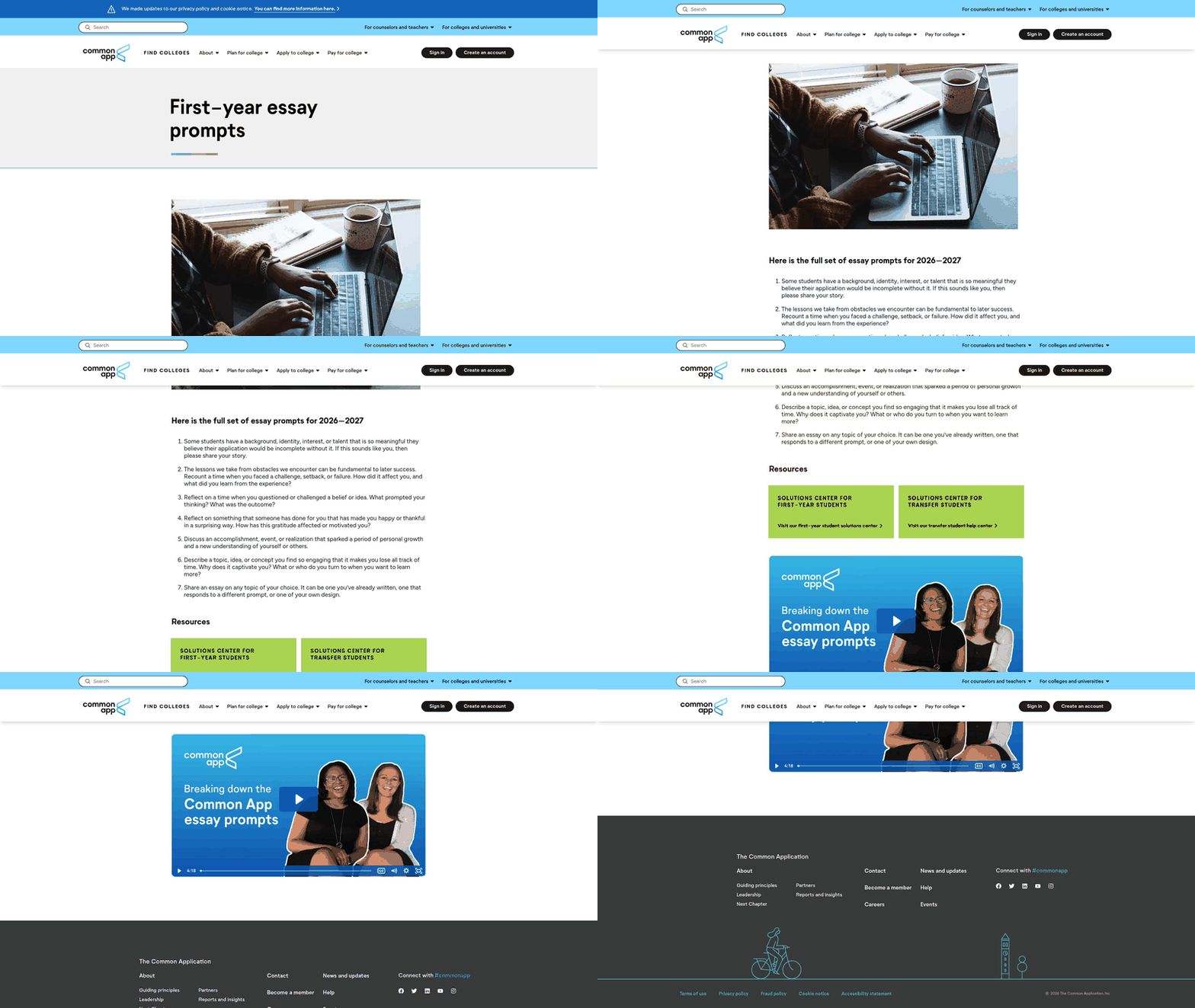
The Common App offers prompts, but most students approach this backward. They pick a prompt, then force their story into it. We recommend the opposite: write the strongest, most specific story you can tell about yourself, then match it to whichever prompt fits. Admissions officers rarely notice or care which prompt you chose. They're reading to answer three questions: Who is this person? Will they contribute something of value to our campus? Can they write?
The essay doesn't need to be about your intended major. The strongest topic may be the one that reveals the habits behind your achievements: how you notice details, handle uncertainty, build trust, revise your thinking, or return to a question after the easy answer stops working. If the activities list shows the outside evidence, the essay should reveal the inner logic. It should help the reader understand not just what you did, but why that pattern keeps appearing in your life.
Structure Around Hook, Story, and Landing
Strong personal essays follow a recognizable three-part structure. Your hook should drop the reader into the middle of something concrete: a specific scene, a moment of tension, a sensory detail. Don't introduce yourself. Don't explain what you're about to write. Open in medias res.
Once you have a scene, resist the urge to over-explain it immediately. Let the reader stand inside the moment before you interpret it. A crowded kitchen, a robotics table after midnight, a debate round gone wrong, a quiet shift at a family business—any of these can work if the scene leads naturally into reflection rather than decoration.
The story and reflection section alternates between two layers. The narrative layer shows what happened: specific scenes, moments, dialogue. The reflective layer reveals what it meant: what you thought, felt, or understood as a result. Your draft should not read like a highlight reel. It should show a mind in motion, especially in the places where your perspective changed.
Your landing should resist the urge to wrap everything up perfectly. Show ongoing curiosity, evolving perspective, or forward direction. Strong essays feel like a continuation, not a conclusion.
We work with students through multiple feedback rounds to refine voice, tighten structure, and eliminate anything that doesn't advance the core narrative. The revision process often matters more than the first draft because it exposes where the essay is trying too hard to impress and where the authentic voice is already present.
Tailor Supplemental Essays
Your Common App essay established your core story, but the supplements decide whether admissions officers can picture you on their campus. Students often treat these as speed-round versions of the main essay, recycling the same language across ten schools with only the university name swapped out. That approach wastes the architecture you've already built. Supplements aren't standalone assignments. They're Act Three of your four-part narrative, proving where your established interests and values connect to specific programs, communities, and institutional priorities.
Each supplement prompt asks a version of the same question: why you and this campus need each other? But the evidence that answers that question is different for every school. When a school asks about intellectual curiosity, they want to see how you'd contribute to specific classroom discussions. When another asks about cross-disciplinary work, they're evaluating how you'd fit programs that blend fields. Generic praise for campus beauty or prestigious faculty tells them nothing. Specific connections—naming a professor whose research aligns with your activity list work, describing how a student organization extends what you started in high school, linking a campus resource to the next stage of your narrative—prove you've done the work to understand what makes that campus distinct.
The constraints here tend to be tighter than the main essay, and they vary significantly by school; the word limit is part of the prompt, not a suggestion. Within those limits, admissions officers are looking for answers to all parts of the prompt, not just the headline question. If a prompt asks what you'll contribute and what you hope to learn, both halves need specific answers drawn from your established narrative and their actual offerings.
How Do You Customize Without Starting From Scratch?
Batching similar prompts saves time without sacrificing specificity. Group your schools by question type: "Why Major?" prompts in one batch, "Community Contribution" prompts in another, "Intellectual Curiosity" prompts in a third. Draft a base version for each type that draws from your activities list and core essay, then customize the second half with school-specific evidence. A prompt-tracking worksheet helps: columns for school name, prompt text, word limit, which angle from your narrative you're using, which campus-specific program or resource you're connecting to, internal deadline, and draft status. When you see five schools asking about intellectual community, you'll draft one strong answer about how you engage ideas, then replace the campus-specific evidence in each version rather than rewriting from scratch five times.
Set internal deadlines two weeks before the application deadline. Last-minute supplement drafting leads to generic language and missed prompt requirements because you're rushing. Your school workload doesn't pause for application season, so protect writing time the way you'd block study sessions before finals.
References
[1] Learn How to Write Great Supplemental College Essays - https://www.collegeessayguy.com/supplemental-essays
[2] Beginner's Guide: Nailing Your Supplemental Essays - https://www.tuitionrewards.com/newsroom/articles/710/beginner-s-guide-nailing-your-supplemental-essays
[3] How to Write a Compelling Personal Narrative From Any Essay - Pathivy - https://pathivy.com/blog/how-to-write-a-compelling-personal-narrative-from-any-essay
[4] College Essay Structure | Outlines, Templates, & Narrative Frameworks - https://www.solomonadmissions.com/post/college-essay-structure-outlines-templates-and-narrative-frameworks/
[5] Building Your Narrative: Activities List, College & Supplemental Essay - https://www.youtube.com/watch?v=TKqMxipM1NY
[6] What Do College Admissions Officers Actually Look For in 2026? - https://premiercollegeguide.com/pcg-what-admissions-officers-look-for-2026.html
[7] How to Format a College Essay: Step-by-Step Guide - https://www.collegeessayguy.com/blog/college-essay-format
[10] The Free Guide to the Personal Statement | College Essay Guy - https://www.collegeessayguy.com/guides/the-free-guide
[12] Guide | 2.2 - Narrative Structure - College Essay Guy - https://www.collegeessayguy.com/guides/the-free-guide/how-to-write-a-montage-essay
Frequently Asked Questions
Should I really put something I only did for a short time at the top of my activities list?
Yes, if that experience connects directly to your core narrative and reveals what drives you intellectually or personally. Admissions officers care more about meaningful engagement than accumulated hours. A shorter commitment can belong near the top when it explains the values, questions, or direction the rest of your application develops.
How do I know if my activities list and personal statement actually connect, or if they read as two separate versions of myself?
Look for a shared pattern. Your list might show repeated leadership, creative discipline, community problem-solving, research curiosity, or service rooted in lived experience. Your essay should make one of those patterns feel personal and specific. If the essay introduces a new side of you, it needs to explain how that side connects to the commitments already visible elsewhere in the application.
Can I reuse the same supplement language across schools if I just swap out the university name?
No. You can reuse a planning framework, but not a generic paragraph. Supplements need evidence that belongs to the specific campus: programs, research opportunities, communities, curriculum, or resources that connect to the story you've already built. The efficient approach is to group similar prompts, draft from the same core angle, and then make the school-specific section genuinely specific.