How to Stand Out in Ivy League Applications
October 18, 2026

Quick answers
- Highly selective applications rose 26% from 2019 to 2022, and acceptance rates kept dropping.
- Harvard turns down enough students with perfect or near-perfect records to fill five incoming classes each year.
- Committees separate participants, operators, and builders. The builders who launch measurable initiatives get the strongest look.
- A narrow focus with a multi-year record beats scattered well-roundedness.
Perfect grades are now the floor
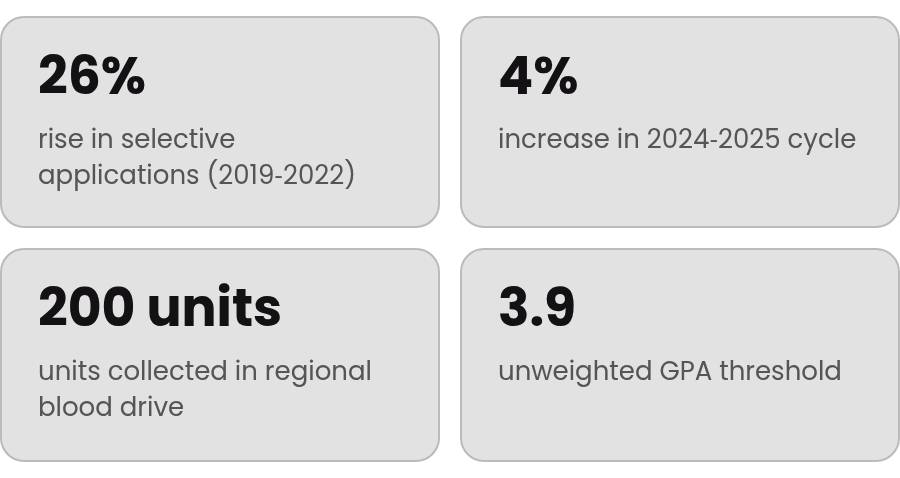
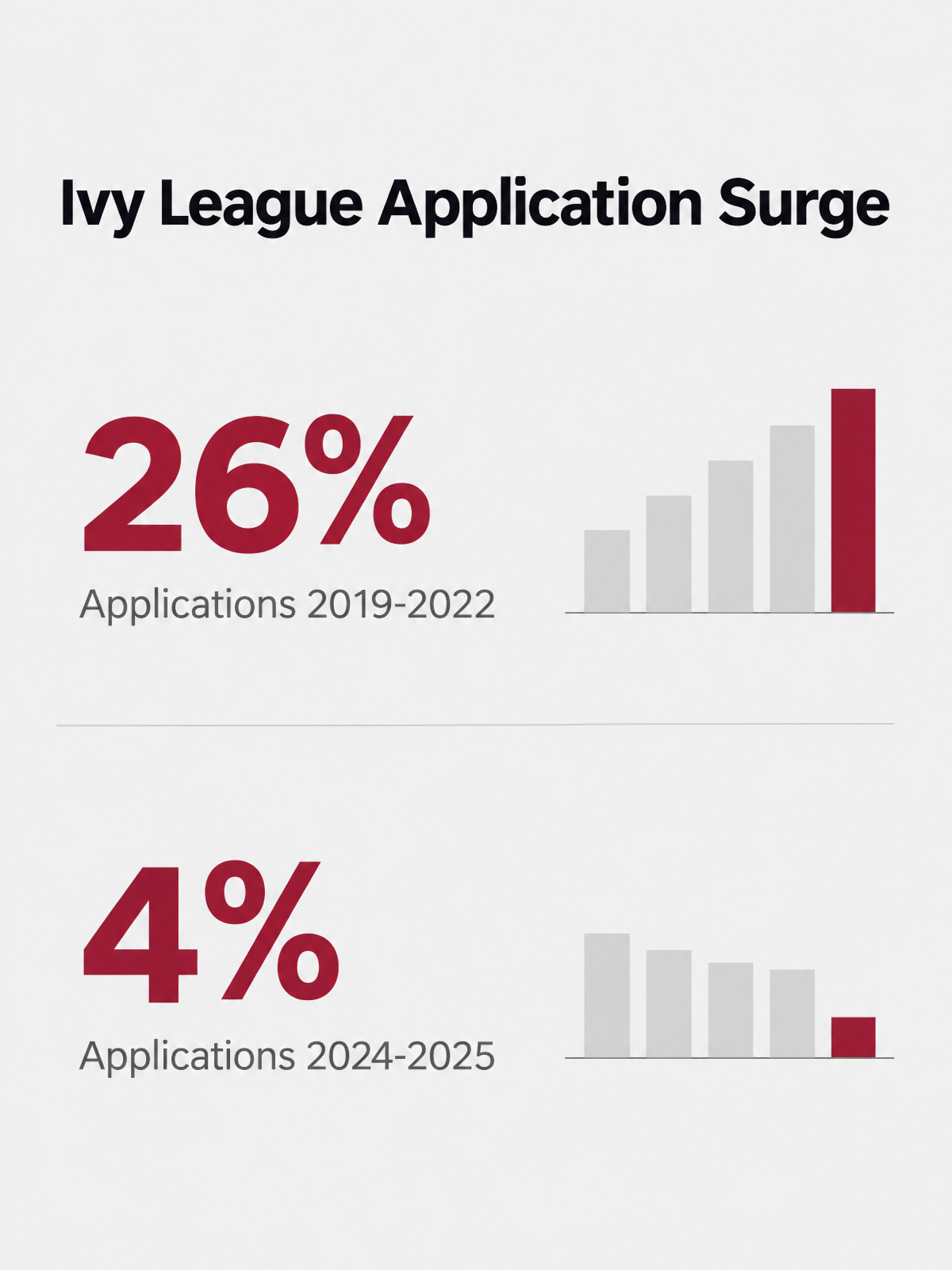
Applications to highly selective schools rose 26% between 2019 and 2022, according to the Common Application, and ticked up another 4% during the 2024-2025 cycle. High selectivity is not a static bar. It keeps moving upward.
Perfect transcripts no longer guarantee a seat. Harvard's longtime Dean William Fitzsimmons has noted the university must turn down more than five incoming classes' worth of students with perfect or near-perfect academic records. At that level, grades become a prerequisite, not a case for admission.
The real return on admissions consulting
Families often ask us to justify the cost of college admissions consulting. We don't publish a single fee here because scope varies by grade, starting point, and services. If you measure ROI only by acceptance letters, you're using the wrong denominator. The value is in structured planning, sharper positioning inside a hyper-competitive regional peer group, and less guesswork—not in a promised admission rate.
Many applications read as if the student never found anything worth building. Admissions readers point to the same gap: no project, experiment, or sustained endeavor that demonstrates real engagement. Consulting can't manufacture a personality, but it can create the conditions for one to show up. We define measurable outputs as milestones—a three-tier impact record, a coherent four-year narrative, outside validation through selective programs or concrete work—plus the review depth behind each draft.
The risk-adjusted version matters because even exceptional students get rejected from top programs. A satisfaction-linked bonus does not change that. We don't sell admission. We help an already strong student become a differentiated applicant that a committee can argue for.
Create a compelling personal narrative
When I sit with families, one pattern shows up repeatedly: committees aren't rejecting accomplished students because they lack credentials. They're rejecting them because thousands of other files tell the same story. The real differentiator is whether an officer can picture you as a specific human being after reading your file.
Build a theme around sustained commitment, not scattered interests
Many students treat the application like a showcase reel: every club, every season, every certificate. Former admissions officers describe reading files where well-rounded looks like checklist completion rather than curiosity. The students who break through pick a narrow lane (rural health access, not "medicine"; computational linguistics, not "STEM") and build a multi-year record proving that focus.
Audit what you've already invested in. Two summers at a free clinic and AP Biology with a public health policy interest make a coherent foundation. Debate, robotics, student government, and theater with no through-line is a decision waiting to be made. Depth and trajectory matter, and some worthwhile activities won't make the final cut.
Connect your theme to measurable contributions
A focused narrative gets stronger when you can point to concrete outcomes. Participation establishes baseline commitment. Operating an existing program shows responsibility. Building something new with measurable results separates your file from the stack.
You can't manufacture a meaningful contribution in senior fall. Starting early gives you time to move from participation to execution, fail once or twice, and still have tangible results by deadlines.
Let your essays reveal the human behind the accomplishments
Perfect grades and a built-out resume prove you can handle the work. Your essays prove you're someone officers want on campus. Too many students use the essay to summarize activities or explain a major. That wastes the only place where your voice is unfiltered.
Strong essays connect a specific moment to a larger pattern of curiosity or growth. The best examples avoid dramatizing the moment itself and instead show the daily practice, question, or follow-up work that came after. They work because they revealed character through concrete detail rather than abstract claims about resilience.
Avoid clichés because they substitute summary for story. "I learned the value of perseverance" tells an officer nothing. Describing 6 a.m. physical therapy sessions for two years while redesigning your extracurriculars around a new mobility constraint shows it. Specificity is what reads as authentic.
Show depth over breadth in extracurriculars
Most families believe a long activity list proves dedication. Admissions committees reviewing thousands of near-perfect transcripts see the opposite: scattered participation reads as resume-building. Narrow focus with escalating responsibility reads as drive.
What distinguishes Tier 1, Tier 2, and Tier 3 impact?
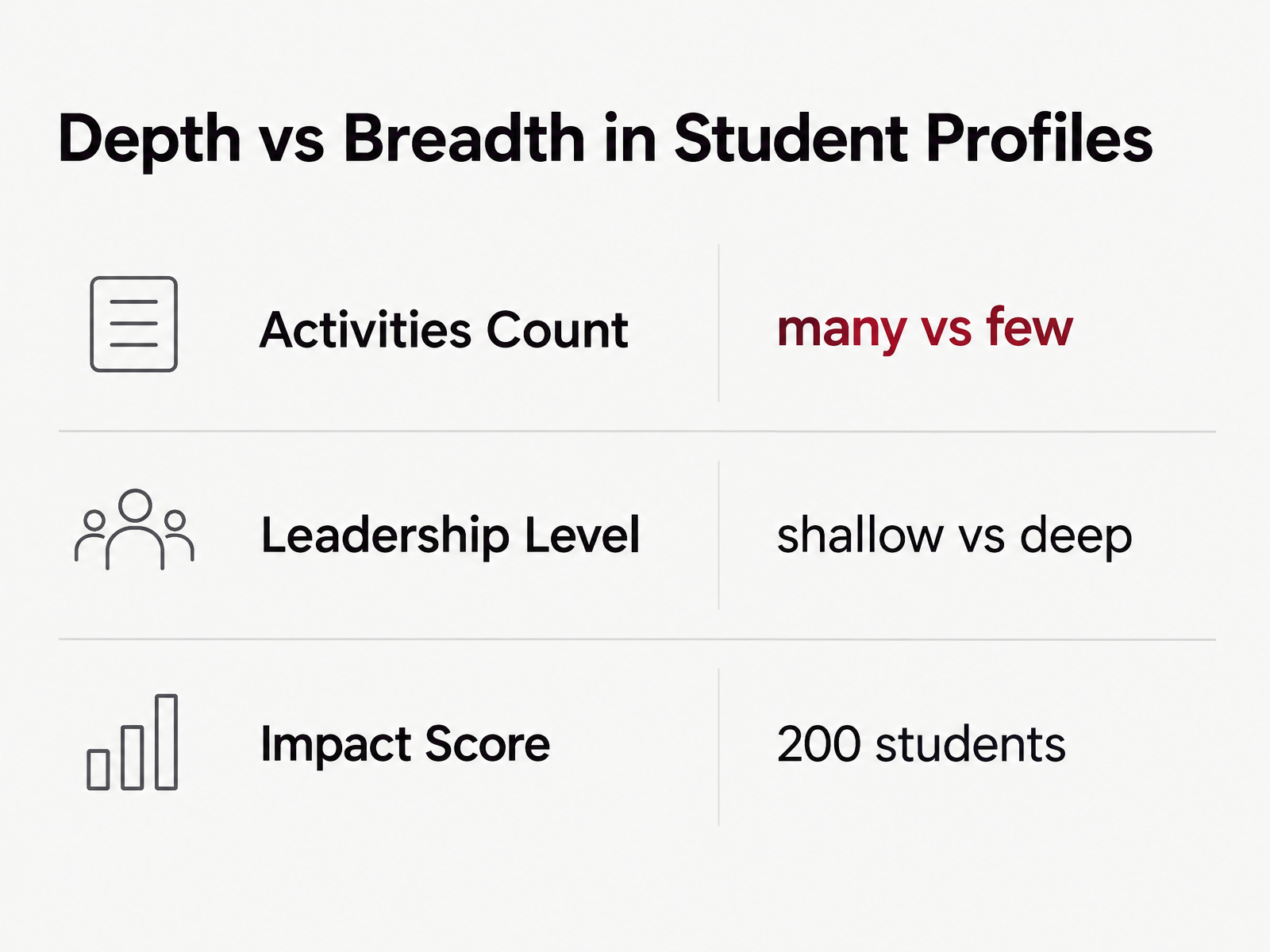
Admissions readers often note that many applications lack tangible indicators of passion: a project, experiment, portfolio, or something the student spent substantial time learning, tinkering, or creating. Understanding impact levels helps you position your work honestly.
Tier 1 is participation: you attend meetings, complete assigned tasks, log volunteer hours. It's a baseline, not a distinction.
Tier 2 is operational leadership: you run an existing club, coordinate events for an established organization, or manage a team inside a defined structure. That shows reliability and organizational skill, but not much initiative beyond maintaining what already exists.
Tier 3 is builder capacity: you launch a tutoring program serving 200 underserved students, coordinate a regional blood drive collecting 200 units during a shortage, or develop a mobile app prototype that addresses a local need. One admissions expert puts it simply: strong passion projects accomplish something beyond typical high school expectations. The measurable outcome matters: funds raised, students reached, programs delivered, prototypes developed.
For students aiming at technical fields, a maker portfolio supplies objective evidence committees trust. Code repositories, CAD files showing iterative design, or prototype videos demonstrating functional hardware move a file from claim to proof. Research supplements with formal mentorship verification carry similar weight, especially with conference presentations or journal submissions.
The strategic insight is local. Admissions officers compare applicants within the same school or region, not against the nation. Becoming a Tier 3 builder in your own context beats joining a prestigious external program where you'll operate as Tier 2 among stronger peers. If athletics is the central commitment, pair it with an intellectual or community through-line that shows the same multi-year focus. Start early, commit deeply, and document outcomes a committee can defend.
Academic rigor: the floor, not the pitch
Grades alone won't get you into an Ivy League school, but they keep your file in the conversation. At selective universities, a near-perfect academic record is often the starting point. After that, intellectual curiosity, initiative, and independent thinking decide who actually gets admitted.
What the academic floor really looks like
Take the most challenging courses your school offers across core subjects—English, math, science, history, and world language—through 12th grade. That pattern matters. Officers want challenge across all core subjects, not just your strengths.
But rigor without strong grades backfires. A consultant suggests avoiding courses where you cannot earn at least a B. An A in honors beats a C in AP Calculus. Find the zone where you're genuinely challenged and still able to excel.
A near-perfect unweighted GPA is often cited as a common Ivy threshold. That usually means mostly A's with occasional room for an A- or B+. One strong junior spring won't offset a weak sophomore year. Officers weight sustained performance over a sudden spike.
Test scores: from optional back to required
Testing policy has shifted by school and year, so check each school directly before you plan. Strong scores can help, but they are best understood as part of the academic floor: necessary to keep the file competitive, not sufficient on their own.
Strong SAT or ACT scores can help applicants stay competitive. Even when schools were test-optional, strong scores helped students who had them. Where a test is required, treat it as one more cleared bar—not the proof that you belong.
Showing intellectual drive beyond transcripts
Committees also look for intellectual vitality: the kind of curiosity that makes you ask new questions instead of only answering assigned ones. Files should show how a student explores ideas beyond required coursework.
If you've exhausted what your high school offers, move to online courses, dual enrollment, or independent study tied to your interests. The goal isn't stacking credentials. It's demonstrating that you pursue knowledge because you want to understand something, not because a syllabus told you to.
Secure narrative-aligned recommendations
The recommendation letter feels like the one part of the application you can't control. But treating recommenders as collaborators rather than distant referees can strengthen the file. Most students ask a teacher in September, hand over a resume, and hope for the best. That wastes the only document written by someone who watched you work over time.
Choose recommenders who witnessed growth, not just grades
The baseline advice is sound: pick junior-year teachers in English, math, science, or history. Letters from teachers and your counselor matter at selective universities.
But the teacher who gave you an A isn't automatically your best advocate. A recommender who watched you struggle, ask questions beyond the syllabus, or help a classmate grasp a concept has more material. A physics teacher who saw you fail the first exam, work through office hours, and then tutor two peers before the final can tell a story. The quiet straight-A student leaves less to write about.
Prepare a recommendation packet that reinforces your narrative
Give your recommender a one-page summary: your core theme, two or three specific moments from their class that illustrate it, and the intellectual quality you want them to highlight. If your application centers on using data to solve community problems, remind your statistics teacher about the local food-access project you built from regression models in her course.
Don't write the letter for them. Give them language that connects your classroom work to your broader story. Include your resume, a draft of your personal statement, and a short note explaining why each school is on your list. You're making their job easier while steering the letter toward the qualities committees need to see.
Timeline matters for early-decision applicants: ask by late September for November 1 deadlines, and by mid-October for regular-decision targets in early January. Teachers write dozens of letters each fall. An early ask with a clear packet earns better attention than a last-minute request.
Optimize supplements, interviews, and final touches
By October of senior year, most of the story is already told. The stumble I see most often isn't a weak profile. It's a student treating the final weeks as a formality. They skim the file once, assume it fits together, and hit submit. Then the officer opens a personal statement about social justice, a supplemental essay about entrepreneurship, and a recommender letter calling the student quiet and collaborative. Each piece is fine. Together they blur the picture.
Run a coherence check across every document
Print everything: personal statement, supplementals, activity descriptions, and the brag sheet you gave your recommenders. Read them in one sitting, as if you're meeting the applicant for the first time. Does a consistent theme emerge? If the personal statement is about intellectual curiosity through independent research, do the activities show sustained inquiry? If the supplements talk about community-building, did the recommender see it?
Committees are not looking for a list of achievements. They're looking for the human being behind the transcript. Coherence is what lets them see you clearly. When a file tells three different stories, officers can't form a sharp picture of who you are or what you'll contribute.
Check tone, too. Inconsistent tone can feel jarring. Calling yourself collaborative in one place and an independent thinker in another, without showing how both are true, reads as inconsistency rather than nuance.
Proofread with fresh eyes and read aloud
Typos won't sink a strong application, but they signal carelessness in a process that rewards precision. Read every essay aloud once. Your ear catches awkward phrasing and repetition your eyes skip on screen. Then hand the essays to someone who doesn't know your story well: a teacher, a cousin, a neighbor. If that person finishes and can't summarize what makes you distinctive, revise.
Watch for overused words. "Passion," "dedicated," and "impactful" go flat quickly. Specificity brings an application to life. Replace "I'm passionate about environmental science" with a sentence that shows what you did: "I spent my junior year testing soil samples from the creek behind my school and presenting my findings to the town council."
Check every school name, program name, and professor name. Copying and pasting from one supplement to another is efficient until you submit an essay to Yale that mentions Brown's Open Curriculum. It happens often, and it's the easiest way to signal you didn't care enough to review your work.
Start early, but not for the reason you think
Profile building often begins in eighth or ninth grade. The reason isn't to manufacture achievements on a schedule. It's because depth takes time to demonstrate. The path from ninth grade to builder-level impact is measured in years, not months: building relationships, learning logistics, and earning the trust to lead something larger cannot be improvised in October of senior year.
When to begin college admissions consulting
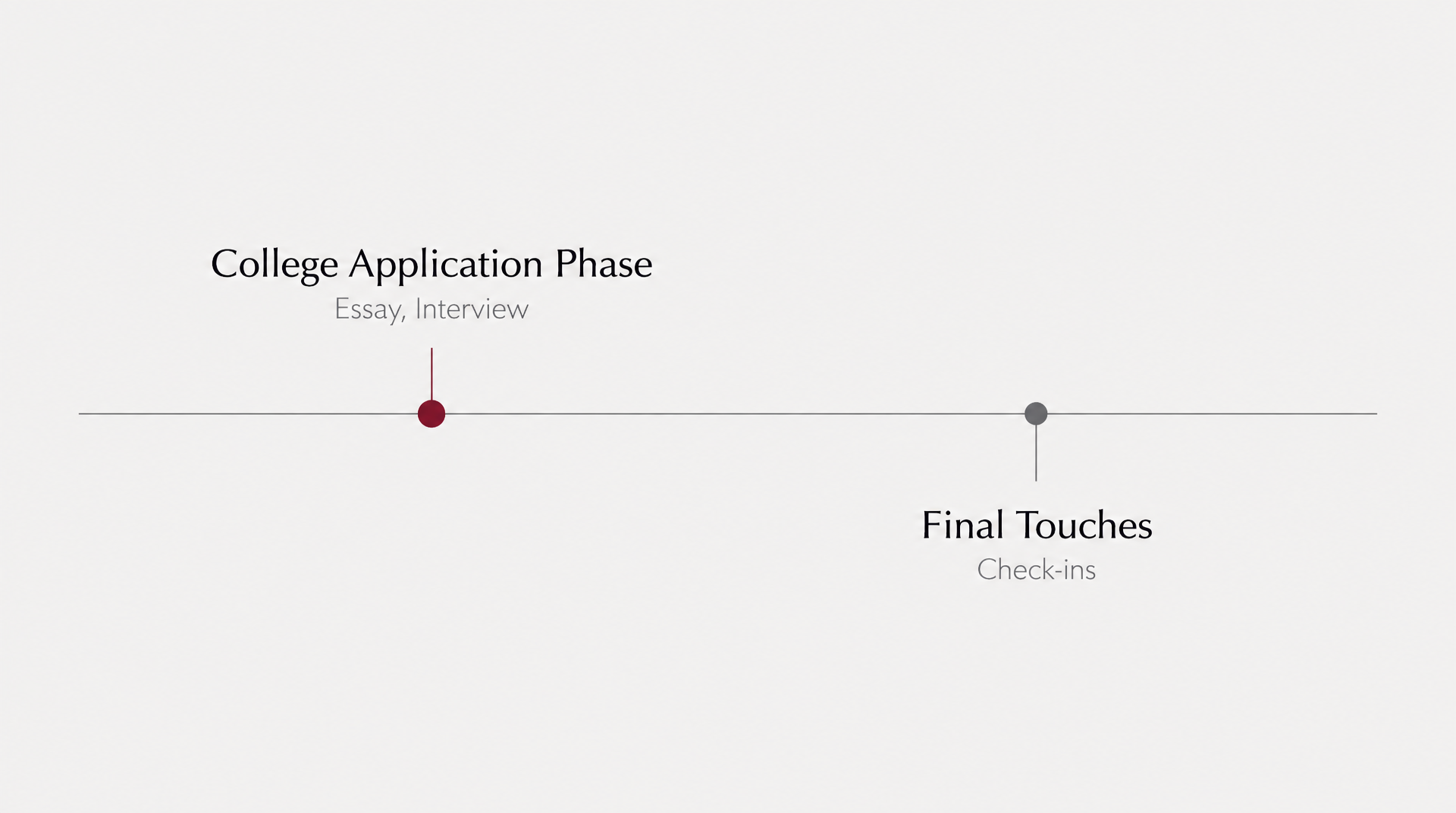
We work with students in two phases. The Life Preparation Phase can start as early as eighth grade. It focuses on identifying a thematic focus, building sustained extracurricular depth, and developing the academic foundation selective schools expect. You're building meaningful experience and skills that later show up on a resume and activity list, not just filling out forms.
The College Application Phase is where we help you translate years of work into a cohesive narrative: essays, interview preparation, and strategic positioning. At least two members of our team review every essay draft, which gives you multiple perspectives on how an admissions officer might interpret the story. We schedule regular check-ins by email, video, and phone to clarify goals, prioritize commitments, and refine positioning.
What our base + bonus model actually means
Pricing varies by scope; we don't post one fee here. Ask for a written quote that ties the base fee to specific deliverables and review depth. The bonus component reflects satisfaction, not admission odds.
We also reserve a small number of scholarships each year for students from low-income families. Beyond admissions support, our alumni network connects students across top universities to exchange advice, support younger applicants, and collaborate on meaningful projects. You come for college. You stay for the community.

References
[1] How to Stand Out to Ivy League Colleges and Other Top Schools - https://www.collegedata.com/resources/getting-in/how-to-stand-out-to-ivy-league-colleges-and-other-top-schools
[2] [10 Tips] How to Stand Out on College Applications - Ivy Coach - https://www.ivycoach.com/the-ivy-coach-blog/college-admissions/how-to-stand-out-college-application/
[3] What Makes an Ivy League Applicant Stand Out? - Spark Admissions - https://www.sparkadmissions.com/blog/what-makes-an-ivy-league-applicant-stand-out/
[4] 5 Ways to Build an Ivy League-Worthy Applicant Profile - TeenLife - https://www.teenlife.com/blog/5-ways-to-build-an-ivy-league-worthy-applicant-profile/
[5] How can I work on standing out on Ivy League applications? - CollegeVine - https://www.collegevine.com/questions/1447/how-can-i-work-on-standing-out-on-ivy-league-applications
[6] How To Get Into An Ivy League School? The Essential Guide - https://www.crimsoneducation.org/us/blog/how-to-get-into-an-ivy-league-school
[8] Getting Into Ivy League Schools | Test Ninjas - https://test-ninjas.com/getting-into-ivy-league-schools
[9] How to Get Into Ivy League Schools: The Definitive Guide - https://www.shemmassianconsulting.com/blog/how-to-get-into-ivy-league
[10] How to Get Into the Ivy League | CollegeVine Blog - https://blog.collegevine.com/how-to-get-into-the-ivy-league
[12] What Do Colleges Really Mean by Holistic Review? - IvyWise - https://www.ivywise.com/blog/holistic-review/
Frequently Asked Questions
Should I drop an activity I've done for three years if it doesn't fit my narrative theme?
Not automatically. Admissions officers value sustained commitment, so abruptly quitting signals inconsistency. Instead, reduce your time investment during senior year and focus new energy on activities that do support your theme, allowing natural depth to emerge where it matters most without creating gaps.
Can I still get into an Ivy League school if my school doesn't offer many AP courses?
Yes. Committees evaluate rigor within your school's specific context, not against national AP course counts. Take the most challenging courses your school offers, pursue dual enrollment or online options if available, and use your additional information section to explain limitations your transcript doesn't show.
How do I know if my extracurricular work qualifies as Tier 3 impact?
Look for evidence that your work changed or expanded an existing situation. You might have created a process others adopted, solved a problem for a defined group, or produced an artifact that can be evaluated. The important distinction is not simply the time invested, but whether your contribution moved beyond assigned responsibilities.
When exactly should I ask teachers for recommendation letters if I'm applying regular decision?
Give teachers enough lead time to think about your work and write with specificity. Along with the formal request, provide a concise reminder of the classes, projects, and questions through which they came to know you. That context is more useful than sending a long list of accomplishments without explanation.
What happens if my personal statement theme contradicts what my recommender emphasized?
A difference is not automatically a problem. A student may be both an independent thinker and a generous collaborator, for example, if the application supplies evidence for each quality. Review the file for genuine conflict, then add context where necessary rather than forcing every document into identical language.