How We Vet College Consultants: 7 Signals That Separate Experts From Salespeople
October 15, 2026

Quick Summary
Most families don't realize private consulting is now common; 25–30% of families use it, and in markets like California, New York, or DC the rate can reach 60%.. Yet no admissions office, professional association, or even the Common App publishes evidence that hiring one changes your odds. You're paying to solve a capacity problem many public schools face with a solution no one can verify. That's why we built our vetting process around what consultants show, not what they say.
The table below distills the seven signals we track when evaluating a consultant. Each signal has a time cost, an evidence trail, and a measured impact on whether the consultant can actually help—or just sound impressive on a sales call. The "Evidence" column tells you what to ask for and where our article explains why it matters. Systematic vetting takes 60–90 minutes and yields a realistic confidence score.
| Signal | What to Look For | Sample Question / Evidence | Evaluation Time | Impact Rating |
|---|---|---|---|---|
| 1. Published Pricing | Base fee + structure in writing before you sign | "Can I see your fee agreement and scope of services before our first meeting?" | 5 min | High |
| 2. Ethical Boundaries (IECA/NACAC) | Explicit statement they won't write essays or guarantee admission | "Will you write any part of my child's essays? What results do you guarantee?" | 10 min | High |
| 3. Outcome Evidence | Specific admit data with denominator (X admitted / Y total clients), not cherry-picked success stories | "What percentage of your clients were admitted to a top-20 school last cycle, and how many total students did you serve?" | 15 min | High |
| 4. Credentialing | Former admissions officer, certified counselor, or 5+ years of verifiable experience | "What's your background—did you work in admissions, and if so, where and for how long?" | 10 min | Medium |
| 5. Honest Scope-Limiting | Clear statement of what they won't do or when consulting isn't worth it | "Are there situations where you'd tell a family not to hire you?" | 10 min | Medium |
| 6. Named Staff (Not Ghostwriters) | You know who's reading essays and giving strategy—by name, with LinkedIn profiles | "Who will actually work with my child, and can I see their credentials?" | 15 min | Medium |
| 7. No "Insider Access" Claims | Zero mention of personal connections to admissions offices or backchannels | "Do you have any relationships with admissions officers that might help my child's application?" | 5 min | High |
| TOTAL | Estimated vetting time: 70 minutes | Confidence score: 6–7 'yes' answers = proceed; 4–5 = caution; ≤3 = walk away | 70 min | — |
What to Look For First
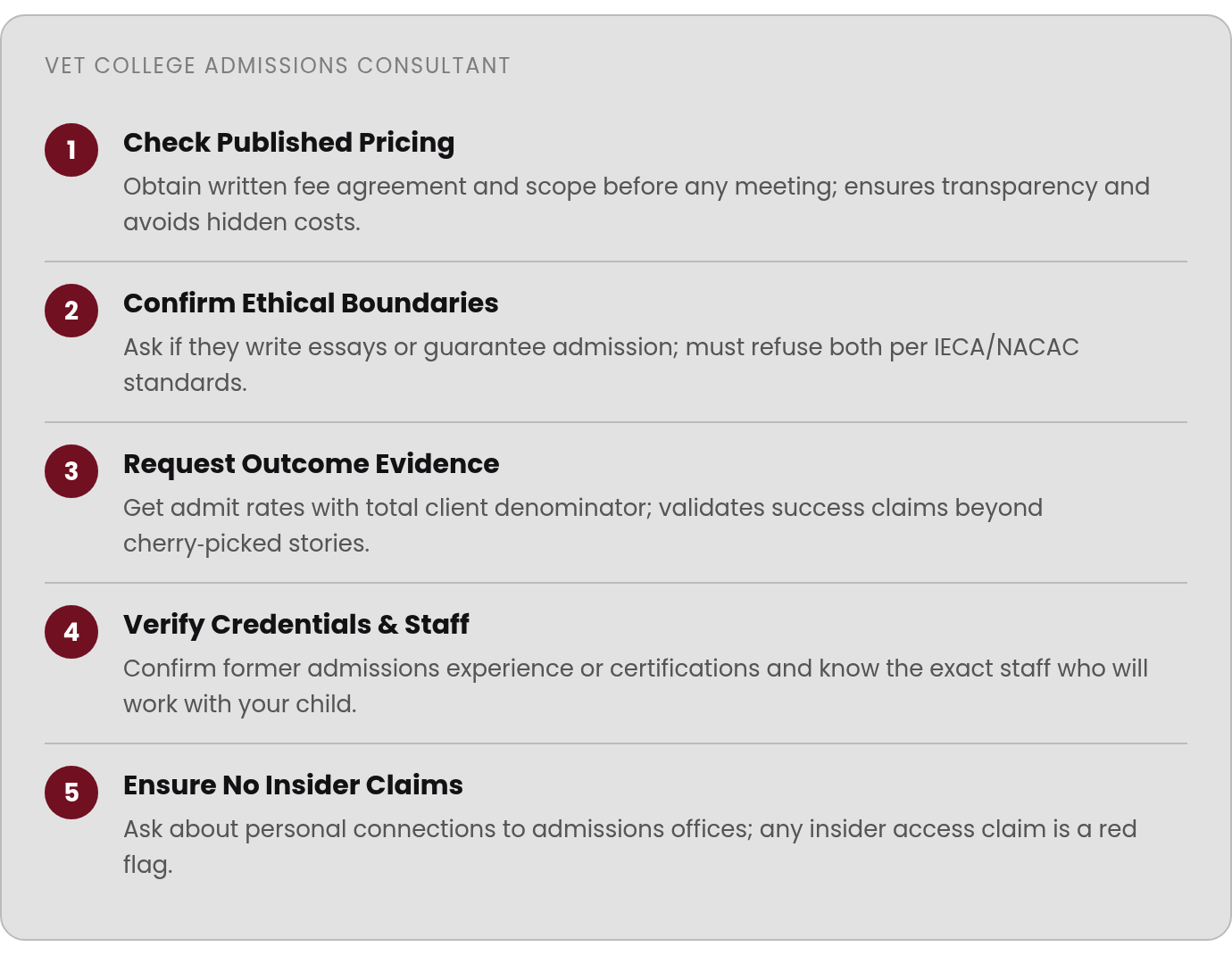
Start with pricing and ethical boundaries—these aren't negotiable. IECA's own standards explicitly forbid consultants from writing essays or guaranteeing placement, and members pledge compliance annually. If a consultant hedges on either, you're done.
Next, demand outcome evidence with a denominator. A consultant who only takes students with 1500+ SATs and then publishes their Ivy admits is demonstrating selection bias, not skill. Ask how they define their success rate and what the denominator includes—every client, or just those who meet certain thresholds.
Finally, listen for honest scope-limiting. The best consultants will tell you when not to hire them. If every answer sounds like a pitch, that's your signal to keep looking.
Key Takeaways
- Private college advising is no longer niche. In high-pressure markets, it's common.
- The consultant population has expanded rapidly, but families still lack independent proof that hiring one changes admission outcomes.
- Ethical boundaries matter as much as strategy. The consultant's job is to guide the student, not become the applicant.
- Demand outcome data tied to the full client pool, not highlight reels from the easiest cases.
- The best consultants openly describe situations where hiring them isn't worthwhile.
Why Vetting College Consultants Matters
When a family begins looking into college admissions consulting, the search often starts from a place of confusion. The market is crowded with generic sales pitches, contradictory advice from friends, and the simple fact that everyone around them seems to be hiring someone. You're not imagining the pressure. You're responding to a real shift in how families approach the process.
The problem is that growth happened faster than accountability could keep up. The number of full-time consultants in the United States climbed from about 1,500 in 2010 to an estimated 8,500 to 10,000 by the end of 2024, and no licensing board, no admissions office, and not even the Common App publishes evidence that hiring one improves your odds. You're paying to solve a capacity problem many schools face—the national average is now 372 students per counselor—with a solution no one can verify. That gap between what consultants claim and what anyone can prove is where bad actors thrive.
What Published Pricing Actually Reveals
Families often treat high fees as proof of quality, but price in admissions consulting correlates only loosely with competence. The average hourly rate for an independent consultant sits around $264, and comprehensive packages run roughly $6,955 on average. Those numbers tell you what the market will bear, not what the consultant will deliver.
The real signal is whether they publish their scope in writing before you sign. What's included in those hours? How many essay revisions? What triggers extra fees? Vague scope is one of the clearest predictors of disappointment later, because it means the consultant either hasn't standardized their process or is deliberately leaving room to upsell.
The same logic applies to outcome claims. When a firm reports that 90 percent of clients get into at least one of their top three choices, ask whether that reflects the consultant you'll actually work with or a firm-wide average inflated by a handful of star advisors. Better yet, ask what their admissions criteria are for accepting students. A polished result means very little unless you know which students were included, which were excluded, and whether the consultant materially improved the application strategy.
Deep Situational Knowledge and Insightful Questioning
Most families shop for consultants the way they'd vet a contractor—credentials, testimonials, maybe a pricing table. But those signals tell you almost nothing about whether the person across from you understands your student's actual situation. Strong consultants distinguish themselves early by moving past generic checklists and instead conducting strategic intake that reveals situational fluency.
The key signal is whether the consultant asks questions that reveal they understand the structural constraints your student faces, or whether they're pitching a one-size-fits-all roadmap.
What Questions Should Signal Deep Admissions Knowledge?
A consultant who understands how admissions actually works will anchor their questions in the realities of your student's high school context. Many school-based counselors are responsible for caseloads far too large to support individualized admissions strategy, which means students often reach junior year with limited guidance on how to shape a coherent application. That gap is where a strong consultant should add value—not by repeating generic deadlines, but by interpreting the student's environment.
An expert consultant asks: How many students from your school typically get into schools like the ones you're targeting? What does the "most demanding" courseload look like at your school specifically, and how does that definition change your strategy? These aren't trivia questions. Selective colleges rarely admit more than one or two students per year from a given high school, so understanding that internal competition is foundational to building a realistic list.
The consultants worth paying for will also probe how your family's narrative intersects with application strategy. If you're a continuing-generation applicant from a well-resourced suburb, your positioning problem is different from a first-gen student at an under-resourced rural school—even if test scores are identical. A consultant who doesn't surface those distinctions in the first conversation is treating college admissions like a standardized product, when in reality it's a market where context determines competitiveness. If the intake feels like it could apply to any student at any school, you're talking to someone who thinks being a parent of college students qualifies them to consult.
Experienced consultants prioritize extracurricular impact—not just participation—and family narrative early, because those are the variables a generic checklist will miss. The consultants worth your time will surface those gaps in the first conversation, not six months in.
Proven Track Record and Transparent Outcomes
One consulting firm may tout impressive percentages; another may highlight decades of experience and thousands of families served; a third may position all its counselors as former deans and directors from top universities. These are the kinds of outcome claims families encounter when shopping for college admissions consulting, and they sound reassuring until you ask what they actually prove.
The challenge is that no external party audits these numbers. Consulting firms report their own results, define their own tiers, and choose which families to accept in the first place. When you evaluate a consultant's track record, the question is not whether they publish a success rate. It's whether you can verify who that rate applies to, how it was measured, and what you're actually comparing against.
What Outcome Data Can You Actually Verify?
Start by separating longevity claims from outcome claims. A firm that has operated for many years and guided thousands of families is demonstrating operational stability, not admissions impact. That tenure tells you the business survived; it does not tell you whether hiring them changes your child's odds.
The same distinction applies to published editorial rankings. When you see a consultant listed in a "Best College Admissions Consultants" comparison, you're looking at brand visibility, not an independent outcome audit. Those lists compile what firms say about themselves; they don't measure what happened to the families who paid.
The transparency gap becomes obvious when you check for published pricing. Many competitors in the consulting space do not publish fees on their websites. That means families cannot evaluate whether impressive outcome claims are worth $5,000, $15,000, or $50,000 until after a sales call. We see that pricing silence as a red flag in itself. If a firm is confident in the value its outcomes represent, it should be willing to name the cost up front so families can make an informed comparison.
Professional association membership offers some baseline accountability. Legitimate consultants often belong to organizations that set ethical standards—forbidding guarantees, banning essay ghostwriting, and requiring written fee disclosure before services begin. Membership tells you a consultant has agreed to those rules; it does not tell you whether they're effective at the work. Use association standards as a floor, not a ceiling.
The pieces still missing from most firms' public profiles are the ones that would let you evaluate outcome claims honestly: detailed before-and-after case studies showing admitted students' profiles alongside rejected peers, class-by-class admission tables broken out by SAT band and GPA range, and transparent no-offer follow-up policies explaining what happens when a family pays and the student is shut out. Until you see that level of specificity, treat every published success rate as a marketing claim that requires your own verification, not a fact you can rely on.
Ethical Pricing and Professional Conduct
We see families waste thousands on consultants who fail the most basic transparency tests—vague scope, hidden fees, and zero evidence they can do what they promise. When pricing and conduct standards function as litmus tests, they don't just measure affordability. They reveal whether college admissions consulting is being sold as a professional service or as an unchecked gamble on your family's hopes.
How Transparent Pricing Reveals Consultant Accountability
Most consultants hide their pricing until you schedule a call, and that's by design. When you can't compare what you're buying until after a sales pitch, you're evaluating urgency rather than value. Industry pricing varies widely: independent consultants often charge hourly rates, while comprehensive packages can range from a few thousand to tens of thousands depending on scope and duration. Those benchmarks exist, yet most firms won't publish them.
When consultants do publish pricing, it clarifies scope immediately. Clear pricing names what you're buying and what happens next. Contrast that with a consultant who quotes a lump sum "for comprehensive support" but won't define how many meetings, essay revisions, or strategy sessions that includes until you've signed. Vague scope also changes the relationship: instead of focusing on the student's plan, every added request can become a negotiation over what the family thought was already included.
Red Flags That Signal Professional Misconduct
Professional associations like NACAC and IECA publish ethical standards that member consultants pledge to follow. These standards typically prohibit consultants from writing essays for students and bar compensation structures tied to specific admission outcomes. These aren't billing guidelines—they're conduct boundaries that separate preparation from fraud.
The most serious red flags cluster around promises no practitioner can keep: guaranteed admission to specific schools, offers to write essays for the student, high-pressure scarcity claims that short-circuit due diligence, and vague answers about who actually does the work. When a consultant frames their service as controlling outcomes rather than improving process, they're either misunderstanding admissions or deliberately misleading you. Both are disqualifying.
Ask directly what the consultant will and will not do. Ethical practitioners refuse work that compromises application integrity—no fabricated activities, no implied insider access, no backchannel promises. They explain what colleges look for; they don't coach students to assemble misleading profiles. The handful of high-profile admissions scandals in recent years all involved practitioners who crossed lines that ethical consultants refuse to approach. If a consultant avoids the question, treat the avoidance as information.
Long-Term Mentorship, Community, and Your Action Plan
Most families assume the work ends when the acceptance letter arrives. We see it differently. The consultant who guided your student through application season should still be available when your freshman hits their first academic setback, questions their major choice, or needs advice on summer internship strategy. Long-term support separates college admissions consulting that treats students as projects from consulting that treats them as people you're invested in beyond a single transaction.
Does Post-Admission Support Actually Matter?
The transition from admitted student to thriving undergraduate is where most families feel abandoned by their consultant. You paid for essay coaching and college-list strategy, and those services ended the day decisions arrived. But the questions don't stop there. Your student will face academic advising appointments where they're asked to declare interest areas before they understand what those majors require. They'll see internship deadlines freshman year for opportunities that shape sophomore summer. They'll wonder whether the pre-med track they committed to on paper still fits the person they're becoming.
A handful of consulting practices maintain contact through the first year of college, answering these questions as they surface. The structure varies: some offer quarterly check-ins, some provide access to an alumni network of recent graduates from the same school, some host workshops on scholarship renewals or study-abroad timelines. What matters is whether the support exists at all, and whether it's included in your original contract or sold as an upsell once you're already committed.
We built our model around lifelong mentorship because we watched too many students succeed at admission and struggle at transition. We host educational seminars, manage a growing alumni network, and offer career advice as our students move through college and beyond. That continuity matters when a freshman needs someone who already knows their goals, their strengths, and the story they told to get in.
Your Vetting Checklist: What to Verify Before You Sign
Print this list and bring it to every consultant interview. The answers reveal whether you're hiring a long-term partner or a short-term vendor.
Scope and Ethics
Ask these questions in the first meeting and mark what you observed. Vague answers are yellow flags; evasive answers are red.
- Ask what services end on decision day and what continues afterward—strong consultants separate process confidence from outcome guarantees and list post-admission support in writing.
- Ask who will actually work with your student, not just who leads the sales call—the most relevant biography is the person your child will meet and message weekly.
- Ask whether the consultant will write any portion of your student's essays—professional standards forbid it entirely, so any hedged answer disqualifies them.
- Ask for three recent references and call each one with the same question: what went less well during the engagement? Every partnership has friction, and how it was handled tells you more than satisfaction alone.
Outcomes and Transparency
These questions test whether the consultant can prove their claims or only assert them.
- Ask how they define their reported success rate and whether any client groups are excluded from it—application strategy only means something when you know the starting pool.
- Ask for written fee structure before services begin, including what triggers extra charges—clear terms keep the relationship focused on advising rather than renegotiating.
- Ask whether they're members of IECA or NACAC and whether they'll provide a signed scope document that references those standards—membership doesn't guarantee quality, but it establishes an ethical floor you can enforce.
References
[1] Red Flags When Choosing a College Admissions Consultant - https://orieladmissions.com/red-flags-when-choosing-a-college-admissions-consultant/
[2] Vetting Your College Consultant: Dos and Donts - SocratesPost - https://socratespost.com/feature/vet-college-consultant/
[3] Best College Admissions Consultants of 2026 - Beyond The States - https://beyondthestates.com/best-college-admissions-consultants/
[4] Best College Admissions Consultants: 5 Firms Compared - https://exceptionalgrad.com/best-college-admissions-consultants/
[5] What is a college consultant? - Sierra Admissions - https://sierraadmissions.com/what-is-a-college-consultant
[6] 4 College Admissions Consultant Red Flags - YouTube - https://www.youtube.com/watch?v=IfCrJhUSJFA
[7] What qualifications or certifications should we look for when hiring a ... - https://www.facebook.com/groups/collegeadmissionsexperts/posts/10161951867525087/
[8] Are College Admissions Consultants Worth It? - GradPilot - https://gradpilot.com/news/are-college-admissions-consultants-worth-it-parents
[9] How to Choose a College Admissions Consultant: 4 Red Flags - https://ingeniusprep.com/blog/how-to-choose-a-college-admissions-consultant/
[10] College Admissions Consultant Red Flags: 15 Warning Signs for Families - https://theivyinst.org/blog/college-admissions-consultant-red-flags
[11] College admissions consulting firm vs. independent college consultant - https://www.acceptu.com/blog/college-admissions-consulting-firm-vs-independent-college-consultant/
Frequently Asked Questions
1. What if a consultant offers a "free initial consultation"—does that change how I should evaluate them?
Free consultations are common sales tactics, not quality signals. Treat that call as a live test of how the consultant thinks: do they answer directly, ask useful questions about your student's context, and put commitments in writing? If the conversation turns into urgency, flattery, or pressure before you understand the service, the free call has already done its job.
2. Should I expect different results if I hire a former admissions officer versus a certified independent counselor?
Former admissions officers can bring useful process knowledge, especially around how applications are read inside an office. Certified independent counselors may bring broader experience across many student profiles, schools, and family situations. Either background can be valuable, but neither replaces evidence of ethical practice, clear scope, and personalized strategy.
3. If a consultant's pricing seems high, does that mean they're more effective than cheaper alternatives?
Not necessarily. A larger invoice may reflect brand positioning, seniority, geography, or the amount of service included. Judge value by what the contract actually covers: meetings, essay feedback, college-list strategy, family communication, post-decision support, and limits on extra fees. Expensive can be worthwhile, but only when the scope is concrete.
4. What happens if my child gets rejected everywhere after paying for consulting—do consultants offer refunds or guarantees?
The more important question is what support exists when results disappoint. Before signing, ask how the consultant handles waitlists, appeal questions, gap-year planning, transfer strategy, or rebuilding a college list after a difficult outcome. Reputable consultants will describe that follow-up process in writing; vague answers leave families exposed at the moment they most need guidance.