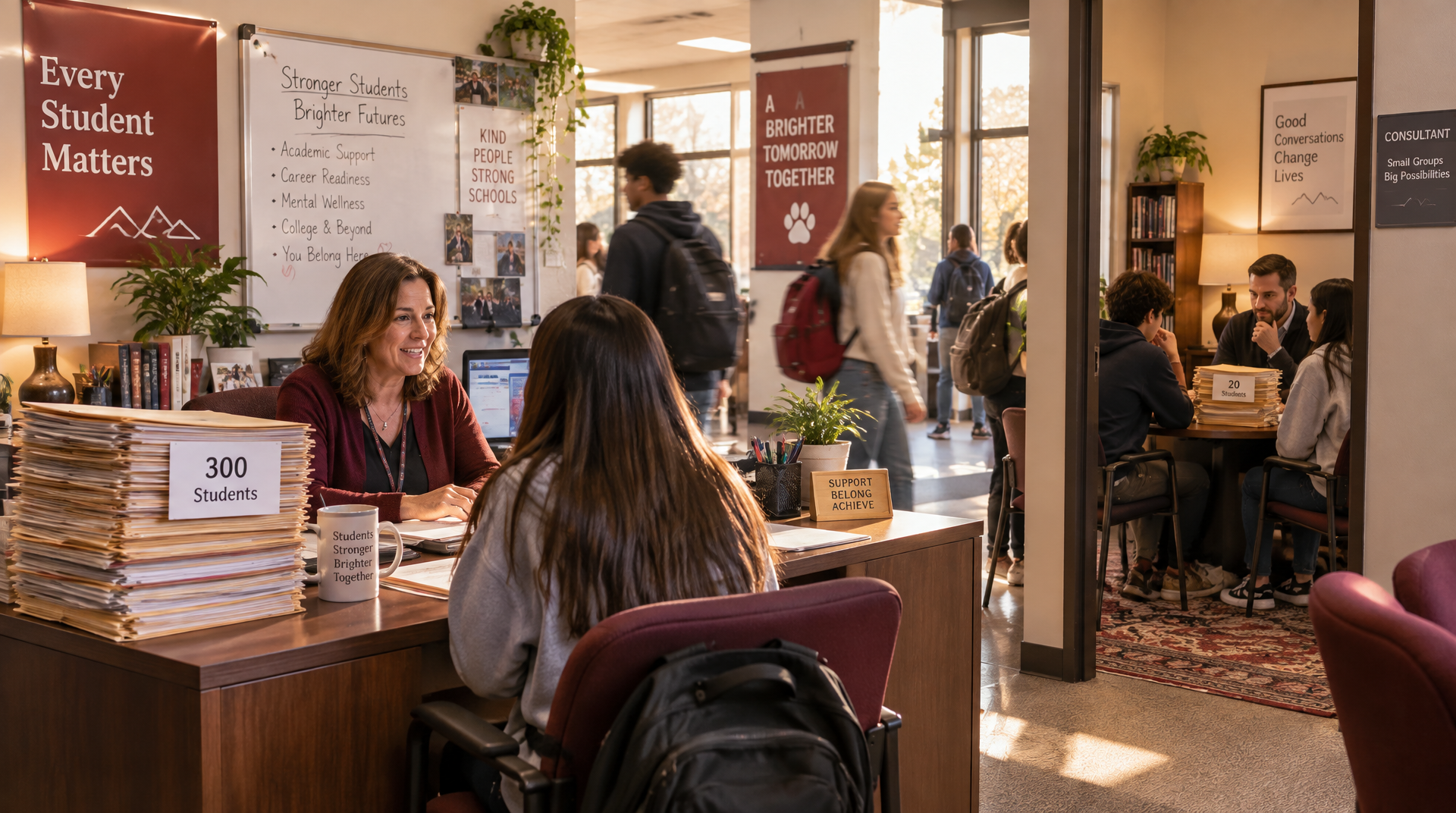
School Counselor vs Private Consultant: 300 Students Each or 20
October 17, 2026
The Short Version
- Public school counselors nationally average 372 students apiece, against the American School Counselor Association’s recommended 250-to-1 ratio. An estimate cited by Road2College puts college counseling at about 38 minutes per student per year.
- NACAC data indicates postsecondary counseling accounts for about 22% of a public school counselor’s time, versus 51% at private schools, where caseloads allow more attention.
- DC College Counseling publishes a 20-student caseload cap and an average of 70 work hours per student. That is a firm-specific model, not an industry rule.
- North Dakota law requires one full-time counselor per 300 students in grades 7–12, with up to one-third of that requirement met by certified career advisors.
- No single licensing standard governs private consultants, unlike the state-approved master’s programs required of school counselors.
School Counselor or Private Consultant? Start With the Math
A junior walks into her counselor’s office in October with a transcript, a test plan, and one question about early decision. Her counselor has maybe 15 minutes before the next student is at the door. That gap between what a student needs and what the calendar allows is where most families start asking about college admissions consulting in the first place.
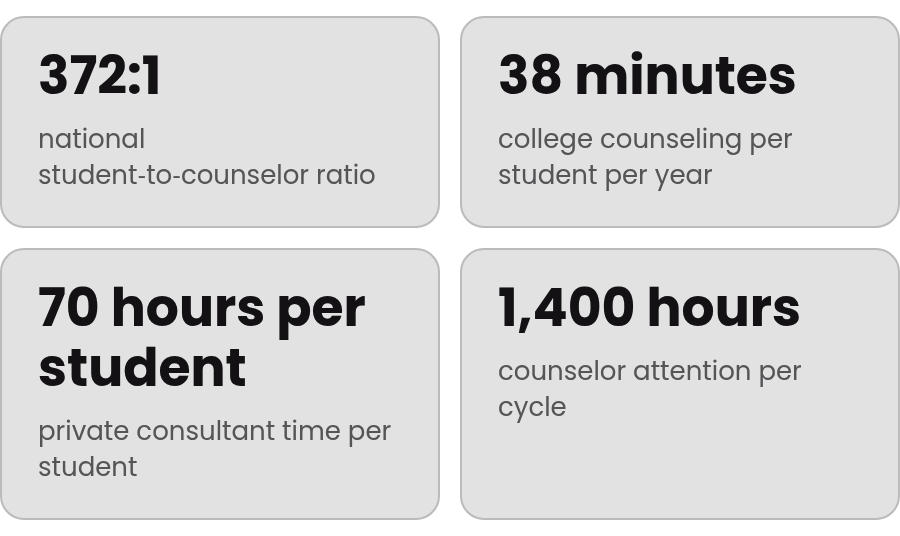
The arithmetic explains it better than any brochure. The American School Counselor Association has recommended a 250:1 student-to-counselor ratio since 1965, and the national average still sits at 372:1 for the 2024–2025 school year. North Dakota writes a floor into law: one full-time counselor per 300 students in grades 7–12, and up to a third of that obligation can be met by a certified career advisor. Public high school students average 38 minutes of college counseling per year, per U.S. Department of Education figures cited in this Road2College guide.
What College Admissions Consulting Actually Buys
It buys sustained blocks of time. The counselor’s day is crowded by design: the role carries academic advising, social-emotional support, and scheduling alongside postsecondary planning, so college work competes with everything else on the calendar. The National Association for College Admission Counseling’s data puts postsecondary counseling at 22% of public counselors’ time versus 51% at private schools. The role itself traces to a 1966 ASCA framework of consulting, counseling, and coordinating. College planning was never the whole job.
| School counselor (public) | Small-caseload consultant | |
|---|---|---|
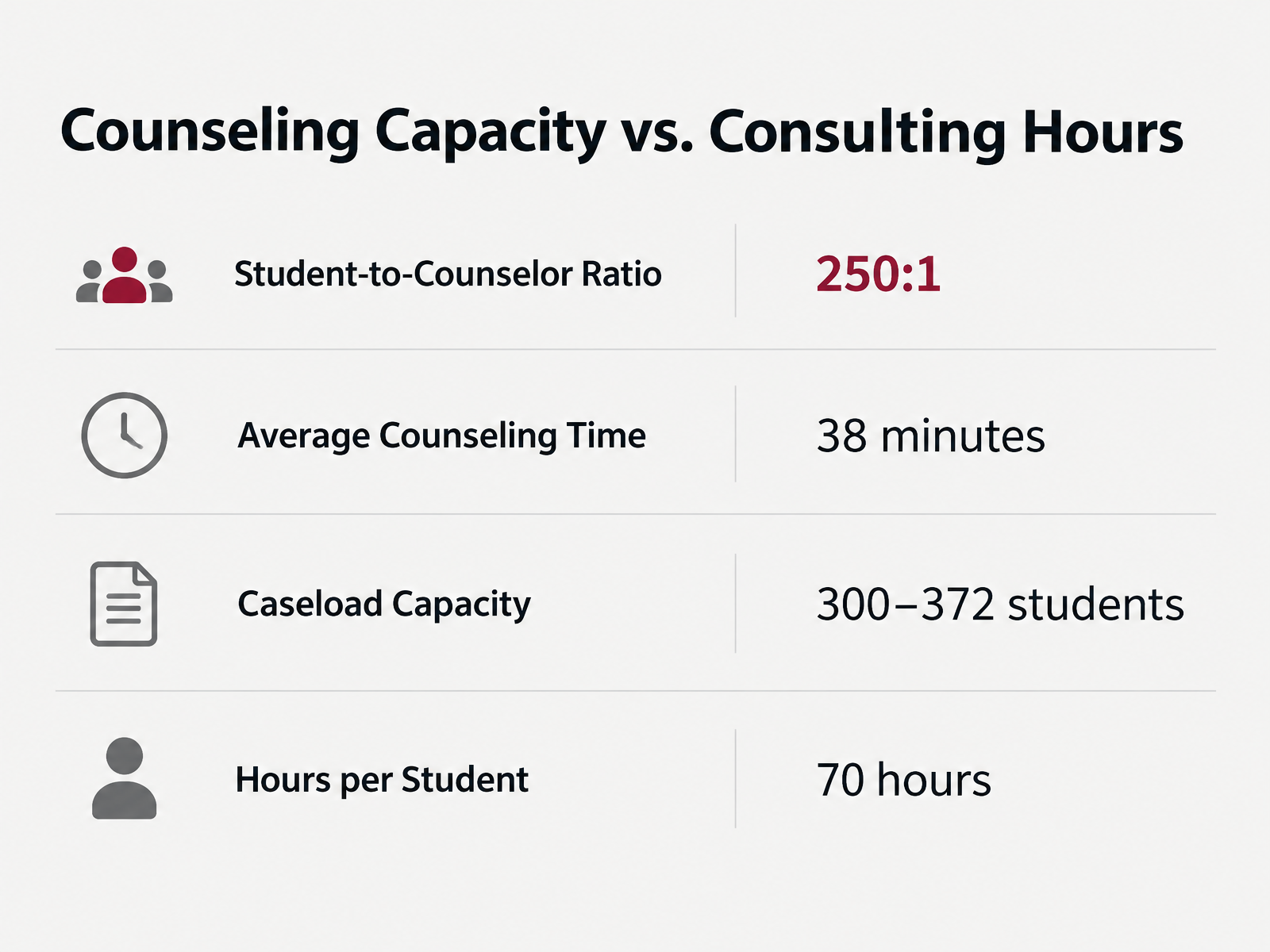
| Caseload | Often 300–372 students; national average 372 | 20-student cap |
| Time on college work | Roughly 22% of the week | 70 work hours per student |
| Mandate | Academic, social-emotional, postsecondary | Admissions process only |
| Credential path | State-approved master’s program | No single licensing standard |
The 20-student cap and 70-hour average are one firm’s stated model, not an industry rule. We also won’t defend pay-for-outcome fee structures; nothing in the available research supports tying consultant compensation to admission results, and consultants who guarantee outcomes are telling you something about their ethics.
For a student with a small list, a strong self-advocacy habit, and a counselor who knows them well, the counselor relationship may already provide much of the recommendation support that matters. Where outside support earns its cost is the student who needs someone checking in weekly.
If you’re weighing whether that’s your kid, our post on six signals you need a college admissions consultant walks through the decision honestly.
Endurable’s Approach: Start With the Caseload Cap
Most families decide to pay for help during second semester of junior year, when essay drafts, test dates, and aid forms all land in the same eight weeks. That’s usually when college admissions consulting stops being abstract. When families ask us how to compare providers, we tell them to ask one number before anything else: the caseload cap.
Caseload Is the Number That Predicts Actual Access
The tightest published benchmark in this space comes from DC College Counseling’s own account of its practice: a maximum of 20 students per counselor, with staff averaging 70 work hours per student, stacked on top of whatever the school counselor already provides. Run that arithmetic and it becomes concrete. Twenty families at seventy hours each is roughly 1,400 hours of counselor attention inside a single cohort’s application cycle. Close to a full working year of one person’s time before a single email goes unanswered.
Now set that against the load a school counselor is carrying. The American School Counselor Association recommends one counselor for every 250 students. Actual national averages have run well above the recommendation for years, and plenty of districts sit higher still. At that scale, sustained blocks of attention on one family’s essay revisions are not a matter of willingness. The calendar will not produce them.
None of this is an argument against school counselors, who are doing a different job with a different mandate. It is an argument about arithmetic: a caseload cap is the only number that tells you how much sustained attention is available to your student.
Across sources, the private-school advantage is partly a staffing story and partly a mandate story. A counselor with 35 students still answers to a school. A consultant with 20 answers to you, and Road2College notes that independent consultants focus on college counseling.
We read that quote the same way: no one can promise an acceptance letter, and we don’t. What we can do is take the fee question off the table as a source of anxiety. Our pricing follows a base-plus-bonus structure, where the base is paid up front and the bonus is tied to your satisfaction with our work, not to any admissions outcome. That is a commercial arrangement, not an independent research claim. Families aren’t paying a premium for a result nobody controls. They’re paying for the quality of the partnership, with a team of advisors reviewing essays and plans from more than one perspective, and with support that can begin as early as 8th grade. If your child is weighing whether outside help is warranted at all, these six signals are a better starting filter than any price sheet.
The One-Page Comparison Families Actually Ask For
A parent will sit across from us this spring with two numbers on a napkin: the size of her daughter’s class and the size of a consultant’s invoice. She wants to know which one buys real attention. We put the honest version of that answer on one page.
Any fair comparison of college admissions consulting against school counseling starts with the dimensions where a number actually exists. The published data supports some parts of that comparison and goes quiet on others.
| Dimension | School counselor | Small-caseload private consultant |
|---|---|---|
| Caseload | 372:1 nationally in 2024–25, against ASCA’s long-standing recommendation of 250:1; North Dakota sets a statutory 300:1 floor | A published maximum of 20 students per counselor |
| Time per student | Roughly 38 minutes a year on college counseling; about 22% of counselor time on postsecondary work | 70 reported work hours per student |
| Service focus | Academic scheduling, personal and social support, some postsecondary planning | Postsecondary applications only |
| Credentials | State certification through approved counselor programs | No comparable published benchmark |
| Cost to families | Provided through public schools at no direct charge | Market rates not established in available data |
| Contact outcomes | Associated with financial aid completion and enrollment in school-counseling research | No admission-rate data published |
One Column Has Numbers and the Other Has Silence
The outcomes column is where we push hardest. On the public side, the ratio question is well documented even if its effect is not settled: the national average sits at 372-to-1, well above the 250-to-1 benchmark ASCA has recommended since 1965, and one analysis argues that decades-old benchmark has little research behind it. Even researchers studying the question concede that little is known about varied caseloads. Meanwhile the private side has no admission-rate evidence at all. Anyone selling you a caseload number as an admission guarantee is selling something the research does not support.
The table favors a private consultant for one narrow job: project-managing a college list and essays with a published 70-hour model. Skip it if your student self-advocates, needs transcripts and scheduling help, and treats applications as a checklist. Your school counselor covers that at no direct cost, and the ratio gap, real as it is, does not change it.
The fee structure question deserves its own answer. A base-plus-bonus model is a commercial arrangement, not an evidence-backed admission lever. Families should ask whether any part of the fee is tied to admission outcomes rather than to the work itself.
Impact on Student Outcomes: What the Data Can and Can’t Say
A family sat with us last spring, holding a consultant’s quote in one hand and their son’s school caseload number in the other. They wanted one study that would settle the question. The uncomfortable part is that the research on college admissions consulting is far thinner than the research on school counseling, and we would rather say that plainly than dress a guess up as evidence.
The Ratio Research Is Real, and It Measures School Counseling
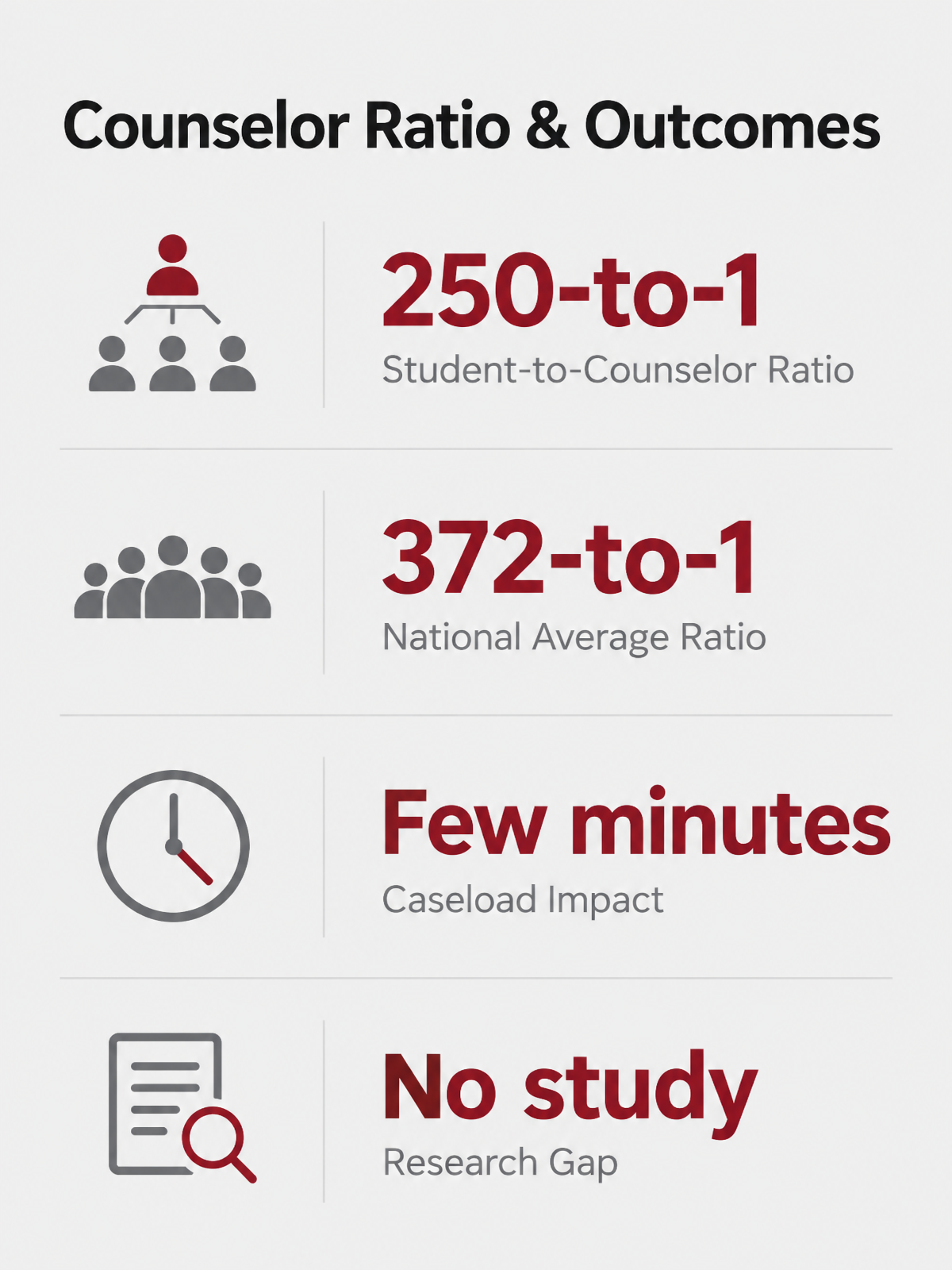
Start with the baseline the profession itself publishes. ASCA’s ratio guidance recommends a student-to-school-counselor ratio of 250-to-1, a benchmark the association has carried since 1965. The national average for the 2024–2025 school year was 372-to-1, according to the same page. Read that carefully. It describes schools, not families who hire help.
Contact is the ingredient families keep circling back to. The research on school counseling associates access to a counselor with college-going steps like financial aid completion and enrollment, and those findings tend to be associational rather than proof of cause. Still, they point at sustained time with a knowledgeable adult as what moves a student forward. One caveat worth naming: researchers have questioned the research basis behind the decades-old 250-to-1 benchmark, so treat the ratio itself as a professional guideline, not a measured law.
Where the evidence gets narrower is in what caseload size can and cannot buy. Studies in this area often find effects concentrated in particular outcomes, like graduation or college enrollment, and absent in others. A ratio tells you how stretched an office is. It does not tell you what happens in the twenty minutes your student gets.
| Question | What the evidence actually says |
|---|---|
| Does caseload track outcomes? | The association links ratio to outcomes such as attendance, discipline, and graduation, modestly |
| Does one-on-one contact matter? | Yes; counselor access is associated with financial aid completion and enrollment |
| Does ratio improve everything? | No; effects show up unevenly across outcomes |
| Do private consultants raise admission odds? | No published study exists |
Workload explains why contact is limited. When a caseload runs to hundreds of students, the minutes left for any single family are few, and college planning competes with scheduling, testing logistics, and crisis response. That is the structural squeeze ASCA’s own numbers describe, and it is why some families look outside the building.
Now the gaps we will not paper over. The available research contains no study linking private consulting to admission odds, no meta-analysis comparing school-only support against private consulting, no survey of student stress or confidence tied to either path, and no long-term data on career or alumni mentoring. What we can speak to is our own published track record: 50% top-10/Ivy admission and nearly all Top 35. Our model is a panel that reviews each student’s essays, activity list, and course plan, starting as early as 8th grade, with a base-plus-bonus fee structured as a shared-risk arrangement rather than as a proven lever. If your student’s list runs to in-state publics and the school counselor answers emails, the data gives you no reason to spend.
References
[1] School Counselor Roles & Ratios - https://www.schoolcounselor.org/about-school-counseling/school-counselor-roles-ratios
[2] US student-to-school-counselor ratio reaches 372:1 in 2024-2025 - https://www.facebook.com/AmericanSchoolCounselorAssociation/posts/new-ratios-released-new-data-indicates-the-student-to-school-counselor-ratio-con/1446533696849170/
[4] School Counselors | North Dakota Department of Public Instruction - https://www.nd.gov/dpi/educators/school-counselors
[5] School Counseling: Caseloads and Responsibilities - https://www.nacacnet.org/school-counseling/
[6] Independent Educational Consulting: Expert Guidance on the Rise - https://www.applerouth.com/blog/independent-educational-consulting-expert-guidance-on-the-rise
[7] Should You Hire a Private College Counselor? - Road2College - https://www.road2college.com/should-you-hire-a-private-college-counselor/
[8] Breaking Down School Counselor & Independent Counselor Differences ... - https://www.dccollegecounseling.com/blog/schoolcounselors
[9] Decades old student counseling benchmark has no research basis - https://hechingerreport.org/decades-old-student-counseling-benchmark-has-no-research-basis/
[10] Does Student-to-School-Counselor Ratio Matter When Considering ... - https://journals.sagepub.com/doi/10.1177/2156759X241304432
[11] Survey Shows Striking Disparity in College Plans Between Students at ... - https://eab.com/about/newsroom/press/survey-college-plans-public-versus-private-schools/
[12] The School Counselor Caseload and the High School-to-College Pipeline - https://www.researchgate.net/publication/264935377_The_School_Counselor_Caseload_and_the_High_School-to-College_Pipeline
Frequently Asked Questions
Does hiring a private consultant raise a student's chances of admission?
There is no published research linking private consulting to admission odds, and no meta-analysis compares school-only support against outside help. The well-documented ratio data describes schools, not families who hire consultants. A consultant promising an acceptance letter is telling you something about their ethics, not their results.
Can a student keep working with their school counselor while also hiring a consultant?
They should, and most caseload-capped models assume it. A small-caseload consultant typically stacks on top of school support rather than replacing it, since the counselor still owns scheduling, transcripts, and the recommendation letter. The overlap is the reason many families decide the extra hours aren't worth the cost.
Does a state law setting a caseload maximum mean more college counseling for my child?
Not necessarily. North Dakota's one-counselor-per-300-students rule for grades 7–12 covers academic, social-emotional, and postsecondary duties together, and up to a third of that obligation may be met by certified career advisors. Nationally, NACAC data puts postsecondary work at about 22% of a public counselor's week.
What should a family ask a consultant before discussing price?
Ask for the caseload cap first. A published maximum of 20 students is a useful reference point, and you can ask what caseload the consultant actually carries. Then ask whether any part of the fee is tied to admission outcomes rather than to the work itself.