Six Admissions Signals Ivy Officers Screen Before Your Stats Matter
October 21, 2026

TL;DR
A student can have a 4.0 GPA and still send an application that says very little. Another may have a solid but not perfect transcript, then show unusual depth through research, family responsibilities, or sustained service. The first step is academic readiness. The wider application should show how that preparation developed and what you did with it. We use six areas—academics, extracurriculars, athletics, personal qualities, recommendations, and the alumni interview—as an editorial audit, not an admissions formula.
Quick Summary
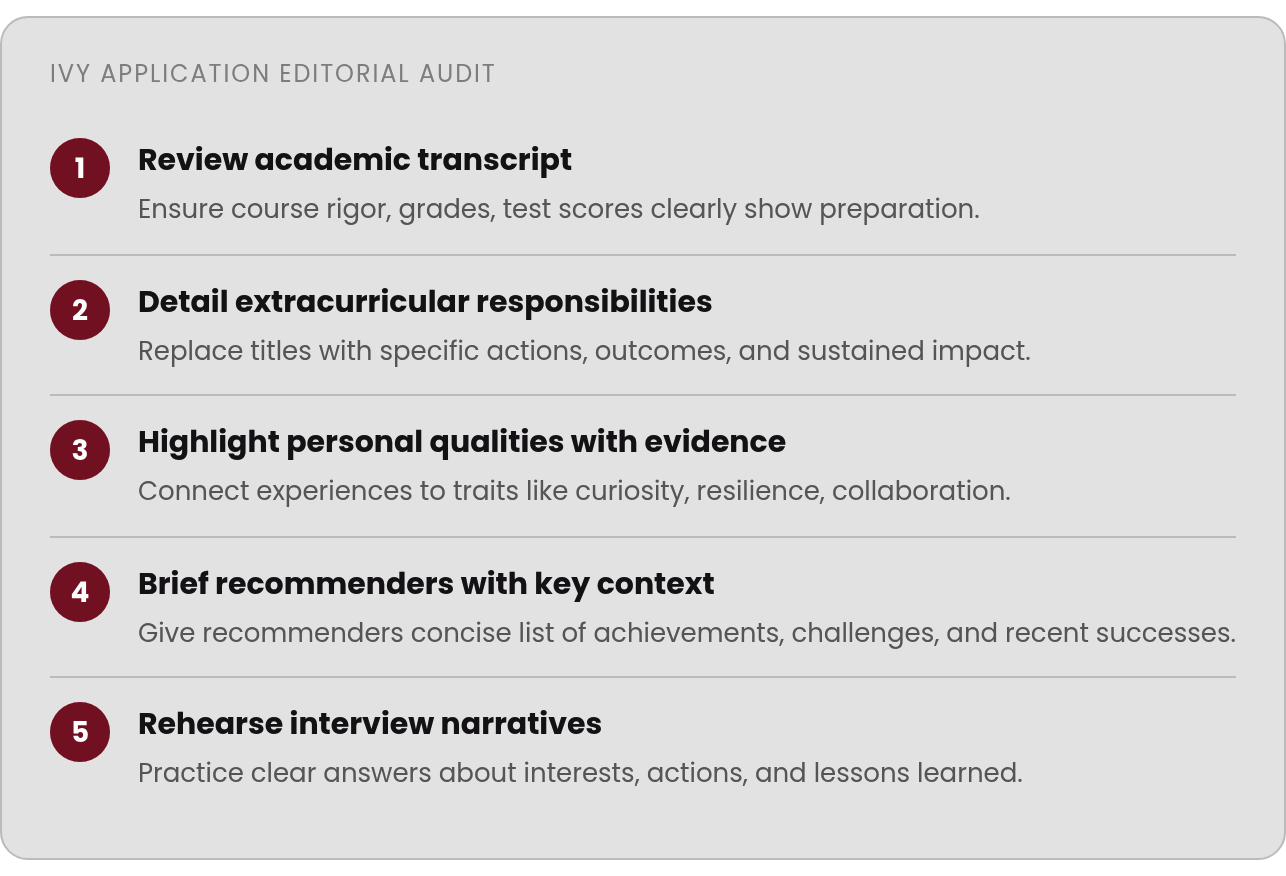
A secondary account of Harvard’s reading procedures organizes the review around academics, extracurriculars, athletics, personal qualities, recommendations, and the alumni interview. We use those categories as an audit, not an Ivy-wide checklist. Athletics belongs only if it reflects something real in your record; do not manufacture an interview theme or activity entry to look complete.
Can this six-area audit strengthen your application?
It can help you find missing context, vague descriptions, and evidence that needs clarification before submission. A broader study of holistic undergraduate admissions review found grades, test scores, and course rigor most important in the institutions studied. Academic strength comes first. The rest of the application should show how that preparation developed and what you did with it.
| Area | Audit example | Preparation stage |
|---|---|---|
| Academics | Transcript, course rigor, test record, original intellectual work | Record achievements as they occur |
| Extracurriculars | Roles, responsibilities, outcomes, sustained commitment | Build interests over time |
| Athletics | Participation, contribution, team context | Document meaningful roles |
| Personal qualities | Curiosity, resilience, responsibility, collaboration | Preserve specific examples |
| Recommendations | Information your recommenders can substantiate | Share context appropriately |
| Alumni interview | Experiences and reflections you can discuss clearly | Rehearse, do not memorize |
In practice, we ask whether the transcript shows sustained academic work, whether each activity explains role, action, and outcome, and whether recommenders and interviewers have concrete context rather than labels. Family employment, caregiving, financial constraints, or limited extracurricular opportunities deserve honest context when they shaped your experience.
Should you average the six ratings?
No. The Harvard-focused account describes an overall judgment across the six areas, not a numerical prediction or equal percentages. The broader study also found that institutions do not use one consistent definition of holistic review. Even when a school lists categories, it does not necessarily assign each one a fixed weight. Our final question is simpler: Can a reader understand your academic preparation and the significance of one or two meaningful commitments without decoding vague labels?
Why These Signals Matter
A student notices that one extracurricular description says almost nothing. Another student has less conventional academic credentials but a remarkable, sustained project. Which application looks stronger? There is no checklist answer because admissions readers consider academic and nonacademic information together.
The cited holistic-review research found that student, family, and school context often carried more weight than nonacademic factors. Performance and attitude were common inputs. That does not make personal qualities decorative. It means context can explain what a student had the opportunity to do and what the student did with it.
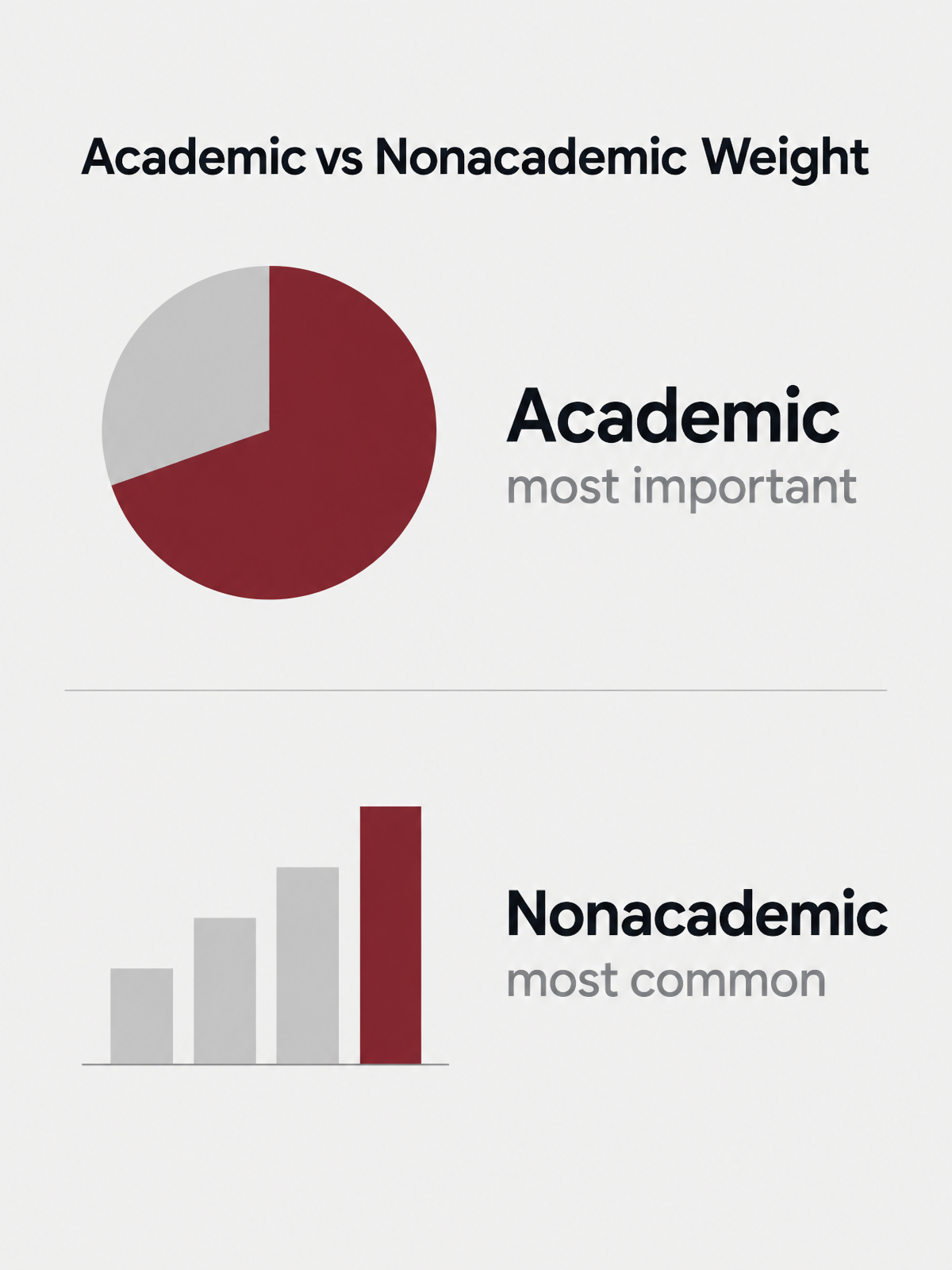
How do academics and nonacademic evidence work together?
The academic file usually establishes whether a student appears prepared for the demands of the college classroom. The wider application can show how that preparation developed, what responsibilities the student accepted, and how the student pursued interests outside class.
-
Confirm that your academic record makes your level of preparation clear. Review course rigor, grading context, and testing decisions for consistency rather than assuming every student should follow the same route.
-
Test whether your strongest activity reveals sustained responsibility, contribution, or intellectual curiosity. If you can list memberships but cannot explain your role, the record will feel thin.
-
Look for evidence of personal qualities rather than labels. Awards, recommendations, essays, and the alumni interview may reveal persistence, curiosity, or care, but only when they connect to particular experiences.
The sources create some tension. Context can matter greatly in holistic review, while the Harvard account gives structured attention to achievements and personal qualities. We reconcile them this way: context explains a student’s circumstances, but it does not replace evidence of what the student did.
An application should not ask a reviewer to infer an entire story from one unexplained line. State the relevant limitation, then show what you did with the access, time, and resources you had.
How should you use the deadline to finish the audit?
Work backward from the submission deadline, not from the day you begin drafting. A deliberate timeline gives you room to clarify details and gives recommenders time to respond.
-
Reserve time to revise activity descriptions, test every essay for specific evidence, and confirm that the application tells a coherent story.
-
Approach recommenders early with a focused list of accomplishments and context. Give them enough time to write from their own experience rather than repeat your résumé.
-
Build time for a final review of factual accuracy, unfinished supplements, missing documents, and inconsistencies.
This is a quality-control practice, not a claim that submitting earlier changes evaluation. Waiting until the deadline can rush the review. Leaving space often produces a clearer record. That discipline cannot manufacture academic strength, but it can prevent genuine strengths from getting buried in sloppy details.
Personal & Interpersonal Signals
A student may spend two years developing an impressive robotics project, yet “robotics team member” tells a reviewer little. Responsibilities disappear. The design process disappears. So does the evidence of persistence, collaboration, or independent work.
That is why we treat each application component as a chance to make earned evidence visible. The answer is not always to add another activity. More titles can make a thin record look even thinner.
Make Contributions and Personal Qualities Readable
Activities often offer the clearest evidence of personal qualities because they connect qualities to action. A reader should see what responsibility you accepted, what you did, and what changed.
-
Replace titles with specific responsibilities. “Treasurer” becomes more informative when you explain that you rebuilt the budget, reconciled monthly records, and presented a new spending plan. The title alone is not the evidence.
-
Show sustained involvement and meaningful contribution. Record when you began, what problem you addressed, and what changed because of your work. A few genuine responsibilities are stronger than a long list of vague claims.
-
Examine one experience from more than one angle. In your essay, explain the situation, your actions, and what you learned. Use the essay to communicate personal qualities, not to complete another admissions category.
-
Connect service to an identifiable need. You might identify a confusing school resource, redesign it, and distribute it to students. Documenting that work can show initiative, though no project guarantees a particular admissions result.
-
Seek depth before adding breadth. The secondary account of Harvard’s ratings argues that exceptional performance in one deeply developed activity can be enough to support the highest rating. One well-explained, consequential activity may communicate more than several unexplained memberships.
Give Recommenders and Interviewers Useful Material
Recommendations and the alumni interview depend on another person’s perception. Your task is to provide accurate context, not control the evaluation.
-
Give recommenders a concise factual brief. List relevant coursework, sustained activities, a recent accomplishment, and one challenge you handled. This can support their memory without scripting their assessment.
-
Leave room for independent judgment. Do not draft the recommendation or dictate its examples. A recommender should choose experiences they know well and describe you in their own words.
-
Practice explaining your interests and experiences. Try a short answer, a longer answer, and one example with a clear beginning, action, and lesson. This can improve preparation without establishing a measured link between interview performance and admission.
-
Distinguish evidence from self-description. Instead of calling yourself dependable, describe a situation in which you kept a commitment, completed a difficult task, or helped a group finish necessary work. Conduct gives the reader something to assess.
-
Keep details consistent across settings. A recommender, interviewer, and essay reader may encounter different versions of the same experience. Dates, roles, responsibilities, and outcomes should remain accurate even as you select the details most relevant to the question.
-
Treat original scholarship as possible academic evidence, not an admissions trick. A documented investigation, an independently developed research question, or an original analytical project may strengthen an academic record. The source associates Harvard’s highest academic rating with near-perfect credentials, unusual creativity, and possible evidence of original scholarship, but it does not establish that original work outweighs honors or guarantees admission.
One source emphasizes academic and contextual considerations, while the Harvard account gives explicit attention to extracurriculars, personal qualities, recommendations, and interviews. We do not treat that as a contradiction. Academics remain central. The personal sections should show how your experiences shaped your conduct, understanding, and direction.
References
[1] A Study of the Use of Nonacademic Factors in Holistic Undergraduate ... - https://www.researchgate.net/publication/331745463_A_Study_of_the_Use_of_Nonacademic_Factors_in_Holistic_Undergraduate_Admissions_Reviews
[2] How Ivy League Admissions Officers Rate Your Application - https://www.collegeadvisor.com/resources/ivy-league-application/
Questions People Ask
Can strengths in extracurriculars offset weak academic credentials?
Not reliably. Exceptional involvement can add meaningful context, but holistic review is not an arithmetic exchange in which one strength automatically cancels another weakness. Treat extracurricular distinction as supporting evidence, not as a substitute for academic preparation.
What should I do if my school offers few extracurricular opportunities?
Explain the opportunity constraints honestly, then provide evidence of what you did with the access you had. Reviewers still need specific examples of your choices, actions, and growth rather than an inference drawn from circumstances alone.
Does the six-area audit predict my Ivy League admission chances?
No. It is an editorial preparation tool, not an admissions formula. Use our audit to identify unclear evidence, missing context, and inconsistencies, not to calculate an acceptance probability.
Can I give recommenders a résumé so they write stronger letters?
A concise factual brief can help, but it should support—not script—the recommendation. Leave the evaluation and wording to them, because the letter is most credible when it reflects independent judgment.