6 Ivy League Admission Factors Families Spend On (And The Two That Rarely Matter)
October 18, 2026

TL;DR
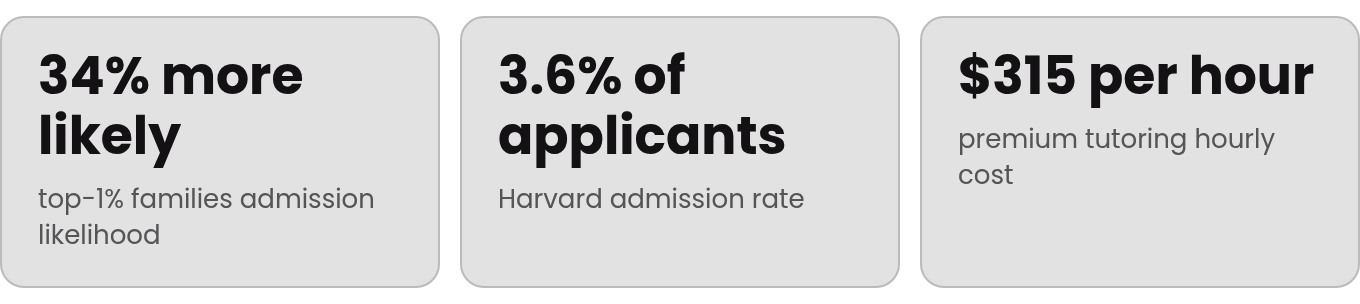
- Top-1% families remain 34% more likely to gain Ivy admission, even after controlling for identical 99th-percentile test scores.
- Two-thirds of the income-based attendance gap at Ivy-Plus schools comes from higher admission rates for wealthy students with comparable scores.
- Legacy preferences account for roughly 30% of the admissions advantage, nonacademic credentials for 20%, and athletic recruitment for 16%.
- Test-prep gains diminish once a student reaches the 95th percentile. Late-stage essay polishing can't compensate for weak resumes or late engagement with rigorous coursework.
- Top Ivies admit low single-digit percentages of applicants, making every credential seem decisive in ultracompetitive admissions.
Quick Summary
Understanding how to get into Ivy League schools starts with where families spend, and what spending actually changes. We've analyzed recent research linking parental wealth and admissions outcomes to separate documented value from expensive assumptions.
Where Families Spend
Families pursuing Ivy-Plus admissions often spend on test preparation, private tutoring, extracurricular development, college counseling, and sometimes private-school tuition or elite athletics programs. These aren't equal in cost or impact.
Test preparation and academic support represent the most visible spending category. Families invest in SAT or ACT tutoring, subject-specific instruction, and essay coaching through a range of formats—from group classes to intensive one-on-one sessions.
High scores clear an academic hurdle, but they don't erase the advantages associated with family resources. A prep course can improve exam performance; it cannot create the broader record admissions offices evaluate.
Other investment areas include long-term mentorship, strategic planning that starts in middle school, and application support. The research doesn't provide detailed cost data for these services, but they demand substantial time and resources.
Where Spending Doesn't Help
Two areas absorb significant spending but deliver inconsistent results: late-stage test-score optimization and last-minute application packaging.
Once a student is already performing at a highly competitive level, further preparation may sharpen a score without changing the application. Intensive essay polishing in the final months can't compensate for a resume that lacks depth or a transcript that shows late engagement with challenging coursework. Presentation can clarify a strong record; it cannot substitute for one.
The most effective investment is long-term: mentorship that helps students identify genuine interests early, build skills and experiences that reflect those interests, and make choices that align with their goals.
Why Wealth Still Matters
Among students who score at the 99th percentile on standardized tests, roughly 10% from middle-class families attend Ivy-Plus schools, while nearly half of their ultrarich peers with identical scores do. That gap isn't just about merit. It's about a system that rewards wealth at every admissions checkpoint.
We see families pour resources into test preparation, academic tutoring, extracurricular development, and college counseling because the stakes feel clear: top Ivies admit low single-digit percentages of applicants, so every credential seems to matter.
What the Research Shows
Elite colleges evaluate applications across multiple dimensions, grouping students by academic strength and other factors. Strong standardized test scores matter, but reaching a certain threshold doesn't guarantee admission. The difference between a very high score and a perfect score often matters less than families assume.
The research separates the wealth-related attendance gap into two parts: differences in admission rates among otherwise comparable applicants, and differences in who applies or ultimately enrolls. That distinction matters because some advantages operate before an admissions officer reads the file, while others affect how the file is assessed.
Legacy preference, nonacademic credentials, and athletic recruitment account for much of the admissions advantage associated with wealth. Legacy status can be inherited, athletic opportunities are concentrated in particular schools and communities, and nonacademic ratings reflect access to experiences and recommenders that are unevenly distributed. None of these advantages is reliably created through late spending.
Those factors explain why wealthy students gain admission at higher rates, but they don't explain everything that prepares students for postcollege success. That's the tension families face when budgeting for Ivy admissions. You can invest in credentials that build genuine intellectual capacity—rigorous coursework, meaningful projects, and sustained skill development—or in forms of polish that open doors because they are associated with privilege. The two categories don't always overlap.
Six Areas Families Invest In
When families ask us how to get into Ivy League schools, they often want to know where their money will actually move the needle. We've mapped the six factors that drive both family spending and admissions outcomes, then tested them against what the evidence actually shows about who gets in.
Three Areas Where Spending Buys a Credential, Not an Advantage
Standardized test preparation is the most transparent investment families make. One-on-one tutoring runs $50 to $200 per hour, while group classes average $30 to $100 per hour. Premium packages reach $315 per hour for 1500+ tutoring, and comprehensive courses range from $599 to $1,899. For students below competitive thresholds, these programs can produce meaningful score improvements; once a student reaches the 95th percentile, additional score-focused prep buys diminishing returns.

The investment buys access to consideration, not admission. Harvard's internal ratings show little difference between a 33 or 36 ACT; both earn a "2" in the academic rating. The spending gets you to the starting line, but crossing it requires advantages that prep courses don't sell.
Academic enrichment appears in the research as a rating context, not a pricing category. The sources document SAT/ACT benchmarks and GPA thresholds, but they don't provide prevalence or cost data for private AP/IB tutoring, college-level research programs, or academic summer institutes. What we know is that earning a "1" academic rating requires near-perfect scores plus "unusual creativity and possible evidence of original scholarship." Perfect grades alone won't do it.
Extracurricular coaching overlaps heavily with recruited-athlete preference, which is where family income shows up most clearly. The sports that drive admission advantages—fencing, crew, squash, sailing—are expensive to access and concentrated in private schools. Recruited athletes consistently gain admission at rates well above their non-athlete peers with similar academic credentials, and these admits come disproportionately from high-income zip codes. The available evidence doesn't itemize what families spend on elite coaching, club fees, or tournament travel, but it's clear that athletic recruitment is a wealth-correlated path that operates as an institutional preference, not a service families can purchase directly.
Three Factors That Operate Outside Family Control
Legacy preference is the largest single driver of the wealth advantage. Families can't purchase this advantage; they either have it or they don't.
Nonacademic ratings capture extracurriculars, leadership, and personal qualities, and wealthy students receive higher scores in this category even when test scores are identical. This isn't a line item families can budget for—it's an institutional network effect.
Donor-related contributions appear in the research as part of the broader legacy and wealth context, but the sources don't document how families allocate donations or what donor-related programs cost.
The pattern is clear: families can spend to meet the academic threshold, but the three factors that deliver the largest admissions advantage—legacy preference, nonacademic ratings, and donor relationships—aren't for sale on an open market. They're institutional preferences that correlate with wealth but don't respond to marginal spending.
Legacy and Development Cases
Legacy preference is the one factor families can't buy their way into. When a parent attended, the advantage is measurable; you can't write a check today to create it for your child applying next year.
Even controlling for academic qualifications, legacy applicants at Ivy League schools are admitted at roughly three times the rate of non-legacy peers. At Harvard, internal admissions data showed legacy status carried its own measurable rating advantage.
Development Cases and Donor Influence
Development cases—applicants whose families make extraordinary financial contributions—are frequently discussed in admissions circles, but the evidence on their impact is sparse. Admissions offices don't publicly acknowledge flagging development cases, and no published research quantifies what threshold of giving triggers consideration or how much it moves the admissions needle.
We see families assume that large donations will secure admission, but the mechanism is opaque. The factors wealthy families can directly invest in—test preparation, essay coaching, extracurricular programs, and strategic planning—tend to build real skills and credentials that serve students well beyond the admissions process.
That's the framework families should use when deciding where to spend: invest where the evidence shows a documented return, not where the mechanism is invisible and the outcomes are unproven.
Smart Spending for Ivy League Aspirations
Many families invest heavily in test prep and extracurricular coaching without stepping back to ask whether those expenses align with the factors that actually influence admissions decisions. The checklist below organizes your current spending around the documented factors—academic credentials, extracurricular depth, and the high-income advantages that remain beyond purchase—so you can attach each expense to an expected outcome and a stopping rule before reallocating dollars.
Audit Your Current Admissions Spending
Start by listing every admission-related expense from the past 12 months: test prep courses, private tutoring, extracurricular fees, college counseling, and any specialized programs. Assign each item to one of the documented categories: standardized test preparation, academic support, extracurricular development, legacy or athletic recruitment advantages, or other nonacademic credentials. Look for status-driven expenses—elite summer programs with minimal impact, or premium tutoring packages that pushed a strong score marginally higher without changing the application's overall strength.
- List all test prep spending (courses, tutors, materials) and note your student's current score percentile
- Identify academic tutoring expenses and whether they address genuine skill gaps or chase marginal GPA gains
- Catalog extracurricular costs and assess whether each activity demonstrates depth in one area or spreads resources across shallow participation
- Note any legacy, athletic recruitment, or donor-related advantages your family has—or explicitly doesn't have
Prioritize Evidence-Based Investments
Once you've mapped your spending, think about how you're allocating resources. If your student lacks legacy status or recruited-athlete potential, focus funds on building genuine intellectual depth rather than expensive nonacademic polish that signals wealth without demonstrating meaningful impact.
The strongest spending decisions address a real need: instruction that closes an academic gap, equipment that supports sustained work, or mentorship that helps a student pursue a serious interest. Free and lower-cost resources can also be effective when the student is motivated and the plan is consistent. A higher price does not automatically produce a stronger admissions result.
- Set a score threshold based on your target schools' middle-50% ranges and stop prep spending once your student reaches it
- Shift extracurricular spending toward one deep, multiyear commitment rather than scattering funds across surface-level activities
- Drop purely résumé-building expenses—leadership conferences, paid internships with no substantive work—that signal wealth without demonstrating impact
Reallocate Toward Depth and Purpose
Strong applications often come from students who invest time and modest resources into original work: publishing research, building a meaningful community project, or developing a skill to an advanced level. These pursuits rarely require the budgets families allocate to test prep or counseling packages. If you've been directing substantial funds toward marginal score improvements, think about redirecting some of those resources toward materials, mentorship, or entry fees for a project your student genuinely cares about. The admissions advantage comes from unusual creativity and evidence of original scholarship—qualities you fund through focus, not dollars.
References
[1] New Study Investigates Why Elite Colleges Favor Rich Kids - Forbes - https://www.forbes.com/sites/prestoncooper2/2023/08/22/new-study-investigates-why-elite-colleges-favor-rich-kids/
[2] Nellie Wartoft's Post - LinkedIn - https://www.linkedin.com/posts/nelliewartoft_study-of-elite-college-admissions-data-suggests-activity-7092157146519240705-vhoe
[3] Study of Elite College Admissions Data Suggests Being Very Rich Is ... - https://www.nytimes.com/interactive/2023/07/24/upshot/ivy-league-elite-college-admissions.html
[4] How Much Does ACT/SAT Tutoring Cost? - HelloCollege - https://sayhellocollege.com/blog/how-much-does-act-sat-tutoring-cost/
[5] SAT Prep Options | SAT Courses - The Princeton Review - https://www.princetonreview.com/college/sat-test-prep
[6] How Much Do SAT & ACT Prep Courses Cost? Part 2 - https://prepexpert.com/how-much-do-sat-act-prep-courses-cost-2/
[7] How Hard is it to Get into an Ivy League School? - C2 Education - https://www.c2educate.com/blog/getting-into-ivy-league-schools/
[8] How Ivy League Admissions Officers Rate Your Application - https://www.collegeadvisor.com/resources/ivy-league-application/
[9] Diversifying Society's Leaders? The Determinants and Causal Effects of Admission to Highly Selective Private Colleges - https://www.researchgate.net/publication/397079817_Diversifying_Society's_Leaders_The_Determinants_and_Causal_Effects_of_Admission_to_Highly_Selective_Private_Colleges
FAQ
If my child already scored in the 95th percentile, will another round of test prep help their Ivy chances?
Usually, the better question is whether the student has an academic weakness that preparation can address. If the answer is no, the next dollar may produce more value when directed toward sustained coursework, a serious project, or mentorship connected to an existing interest. A score should support the application rather than consume the time needed to build it.
Can we compensate for starting late by hiring premium college counseling in senior year?
A counselor can help organize materials, identify gaps, and present the student's record clearly. That assistance has limits, however. It cannot create years of coursework, leadership, or substantive work that were never pursued. Families beginning late should concentrate on accuracy, realistic school selection, and a manageable application process rather than trying to manufacture a dramatic profile.
Our family has no legacy connection, so should we focus spending differently than peers who do?
Yes. Without an inherited institutional connection, families should avoid treating paid polish as a substitute for substance. The more productive use of resources is to help a student pursue demanding work, deepen a genuine interest, and document what they learned or contributed. Those steps strengthen the application without depending on a preference the family cannot create.
Do private school students actually get better recommendation letters, or is that just perception?
The research associates private-school attendance with stronger outcomes in this part of the application, but a recommendation is only one element of a broader institutional context. Families should focus on giving teachers and counselors enough time and evidence to write specifically about the student's work, character, and development. Changing schools solely for a presumed admissions signal is not a reliable strategy.