7 Institutional Priorities Ivies Fill Before Academic Merit (And Which You Can Actually Influence)
October 21, 2026

TL;DR
- Penn has reported that about 85% of applicants are academically capable, yet most are still rejected. Academic readiness is a baseline, not the deciding factor.
- Legacy status may be an institutional consideration at some schools, but the sources reviewed do not establish that Early Decision gives legacy applicants the strongest advantage. If you don’t have this connection, you can’t create it.
- States like North Dakota, Wyoming, and West Virginia produce far fewer applications in selective pools, which may make those applicants less common in regional review—but that does not create an automatic admissions advantage.
- Recruited athletes can occupy a meaningful share of seats in some analyses, and one Harvard case-data analysis reports admit rates far above unhooked applicants.
Quick Summary
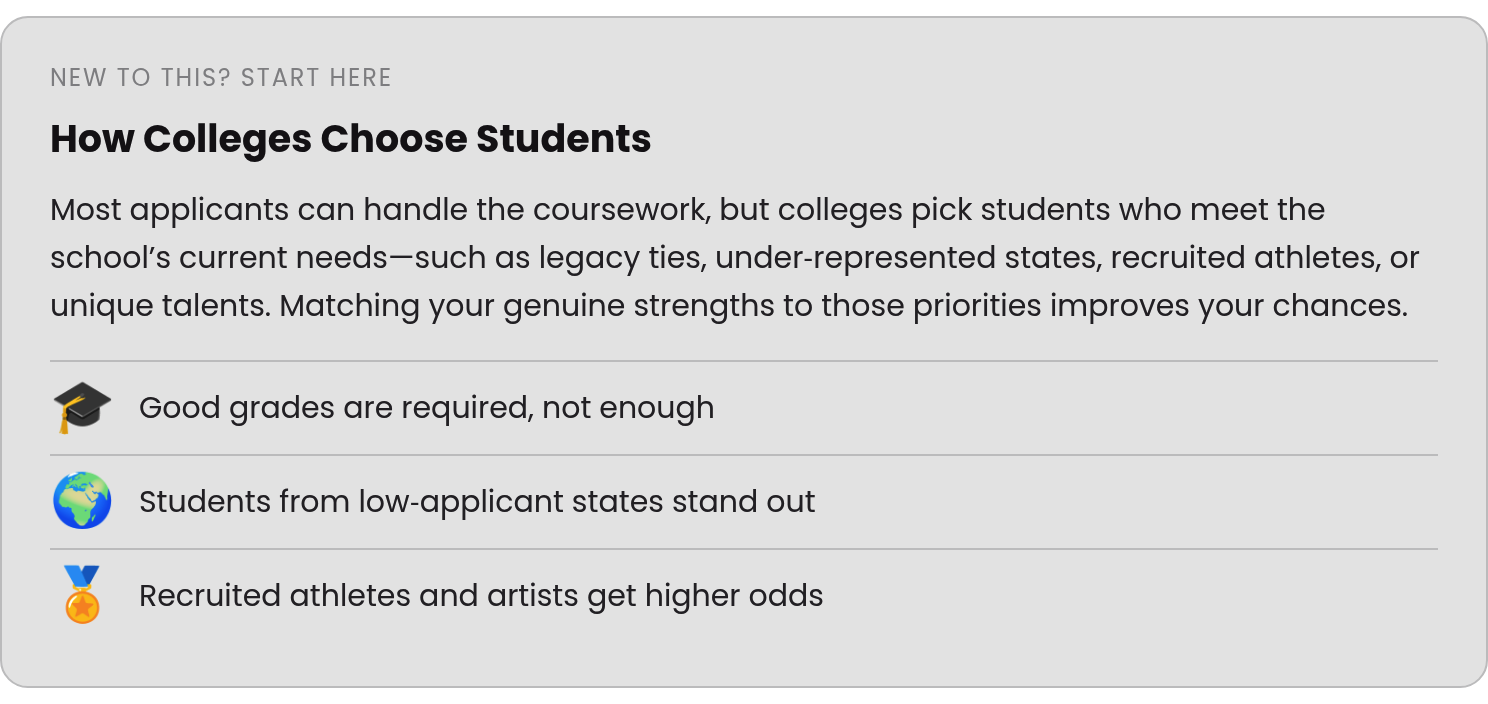
When a Penn admissions officer says 85% of applicants are academically capable but most still get turned away, the sorting mechanism becomes clearer: admissions is not only about who can do the work. It is also about which students fit the institutional needs that matter most to a given school in a given year—whether that’s a flute player, a goalkeeper for the men’s soccer team, or a student from a less-represented region.
This framework shows which institutional needs you might meet and what application choices you control. It is not a verified Ivy-wide selection order or a documented ranking—it is a lens for matching your genuine strengths to the priorities schools appear to care about.
| Consideration | Available Evidence and Limits | What You Can Control | Quick Action Tip |
|---|---|---|---|
| Legacy/Development | Some selective institutions report higher admit rates for legacy applicants; the sources reviewed do not establish a uniform Early Decision–specific advantage | Whether to apply Early Decision if you are legacy and believe it fits your priorities | If you are legacy, research the institution’s current policy; if not, don’t build your list around an inherited connection you lack |
| Geography | Some states and rural areas produce fewer applications, making those applicants less common in regional pools; this may not convert into an admissions edge | How you present your community ties and what you accomplished within local resources | Highlight specific local projects and results instead of treating geography as an automatic hook |
| Athletics | One Harvard case-data analysis reports recruited athletes admitted at far higher rates than unhooked applicants; athletic seats are limited | Whether to pursue formal athletic recruitment through NCAA channels | If you are a competitive athlete, contact coaches early through official channels; otherwise, treat this as outside your control |
| Arts | Portfolio, audition, and supplement routes let students document ability; not every school treats them as a talent-based admissions pathway | Quality, format, and fit of submitted work | Submit supplements only when the work is genuinely distinctive and connected to your academic narrative |
| Research Interests | Admissions commentary sometimes suggests unusual majors can balance a perceived applicant-pool imbalance, but the sources reviewed do not establish department-level preferences | How you document genuine intellectual engagement through essays, projects, or research experience | Research current departmental strengths and connect them to your demonstrated interests; don’t assume major choice alone drives decisions |
| Academic Fit | Strong academic performance is usually a baseline, not a differentiator. Most admitted students have rigorous records. | Course rigor and intellectual curiosity shown through electives and independent work | Take the hardest courses available in subjects you care about, not just the ones that pad GPA |
| Leadership/Character | Some holistic-review analyses identify leadership, engagement, and social values as nonacademic factors; published Ivy rubrics are not available | Depth of commitment, measurable impact, and how you frame what you learned | Show two sustained commitments with clear outcomes rather than ten shallow involvements |
Three Strategic Takeaways
Academic preparation remains central. Most applicants to highly selective schools are academically qualified but still rejected, meaning strong academics are necessary but not sufficient. Maintain the most rigorous curriculum available and pursue genuine intellectual depth in subjects you care about.
Institutional considerations distinguish academically capable applicants. Some admissions consultants describe examples of students connecting to a stated institutional priority, such as a school’s emphasis on interfaith engagement, and gaining admission early—but those are anecdotal illustrations, not a formula. Research each school’s current published priorities and show genuine connections between your interests and its goals.
You control how you document genuine strengths more readily than you control institutional needs. A humanities-focused applicant in a STEM-heavy pool might stand out if a school is trying to balance intended majors, but that is a possibility, not a documented admissions pathway. Focus on clear, truthful evidence of what you’ve built, learned, or changed rather than trying to manufacture advantages you don’t have.
Why Institutional Priorities Matter
Admissions officers build a class the way you’d assemble a team or cast a play. They are not ranking applicants by pure merit. They are looking at who fills which role, who brings something the incoming class lacks, and who addresses a specific institutional need that year. This is the article’s lens, not a verified Ivy-wide process.
A flute player may fill a literal gap in the orchestra. An applicant from North Dakota may be less common in a geographic pool. A philosophy major might balance out a cohort with many computer science applicants. These are examples of institutional thinking, not evidence that any particular applicant will be chosen.
These priorities shift. A profile competitive last cycle may not be in demand this year, through no fault of yours. For example, a school might expand its engineering cohort one year while another emphasizes humanities programs. Another institution may focus on specific research-lab contributions or interdisciplinary inquiry. Treat those examples as illustrative, not as predictions about a particular admissions cycle.
Class composition follows goals, not ranked merit
Holistic admissions weighs multiple dimensions. Admissions readers may verify that you can handle the academic work, assess how your circumstances shaped what you accomplished, then evaluate what you might contribute to campus. Schools differ in how they prioritize socioeconomic diversity, geographic representation, and particular talents or academic interests.
One cited analysis reports a 682-student socioeconomic-diversity gap at selective institutions. Because selective classes are largely fixed in size, that gap should not be read simply as a shortage of qualified applicants. It illustrates how compositional choices—not only academic qualification—can shape outcomes among students who are already academically competitive.
Admissions commentary often notes that highly selective colleges could fill their classes several times over with high-achieving applicants. The key question, then, is not only whether you can do the work, but what else your file signals to a particular institution’s readers.
Legacy, Alumni Giving & Geographic Diversity
Legacy and alumni-giving relationships are inherited circumstances, not application strategies you can manufacture. Selective institutions may admit legacy applicants at higher rates than non-legacy applicants, but admit-rate comparisons measure how often applicants with a given characteristic are accepted, not what share of the incoming class carries that characteristic. The actual proportion of legacy students in an enrolled class may be lower, and admission advantages vary across institutions.
Early Decision often shows higher admit rates than Regular Decision for several reasons, including self-selection and yield. That does not erase the selection pressure on Regular Decision applicants. Because early admits occupy seats in a relatively fixed class, the remaining pool may face more competition. The reported 682-student socioeconomic-diversity gap should be read the same way: fixed class sizes make compositional choices meaningful.
These patterns may reflect institutional choices about yield management and donor cultivation, not a judgment about comparative merit. If your family has no existing relationship with a university’s development office, you can’t create one through the application. If you are a legacy applicant, an advantage may exist in some pools; if not, you can’t invent it.
How to Present Geographic Context Without Manufacturing a Hook
Many selective schools receive heavy volume from California, New York, Massachusetts, and Texas, while drawing far fewer applications from places like North Dakota, Wyoming, or West Virginia. That imbalance can create regional scarcity, not a guaranteed hook. In a regional subcommittee discussion, such an applicant may be one of few voices from that geography.
You control how you describe genuine community ties, not your home address. If you led a rural broadband advocacy effort, coordinated COVID testing across three counties, or built the first computer-science club your high school offered, describe those responsibilities and results in concrete terms. In many selective admissions offices, regional staff contextualize accomplishments within the resources and opportunities your school and community actually provided. Fabricating hardship or overstating rural isolation backfires when the officer knows your high school profile.
Development cases—applicants whose families have substantial donor relationships—appear in consultant discussions as a named category. The sources we reviewed do not explain donor-threshold mechanics, institutional assessment processes, or family actions that improve admission odds.
Treat family background as context you accurately report when relevant, not leverage you invent. If you aren’t a legacy or development case, align your application with demonstrated strengths you have built, not inherited circumstances you can’t change.
Talent Recruitment: Athletics, Arts & Research
A junior plays varsity soccer, has a cello recording she’s proud of, and spent last summer cleaning data for a university lab. Each of those strengths reaches an admissions office through a different door. If you’re working with a talent, the channel you use may matter as much as the talent itself.
Athletic recruitment runs through coaches. In the Harvard case data, recruited athletes were admitted at far higher rates than applicants without a hook. Arts and research work go through the regular read instead. That first read is short, often cited as 8 to 15 minutes per file, so clarity wins. Don’t expect a talent scholarship either. Ivy undergraduate aid is generally need-based.
What Should You Verify for Each Target School?
Treat every rule as unconfirmed until it appears on the school’s current pages.
- Athletics: Pull eligibility, contact rules, and required materials from the institution’s current athletic and admissions instructions. Last year’s process may not match this year’s.
- Arts: Check whether the school accepts an arts supplement and the exact format it requires. Accepting your work is not the same as running a talent-based admissions pathway.
- Worksheet row: Log each school’s published recruiting contact, submission requirements, and deadlines. Leave dates blank until you verify them.
How Do You Document Talent and Research Clearly?
Readers respond to specifics that align with your stated interests, not vague prestige.
- Talent: State your contribution, your level of accomplishment, and how long you sustained the work.
- Research: Name the question you investigated, your methods, your personal role, and your findings or limitations. A summer lab doesn’t feed into admissions decisions on its own.
- Channels: Send portfolios or recordings only where the school permits them. Unrequested extras tend to get skipped.
Academic Fit, Intended Major Balance & Program Needs
When you tell someone you want to major in neuroscience, philosophy, or studio art, the first question you hear is often: “But what will you do with that?” The same worry shows up in college applications. Students assume admissions officers want declared STEM majors or pre-professional tracks because those signal focus and institutional utility. That assumption is not supported by the sources reviewed. Schools need humanities majors as much as they need engineers. They are forming a community, not staffing a corporation.
Some admissions commentary suggests colleges monitor intended-major balance, but the evidence reviewed does not establish rigid quotas or department-level admissions preferences. A philosophy applicant in a pool perceived as computer-science-heavy could stand out as a possible balancing candidate. That is a possibility, not a documented rule. The catch is that your declared interest has to make sense against everything else in your application: your coursework, your activities, your essays, and your recommendations.
What Does Academic Fit Actually Mean?
Academic fit is the match between what you’ve already learned and what a program offers. If you say you want to study computational biology, admissions readers may expect to see evidence: AP Biology and Computer Science courses, a summer research project analyzing genomic datasets, or a science fair project that combined the two fields. If your transcript shows mostly humanities electives and your activities list mentions theater and debate, the disconnect can weaken your application. It doesn’t mean you can’t apply as a biology or computational biology major—it means you need to explain the path that got you there.
Go past the rankings and study what a program actually offers and requires. Residential college systems, freshman seminar models, and junior independent work can all shape what your four years would look like. Read through a department’s course catalog, note the requirements, then connect those details to your own academic questions in your essays. That specificity signals you’ve thought beyond the rankings. It works best when it rests on a real foundation: a student’s genuine theater background, for example, becomes more persuasive when she pairs it with evidence she has researched what a specific program offers that her other schools don’t.
Some admissions analyses suggest class composition involves balancing intended majors alongside geography, athletics, and other dimensions. Schools may monitor which programs are over-enrolled and which need more students. An English major in a pool where a large share of applicants declare engineering or computer science might be seen as contributing to intellectual variety—but that is not a guaranteed advantage. The evidence reviewed does not establish major-specific intake targets or departmental admissions preferences, only that balance can matter in class construction.
Building a Priority Alignment Worksheet
Take a sheet of paper and create five columns: Demonstrated Interest, Supporting Work, Program Feature to Verify, Application Component, and Next Action. In the first column, write the academic question or field you’re genuinely curious about—not the major you think sounds impressive. In the second, list the coursework, competitions, internships, or independent projects that prove you’ve already engaged with that interest. These don’t need to be prestigious. A summer spent teaching yourself Python to scrape census data for a local nonprofit is more compelling than a generic research internship title if you can explain what you learned.
In the third column, identify a specific program feature you can verify: a particular lab, a cross-disciplinary certificate, a study abroad partnership, or a faculty member whose work aligns with your questions. Don’t list the feature because it sounds good. List it because you understand what it would let you do. In the fourth column, note where this connection belongs in your application—your “Why This School” essay, your main Common App essay, or your activities descriptions. In the fifth, write the concrete next step: email a professor to ask about undergraduate research opportunities, attend a virtual info session for a specific department, or read a recent thesis from the program to understand its scope.
Suppose you spent three years organizing a community garden that distributed produce to food-insecure families. You want to study environmental policy. You took AP Environmental Science and wrote your junior research paper on urban food systems. For the worksheet: your demonstrated interest is sustainable agriculture and policy design. Your supporting work includes the garden project, the coursework, and the research paper. The program feature you verify might be a college of agriculture and life sciences that offers an environmental policy concentration or a community-based food-systems lab—confirm the specific name and focus on the school’s current site before relying on it. Your application component is the school-specific supplement. Your next action might be to read faculty profiles in the relevant department and outline how your garden work connects to their research questions.
This exercise doesn’t promise improved outcomes. It organizes your thinking so that when an admissions officer opens your file, they see a student who knows why they’re applying and what they’ll contribute. That’s what academic fit actually measures.
Leadership, Character & Supplemental Materials (Essays & Recommendations)
Admissions commentary often describes personal ratings with anchors like “extraordinary” at the top tier and “minimal engagement” at the bottom. For most students, the question is simple: what evidence do admissions officers look for in a first read? A research study of holistic admissions practices at selective private colleges identified nonacademic factors officers actually use: performance measures like engagement, leadership, and teamwork, plus attitudinal traits including adaptability, ethics, and social values. These aren’t published Ivy rubrics, but they match what admissions offices often describe when explaining personal ratings.
Students often struggle with the gap between the activity and the evidence. Holding a club officer title doesn’t automatically demonstrate leadership. In this framework, readers may assess influence: did you solve a problem, mobilize others, or create something new? They may look for initiative: did you identify a need yourself, or were you handed a role? And they may evaluate impact: what changed because you were there?
Writing essays that make leadership concrete
Your essay isn’t the place to announce that you’re a leader. It’s where you show how you think when facing a specific situation. Admissions officers read hundreds of essays and can often distinguish between a polished narrative written for effect and authentic reflection.
Instead of “I learned the importance of teamwork,” a stronger passage might read, “When two committee members stopped responding to emails in October, I scheduled a fifteen-minute call with each to learn what had changed. One had picked up a retail shift that conflicted with our meeting time. We moved the meeting.”
That’s a structure principle: name the situation, describe your choice, and explain what you learned from the outcome. Keep your own observations and language. Revision should clarify and tighten, not replace your voice with someone else’s polish.
Helping recommenders write with context
You control what information recommenders have, not what they write. Prepare a brief summary for each recommender: list the projects and responsibilities they personally observed, include the time period and your specific role, and note any measurable results if they’re accurate.
A science teacher who supervised your independent research can describe your problem-solving approach and intellectual curiosity if you remind them which experiment you’re referencing. A coach who watched you work through an injury can speak to resilience if you provide the timeline. Recommenders choose their own assessments. Your job is to make their memory concrete.
Quantifying community impact without inflating it
Numbers clarify scale, but only when paired with an honest account of your contribution. If you organized a fundraiser, state the amount raised, the number of months it took, and who else worked on it. If you tutored students, specify how many, for how long, and what subject areas you covered.
Admissions consultants often note that depth in one or two sustained activities matters more than holding ten shallow roles. Officers may read applications multiple times during committee review. A claim that attributes an entire group’s result to one student’s leadership can read as exaggeration under that level of scrutiny.
References
[1] Institutional Priorities: How They Impact Students - https://collegeboundmentor.com/institutional-priorities/
[2] Ivy League Admissions Process: What Officers Look For - https://orieladmissions.com/ivy-league-admissions-process-what-officers-look-for/
[3] What the Heck are "Hooks" and "Institutional Priorities"? - https://www.collegeessayguy.com/blog/what-are-hooks-in-college-admission
[4] Ivy League - How to Increase Socioeconomic Diversity at the Ivies - https://todaysstudents.org/ivy-league-how-to-increase-socioeconomic-diversity-at-the-ivies/
[5] What Affects Ivy League Acceptance Rates the Most - Pathivy - https://pathivy.com/blog/top-5-factors-that-influence-ivy-league-acceptance-rates
[6] What Do Colleges Look For? Institutional Priorities - InGenius Prep - https://ingeniusprep.com/blog/athlete-legacy-admissions-advantage/
[7] Do You Need National Awards to Get into Ivy League Schools? - IvyWise - https://www.ivywise.com/blog/do-you-need-national-awards-ivy-league/
[8] What Ivy League Schools Are Really Looking For in Applicants - https://novellaprep.com/blog/what-ivy-league-schools-are-really-looking-for/
[9] How Ivy League Schools Review Applications - Fortuna Admissions - https://fortunaadmissions.com/college/how-ivy-league-schools-review-applications/
[10] A Study of the Use of Nonacademic Factors in Holistic Undergraduate ... - https://www.researchgate.net/publication/331745463_A_Study_of_the_Use_of_Nonacademic_Factors_in_Holistic_Undergraduate_Admissions_Reviews
FAQ
If I'm not a legacy applicant or recruited athlete, should I even bother applying to Ivy League schools?
Yes. Many admitted students do not have legacy or athletic hooks. Penn has reported that about 85% of applicants are academically capable, meaning the competition happens among qualified students, not just among those with inherited advantages. Focus on aligning your genuine strengths with specific program needs rather than comparing yourself to applicants with different structural advantages.
How do I know which academic departments a school is actually investing in this year?
Check the school’s strategic plan, recent press releases about new facilities or faculty hires, and departmental websites for announcements about expanded programs or research initiatives. These sources may reveal current priorities more accurately than outdated rankings. For example, if a university announces a new interdisciplinary institute combining philosophy and cognitive science, applicants with genuine interests in those fields may align with a documented institutional initiative—but that is still not a guarantee.
Does applying from a rural state guarantee an admissions advantage?
No. Geographic scarcity may make an applicant less common in a regional pool, but it does not guarantee admission. You still need strong academics and a coherent application. Officers may contextualize your accomplishments within what your school and community actually provided, so fabricating hardship or overstating isolation can backfire when they know your high school profile. Describe genuine community ties and region-specific responsibilities with concrete results instead of treating your address as an automatic hook.
Should I submit an arts or research supplement if my work is strong but not award-winning?
Only if your work is genuinely distinctive and connects to your stated academic interests. Generic participation may not move your application forward during an 8-to-15-minute first read. A portfolio or research abstract works when it demonstrates depth of practice and aligns with how you describe your intellectual direction in essays. If you can’t explain why this specific work matters to your application narrative, skip the supplement.
What's the difference between listing leadership titles and demonstrating actual leadership in my application?
Admissions readers may assess influence, initiative, and measurable impact rather than role names. A club officer title without evidence of what you solved, who you mobilized, or what changed because of your work can read as shallow involvement. Instead of writing “I learned the importance of teamwork,” describe the specific situation you faced, the choice you made, and the concrete outcome that followed, using your own observations and language.