Domestic vs International Applicants: Two Different Admissions Playbooks
September 26, 2026

Key Takeaways
- The "international applicant" label splits into two separate tracks: one governs how a college reads transcripts, the other governs visa status and funding eligibility.
- Cornell classifies applicants by where they currently attend school, so undocumented students and DACA recipients from U.S. high schools count as domestic.
- The University of Arizona Graduate College classifies by citizenship and residency at the time you apply, marking pending green card holders as international.
- A U.S. citizen finishing high school abroad submits records under international requirements, while a non-citizen at an American school follows domestic ones.
- International applicants typically face TOEFL or IELTS testing, institutional-only aid at need-aware schools, and a consular visa interview before they can enroll.
Why "International Applicant" Isn't One Label
Start here, because most families don't: "international applicant" is not a single admissions category. It's two tracks that overlap. One controls how a college reads the student's academic record. The other controls visa status, funding eligibility, and everything that happens after admission. The work I'd do first with any family is to pull those two questions apart instead of treating them as one label.
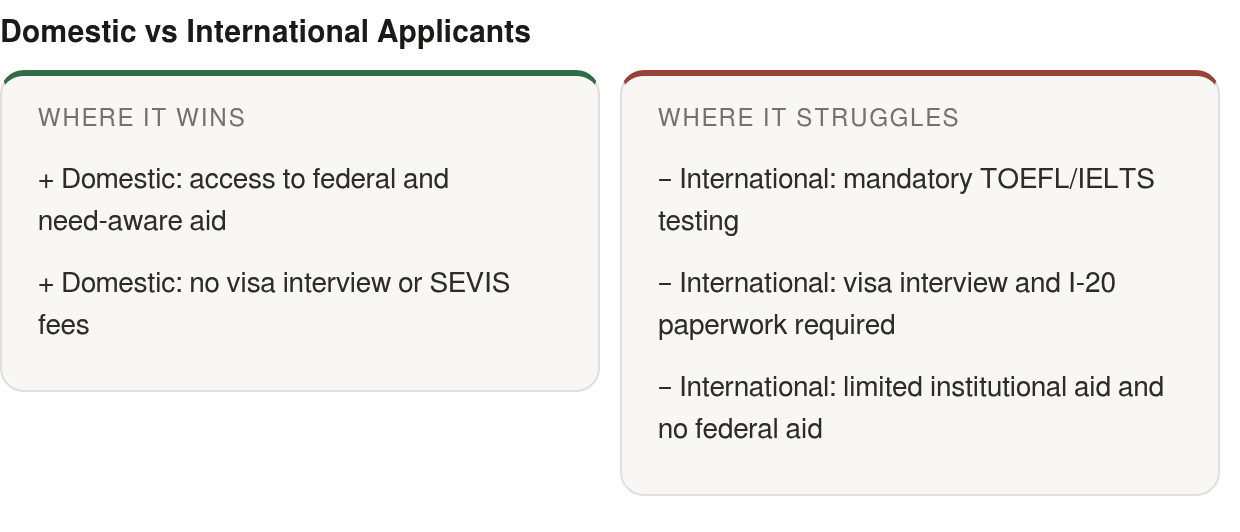
They often point in different directions. A student can present academic records through one process and still need immigration documents once admitted. So the planning has to name which track applies where, up front, because that single classification shapes deadlines, testing, financial planning, recommendations, and the way the student explains the file later.
How Do Colleges Decide If You're Domestic or International?
There's no universal rule. Classification shifts by school, and by what the label is being used to decide. Cornell reads applications by where you currently attend school, comparing you against peers from your school and region, not by citizenship. Undocumented students and DACA recipients who graduate from a U.S. high school count as domestic there.
Graduate programs often flip that logic. The University of Arizona Graduate College classifies by citizenship and residency at the time you apply. Green card pending with USCIS but not approved? You're international. Full stop.
Which means the same person can be domestic at one school and international at another. Re-check your status per institution before you write a single essay. Confirming classification early is how you avoid the costly mistake of submitting the wrong transcript format.
What Actually Differs Between the Two Playbooks?
The credential track drives your transcript and testing. The legal track drives your visa, your funding, and the interview stage almost nobody rehearses. Our advisors, several of them graduates of Harvard, Yale, and Princeton, help students map every phase, from the application itself through the steps that follow an acceptance.
| Dimension | Domestic Applicants | International Applicants |
|---|---|---|
| Classification driver | Citizenship or residency status | High school system or citizenship, varies by school |
| Academic record format | U.S. transcript standards | International credential rules per Common App guidance |
| English testing | Not required | TOEFL/IELTS often required |
| Financial aid | Federal and institutional aid | Institutional aid only, need-aware at many schools |
| Post-admission step | Enroll directly | Visa interview and I-20 processing |
| Support services | Advising, essay coaching | Advising plus visa-interview prep |
Why Does the Visa Interview Deserve Its Own Prep?
An acceptance letter is not a seat. For international students, the consular interview stands between admission and enrollment, and a shaky answer about intent to return home or how the degree gets paid for can undo a year of work.
During the application phase, each student gets customized mentorship through essay writing, interview preparation, and the milestones that come with the process. Regular check-ins keep no stage from becoming an afterthought. You can read more about that reader-room perspective in our Harvard acceptance insights.
Domestic applicants don't need this layer. Students who do need the consulate stamp should treat it as part of the admissions plan, not paperwork to sort out after the celebration.
Academic Credentials and Testing, Track by Track
The two playbooks split hardest when a college reads the transcript. The Common App's own guidance is blunt about it: a U.S. citizen who finished high school abroad submits records under international requirements, while a non-citizen who attended an American international school follows domestic ones.
Good admissions consulting pins down the credential track before a single test is booked. Get that first question wrong and the student can end up prepping for the wrong exam, explaining grades on the wrong scale, or writing an application that doesn't match the way the file will actually be read.
The Credential Track Runs on Your School System, Not Your Citizenship
The wrinkle families miss is that an admissions office can use one definition for academic review and another for tuition, aid, or immigration paperwork. Undergraduate admissions through the Common App focuses on the school system, because that's what tells a reader how to interpret coursework, grading, and exams. Some graduate offices use legal status instead, since they're sorting applicants for residency and funding.
So a student may need one strategy for presenting classroom performance and a separate one for enrollment logistics. We build each student a plan that names the right credential track from the start, then checks each college's policy before the application is finalized. Cornell's own classification notes are a good reminder that this gets answered school by school, not assumed across a whole list.
Testing and Curriculum Expectations by Track
The pieces line up differently depending on the academic system behind the file. The curriculum column matters later too, because a student should be able to explain why their coursework prepares them for the U.S. major they picked.
| Element | Domestic-track record | International-track record |
|---|---|---|
| Transcript format | U.S. GPA scale, U.S. high school | Home-country system, often needs conversion |
| Common curricula | AP courses, U.S. diploma | IB, A-Levels, national board exams |
| English proficiency | Not usually required | TOEFL/IELTS often required |
| Standardized tests | SAT/ACT per school policy | SAT/ACT plus English proof |
Test-optional policies don't erase every testing question. A school may waive one exam while still asking for language evidence, or a clearer benchmark from a grading system its readers see less often. Confirm each school's current policy directly. These requirements shift year to year.
Where Our Test Strategy Diverges by Applicant Type
We build test plans around the track a student sits in. A domestic-track student with strong AP results may lean into a test-optional pitch if the rest of the record is clear. An international-track student on A-Levels often benefits from pairing a competitive SAT with a clean TOEFL, since that combination helps a reader understand both academic readiness and classroom fluency.
That credential clarity pays off twice. It sharpens the application, and it gives the student a coherent way to talk about the file later. We walk through how readers weigh these signals in our breakdown of what wins in Harvard's reader room. Heavy GPA-conversion work may be unnecessary only when a school explicitly accepts raw foreign transcripts.
Financial Aid, Scholarships, and Funding Strategies
Money is where the two playbooks separate fast, and it loops right back into the visa stage families forget. A domestic student fills out the FAFSA, taps federal aid if eligible, and compares packages. An international applicant faces a shorter list of open doors and a longer list of school-specific rules. Funding and school-list strategy are one connected problem here, not two.
The financial paper trail matters beyond affordability. When an international student sits for the visa interview, the officer wants proof the degree can be paid for. Aid packages, scholarship letters, and family financial documents all become part of that evidence. Families who understand this early can build a list around realistic enrollment, not just admissions odds.
The Aid Doors Open Differently for Each Track
Domestic and international applicants play by different rules from the very first form. The contrast below is worth understanding before you settle on a target list.
| Funding element | Domestic applicant | International applicant |
|---|---|---|
| Primary aid form | FAFSA | CSS Profile (school-dependent) |
| Federal aid access | Yes | No |
| Need-based institutional aid | Widely available | Limited to specific schools |
| Merit scholarships | Broad eligibility | Narrower, often competitive |
| Ties to visa interview | Minimal | Direct proof of funds |
For international applicants, part of the school list should be built around which campuses actually fund students on their visa status. Applying to a need-aware school with no plan for the gap is how strong candidates get admitted and then can't enroll.
Skip the generic scholarship-hunting spreadsheet if your target schools don't offer aid to international students. That time is better spent documenting funds for the interview. We tell families to confirm each school's international aid policy first, then chase external scholarships second.
This is where customized planning earns its keep. We tailor each student's school list to their goals and profile, so the list you build is one you can actually enroll in. Drawing on decades of admissions experience and a track record across Ivy League and top-tier schools, our team runs a collaborative panel that pressure-tests those decisions from several angles.
Visa, Documentation, and Post-Admission Logistics
Acceptance letters feel like the finish line. For international families, they're the starting gun. The paperwork that follows an offer is where enrollment actually gets won or lost, and it's the stage too many consulting plans treat lightly.
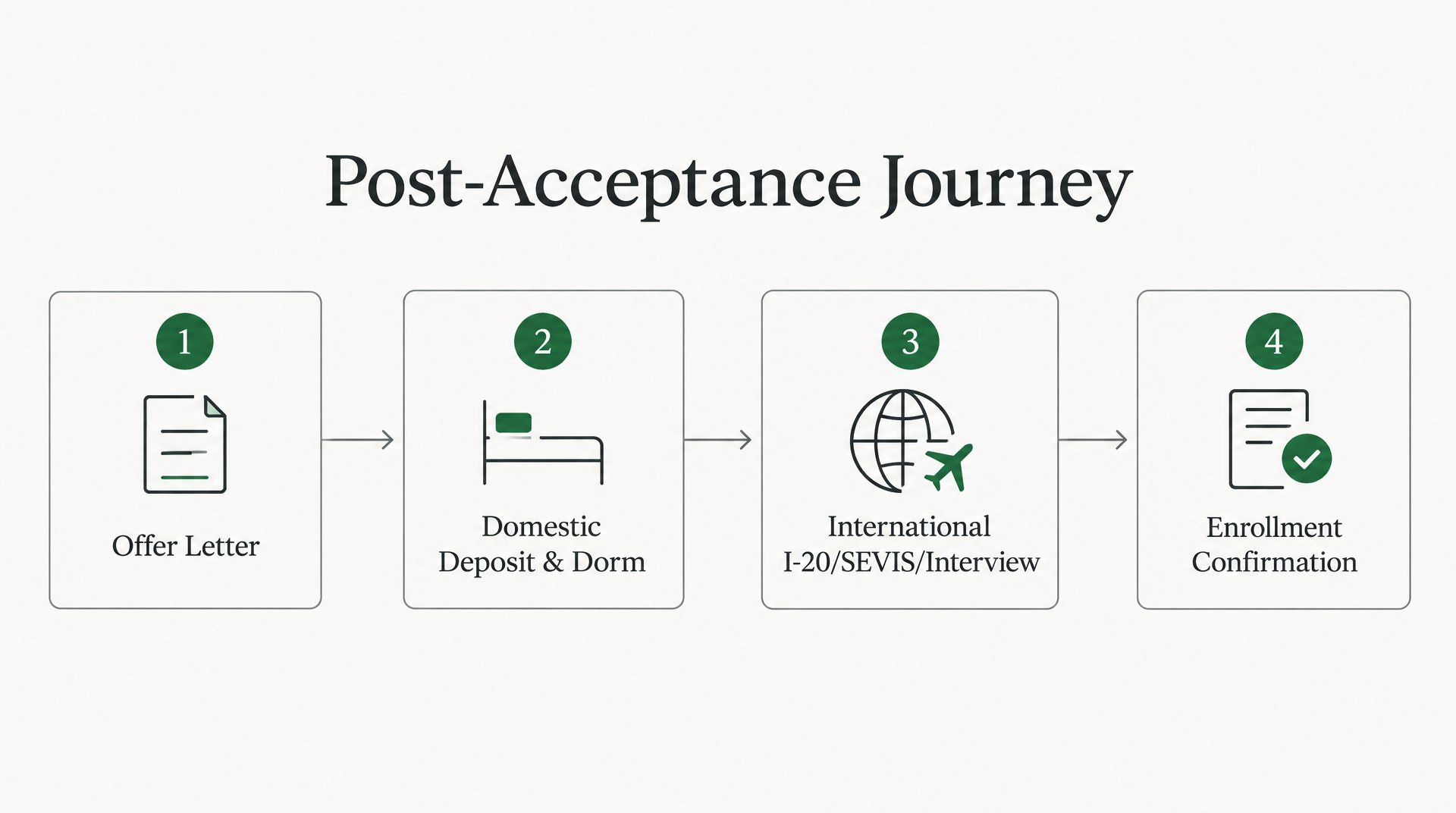
A U.S. applicant confirms enrollment, pays a deposit, and books a dorm. An international admit does all of that plus a second track: the school issues an I-20 (or DS-2019 for exchange students), the student pays the SEVIS fee, then schedules a consulate interview for an F-1 or J-1 visa. Miss a link in that chain and the seat waits without you.
Where the Two Playbooks Diverge
Once the offer lands, the tracks split sharply, and the international one adds steps on a timeline you don't fully control.
| Post-acceptance step | Domestic admit | International admit |
|---|---|---|
| Enrollment deposit | Yes | Yes |
| Housing deposit | Yes | Yes |
| Proof of health insurance | School-dependent | Usually required |
| I-20 / DS-2019 issuance | Not applicable | Required before visa |
| SEVIS fee + visa interview | Not applicable | Required |
| Credential evaluation + document translation | Rarely | Often |
Document translation and credential evaluation catch families off guard. Transcripts issued in another language typically need certified translation, and some programs want a course-by-course evaluation before they finalize the file. Start that early. It runs on institutional timelines you don't set.
The consulate interview is its own hurdle. An officer wants to see that the academic plan is credible, that the funding story is documented, and that the student can explain the record without sounding rehearsed or confused. The interview-prep discipline we build during the application phase, part of the customized mentorship every student gets, gives students practice speaking clearly about their goals. Our growing alumni network adds a community of students who've already managed competitive admissions. You can see how our reader-room thinking works in our Harvard acceptance breakdown.
One caveat: if you already hold citizenship or a green card, skip the visa track entirely. This prep is for students who need the consulate stamp. For them, work authorization paths like CPT and OPT belong in the plan from day one, not after graduation.
Recommendation Letters and Counselor Support
Recommendation letters get treated as an afterthought, and that mistake costs international students twice. The first cost is obvious: a weak file. The second is quieter. When a student later has to explain why a U.S. school was the right fit, strong letters can reinforce a consistent academic story. That's why we help international students shape the whole application so the file reads clearly whether it lands in the admissions office or comes up again after the offer.
Domestic applicants usually submit two subject-teacher letters plus one from an academic counselor who knows the U.S. system cold. International applicants may work with a counselor who has never written for an American committee, sometimes in a second language, and may need supplemental letters to fill context gaps.
Where the Two Letter Playbooks Diverge
| Element | Domestic Applicant | International Applicant |
|---|---|---|
| Core teacher letters | 1-2 subject teachers | Same, but may need translation |
| Counselor letter | School counselor fluent in U.S. norms | Counselor often unfamiliar with U.S. format |
| Common supplemental | Coach, mentor | Employer, community leader, program director |
| Language risk | Low | Higher; tone and idiom get lost |
| Visa relevance | None | Reinforces your enrollment story |
The language barrier is the piece families underestimate most. A counselor abroad might write a heartfelt letter that reads flat once the nuance drops in translation. U.S. readers expect specific anecdotes, comparative ranking, and plain claims about character rather than titles and formalities, so it helps to understand those norms early.
Our Panel Approach to a Multi-Advisor Strategy
Our collaborative model brings several sets of eyes to every part of the application. The team, which includes Harvard and Yale graduates, works as a panel to give students detailed feedback on applications and essays, drawing on the same signals we break down in our look inside Harvard's reader room.
For international students, that feedback keeps the essay, activities list, and supporting materials pointed at one consistent story. Consistency matters because readers shouldn't have to assemble a student's identity from disconnected pieces. The file should make the academic direction, the personal strengths, and the institutional fit feel aligned.
Endurable Education's Dual Playbook: Support for Both Cohorts
Most consulting firms pick a lane. They either coach American teenagers through the Common App, or they specialize in moving students across borders. The families who get stuck are the ones who need both at once. That's the gap our consulting is built for, because we run both playbooks under one roof.
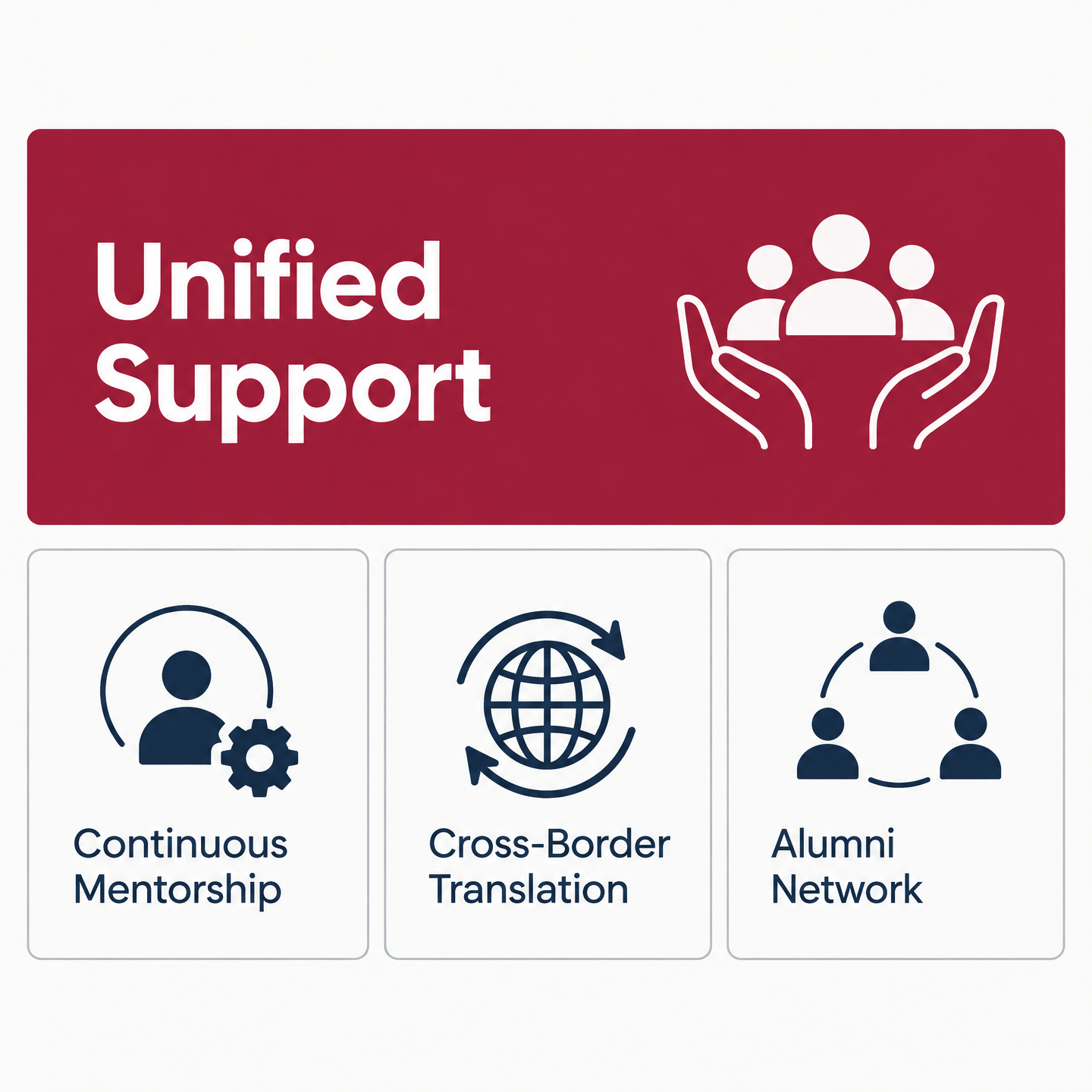
A domestic-only firm can polish essays but may go quiet the moment an I-20 lands in the inbox. An international-only firm may know the paperwork chain cold yet not fully understand how a U.S. reader interprets voice, rigor, recommendations, and fit. We don't hand students off at the seam between those two jobs. The team carries a student from customized planning through panel counseling and long-term mentorship without dropping the thread.
The Cross-Border Experience Generic Firms Skip
The application itself is where cross-border experience earns its keep. We prep international students the way we prep everyone: with specifics. That means helping them translate a background built across different school systems into an application a U.S. committee reads clearly, drawing on our Harvard, Yale, and Princeton credentials and a track record ranked #1 in Mainland China for admissions to Harvard, Yale, Princeton, Stanford, and MIT. A file that tells one coherent story reads as credible. A file that scatters raises flags.
That same alumni network serves both cohorts, which is the piece single-track firms can't copy. Domestic applicants get insider reads on committee expectations. International applicants get that identical insight plus counselors who have guided hundreds of case studies across the US, China, the UK, Canada, Hong Kong, Mexico, and more.
| Dimension | Endurable Education | Domestic-only firm | International-only firm |
|---|---|---|---|
| Essay & credential coaching | Both tracks | Strong | Limited U.S. fluency |
| Panel-based application review | Core service | Varies | Varies |
| Harvard/Yale alumni access | Both cohorts | Rare | Rare |
| Long-term mentorship | Yes | Varies | Often one-cycle |
| Pricing structure | Base plus outcome-based bonus | Flat fee | Flat fee |
A caveat worth saying plainly: if your file is a straightforward domestic application with no cross-border complexity, a strong domestic-only firm may serve you fine. Our dual experience pays off most when both a U.S. application and an international background touch the same file. That's the family we're built for.
Where This Leaves You, and What to Do Next
International admits still have documents, deadlines, and interviews to manage after a college says yes. That's the part a domestic plan never accounts for, and it's where dual-track consulting earns its cost: the application has to be strong enough to win the offer and organized enough to turn that offer into an actual seat on campus.
The Two-Track Decision Matrix at a Glance
| Decision Point | Domestic Track | International Track |
|---|---|---|
| Credential reading | Set by U.S. school system | Set by where exams were sat |
| Testing | Standard U.S. calendar | Plus English proficiency, scale conversion |
| Funding | FAFSA, federal aid | Fewer doors, more forms, aid becomes visa evidence |
| Post-offer steps | Deposit, dorm | Deposit plus I-20, SEVIS, consulate interview |
| Recommendations | U.S.-fluent counselor | Counselor often unfamiliar with U.S. committees |
Read the matrix top to bottom and the pattern jumps out. The international column always carries an extra load, and that load keeps going after the decision arrives.
Where Our Track Record With International Students Helps
If you want a team that has guided students across both tracks, that's where our experience runs deep. Our advisors include graduates of Harvard, Yale, and Princeton, and we've been ranked #1 in Mainland China to Harvard, Yale, Princeton, Stanford, and MIT admissions for the past five years. That comes with customized planning and a collaborative panel shaped by hundreds of case studies across the US, China, UK, Canada, Hong Kong, Mexico, and more. We treat the U.S. reader room as something we know how to manage for domestic and international students alike.
Timing is the thing to act on now. Early Decision and Early Action deadlines fall in the coming weeks, and consulate appointment slots tighten fast once offers go out. Book your initial consultation this cycle, not next. For a closer look at how a coherent file wins, read our Harvard reader-room breakdown.
References
[1] Domestic vs International Applicant - https://membersupport.commonapp.org/s/article/early-decision-hzreaejs
[2] Domestic vs International Applicants | Graduate College - https://grad.arizona.edu/admissions/types/domestic-vs-international-applicants
[3] Am I considered a domestic or international applicant? - https://cornelladmissions.happyfox.com/kb/article/478-am-i-considered-a-domestic-or-international-applicant/
Frequently Asked Questions
Can the same student be classified as domestic at one school and international at another?
Yes. A student's label can change because each institution defines the category for its own purpose: academic review, residency, tuition, aid, or immigration processing. Do not copy one school's answer across the whole list. Check the policy for each campus and, when necessary, ask admissions in writing.
I'm a U.S. citizen who finished high school abroad. Do I still deal with the visa track?
No. Citizenship removes the visa requirement. The academic side may still require extra care, though, because records earned outside the U.S. can be evaluated under a different credential system. Plan for transcript formatting, grade interpretation, and curriculum explanation even if immigration paperwork is irrelevant.
Do test-optional policies help international applicants the same way they help domestic students?
They can help, but they do not always simplify the file in the same way. International applicants may still need to prove classroom readiness and English fluency through other materials. Before dropping any exam, confirm whether the college separates standardized testing from language documentation.
What is the difference between an I-20 and a DS-2019?
They are school-issued documents tied to different visa categories. The correct form depends on the student's program type and status. After the school issues it, the student follows the required fee and appointment sequence before traveling for enrollment.
Do green card holders and citizens need the same post-admission prep as other international students?
No. Citizens and green card holders do not need the consular portion of the process. Their planning should focus on ordinary enrollment steps and, where relevant, how their academic background is presented to the college rather than on visa approval.
Why would financial aid documents matter at the visa interview?
Because affordability is part of the enrollment story for students who need a visa. The student should be able to show that the funding plan is realistic, documented, and consistent with the college's offer. This is why aid strategy should be built before the application list is final.
How should international applicants handle recommendation letters written by a counselor unfamiliar with U.S. norms?
Give the counselor context early. The best support includes concrete classroom examples, clear comparison to peers, and direct evidence of intellectual or personal strengths. If the school letter cannot provide that context, a carefully chosen supplemental recommender can add useful perspective.
When should international admits start credential evaluation and document translation?
As soon as the college requests them. These tasks often involve outside evaluators, school offices, and official records, so they can move slowly. Treat them as enrollment requirements with their own timeline, not as clerical details to handle at the end.