Cornell's Acceptance Rate Hides Wide Gaps Between Its Seven Colleges
September 25, 2026
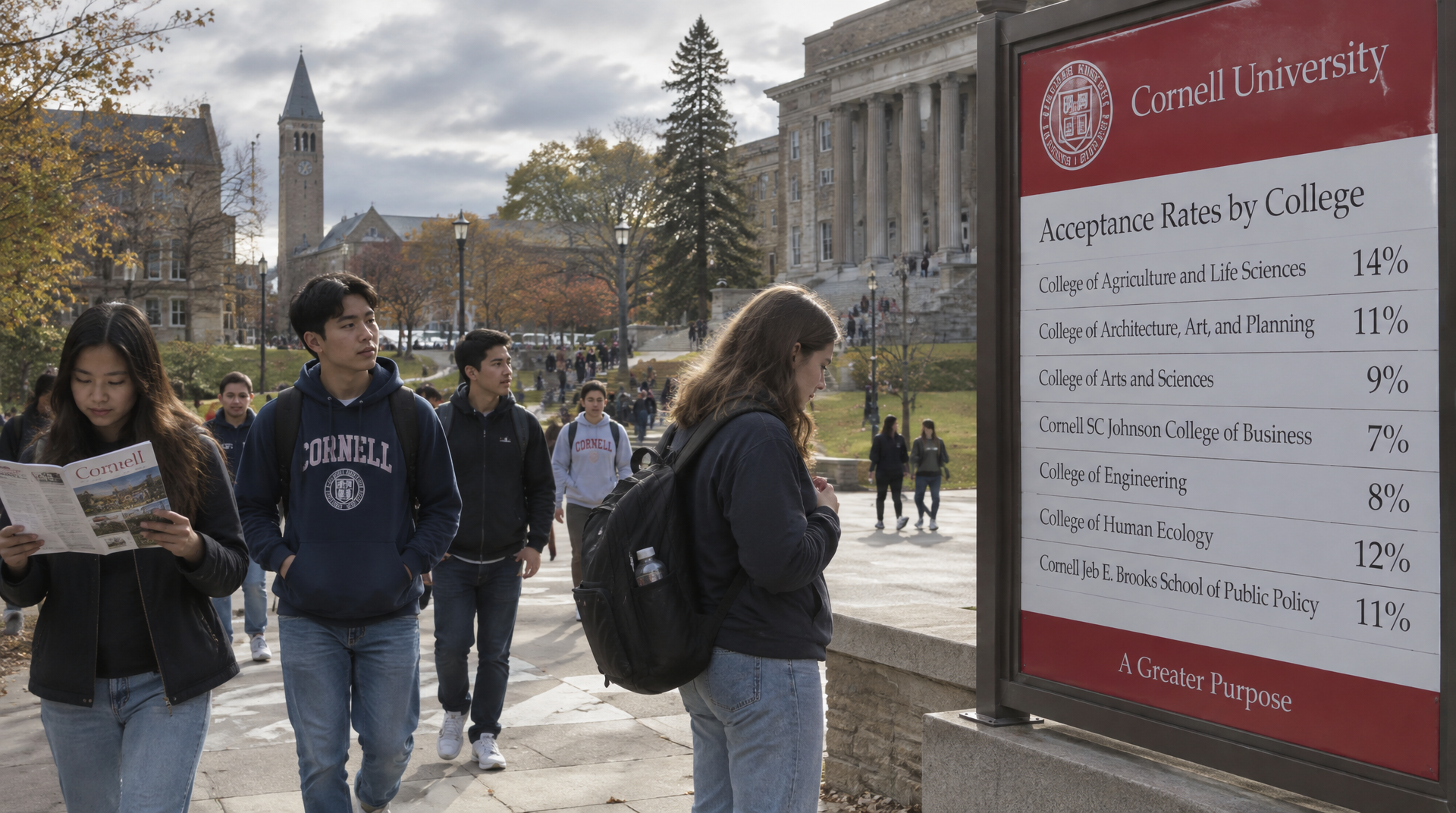
Before we get into it, the short version:
- Cornell admitted 5,516 of 65,612 applicants for the Class of 2028, an 8.4% overall rate that blends seven separately reviewed colleges.
- The regular round for the Class of 2028 ran tighter than the headline, admitting just 7.8% of applicants.
- Cornell's early-decision admit rate fell sharply in the latest cycle.
- In that 2024-25 early round, only 1,161 of 9,973 early-decision applicants got in.
- Each of Cornell's seven undergraduate colleges reads files independently, and the university stopped forwarding mismatched applications between units once volume passed 72,000.
- Cornell turns away 93% of high-achieving applicants, which means strong numbers are the entry fee, not the deciding factor.
What That 8.4% Actually Hides
The 8.4% overall rate for the Class of 2028 is a mirage. That one number folds together seven undergraduate colleges that each run their own review, which is why families should stop treating "getting into Cornell" as a single decision. You apply to one specific college. Your odds move depending on which one.
Here is what the data supports. Cornell admitted 5,516 of 65,612 applicants for the Class of 2028, and the regular round ran tighter at 7.8% (per College Transitions). Cornell publishes clean admit numbers at the university level, not per college, so the table below is built around the strategic fit each college rewards, not around per-college admit rates that no one actually reports.
Which Cornell college fits your story, and why
| College | Strategic edge we watch for |
|---|---|
| Arts & Sciences | Broadest pool. Depth in one academic story matters more than range. |
| Engineering | Math-heavy profile; quantitative strength should be evident across the file. |
| Agriculture & Life Sciences | Land-grant mission favors NY applicants and research fit. |
| Human Ecology | Niche programs reward a clear "why this major" case. |
| Industrial & Labor Relations | Small, focused; policy and labor interest must be genuine. |
| SC Johnson (Nolan + Dyson) | Business-specific coaching pays off; Dyson is among the most selective units. |
| Architecture, Art & Planning | Portfolio and studio fit carry the file. |
| Brooks School of Public Policy | Newest unit, smallest cohort, sharpest positioning needed. |
Because each college reviews applications on its own, the smart play is matching your record to the college that fits it. That kind of student-by-student planning is core to how we work.
The early-decision problem, in one paragraph
Early decision at Cornell is binding, and that is the catch. ED locks you into one college before you can compare financial aid offers, so the round you pick carries real weight for any family watching cost. The quick version:
- ED binds you before you can compare aid packages. For a low-income applicant, that means surrendering the ability to weigh competing offers.
- Each college admits separately, and Cornell no longer shuffles mismatched applications between units. Pick a college for its rumored odds instead of genuine fit under ED, and you get no second chance while still bound to the commitment.
- The overall rate misleads. A small, focused unit like Brooks and a broad pool like Arts & Sciences are not the same contest.
- Strong stats are the floor, not the story. Fit and a specific "why this college" case decide the margin.
Why the Cornell Acceptance Rate Deserves a Closer Look
One acceptance rate tells you almost nothing about the decision a family actually faces. That gap gets sharpest for low-income applicants once you look at how the early round has shifted. Any conversation about Cornell should start there, because the early-decision "boost" families have chased for years is shrinking fast.
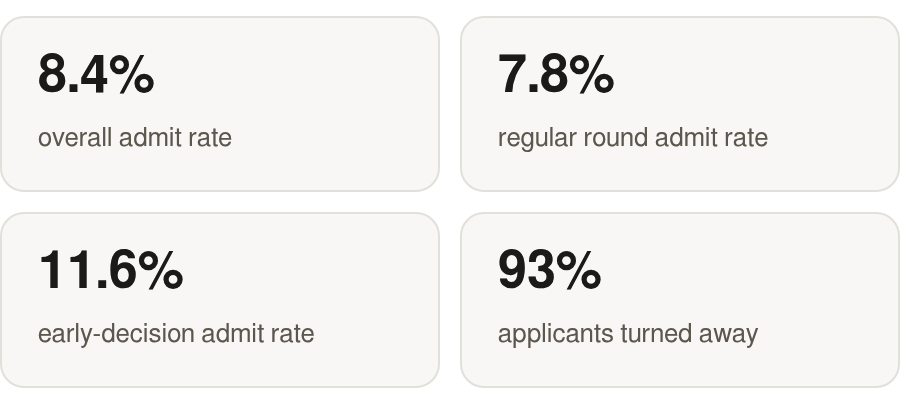
The direction is clear. Cornell's early-decision admit rate has dropped hard over recent cycles, from a much larger advantage for the Class of 2024 to a far narrower one in the latest reported round (per College Transitions and Cornell's own class profile). The old statistical argument for committing early no longer holds the weight it once did.
Why the early-decision math punishes low-income students
Early decision is binding. You commit to enroll before you can compare financial aid offers. For a full-pay family, that gamble may feel manageable. For a low-income student, it can mean giving up the chance to weigh Cornell's package against another Ivy, a liberal arts college, or a state flagship offering merit money.
That trade made more sense when the early round looked like a much bigger lift. It makes far less sense now that the advantage has compressed. We flag this early with families who qualify for significant need-based aid. Often the smarter move is the regular round, where every offer stays on the table.
How the seven-college structure compounds the risk
Cornell does not read applications centrally. Your file goes straight to the one college you named, and each office judges fit on its own terms. Cornell also stopped forwarding mismatched applications between units once volume made the practice impractical (as a former A&S admissions officer explains).
Stack that on top of ED and the risk multiplies. Pick a college for a rumored advantage instead of real fit, do it under a binding agreement, and a fit mistake becomes an irreversible, aid-blind bind. There is no second chance. You can only apply to one Cornell college.
| Round | Class of 2024 | Class of 2026 | 2024-25 cycle |
|---|---|---|---|
| ED admit rate | ~24% | 21% | 11.6% |
| Aid comparison possible? | No | No | No |
| Binding commitment? | Yes | Yes | Yes |
So how should this shape your list?
Treat the acceptance rate as a planning tool, not a target. The real questions are which college fits your record, whether early commitment costs you aid flexibility, and whether the remaining early advantage is worth that cost. We build lists around fit and aid first, then decide on timing. Our take on the Ivy admissions constraint check works the same way.
If you need to compare offers, skip ED. The evidence no longer backs the gamble.
The Overall Cornell Acceptance Rate, in Ten-Year Context
The number quoted in every ranking guide is a decade low, but it hides a longer story. Cornell's overall rate has bounced between 7.3% and 10.7% across the last five entering classes, and this single figure is really an average of seven separate contests. It tells you almost nothing about the college you actually apply to.
Here is the context most families skip. The pandemic-era surge pulled the rate down fast, then it settled into a tight band. We treat that band as the real baseline, not the headline year everyone repeats.
The overall rate is a moving target, not a fixed bar
| Entering Class | Applicants | Admits | Overall Rate |
|---|---|---|---|
| Class of 2024 | 51,500 | 5,514 | 10.7% |
| Class of 2025 | 67,380 | 5,852 | 8.9% |
| Class of 2026 | 71,164 | 5,168 | 7.3% |
| Class of 2027 | 67,846 | 5,358 | 7.9% |
Those figures come from College Transitions' admissions data. Notice the jump in applicant volume once test-optional review took hold. Applications climbed by roughly 20,000 in two cycles while admit counts stayed flat. That math alone explains most of the compression.
There is a sourcing wrinkle worth flagging. One analysis puts a recent cycle at 8.7% on 72,523 applications (per Top Tier Admissions), a different count than the numbers above. These are adjacent cycles, not a conflict. The lesson: always pin a rate to a specific class year before you build a plan around it.
Test-optional widened the funnel, not the door
More applications did not mean more seats. When the pool grows and the class size holds, the denominator does the damage. For a low-income student, that reshapes the early-decision calculation directly. A larger, more anxious pool pushes more strong candidates toward the early round chasing an edge the data no longer guarantees.
That matters because early decision can force the timing of the financial choice before the family has enough information. The seven-college structure sharpens the risk, since a strong application is not redirected if the first-choice college says no. A student who treats one Cornell unit as a backdoor to another is planning around a process Cornell abandoned.
The waitlist is not a backstop
Families often treat the waitlist as a soft landing. The Class of 2024 numbers take that apart. Of 6,750 qualified applicants offered a waitlist spot, 4,791 accepted the offer, and only 190 got a fall seat (per Cornell's class profile).
That is under 4% of those who waited. For a student who needs to compare packages, banking on the waitlist is worse than a rejection, because it stalls every other decision. Build the list around college-level fit and financial range, not around the overall number or a waitlist hope.
College-by-College Acceptance Rates: What Cornell Won't Tell You
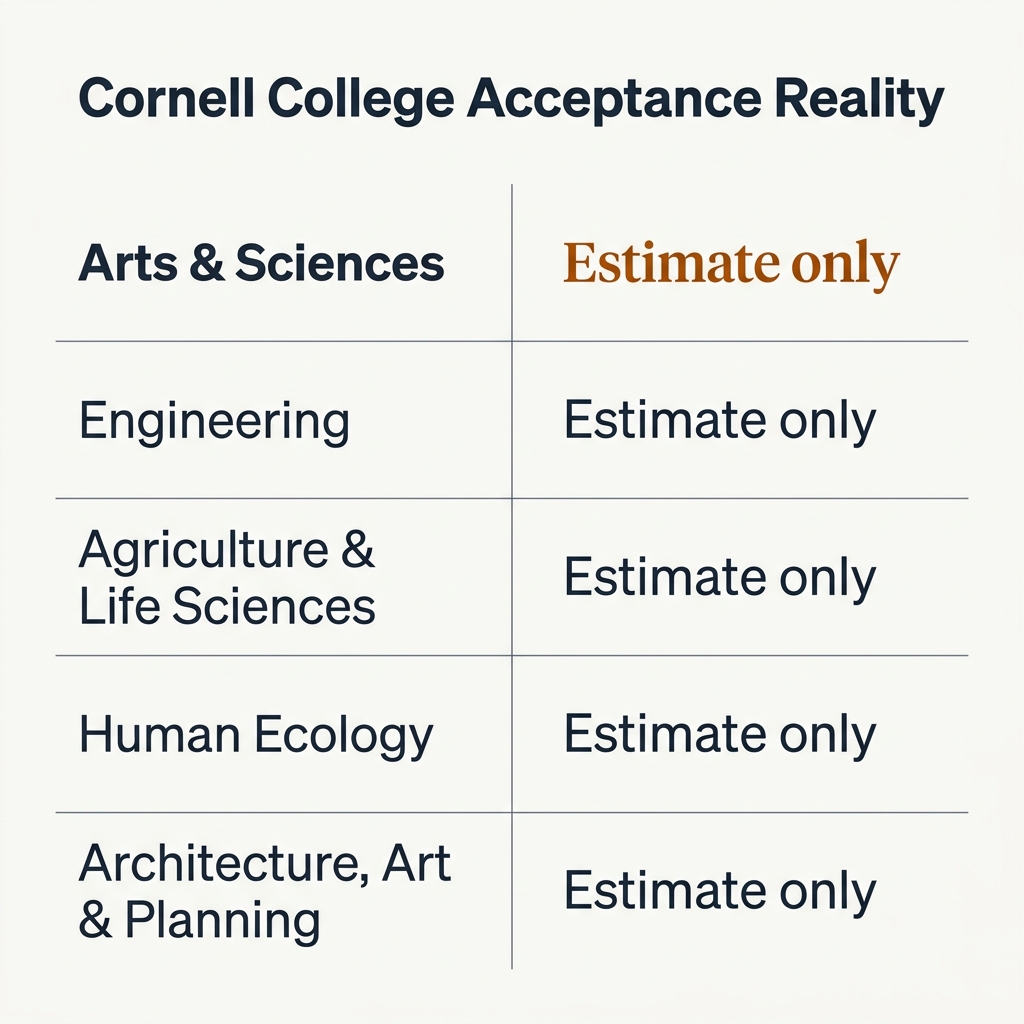
Cornell will not hand you seven clean admit rates, and that absence is the first thing any plan has to reckon with. The university reports admissions at the institutional level, so the "College of Engineering acceptance rate" floated online is almost always an estimate someone built from enrollment counts. We treat those estimates as directional, not gospel.
What Cornell does publish shows where the pressure sits. Enrollment concentrates in the two largest colleges, Arts and Sciences and Engineering, while units like Architecture, Art and Planning enroll far smaller cohorts. That size gap fuels most of the estimated-rate mythology online (per College Transitions). Small colleges are not automatically easier, though. A tiny cohort can mean a brutally thin margin, where a handful of extra strong applicants swings the perceived odds hard.
Why won't Cornell publish seven separate rates?
Because each college reviews its own applications. There is no central office sorting the pile (as College Transitions explains). Applications first clear a baseline academic review, then the real evaluation happens inside the college you named.
That structure makes admit-rate shopping especially risky. A student who looks plausible for policy, labor, engineering, and business has not found four ways into Cornell. They have found four different reads, each asking for different proof. The application has to make one of those cases clearly.
Endowed vs. contract: the aid gap hiding in the table
The split that matters most for low-income families is not size. It is sector.
| College | Sector |
|---|---|
| Arts & Sciences | Endowed |
| Engineering | Endowed |
| Agriculture & Life Sciences | Contract |
| Human Ecology | Contract |
| Industrial & Labor Relations | Contract |
| Dyson (Applied Economics) | Contract |
| SC Johnson / Nolan | Endowed |
| Architecture, Art & Planning | Endowed |
Sector labels come from Cornell's Class of 2024 profile. Contract colleges are state-supported land-grant units, and Cornell's obligation to serve New York residents factors into how they read applications (per College Transitions).
For a New York student on a tight budget, that structural fact changes the math. A contract college can shift your net cost in ways an endowed college cannot. That is exactly the comparison an early-decision commitment erases before you ever see the aid letter.
How should your plan read this table?
Treat sector as a signal about aid, not a shortcut to easier odds. The colleges also keep moving their own boundaries. Until Fall 2017, Ag and Life Sciences figures included Dyson, and Human Ecology counted the Brooks School until Fall 2023 (Cornell's factbook notes). Comparing old rate estimates across those reshuffles is apples to oranges.
Our advice is blunt: pick the college that fits your intended work, then decide on timing. If your fit points to a contract college and money is tight, the aid comparison you get in the regular round is worth more than a shrinking early edge.
Early Decision vs. Regular Decision, College by College
Cornell hands you clean admit numbers by round, but not by college. So the "College of Engineering ED rate" you see online is almost always someone's estimate, not a published figure. A plan that leans on those per-college early splits is built on sand, and that hits hardest for the families with the least room to gamble.
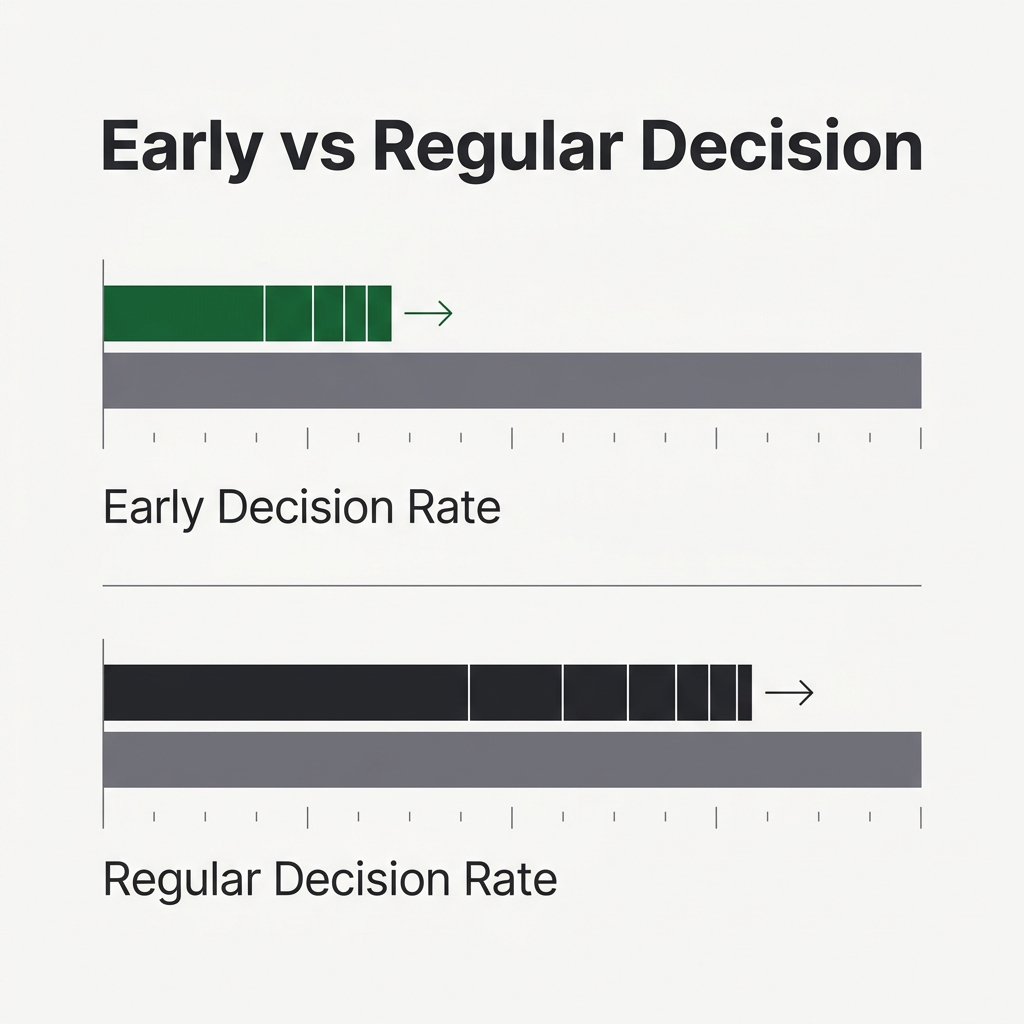
The gap between the early round and regular decision is real, and it is the whole reason families chase ED. Cornell fills a sizable share of its class through early decision before regular applications are even read, which shrinks the seats left for the spring pool. That single dynamic is the assumption we push back on with lower-income students.
The early edge is real, but it comes bound to a signature
The early admit rate sits above regular decision, and the applicant pool keeps climbing year over year. But the boost is not a free lift. ED is a signed agreement: apply, get in, and you withdraw every other application. Part of the "edge" reflects who self-selects into that pool, not a discount the admissions office hands out. The early boost is real, and it is locked to a decision you cannot undo.
| Round | What's published | Why it matters |
|---|---|---|
| Early Decision | Binding; higher admit rate | Edge comes attached to a commitment |
| Regular Decision | Larger applicant pool | Lets you compare aid across schools |
A large applicant pool and a binding early commitment. The math that seems to justify the ED bet quietly ignores what you give up to make it.
Why ED punishes low-income applicants specifically
The financial issue is not abstract. A student admitted early has to decide before other aid letters arrive, so the family loses the comparison that often reveals the true affordable choice. For a student weighing several selective schools, that comparison may be the only leverage they have.
The decentralized structure makes it worse. If the application was aimed at the wrong college, the result is not just a weaker read. It is a weaker read attached to a binding financial timeline.
When ED actually makes sense
| Your situation | ED or RD? |
|---|---|
| Cornell is a clear first choice and you can afford it without comparing aid | ED |
| You need to compare financial aid across schools | RD |
| You picked a college mainly for its admit rate, not fit | RD |
Skip ED if aid comparison is non-negotiable for your family. For students who genuinely love one Cornell college and can attend regardless of the package, ED can still work in their favor. Everyone else keeps options open in the regular round. Our broader take on picking targets under real constraints lives in the Ivy admissions constraint check.
International vs. Domestic Profiles, College by College
The uncomfortable truth for globally-minded families is that Cornell publishes even less about international admit rates by college than it does about per-college rates overall. For an international applicant, the first move is to stop hunting for a hidden table Cornell never released and start building around the parts of the process that are visible.
We push international families to start from what Cornell actually reports, not from the per-college international percentages floating around forums. Cornell reports that share for the university as a whole, not college by college (per College Transitions). A separate count of the most recent cycle logged 72,523 applications without splitting admits by nationality (per Top Tier Admissions). Any consultant claiming a precise international rate for, say, Engineering is estimating.
Cornell reviews you inside one college, not one country
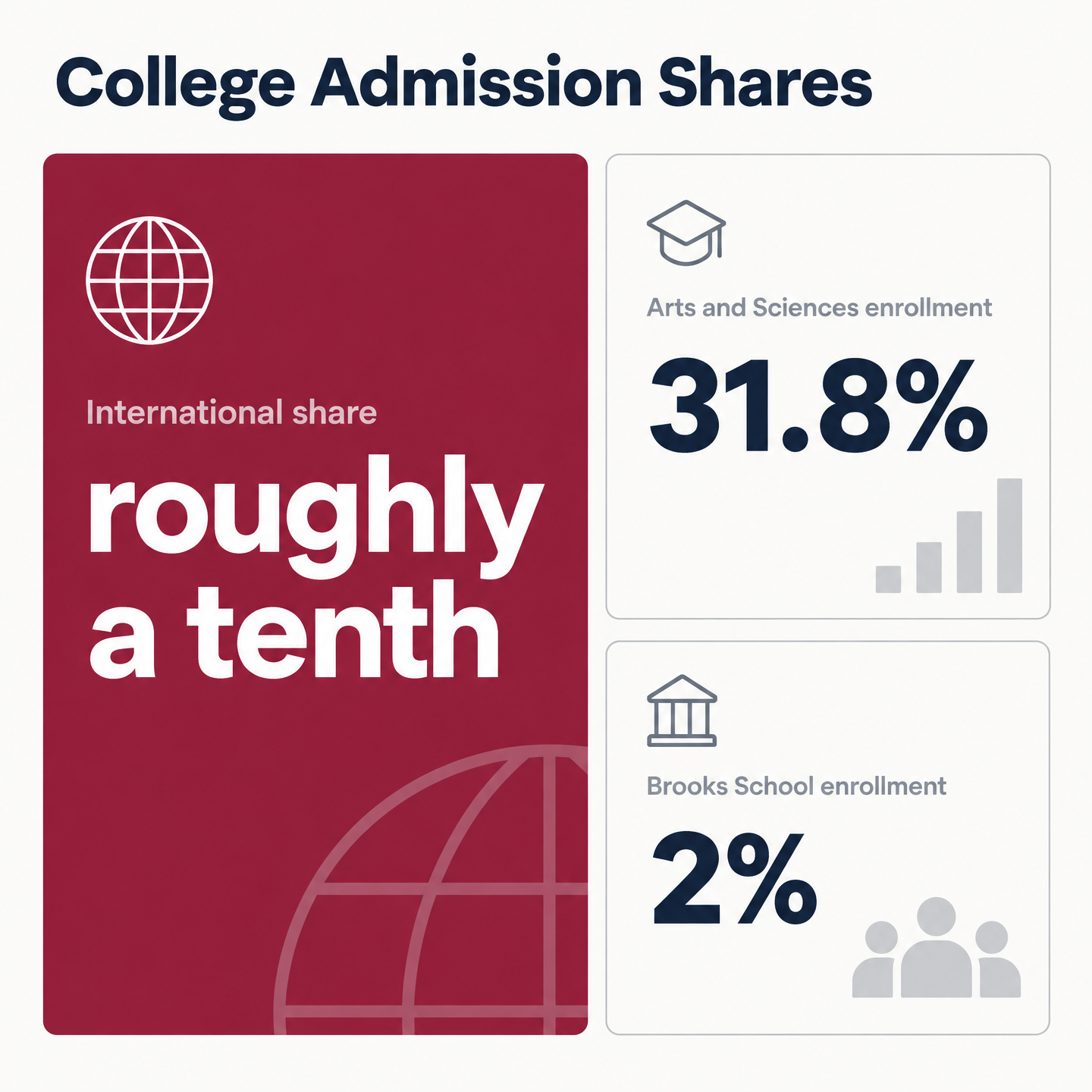
Each college runs its own read, so an international applicant to Arts and Sciences (31.8% of enrollment) sits in a different pool than one aiming at the Brooks School of Public Policy (2% of enrollment), even holding stats constant (enrollment shares per College Transitions). Interest clusters heavily in a handful of programs, so the applied pools in Engineering and Dyson run tighter than the university-wide picture suggests. That read is where an unexplained grading system or a weak language signal quietly sinks a file.
The practical problem is translation. A transcript, grading scale, curriculum, or school context that seems obvious at home may not read clearly in Ithaca. The application has to make the academic record legible while proving the chosen college is the right home.
The ED aid trap is sharper for international applicants
This is where our angle bites hardest. Domestic low-income students at least apply in a system where institutional aid is often more predictable. International aid at many US universities is more limited and can be reviewed differently, so an international ED commitment may carry even less room for financial error.
And the statistical reason to accept that bind has weakened. Cornell keeps trimming the portion of each class it fills through early decision, and the ED pool can skew toward applicants who do not need to compare aid, which raises the pressure on students who do (ED figures via College Transitions). For most international applicants who need meaningful funding, we say skip ED at Cornell.
| Consideration | Domestic applicant | International applicant |
|---|---|---|
| Aid review | Often need-blind, strong aid | Frequently need-aware, limited aid |
| ED financial risk | High for low-income students | Higher, aid rarely competitive |
| First-review hurdle | Curriculum familiar to readers | Grading, language must be legible |
| College choice stakes | No inter-college trading | No inter-college trading |
Choose the college for genuine fit, run the net-price estimator before you commit, and treat regular decision as the round that keeps your aid options intact. Our Ivy admissions constraint check walks through how we weigh that fit-versus-odds call.
What Test-Optional Policies Do to College-Specific Selectivity
Families run into this fast: Cornell does not publish test-optional data broken out by its seven colleges. No submission rate for Engineering, none for Arts and Sciences, nothing that lets you compare how much each unit still weighs a score. Anyone who promises you a per-college test-optional breakdown is handing you an estimate, not a fact.
What we can anchor to is the last cycle Cornell reported clean testing figures at the university level. The university reported that 72.6% of enrolling students submitted SAT scores and 35.8% submitted ACT scores. Those numbers mark the baseline before test-optional reshaped who applies.
The per-college blind spot cuts deepest for low-income applicants
Cornell funnels each application to the college named, and that college runs its own review (per College Transitions). Test-optional does not change that structure. It just removes one data point from a review you already cannot see inside.
For a low-income student, that opacity gets expensive. You cannot know whether the college you picked quietly rewards a strong score or shrugs at a missing one. You are guessing in the dark, and the guess is riskier if you apply early.
| Data point | What Cornell publishes | What it means for your list |
|---|---|---|
| SAT submission rate | 72.6% (Class of 2024, university-wide) | A baseline, not a per-college guide |
| ACT submission rate | 35.8% (Class of 2024, university-wide) | Overlaps with SAT submitters; not additive |
| Per-college submission rate | Not published | You cannot tell which unit weighs scores hardest |
| Before-vs-after test-optional shift, by college | Not published | Any per-college trend claim is someone's estimate |
Test-optional plus early decision stacks the risk
The brochures rarely connect these policies. Test-optional was pitched as a door-opener for students who could not afford prep or repeat sittings. Pair it with early decision, though, and the same students may face a tighter strategic choice.
Apply ED test-optional and you commit to Cornell before seeing the full aid landscape, to a college whose scoring habits you cannot verify, with one fewer credential in your file. Three unknowns, one irreversible signature. We walk families through exactly this stack before they sign.
Our read: test-optional genuinely lowers the cost of applying, and for a strong student with a soft score it removes a real liability. Skip the ED gamble if you need to compare aid. The regular round costs you nothing but time, and it keeps every offer on the table.
Targeting a Specific Cornell College Without Getting Burned
The most dangerous move a low-income applicant can make is to pick a Cornell college by its admit rate and then lock it in with early decision. Once you commit ED, your aid-comparison window is gone. Do it for the wrong college and you have compounded the mistake, because any credible strategy has to account for one fact: you can only apply to one Cornell college.
That last point deserves weight. Years ago, if your application read like Engineering but landed in Arts and Sciences, a reader might forward it to a better-fitting office. With tens of thousands of applications each cycle, that practice is gone. The burden is fully on you to prove fit up front. Strong strategy now starts with the question a former A&S admissions officer says matters most: which Cornell college can you prove you belong in?
Fit beats raw numbers in every college's read
Each college wants different evidence, and a convincing lower-GPA file can outshine a higher-GPA one with weak rationale, per that same insider guide.
CALS requires direct entry to a specific major, so a food-systems or animal-science story has to be visible in your coursework and activities. AAP is the only college that still puts faculty in the room; architecture applicants build portfolios over years and get interviewed by faculty. Arts and Sciences rewards intellectual breadth and a genuine appetite for working across disciplines. A student with a real hospitality or operations record fits Nolan; one chasing its higher admit rate does not.
Every file has to clear a college-level first review before deeper reading begins. Getting past that filter is the floor, not the finish. Fit carries you the rest of the way.
Where tailored coaching changes the profile
Here is how we approach the gap between a generic strong applicant and a college-specific one.
| Dimension | Typical Applicant Profile | Our Tailored Coaching |
|---|---|---|
| College choice | Picks by admit rate | Maps evidence to the college you can prove |
| Coursework | Broadly rigorous | Aligned to the target major (direct-entry for CALS) |
| Extracurriculars | Impressive but scattered | Concentrated around one clear through-line |
| Portfolio (AAP) | Assembled late | Built over years for faculty review |
| ED decision | Applies early for the "boost" | Weighed against aid, only if fit is airtight |
We build the ED question into every fit conversation, not after it. For a family that needs to compare aid offers, a binding early commitment to a shaky-fit college is the worst of both worlds. You can read more on how we pressure-test applicant profiles in our Ivy constraint check.
Skip early decision entirely if your fit for a specific college is not yet provable, or if you cannot afford to attend without comparing packages. The shrinking ED edge no longer justifies that gamble. Build the fit case first. Choose the round second.
How to Make the ED Call This Cycle
Everything above points to one decision that outweighs any single admit rate: whether to bind yourself to Cornell through early decision. For low-income applicants, that is where the math has quietly turned against the old playbook.
The old playbook said apply early if you can. The better one asks three questions first. Can you afford Cornell without comparing aid? Can you prove fit for the specific college? Are you using ED because Cornell is truly the right school, or because the admit-rate chart looks tempting? If any answer is shaky, the regular round is usually the safer strategy.
The decision matrix we use with families
Not every applicant should treat ED the same way. Here is how we sort it.
| Applicant profile | ED or RD? | Why |
|---|---|---|
| High financial need, no clear aid frontrunner | Regular decision | Keep the right to compare packages before you commit |
| Strong fit + Cornell is clearly the most affordable option | ED defensible | Commitment costs little when the aid answer is already obvious |
| Picking a college purely for a rumored higher admit rate | Neither, rework the list | A fit mistake under ED is irreversible and aid-blind |
The pattern is simple. If comparing offers could change where you enroll, do not lock yourself in early.
Your step-by-step plan
- Name the specific college first, not "Cornell." Enrollment concentrates in Arts and Sciences (31.8%) and Engineering (23%), while Brooks School of Public Policy sits near 2% (per College Transitions). Fit for that unit drives your read.
- Run your net-price estimate before choosing a round. If aid is decisive, default to regular decision.
- Map your recommenders and activities to the named college's priorities. A teacher who can speak to your research bent reads differently for Engineering than for a humanities program, so line up your advocates with the unit before you submit.
- Pull Cornell's Common Data Set and its undergraduate admissions factbook for the cleanest institution-level numbers.
- Build the essay around genuine fit for your named college.
Where our work pays off most
We deliver the strongest return for applicants whose file lives or dies on college-specific fit. Think a Dyson or SC Johnson business applicant with a real entrepreneurial record who needs the story to read unmistakably as that unit. That is precisely where a wrong ED commitment does the most damage, and where sharp targeting moves the needle.
If you want help mapping the round-and-college decision to your aid picture, our team walks families through it directly. Start with our college admissions planning blog, or book a consultation to pressure-test your list before deadlines close in.
Skip the ED gamble if aid comparison could change your answer. On that one call, everything else follows.
References
[1] Cornell University Acceptance Rate and Admissions Strategies - https://www.collegetransitions.com/blog/how-to-get-into-cornell-admissions-data-and-strategies/
[2] [PDF] PROFILE: CLASS OF 2024 - Institutional Research & Planning - https://irp.cornell.edu/wp-content/uploads/2021/02/Profile2020_first-year.pdf
[3] Undergraduate admissions - Institutional Research & Planning - https://irp.dpb.cornell.edu/university-factbook/undergraduate-admissions
[4] Which Cornell College Should You Apply To? Insider Admissions Guide - https://toptieradmissions.com/which-cornell-college-to-apply-to/
Frequently Asked Questions
Can I apply to more than one Cornell college at the same time?
No. Cornell asks you to choose one undergraduate college on the application. That means the first strategic question is not whether your profile is "Cornell-level," but which college can read your record and immediately understand why you belong there.
Does applying to a smaller college like Brooks improve my odds?
Not by itself. A small cohort can be highly selective because there are fewer seats and a narrower set of academic priorities. Brooks, for example, requires a policy-centered case that feels deliberate, not a last-minute attempt to avoid a larger applicant pool.
Are Cornell's contract colleges cheaper for New York residents?
They can be meaningfully different for New York families because the contract colleges operate within Cornell's land-grant structure. The key is to model net cost before choosing a round, since the sticker-price category alone does not tell you what your actual aid letter will look like.
Is accepting a Cornell waitlist spot worth it if I need to compare aid?
Treat the waitlist as a long-shot option, not a financial plan. If aid comparison matters, place a deposit at an affordable school you would be happy to attend, then decide later whether a Cornell waitlist offer is realistic and financially workable.