How to Turn Scattered Activities Into One Spike Admissions Readers Remember
September 26, 2026
Quick Answers
- Admissions officers read fast, so a coherent spike keeps your file legible instead of asking the reader to reverse-engineer your pattern.
- At the most selective schools, generalist profiles blur together because thousands of applicants show strong grades, activities, and recommendations.
- A recognizable hook changes the context your application gets read in. Without one, you land in the broadest, most crowded lane.
- Depth doesn't have to mean one activity. A theme can run through a small set of serious, connected pursuits.
- Treat the Common App activity section as evidence, not a checklist to fill.
- Selective schools reward initiative that affects real people more than activities that borrow prestige from a brand name.
Why a Spike Beats "Good at Everything"
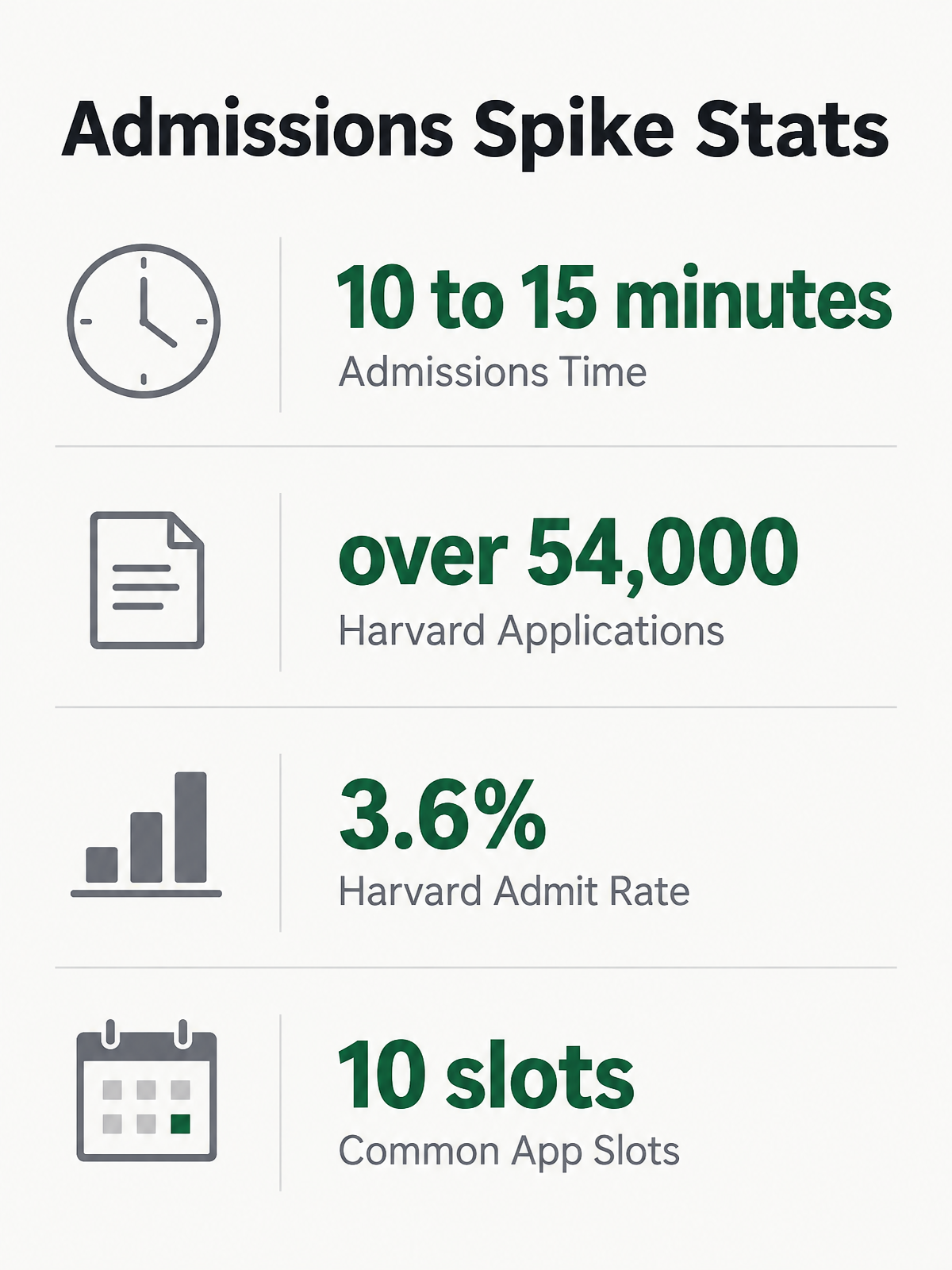
A spike makes you readable, and speed is why it matters. Admissions officers spend only 10 to 15 minutes per file, according to insights from Pioneer alumni. Scattered activities force the reader to connect dots you should have connected for them. A clear spike survives that skim. Our customized planning helps each student surface that story early.
The stakes explain the urgency. For the Class of 2029, Harvard drew over 54,000 applications and admitted just 1,970, a 3.6% rate, per the spike strategy analysis. At that scale, "pretty good at a lot of things" doesn't pull you out of a crowd of similar profiles. That's why our life preparation phase pushes students to build real experiences long before applications, so a genuine thread runs through the list.
Your Spike Decides Who You're Compared Against
Admissions offices don't rank every applicant against the whole pool. They sort applicants into groups based on whether you have a recognizable hook, then compare mostly within your group, the spike strategy piece explains. Well-rounded students without a hook end up in the largest, most crowded group, competing with the most people for the fewest relative spots.
That reframes the whole choice. Picking your spike theme is picking your competition pool. A generalist gets dropped into the biggest bracket. A student with a clear specialty competes against a smaller, more specific set. We spend real time here, because this decision shapes everything downstream.
Depth Wins, But It Isn't One Activity
The sources split in a useful way. One camp argues a single narrow spike beats broad well-roundedness. Another, CollegeVine's tier breakdown, makes the case for "juxtapositional depth": two or three fully committed pursuits that show different sides of you, like a quarterback who also plays competitive jazz band.
Both hold up at different scales. The spike is the recognizable theme that sorts you into a group. The activities are how that theme gets expressed. A spike isn't one line on a résumé. It's a thread that can run through several committed pursuits, all pointing the same way.
Too many activities actually reads as a negative. CollegeVine notes it signals a student who never found a focus. The Common App's 10 slots tempt everyone to fill all 10, but filling them was never the goal.
Prestige Is a Proxy, Not the Prize
Credible spikes come from building something real, not from buying access. Selective schools are wary of pay-to-play programs and prize community contributions because they're "harder to fake," Pioneer's guide notes. A student who spots supply-chain problems at a coffee shop and builds an inventory system is showing initiative that affects other people. That's the signal.
So don't chase a flashy summer program you can't show any output from. Readers reward depth and initiative, not the brand name attached. Our mentorship focuses there, because that's what holds up under a 10-minute read.
Auditing the Activities You Already Have
Most students walk into an audit with the same problem: a long list and no clear sense of which entries actually carry weight. The activity section isn't a storage bin for everything you've ever joined. It's the evidence room for the case you want the reader to understand.
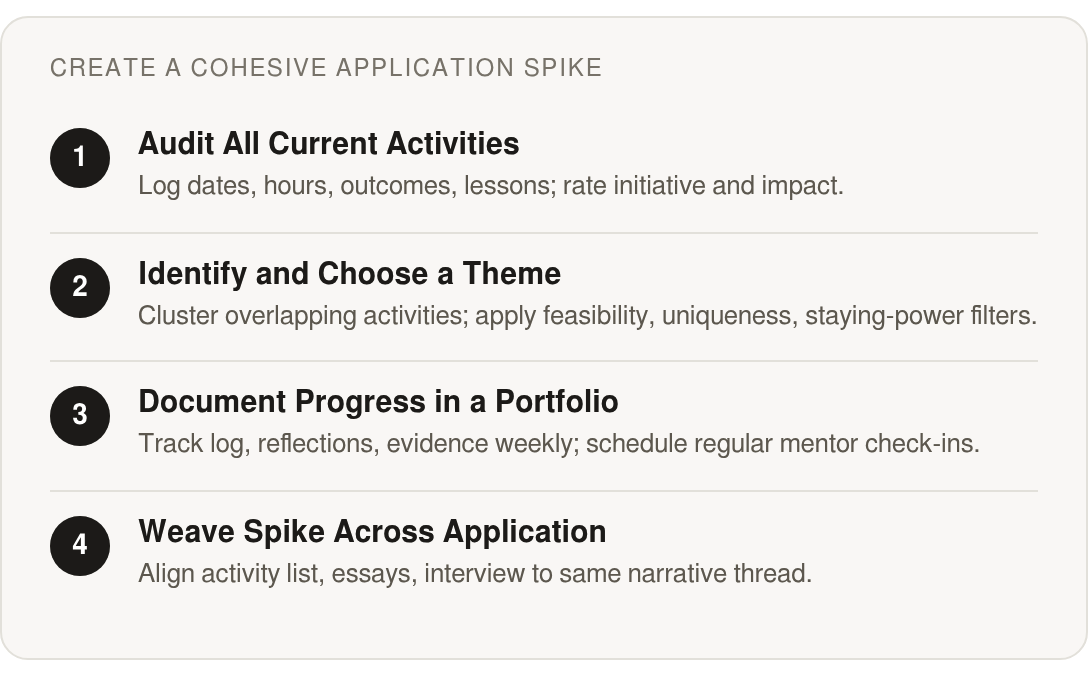
Before we help a student shape a spike, we inventory everything they do. Most of the useful material lives outside the obvious clubs.
Good admissions work starts here, with the boring job of writing it all down. Not just the debate team and the varsity sport. The part-time job, the sibling you watch after school, the weekly library shift, the Minecraft plugins you coded that got a thousand downloads. As CollegeVine's tier breakdown puts it, anything you do routinely outside class that changed how you grew counts. That definition is wider than most families assume.
Log Everything Before You Judge Anything
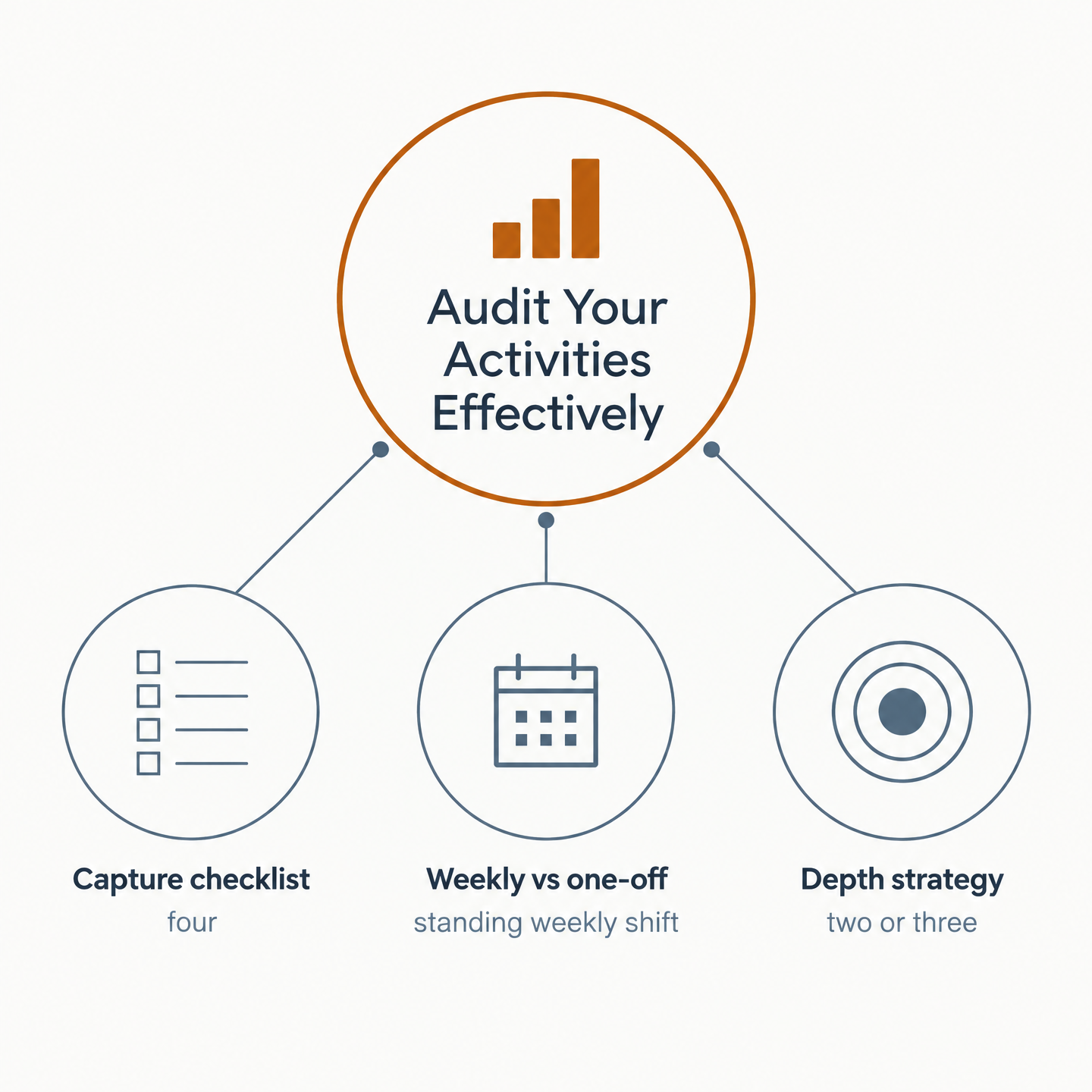
Your first pass is pure capture, no editing. For each activity, record four things: dates, hours per week, concrete outcomes, and one honest sentence on what it taught you. That reflection line is the one people skip, and it's the one that reveals whether an activity has real gravity or just filled time.
Depth shows up in the pattern of commitment. Weekly effort across a school year reads differently from a one-off obligation added for optics. CollegeVine notes that volunteering once to check a box doesn't belong on your application, while a standing weekly shift does. The log makes that difference visible instead of leaving it to memory.
Rate for Initiative, Not for the Brand Name
Once everything's on paper, score each item on initiative and impact, not on how impressive the name sounds. Ask what changed because the student was there. Did they improve a process, teach someone, build something, publish something, organize others, or solve a problem that would have stayed unsolved?
This is where an ordinary responsibility can outrank a polished credential. A student who treats a job, a family obligation, or a school role as a place to notice problems and act on them may have more to show than a student who attended a selective-looking program and left no mark.
Cluster the Themes, Then Find the Thread
Now look for overlap. Lay your rated activities out and watch which ones rhyme. A research project, a science fair entry, and tutoring younger students aren't necessarily three separate stories. They might be one thread about inquiry and teaching.
The goal isn't to jam every entry into one category. It's to see which activities reinforce one another on their own. When several commitments share a question, a skill, an audience, or a problem, the application starts to feel intentional instead of assembled.
One warning the audit surfaces fast: sprawl without a thread weakens the file. If the list feels noisy, the fix usually isn't adding more. It's cutting, sequencing, or reframing. For students weighing whether to run this alone or with help, our take on hiring a consultant walks through when the audit is worth outside eyes.
Choosing and Shaping the Theme That Ties It Together
The audit gives you raw material. Picking the theme is where most students freeze, because it feels like betting the whole application on one guess. We reframe that decision: you're not just choosing a passion, you're choosing the lens the rest of the file gets read through.
Treat theme selection as a strategic call, not a branding exercise. The theme has to be visible in the work already done, plausible in the time remaining, and specific enough that a reader remembers it after the file closes.
How Do You Pick the Theme Worth Betting On?
Run each candidate through three filters: feasibility, uniqueness, and staying power.
Feasibility asks whether you can produce something real with the runway you have. A junior with 18 months needs a theme that can generate outside recognition in that window, not one that takes a decade.
Uniqueness asks how crowded your pool already is. Look at where your interest sits relative to what your school and your target majors already overflow with. If everyone around you is doing the same thing, the theme is working against you.
Staying power asks whether you'd keep at it with no application attached. The TKS analysis puts it bluntly: a spike is the result of years of actual work, not a line you write. Manufactured interest shows, because the effort stops the second the motivation is gone.
Does the Spike Have to Be One Narrow Activity?
No. TKS argues for one deep, externally recognized area, and that clarity matters. But the proof can come from more than one setting if those settings strengthen the same central idea.
A student themed around community health might combine research, a clinic volunteer role, and a policy blog. One theme, several proof points. The point isn't that every activity looks identical. It's that each one adds a useful dimension to the same direction.
The real risk to watch is padding. Disconnected commitments, even impressive ones, dilute the message a spike is supposed to sharpen.
What Actually Signals Depth to a Reader?
Prestige can help a reader notice an activity, but it can't stand in for substance. TKS points to headline results like an iOS app that reached over 2,000 users. Pioneer stresses that selective schools value work whose contribution is harder to fake.
The signal underneath both is demonstrated initiative. Readers want a student who saw an opportunity or a problem, took responsibility, and produced something that affected someone beyond themselves.
So track impact you can name: beneficiaries served, funds raised, users reached, work published. Those details make your theme legible to a reader moving through your file in minutes.
Documenting Progress and Building the Portfolio
A spike only works if you can prove it. Two years of steady work means nothing on an application unless you captured it as it happened. Most of the work we do at this stage is unglamorous: helping students build a running record before memory fades and evidence disappears.
Start documenting the moment you commit to a theme, not the summer before you apply. The students who struggle most with the activity list and essays are the ones reconstructing three years from a blank page. A living portfolio fixes that. It turns application season from an archaeology dig into an editing job.
The Portfolio Setup That Actually Gets Used
Pick something you'll open weekly, not a system that looks impressive for a day. A private note-taking app or a simple site builder both work. Structure matters more than the tool.
A portfolio holds up best when it tracks a few clear streams:
- The log. Date, activity, what you did, what changed. One or two lines is enough. This feeds your activity list directly.
- The reflection. After a milestone, write a short entry tying the work to your growth. Why did it matter? What did you learn about yourself? These become raw essay material.
- The evidence. Photos, short videos, certificates, screenshots of press, links to anything you built or published.
Not all proof carries equal weight. A screenshot of your code repo with real download counts beats a participation certificate. Outside coverage, a published piece, or a measurable result signals impact a reader can verify. Save the concrete stuff.
Check-Ins Keep the Story Honest
A portfolio drifts without feedback. Our regular check-in cadence exists to catch that drift early. Those sessions keep students on track, and our collaborative panel approach brings different perspectives to the work as it accumulates.
Mentor feedback matters most for reflection. Students underrate their best work and overrate the flashy stuff. An outside read sorts signal from noise before it hardens into an application.
Want the bigger picture on sequencing this alongside rigor and testing? See our guide on how to sequence rigor, tests, and leadership before junior fall.
Telling One Story Across the Whole Application
A spike wins on paper only when the story lands the same way in three places: the activities list, the supplemental essays, and the interview. Most students treat these as separate assignments. We treat them as one narrative told at three lengths.
The reader sees your activity descriptions first, in fragments. Then the essay has to deepen that same thread, not introduce a stranger. If your list screams robotics and your personal statement wanders off to a beach vacation, the reader feels the seam. Good work closes that seam so the whole file reads as one person.
The Origin, Growth, Challenge, Outcome Arc
The frameworks that survive a fast read are simple. A transformation arc works: where you started, what changed you, who you are now. A problem-solution structure works when your spike solved something real. Both give the reader a beginning, a middle, and a point.
Anchor the essay in the moment your spike got hard. The failed prototype. The club that almost folded. Readers remember struggle handled with judgment, not a highlight reel. Your outcome means more when they watched you earn it.
Numbers That Show Scale Without Bragging
Quantitative impact belongs in your story, but framing matters. "I led a team" is weaker than "our tutoring group reached 40 students across three schools." One is a claim. The other is a fact the reader can picture.
Bury the number inside the action, not in a victory lap. Let the scale describe the work, then move on. The essay should sound like someone reporting what happened, not someone selling it.
Our interview preparation carries the same thread forward, so a student can speak to their spike as naturally as they wrote about it. When essay coaching aligns each supplement to the specific prompt, the school sees a student who chose them on purpose. That alignment is the payoff of every earlier step.
Where This Leaves You (and When a Spike Is the Wrong Move)
The most common mistake we see isn't picking the wrong spike. It's forcing one that doesn't exist yet. Students hear that depth beats breadth, then bolt a fake theme onto activities that have nothing to do with each other. Readers catch the seam every time.
Forced relevance is the tell. If you have to write two sentences explaining why your debate trophy connects to your coding project, the connection isn't real. A spike should feel obvious once you name it, not need a translator.
Warning Signs a Spike Is Turning Into a Checkbox
Over-extension is the quiet killer. You commit to a theme, then keep piling on titles to look serious: three club officer roles, a nonprofit you founded but never ran, a summer program you attended once. That's breadth wearing a spike costume.
Watch for these signals your spike has gone hollow:
- You can list your roles but not a single problem you actually solved.
- Your "leadership" is a title with no one following and nothing built.
- You'd struggle to talk about it for five minutes in an interview without repeating your resume.
- The work stopped growing a year ago, but you kept the label.
Superficial leadership fools the most students. Being president of a club that meets twice a year proves nothing. A reader wants to see what changed because you were there.
When Breadth Actually Beats Depth
Sometimes it does, and pretending otherwise is bad advice. Genuinely multi-talented students lose something by narrowing. A serious violinist who also competes nationally in math shouldn't flatten both into one forced story. Two authentic peaks read stronger than one manufactured one.
So run this check before you commit. Do your activities share a real thread, or are you inventing one? Has the work deepened over time, or just multiplied? Could you defend it in conversation without a script?
If you answer no across the board, keep your genuine breadth and make each piece excellent. A spike you have to fake is weaker than honest range.
References
[1] The 'Spike' Strategy: Why One Deep Passion Beats Five Shallow Ones - https://www.tks.world/blog/the-spike-strategy-why-one-deep-passion-beats-five-shallow-ones
[2] The "Spike" vs. "Well-Rounded": Choosing Extracurriculars That Tell ... - https://www.cirkledin.com/library/extracurricular-activities-and-leadership/college-application-spike-well-rounded-strategy/
[3] Summer Extracurriculars Colleges Value: 4 Criteria to Focus On - https://pioneeracademics.com/news/summer-extracurriculars-college-admissions/
[4] Breaking Down the 4 Tiers of Extracurricular Activities - https://blog.collegevine.com/breaking-down-the-4-tiers-of-extracurricular-activities/
Frequently Asked Questions
How many activities should I actually list on the Common App if filling all 10 is a mistake?
Use the activity section selectively. An entry should earn its place by showing commitment, growth, responsibility, or impact. If an activity only proves that you attended something briefly, it probably weakens the pattern instead of strengthening it.
I'm only a freshman. When should I start documenting my spike?
Start early enough that small moments are not lost. The most useful notes are often not major awards, but quick records of what you tried, what failed, what improved, and what you noticed about yourself while doing the work.
What if my activities genuinely don't share a thread?
Do not invent a connection just because "spike" sounds strategic. If your strongest work lives in separate areas, present each area clearly and let the application show range. Authentic excellence beats a theme that collapses under basic questioning.
Does attending a prestigious summer program actually help my application?
It can help if the program becomes a platform for real work. The stronger question is what you produced, learned, built, or contributed because of the experience. Attendance alone rarely carries the same force as evidence of initiative.
How do I quantify impact for a spike that has no obvious numbers?
Look for scale in the work itself: audience, frequency, reach, output, or visible change. If numbers feel artificial, use concrete evidence instead, such as a published piece, a finished tool, a curriculum you created, or feedback from people who used your work.
Can I change my spike theme partway through high school?
Yes, but treat the change as a strategic pivot rather than a cosmetic rename. The new direction should explain your next choices and make better use of your existing evidence. If it leaves earlier work stranded, the shift may create more confusion than clarity.
Should I run this activity audit myself or hire a consultant?
You can start alone by listing everything honestly and separating real contribution from résumé decoration. Outside guidance helps when judgment gets blurry: students often miss the significance of ordinary responsibilities and overvalue activities that merely look polished. Endurable Education's guidance closes the seam between activities, essays, and interviews so the file reads as one person.