7 Edits That Make Your Personal Essay Move a Tired Reader
September 26, 2026

Why These Edits Matter
Most applicants treat essay editing as a spelling pass. In our consulting work, that's the most expensive mistake families make, because the personal statement is the one document that carries a student's voice into a room full of tired readers. An admissions officer on their hundredth essay of the night doesn't slow down for clean grammar. They slow down for a specific, human moment.
So we frame revision as spending, not tidying. Each edit is time and effort spent on one return: how a reader feels at the last line. Some edits take fifteen minutes and shift everything. Others eat an afternoon and barely move the needle. Telling those apart is the whole job.
What Does a Tired Reader Actually Reward?
Specificity and reflection. Not polish. The personal statement is the metaphorical "heart" of an application, the piece that captures who a student is and what drives them. When a reader is fatigued, one vivid, concrete detail wakes them faster than any elegant sentence.
The highest-return edits go straight at that fatigue. College Essay Guy frames the essay's job as showing the skills, qualities, values, and interests you'll bring to a campus, not cataloging achievements. Scenes on their own are inert. The fix is welding each scene to a takeaway, so every image earns its spot.
- Open with your strangest private detail, not a summary. The trait you think is uniquely odd is usually the one a reader connects with fastest.
- Add the "so what" after each anecdote. A scene with no reflection reads like a diary entry and loses a fatigued reader by the second paragraph.
How Much Editing Is Too Much?
Revise toward your voice, not away from it. The sources genuinely conflict here, and it's worth naming. One camp treats revision as non-negotiable, pushing multiple passes to drag an essay past a draft that isn't landing yet. Another warns that over-polishing works against authenticity.
Both are right, and the resolution is simple. Draft as many times as you need, but every pass should sharpen your voice instead of sanding it down. We tell students to reject feedback that makes the essay sound more generic, even when it comes from a teacher they trust.
- Cut clichés like "I'll remember that for the rest of my life." Johns Hopkins flags these as the fastest way to sound like everyone else.
- Keep one narrator, many facets. A single focused voice can still reveal several values without confusing the reader.
Skip these edits if your draft is already personal and voice-driven and you're just chasing perfection. Past that point, more editing trades authenticity for nothing. The seven edits ahead matter most for essays stuck at competent but forgettable, which is exactly where a borderline application lives. Move a tired reader, and you move a decision.
Triage, not decoration. Start with the edits that change how the essay is experienced: the first line, the emotional logic, the walk from scene to meaning, the friction pulled out of every sentence. Grammar still matters, but only after the essay has a pulse.
Edit #1 – Write a Hook That Earns the Next Sentence
The opening line is the single highest-ROI edit on the whole page. It costs maybe twenty minutes to rewrite, and it decides whether a reader leans in or skims to the next file. Of every sentence in the essay, this is the one where a small revision does the most to reshape a first impression.
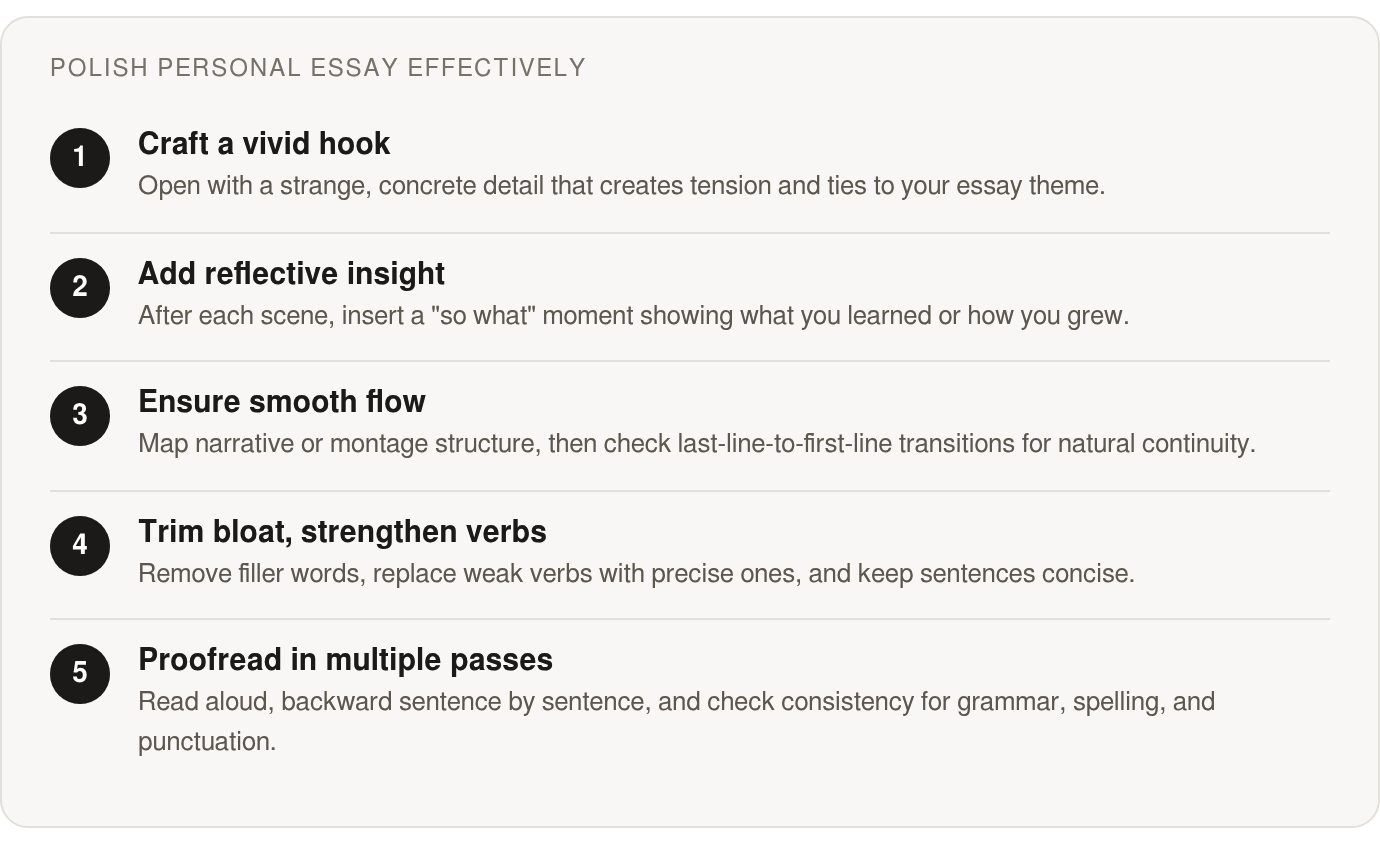
And most families underprice the downside. A weak hook doesn't just fail to help. It drains goodwill before your best paragraph ever gets read. When we mentor students through applications, a generic opening is one of the first things we go after, because it sets a reader's expectations for everything that follows.
A Vivid Scene Is the Floor, Not the Finish Line
Writing coaches will tell you to open with a scene, and they're half right. Fiction technique like scene and specific detail makes a moment concrete. But editor Peter Mountford pushes back hard: clients assume scenes are inherently gripping, and a lot of scenes are quite dull.
A scene earns its place only when it carries tension or something at stake. Pretty imagery with no friction is a screensaver.
- Open on a moment where something is at risk, not a moment where you feel a nice feeling. Conflict pulls a reader forward. Contentment doesn't.
- Cut any opening that could headline someone else's essay. If a stranger could have written your first line, it's generic, and College Essay Guy flags generic hooks as a top mistake.
Your Weirdest Private Detail Is the Most Universal One
The move that separates a good hook from a memorable one is counterintuitive: lead with the detail you assume is too odd to share. The trait you think is uniquely strange is often broadly recognizable once you state it plainly, which is exactly why a hyper-specific opening can feel universal. That dissolves the old tension between "only you can tell this" and "the reader has to connect."
This is where honesty does the heavy lifting. Mountford's editors say readers can smell a half-truth a mile off. The rawest, most private detail is almost always the strongest first sentence.
- Draft three openings from your most peculiar personal detail before you reach for anything polished. Specificity is what makes a reader feel seen.
- Run an honesty check on the hook. If it protects your ego instead of telling the truth, it reads as performance, and the reader checks out.
One Hook, Welded to Your Theme
A brilliant opening that has nothing to do with the rest of your essay is a debt, not an asset. The hook has to point straight at the central idea the reader will meet in your closing lines.
Expect this to take drafts. College Essay Guy notes it's very rare to see an outstanding statement that went through fewer than five. This is the kind of iterative work our collaborative, panel-style feedback is built for, putting several sets of eyes on the writing that carries a student's story.
- Reread your final paragraph, then check that your first sentence sets it up. A hook disconnected from the theme wastes your best line.
- Test the hook on someone who doesn't know your story. If they can't guess what the essay is about, tighten the link before you touch anything else.
Edit #3 – Turn Events Into Growth the Reader Can See
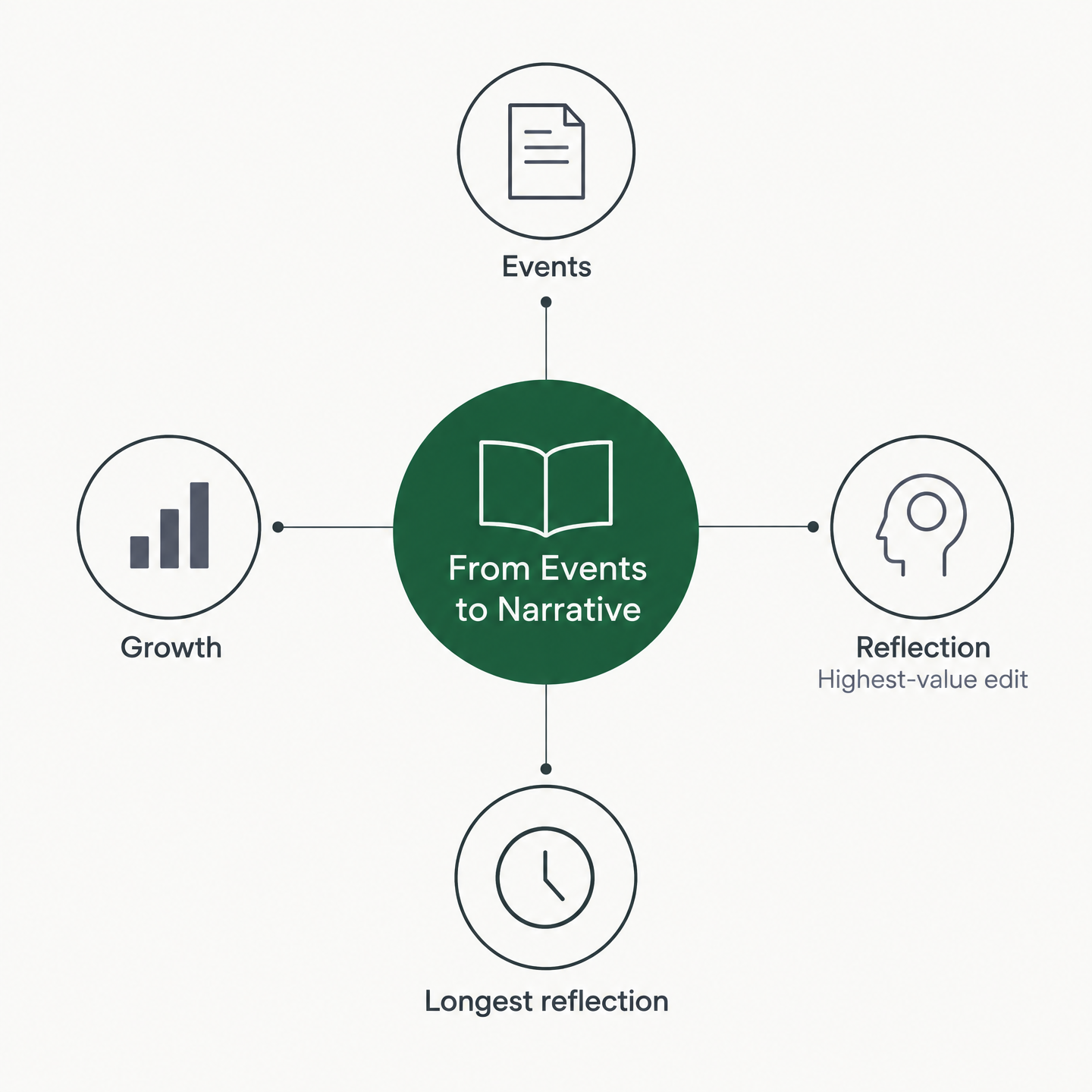
A story is just events until you tell the reader what those events did to you. That gap, between what happened and what you made of it, is where most essays stall. Closing it is often the revision that turns a competent draft into one with emotional force. This is the point where an essay stops reporting and starts revealing.
The practical payoff: adding a new scene is real work. Adding the missing reflection behind a scene you already have is a smaller change, and it often lifts the whole essay from "nice moment" to "I understand this person." That's why we work so closely with students on the writing that carries their argument.
Why Do Admissions Readers Reward Reflection?
Vivid detail alone is inert. The fix, drawn from College Essay Guy's personal statement guide, is inserting "so what" moments where you pull an insight out of the experience.
The strongest version of "show, don't tell" is really show, then extract. Each scene has to earn a takeaway. A paragraph that describes a failed robotics build is a memory. A paragraph that describes it and names what it taught you about your own stubbornness is a growth arc.
- Map your story to situation, action, result, and reflection, then check that the reflection is the longest section, not the shortest.
- Mark every scene with a "so what" note in the margin. If a scene has no takeaway, cut it or dig for one.
Situation, Action, Result, Reflection: Where Does the Weight Go?
Most students front-load the situation and rush the reflection. Flip the ratio. The result matters less than what the result taught you about how you think, decide, or recover.
Reflection is usually what the later drafts add. First drafts report the facts. Later drafts find the meaning.
- Draft the reflection as its own pass, after the narrative is stable, so you're not forcing insight around plot.
- Cut one sentence of scene-setting for every sentence of reflection you add, to protect the Common App word count.
One Voice, Many Facets
A tension worth naming. College Essay Guy suggests a reader should pick up several distinct values across your essay. But Writer's Digest argues that cramming all of your selves into one piece makes you seem "so uncertain, so indecisive, that we merely confuse the reader."
Both are right, on different axes. Keep one narrator, one consistent voice, and let that single voice reveal several values through what it notices and how it reflects. Unify the persona. Diversify the qualities it shows. If you're weighing whether a coach can help you find that line, our take on price and consultants is worth a read.
- Read the essay aloud and confirm it sounds like one person throughout, not a committee.
- List the values a stranger would name after reading. If they all rhyme with "hard work," you're repeating one trait, not showing range.
Edit #5 – Make the Essay Move Without a Jolt
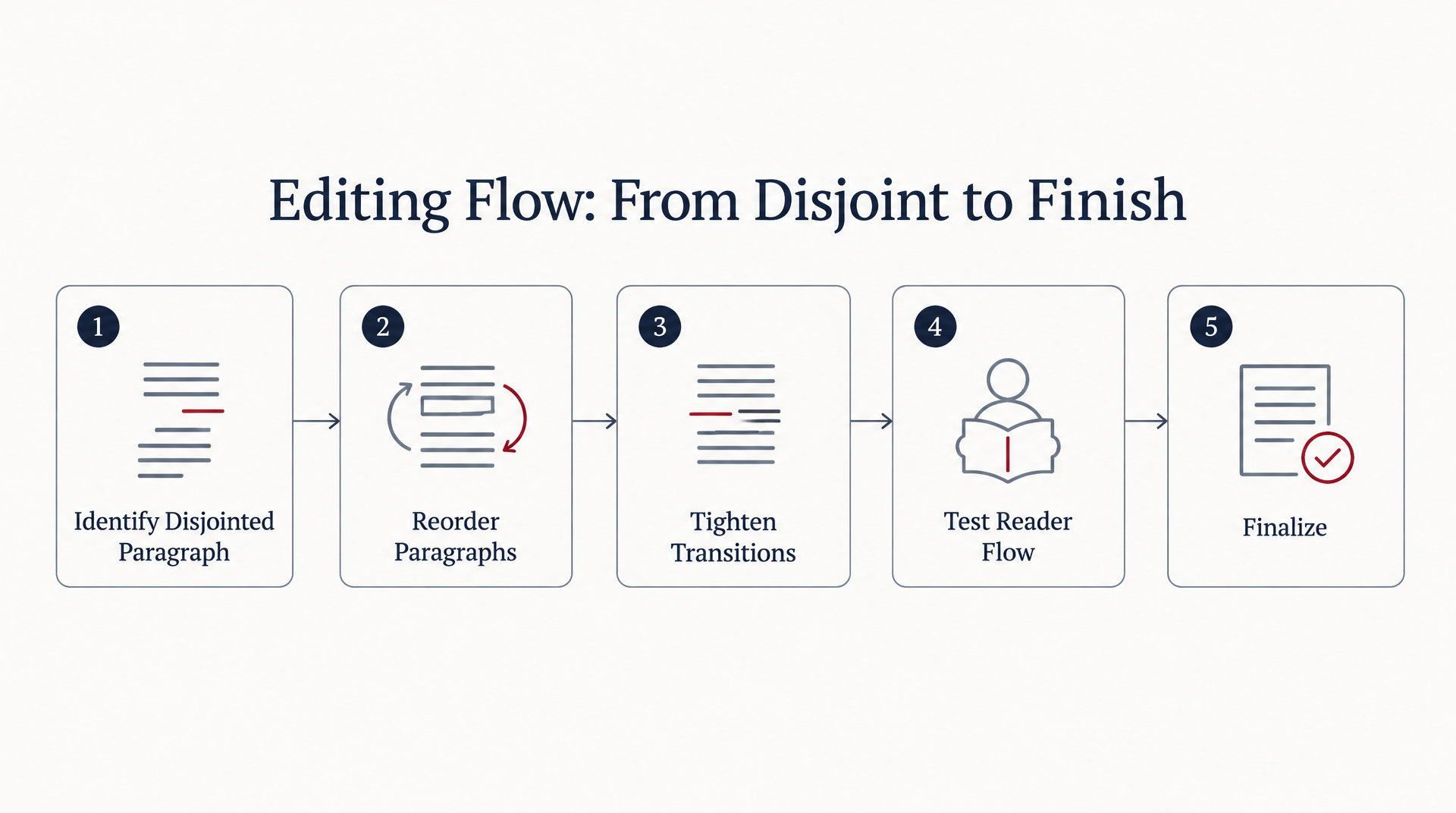
Flow is the edit that pays off quietly. A reader rarely notices smooth transitions, but they always feel the jolt when a paragraph drops them somewhere unexpected. A disjointed essay is one of the most common reasons a strong story lands flat.
The math is friendly. Reordering paragraphs and tightening transitions is cheap. Far less effort than drafting, and no new writing. A reader who never stumbles reaches your closing line with attention intact, and intact attention is where a score bump actually comes from.
How Do You Test Whether Your Essay Flows?
The fastest test is the last-line-to-first-line check. Read the final sentence of each paragraph, then the first sentence of the next. If the jump feels natural, you have flow. If you need to reread, you have a seam.
Structure matters more than clever transition words. College Essay Guy frames the personal statement as either a Narrative or a Montage, and each has its own logic. Narrative moves through cause and effect. Montage links scenes by a shared theme. Pick one and let it govern paragraph order.
- Map your essay to a Narrative or Montage structure before touching sentences. Knowing which arc you're building tells you what order the paragraphs belong in.
- Run the last-line-to-first-line check on every paragraph break. Any spot that forces a reread is a transition to rebuild.
- Use plain connective moves like "so," "then," and "but" instead of stiff phrases like "Also." Overused transition words signal effort, not ease.
- Close by circling back to your opening image or idea. A final line that answers the hook gives a tired reader the satisfying click of a story completing itself.
Skip the deep structural rework if your draft already reads clean start to finish. Not every essay needs reordering, and forcing transitions onto writing that already moves well just adds noise. Fix the seams that exist. Leave the ones that don't.
Edit #6 – Cut the Bloat, Trade Up Your Verbs
Wordy writing is the cheapest edit on this list to fix and the easiest to ignore. A tired reader feels bloat before they can name it. Sentences sag, the eye slides, and your best idea arrives buried under three qualifiers. In our consulting work, this is often the fastest place to win a reader's attention back.
The cost-benefit read: trimming words and swapping weak verbs takes an afternoon with a highlighter, not a rewrite. Yet it changes how confident you sound on every line. A reader reads crisp prose as a clear mind, and that impression follows your file into the decision.
Weak Verbs Leak Confidence
Verbs carry a sentence's energy. Lean on "was," "had," and "made," and you tell the reader what happened without letting them feel it. Strong verbs do the work in one word, and the tone shifts with them.
- Replace "was running" with "ran," "was thinking" with "reasoned," "made a decision" with "decided." Compressed verbs read as decisive, and decisiveness is what an essay about you should project.
- Cut "there is" and "there are" openers. "There are three reasons I stayed" becomes "Three reasons kept me there." The sentence gains a subject and momentum in one move.
- Delete adverbs propping up weak verbs. "Walked quickly" is "hurried." "Said loudly" is "shouted." One precise verb beats a verb plus a crutch.
Run a Word-Count Audit Before You Submit
Verbose language is a documented turnoff for readers grinding through a stack of files. A simple audit catches the padding you stopped seeing around your tenth draft.
- Paste each paragraph into a word counter and flag any sentence over 25 words. Long sentences hide redundancy. Split them and watch the meaning sharpen.
- Search your draft for "in order to," "the fact that," and "due to the fact that." Each one collapses to a single word with zero loss.
- Read the essay aloud and cut anything you stumble over. If your own mouth trips, a tired reader's eye will too.
This edit rarely adds an idea. It just lets the ideas you already have land clean.
Edit #7 – Proofread Like It's Insurance
The honest read on proofreading: it has the lowest ceiling of any edit on this list. A flawless comma won't win a seat. But a cluster of small errors quietly signals carelessness, and that impression rides your file straight into the decision. We treat this pass as insurance, not offense. Cheap to run, expensive to skip.
The trap is timing. Proofread too early and you polish sentences you'll later cut, wasting the effort. Run this pass last, after the hook, reflection, and flow are locked. That sequencing is where the return on your time shows up.
Run Three Passes, Not One
A single read leaves plenty behind. Your brain fills in what it expects to see. Split the work into targeted passes and the catch rate climbs without eating much more time.
- Read the essay aloud, slowly. Your ear catches dropped words and clunky rhythm your eye skips right over.
- Read it backward, sentence by sentence. Breaking the narrative pull lets you judge each sentence as mechanics, not story.
- Do one pass for consistency alone. Check tense, verb agreement, and whether you switched between past and present halfway through.
The Errors That Actually Cost You
Not every slip carries equal weight. Some read as typos a reader forgives. Others read as a writer who never reread the work.
- Fix homophones your spell-checker misses: their/there, its/it's, affect/effect. Software passes these. A reader doesn't.
- Confirm every name is spelled right, especially a school's name in a supplemental. Nothing tanks goodwill faster than the wrong college in a "why us" essay.
- Check comma splices and run-ons. They make a reader work harder, and a tired reader rewards ease.
One move we push with every student: get a second set of eyes. You can't proofread your own draft with fresh attention after twenty rereads. A peer, a mentor, or someone who has never seen it will catch what you've gone blind to. That last outside pass is often what turns a borderline draft into a clean one.
References
[1] Personal Essay Advice From Editors - Peter Mountford Writing Coach - https://www.mountfordwriting.com/writing-advice/best-personal-essay-advice-from-editors
[2] How to Bring Your Voice to Life in Personal Essays - Writer's Digest - https://www.writersdigest.com/improve-my-writing/how-to-bring-your-voice-to-life-in-personal-essays
[3] How to Write a Personal Statement (Tips + Essay Examples) - https://www.collegeessayguy.com/blog/personal-statement
[4] How to Write the Personal Statement for College Applications - https://www.writingclasses.com/toolbox/articles/how-to-write-the-personal-statement-for-college-applications
[5] Strategies for Writing the Perfect College Essay - Summer at Hopkins - https://summer.jhu.edu/hopkins-experience/blue-jay-bulletin/blog-library/6-strategies-for-writing-the-perfect-college-essay/
Frequently Asked Questions
1. How many drafts should I actually expect my personal statement to take?
Expect more than a quick cleanup. Early drafts usually help you discover the facts of the story; later passes help you decide what those facts mean. If a revision only makes the prose smoother without making the insight sharper, it is probably not the pass you need.
2. Should I start proofreading while I'm still drafting?
No. Mechanics should come after the bigger decisions are settled. If you correct commas before you know which paragraphs belong, you spend energy perfecting lines that may disappear.
3. What if my draft already sounds personal and voice-driven?
Protect it. If the essay already feels unmistakably like you, the right move may be restraint. Make only the changes that clarify the reader's experience, and avoid edits that make the piece safer but flatter.
4. A teacher gave me feedback that makes my essay sound more generic. Should I follow it?
Use the feedback selectively. A teacher may be right about confusion, pacing, or missing context, but the fix should still sound like you. Translate useful criticism into your own language instead of adopting someone else's style wholesale.
5. How do I know if a scene actually belongs in my essay?
Ask what changes because of it. A scene belongs when it reveals pressure, choice, consequence, or self-understanding. If it only proves that something happened, it may be background rather than essay material.
6. What's the difference between a Narrative and a Montage structure?
One structure follows a chain; the other follows a pattern. In the first, each event causes or complicates the next. In the second, separate moments sit beside each other because they reveal the same central idea from different angles.
7. Won't showing multiple sides of myself make my essay more interesting?
Only if the essay still feels governed by one mind. Range is useful when it shows complexity; it becomes distracting when every paragraph seems narrated by a different version of you. Let the same voice notice different things.
8. Why should someone else proofread my essay if I've already read it many times?
Familiarity makes errors invisible. A new reader is not emotionally attached to the sentence you meant to write, so they can catch what is actually on the page: missing words, wrong names, grammar slips, and awkward rhythm.