How to Position for Ivy League Admission Across Four Years, Not Four Months
October 20, 2026

In short: Ivy League applicant pools are large, available seats are limited, and acceptance rates at most of these schools remain in the single digits. Admissions offices usually evaluate academic and extracurricular records in context—including what was available at your school—so a coherent four-year plan matters more than a late sprint. Ninth grade builds the foundation; tenth grade deepens engagement; junior year strengthens the academic and activity record; senior fall is for execution. Strong grades and a rigorous course sequence are more often a baseline expectation than a differentiator.
Quick Summary
Getting into an Ivy League school means building a case across all four years of high school, not assembling an application in senior fall. We see families treat this as a twelve-month sprint when admissions committees are reading a four-year story. The students who get in often started early enough that their transcript, activities, and essays form a coherent narrative rather than a list of disconnected achievements.
The numbers are unforgiving. Ivy League applicant pools are large, and admit rates remain in the single digits. Most applicants with strong records are still not admitted. A late push in rigor or a resume padded with senior-year clubs rarely changes the outcome. What tends to change outcomes is intentional planning that uses each high school year for what it is designed to do.
The Four-Year Structure That Works
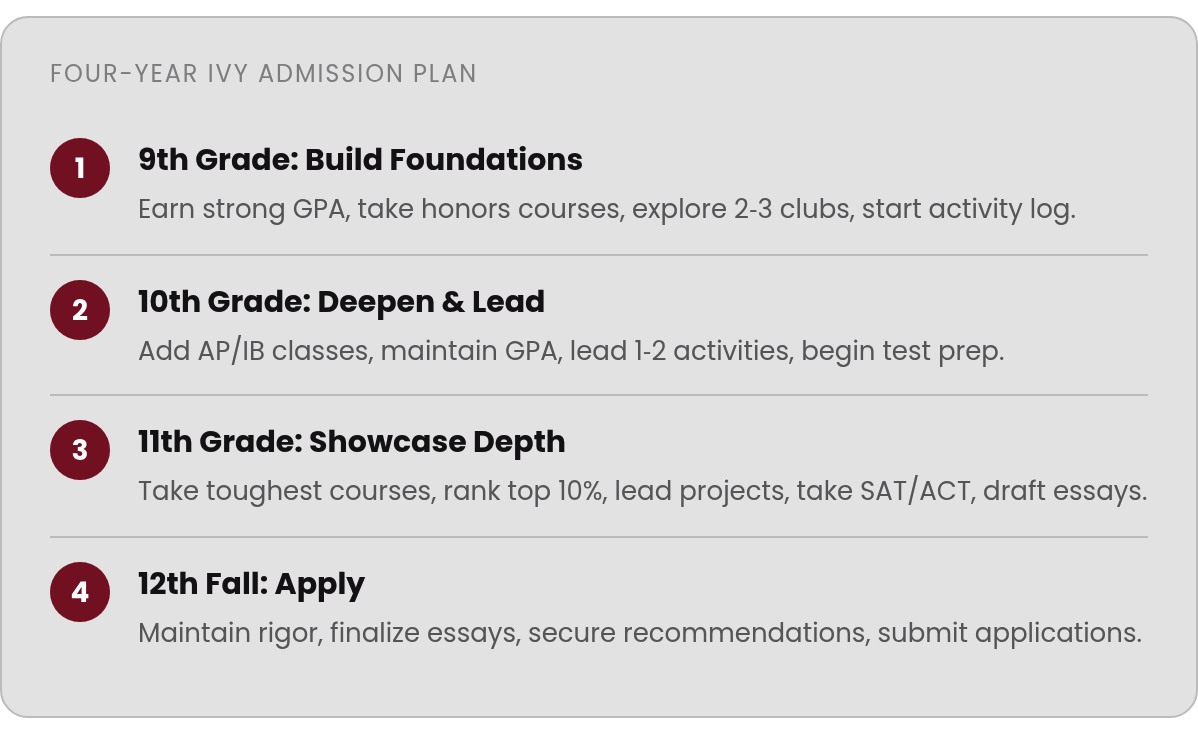
Each grade has a job in your admissions story. Ninth grade builds the foundation with strong grades, challenging courses where available, and initial exploration of interests. Tenth grade deepens that exploration and adds leadership in one or two core activities. Junior year is when your profile must show real depth: competitive test scores if required, advanced coursework where available, and sustained impact in activities that matter to you. Senior fall executes the application, but by then your academic record and activity depth are already largely set.
The timeline below maps those four years to the five categories admissions officers evaluate: academics, extracurriculars, testing, essays, and application logistics. We built it from what former admissions officers commonly describe as the signals they look for in an initial application review, then worked backward to show when each signal needs to be in place.
| Year | Academic Milestones | Extracurricular Milestones | Testing Milestones | Essay & Application Milestones |
|---|---|---|---|---|
| 9th | Enroll in the strongest courses available; establish a strong GPA baseline | Explore 2-3 clubs or activities; attend meetings consistently | Take PSAT 8/9 if available for baseline | Start activity log; meet school counselor |
| 10th | Add AP, IB, dual-enrollment, or honors options where available; maintain or raise GPA | Deepen involvement in 1-2 core activities; seek early leadership or organizational roles | Take PSAT 10 if available; begin SAT or ACT prep only if needed and testing is accessible | Research potential college majors and programs; confirm current testing policies at target schools |
| 11th | Take the most rigorous courses available; aim for strong standing in your school context | Hold leadership positions; launch or lead a meaningful project, even if small | Take SAT or ACT in spring if required or beneficial; review current test-required/test-optional policies before retaking | Begin college list; identify recommenders; draft essay ideas |
| 12th Fall | Maintain rigor and grades through first semester | Continue leadership and depth in core activities | Retake tests only if current policies and score gaps support it | Complete Common App essay and supplements; submit applications |
If advanced courses are limited, use the strongest available options and document self-study, dual enrollment, or other sustained academic work where possible. If testing access is limited, plan around available test dates and confirm whether the schools on your list are test-optional, test-flexible, or test-required. If counseling is limited, ask the counseling office for the school’s course sequence, testing calendar, recommendation process, and deadlines, then track the remaining steps yourself. If meaningful extracurricular opportunities are scarce, a small self-directed project, community initiative, or online learning sequence can still build a sustained body of work.
Starting early gives you access. A student who begins positioning in ninth grade can take the strongest courses available, build multi-year depth in activities, and earn teacher recommendations that describe sustained growth. A student who waits until junior year is working with a narrower transcript, thinner activities, and less time to correct course. Many school counselors cannot provide this sustained, individualized planning because of high caseloads and competing demands. That gap is one reason families turn to structured, multi-year support.
The risk of leaving major work until senior year: admissions offices often evaluate your record in context. If several other students from your high school present four-year depth and you present one strong year, the contrast can be visible. Some former admissions officers say they want to see the person behind the transcript, not a list of achievements. That person is usually developed over years.
Why Long-Term Positioning Matters
Years before you open the application, admissions committees evaluate four years of academic choices, not twelve months of achievements. A student who builds course rigor steadily from ninth through twelfth grade tells a fundamentally different story than one who loads advanced classes only as a senior. That narrative difference shows up across every part of the file.
Many admitted students present strong grades, challenging coursework, and meaningful extracurricular involvement. Testing is often strong as well, but most applicants with high scores are still not admitted. Academic credentials generally function as a baseline requirement rather than a differentiator. A senior-year spike cannot manufacture three earlier years of sustained rigor or the depth of engagement that separates admitted students from the qualified majority who are turned away.
Academic Standing Cannot Be Retroactively Built
Your transcript matters most, and it accumulates over time. Colleges commonly report that curriculum rigor and grades in college-preparatory courses are among the top factors in admissions decisions. A student who gradually increases the difficulty of their schedule across four years demonstrates readiness in a way that a last-minute course load cannot replicate. This is not about taking every advanced class available. It is about strategic course selection that builds coherently toward your stated interests.
The same principle applies to extracurriculars. Admissions officers look for sustained commitment and genuine growth, which by definition take years to build. Some guidance sources note that successful candidates often show passion that develops over time, with depth of knowledge that reveals hours spent researching, building, or creating. A student who joins six clubs senior year to fill out an activities list presents a different profile than one who spent three years deepening a single meaningful project.
The Hidden Cost of Waiting
Many families underestimate how little individualized college strategy their school provides. In some schools, counselor caseloads run high enough that personalized planning time is limited. School counselors juggle scheduling, mental health support, and crisis response for many students at once. Even a dedicated counselor may not be able to offer ongoing, individualized planning for every selective candidacy.
Admissions officers often evaluate course selection against what is available at each school. Yet students from under-resourced schools may self-select out of advanced tracks even when those courses exist. Some research points to concerns about elitism and belonging as part of that pattern. The context comparison can be shaped by access before transcripts are built. A four-year plan can help you claim the full rigor available to you early, when course sequences still matter.
Middle-school placement can determine what is available in ninth grade, but colleges review the high school transcript. If your middle school choices limited your starting point, ninth grade is the first major opportunity to show an upward trajectory. That matters because the transcript becomes the record selective colleges actually evaluate.
When we map out positioning with families, we focus on what each year is for. Ninth grade builds the foundation: solid grades, deliberate course planning, and exploration of genuine interests. Tenth grade deepens commitment: advanced course selection where available, early leadership roles, and focused summer opportunities. Junior year positions you: higher-level leadership, testing decisions, and school-list development. Senior fall executes: applications, essays, and recommendations. The work of getting into an Ivy League school happens across all four stages, not in the final one alone.
Testing requirements have shifted in recent years. Some selective colleges have returned to requiring SAT or ACT scores after test-optional periods, while others remain test-optional or test-flexible. Check each school’s current policy before deciding whether to test, retake, or skip.
Senior Year: Executing the Application
Senior fall is when the three-year positioning you have built either becomes a coherent application or stays scattered notes in a folder. We see families treat this as the start of the process, but the admissions committee reads it as the final chapter. The students who get into Ivy League programs are not assembling credentials in October—they are translating work that is already finished into a narrative that connects their transcript, activities, and intellectual curiosity.
Finalize your college list. Choose between Early Decision, which is often a binding commitment to attend if admitted, and Regular Decision. Complete the Common Application and school-specific supplements. Most selective schools require two teacher recommendations and a counselor letter. Prepare for optional alumni interviews. Many schools release regular decisions in late March, often on Ivy Day, while early applicants typically hear in mid-December. A missed deadline or generic essay can undermine otherwise careful preparation.
Start your Common App essay in August if you have not already. Draft, wait three days, revise. Repeat until the essay reads like you wrote it, not like you assembled it from advice columns. The prompt matters less than whether the essay reveals how you think when a situation forces you to make a choice. Your essay needs to show intellectual curiosity or self-awareness that distinguishes your voice from others in the applicant pool.
Supplemental essays require research into each school’s programs, culture, and academic offerings. Ivy League schools often ask why you want to attend their institution specifically, and generic answers about prestige or location signal you did not do the work. Read faculty research in your intended major. Find a student organization that aligns with your extracurriculars. Name a specific course or lab that fits your academic goals. The supplement is where you prove you understand what makes Yale different from Princeton beyond the acceptance rate.
Request letters of recommendation from teachers who taught you in junior year in core academic subjects and saw you contribute beyond turning in assignments. Give them at least six weeks before the first deadline, a résumé summarizing your activities, and a short note explaining why you are asking them specifically. A strong recommendation describes how you approach problems and engage with material, not just that you earned an A.
Prepare for the optional alumni interview by reviewing your application, reading recent news about the school, and practicing answers to questions about your academic interests and extracurricular impact. Treat the interview as an opportunity to demonstrate genuine interest and engagement with the school’s specific offerings. Interview availability varies by school and region, so if you do not receive an invitation it may reflect logistical constraints rather than your candidacy.
Before deciding whether to retake tests in the fall, confirm whether each school on your list is test-required, test-optional, or test-flexible. If a school is test-required and your score is below the level you can reasonably achieve with focused preparation, a retake may be useful. If a school is test-optional and your transcript is stronger, the same retake may not be necessary.
When Outside Help Actually Helps
The question is not whether to seek outside help. It is what kind of help moves the needle when positioning for selective admissions means competing in an exceptionally crowded applicant pool.
What Structured Expert Input Provides
We see two forms of external support that families consider: reactive application help in senior year, and multi-year advising that builds the candidacy itself. The latter tends to be more useful because selective admissions readers often look for sustained intellectual curiosity and a coherent narrative across four years. Those qualities are difficult to assemble in senior fall.
Some families work with advisors who provide ongoing course planning, extracurricular roadmapping, and essay development over multiple years. The most useful advising arrangements create accountability and timeline discipline rather than guaranteeing a particular outcome. Students who start working with a mentor early give themselves more room to deepen a project, revise their writing, and recover from setbacks before applications open.
Some families also use academic mentorships that pair students with professors or researchers on individualized projects. These projects may lead to presentations, publications, or competition entries, but outcomes vary widely. Mentorships are most useful when a student has demonstrated serious interest in a field but lacks institutional connections to pursue advanced work. Long-term mentorship can also cultivate the habits that later read as intellectual curiosity or initiative; those traits often look innate in an application, but they are frequently practiced over years.
Skip this route if your child already has access to advanced research through their school or local university. Pursue it when the student has genuine interest but lacks access, and when the project can be sustained rather than treated as a one-time résumé line.
References
[1] How To Get Into An Ivy League School? The Essential Guide - https://www.crimsoneducation.org/us/blog/how-to-get-into-an-ivy-league-school
[2] A high schooler's guide to preparing for the Ivy League - https://www.savingforcollege.com/article/a-high-schooler-s-guide-to-preparing-for-the-ivy-league
[3] What High School Classes Should You Take for Ivy ... - https://www.conciergecollegeconsulting.com/high-school-classes-ivy-league-college-admissions/
[4] How early should I start preparing my child for the Ivy ... - https://www.solomonadmissions.com/post/how-early-should-i-start-preparing-my-child-for-the-ivy-league/
[5] Early College Planning: A Grade-by-Grade Timeline - https://ingeniusprep.com/blog/early-college-planning-a-grade-by-grade-high-school-timeline/
[6] The Complete Timeline for Ivy League Applications (9th– ... - https://riseglobaleducation.com/blogs/the-complete-high-school-timeline-for-ivy-league-applications
[7] Elite Destinations: Pathways to Attending an Ivy League ... - https://www.researchgate.net/publication/263420765_Elite_Destinations_Pathways_to_Attending_an_Ivy_League_University
Frequently Asked Questions
1. If I didn't take the hardest courses in ninth grade, can I still recover my Ivy League chances?
You can strengthen your position by increasing rigor in tenth and eleventh grade, but admissions officers will still notice when advanced coursework begins. If your school did not offer advanced options or you were placed out of them early, make that context clear in the counselor recommendation or additional information section. Focus on showing depth in the courses you do take and building a coherent narrative around your academic trajectory. Strong performance, thoughtful recommendations, and meaningful work outside the classroom can show that your preparation is moving in the right direction.
2. How do admissions officers actually compare students from the same high school?
Admissions offices often read applications by region and consider what courses and opportunities were available at each school. They may also consider how a student's choices fit the school's broader academic culture, responsibilities outside school, and access to enrichment. Your course selections should therefore make sense in context and show that you pursued appropriate challenge rather than simply collecting advanced labels.
3. What happens if my school counselor doesn't have time to help me plan all four years?
Ask your counselor for the school’s course sequence, testing calendar, recommendation process, and application deadlines, then track the remaining decisions yourself. A private advisor, teacher, department chair, or mentor may help fill gaps, but outside support should supplement—not replace—the counselor’s official guidance and your own responsibility for meeting requirements.
4. Does strong test performance in junior year offset weaker ninth and tenth grade transcripts?
A competitive score can confirm academic readiness, but it cannot replace sustained rigor, a coherent narrative, or multi-year extracurricular depth. Use testing to strengthen the academic record you have, while making later course choices and activities demonstrate clear growth. Because testing requirements have changed at many schools, check current policies before deciding whether to retake.