Inside a Stanford Acceptance: What the Consultant Did and Didn't Touch
October 20, 2026
Why This Topic Matters
Stanford and its graduate schools are highly selective; admission rates vary by program and year. The gap between submission and admission is where families wonder whether a consultant changes the odds.
We work with students on essays, interview prep, and application strategy—the parts of the process you control before you click submit. That work centers on narrative clarity: sharpening the "why Stanford" essay, helping a student articulate why a particular program matters to them, and making sure the application tells a coherent story. A former Stanford admissions officer described her role as reading "the whole student," not just test scores, and noted that authenticity consistently mattered more than polish. The committee reads for the story—what the student presents across essays, activities, and voice—not just the numbers.
What a Consultant Can Influence Through Better Preparation
Our role is to excavate the authentic story already present, but buried under vague language or over-manufactured prose. We surface the narrative admissions officers need to see through iterative feedback that peers and teachers often cannot sustain over multiple drafts. The committee still controls what happens after submission.
Common mistakes identified by admissions experts include over-polishing the "why Stanford" essay until the student's voice disappears, failing to connect personal experiences to what Stanford specifically offers, and relying on jargon instead of concrete examples. We provide mentorship to address those gaps, but the core message must remain the student's. Our editorial rigor refines what is already there. It does not fabricate an advantage.
The interview phase illustrates the practical limits of preparation. Stanford interviews candidates for a limited number of spots, making the post-interview odds uncertain. These conversations are typically conducted by alumni, who assess whether the applicant demonstrates the qualities Stanford says it seeks. We prepare students through mock sessions and feedback, but the interviewer hears the student's voice, not ours. Our contribution is helping the student articulate experiences with enough clarity and specificity to make the conversation useful.
Key Takeaways
- Stanford's admissions committee reads the whole student across essays, activities, and voice rather than relying primarily on test scores. Consultants can sharpen that presentation before submission, but the committee still controls what happens next.
- The interview stage involves candidates competing for a limited number of admission spots, creating uncertain post-interview odds that consultants can prepare for but not control.
- Admissions officers have admitted students with modest GPAs but compelling essays about overcoming adversity while rejecting applicants with perfect scores and generic essays.
- A consultant refines the presentation and narrative clarity of an authentic story through iterative feedback. That influence ends when institutional review begins; the consultant does not fabricate an advantage or write the application.
- The application must remain coherent across essays and interviews. Preparation can help a student communicate consistently, but it cannot determine how the committee interprets that material.
- Mock interview preparation helps candidates discuss a few defining moments in depth instead of trying to summarize an entire résumé.
What a Consultant Actually Does
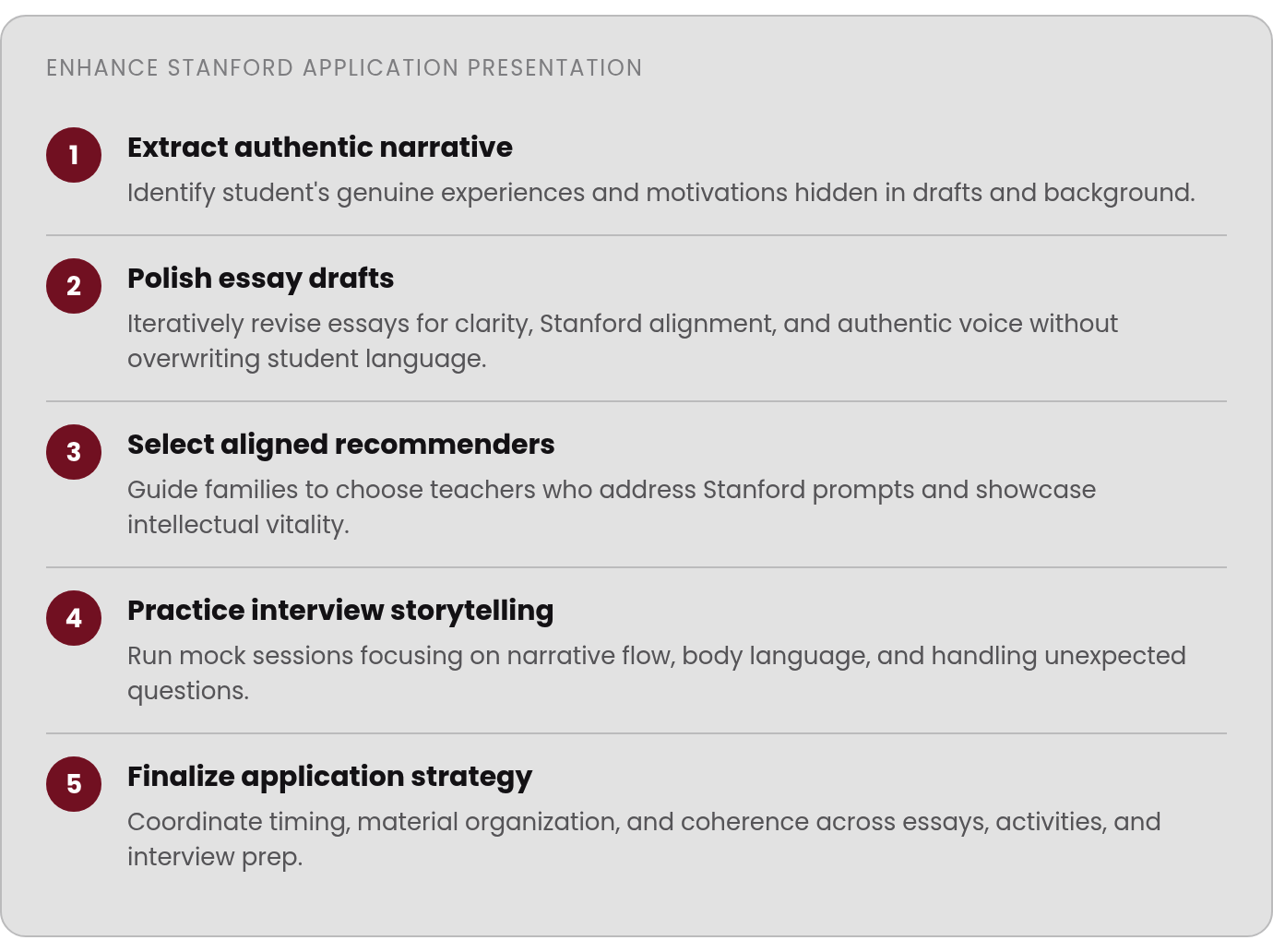
We coach on four areas before an application reaches Stanford's admissions committee: essays, recommender selection, interview preparation, and application strategy. Each contribution stops at a clear boundary. We refine the presentation of the student's story, but we do not write it for them or influence the committee's final decision.
Essay Coaching Without Taking Over
When we work on essays, our job is to help students surface the authentic story already present in their backgrounds. The substance has to belong to the student. Our feedback can identify a vague passage, an unsupported claim, or a connection to Stanford that feels generic, but the student must supply the underlying experience and interpretation.
We push through multiple rounds of revision to make sure the "why Stanford" essay shows genuine alignment with the school's values, not manufactured enthusiasm. The work may involve clarifying what the student did, why it mattered, and how it connects to Stanford's opportunities. It should not replace the student's vocabulary or turn a personal reflection into institutional marketing copy.
Recommender Selection and Interview Preparation
We also help families choose recommenders and make sure their letters address what Stanford asks for. We guide students toward teachers or mentors who can address the qualities the application asks about, not simply repeat their grades. A detailed letter responding directly to the school's prompts is more useful than generic praise.
For interviews, we run mock sessions that cover storytelling, body language, and behavioral questions. The goal is not to script an answer for every possible prompt. Instead, students practice explaining their choices, responding when a question moves in an unexpected direction, and developing a meaningful experience rather than listing accomplishments. Interview preparation can make the student more composed, but the admissions officer remains responsible for evaluating fit.
How This Played Out for One Student
What We Touched
In our experience, the work touches the same four areas before submission: essays, recommender selection, interview preparation, and application strategy.
The "why Stanford" essay often brings these activities together. Applicants may list programs without explaining the personal connection, and our role is to ask better questions while the student supplies the answers, examples, and point of view.
What Remained Beyond Reach
The admissions committee's internal review and final decision sit beyond any consultant's influence. We can help a student present leadership potential and intellectual vitality, but we cannot alter the substance of the student's background or determine how readers weigh it. Our data-driven approach helps applicants present their strongest cases. It does not provide access to the committee or control its deliberations.
Practical Advice for Families
You may be reviewing your child's Stanford application one more time before submission. The consultant has commented on several drafts, helped identify appropriate recommenders, and conducted practice interviews. At that point, the useful question is not whether the consultant can secure an acceptance. It is whether the application now represents the student clearly and honestly.
The consultant's influence stops when the application enters Stanford's review system. The committee's internal discussion, scoring process, and final vote belong to the institution. The former admissions officer's account reinforces the same point: readers assess the complete applicant, including the substance behind the presentation. Consulting can improve the presentation, but it cannot substitute for substance.
Understand What You're Paying For
When you hire a consultant, you are paying for application quality, not influence. Our team refines the narrative clarity of a "why Stanford" essay, helps students connect their experiences to the institution, and advises on recommender selection. We also use practice conversations to help applicants explain their interests without sounding rehearsed.
We do not write essays for students or sit on the admissions committee. The value lies in surfacing what is already meaningful in a student's background and helping the student communicate it precisely. Editorial polish cannot create depth where none exists. The committee still evaluates fit, authenticity, and intellectual vitality on its own terms.
Preserve the Student's Voice
The most common mistake families make is handing too much control to the consultant. When parents ask someone to "just fix it," they risk losing the asset Stanford values most: the student's authentic perspective. One admissions reader noted that many successful applicants do meaningful things in ordinary jobs, meaning depth and impact matter more than prominent titles. A student who founded a small nonprofit to amplify the voices of brain trauma survivors may communicate leadership more convincingly than an applicant who lists a dozen generic positions.
Ask your consultant to coach, not ghost-write. If your child cannot explain the essay's central argument in their own words, the consultant has overstepped. If the final draft sounds like polished marketing copy rather than a teenager's reflection, the process needs to be pulled back toward the student. The healthiest model is a feedback loop: the student writes, the consultant identifies weak spots, and the student revises.
Watch for three red flags: a "why Stanford" essay that lists programs without explaining personal connection, recommender letters that do not address the school's questions, and interview preparation that scripts answers instead of teaching storytelling principles. We can help families avoid those problems only when the student retains ownership of the material.
References
[1] Stanford Business School’s ‘Application Essentials’ tackles an ... - https://www.instagram.com/poetsandquants/reel/DalM7giFMI7/?hl=af
[2] What does an admission consultant with Harvard & ... - https://www.mbacrystalball.com/blog/2021/05/24/mba-admission-consultant-harvard-stanford/
[3] I’m Irena! Former Stanford Admissions officer, independent college ... - https://www.reddit.com/r/ApplyingToCollege/comments/13impgn/im_irena_former_stanford_admissions_officer/
Common Questions
If I work with a consultant on my Stanford essays, will the admissions committee be able to tell someone else helped me?
The strongest protection is ownership. A consultant may point out weak logic, unclear transitions, or unsupported claims, but the student should be able to explain every idea and example without relying on a memorized script. The finished essay should retain the student’s natural perspective rather than sounding like generic admissions copy.
What's the difference between what happens before I submit my application and what happens after?
Before submission, a consultant can provide essay feedback, recommender guidance, interview practice, and application strategy. After submission, the admissions committee controls the review process and determines the result. The consultant’s responsibility is preparation; the institution’s responsibility is evaluation.