Data-Driven Admissions Help That Actually Moved Stanford and MIT Applicants
September 28, 2026

The Short Version
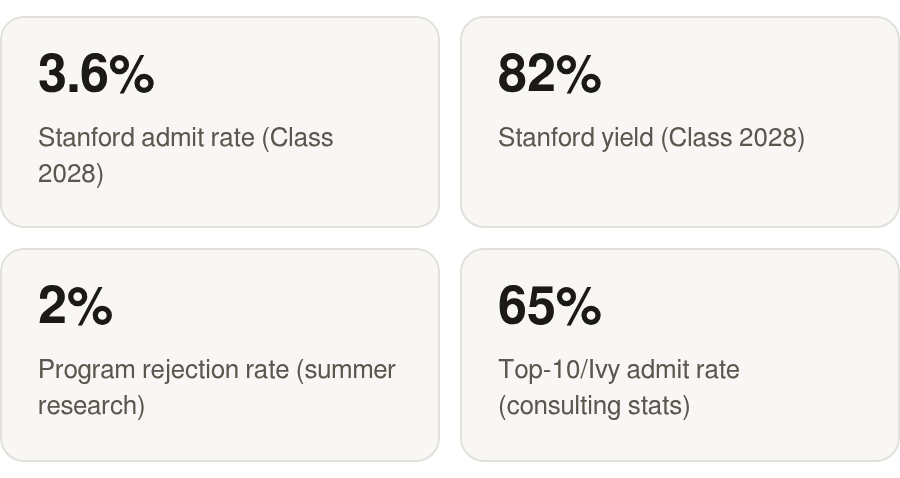
- Stanford admitted 3.6% of applicants for the Class of 2028, the lowest rate in school history.
- That class posted an 82% yield, which suggests Stanford rewards demonstrated interest. Specific "why us" essays read differently than generic ones.
- Test requirements are back for the Class of 2030. The test-optional gamble is closing.
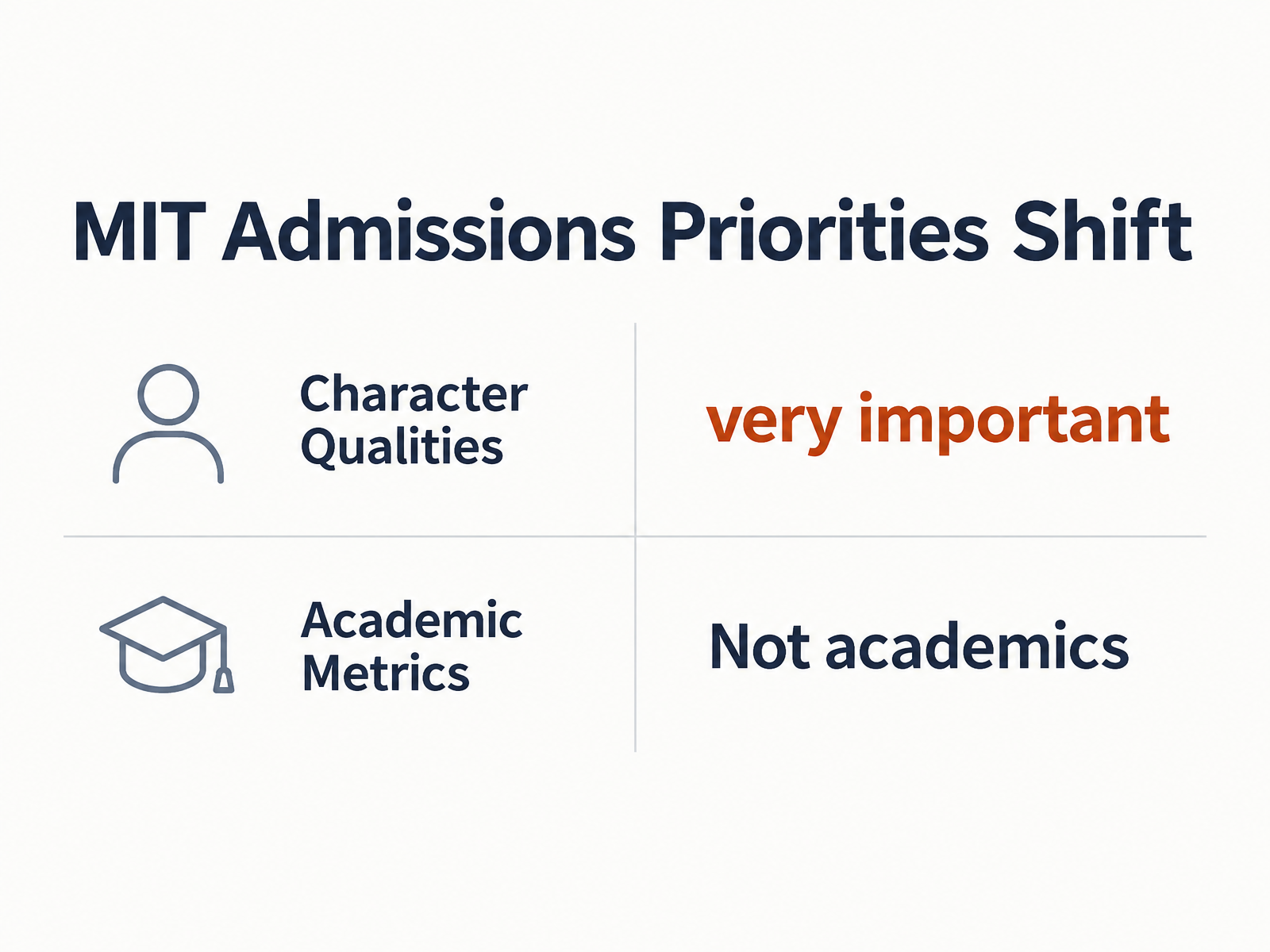
- MIT's Common Data Set lists character and personal qualities as the only "very important" factor, ranked above academic metrics.
- Stanford stopped publishing its restrictive early action numbers years ago, so any early-round advantage is hard to see from the outside.
- One redirected student landed a Stanford Kavli Institute internship after a 2% program turned him down, producing a primary-author journal publication and two conference presentations.
- For schools admitting above 20%, data modeling adds little. The margins don't justify a performance bonus.
Why We Tie Our Fee to the Outcome
Stanford admitted 3.6% of applicants for the Class of 2028, the lowest rate in its history, per Crimson Education's data. At those odds, consulting only earns its fee if it moves a needle you can measure. So we build our work around a base fee plus an admission-outcome bonus. The money follows the result.
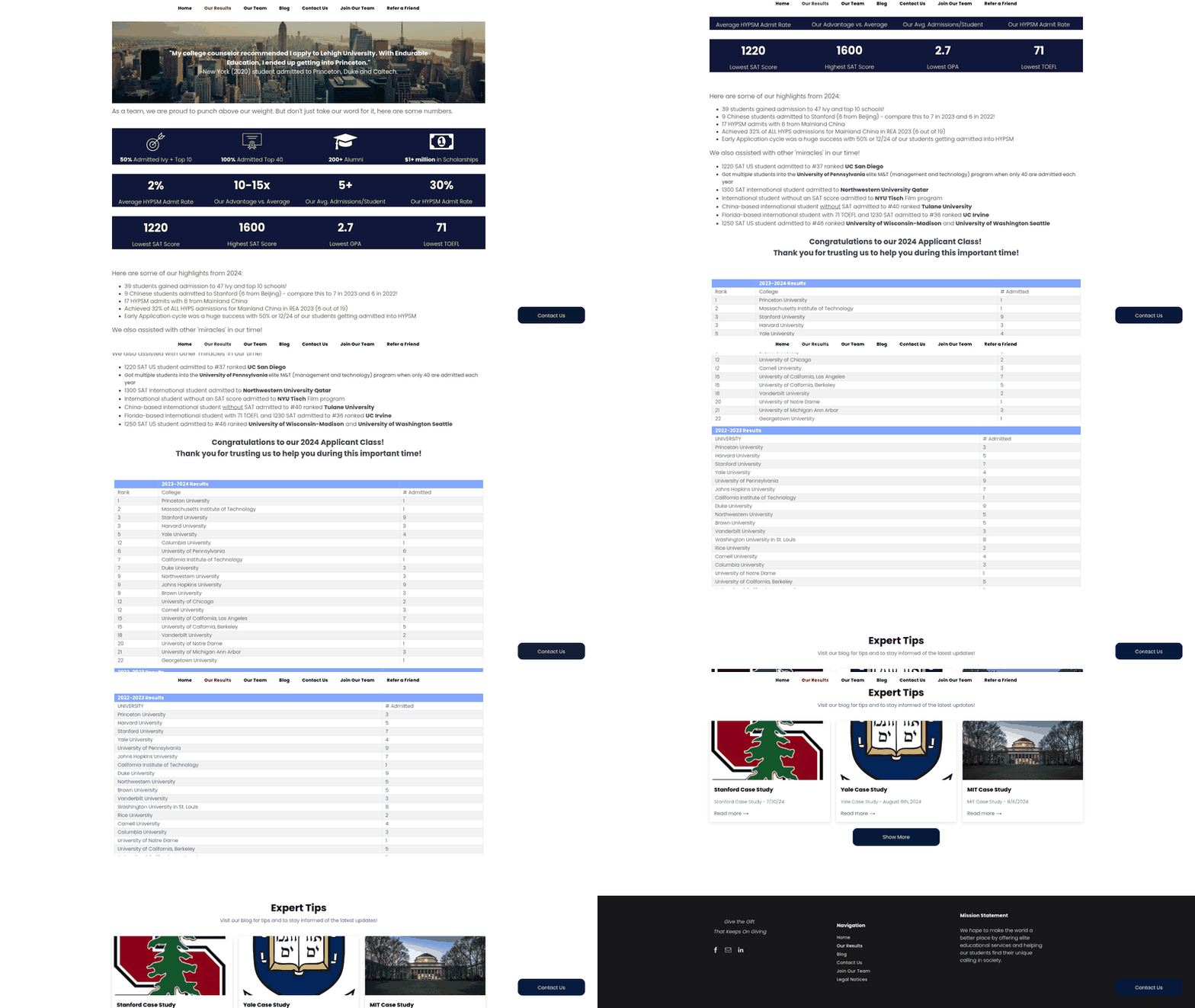
Here's the fast read on where data-driven work shifts an applicant's position, and where it doesn't.
The Metrics That Separate Admitted From Deferred
| Metric | Stanford benchmark | Typical applicant baseline | Data-enhanced target | Impact |
|---|---|---|---|---|
| Overall admit rate | ~3.6% (Class of 2028) | N/A | Aim for early-round fit | 🔴 High |
| Early-round edge | REA data no longer published | Applies Regular Decision | School-specific timing call | 🟡 Medium |
| Testing | SAT/ACT required (Class of 2030) | Test-optional gamble | Submit strong scores | 🔴 High |
| Yield context | 82% yield (Class of 2028) | Generic "why us" essay | Demonstrated-fit essay | 🔴 High |
The early-round question deserves a hard look. Stanford stopped reporting its restrictive early action numbers and acceptance rates several years ago, which limits how much anyone can say about the edge that round offers. At comparably competitive schools, early applicants often enjoy a statistical advantage. But that pool is also padded by recruited athletes and hooked applicants, so the raw number flatters the round.
Our guidance to families is deliberately narrow: use early timing only when the file is already strong enough to benefit from it. A rushed early application can cost more than it gains, especially when the student would have been sharper and more complete a few weeks later.
Time, Difficulty, And What Data Fixes First
Each phase carries a different effort cost. Profile building is the long game, months to years, and the hardest of the four, because most students lack a coherent through-line. Data analysis on public admit statistics is fast, usually a few days, and low difficulty. Essay refinement sits in the middle, since it takes repeated revision to turn activity into meaning. Interview prep is easy to schedule, but families often leave it too late.
Three quick wins data-driven work delivers before the first deadline:
- Timing call: Model whether early action helps for your specific target, since the edge varies school to school.
- Testing decision: With test requirements returning for the Class of 2030, the test-optional gamble is closing. Decide now.
- Fit signal: An 82% yield means Stanford protects for demonstrated interest. A specific "why us" essay reads differently than a generic one.
Prerequisites You Gather Before The First Session
Pull three data sources before any strategy work. First, the Stanford Common Data Set for admitted-student profiles. Second, your own activity logs and transcripts. Third, your school's recent placement history, since context matters to readers who compare you against your peers.
One honest scope limit: if your target admits more than 20% of applicants, this level of data modeling is overkill. The margins there don't justify a performance bonus. For sub-5% odds like Stanford, aligning fee to outcome is where the math starts working.
What the Data Can Actually Measure
The only factor MIT ranks "very important" in its Common Data Set is character and personal qualities. Not academics.
That reframes what data-driven work should measure. The strongest signal is measurable profile strength: verified research output, published work, documented leadership. The kind of milestone that survives committee.
One case from the NY Post's roundup of admissions firms shows this well. A student rejected from a 2% summer research program was redirected to faculty matching his interests, landed an internship tied to Stanford's Kavli Institute, and produced a primary-author journal publication plus two conference presentations. Those are countable outcomes. An admit letter is not.
How should this shape a base-plus-bonus contract?
Now the tension. Firms sometimes market eye-catching outperformance stats, but any guaranteed admit claim is structurally dishonest, because the committee vote sits outside anyone's control. Those numbers often reflect selection bias. Strong applicants enroll with strong firms.
So we separate controllable work from institutional judgment. A contract should pay for the planning, feedback, research direction, and profile development a consultant can actually perform. It should not pretend the final committee vote is a product anyone can manufacture on demand. Our pricing keeps the incentive on quality, clarity, and client satisfaction rather than on a decision made outside the room.
Be cautious with any firm that insists on tying a bonus strictly to the admit decision. That structure sells you certainty that doesn't exist. We'd rather be honest about where data helps and where the committee takes over. Our deeper piece on data versus gut instinct in admissions walks through the reasoning.
Consider the scale of what stays uncontrollable: Harvard reads roughly 60,000 applications for about 2,000 seats, and most rejected students are academically qualified to attend. The decision is not a measure of the work. Pay for the signal you can build. Never pay for the vote.
Building a Profile the Numbers Actually Reward
Start with the numbers you can verify. MIT publishes SAT Math admit rates by band: 15% for the 750-800 range, 10% for 700-740, 5% for 650-690, per Chris Peterson's breakdown. Read fast, and that gap looks like proof that a higher score buys admission. It doesn't.
Peterson's own explanation is the heart of good admissions work: MIT doesn't prefer the 800. It prefers the traits that tend to travel with it. An IMO medalist who scored 800 beats a 740 applicant because of the medal, not the 40 points. That distinction changes how you build a profile with data.
Which Numbers Should You Benchmark, And Which Should You Ignore?
Benchmark the entry thresholds, then stop optimizing them. Pull the Stanford Common Data Set and MIT's published ranges to confirm you clear the bar. Peterson notes that nearly half of one MIT class were high school valedictorians, but not because MIT values class rank. It values the academic accomplishments that tend to produce valedictorians.
Once you're inside those ranges, more points are usually the wrong project. Map your GPA, rigor, and scores against the published averages, close any real gap, then redirect the rest of your energy toward work that reveals intellectual force rather than compliance with a benchmark.
Where should that energy go? Peterson is explicit that MIT admits people, not test scores, and that it prizes genuine academic accomplishment and the kind of work that earns strong recommendations. That's the target worth chasing. It's also why our customized planning can start as early as 8th grade, building meaningful experiences and skills long before the application itself.
How Do You Measure Progress When Admission Itself Is Unpredictable?
The right measurement system starts before the application is written. Track countable profile milestones: verified research output, published work, documented leadership with hours and outcomes attached. These signals map to the qualities schools reward, and they exist whether or not the committee says yes.
That changes how a family should judge progress. A strong month may mean a better research mentor, a cleaner activity arc, a sharper recommendation strategy, or a leadership project with real evidence behind it. Those gains aren't cosmetic. They become the raw material for the file.
Our panel approach gives you several perspectives on your applications and essays, so the record you build is real, provable, and reviewed from more than one angle. The goal isn't to make the file look busy. It's to make the student's pattern of choices legible.
What About Early Rounds And Demographic Fit?
Early rounds can be worth targeting when your profile is ready by fall. Our regular check-ins keep you on track toward that kind of timeline, so a strong early application isn't a scramble.
Skip the demographic angle unless it's genuinely part of your story. Forcing a socioeconomic narrative onto a profile that doesn't have one reads false in committee. Data-driven work means building an honest, quantified record of who you are, then benchmarking it against what these schools actually reward.
Using Data for Essay and Narrative Strategy
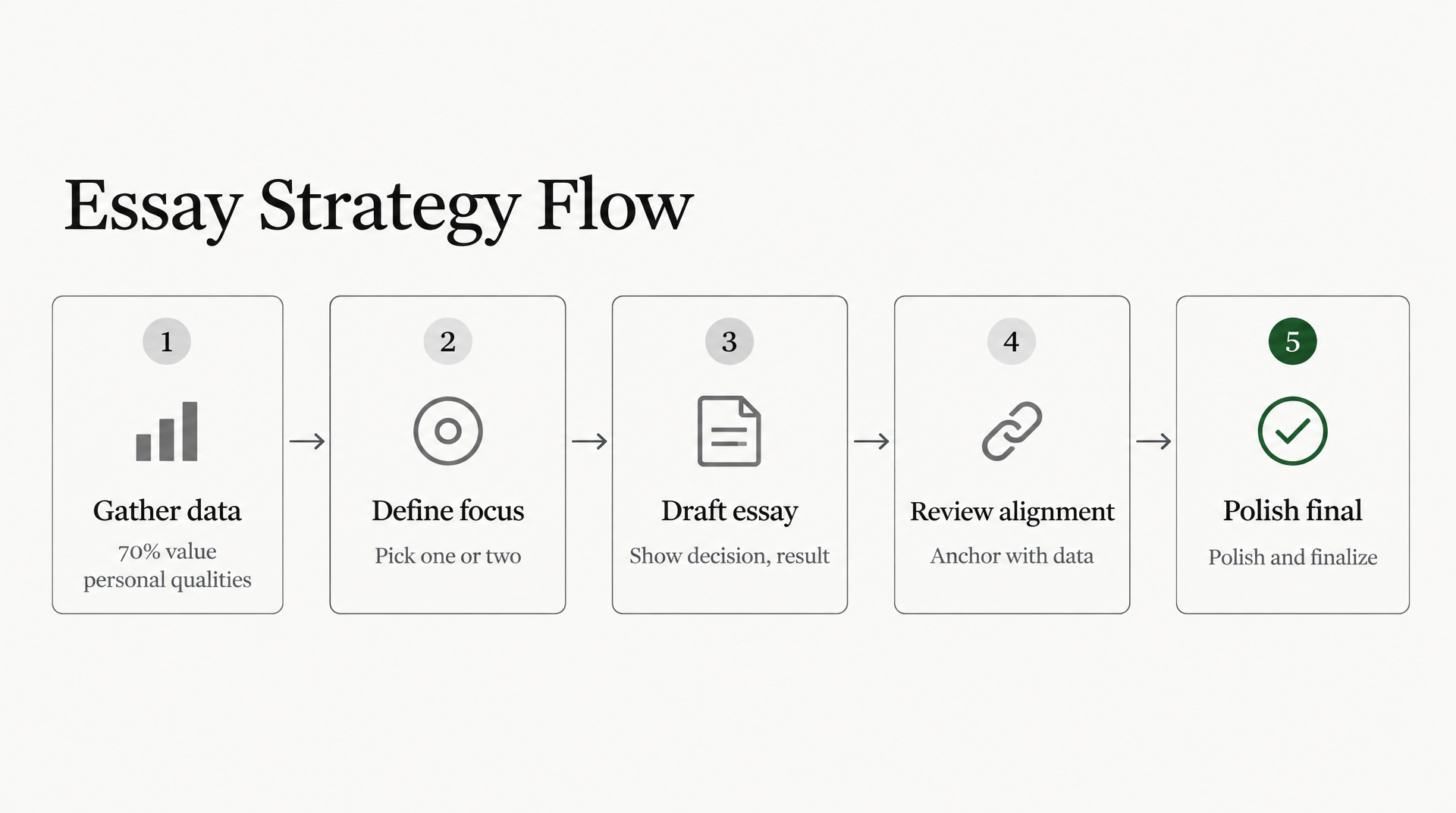
The best essay strategy starts with a hard fact about how officers read. In a NACAC survey cited by a Science Advances study on personal qualities, 70% of admissions officers said they weigh personal qualities as an important factor. That number should reset what your essay is trying to prove.
This is where consulting earns or wastes its fee. If your narrative optimizes for the wrong signal, no amount of polish saves it. The same study found that officers "simply do not have a common definition of holistic review beyond 'reading the entire file.'" You're not writing to a rubric. You're writing to a human looking for specific traits.
The Seven Qualities Are Your Real Essay Targets
The Science Advances team had human raters code seven distinct personal qualities in 3,131 applicant essays, things like prosocial purpose and leadership, not one blurry "character" score. Their fine-tuned language models then reproduced those human codes across demographic subgroups.
That gives you a concrete checklist. Pick one or two of those qualities and build the whole essay to demonstrate them through action. Don't claim leadership. Show the decision, the people you moved, the result you owned.
This is also where the application stops being a transcript summary. A grades-and-scores recap wastes a channel that can show judgment, initiative, generosity, resilience, or intellectual appetite. The essay should reveal what the rest of the file can only imply.
Data Makes Anecdotes Credible, Not Impressive
Families often assume that adding numbers to an essay makes the writing sound more rigorous. It doesn't. Numbers anchor a story so the reader believes the reflection that follows.
Say you led a tutoring project. "I tutored 40 students and pass rates rose from 55% to 80%" is not the point. The point is what you decided when the first cohort failed. The metric buys you the credibility to make that reflection land.
That national study coded qualities from essays describing extracurricular and work experiences, and those scores added real predictive value for six-year graduation across a sample of 309,594 students. The signal lives in what your actions reveal about you, not in the raw figure.
How Our Pricing Rewards Verifiable Progress
Essay work is one of the clearest places to separate progress from prediction. You can see whether a draft has moved from abstract claim to concrete scene. You can test whether it proves a quality through choice and consequence. You can revise until the reader has evidence, not just adjectives.
That's why our work emphasizes customized planning, collaborative essay feedback, and the experiences you build across the life-preparation phase. Our team, including advisors who graduated from Harvard and Yale, works alongside you through regular check-ins so the effort lands where it counts.
Skip the number-stuffing if your story already carries emotional weight on its own. For a personal essay about loss or identity, forced metrics cheapen it. Save the data-rich approach for activity essays and the "why us" prompts, where evidence of impact does real work.
Predictive Modeling and AI Tools: What to Trust
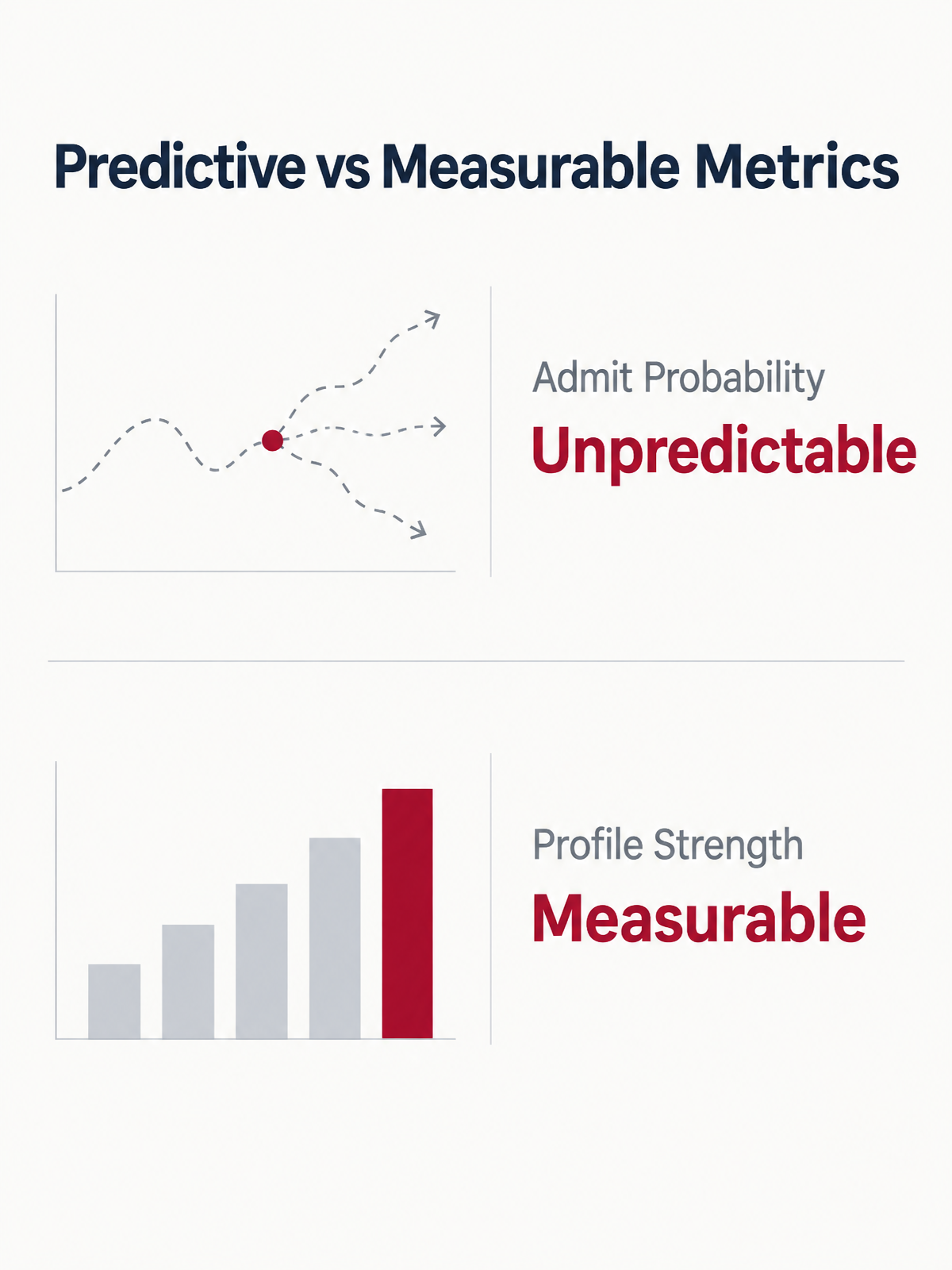
Predictive tools promise to tell you your odds. They can't, and the best evidence comes straight from the people making the decisions. This matters directly to how you price data-driven help, because a bonus tied to something unpredictable is a bad bet for both sides.
The distinction that governs everything: admit probability is not predictable, but profile strength and downstream fit are. That's the line that should decide which AI tools you trust and what any performance-based fee is allowed to reward.
Admit-Odds Predictors Fail Because the Decision Isn't in the Data
Admissions data shows the shape of past decisions, not the reasons behind them. Chris Peterson, an MIT admissions officer, put it bluntly in The Difficulty With Data: the numbers show "where the decision wasn't," not the basis on which it was made.
He describes the outcome forming "like a storm forming over the gulf" once every ingredient hits committee. No model sitting outside that room can reproduce it. That's why he calls the "what are my chances" question unanswerable, even by officers themselves.
So any dashboard that spits out a percentage chance at Stanford or MIT is selling correlation dressed as prediction. Treat those numbers as fiction. If a consultant's outcome bonus rides on beating a predicted admit rate, they're betting your money on a coin they can't weight.
AI Essay Scoring Predicts Fit, Not Admission
This is where the tools can still earn their keep. What matters is what a scoring tool claims to measure. A model trained to guess admission outcomes chases the final committee interaction. A model trained to read qualities in your writing does something an officer would recognize.
In practice, an outcome-predictor might tell you that certain keywords appeared more often in successful applications at a given school last cycle. That pattern can shift the moment the reader pool or institutional priorities change. A quality-reader instead flags whether your essay actually surfaces traits like initiative, curiosity, or care for others in a way a human would notice on the page.
The second kind is useful because it points at something you can revise before you submit. You cannot edit the committee's mood. You can edit whether your leadership example reads as a claim or as a scene with evidence behind it.
Our collaborative, panel-based review does the same work by hand. We check whether your narrative surfaces the traits that survive a human read. The mentorship stays human, and our team, with graduates from Harvard, Yale, and Princeton, brings real admissions experience to every essay.
Tie Bonuses to Signal, Not the Committee Storm
The pricing rule is simple: reward milestones you and the consultant can influence, not the admit letter neither side controls. That's the honest version of performance-based consulting.
Set that against the flashy placement stats some firms advertise. High admit rates among their clients often reflect who they enroll, not the lift they added. Selection, not causation.
For us, the practical anchor is verifiable profile gain during the life-preparation phase: a documented leadership role, a meaningful activity that lands on your resume, essays refined through real feedback. These are countable. A final decision is not yours to engineer. A fact on your CV is yours to keep.
Skip any consultant who guarantees admission for a bonus. The data says they can't deliver it, and Peterson's own words say they shouldn't pretend to.
References
[1] The Difficulty With Data | MIT Admissions - https://mitadmissions.org/blogs/entry/the-difficulty-with-data/
[2] Stanford Acceptance Rate Results for Class of 2029 - Crimson Education - https://www.crimsoneducation.org/us/blog/stanford-acceptance-rate
[3] Ivy Whisperers: 10 elite gurus getting your kids into top schools - NY Post - https://nypost.com/lifestyle/best-college-admissions-consulting-firms-ivy-league/
[4] How to Get Into MIT + Admissions Requirements 2024/2025 - https://www.collegeessayguy.com/blog/how-to-get-into-mit
[5] Stanford Common Data Set - https://irds.stanford.edu/data-findings/cds
[6] Using artificial intelligence to assess personal qualities in college ... - PMC - https://pmc.ncbi.nlm.nih.gov/articles/PMC10569720/
Common Questions
1. If Stanford no longer publishes early action data, how do I decide whether to apply early?
Treat early application as a readiness test, not a superstition. If your activities, recommendations, testing, and essays are already coherent by the fall deadline, early timing may be worth using. If the file still needs a stronger academic update, a sharper activity description, or more thoughtful essays, Regular Decision can be the more strategic choice.
2. Does a perfect SAT score meaningfully improve my odds at MIT?
Only up to the point where the score proves academic readiness. After that, MIT is looking for the substance behind the number: unusual problem-solving, academic initiative, recommendations that describe real contribution, and accomplishments that show how the student thinks. The score opens the door; the profile explains why the reader should keep paying attention.
3. Should I always add statistics to my college essays to seem more rigorous?
No. Use data when it makes the action clearer. A service project, research role, business experiment, or team initiative may benefit from a concrete before-and-after. A personal essay rooted in grief, identity, family, or moral conflict often becomes weaker when the student forces in a metric just to sound impressive.
4. Why won't Endurable Education guarantee admission in exchange for a bonus?
Because no ethical consultant controls the final vote. Our role is to improve the parts of the process that can be improved: strategy, positioning, profile development, essay clarity, and review quality. A guarantee would blur that line and encourage families to mistake confidence for control.
5. Is data-driven admissions help worth it for a school with a 25% acceptance rate?
Usually not at the same intensity. For less selective targets, the better investment may be clean school-list strategy, strong but efficient essay support, and merit-aid positioning. Heavy modeling is most useful when the school is so selective that small differences in fit, timing, and evidence can matter.
6. What documents should I gather before my first strategy session?
Bring the public profile data for your target schools, your transcript, your testing record, your activity list, and any notes on where students from your high school have recently enrolled. That lets the first session move straight into diagnosis: what is already credible, what is missing, and what needs to be built before deadlines arrive.
7. How should I handle a demographic or socioeconomic angle in my application?
Use it only if it helps explain your actual choices, constraints, responsibilities, or perspective. Admissions readers can tell when a student is borrowing hardship language because it sounds strategic. A stronger approach is to tell the truth precisely and let the record show how your background shaped what you did.