5 Ways Admissions Consultants Charge, and the Tradeoff Each One Hides
September 29, 2026

Key Takeaways
- Admissions consultants bill in a handful of ways: flat-rate packages, hourly work, retainers, essay-only help, and hybrid base-plus-bonus deals.
- Each model hides a different tradeoff, from rigid scope to open-ended cost.
- The question that matters most is not what the consultant costs.
- It is what the consultant is paid to do.
What the Billing Model Is Really Buying
Two families sit across from the same consultant. One pays a flat fee. The other signs a contract with a bonus tied to acceptances. Same advisor, same expertise, but the incentives pulling on that advisor now point in different directions. That difference shapes everything downstream.
How a firm bills isn't a bookkeeping footnote. It sets the scope of work, the advisor's motivation, and your family's stress. In this field, full-service packages run around $6,500 on average and premium engagements can climb past $100,000. The charging model is the part most families never think to question. We think you should.
How the money steers the work
A charging model is the structure a consultant uses to bill you. It decides what the advisor is rewarded for doing. Pay for outcomes, and you reward outcomes. Pay for hours, and you reward hours. The money steers the work whether anyone means it to or not.
Our standard is simple. You should get enough individual attention for the plan to reflect your actual strengths, constraints, and goals. Prestige and price can matter, but neither replaces close guidance. A bonus tied loosely to acceptances can push the other way. It rewards a visible result rather than the quality of the match. That can nudge an advisor toward safer lists or bigger client loads. We keep our roster small each cycle for exactly that reason. Customized planning stays customized.
Those two forces point away from each other. That's the tradeoff a bonus can hide.
What each model costs, and who it fits
Pricing swings widely with scope. The College Investor pegs the low end near $85 per hour, with the priciest consultants charging up to a $10,000 flat fee. An IECA survey cited by the same source put the average hourly rate around $200 and typical packages between $4,000 and $6,700. The "starting price" you see depends on how much scope and intensity you're shopping for.
| Model | How It's Structured | Predictability | Risk to Family | Best-Fit Profile |
|---|---|---|---|---|
| Flat-rate package | One fee, full scope ($4,000–$10,000+) | High | Overpaying if needs are light | Families wanting budget certainty |
| Hourly | Pay per session ($85–$200/hr) | Low | Rushed work under the clock | Families needing targeted help |
| Essay-only | Per-project or per-session | Medium | Narrow scope misses strategy | Strong students, one weak spot |
| Base-plus-bonus | Base fee plus outcome incentive | Medium | Advisor steers toward easy admits | Families who want the incentive visible |
The hourly model carries a quieter risk worth naming. When the clock is running, families feel pressure to move fast. Rushed applications are a real cost of that pressure.
Can you trust an advertised acceptance rate?
Not on its own. The College Investor warns that testimonials hide what goes unsaid, and a high price or a prestigious name doesn't guarantee results. A strong-looking number can come from an applicant pool that was already likely to succeed, especially when a firm won't explain how it counts schools, deferrals, waitlists, or students who applied mostly to safer options.
We built our base-plus-bonus model to keep that incentive in the open rather than buried. If you want the fuller cost breakdown, our guide to five consultant types walks through the tradeoffs one by one. Match the model to your timeline and budget. Always ask what the advisor gets paid to do.

Flat‑Rate Packages: Predictability vs. Flexibility
A family sits down in the spring of junior year, staring at a menu of services they only half understand. They want one number. Not an hourly meter, not a bonus clause, just a single price that covers the whole road from school list to submitted applications. That instinct is what flat-rate packages sell, and it's why they're the most common structure in this business today.
A flat-rate package bundles a defined set of work into one fee: timeline planning, a set number of essay drafts, interview prep, and application review. What sits inside that bundle varies more than families expect. Some firms count "one essay" as a single review pass. Others include unlimited revisions until you hit submit. Reading the scope line by line matters more than reading the headline price, because "flat rate" describes the billing shape, not what actually lands in your inbox.
What a flat rate actually buys
The appeal is certainty. You know the cost, the deliverables, and roughly when each milestone lands. For families who want to budget once and stop worrying, that predictability is worth a lot.
The detail that separates a good package from a weak one lives in the fine print. Watch three things: how many drafts each essay really gets, whether meetings are capped or open, and what happens to unused sessions at the end of a cycle. A package that looks generous on paper can quietly run thin if every interaction draws down a hidden counter.
There's a staffing question worth pressing, too. Private Prep's own data argues that caseload and individual attention predict outcomes more reliably than a consultant's prestige or price tag. A flat rate only holds attention steady if the firm caps how many students each advisor carries. Ask directly how many families your counselor works with in a cycle, and treat a vague answer as a warning sign.
Where the fixed scope pinches
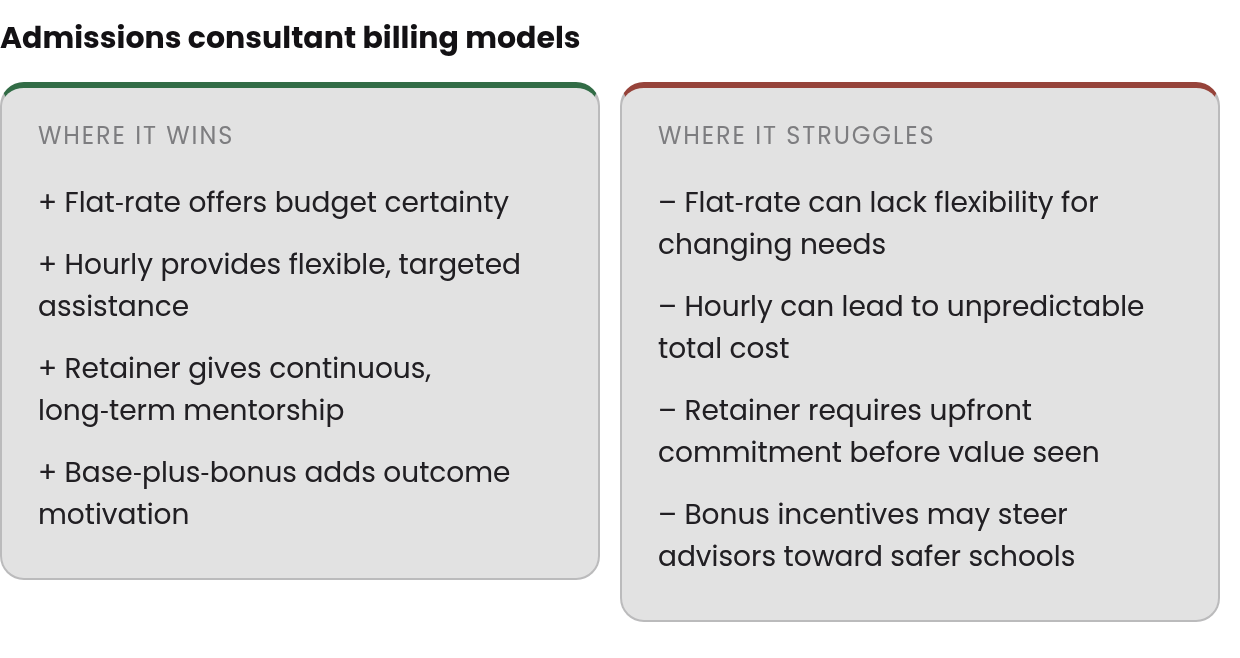
The tradeoff is rigidity. A package built around, say, five supplemental essays (the extra school-specific prompts beyond the main Common App essay) doesn't flex when your dream school drops three surprise questions. Ask for more, and you're back to negotiating add-ons, which quietly reintroduces the hourly meter you paid to avoid.
Flat rates also assume every student needs the same map. A recruited athlete and a first-generation applicant to a need-blind school are running different races. When the scope is fixed, customization is the first thing that gets squeezed.
How flat-rate compares to bonus-tied pricing
This is where our own model diverges, and we want to be honest about the tradeoff. A pure flat rate keeps the consultant's incentive neutral. They get paid the same whether you land at your reach school or your safety.
Layer an acceptance bonus on top and the math shifts. The advisor now has a financial reason to care about the outcome, which some families like, but the trigger has to be defined carefully. If the bonus pays for any admission letter, the model can reward conservative lists. If it pays for a specific goal agreed on in advance, it's easier to keep the work centered on fit. Our base-plus-bonus structure runs on a limited roster each cycle so the student never becomes one name in a large outcome spreadsheet. If you want the full comparison of how each structure bends behavior, our breakdown of five consultant charging types walks through it.
A quick caveat: if your needs are simple and well-defined, a lean flat-rate essay package is often the smarter buy. Don't pay for a four-year plan you won't use.
Hourly Consulting: Customization vs. Cost Uncertainty
Say you already have a school list and a solid first essay draft, but you keep second-guessing your Common App activities section. You don't need a four-year plan. You need two hours with someone sharp. That's the case hourly consulting is built for, and it sits at the flexible end of the market.
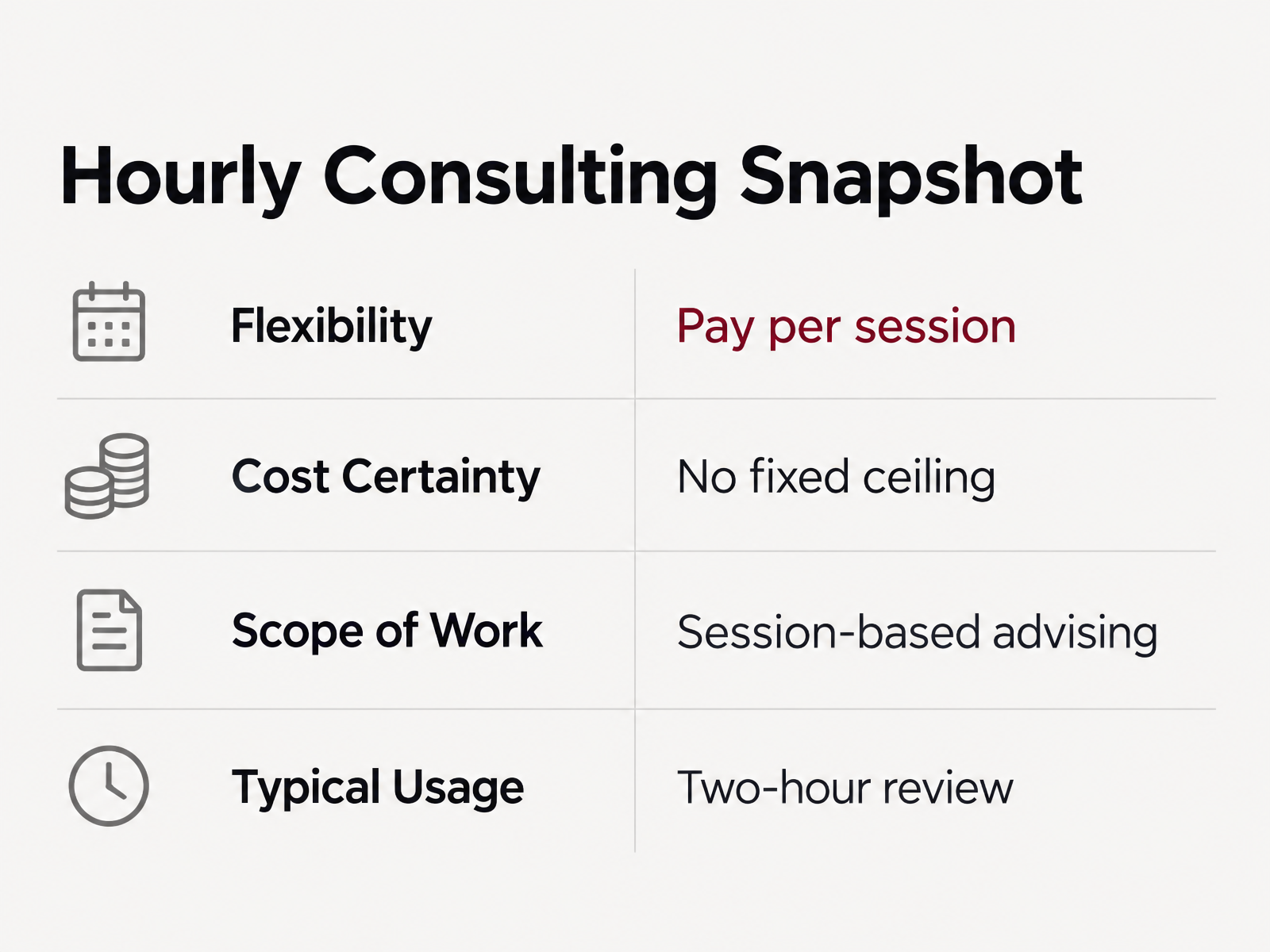
Hourly billing means you pay per session or per task, nothing bundled. You buy exactly the help you want and stop when you're done. That freedom is real, but so is the meter running in the background.
What hourly consultants actually charge
Hourly consulting is pay-as-you-go advising, billed by the session, with rates set by the consultant's experience and specialty.
Rates swing hard. The 2026 Private Prep report puts hourly work in a wide range, from lower rates to premium rates. That span tracks who you're hiring more than any other factor.
| Consultant type | Position in the range | Best for |
|---|---|---|
| Newer / generalist | Low end | Quick essay checks, activity list review |
| Experienced independent | Middle of the range | Strategy sessions, supplement feedback |
| Former selective-admissions officer | Top end | Interview prep, high-stakes case reads |
The bottom and top of the hourly market describe different shoppers. Newer practitioners and undergraduate-focused counselors usually fit shorter, tactical tasks. Seasoned or graduate-focused consultants command more because families are buying judgment under pressure, not just minutes on a calendar. The starting price you see depends entirely on the tier you walk into.
Where hourly billing hides its cost
The tradeoff is cost uncertainty, and it shows up in feedback depth. When every revision has a price tag, families ask for fewer of them. You might skip the third essay pass that would have sharpened the whole piece, because the clock feels expensive.
Hours pile up quietly, too. A full cycle with school research, multiple supplements, and interview prep can stack into double-digit hours fast. Once the work grows beyond a targeted problem, hourly help can drift into package-level spending without giving you the comfort of a fixed ceiling.
Two habits keep this honest. Set a cap before you start, an agreed number of hours you won't exceed without a conversation. And ask the consultant to log time per task, so you can see where the money goes.
How this connects to bonus incentives
Hourly earns a quiet point in its favor here. It doesn't pay the advisor differently based on which college says yes. The consultant sells time and judgment, so the incentive is cleaner than in an outcome-triggered contract.
That doesn't make hourly automatically better. The risk just moves from incentive alignment to project management. A family that can show up prepared, decide quickly, and use sessions surgically may get excellent value. A family that needs reminders, deadline tracking, list strategy, essay sequencing, and emotional coaching may find that the open meter creates stress instead of freedom. The Private Prep report is useful here because it separates types of service, not just prices.
Hourly sidesteps acceptance-based pressure entirely. Nobody profits from steering you toward a safer college. The catch is that you carry the budgeting risk yourself. For a family that wants targeted help and can self-manage, that's a fair trade. For one that needs full-cycle guidance, the meter can become the very problem it was supposed to solve.
Retainer Models: Ongoing Support vs. Upfront Commitment
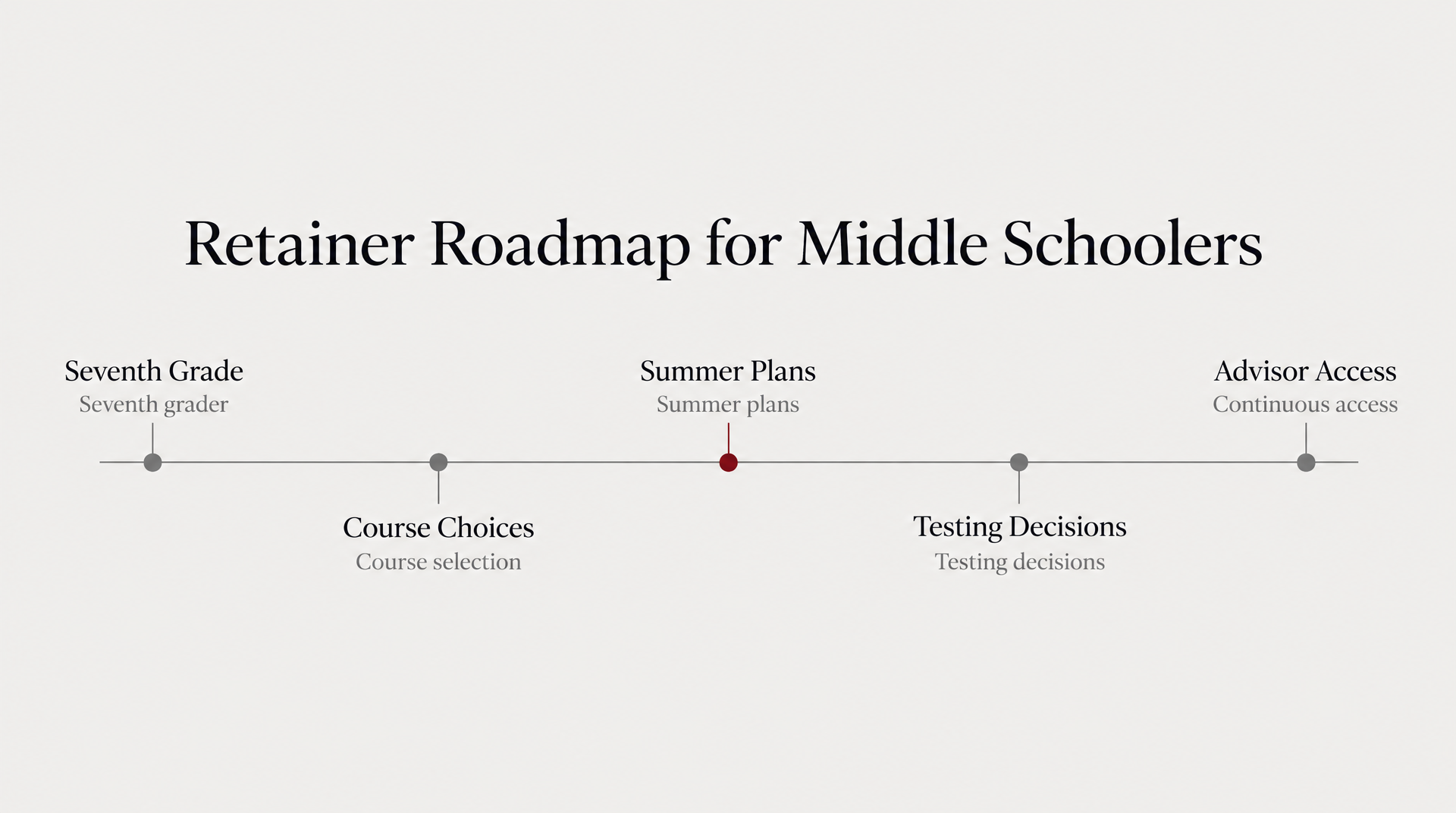
A family has a seventh grader who already talks about engineering programs. They don't need application help yet. What they want is someone in their corner for the next five years, a steady voice as course choices, summer plans, and testing decisions pile up. That's the instinct a retainer serves, and it sits at the long-haul end of the market.
A retainer means you pay a regular fee, monthly or quarterly, for continuous access to an advisor. Some contracts run from middle school through college enrollment. Instead of buying a fixed bundle of drafts and calls, you keep an advisor on call for whatever comes up. Framed monthly, the math can look gentler than a lump sum. Private Prep's 2026 analysis puts a full-service package around $6,500 for most families, which spread across four years works out to roughly $135 a month.
What a retainer actually buys you
The real product is continuity. When your student panics about a dropped AP course or a coach's recruiting email at 9 p.m., there's a known person to ask. That go-to relationship is where early mentorship earns its keep.
Who's on the other end matters just as much. The same report notes that full-service packages keep lower student-to-counselor ratios, which is what enables the deeper personalization that justifies the premium. A retainer only works if the advisor's roster stays small enough to actually answer you.
Where performance bonuses distort the fit
This is where our angle sharpens. Some retainers layer a base fee with a performance payout. On paper it aligns everyone around results. In practice, the metric can point the advisor the wrong way.
A long-term advisor shapes far more than the final college list: course rigor, extracurricular depth, testing strategy, summer choices, recommendation planning, and how a student tells their story. If the bonus only appears at the finish line, ask whether the contract rewards the quality of that multi-year development or just the letter at the end. The danger isn't that a bonus exists. It's a bonus that flattens years of advising into one blunt trigger.
Families can't easily audit the metric, either. A firm waving a glossy success number to justify its bonus is asking you to trust a statistic without seeing who was counted, which colleges made the list, or whether the final choice was right for the student. An outcome bonus should open a question, not close the sale: acceptance to what, and was it right for the student?
| Model | Payment | Best for | Hidden tradeoff |
|---|---|---|---|
| Retainer (base only) | Monthly or quarterly, multi-year | Early starters wanting a long-term mentor | Early financial commitment before you see value |
| Retainer plus bonus | Base fee plus acceptance-tied payout | Families chasing a headline result | Bonus can oversimplify the goal |
| Flat-rate package | One lump sum | Predictable, defined scope | Less flexibility mid-process |
Skip the volume-driven bonus retainer if fit matters to you more than a résumé of logos. Our base-plus-bonus model ties the performance piece to the specific result we map out with you, not a generic admissions tally, so the incentive stays on finding genuine fits. That includes telling a student when a reach school is wrong for them. If you want to weigh this against other structures, our breakdown of five consultant types digs deeper.
Hybrid Bundles: Our Base + Bonus Model
Say a family loves everything about an advisor except the price on a full flat-rate package. They want strong support, but they also want the advisor to have some skin in the game. That middle ground is what a hybrid bundle sells, and it's the structure we built our own model around.
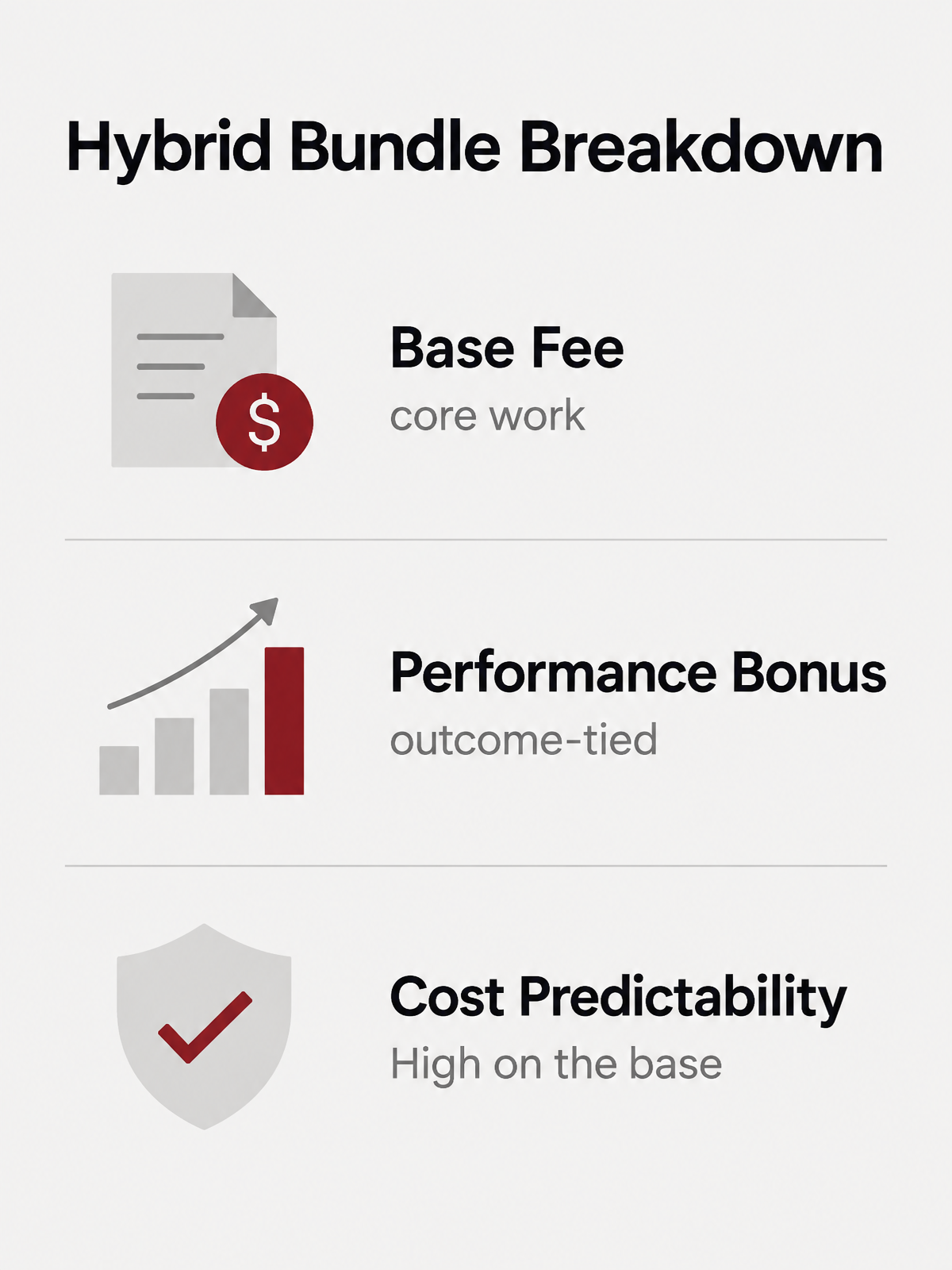
Here's how it works. You pay a guaranteed base fee that covers the core work: school-list building, essay coaching, timeline planning, and application review. On top of that sits a performance bonus, earned only when the student reaches an agreed-upon outcome. The base keeps the essentials predictable. The bonus adds motivation without turning the whole engagement into a gamble.
Does a bonus push consultants toward the wrong schools?
This is the honest tension, and we'd rather name it than hide it. Any admissions bonus creates a pull toward higher-odds schools. An advisor chasing a payout can quietly favor the college most likely to admit you over the one that stretches, challenges, or suits you best.
We designed our version to blunt that pull. The base fee funds the real mentorship no matter where you apply, so the bonus is a supplement, not the advisor's paycheck. Our work leans long-term and collaborative, which means fit drives the school list first. To keep incentives honest, we tie bonuses to outcomes the family defines up front, whether that's a target reach school, a specific scholarship threshold, or an early-decision result. (Early decision means applying to one school early with a binding commitment to enroll if admitted.) Writing the trigger down before the process starts removes the temptation to redraw the finish line later.
| Dimension | Pure Flat-Rate | Pure Bonus | Hybrid (Base + Bonus) |
|---|---|---|---|
| Cost predictability | High | Low | High on the base |
| Advisor motivation | Steady | Aggressive | Steady with upside |
| Risk of fit distortion | Low | High | Moderate, managed |
| Family financial risk | Upfront | Outcome-tied | Split |
Skip a hybrid model if you already have a tight, fit-first school list and just want fixed-fee execution. The bonus only earns its keep when you value that extra push and trust the advisor to keep fit ahead of the payout.
Choosing the Right Model for Your Family
Start with the question that actually sorts families, not the one they ask first. Most parents open with "how much does it cost?" The better opener is "what do we most need to protect: our budget, our time, or the fit of the final school?" Your answer decides which structure fits you, and it matters more than any headline price.
One pricing wrinkle can distort the whole comparison. Private Prep's 2026 cost report found that former admissions officers charge a 35–45% premium for that background, yet higher pricing doesn't necessarily correlate with better outcomes. So the thing to shop for is attention per student. The thing most premium pricing actually sells is a résumé.
Which priority should drive your choice?
Run your family through this before you read a single price sheet. Be honest about which line carries the most weight.
- Budget ceiling. Do you need one fixed number you can plan around, or can you absorb a variable bill? Regional spread is real: Private Prep's data shows full-service package pricing swinging widely between the Tri-State area, the national average, and the West Coast.
- Timeline. Starting in eighth grade buys years of mentorship. Starting senior fall buys triage.
- Risk tolerance. Do you want the consultant to carry part of the financial downside, or is a flat fee simpler for you?
- Incentive alignment. Do you want skin in the game, and do you understand what a bonus actually rewards?
That last line is where families get quietly misled.
Does a bonus reward the thing you actually want?
A bonus is only useful when it's tied to the right target. If the contract rewards a broad admissions result, the advisor can get too focused on probability. If the contract rewards a goal you defined together, the conversation stays closer to the student's real ambitions.
The fix is structural. A bonus tied to a target you set together, paired with a capped roster, keeps the incentive pointed at your student instead of the advisor's marketing claims. That distinction is the whole ballgame.
| Priority | Flat-Rate | Hourly | Retainer | Base + Bonus |
|---|---|---|---|---|
| Budget certainty | High | Low | Medium | High on the base |
| Flexibility | Low | High | Medium | Medium |
| Shared financial risk | None | None | None | Split |
| Best fit | One clear number | Targeted, late-stage help | Long-haul mentorship | Predictable support plus aligned outcomes |
How to pressure-test a model before you sign
Skip a bonus model entirely if your target schools admit most applicants. In that case, you're paying for an incentive that probably won't change much. But at the selective tier, where fit and positioning decide the result, we think a base-plus-bonus structure with a capped roster is the honest choice, because it aligns what we earn with what you came for. For a fuller breakdown of the five structures, see our comparison of consultant types.
Before you sign anything, ask two questions: how the firm defines success, and how many students each advisor supports in a cycle. Those answers tell you more than any polished percentage on a sales page.
References
[1] Cost of College Admissions Consultants: 2026 Report - https://privateprep.com/cost-of-college-admissions-consultants-2025-report/
[2] How Much Does A College Admissions Consultant Cost? - https://thecollegeinvestor.com/43895/college-admissions-consultant/?srsltid=AU7gw4Uo5SAJsL0-gdcICwI-3665yCtw-p69_Tmsbt8PmNrE4rOidU0N
[4] How Much Should I Charge for my Independent College Counseling ... - https://www.collegeplannerpro.com/blog/fee-structure
Common Questions
1. Can I switch from one charging model to another partway through the process?
Most families lock into a model at signing, though hourly and essay-only structures leave the most room to add scope later. Starting hourly and adding sessions is common, but converting a package with a defined scope usually means renegotiating add-ons. Clarify switching terms before you sign, not after.
2. Are former admissions officers worth their higher fees?
Sometimes, but the title should not be the whole reason you hire someone. Former admissions officers can bring useful context about how files are read, especially for selective schools. Still, ask how they will work with your student week to week, how feedback is delivered, and whether you are paying for active guidance or just a credential.
3. Does where I live change what I'll pay?
Yes. Admissions consulting is still shaped by local markets, especially in regions where families are used to paying for high-touch academic support. Compare local quotes against national figures, and make sure you are comparing the same scope of work rather than two packages that only sound similar.
4. How is a retainer different from a flat-rate package?
A retainer buys continuous access over months or years for a recurring fee, while a flat-rate package buys a defined bundle of deliverables for one lump sum. Retainers suit early starters wanting long-term mentorship. Flat rates suit families with a clear, contained scope who value budget certainty over open-ended availability.
5. When is a bonus-based model a bad fit for my family?
It is a bad fit when the outcome is already highly likely or when you only need straightforward execution. Also skip it if the bonus trigger feels vague, overly broad, or disconnected from the schools your student would genuinely attend. A bonus should sharpen accountability, not pressure the list in the wrong direction.
6. How can I tell if a package is thinner than it looks on paper?
Read the scope line by line, not the headline price. Check how many drafts each essay actually gets, whether meetings are capped or open-ended, and what happens to unused sessions at the end of a cycle. A generous-looking package can run thin if every interaction quietly draws down a hidden counter.
7. What's the single best question to ask before hiring a consultant?
Ask, "What exactly are you paid to optimize for?" The answer reveals whether the consultant is focused on fit, speed, hours billed, visible acceptances, or a specific outcome you define together. Endurable Education caps its roster each cycle for this reason, so the incentive and the attention stay connected.