What Makes a School Truly Ivy League? Clearing Common Confusions
September 28, 2026

The short version
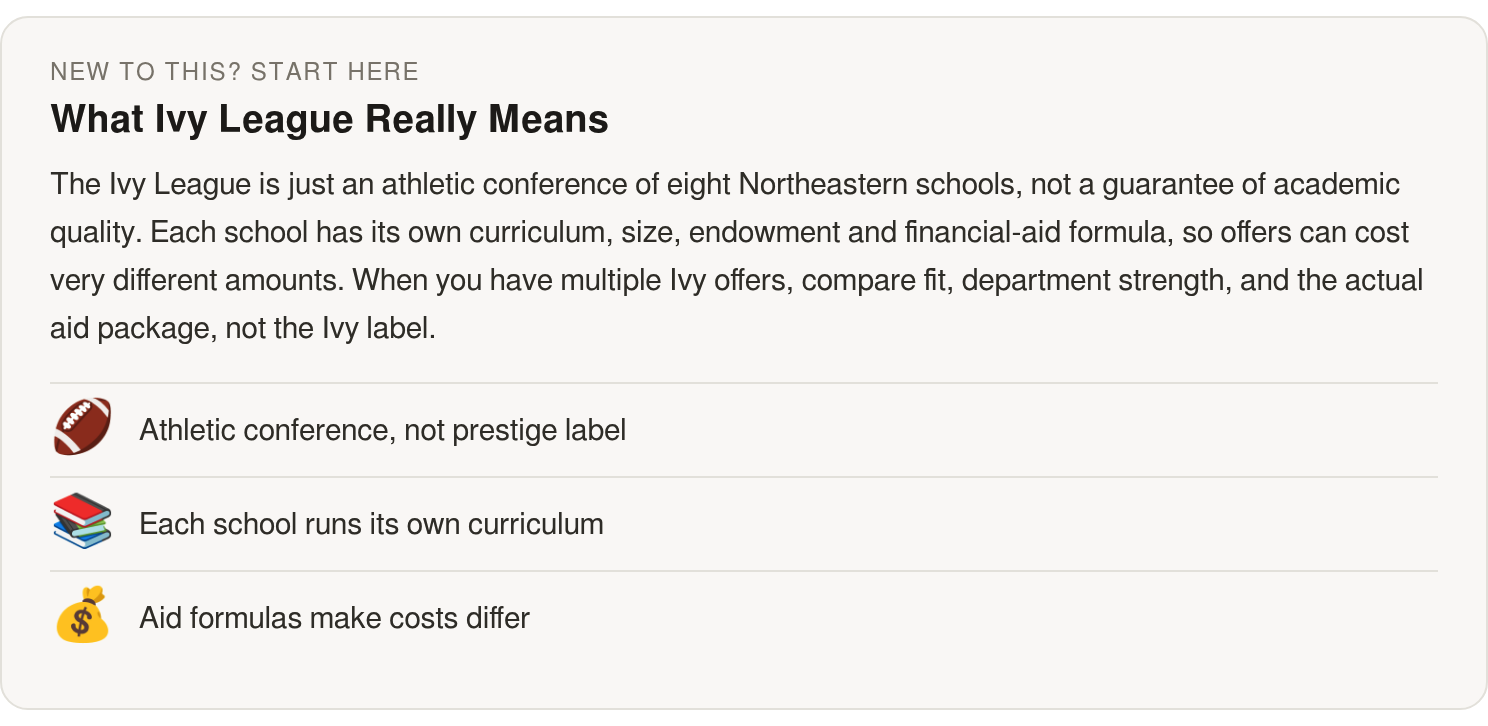
"Ivy League" is the name of an athletic conference, like the ACC or the SEC. It is not an official stamp of academic quality. Eight schools belong to it, and each runs differently, from Brown's Open Curriculum to Dartmouth's term calendar. Two offers that both promise to "meet 100% of demonstrated financial need" can leave a family paying very different amounts once you read the fine print. Each school uses its own aid formula, so the income levels that trigger the biggest discounts shift from campus to campus. Enrollment runs from small, tight-knit colleges to large research universities, so daily life varies a lot. Endowments vary too, with some members sitting on resources that dwarf the rest of the conference. Full guide: about 15 to 18 minutes. The offer-comparison section alone: 3 to 4 minutes.
Where this guide actually helps
This guide does two things. First, it clears up what "Ivy League" really means. Then it moves to the problem families hit after results arrive: how to choose among Ivy offers.
In our consulting work, the whole question flips the moment decisions come out. The frantic "how do I get in" phase gives way to something more precise. Several acceptances are on the table, and there is no obvious way to compare them.

That post-decision stage is where our Harvard- and Yale-trained team spends most of its time. It's also where generic Ivy content tends to stop. What follows are the facts you need first, then the counseling logic for turning offers into a decision you feel good about.
What this guide covers
We walk through the definition, the eight schools, the common lookalikes, and the framework for picking among Ivy acceptances. We start with the term itself and build toward the stage most students are left to handle alone.
The layout at a glance:
| Section | What You'll Learn | Depth |
|---|---|---|
| What Is the Ivy League? | The athletic-conference origin and why the "prestige" shorthand misleads | Beginner |
| The Eight Schools | Distinct strengths, from Brown's Open Curriculum to Dartmouth's term system | Beginner |
| Public Ivies & Lookalikes | Schools confused for Ivies and why the label matters less than fit | Intermediate |
| Comparing Your Offers | Matching your specialization to departmental strength, reading aid packages line by line | Advanced |
One fact reframes everything. The College Essay Guy guide to the Ivy League points out that the name is just an athletic conference, on par with the ACC or SEC. It is not a synonym for "great college." That single distinction changes how you weigh an offer.
How long is this?
Plan for 15 to 18 minutes for the whole thing, or 3 to 4 minutes if you skip to the offer comparison. The early sections are easy orientation. The later ones ask more of you, because comparing acceptances means weighing real tradeoffs in academic fit and money.
Who this is for
Students holding or expecting Ivy offers, plus the parents and counselors in the room with them. Still building your list? The definitional sections will ground you. Already have decisions in hand? Skip ahead.
A word on scope. If your focus points to one program another Ivy doesn't even offer, you may not need a deep comparison. IvyWise notes that these schools recruit specialists, not generalists. The same logic that made your application compelling can point you toward where you'll thrive.
We'll also flag a trap families miss. Aid language can read identical across two schools and still produce different bills. That comparison gets its own careful pass later. For a wider look at how different advising models handle this stage, our breakdown of five consultant types pairs well with this.
Why the prestige label stops helping
Most families come to us for one reason. They want in. What catches them off guard is how much harder the decision gets after the acceptances arrive. Two or three Ivy offers on the table, and the prestige label suddenly does nothing. It applies so broadly that it can't tell you which campus, department, aid package, or teaching style is right for you.
That's the work this guide is built for. Facts about what the Ivy League is and isn't matter most when you're holding offers and trying to choose.
Why doesn't the "Ivy" label help you choose?
Because the eight schools aren't interchangeable. One might feel like an intimate undergraduate college. Another runs like a sprawling research university with a completely different classroom culture. A shared athletic label tells you nothing about whether you'll find the right major, the right mentoring, or the right academic rhythm.
Set that against College Essay Guy's reminder that Ivies carry real weaknesses. A school might not offer your major at all, or its department in your field might trail a non-Ivy across town.
So when two Ivy offers sit side by side, the question isn't "which one is more Ivy." It's which one fits the academic life you're about to live.
Do two Ivy offers actually cost the same?
No, and this trips up more families than anything else. The Ivies all run generous aid programs, which makes it easy to assume they're interchangeable on price. They aren't.
Each school runs its own formula. Sticker prices sit high, but the net cost a family actually pays can land far lower, and the income thresholds that trigger the biggest discounts differ school by school. "Meeting need" produces very different real prices for the same family.
The international piece splits further. IvyWise describes need-blind admissions across all eight for U.S. applicants, but Times Higher Education reports that only Harvard, Yale, and Princeton extend that to international students. Both are accurate at different scopes. If you're an international admit, that one detail can reshape your entire cost comparison. Compare aid packages line by line. Never assume they match.
What the Ivy League actually is
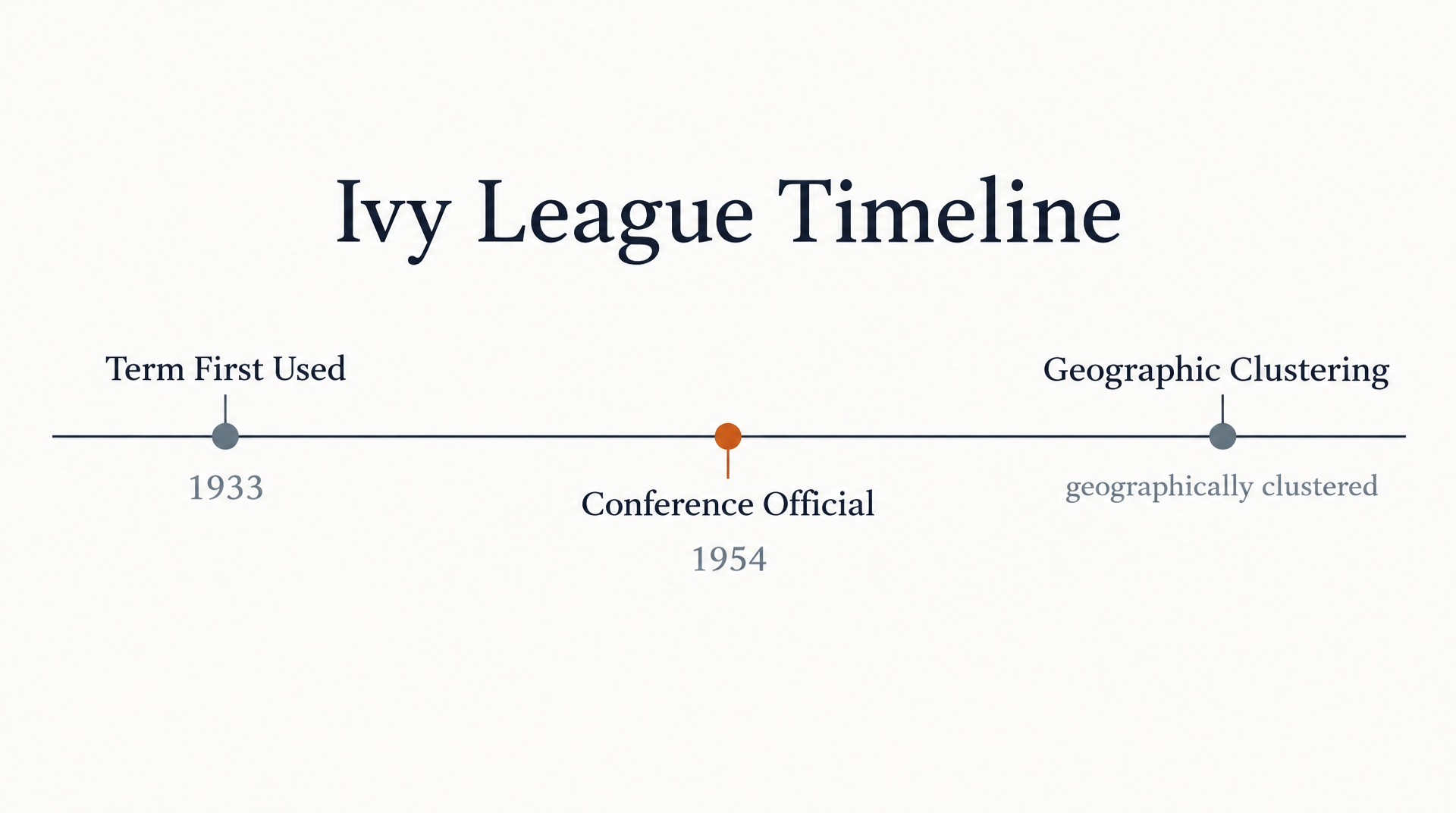
The single most useful fact for a student holding multiple Ivy offers is also the one nobody dwells on: the Ivy League is not a tier. It began as an athletic conference of eight schools clustered in the Northeast, made official in 1954, as Wikipedia and BestColleges both lay out. That history matters in our work because it means the label tells you almost nothing about which school fits you.
The practical effect is easy to miss. Once offers are in hand, "Ivy League" is a category, not a decision tool. You still have to look at the school underneath it: curriculum, departmental depth, undergraduate attention, campus culture, and cost.
What actually separates one Ivy from another?
Scale and structure, mostly. Some run on distinctive calendars and keep classes small. Others operate at a far larger scale. Brown's Open Curriculum lets you build your own path with no core requirements. Those structural choices shape daily academic life far more than the shared name does.
None of this is cosmetic. A specialist who got in by going deep in one field, which is exactly what Ivy committees reward over the well-rounded-generalist myth IvyWise flags, should look hard at how that field is taught on each campus. Departmental fit beats a general sense of prestige.
Do all eight cost the same after aid?
No. Financial aid policy varies school to school, and "meeting need" is a formula, not a fixed price. Those formulas diverge across the eight, and they diverge by applicant too. Policies that look nearly identical for domestic students can split sharply for international ones, and that gap changes the real cost comparison between two offers.
My read: treat each award letter as its own document, not a generic Ivy aid package. Read the grants, the student work expectations, the family contribution, and any remaining gap before you compare emotional preferences.
One caveat, stated plainly. If the Ivy brand is your only reason for choosing, the evidence is against you. Plenty of accomplished corporate and professional leaders never attended an Ivy as undergrads. The prestige is real. It just isn't a tiebreaker between two schools that both carry it. Fit is.
What a real offer comparison looks at
Most of our work gets loud during application season. The quieter, harder conversations come after the offers land. A student with three acceptances doesn't need help getting in. They need a way to tell nearly identical prestige labels apart.
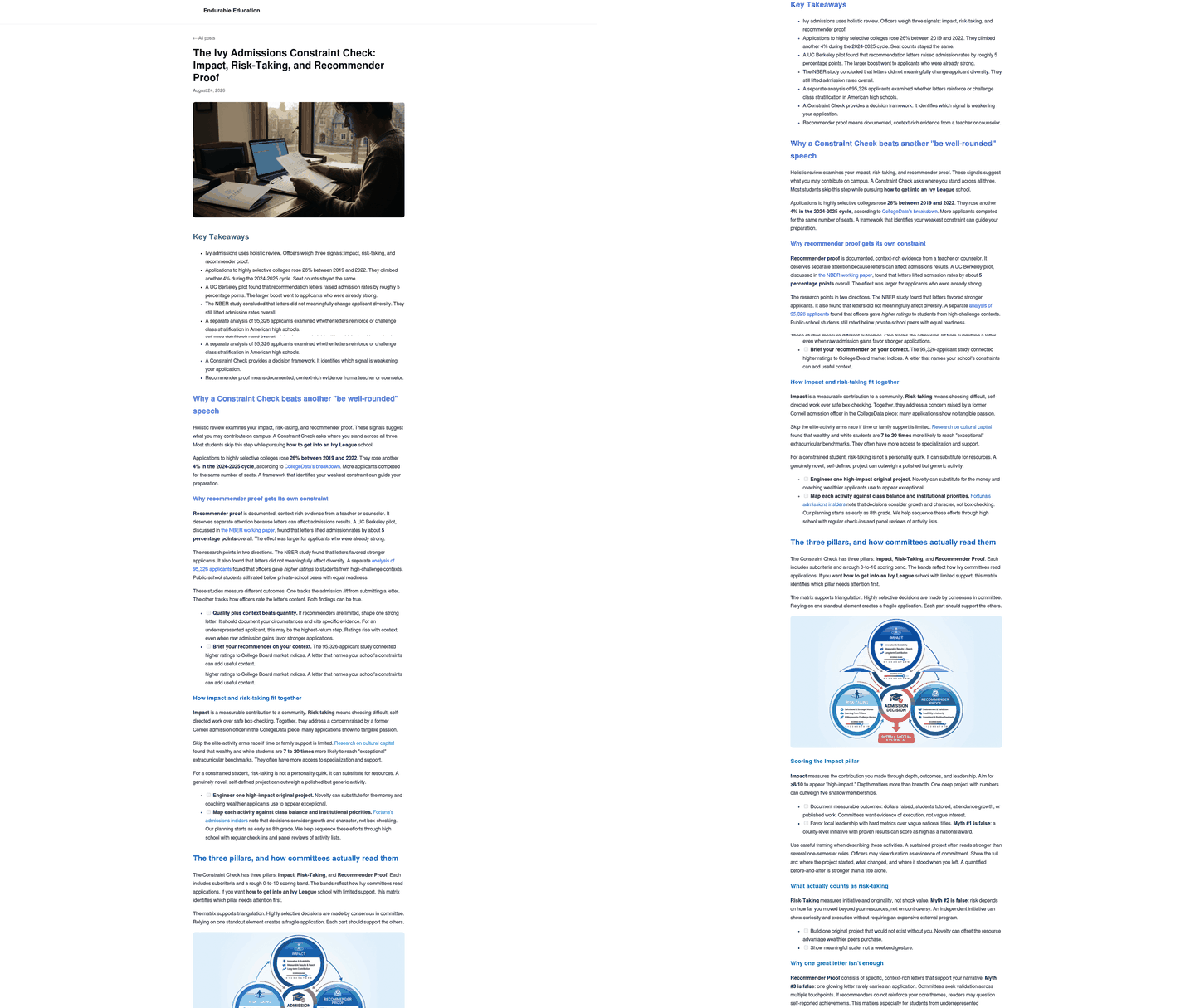
The shift we coach families through: the tools that won admission now run in reverse. The same fit analysis, the same honest read of a school's weaknesses, the same attention to what makes a student unusual. Good consulting here isn't cheerleading for the "best" Ivy. It's a side-by-side comparison that ignores the label and looks at what each school actually delivers for your goals.
Acceptance rates stop meaning anything once you're in
Ivy admit rates vary widely, and students read that spread as a prestige ranking. It isn't. As College Essay Guy explains, all eight are prestigious and academically rigorous, so a lower rate reflects applicant volume and program mix more than raw difficulty.
The number that got you in doesn't measure the four years that follow. Once you hold an offer, the gap between schools tells you almost nothing useful. The rate got you in the door. It has zero bearing on which door you should walk through.
The aid split that reshapes international offers
This one catches families off guard, and the sources genuinely disagree. IvyWise says all eight practice need-blind admissions. Times Higher Education clarifies that need-blind reaches international students at only Harvard, Yale, and Princeton.
Both are right, at different scopes. For a U.S. applicant, you can talk about the policy across the conference. For an international student, school-by-school policy matters right away, because eligibility and package strength can swing the final decision.
So don't rank international offers by reputation first. Compare what each school is actually willing to fund. A famous name with a weak aid outcome may be less realistic than an equally strong peer with a clearer path to affordability.
Match your focus to the department, not the name
Ivies recruit specialists, not generalists, so the smart way to pick is to match your academic focus to each school's departmental strength.
They reward this because they're built differently. Brown is known for its Open Curriculum. As College Essay Guy notes, each Ivy has its own strengths and weaknesses, so no two are interchangeable.
Be honest about the weaknesses too. A school might not offer your intended major, or run a program well behind a peer's. We say it plainly: if the department you need is thin, that offer drops down your list no matter what's on the envelope. For families wrestling with these tradeoffs, our college admissions life planning blog digs deeper into fit-first decisions.
Ivy versus Ivy, and Ivy versus everyone else
The comparison most families never run isn't Ivy versus non-Ivy. It's Ivy versus Ivy. Once the offers are in, the question stops being "is this school elite enough" and becomes "which of these very different institutions actually fits."
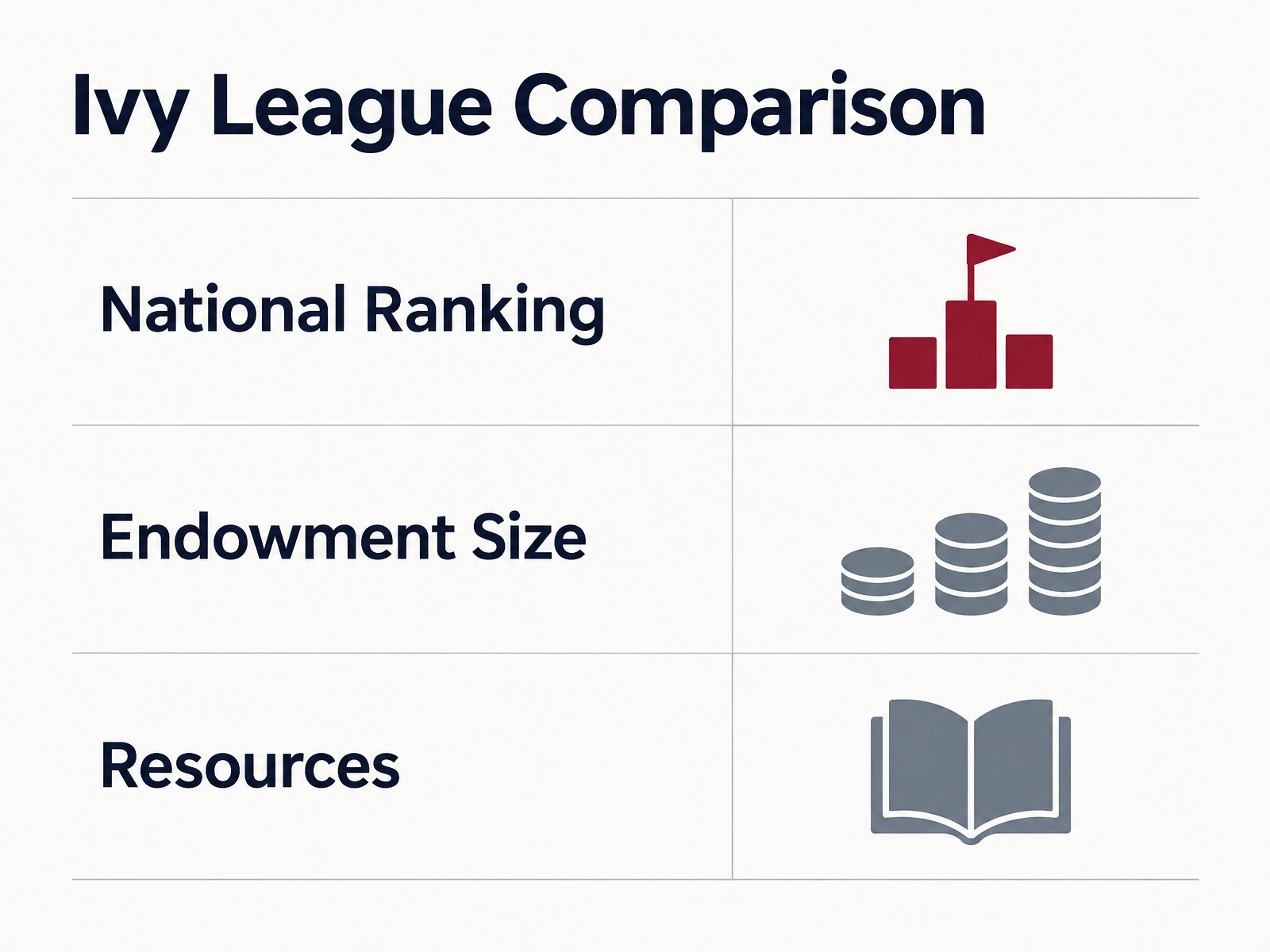
The differences make the case. The eight sit at different rungs of the national rankings, and their endowments and resources vary widely from one campus to the next. Enrollment swings from compact undergraduate colleges to full research universities. A student weighing three acceptances isn't picking within one lived experience. They're choosing among campuses with different academic structures, advising cultures, and resources.
How do Ivy offers compare with non-Ivy options?
Start with the honest ceiling on what the label buys. Stanford and MIT rival any Ivy in rankings and reputation but never joined, simply because they sat outside the original geographic cluster, as Fortuna Admissions explains. The Ivy line is athletic history, not a quality boundary.
The career data drives it home. Ivy graduates make up only a modest share of top corporate leadership, and several non-Ivy schools produce comparable or greater numbers of top CEOs. Sharper still: no single Ivy dominates that field, so "which Ivy is most prestigious" is a far weaker tiebreaker than students assume.
What should you weigh when offers compete?
Match your specialization to each school's departmental strength. That's the single most useful filter we apply. The Ivies recruit specialists, and each has real disciplinary gaps or programs weaker than a rival's, as College Essay Guy makes plain. Follow the substance of the program, not the shorthand of the brand.
Concrete details beat prestige here. Class sizes, student-faculty ratios, academic calendars, and campus resources differ meaningfully from one Ivy to the next. If you learn best in small seminars, that gap should outweigh a one-slot ranking difference.
When does the Ivy label deserve to lose?
Skip the label entirely when a non-Ivy offer fits your goals better. If your target major is stronger elsewhere, or a school's structure matches how you actually work, the Ivy tag should carry almost no weight in the final call.
The one time it matters: fields where the alumni network genuinely opens doors, and only when a specific school's network lines up with your path. Even then, weigh it against fit, not against the badge.
When the decision gets stuck
Most decision-season problems trace back to one root: families keep running the application-season playbook after it stops working. The offers are already in hand, but the habits that won them are still driving the choice. That mismatch is behind almost every stuck conversation we see.
The pattern is familiar. A student ranks their three acceptances by prestige, freezes, then asks us to break the tie. It won't break, because prestige is too blunt an instrument across this group. The fix is to throw out the ranking and rebuild the comparison around fit.
Why can't you decide between two "equal" offers?
Because you're comparing labels, not schools. When two offers feel identical, you've usually flattened them into a single "Ivy" category and lost the differences that matter.
Pull each school apart by size, academic character, and how undergraduates actually get taught. A compact college and a large research university feel nothing alike day to day. Once you name those gaps, the "tie" tends to resolve on its own.
If it still doesn't, you're missing information, not staring at a genuine dead heat. You haven't visited, talked to current students, or read the specific department you'd live in.
What if the aid packages don't match?
Two offers, two very different net costs, and a strong pull toward the pricier name. Our stance is blunt: an Ivy isn't worth years of avoidable debt when a peer offer costs far less and fits just as well.
Work the real numbers, not the sticker price. Compare net cost after aid, side by side, against what each school delivers for your goals.
Skip the whole exercise if one school is clearly the better fit and the aid is comparable. You don't need a spreadsheet to confirm the obvious. The troubleshooting only matters when the offers are genuinely close, which is exactly when families call us.
Which resources actually move the decision
Once the offers land, the resources that mattered during application season change completely. You're no longer chasing information on how to get in. You're gathering the specific data that lets you compare schools you're already admitted to. This is where families often realize their bookmark folder is full of the wrong links.
The good news: the most useful tools at this stage are free and public. You just have to know which ones move a decision.
Which resources help you compare offers?
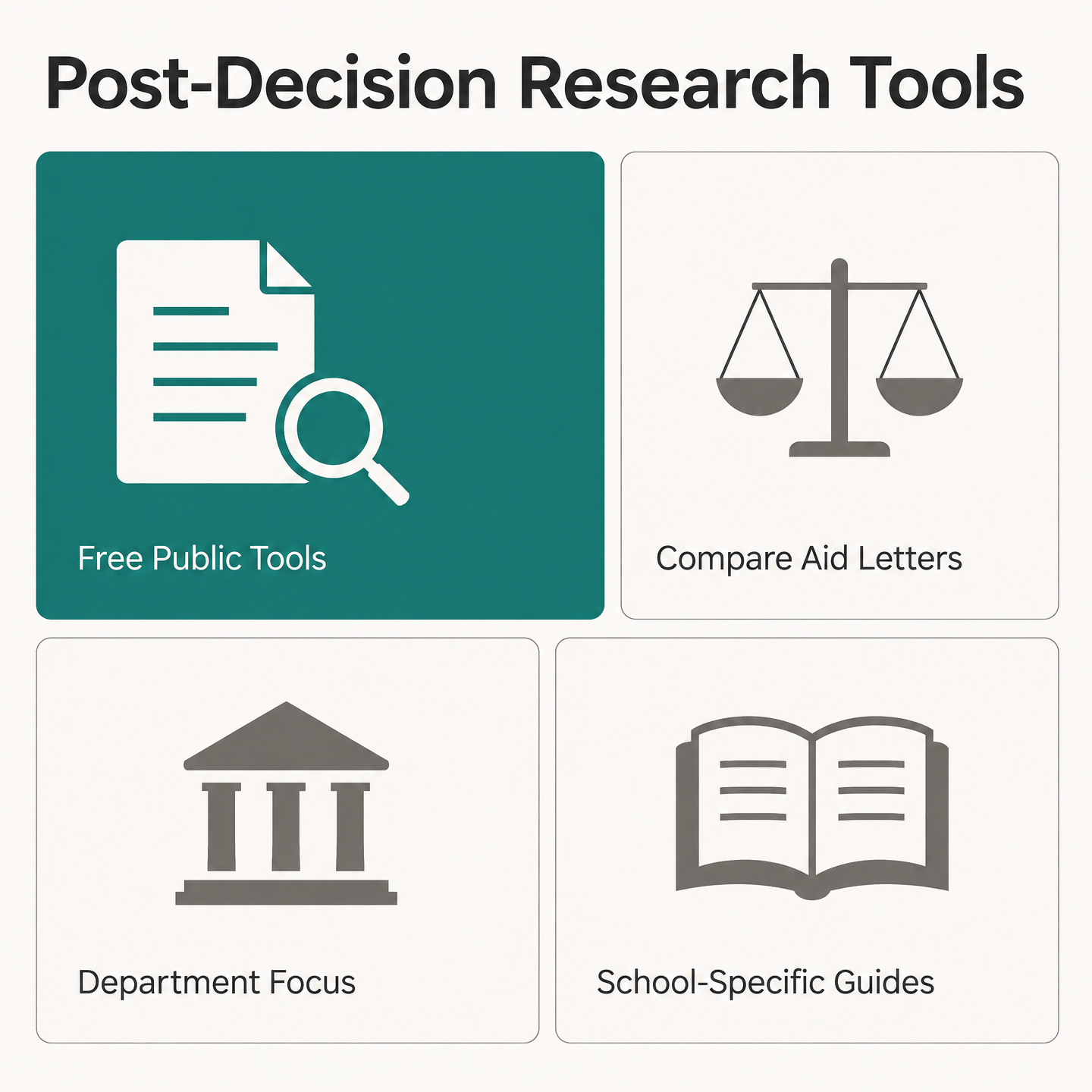
Start with each school's official admitted-student materials. Every Ivy runs admitted-student programming, publishes departmental course catalogs, and posts detailed financial aid breakdowns. These beat any third-party ranking because they show what your specific four years would look like.
Pull the financial aid letters side by side first. Look past the headline total and separate grant aid from what requires student work and what stays the family's responsibility. It's the most concrete comparison you can run, and the one families skip while debating prestige.
Then dig into the department, not the university. A school-by-school admissions guide tells you how to get in. What you need now is the course list, the faculty roster, and the research or internship pipeline in your intended major. Guides that break down each Ivy by academics and fit are a fine starting point, but treat them as raw material, not verdicts.
How our team helps you weigh offers
We apply the same customized planning that guides students through the application. No two students are alike, so no two comparisons are either. We line up aid package, department strength, and fit in your field against your own goals. No prestige column. That kind of tailored comparison does more work than any ranking site.
We also lean on our collaborative, panel approach. Every student gets a range of perspectives from our team, which surfaces fit signals and tradeoffs no brochure captures.
If you want a clearer picture of how different advising models handle this stage, our breakdown of the five types of college admissions consultants lays out the tradeoffs each one forces.
What to do once the offers are in
By the time you're deciding, the label has done all the work it's going to do. Eight schools, genuinely different from one another, sharing a name that traces back to ivy on old campus walls. Hold that in mind and the decision stops being about prestige and starts being about fit.
This is where our work earns its keep. The application-season energy fades, and a quieter question replaces it: several acceptances, all elite, and no label precise enough to break the tie. Our Harvard- and Yale-trained team spends real hours in exactly this space, building the side-by-side comparison the prestige story can't give you.
What should you actually do next?
Throw out your ranking first. If you've sorted your offers by reputation, that list is probably hiding the information that matters most. Rebuild the comparison around what each school delivers for your goals: the major, the department strength, the campus size, the aid package.
Then go straight to each school's admitted-student materials. Course catalogs, financial aid breakdowns, admitted-student programming. They describe the school you're actually choosing, not an aggregate score.
When is this framework wrong for you?
Skip the agonizing if one offer clearly fits and the others don't. Not every choice is close. If one school has the exact program you want and the others don't offer it at all, the decision is already made. Forcing a comparison onto an obvious answer just wastes your spring.
The framework matters most when the offers feel identical. That feeling is the signal you've flattened distinct schools into a single label.
For students who want to go deeper on how consultants differ and what each type's tradeoffs are, our breakdown of the five consultant types is a useful next read. The offers are the finish line for admissions. They're the starting line for the choice that actually shapes your four years.
References
[1] Ivy League - Wikipedia - https://en.wikipedia.org/wiki/Ivy_League
[3] What Are the Ivy League Schools? - Fortuna Admissions - https://fortunaadmissions.com/college/what-are-the-ivy-league-schools/
[4] What Are the Ivy League Schools? - IvyWise - https://www.ivywise.com/blog/what-are-ivy-league-schools/
[5] A Complete Guide to the Ivy League Schools - College Essay Guy - https://www.collegeessayguy.com/blog/ivy-league-schools
[6] What are the Ivy League schools? - Times Higher Education (THE) - https://www.timeshighereducation.com/student/advice/what-ivy-league
[7] IVY LEAGUE Definition & Meaning - Dictionary.com - https://www.dictionary.com/browse/ivy-league
[8] What Is the Ivy League? | BestColleges - https://www.bestcolleges.com/blog/what-is-ivy-league/
Common Questions
1. What exactly is a "Public Ivy," and is it an official designation?
A Public Ivy isn't an official category. It's an informal label for public universities often compared with the Ivies because of reputation, selectivity, or academic strength. The label can be useful shorthand, but it does not confer Ivy League membership, so evaluate those schools by program fit, cost, and campus experience.
2. Why didn't Stanford or MIT ever become Ivy League schools?
Stanford and MIT never joined because the Ivy League formed around a specific northeastern athletic grouping. Their absence says nothing about academic strength. Both rival or exceed Ivy programs in many fields, which is exactly why the Ivy label should not be treated as a quality boundary.
3. Does graduating from an Ivy guarantee a top career?
No. Ivy credentials can help, especially in fields where a particular alumni network matters, but they do not guarantee elite outcomes. Your field, performance, relationships, internships, and the specific opportunities available through your school still matter more than the label alone.
4. I'm an international admit. How does that change comparing two Ivy offers?
International applicants need to read each school's aid policy especially carefully. Some policies that sound broad in domestic admissions discussions do not apply the same way internationally. Compare the actual award letters and final net cost before assuming two Ivy offers are financially equivalent.
5. When does an Ivy's endowment actually affect my experience?
Endowment size can influence aid generosity, research funding, facilities, and the breadth of academic resources. It matters most when those resources touch your actual path: affordability, lab access, faculty opportunities, or funding in your intended field. A large endowment by itself is not a reason to enroll.
6. What should I gather to compare offers once they land?
Gather each financial aid letter, admitted-student materials, course catalog, faculty roster, and department-specific opportunities in your intended major. Endurable's team then helps organize those inputs around aid, academic strength, and fit, without giving prestige its own column.