How Admissions Committees Really Score Applications, and Where Consulting Actually Helps
September 28, 2026

Key Takeaways
- Selective committees run on competing versions of holistic review, so two readers can weigh the exact same file differently.
- Scores are comparative. The same transcript reads differently depending on the school's context and applicant pool.
- Committee review happens at only a thin slice of the roughly 4,000 US colleges, usually the most selective ones.
- The early twentieth-century "character" and "whole man" standards were built to exclude Catholic and Jewish applicants who scored well on exams.
- University of Wisconsin graduate guidance requires each application to be read by at least two members, one holding authority to both admit and deny.
What families get wrong about how files get scored
Most families treat admissions scoring like a locked room. It isn't. Committees run on definitions, rubrics, and side-by-side comparisons. The applicant who understands those mechanics writes a stronger file than the one who guesses. That gap is where admissions consulting either earns its fee or wastes your money.
The recurring problem: officers don't share one definition of what they're scoring. Research on selective college admissions describes competing versions of holistic review all in active use at once: whole file, whole person, whole context. Readers working from different definitions weigh the same application differently. You can't assume the reader assigned to your file will supply favorable context on your behalf. That's why we use a collaborative panel, so more than one advisor makes sure the context a lone reader might miss gets built into the file itself.
Why knowing the scoring changes your odds
Scores are read relatively, not absolutely. A lower GPA from a rarely represented high school can outscore a higher GPA from a school that floods a campus every year. The number on the transcript doesn't move. What moves is the baseline the reader measures it against.
So the real return on strategy comes from reframing the same objective record, not inventing a better one. Even a structured rubric that scores grades, tests, research, and fit can carry forward the disparities it was meant to reduce. A rubric makes bias visible. It doesn't erase it. An applicant who names the context the rubric would otherwise score against them gains ground the numbers alone can't buy.
Be skeptical of the word "holistic"
Take the term with a grain of salt. The College Board frames holistic review as rigorous, mission-aligned human judgment and calls the "black box" story ill-informed. A systematic literature review tells the darker origin: the "character" and "whole man" standards of the early twentieth century were invented to keep out Catholic and Jewish applicants who aced the exams.

Both are true at once. The mechanism was built to discriminate, and that same context-sensitivity now lets a "whole context" reader reward disadvantage. History doesn't decide how the tool gets used today. It explains why definitional discipline matters so much for you.
Where misplaced effort costs the most
Effort spent polishing a metric the reader discounts is effort thrown away. Families routinely pour money and hours into numbers a given program has already decided to weigh lightly. The same leak shows up in undergrad applications when families chase a score instead of a story.
We'd rather you spend that energy where it scores. That's the honest test for whether you actually need an admissions consultant: does the help move a scored category, or just add polish? If it's only polish, skip it.
Inside the committee room: who reads, and when it matters
Picture the room. A group of counselors around a table, sometimes a handful, sometimes a crowd, working 10 to 12 hour days for a week or more, per Collegewise's behind-the-scenes account. This is committee. It runs at only a thin slice of the country's roughly 4,000 colleges, mostly the selective ones. Knowing who sits there and how a file moves is where good consulting stops guessing and starts targeting.
The vote itself is not where most of your leverage sits. The decisive work happens before anyone in that room speaks. That upstream compression is exactly where our mentorship focuses, guiding students through the essays and activity lists that shape the file long before it reaches the table.
Who's actually in the room
More than one person, always. A Collegewise counselor who spent ten years in selective admissions says she never once held sole power over a decision. Files get multiple reads, and a Director, Dean, or VP of Enrollment typically signs off on every outcome.
Graduate practice pushes further. The University of Wisconsin guidance requires each application to be read by at least two members, one of them holding authority to both admit and deny. Committees also align on shared definitions first, because reviewers "start with different experiences" and would otherwise score the same file unevenly.
That last point is the one that matters for you. If reviewers hold competing private definitions of terms like first-generation or context, your narrative can't count on the reader supplying the favorable reading. You have to make it explicit.
How a file moves from intake to vote
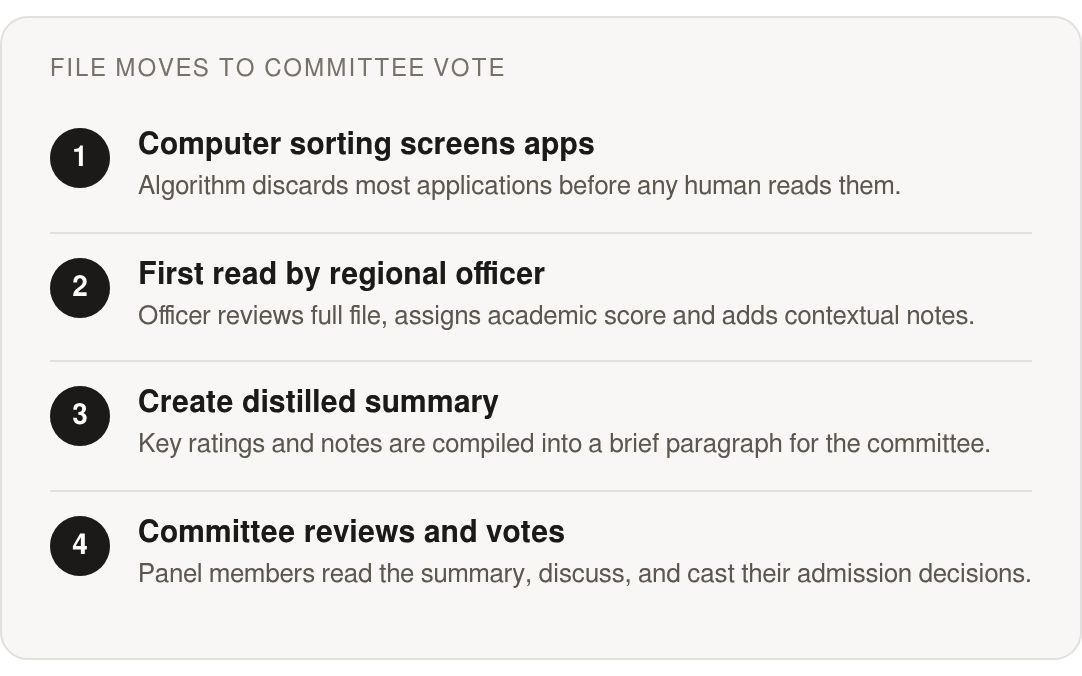
Most applications never reach committee. Computer sorting eliminates a large share before any human reads them, IvyWise explains. Survivors get a regional officer's quick first read, an academic score on the school's rubric, and a notes field for the things scores can't capture.
Then a genuine contradiction worth naming. IvyWise says the committee does not see your full application, only scale ratings and key info, so members can vote quickly. Wisconsin's best practices insist reviewers read the entire file in the context of a student's circumstances.
Those accounts describe different points in the process. The initial reader may study the full file, but the group often works from a distilled version. Your leverage sits with the person who turns your application into the summary everyone else will trust.
Where consulting actually changes the score
On the compression, not the vote. An MBA reviewer may spend under 15 minutes on a file, and that reading becomes the story an advocate tells in a single paragraph. Shape the few signals that survive the screen and you shape the summary.
Because admissions runs on panels and distilled ratings, our consulting is built around the same structure. Our team reviews each application through a collaborative panel, giving students different perspectives on the essays and activity lists that decide which signals make it into that one paragraph.
The five categories a rubric actually scores
Five categories drive most scoring rubrics: academics, extracurriculars, leadership, fit, and narrative. Each gets its own weighted line, and each rewards different signals. Know which signal earns points and you stop guessing and start building toward the score.
Our base-plus-bonus pricing keeps our incentives lined up with yours: part of what we earn depends on how your application turns out. So we build plans around the categories a committee actually rates, tailored to each student's strengths and goals. That alignment matters because a rubric is measurable, and so is the return on advice built around it.
Academics: the rubric reads the trend, not just the total
Reviewers rarely stop at your overall GPA. A walk-through from former adcomm members shows how they weigh the year-by-year breakdown, the trend line, and course rigor together. One fictional applicant carried a 3.7 that slid from 4.0 down to 3.4; another posted a 3.35 that climbed from 2.8 to 3.8. The rising 3.35 read stronger.
Rigor is scored against context, too. That same account notes a 3.7 in sports management is not automatically stronger than a 3.3 in economics or engineering. Test scores work the same way. A quant percentile below the 75-80% band can flag a concern at some top programs unless other parts of the file prove the skill.
That's why we push clients to fix trajectory and rigor early, not to chase a single headline number.
Extracurriculars, leadership, and fit each get their own column
Depth beats a long list. Research on rubric-based holistic review shows programs break an application into distinct rated dimensions rather than one blurred impression, so traits like involvement, initiative, and perseverance can each earn a separate score. Read that way, the file rewards depth over volume.
Leadership and fit show up as their own dimensions. Indiana's holistic admissions toolkit lists indices of leadership and mission alignment as scored factors, weighed alongside the academic record. Fit isn't a vibe. It's whether your record maps to what the program says it wants.
One caveat, stated plainly: if your activities are scattered with no throughline, adding more won't raise these scores. Consolidate before you expand.
Narrative: the category consulting moves the most
Narrative is where the separate columns start to make sense together. A reader can see rigor, activities, leadership, and fit as disconnected fragments unless the application explains how they belong to the same person.
This is also where outside guidance does the most practical work. A well-framed file tells the reader how to connect the evidence instead of hoping they infer the pattern. That's the case for why data beats gut instinct in this work.
Match your effort to the columns that get points. When advice targets the rubric, the return is something you can actually measure.
How reviewers trade a strength against a weakness
Picture a file that reads a 3 on the academic scale and a 5 on personal qualities. She earns straight A's but took only three AP classes when her school offered nine. That gap would sink a purely quantitative read. In the IvyWise committee example it doesn't, because her essay about losing her vision and organizing eye exams for underprivileged kids gives the reader a story worth advocating for. That's the trade-off machinery at the center of admissions done right.
The rule that governs those trade-offs, straight from the same source: GPA and test scores "can be the sole reason you are denied, but will never be the sole reason you are accepted." Weak numbers close doors. Strong context opens them. That's why we spend effort on the side of the equation that can actually move a vote.
Weighing a low metric against the story behind it
Contextualization is the mechanism. Indiana's holistic admissions toolkit tells readers to avoid GPA and test-score cutoffs and to read every credential against the applicant's circumstances. No single factor accepts or excludes. A low metric isn't a verdict. It's a data point waiting for context.
But context only helps if the reader applies it consistently, and that's the catch. In an experimental simulation, only officers using a "whole context" view were disproportionately likely to admit a low-income applicant. The practical lesson: don't leave the reader to hunt for the frame. Put the frame where the scoring happens.
"Holistic" doesn't automatically mean fair
The word carries an ugly history, even where modern institutions use it for different aims. The College Board's guide frames today's holistic review as rational and fair, calling the persistent "black box" myth something that "serves no one well." Both readings coexist.
That tension is the point: holistic review is a tool, not a guarantee. In careful hands it can account for opportunity, constraint, and evidence the numbers miss. In sloppy hands it can turn preference into policy. Treat the process as human judgment that needs help reading the record accurately.
Can a rubric make the trade-offs measurable?
Yes, and that's the part families can actually use. Rubrics can make trade-offs more measurable and help separate admitted from non-admitted students as intended. Indiana's toolkit puts it plainly: rubrics "promote equity and inter-rater reliability and mitigate bias."
A rubric turns fuzzy judgment into line items you can target. If a reviewer scores leadership and context against defined criteria, you build toward those criteria instead of guessing. That's the logic behind data-driven advice: a measurable rubric produces a measurable return on the strategy built around it.
The biases that shape a score before you ever apply
Holistic review is context-sensitive by design, and that cuts both ways. A systematic review of holistic admissions examines how the process affects low-SES students and shows the same discretion readers bring can either widen access or narrow it, depending on how it's used. That matters for anyone paying for consulting, because fair judgment depends on disciplined use of context, not good intentions.
The tension is documented from several angles. The College Board's guide walks through how mission-aligned review is meant to work, while other scholarship examines where the same discretion goes sideways. Our read: intent and function are different questions. A process meant to include still depends on disciplined definitions to actually do it.
The same metric can carry a hidden disparity
Standardized rubrics reduce guesswork. They don't erase the reader. Research on rubric-based holistic review calls it a promising route to more equitable evaluation, yet a rubric only scores what the inputs feed it. When a metric draws on measures shaped by outside gaps, those gaps ride straight into the score. The rubric didn't create the bias. It inherited it.
The GRE example sharpens the point. When departments lean on test-score cutoffs, the cutoff feels objective. But it can quietly filter by who could afford to sit for the test and send scores in the first place. An objective-looking gate still carries an access cost.
Why two readers score the same file differently
Two people can look at identical evidence and land in different places. Wisconsin's admissions playbook advises committees to review commonly used terms and the layout of the application up front, so evaluation stays equitable across every applicant and every reviewer.
There's a lever here. Bowman's 2018 finding, cited in that same guidance, shows committees with diverse backgrounds and experiences are more effective at selecting applicants with diverse backgrounds. Who reads your file shapes the number it earns.
You can't pick your reader. So you plan for the least generous one. Our work isn't inflating your record. It's reframing the same objective record against the reader's baseline so the score holds up no matter whose definition is in the room. If you're weighing whether an advisor is worth it, ask whether the strategy would still make sense to an unfriendly reader.
Building the four-year timeline (and prepping the interview)
A strong application isn't built in the fall of senior year. It's built over four years, and the calendar matters as much as the content. Good consulting maps that calendar backward from decision day, so no milestone gets crammed into a panicked October.
Our incentive isn't to keep students busy for its own sake. We push hard on the few dates that actually move the needle and stay quiet on the busywork that doesn't.
When consulting input actually matters
Think of the timeline in three windows. Freshman and sophomore years are for course selection and building the extracurricular story a committee will later read as a trend, not a total. Junior year is testing, deep involvement, and drafting the narrative. Senior fall is submission and interviews.
Most families over-invest in senior fall and under-invest in the two years before it. That's backward. The signals a reader scores highest, sustained commitment and an upward academic trend, get locked in long before the application opens.
Early decision is the one senior-year lever worth real attention. Applying early signals genuine fit, and fit is a scored category. We only recommend it when the school is a true first choice and the file is ready. Skip it if you're still reaching for a higher test score or a stronger fall semester. Rushing a weaker application into an early round wastes your best card.
How to prep for the interview
Interviews rarely make an admit, but a flat one can confirm a committee's doubts. Treat it as advocacy, not interrogation.
Our interview prep runs like the real thing. Using a panel approach, we bring different perspectives to your practice sessions and give feedback tied to specific moments, not vague encouragement. Regular check-ins keep you refining right up to the day.
That loop of practice, feedback, and refinement matters because interviews are easy to misjudge from the inside. The goal isn't a memorized performance. It's a student who can explain their choices, interests, and fit clearly under pressure.
Your next move: judge the consulting by the score, not the decision
Most families measure the value of consulting by one number: did the kid get in? That's the headline, and it's the worst single metric to judge by. Admission depends on the applicant pool, the year, and luck at the margins. A cleaner read tracks the inputs a committee actually scores and asks whether they moved.
Here's where our base-plus-bonus model forces honesty. Part of what we earn is tied to outcomes, so we can't hide behind activity. We measure ourselves by admissions results, the offers our students receive, and whether those results justify the fee.
The metrics that actually tell you something
Split them into quantitative and qualitative, because both count.
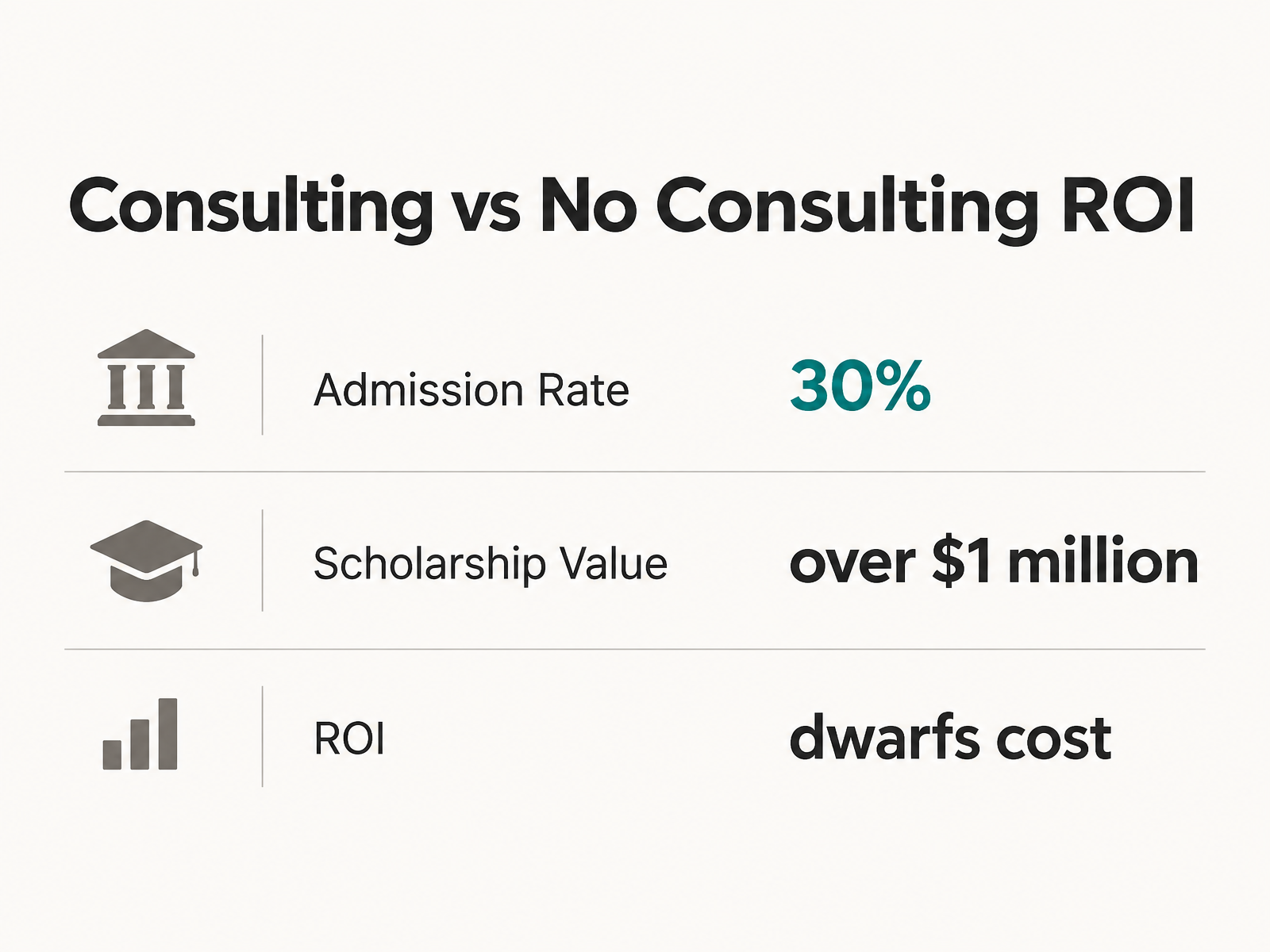
On the quantitative side, we watch admit breadth, not a single yes. The broader the set of offers, the more leverage students have on financial aid and program choice. We also track HYPSM admit rate against the base rate. The average sits near 2%; our students land closer to 30%. That gap is the number families should ask any advisor to produce.
The qualitative side is harder to graph and just as real. Confidence going into interviews. A narrative the student can defend without a script. Writing skill that outlasts the application. These compound over four years and show up long after decision day.
Running the ROI math
The cleanest calculation compares scholarships and tuition saved against the consulting fee. We've helped students earn over $1 million in scholarships collectively, and a single merit award often dwarfs the cost of the guidance that produced it.
Watch one trap. Higher fees don't reliably buy better outcomes. If an advisor can't tie their price to measurable results, the ROI case is missing.
And skip heavy consulting entirely if your student is targeting open-admission or lightly selective schools. The rubric machinery barely applies there, and the fee won't return. The math only works when the score gap is wide enough to be worth closing.
References
[1] Admissions Committees: What Goes On Behind-the-Scenes - Collegewise - https://collegewise.com/blog/admissions-committees-behind-the-scenes
[2] What Really Happens During an MBA Admissions Committee File Review - https://www.stacyblackman.com/blog/what-really-happens-during-an-mba-admissions-committee-file-review/
[3] Admissions Committees Best Practices - https://kb.wisc.edu/grad/131751
[4] Holistic Admissions Toolkit - Indiana University Graduate School - https://graduate.indiana.edu/faculty-staff-resources/holistic-admissions-toolkit/index.html
[5] Admissions Committee: The Review Process - IvyWise - https://www.ivywise.com/ivywise-knowledgebase/how-the-admissions-committee-review-process-works/
[6] [PDF] Understanding Holistic Review in Higher Education Admissions - https://highered.collegeboard.org/media/pdf/understanding-holistic-review-he-admissions.pdf
[7] (PDF) Holistic Admissions in Higher Education: A Systematic Literature ... - https://www.researchgate.net/publication/393446136_Holistic_Admissions_in_Higher_Education_A_Systematic_Literature_Review
[8] Rubric-based holistic review: a promising route to equitable ... - arXiv - https://arxiv.org/html/2110.04329v1
[9] What are We Talking About When We Talk About Holistic Review ... - https://www.researchgate.net/publication/324761859_What_are_We_Talking_About_When_We_Talk_About_Holistic_Review_Selective_College_Admissions_and_its_Effects_on_Low-SES_Students
Still Wondering?
1. What if my high school sends hundreds of applicants to the same colleges every year?
You need to explain your environment, not complain about it. Show the reader what academic rigor, competition, opportunity, and constraint look like at your school so the transcript is read in the right frame.
2. Will adding more extracurriculars raise my activity score?
Only if the new activity strengthens the same pattern the rest of the file is already building. A better move is often editing: elevate the commitments that prove initiative and continuity, and stop giving equal space to weak entries.
3. Do graduate committees read files the same way undergraduate committees do?
Not always. The biggest difference is volume. Graduate programs can often preserve more nuance because the pool is narrower, while large undergraduate offices need faster ways to sort and summarize.
4. When should I skip applying early decision?
Skip it when the application would be materially stronger later. Early timing cannot rescue an unfinished file, and the binding commitment only makes sense when the academic, financial, and fit questions are already settled.
5. What single number should I ask a consultant to produce before hiring them?
Ask for an outcome metric tied to the kind of schools your student is actually targeting. A useful consultant should be able to explain not just wins, but the denominator behind those wins and how comparable past applicants were.