How to Pressure-Test Your Application With Three Readers Before You Submit
September 29, 2026

What You Need to Know
- The triad review puts three distinct readers on your application before you submit: a former admissions officer, a current college student, and a mentor who knows you well.
- The four-step workflow can take a couple of weeks or longer, depending on reader availability and revision needs.
- Each reader has one job. The officer or expert mentor tests fit and content judgment, the student checks voice, mechanics, and authenticity, and the mentor confirms it still sounds like you.
- A single reviewer can miss tone drift, hidden repetition, and prompt misalignment that several distinct readers are more likely to catch.
- Timing depends on the reader and the draft. Set a clear return window before you send the file.
- Platforms like Google Docs can support threaded feedback. A shared PDF can work for a cleaner read-only pass. Admissions platforms may help when several pieces are moving at once.
Quick Summary
You've finished the essay. You've read it until every sentence feels familiar. Now your judgment is going blurry. That is the moment to hand the application to other people on purpose. The triad review at the center of many admissions consulting practices puts three distinct readers on your file before it ever reaches a real committee: a former admissions officer, a current college student, and a mentor who knows you well.
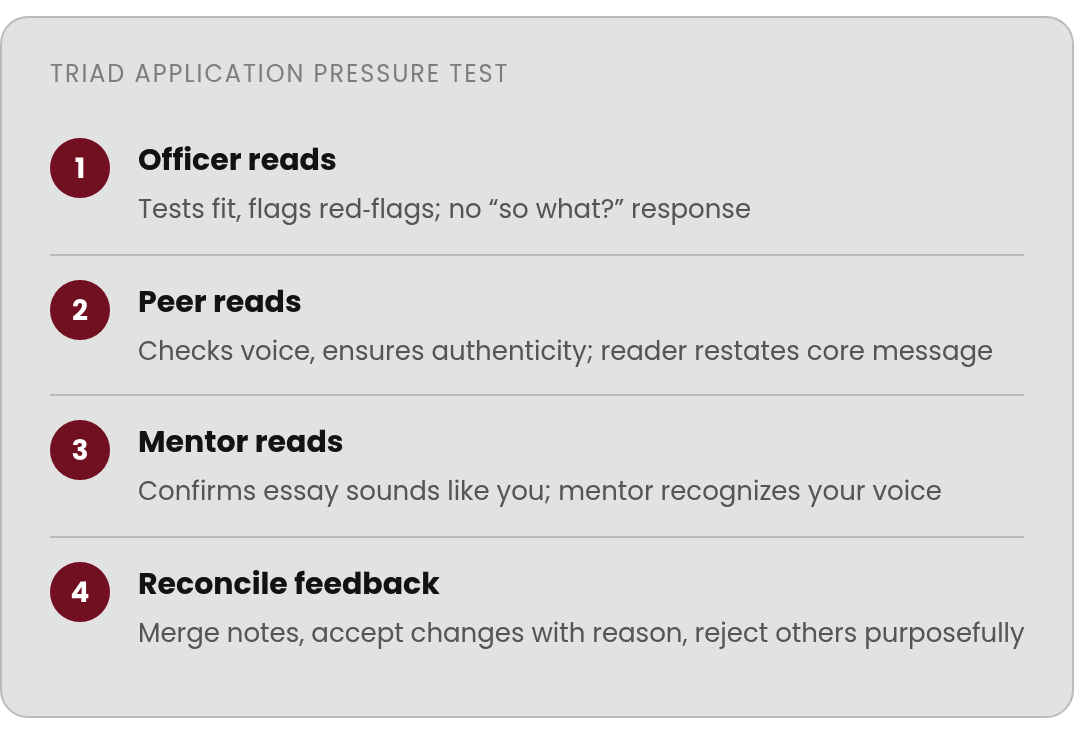
Each reader catches a different kind of risk. The former officer studies whether the application makes sense for the school. The current student listens for voice, mechanics, and authenticity. The mentor checks whether the person on the page is still recognizably you. Run this as one coordinated, front-loaded round. It gives you a realistic pressure-test without turning your essay into something a committee wrote.
Here's the workflow at a glance.
| Step | Goal | Who's Involved | Time Needed | Success Indicator |
|---|---|---|---|---|
| 1. Officer read | Test fit, content judgment, and red flags | Former admissions officer or expert mentor | Shared review window | No "so what?" reactions to your main story |
| 2. Peer read | Check voice, mechanics, and authenticity | Current college student | Shared review window | Reader can restate your core message in one sentence |
| 3. Mentor read | Confirm it sounds like you | Teacher, coach, or advisor | Shared review window | Mentor recognizes the real you, not a polished stranger |
| 4. Reconcile | Merge feedback without over-editing | You | Dedicated revision block | You accept changes with a reason, reject others on purpose |
Too Many Cooks Sink More Essays Than Weak Writing
The biggest risk isn't a bad reader. It's a crowd of them. A large circle of proofreaders can pull the essay in competing directions until the original voice disappears. Keep the review tight: three roles, three assignments, and one final decision-maker. That decision-maker is you.
Watch for these traps at each stage:
- Vague feedback: Ask each reader for specific line comments, not "it's good."
- Late readers: Set a firm return date up front so one slow reply doesn't stall everything.
- Editing to consensus: Change a line only when you agree with the reason, not because someone flagged it.
Pick your tools by how much back-and-forth you want. A live document can work well when readers need to reply to comments. A locked read-through format can help when you want some distance from line editing. An admissions platform may help when several application pieces are in motion at once.
After all the notes are in, move to reconciliation only after you have reviewed each reader's notes. Then revise the draft or decide, deliberately, not to.
Why Three Readers Beat One Set of Eyes
By the time a student has revised a personal statement enough to recite it from memory, the writing may be polished. What the student often cannot see anymore is whether it still lands with a stranger. That blind spot is exactly what a three-reader system can help address, and it is the part of the process families most often skip.

Real committees don't read your file like a private diary. Your application moves through several sets of eyes, each weighing different things. When you pressure-test with three readers first, you're rehearsing that same multi-lens read before the stakes are real.
Students and counselors sometimes describe similar results. On a CareerVillage thread about how many people should review an essay, one respondent said to get "people from different aspects of your life" so the essay "sounds like you in all forms." Another respondent recommended three readers for "diverse perspectives," working from big-picture changes down to grammar. The number matters less than the mix.
One Reader Can Leave Predictable Gaps
A single reviewer may catch surface errors and still miss structural ones. Three issues commonly go unnoticed when only one person reads the work.
Tone may drift without being flagged. Repetition can hide because the reader gets used to the phrasing by the second pass. Prompt alignment may be missed because one reader might not re-check the draft against the actual question.
Three readers, each with a distinct job, can close those gaps. One reads like an evaluator. One reads like a near-peer who knows what sounds overworked. One reads like someone who can tell when your language has stopped sounding like your language.
A coordinated, front-loaded review round can also help. Instead of dumping every comment into one messy pile, brief all three readers on the same draft, set a shared return window, and reconcile once. This can produce sharper notes and fewer contradictions than repeated staggered revision cycles. It also reduces the risk of feedback fatigue.
The payoff is confidence. You submit knowing your application already survived a committee-style read.
Choose Your Three Readers Strategically
The hardest part of the triad isn't the review. It's picking the three people. Most families default to whoever's closest: a parent, a favorite teacher, a friend who writes well. That instinct is fine for a quick grammar pass, but it wastes the real power of a structured read. It is often where gut feeling wins out over strategy.

Treat each reader as a specific role, not a warm body. You want distinct vantage points that map to how a committee reads your file: fit, authenticity, and voice. Fill each seat with someone who can actually see that layer.
Match Each Seat to the Layer It Reads
Start with the former admissions officer. This person reads for fit and red flags, the same way a committee weighs whether you belong at a given school. If you can't reach one directly, an expert mentor or counselor who has sat on the other side of the desk covers similar ground.
Next comes the current student. Someone close to the college experience reads for voice, mechanics, and authenticity. They know what sounds rehearsed and what sounds real, because they recently made the same translation from teenage life into application language. Keep the current-student role narrow, though. A peer is usually less reliable for substantive fit and content judgment because they generally have less admissions-review context.
Third is the mentor who knows you well. A coach, a longtime teacher, or a supervisor reads for whether the essay actually sounds like you. That voice check is one parents and strangers can't reliably provide.
Community advice backs this mix. On the same CareerVillage question, one respondent suggested different roles rather than more of the same voice.
Screen for Reliability, Not Just Goodwill
Enthusiasm doesn't equal usefulness. Before you hand over a draft, check three things. Is this person actually free before your deadline? Do they understand the kind of judgment you're asking for? Can they give feedback clearly enough that you can act on it?
Don't stack the same lens twice. Two English teachers give you one perspective, not two. The same goes for pairing your subject teacher with your counselor if they'll flag identical things.
Brief each reader plainly. Tell them which layer to watch, give a firm date, and let them focus on it.
Give Each Reader One Clear Job
"Please edit my essay." That's the request most students send, and it's almost useless. The reader doesn't know if you want grammar fixes or a verdict on whether the whole story holds together. Vague asks produce vague feedback, and you burn a reviewer's attention on the wrong layer.
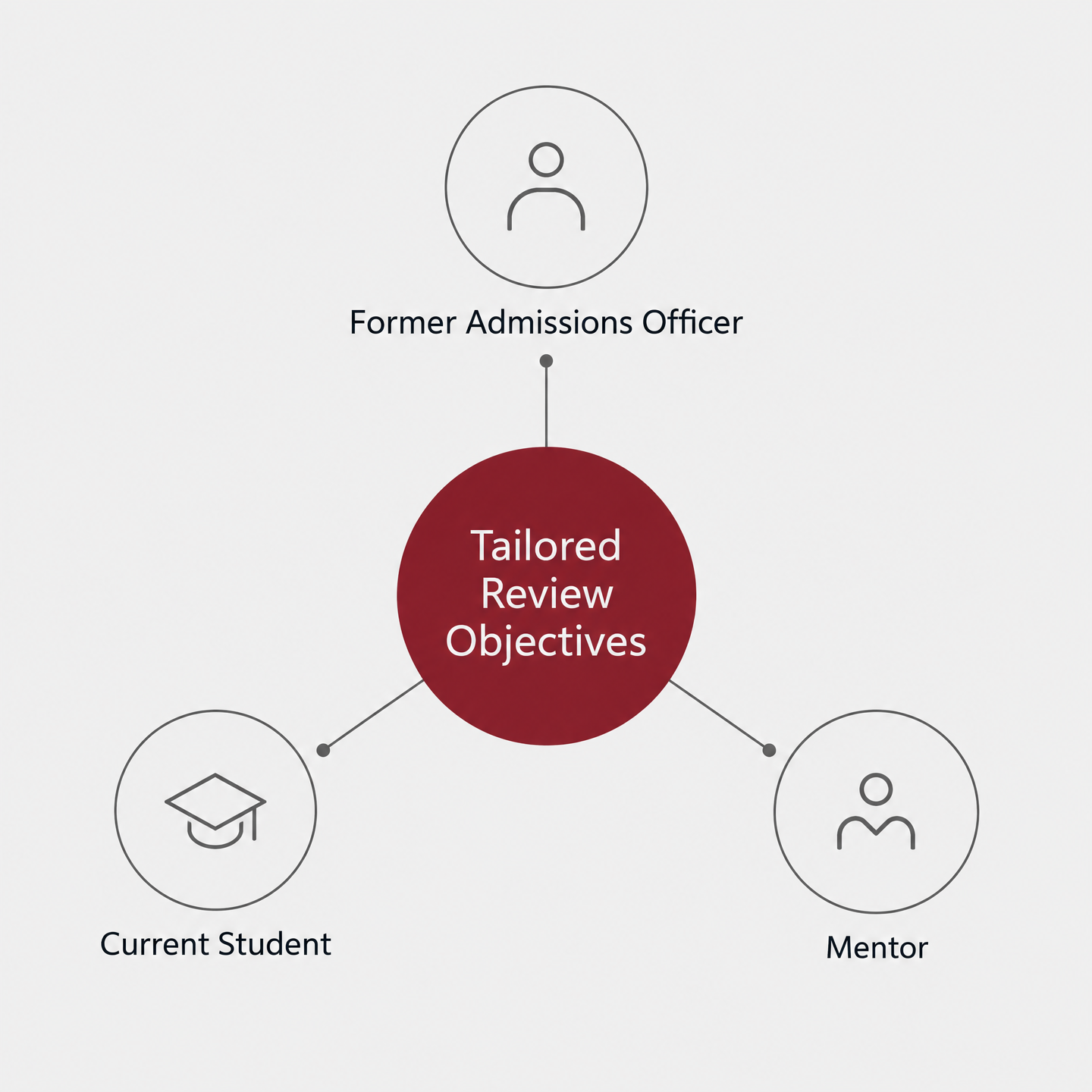
The fix is simple. Give each reader a written objective before they open the file. One sentence, tied to the component in front of them and the role they're playing. The former admissions officer or expert mentor reads for fit and content judgment. The current student reads for voice, mechanics, and authenticity. The mentor reads for whether it sounds like you. Their instructions should say exactly that.
One Objective Per Component, Not One for the Whole File
Break your objectives down by application piece, because each piece does a different job. Your resume needs a check for clarity and impact: can a stranger grasp what you actually did in each activity? Your personal statement needs a read for prompt alignment and narrative arc: does it answer the question and move somewhere? Supplemental essays, the shorter school-specific pieces, need a fit check: does this answer sound like it belongs at this school, or could you paste it into any application?
Write the objective as a specific question. Not "is this good," but "does the second paragraph earn the conclusion?" Specific questions get you actionable notes instead of a thumbs-up.
The Three Objective-Setting Mistakes That Waste a Review
Bad objectives usually fail in one of three ways. They're over-broad ("fix everything"), which spreads a reader thin. They're contradictory across readers, so you get whiplash between "add more detail" and "cut it down." Or they're missing entirely, and the reviewer defaults to hunting typos.
Match each objective to how colleges actually read you. Holistic review, where admissions officers weigh the whole file together instead of a single number, means your objectives should test the same thing: does each piece pull its weight, and do they add up to a coherent person? That alignment is what turns three friendly reads into a real pressure-test.
Build a Structured Feedback Template
Three readers only help if their feedback lands in the same format. When one sends a marked-up document, another texts you a paragraph, and the third leaves voice memos, you spend hours translating instead of revising. A shared template fixes that. Standardize how people comment, and you can actually compare notes side by side.
Keep the template deliberately plain. A few open prompts, asked in the same order by every reader, beat an elaborate form: what works, what doesn't, and what you'd change. Each reader answers through their own role, so the admissions-minded reader's "what works" is about fit, the student's is about authenticity, and the mentor's is about voice. Same questions, different lenses.
What Should the Template Actually Capture?
Split every reader's response into two layers. Macro notes cover the big stuff: does the story arc hold, does the opening earn its place, does the ending land. Micro notes cover line-level fixes: a clunky sentence, a wrong word, a comma splice. Keeping them separate stops a reader from burying a structural problem under grammar nitpicks.
Add a short rating block at the top. A simple score on a handful of qualities, like clarity, authenticity, and impact, can help. The numbers aren't the verdict. They're a fast signal that tells you where to look when you consolidate. A weak mark on authenticity from your current-student reader means something very different than a weak mark on clarity.
Inline Comments or a Summary Table?
Use both, for different jobs. Inline comments in Google Docs or Track Changes in Word can be useful for micro notes, since they attach the fix to the exact spot. The macro notes and the scores belong in a summary block at the top of the file, where you read them first and set your revision priorities.
One habit can help: use a shared live document when possible rather than emailed attachments. When readers annotate the same file, you can see whether several people are reacting to the same sentence or whether a note is isolated.
Distribute Your Materials Without Losing the Thread
Three thoughtful readers can still produce chaos if you send them different files at different times with no shared clock. Distribution is where most triads quietly fall apart. Getting materials out cleanly is the unglamorous half of the process, and it decides whether you get comparable feedback or disconnected opinions.
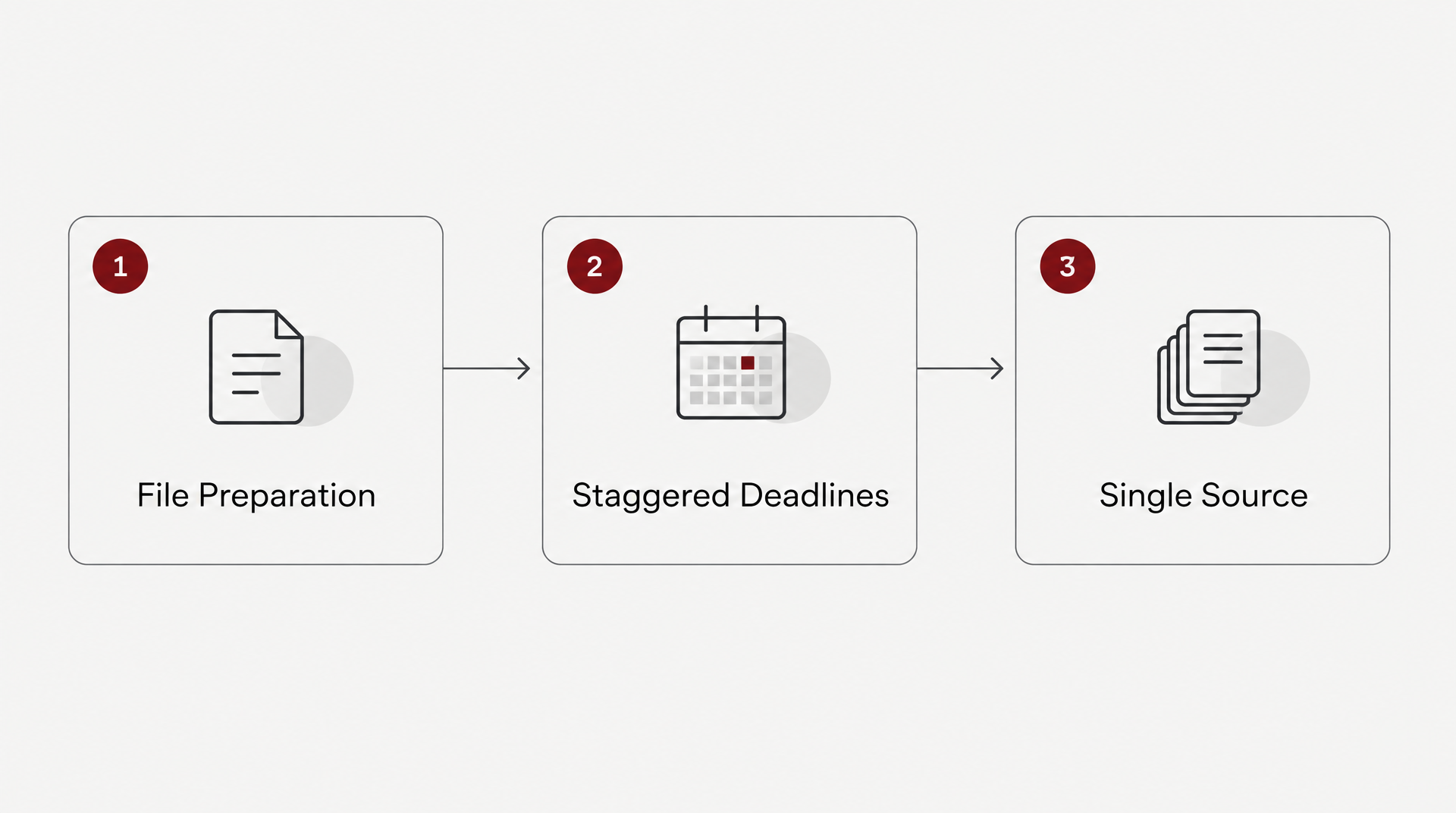
Start with the file itself. Send a PDF with a comment layer or a shared document with commenting turned on, never a flat image or a copy pasted into an email body. Both formats can keep each reader's notes anchored to the exact line they're reacting to. That matters when your former officer flags a fit problem in one paragraph and your mentor questions the voice in the same spot. You want their marks living in the same place, not scattered across texts and voice memos.
Give Each Reader a Tight, Coordinated Window
Open-ended deadlines are the enemy. "Whenever you get a chance" turns a planned review into silence and follow-up emails. Ask each reader for a response inside a short, fixed window, and coordinate the dates so feedback arrives as one batch rather than as repeated staggered cycles.
Coordinating protects the reader too. A busy teacher or a student mid-semester can hold a defined slot far more easily than an open commitment. Tell them exactly what you need: the component, the one objective tied to their role, and the date you'll close the file. Short asks get answered.
One Draft, One Name, One Source of Truth
Version confusion kills more revisions than bad advice does. When two readers comment on two different drafts, you can't tell which suggestions still apply.
Fix it with plain version control. Name each file with the date and a version number, keep one live copy that everyone comments on, and archive the rest. Before you send, brief readers on any institutional rules. If your essay touches confidential family matters, or your school has policies about outside help, say so up front. Clear boundaries keep the read honest and the process yours.
Gather, Consolidate, and Make Sense of the Notes
Three sets of notes just landed in your inbox. One reader flagged your opening. Another loved it. The third didn't mention it at all. Now what?
This is where most students stall. The goal isn't to average the feedback. It's to lay it side by side and decide what actually needs to change.
Build One Matrix, Not Three Inboxes
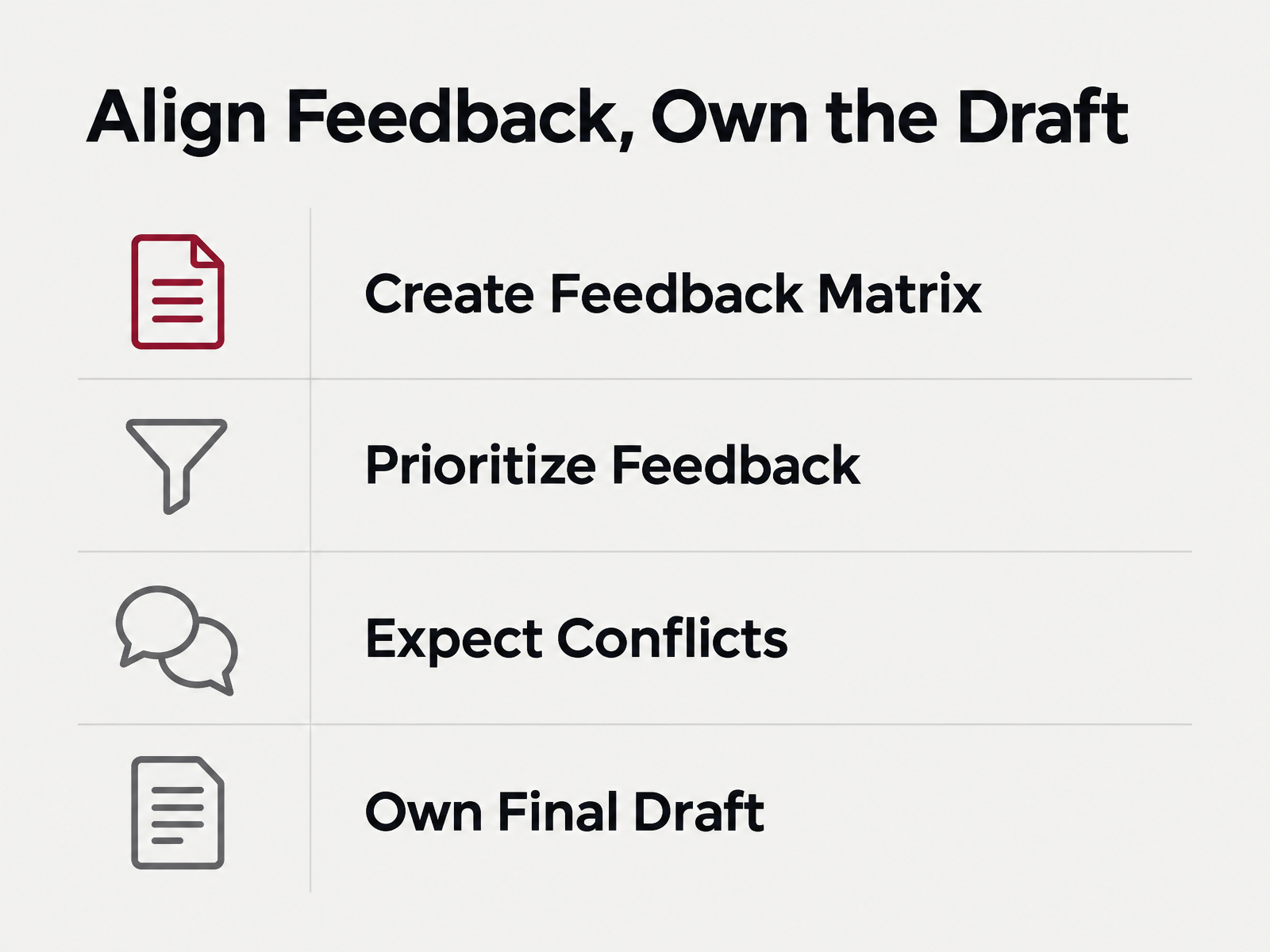
Open a simple spreadsheet. List each essay paragraph or application component down the left column. Give each reader their own column across the top: the former admissions officer, the current student, the mentor.
Now drop every comment into the cell where it belongs. Fit notes go in the officer's column, authenticity notes in the student's, voice notes in the mentor's. When you're done, you can read across any row and see all three reactions to the same line at once.
The patterns jump out fast. If multiple readers circle the same paragraph, that's a real problem, not a matter of taste. Repeated language tells you something too. If several people write "unclear focus" or "tone feels off," a deeper issue is sitting underneath, not a stray preference.
Weight the Feedback, Keep Your Voice
Not every comment carries equal weight, and pretending otherwise wastes your time. A former officer's read on fit outranks a peer's hunch about fit. A current student's take on whether you sound authentic outranks a generic style preference. Because peers may not have much admissions-review context, their comments are more reliable for voice, mechanics, and authenticity than for substantive fit or content judgment. Trust each reader most on the layer they were assigned to read.
Conflicts will happen. When your officer wants a story cut and your mentor wants it kept, go back to the objective you gave each of them and let the role break the tie. This is exactly where strategy should win out over gut instinct.
One rule holds above all: you own the final draft. Readers flag problems. You decide the fix. Keep the sentences that still sound like you, even when a reader would phrase them differently.
Revise, Refine, and Run a Final Read-Through
Your feedback matrix is full. Now comes the part where you actually change the essay, and it's easy to overcorrect. A reader flags a line, you rewrite it, and three edits later the paragraph no longer sounds like you. Revision works best when you move in one direction: fix the macro problems first, then the micro ones.
Start with the fit and story notes from your former admissions officer or expert mentor. Those are structural. If the officer says your opening buries the point, that changes whole paragraphs, so do it before you touch a comma. Then bring in the student's voice and mechanics notes and the mentor's voice notes. Save grammar and word choice for last, because polishing sentences you're about to cut wastes your time.
The Final Pass That Catches What Editing Misses
After revising, run one clean pass with fresh eyes. This is a different job than editing. You're not improving anymore. You're verifying. Read the whole thing out loud, slowly, and check these before anything gets submitted:
- Prompt match: does the essay answer the actual question, not the one you wish they'd asked?
- Word count: within the limit, including any hard character cap on supplements.
- Name consistency: your name, the school's name, and any professor or program you cite are spelled correctly. A wrong school name reads as carelessness to a committee.
- File and formatting: correct file name, clean PDF, working links on any supplemental materials, and recommendation uploads confirmed in the portal.
One more move can separate a good triad from a great one. Loop in an optional fourth reader for this last pass only, someone senior who hasn't seen earlier drafts. A counselor or experienced mentor reading cold may catch the small error everyone else stopped seeing.
When you submit, screenshot the confirmation page and save the email. Then close the loop with your three readers. Tell them it's in, thank them for the hours they gave, and update them when decisions land. They pressure-tested your file when it mattered. They earned the follow-up.
References
[1] How many people should I get to proofread my college essays and ... - https://www.careervillage.org/questions/790178/how-many-people-should-i-get-to-proofread-my-college-essays-and-go-over-my-application
[2] How to Peer Review a College Essay - Academia.edu - https://www.academia.edu/36664401/How_to_Peer_Review_a_College_Essay
Still Wondering?
1. What if I can't find a former admissions officer to be my first reader?
Look for someone who has evaluated applications professionally or worked closely with admissions decisions. The important quality is judgment about institutional fit: they should be able to tell whether your materials make a persuasive case for a particular college, not just whether the prose is polished.
2. Can a parent fill one of the three reader seats?
A parent can be useful for spotting missing context, family details, or practical errors. But for the formal triad, use someone with a little more distance. The mentor seat works best when the reader knows you well but can still respond like an educator, coach, or supervisor rather than as family.
3. If I have access to six willing readers, why limit it to three?
Use extra help selectively instead of giving everyone the whole essay. One person might verify activity titles, another might proof a final PDF, and another might check a scholarship supplement. For the main application read, too many broad opinions make it harder to tell which advice is strategic and which is just preference.
4. How do I resolve two readers who give directly contradictory feedback?
Separate the problem from the proposed fix. Two readers may disagree on the solution while still pointing to the same weak spot. Ask yourself what each comment is really diagnosing, then choose the revision that solves the issue without making the essay sound less like you.
5. Should I send the draft to all three readers at once to save time?
In most cases, yes. A single coordinated round with the same draft, the same brief, and the same return window can give you independent reactions before you revise. This front-loaded approach may reduce feedback fatigue and helps you compare comments more easily. If you need a second look after major changes, use a fresh reader for a narrow pass.
6. What happens if one reader goes silent and stalls the whole timeline?
Build a backup plan before you send the draft. In your request, include the return date and say that if they are too busy, you completely understand and can ask someone else. That gives the reader an easy exit and keeps you from waiting politely while your deadline gets closer.
7. Which tool should I use to collect feedback from all three readers?
Pick the tool your readers will actually use carefully. A live document can work well for interactive comments, while a PDF can be better if you want a cleaner read and less tinkering with the text. The key is consistency: choose one system before feedback starts so you are not merging notes from multiple places.
8. Is bringing in a fourth reader ever worth it?
Yes, but only after the real revision work is done. A late reader should not reopen the essay’s strategy or voice. Give them a narrow assignment: catch mechanical errors, formatting problems, and application-portal issues before you press submit.