The Ivy League Application Timeline Most Families Start Too Late
October 18, 2026

Key Takeaways
- Early acceptance rates at some Ivies run higher than regular rounds, but the gap varies by school and year and reflects preparation more than the act of submitting early.
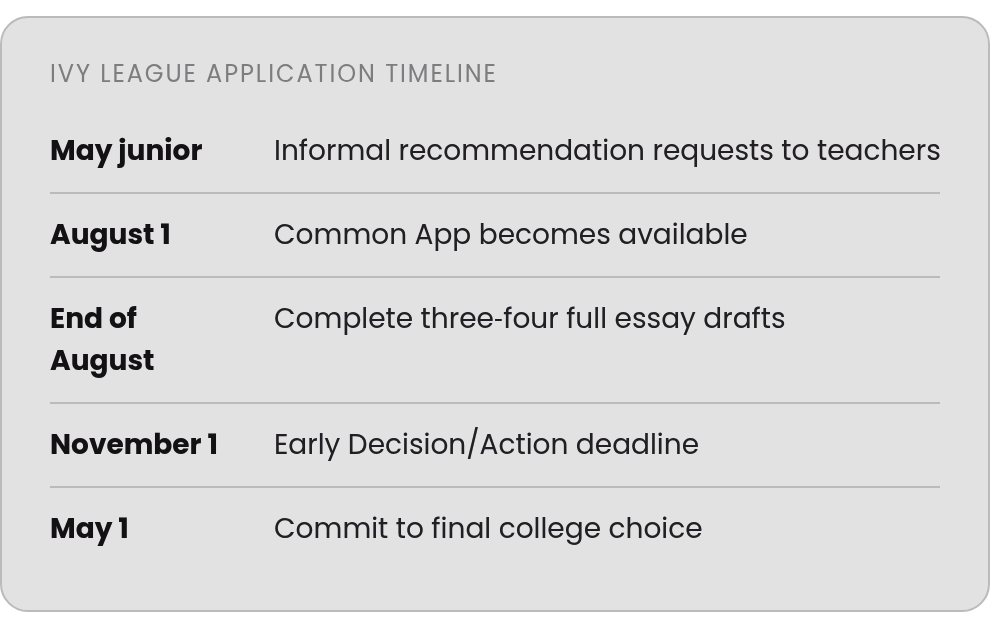
- Strong recommendation letters require informal teacher requests in May of junior year, not September when faculty are already overloaded.
- Common App essays need three to four complete revisions by end of August to meet competitive standards for early applications.
- All eight Ivy League schools set their Early Decision and Early Action deadlines for November 1 each year.
- Harvard rejects approximately three-quarters of applicants holding a perfect 1600 SAT score, making academic excellence insufficient alone.
- Early applicants gain no reading-order advantage since admissions officers travel until deadlines and review all early files simultaneously.
Quick Summary
Most families discover too late that competitive Ivy League applications begin months before deadlines. While the Common App opens August 1, the work of refining essays, securing strong recommendation letters, and building a coherent narrative requires far more lead time than the calendar implies. The window closes faster than most families realize.
The Fixed Calendar That Defines Your Working Time
The Ivy League application calendar follows a predictable pattern. Early applications across all eight schools are due November 1. Regular decision deadlines cluster between January 1 and 5; Brown and Penn use the January 5 date mainly to attract more applicants and lower their admission rates, so it is not a meaningful recovery window for late starters.
This rhythm means your working time shrinks as the calendar advances, especially if you're applying early. That means finalizing materials by fall of senior year.
| Milestone | Date | What It Means |
|---|---|---|
| Common App Opens | August 1 | Applications become available |
| Early Decision/Action Deadline | November 1 | Binding (ED) or restrictive (REA) early round |
| Regular Decision Deadlines | January 1–5 | Most Ivy applications due |
Why Starting Late Compresses Your Timeline
Families who begin in senior fall face cascading deadlines. The late-start sprint below is the recovery path: finalize your Common App essay and activity list quickly, line up recommenders, and decide whether your test scores support an early application. Regular decision still requires the same level of polish under tighter time pressure.
Why Starting the Timeline Early Matters
The Common App opens August 1, but the work that determines whether you'll be competitive begins months earlier. Strong recommendation letters usually start with informal requests in May of junior year, and Common App essay drafts need three to four complete revisions by end of August. Supplemental essays multiply that workload by the number of schools on your list.

The Real Advantage of Starting Early
The acceptance-rate gap tells part of the story. Early rounds at some Ivies report higher percentages than regular rounds, but the size of the gap varies by school and year. Those numbers may look like an edge.
But the numbers obscure what creates the advantage. Students admitted early didn't just submit two months sooner. They finished strong applications while peers were still drafting. Starting with enough time means you can refine essays until they genuinely reflect your story, organize your activity list to show sustained commitment rather than scattered accomplishments, and create supplemental responses that directly address what each school values. That difference in preparation shows up across every component of your application.
Starting early does not mean your application gets read first. Former admissions officers confirm that Early Decision and Early Action files don't get reviewed sooner just because you submit in October. Officers are traveling until deadlines hit, and decisions release on the same day for all early applicants. The benefit comes from having time to revise before you finalize, not from gaming the reading order.
When Academic Excellence Isn't Enough
Harvard rejects about three-quarters of applicants with a perfect 1600 SAT. Academic accomplishment clears the threshold, but holistic review demands more. Your essays need to reveal what you'll contribute beyond grades. Your activity list needs to show sustained development in areas you care about, not credential collection. That narrative work takes iteration you won't have if you're starting essays in October.
We focus on long-term preparation, starting as early as 8th grade. This timeline lets students build meaningful experiences before applications begin. Students who give themselves that runway can balance senior coursework, testing, and application work without the pressure that comes when November 1 is weeks away and essays are still in rough draft form. The calendar doesn't bend. The question is whether you've built enough runway before it closes.
Year-by-Year Timeline Checklist
8th Grade and Middle School: Build Foundational Habits
Most families wait until junior year to think about how to get into Ivy League schools. That timeline fails before it starts. The students who earn admission in regular decision have been building their profile since 9th grade, and the habits that make that possible often begin earlier.
In 8th grade, focus on reading volume and variety. Students who read widely develop the analytical voice admissions officers recognize in essays three years later. Start a community service commitment you can sustain through high school rather than collecting one-off volunteer hours. If your school offers pre-AP or accelerated math, enroll. Advanced math sequences often begin in middle school, so starting early keeps options open later.
- Establish a consistent reading habit across fiction, nonfiction, and journalism. This builds the writing fluency you'll need for college essays without realizing you're preparing.
- Identify one community service commitment and begin regular participation. Long-term involvement shows depth and genuine commitment.
- Enroll in the most advanced math course your school offers. Many competitive applicants take advanced math throughout high school, and that path often starts in middle school.
9th Grade: Explore Widely, Choose Rigor
Ninth grade is the exploration phase for extracurriculars and the foundation of your transcript. Students often underestimate freshman year or commit too quickly to a single path before discovering what genuinely interests them.
Take the most rigorous courses available in core subjects: honors English, accelerated math, lab sciences. If your school offers pre-AP courses, take them. These signal to admissions officers that you sought challenge from the start. Join three to five extracurricular activities in different domains to find what genuinely interests you. Don't optimize for prestige yet.
- Enroll in honors or pre-AP courses in English, math, science, and history. Competitive applicants show academic rigor from 9th grade forward, not just in junior year.
- Join three to five extracurricular activities across different areas. Exploration now prevents the scattered resume that comes from late-start panic additions.
- Maintain strong grades from the start. Freshman grades count for Ivy League applications, and a weak start creates a recovery narrative you don't need.
- Begin informal relationships with teachers who might write recommendations later. Strong letters come from teachers who watched you grow over multiple years.
10th Grade: Narrow Focus, Deepen Commitment
By sophomore year, you should identify two to three core interests that connect to a potential academic focus. This is when exploration shifts to depth. Drop the activities that were just experiments. Double down on the ones where you see a path to leadership or measurable impact.
Course selection becomes more important. Take your first AP courses, typically AP World History, AP European History, or AP Human Geography depending on your school's sequence. If you're on track for STEM, make sure you're in Chemistry or Physics with a path to AP sciences by 11th grade.
- Narrow extracurriculars to two or three core commitments and pursue leadership roles. Admissions officers want to see progression from member to contributor to leader, which takes years to build.
- Take your first AP courses in subjects that align with your academic interests. This establishes the rigor trajectory admissions officers expect without overwhelming your schedule.
- Begin a summer project or program that deepens one of your core interests. Competitive applicants use summers for growth, not just employment or downtime.
- Take the PSAT in October as a diagnostic for SAT preparation. This identifies weaknesses early enough to address them before junior year testing windows.
11th Grade: Test, Lead, and Begin College Research
Junior year is the highest-stakes year for your transcript. Many competitive Ivy League applicants take several AP courses in core subjects, and junior year carries much of that load. Plan for a rigorous schedule that includes advanced math and science if your school offers them.
Take the SAT or ACT for the first time in March or April. Plan for a second attempt in June if needed. Aim to finish testing by the end of junior year so senior fall is available for essays and applications, not retakes.
- Take a rigorous course load that includes advanced math and science. This is the year admissions officers scrutinize most closely for academic intensity.
- Assume a visible leadership role in your top one or two extracurriculars by spring. President, captain, or founder titles matter less than tangible contributions you can describe.
- Take the SAT or ACT in March, April, and June if a retake is needed. Finishing testing by end of junior year gives you the full senior fall for essay drafts.
- Request recommendation letters informally in May from two teachers. Asking in spring before teachers are overloaded with senior requests produces stronger, more thoughtful letters.
- Visit colleges during spring break or summer. In-person or virtual tours help you identify fit and provide material for supplemental essays later.
Summer Before Senior Year: Draft Essays and Finish Testing
This summer is your last buffer period. If you haven't finished standardized testing, register for August or September dates immediately. If testing is complete, this is your only sustained block of time to draft your personal essay before the school year consumes your schedule.
Use the summer to test different essay approaches, identify the story that best represents you, and secure outside feedback before school responsibilities resume. Students who enter senior year with a polished personal statement can focus on school-specific supplements in October.
- Complete three to four drafts of your personal essay by end of August. Starting in summer provides iteration time that disappears once school starts and deadlines loom.
- Finalize SAT or ACT testing by August or early September at the latest. Finishing testing early removes pressure and lets you focus on applications.
- Pursue a capstone project, internship, or program that adds depth to your core interest. Productive summers differentiate competitive applicants from strong ones.
Senior Year Fall: Execute the Application Plan
By senior fall, you're operating on a fixed calendar that closes fast. Portfolio building ends and execution begins. Your essays, recommendation letters, transcript, and test scores must come together in a coordinated submission across multiple schools, each with distinct requirements and writing prompts.
In September, formalize recommendation requests with a resume and a short note about why you're asking each teacher. Draft school-specific supplements as soon as prompts are available. UC applications require separate essays with a late November deadline, so if you're applying to California schools, prioritize those first to avoid overlap with restrictive application windows elsewhere.
- Submit formal recommendation requests by mid-September with a resume and talking points. Teachers appreciate context about what you want them to emphasize.
- Finalize your college list by early October, balancing reach, target, and safety schools. Many competitive applicants apply to several schools.
- Draft and revise all supplemental essays by mid-October if applying through restrictive programs. Rushed supplements are where otherwise strong applications weaken.
- Track individual school deadlines using a spreadsheet with portal login credentials. Missing one deadline because you relied on memory undermines months of preparation.
- Complete applications two days before each deadline rather than on the due date. Technical issues, recommendation delays, and payment processing problems are common in the final hours.
Senior Year Spring: Maintain Performance and Decide
Admissions decisions release in mid-December for restrictive applicants and late March for regular applicants. If you're admitted through a binding program, you're done: withdraw all other applications and commit. If deferred or denied, shift focus to remaining schools and submit any new materials that strengthen your case.
Colleges review mid-year grades before finalizing regular offers. A senior slump, especially in AP courses, can reverse an acceptance. Maintain the same intensity you showed junior year through the end of the school year.
- Continue the same academic rigor and GPA through senior year. Mid-year reports matter for regular applicants, and colleges can rescind offers for significant grade drops.
- Compare financial aid offers and visit admitted student days in April. Financial fit matters as much as academic fit, and revisiting campuses helps clarify your decision.
- Commit to your final choice by May 1, National College Decision Day. This deadline is firm across all schools.
What Happens When You Start Late
We see five failure modes repeat across late-start families, and each one compounds the others. A student who realizes in October of senior year that they want to compete for Ivy League schools faces a different problem than generic application stress. They're trying to compress a multi-year timeline into weeks, and the calendar doesn't bend. Here's what breaks first, and what recovery looks like when you're already behind.
Shallow Extracurricular Narratives Built in a Rush
Yale's admissions office describes what it values as sustained involvement in a smaller number of activities, not a resume packed with recent additions. Students who start planning in September of senior year often try to manufacture leadership by joining new clubs or launching one-off community service projects. Those late additions usually read as resume-padding. Real depth requires sustained commitment over years, not months.
If you're starting late, don't add breadth. Double down on what you've already done. A student with two years in robotics club who suddenly becomes treasurer of three new organizations reads as resume-padding. The same student who spends fall semester designing and testing a competition robot, documenting failures and iterations, shows growth. Focus your Common App activity descriptions on specific outcomes and obstacles, not titles.
Recommendation Letters Requested After Teachers Are Overloaded
Informal requests should happen in May of junior year, not September when teachers are already fielding senior requests. Late-start families miss this window entirely. By the time they realize they need strong letters, teachers have committed their bandwidth. You end up with generic letters that restate your transcript rather than clarify your character.
The sprint plan above uses this recovery: approach a junior-year teacher, acknowledge the late timing, provide three specific moments from their class, and skip teachers you had freshman or sophomore year unless the relationship was exceptional.
Test Scores Finalized Too Late for Strategic School Selection
Most competitive applicants finish testing by end of summer before senior year, which gives them September and October to adjust their school list based on where their scores position them. Late-starters often take their final SAT or ACT in October or November, learning their scores after early deadlines have passed. You can't build a realistic reach-target-safety list when you don't know whether you're competitive.
If you're taking a November test, apply regular decision to all schools. Early rounds can report higher admission rates at many Ivies, but that advantage comes from students who had their materials polished by end of September. Rushing an early decision application with an untested score doesn't replicate that timeline. Submit regular decision applications with scores you're confident in rather than gambling on a November sitting you haven't seen results from.
Essays Drafted Without Iteration Time
Strong Common App essays go through multiple rewrites, with trusted advisor review between drafts. Late-start students often produce one draft in October and submit it with light editing. The difference shows. First drafts tend toward generic personal growth narratives. Later drafts reveal specific moments that only that student could write about.
We recommend a focused two-week sprint if you're behind: write a complete rough draft in two days, let it sit for three days without looking at it, then rewrite from scratch rather than editing. That second draft forces you to keep only the scenes and details that stuck in memory. Have one trusted reader give feedback on structure and specificity, then polish. Two full rewrites beat five rounds of light editing.
Late Timing That Forces Regular Decision Against a Stronger Pool
Here's the tension no one explains clearly: early decision deadlines are November 1, but admissions officers don't prioritize early submissions within that round. A former Penn admissions dean notes that applications submitted weeks before the ED deadline don't get read sooner because officers are traveling and presenting until the deadline hits. Decisions release on the same day for all ED applicants. The same logic holds for regular decision: submitting in December instead of January does not put your file ahead of the review pile.
That means the early advantage isn't procedural, it's qualitative. Students who had their materials ready by September submit calm, polished applications. Students rushing to meet the early deadline submit stressed, under-revised work. If you're starting in October and can't produce September-level polish in four weeks, regular decision becomes your viable path. The acceptance rate drops, but you'll compete with a stronger application. We'd rather see a focused RD application than a rushed ED submission that wastes your binding slot on a weak file.
References
[1] Ivy League Regular Decision Deadlines - https://www.ivycoach.com/the-ivy-coach-blog/college-admissions/ivy-league-regular-decision-deadlines/
[2] Ivy League Deadlines: A Complete List - AdmissionSight - https://admissionsight.com/ivy-league-deadlines/
[3] College Application Deadlines 2026-2027 | BestColleges - https://www.bestcolleges.com/blog/college-application-deadlines/
[4] When Do College Applications Open for the Class of 2027? - IvyWise - https://www.ivywise.com/blog/when-do-college-applications-open/
[5] The Ivy League College Application Process - https://www.collegeadvisor.com/resources/the-ivy-league-college-application-process/
[6] The Complete Timeline for Ivy League Applications (9th–12th Grade) - https://riseglobaleducation.com/blogs/the-complete-high-school-timeline-for-ivy-league-applications
[7] Ivy League Early Application Deadlines | Class of 2030 - https://www.ivycoach.com/the-ivy-coach-blog/ivy-league/ivy-league-early-application-deadlines/
[8] A Guide to Early Applications to the Ivy League - Crimson Education - https://www.crimsoneducation.org/us/blog/early-applications-and-the-ivy-league
[10] Ivy Day 2026: What to Expect and How to Prepare for Any Outcome - https://admittedly.co/ivy-day-2026/
[11] The Ideal College Application Timeline (2026–2027) - https://www.shemmassianconsulting.com/blog/college-application-timeline
[12] When Is the Best Time to Submit Your College Applications? - https://www.saraharberson.com/blog/best-time-to-submit-college-applications
[13] When Should You Start Working On Your University Applications? - https://www.crimsoneducation.org/us/blog/when-should-you-start-college-applications/
Questions People Ask
Should I apply Early Decision if my test scores won't arrive until November?
Apply Regular Decision instead. Waiting for confirmed results lets you make a more informed school list and avoid committing to a binding application before you know how the rest of your file looks. The additional time can also be used to strengthen school-specific responses.
Can strong senior year grades offset a weaker freshman GPA for Ivy League admissions?
An upward academic trend can provide useful context, particularly when later courses become more demanding. It is not a reset, however. Use the remaining semesters to demonstrate consistency, choose challenging courses you can handle, and give your counselor information that explains any meaningful change in performance.
What happens if I ask teachers for recommendation letters in September of senior year?
The request may still succeed, especially if the teacher knows your work well, but the compressed timing makes preparation important. Send a concise resume, relevant accomplishments, and a short explanation of your goals so the teacher has material beyond the gradebook. A respectful request and organized supporting notes cannot recreate months of lead time, but they can make the letter more specific.