The Ivy League Readiness Audit: Transcript Risk, Leadership Impact, and Structural Gaps
October 20, 2026

TL;DR
Regional admissions officers can spot transcript risk within seconds. About 80% of academically qualified applicants to selective schools get rejected—strong grades are baseline, not differentiator. A B in AP Calculus may read better than an A in standard algebra, but only if the officer sees you deliberately chose the harder path. Officers know your school's course catalog and will notice if you took three AP classes when fifteen were available. Leadership claims need evidence of measurable impact—club president without documented initiative carries minimal weight in competitive review. Test scores either confirm what your transcript shows or raise questions; advanced STEM coursework paired with lagging math scores creates a flag during committee discussion.
Why an early readiness check matters
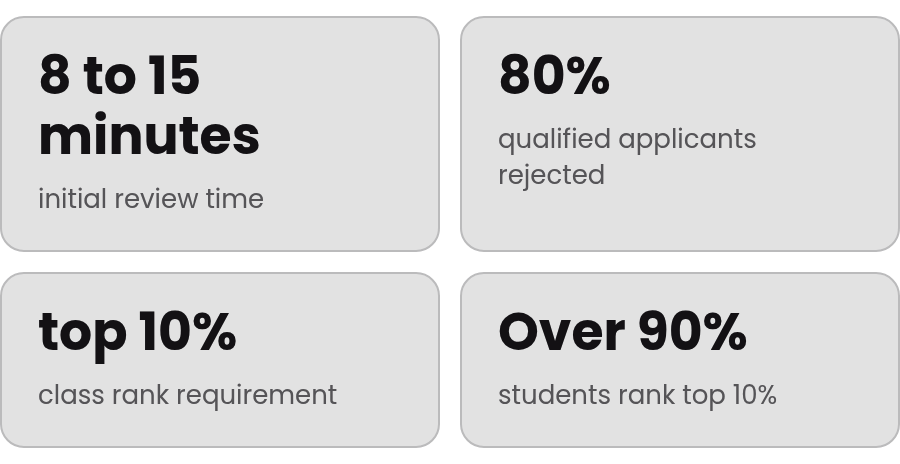
The typical Ivy League application gets 8 to 15 minutes in first read. That's the window where your four years either register as competitive or don't. Roughly 80% of applicants to selective schools are academically qualified but rejected, which tells you strong grades alone don't secure admission.

An early Ivy League readiness audit helps you spot transcript risk before applications go out. What separates admitted students is course rigor in context: whether you challenged yourself with the hardest classes your school offered and whether that rigor shows up clearly when a regional officer processes your file.
Structural gaps matter more than most families expect. If your curriculum doesn't align with what selective schools recognize as rigorous—honors sequences, AP depth in your intended field, advanced electives—that misalignment can blunt the value of strong grades. A B in a challenging AP course may read stronger than an A in standard coursework, but only if the officer sees that choice was deliberate.
What leadership impact actually measures
Leadership claims need evidence. Former Yale admissions officer Eddy C. noted that among competitive applicants, "what separated students was how they communicated about themselves: how they saw their own successes, how they talked about the successes of others, and how they'd contribute to the community." Long-term commitment to a few areas carries more weight than scattered involvement.
We see families assume any officer role or club presidency checks the leadership box. It doesn't. Officers evaluate depth of contribution and measurable impact within your opportunities. Did you start something new, expand something existing, or solve a problem others ignored? An audit surfaces whether your activities show initiative or simply attendance.
Why test scores still matter
Testing policies vary by school and continue to evolve, so we recommend confirming each university's current policy before applying.
Testing strategy matters because standardized results either confirm or complicate the narrative your transcript builds. If your transcript shows advanced STEM coursework but your math score lags, that gap becomes a question mark in committee. Understanding how admissions officers weigh different components helps you decide where effort is best spent.
An early review lets you address structural gaps—course sequencing, testing strategy, activity depth—while there's still time to adjust. It's not a prediction of admission. It's a planning tool that helps you understand what officers will see when they read your file.
What admissions officers actually read in your transcript
When an officer at Harvard, Yale, or Princeton opens your application, the transcript gets scanned for one question: did you take the hardest classes your school offered, and did you earn strong grades in them?
The regional admissions officer assigned to your school knows its profile. They know which classes are genuinely rigorous versus inflated, so they can distinguish a student who pursued challenge from one who protected a GPA through easier choices. Strong performance in AP Calculus, AP Chemistry, and honors English signals something different from a perfect average built in standard courses. What matters isn't the absolute number on your transcript—it's whether that grade reflects sustained work in demanding material. Committees see many students who maintain perfect grades by avoiding courses that threaten their GPA, and those applications move differently from files showing consistent strength across challenging subjects.
The second read happens at committee, where your transcript gets discussed alongside peers from your region. This is where available course use becomes critical. If your school offers fifteen AP courses and you took three, that gap will be noted. If your school offers five and you took all five, that tells a story. Admissions officers review "rigor of secondary school record" as their top academic factor, which means they're measuring you against what was actually available, not against a national standard.
The self-audit checklist
Start by getting clear on what your school actually offers. Pull your course catalog and identify every honors, AP, IB, or dual-enrollment option.
-
Rigor relative to your school: You've pursued a meaningful portion of the advanced courses available in your grade level. A transcript with gaps in available rigor will raise questions in committee, even with strong grades.
-
Grade trend in rigorous courses: Your grades remain solid across the most demanding courses. Strong performance in challenging courses reads better than higher grades in standard courses, and consistency across multiple rigorous classes strengthens your profile.
-
Class standing context: If your school reports rank, Over 90% of students at top universities rank in the top 10% of their high school class, so anything outside that range is a signal to address rather than an automatic disqualifier.
-
Vertical rigor progression: Your course difficulty increases each year. Freshman and sophomore years set the foundation; junior and senior years should show you pushing into the most advanced offerings your school has.
-
Alignment with intended major: If you're applying as a STEM major, your transcript shows consistent strength in math and science. Admissions officers look for demonstrated interest in a specific field with coursework that proves it.
These are the signals officers are actually reading early in the process. If your transcript checks these boxes, you've cleared an important academic threshold. If not, the risk may not be overcome by essays or extracurriculars alone.
Leadership credentials versus documented impact
The colleges that dominate leadership pipelines have historically concentrated access to specific institutional roles. But Ivy credentials predict access to gatekeeping networks, not leadership success itself. When you audit your transcript against Ivy League standards, you're optimizing for institutional entry, not necessarily for the skills that produce impact once you're there.
The data is stark. Some Fortune 500 CEOs graduated from flagship state universities rather than elite private schools. Among the wealthiest Americans, some have no college degree, including Zuckerberg, Gates, Ellison, and Dell. An Ivy degree opens doors into law and politics. It does not reliably produce entrepreneurs or innovators. That distinction matters when you think about curriculum planning and the purpose behind your goals.
Access gaps built into the system
Structural barriers shape which students encounter research opportunities, AP courses, and extracurricular depth. Students at well-resourced private high schools often have access to experiences that public school peers simply cannot replicate, no matter how driven. Admissions officers are aware of these disparities and evaluate applications within the context of what each school actually offers.
-
Audit what research opportunities exist at your school. Research projects and independent investigations can strengthen applications, but officers weigh them against what your school and community actually offer. If your school lacks formal research programs, identify whether local universities or community partnerships can fill that gap.
-
Document how your school's course catalog compares to regional standards. Admissions officers know which high schools offer rigorous coursework and which offer limited options. If your transcript shows you took every available rigorous option, that legibility matters.
-
Identify which extracurricular depth is actually available to you. Leadership roles that allow sustained, measurable impact carry weight in applications. Focus on opportunities where you can demonstrate genuine contribution and growth, rather than collecting credentials.
What your readiness audit reveals
An Ivy League readiness audit compares what your school and community offer against what competitive colleges see in strong files; the gap is your structural constraint.
The five-pillar assessment framework
A student's first read is brief, and the transcript must make its academic choices understandable before the rest of the file receives sustained attention. The central question is whether you used the opportunities your school provided and performed well in demanding work.
This audit template gives you a way to see your profile through that same lens. You're not trying to game the system. You're identifying where your transcript reads as competitive and where gaps exist that you can still address before applications go out.
Assessment template
Use this framework to assess your academic readiness across the dimensions that matter most in selective admissions. Fill out your current status honestly, then use the risk level and recommended action to prioritize your next moves.
| Pillar | Key Indicator | Current Status | Risk Level | Recommended Action |
|---|---|---|---|---|
| Curriculum Rigor | Percentage of available honors/AP/IB courses taken in core subjects | (list courses taken) | Assess whether you've used your school's hardest options in English, math, science, and social studies | If gaps exist: add one reach course for senior year; if finished, document why certain rigorous options weren't available |
| Grades in Rigor | GPA in your most advanced courses versus overall GPA | (compare) | Flag if performance in advanced courses diverges significantly from your overall GPA; that signals struggle with genuine difficulty | If struggling: assess whether the course matches your skill level or needs support; do not drop to protect GPA |
| Class Standing & Transcript Context | Rank, weighted/unweighted GPA, and school profile | (record) | Check your school's profile to understand how rigor is distributed across your student body | Nothing to change, but use this context when writing supplemental essays—explain rigor relative to your school's norms |
| Research or Independent Work | Documented project, publication, or structured research mentorship | (yes/no; describe) | Independent research and documented projects strengthen applications; absent this, explore whether your school offers research partnerships | If absent: explore whether your school offers research partnerships, summer programs, or faculty mentorship starting now |
| Test Scores in Context | SAT/ACT percentile and whether scores align with transcript rigor | (record percentile) | Scores that lag rigor signal test anxiety or preparation gaps; scores that exceed GPA signal test strength over coursework | If misaligned: consider a retake to better reflect your academic preparation, but only if you believe a higher score is achievable; otherwise invest time in positioning and your application narrative |
What this template reveals
Exceptional status means you've used all available rigor, earned strong grades in it, documented independent work, and your test scores confirm academic preparation. Your file reads as competitive on academics alone; your differentiator lies elsewhere.
Strong status means you've taken most available advanced courses with solid grades and your scores are competitive. Small gaps exist—perhaps less research experience or uneven scores—but nothing that disqualifies you. Focus on deepening one area: research, depth in a major, or leadership in an academic club.
Adequate status signals you're academically qualified but haven't maximized available rigor, or grades in advanced courses have slipped. Your transcript meets baseline expectations, but you'll need to differentiate through other parts of your application. At this level, context matters more—a compelling story about overcoming resource constraints or taking initiative outside formal coursework can shift how readers interpret your academic record.
Below Standard means your transcript falls outside the competitive range for highly selective schools. This doesn't disqualify you from admission, but it narrows your target list and means your essays, recommendations, and extracurriculars must carry significantly more weight. Consider whether your school offers additional rigor you haven't accessed, or whether your target schools should shift.
What to do with your audit results
- Identify which advanced courses remain available to you and enroll in at least one if it aligns with your interests
- Check whether your school partners with local universities for dual enrollment or research placement
- Ask a teacher or mentor whether your grades in rigorous courses reflect your actual skill or signal that you need support
- Research whether your target schools publish data on research experience or independent work among admitted students
- Schedule a meeting with your school's college counselor to discuss whether your class rank and transcript context need explanation in supplemental essays
This audit is a starting point, not a judgment. Your courses should reflect genuine intellectual interest, not checkbox collection. The goal is alignment: coursework that signals what you actually care about and prepares you for the work ahead.
References
[1] Ivy League Admissions Process: What Officers Look For - https://orieladmissions.com/ivy-league-admissions-process-what-officers-look-for/
[2] Superhuman High School Transcripts Are Key To Ivy ... - https://www.forbes.com/sites/jamesmarshallcrotty/2014/09/30/superhuman-high-school-transcripts-are-key-to-ivy-league-admission-is-that-such-a-bad-thing/
[3] 12 things Ivy League admissions officers actually look at ... - https://riseglobaleducation.com/blogs/what-ivy-league-admissions-officers-actually-look-at
[4] Do Ivy League Degrees Matter for Leadership Success? - https://www.independent.org/article/2025/01/22/do-ivy-league-degrees-matter-for-leadership-success/
[5] New Research Shows Barriers to College Admissions for ... - https://industryinsights.act.org/2023/07/ivy-plus-research
[6] New Report Challenges the Dominance of Ivy League ... - https://manhattan.institute/article/new-report-challenges-the-dominance-of-ivy-league-education-in-american-leadership
[7] What Do Colleges Really Mean by Holistic Review? - https://www.ivywise.com/blog/holistic-review/
[8] taking easier classes to protect your GPA is not a strategy. ... - https://www.facebook.com/admittedlypodcast/videos/which-is-means-more-in-ivy-admissions-rigor-or-gpa-lets-talk-about-it/1557377995926947/
[9] How To Get Into An Ivy League School? The Essential Guide - https://www.crimsoneducation.org/us/blog/how-to-get-into-an-ivy-league-school
[10] How to Get Into the Ivy League: Which Strategies Work? - https://collegecommit.com/how-to-get-into-the-ivy-league/
Frequently Asked Questions
If my school offers limited AP coursework, will admissions officers compare me unfavorably with students from schools offering much more?
Admissions officers evaluate rigor relative to what your specific school offers, not against a national standard. Taking every advanced option available signals that you used your opportunities. Your school profile gives the reader the context needed to understand that record.
Does a single B in an AP course during junior year disqualify me from Ivy League consideration?
A single B is not disqualifying. The broader pattern matters: whether you continued taking demanding courses, maintained reasonable consistency, and showed that the grade reflected an appropriate academic challenge rather than a recurring decline.
My SAT math score is lower than my other sections, but I'm taking AP Calculus and AP Physics—should I retake the test or focus on other parts of my application?
First check the relevant university's current testing policy and your application timeline. A retake may be worthwhile if additional preparation is likely to produce a score that better represents your ability. Otherwise, use the rest of the application to show your mathematical preparation through coursework, projects, and recommendations.
I've been treasurer of two clubs but haven't started anything new—does that count as leadership impact?
A title can be meaningful when it reflects real responsibility. Describe what you changed or delivered in the role: improved financial processes, funded new programming, or helped a group solve a practical problem. If the position involved little beyond attendance, deepen one activity where your contribution can become more substantial.
How do I explain that my school doesn't offer research programs or university partnerships when selective colleges expect independent work?
Admissions officers evaluate you against what was actually available, not against national norms. If your school lacks formal research infrastructure, use supplemental essays to explain that context while highlighting any alternative initiative you took—self-directed projects, community partnerships, or online mentorship. The goal is showing intellectual depth within your constraints, not claiming opportunities that were unavailable.