What Ivy League Actually Means: Eight Schools, One Admissions Playbook
October 24, 2026

Key takeaways
- The Ivy League began as an athletic coalition, not an admissions category, which helps explain why other highly selective universities are not members.
- For recent classes, several Ivies have reported acceptance rates in the low single digits, leaving many applicants competing for each available place.
- Application volume has risen across the league while class sizes remain relatively stable, intensifying competition.
- Most admitted Ivy students rank near the top of their high school class and present strong unweighted GPAs.
- Each school has distinct academic structures and priorities. Binding early decision can also remain exceptionally competitive, even when an institution’s overall applicant pool changes.
- Admissions research emphasizes the role of educational guidance, perceived access, and a student’s surrounding context, not grades or prestige alone.
- The research cited here does not support claims that admissions readers evaluate supplemental materials after submission or conduct meaningful applicant interviews.
History of the Ivy League
A student deciding between Yale and Cornell may see the same familiar label on both applications. That similarity disappears once you examine how the schools differ in curriculum, culture, selectivity, and history. The first useful lesson in learning how to get into Ivy League schools is that Ivy League membership did not begin as an admissions category. The eight schools also do not offer identical odds or admit students for identical reasons.
How did the Ivy League begin?
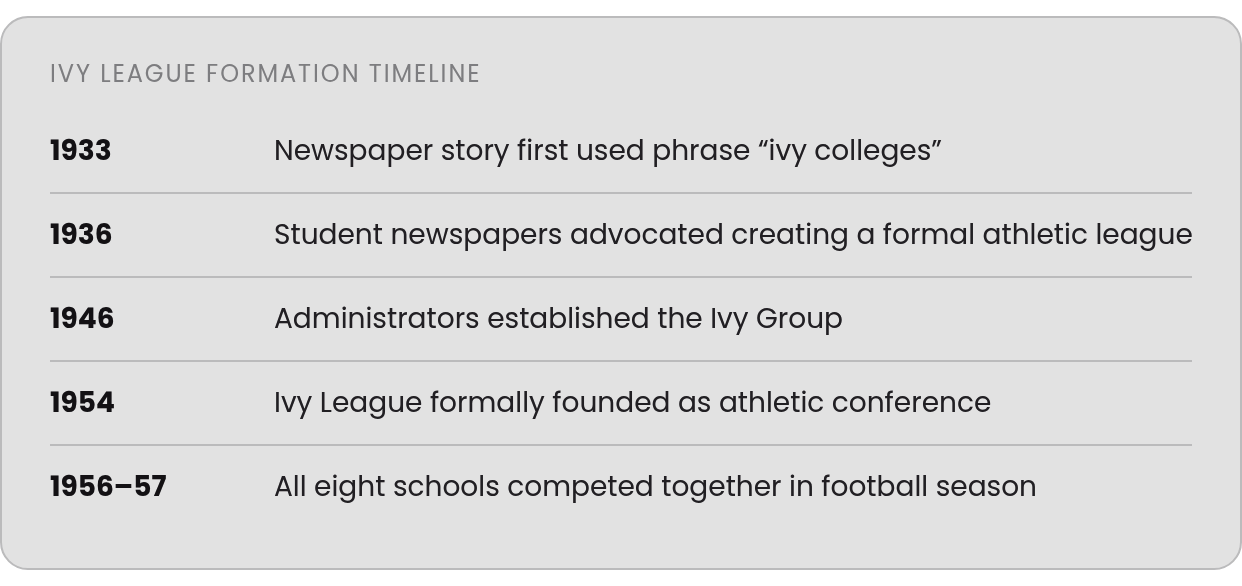
The phrase “ivy colleges” first appeared in a 1933 newspaper story by sportswriter Stanley Woodward, according to Princeton University Archives.
That history settles a common point of confusion. The league began as an athletic coalition, but those same institutions developed exceptional academic reputations over time. Recent acceptance rates show how highly selective the “Ivy” label has become. A somewhat higher numerical chance at one school does not necessarily mean a lower academic bar. As Times Higher Education notes, Cornell continues to admit students of comparable academic caliber.
What does the label mean for your application strategy?
Today, “Ivy League” serves as shorthand for a highly selective tier, even though membership is still defined by the athletic conference. Prestige also has limits. According to this admissions overview, only around 10% of Fortune 100 CEOs attended an Ivy, and two large public universities produced more chief executives at top-100 companies than any individual Ivy.
The more useful implication comes from Ann Mullen’s study of 50 Yale students. Families with more educational resources often receive stronger guidance and begin viewing elite colleges as attainable earlier. Understanding which application pathway suits each school’s priorities can sharpen your approach. One Ivy strategy cannot work for every student and every campus.
Build your list around academic competitiveness, school-specific fit, and realistic timing.
The Eight Institutions: Core Characteristics
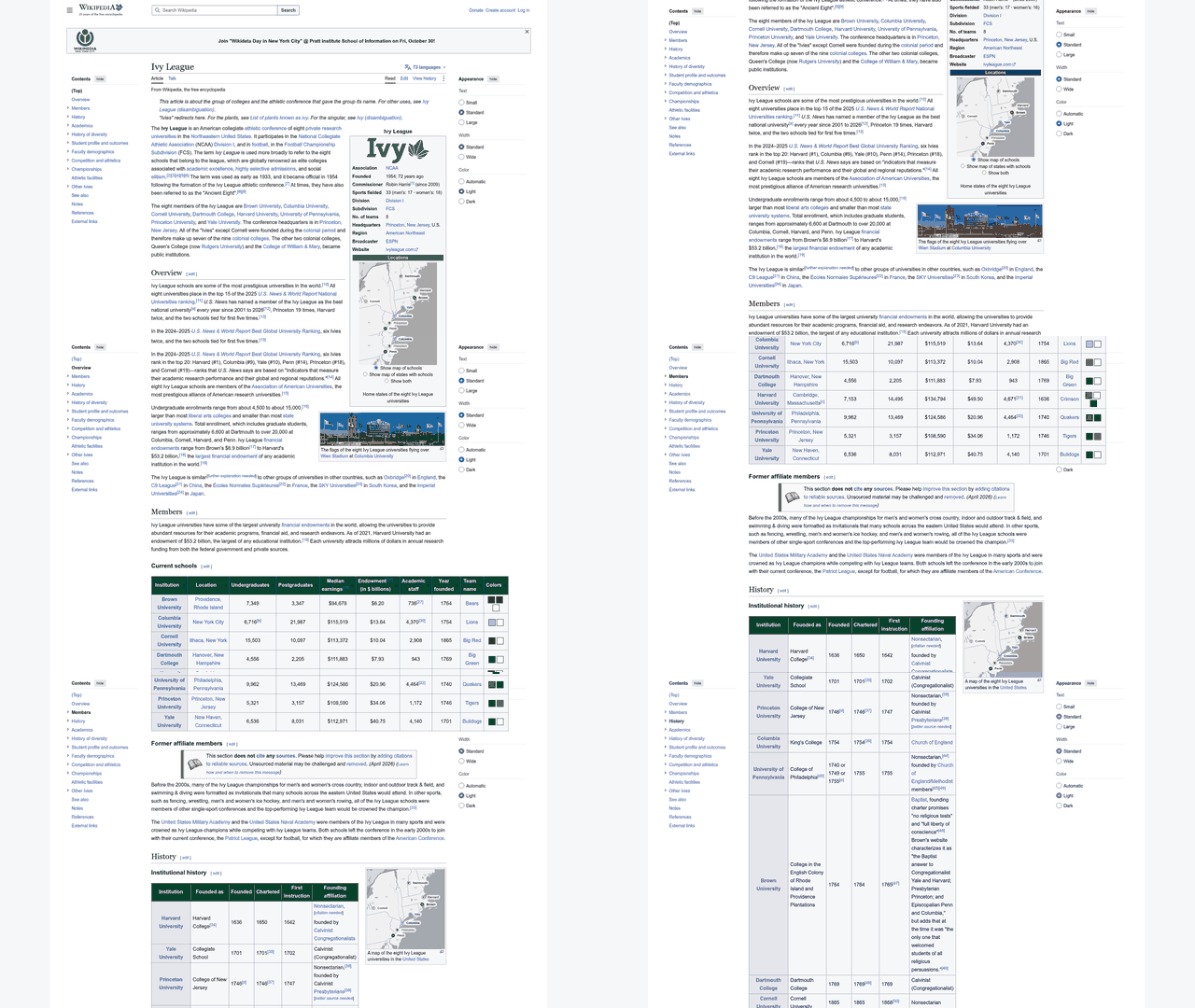
The eight institutions share a conference badge, but how to get into Ivy League schools requires recognizing that each builds its class around different academic structures, cultural priorities, and selectivity patterns. Seven were founded before 1770: Harvard in 1636, Yale in 1701, Penn in 1740, Princeton in 1746, Columbia in 1754, Brown in 1764, and Dartmouth in 1769. Cornell was founded later, in 1865.
That century-long gap matters less today than the structural differences applicants actually encounter.
Where acceptance rates and application volumes actually diverge
Recent reported acceptance rates at several Ivies cluster in the low single digits. Application volume has risen sharply across the league while class sizes remain relatively stable, making each admissions cycle more competitive.
Most admitted students rank near the top of their high school class and present strong unweighted GPAs. A slightly lower GPA can still be well above the national average, but another part of the application may need to carry more weight.
Each institution also admits through a different academic structure and set of priorities. These distinctions shape who applies and who enrolls. Study the individual school rather than inferring too much from the shared name.
The Unified Admissions Playbook
Every fall, a family sits down with eight school names and one urgent question: does applying early change the outcome? At some schools, it can materially change the applicant pool. That makes timing a strategic decision rather than an administrative detail.
What Do the Early and Regular Numbers Actually Show?
An Ivy admissions overview also shows that highly selective schools can remain especially competitive in binding rounds even when their overall applicant pools change.
Read that gap as a different pool, not a discount. Early rounds tend to attract smaller, more committed groups, including recruited athletes, legacy applicants, and candidates a school has identified as priorities. A higher acceptance rate describes the composition of that pool. It does not mean an early application gives you an advantage over a substantially stronger regular-round file.
Binding early decision is usually a poor choice when you still need to compare aid offers, when additional coursework could strengthen your transcript, or when senior-year grades will meaningfully improve your candidacy. Before choosing among the schools, review each deadline, notification date, and binding obligation.
Why Do Strong Grades Alone Stop Predicting Anything?
Grades establish academic readiness, but they cannot distinguish applicants within a highly competitive pool. A transcript can show that a student is prepared for demanding coursework. The rest of the file must explain what that student has done with that preparation.
A strong transcript sets the floor. Treat the rest of the file as a portfolio: research contributions that reviewers can verify, recommendation letters that describe specific work rather than general praise, essays that show school-specific fit, and evidence of meaningful impact should reinforce one another. Context matters as well. A sustained project, genuine responsibility, and a clear account of personal motivation can make an application easier to understand.
An interview or material submitted after the deadline should not be treated as a substitute for a complete original application. If your application does not make its case before the deadline, an addition is unlikely to repair the central problem.
Actionable Strategies for a Strong Ivy Application
We see students approach the Ivy Leagues with a checklist mentality: perfect GPA, top test scores, leadership titles. Those credentials matter, but treating them as sufficient rather than necessary is where strong applications stall. At this level of selectivity, the distinction often comes down to how you explain your achievements as evidence of a coherent direction, not whether you collected enough items for a résumé.
Build a narrative around sustained intellectual direction, not credential variety
The research cited earlier tells a consistent story: admissions readers want evidence that you love learning in a specific domain and can contribute to the school’s academic community. Privileged applicants’ high schools often positioned them explicitly toward Ivy League institutions, while less-privileged students sometimes regarded elite universities as outside the realm of possibility. Part of that gap was financial, but part was psychological and structural.
For your application, choose activities that demonstrate intellectual depth over simple breadth. In our admissions work, the strongest narratives usually come from sustained engagement with a subject, followed by reflection on what you learned and where you want to go next. A long list of activities without an explanation of your role leaves readers without a clear sense of your direction.
Your essays should connect sustained interests to specific resources, faculty, or programs at each school. Generic language about “academic excellence” or a “diverse community” suggests that you are applying to a brand rather than an institution. Admissions readers often want to see whether applicants love the school and can envision themselves contributing to its academic community. That level of specificity requires more than reading the admissions website. Look at recent faculty publications, student journals, or department newsletters for details that genuinely connect with your work.
A practical test is to draft a one-paragraph explanation for each school. Ask whether it could be exchanged with the paragraph you wrote for another university. If so, you are probably communicating prestige rather than fit.
Specificity also helps when your interests extend beyond a formal major. You might mention a faculty member whose work raises questions you want to pursue, a course that challenged an assumption you once held, or a student organization that gives your interests a practical outlet.
Interpret early-decision data as one strategic input, not a guarantee
Early application rates run higher than regular-decision rates, but the difference needs context. The historical figures summarized in Ivy League admissions statistics show meaningful differences between the early and regular pools. Those differences are real, though they do not mean an earlier deadline improves every applicant’s chances by the same proportion.
The early pool may contain recruited athletes, legacy candidates, and applicants whom committees have already flagged as high priorities. Applying early can also change how a file is read. A candidate with exceptional test scores but little demonstrated direction may gain less than a candidate whose grades, recommendations, and essays establish a clear pattern. Waiting, meanwhile, can allow an applicant to add stronger academic evidence, a consequential project, or a clearer explanation of how priorities have developed.
If your academic credentials sit at the lower end of the admitted range, applying early to your top choice can help, but only if the rest of the file demonstrates school-specific fit. A score that is strong nationally can still sit near the lower end of many admitted Ivy ranges.
Choose the round based on the maturity of your file, not the assumption that earlier is always better.
Prepare for interviews by making your interests and contributions legible
Not every applicant receives an interview, and admission does not hinge on one. Still, when offered, use the conversation to make your application’s narrative concrete. We coach students to prepare by explaining their sustained interests, their specific contributions, and why particular resources at the school matter to their next steps. The goal is clarity, not a polished performance.
Preparation should go beyond naming favorite organizations. For each major experience, be ready to explain the problem you addressed, the part that was genuinely yours, what you learned from an unsuccessful attempt, and how another student could continue the work. Readers may also ask how you handle disagreement, collaborate with people who view a subject differently, or respond when evidence complicates your initial position. Specific examples are more useful than broad claims about curiosity or leadership.
When comparing possible paths, look beyond test scores to the depth of your work, the guidance you received, and recommendations that speak to your character and contribution. As one source put it, “Scores open doors. They don’t walk you through them.”
If you are preparing for selective admissions and want help translating your achievements into a coherent application, we work with students on this process. The strategy remains consistent: sustained intellectual engagement, school-specific fit, and evidence of contribution matter more than credential accumulation alone.
Fit Assessment: Is an Ivy League School Right for You?
A student can have an exceptional transcript, strong activities, and a convincing reason to apply, yet still choose the wrong college. That is not failure. It is a reason to compare the Ivy League’s academic environments, costs, and selectivity rather than treating one label as eight interchangeable outcomes.
Fit matters more than the label
Cornell presents a different admissions profile from the other Ivies, but its acceptance rate cannot tell you whether its academic environment suits you. If Cornell interests you, examine its undergraduate college structure and programs rather than applying because its rate appears less restrictive.
The learning environments also differ. Campus settings, academic calendars, and curriculum requirements vary by school. Some students may prefer a traditional non-urban campus, while others may want an urban setting or more freedom in shaping their studies.
Holistic review means admissions readers assess the whole application, not the transcript alone. Treat required writing as part of the original application and use it to show how your strengths, experiences, essays, and recommendations reinforce one another before submission.
Prestige cannot erase the price or academic mismatch
An Ivy League education can be valuable, but the label alone does not determine a student’s career path or guarantee a good fit. Consider the programs, learning format, community, and long-term goals that matter to you.
Affordability deserves the same scrutiny. Published cost comparisons vary by academic year, tuition, housing, fees, and financial aid. Review each school’s official pricing and aid information directly instead of relying on a single broad figure. Ask whether the programs, learning format, and net price your family can sustain align with the student’s goals.
Apply to an Ivy if its academic structure and costs make sense, not simply because the label feels prestigious. If you cannot identify a specific program, environment, or community that fits, keep looking.
References
[1] Ivy League Acceptance Rates and Admissions Statistics - https://www.ivycoach.com/ivy-league-admissions-statistics/
[2] Ivy Leagues Complete 2026 Overview for Students and Parents - Scholaro - https://www.scholaro.com/db/News/ivy-leagues-complete-2026-overview-for-students-and-parents-253
[3] What Are The Ivy League Schools? Should You Apply To One? - https://www.crimsoneducation.org/us/blog/ivy-league-schools
[4] The Origins of the “Ivy League” - University Archives - https://universityarchives.princeton.edu/2015/07/the-origins-of-the-ivy-league/
[5] A Complete Guide to the Ivy League Schools - College Essay Guy - https://www.collegeessayguy.com/blog/ivy-league-schools
[6] What are the Ivy League schools? - Times Higher Education (THE) - https://www.timeshighereducation.com/student/advice/what-ivy-league
[7] Elite Destinations: Pathways to Attending an Ivy League University - https://www.researchgate.net/publication/263420765_Elite_Destinations_Pathways_to_Attending_an_Ivy_League_University
Still Wondering?
1. Is the Ivy League the same as the most selective colleges in the country?
No. Selectivity and league membership are separate ideas. A college can attract an exceptionally competitive applicant pool without belonging to the Ivy League, so students should evaluate schools by their programs, campus environments, and admissions policies rather than by the label alone.
2. Does applying early decision increase an applicant’s chances of admission?
Early decision is a binding commitment, not a guaranteed route to admission. Before choosing it, confirm that the institution is your first choice, that comparing financial aid offers is not essential, and that submitting early will not prevent you from adding important academic evidence later.
3. Is Cornell easier to get into than the other Ivy League schools?
A published rate cannot answer that question by itself. Cornell’s structure gives applicants several undergraduate settings to compare, and the relevant question is whether the available college, program, and campus experience match the student’s goals.
4. How can students determine whether an Ivy League school is a good fit?
Start with the student’s preferred course structure, location, community, intended field, and sustainable net price. Then compare official program and financial-aid information with the student’s priorities. A school belongs on the list when those details support a credible academic and personal plan, not merely because its name carries status.